Short answer: Honda Gold Wing reliability is excellent by touring-motorcycle standards — a proven 1,833cc flat-six with no chronic engine failure, a shaft final drive with no chain to wear, and a high-mileage owner record that regularly passes 150,000 miles with routine maintenance. But Honda Gold Wing reliability is not a blank cheque: three recalls touch the 2018-on bike, the air filter is a labour-heavy job, and the service book matters more than the odometer. This Honda Gold Wing reliability guide covers the sixth-generation bike (2018 onward) only, with every recall, interval, and cost labelled by year and source.
One framing fact belongs up front in this Honda Gold Wing reliability guide: the bike covered here is the 2018 redesign, not the 2001–2017 Gold Wing. The sixth-generation machine is roughly 90 lb lighter, uses a double-wishbone front end instead of conventional forks, offers a 7-speed DCT option, and runs a different service schedule — valve-clearance inspection at 24,000 miles, not the older bike’s 32,000. Any guide mixing the two generations will get Honda Gold Wing reliability wrong, so this one never does.
Honda Gold Wing Reliability Overview
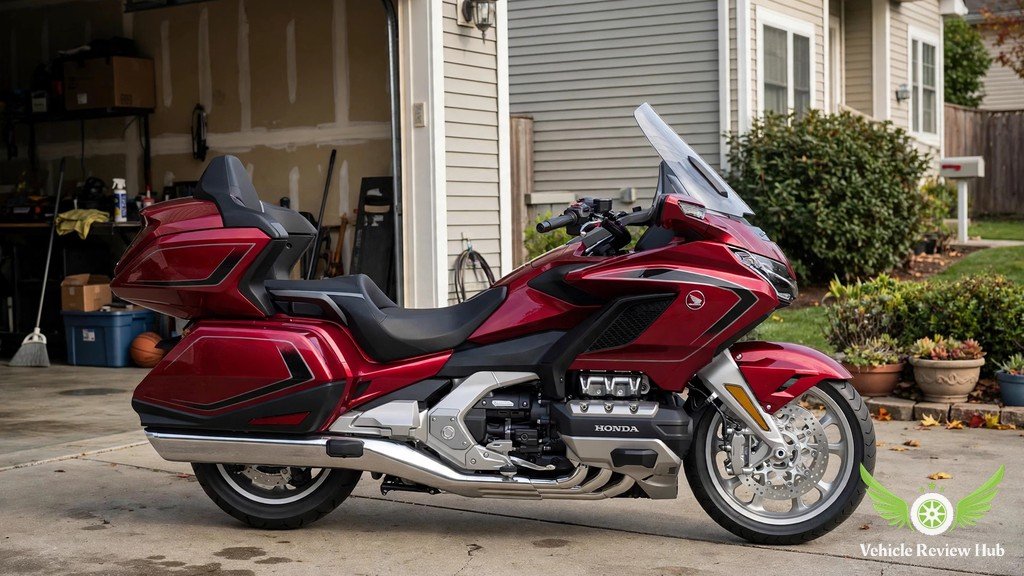
The headline for Honda Gold Wing reliability is simple: owners trust this motorcycle with their longest trips, and the record backs them up. Across eight model years of the current generation there is no chronic engine failure, no gearbox scandal, and no pattern of roadside breakdowns — just three recalls, ordinary wear items, and a service rhythm that rewards owners who keep it. For the full model story behind the badge, see our Honda Gold Wing review.
MCN Owners Give Reliability 5 Out of 5 From Four Reviews
MCN owners give reliability 5 out of 5 from four reviews, and that sentence needs its warning label, because it is the most over-quoted figure in Honda Gold Wing reliability coverage. Four owners cannot prove a reliability record, and this Honda Gold Wing reliability guide refuses to let a 5-out-of-5 from four people outweigh wider evidence. What the British sample shows is direction: no owner reports a mechanical failure, and praise concentrates on build quality, comfort, and engine smoothness. Stronger evidence for Honda Gold Wing reliability is the owner-forum record: high-mileage examples past 150,000 miles are commonly reported with routine maintenance only, and the flat-six has no known weak point. The engine and chassis are proven; the small-sample score is encouraging but thin.
How Mileage, Storage and Previous Care Affect Reliability
How mileage, storage, and previous care affect reliability matters more on a Gold Wing than on most motorcycles, because these bikes are bought to cover big distances and then sometimes sit for months. High mileage alone is not a red flag for Honda Gold Wing reliability — a 100,000-mile bike with a stamped service book beats a 20,000-mile bike with no records. Storage is the quiet risk: a winter without a battery tender can mean a weak battery and flat-spotted tyres, and DCT bikes carry parking-brake and electronics draws that punish neglect. Previous care shows in details checkable in ten minutes: tyre date codes, brake-disc condition, fork-seal weeping, and air-filter history. For Honda Gold Wing reliability, the service book is the bike’s CV — gaps in it are a negotiation, not a footnote.
Honda Gold Wing Common Problems and Wear Items
Common problems on the current Gold Wing are refreshingly ordinary for Honda Gold Wing reliability: no chronic engine failure, one serious recall, two smaller ones, and wear items any inspection catches. The platform has run since 2018, so teething troubles have had years to surface — and largely have not.
Recall 24V-820: Primary Drive Gear Bolt on 2018 to 2021
Recall 24V-820, Honda campaign KQ9, is the serious one in Honda Gold Wing reliability, and it deserves plain explanation. Certain 2018–2021 GL1800 Gold Wings — all variants, bagger and Tour, manual and DCT — totalling 18,196 US units may have a primary drive gear bolt on the crankshaft that can break. If it breaks, the pulse rotor can fall off, the ignition signal fails, and the engine may stall and lock the rear wheel. Honda reported 51 warranty claims and one injury as of October 2024, issued a stop sale, and sent owner letters in December 2024; the remedy is a free bolt replacement. Production ran from November 2017 to July 2021, when an improved bolt entered production. For Honda Gold Wing reliability, the rule is absolute: a 2018–2021 bike without proof of this repair is a walk-away or price-chip item, never a shrug. Visordown’s recall summary covers the 18,196-unit campaign.
Tires, Brakes, Final Drive, Battery and Electrical Checks
Tires, brakes, final drive, battery, and electrics make up the rest of the Honda Gold Wing reliability watch list. Tyres are 130/70-18 front and 200/55-16 rear on the Tour, and the wide rear is the big consumable — check date codes, not just tread, because a touring bike can age out a tyre before it wears it out. Brakes are dual 320 mm front discs with six-piston calipers and a single 316 mm rear disc under Combined ABS; check pad thickness and disc condition. The shaft final drive is a Honda Gold Wing reliability advantage — no chain to lube or adjust — but its oil still needs changing on interval, and a weeping final-drive seal is a real fault, not character. Batteries deserve attention on DCT bikes, where parking-brake and electronics draws punish poor storage. On electrics, test the windscreen motor, luggage latches, Smart Key with both fobs, and audio and CarPlay pairing; a warning light that never clears is a fault, not a quirk.
Honda Gold Wing Maintenance Schedule and Servicing
The maintenance schedule is the backbone of Honda Gold Wing reliability: a first service at 4,000 miles, then a calm 8,000-mile rhythm, with valve and air-filter work at longer intervals that still demand real labour. Compared with many touring rivals, the Gold Wing asks for little — but what it asks for must happen.
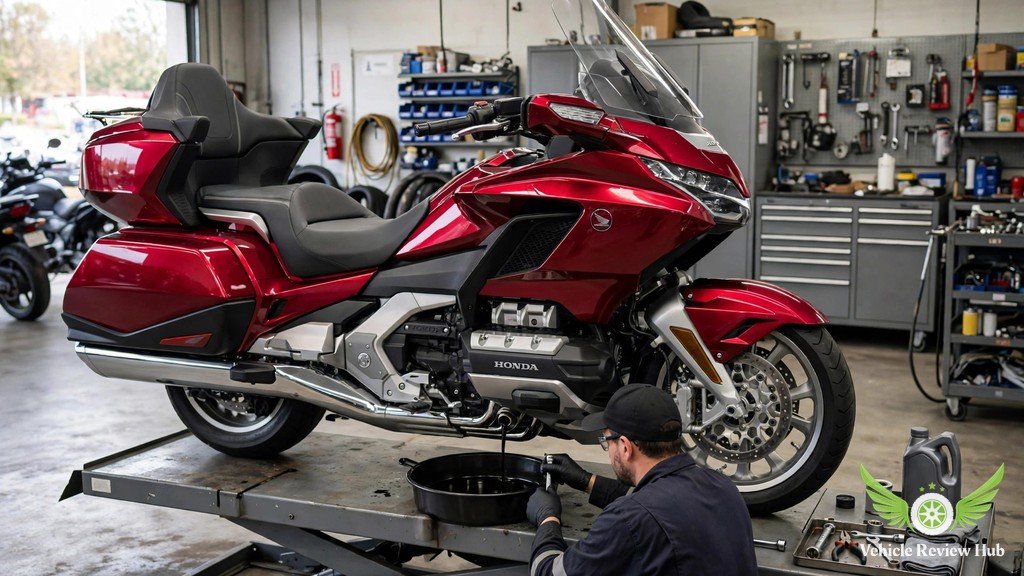
No 600-Mile Service: First at 4,000 Miles, Oil at 8,000
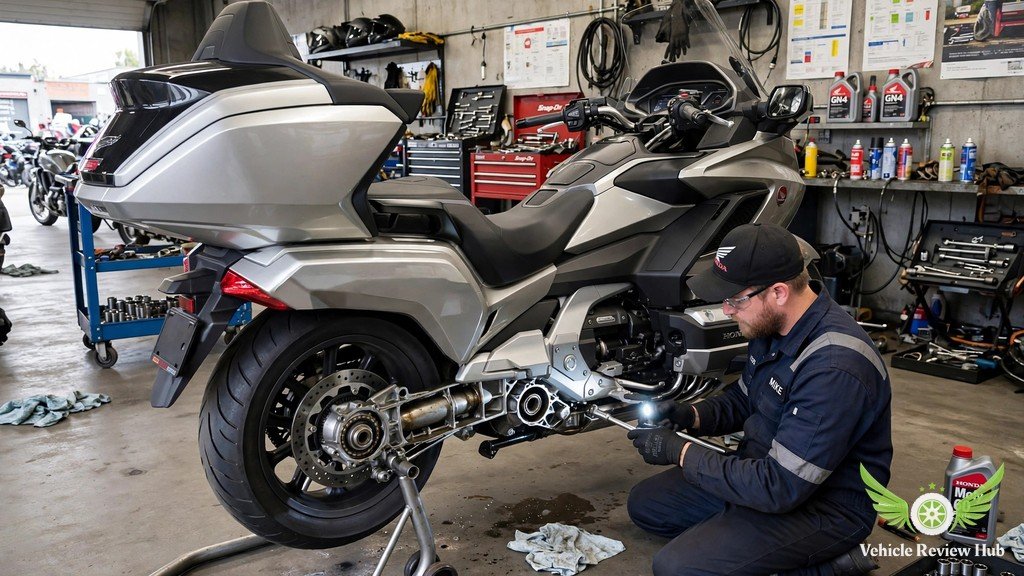
No 600-mile service: first at 4,000 miles, oil at 8,000 — and that sentence corrects the single most common Honda Gold Wing reliability error, because many buyers assume a break-in service that this bike does not have. The sixth-generation manual sets the first service at 4,000 miles, then engine oil and filter every 8,000 miles or 12 months, whichever comes first. A used bike whose first stamp is missing deserves a discount, and one whose oil changes run long deserves suspicion — the flat-six is tolerant but not immortal. This Honda Gold Wing reliability guide never presents the older generation’s intervals as current ones; the 2001–2017 bike ran a different schedule, and carrying it forward is how buyers get caught. For the performance numbers behind those miles, see our Honda Gold Wing performance guide.
Valve-Clearance Inspection at 24,000 Miles and Plugs at 16,000
Valve-clearance inspection at 24,000 miles and plugs at 16,000 are the two longer-interval jobs in Honda Gold Wing reliability. The Unicam flat-six gets its valve clearances inspected every 24,000 miles — inspected, with adjustment only if a clearance has moved. Spark plugs fall every 16,000 miles, alongside the air cleaner. Neither job is cheap in labour on a fully faired touring bike, but neither is frequent, and neither has produced a pattern of failures when skipped once — the risk of skipping is cumulative, not instant. The trap, again, is generation mixing: the fifth-generation valve interval was 32,000 miles, and quoting it for a 2018-on bike understates current maintenance by a full 8,000 miles.
| Service item | Interval (6th gen, 2018 onward) | Note |
|---|---|---|
| First service | 4,000 miles | No 600-mile break-in service exists |
| Engine oil + filter | Every 8,000 miles / 12 months | Whichever comes first |
| Spark plugs | Every 16,000 miles | Same visit as the air cleaner |
| Air cleaner | Every 16,000 miles | Labour-heavy: significant bodywork removal |
| Valve-clearance inspection | Every 24,000 miles | Inspection, not automatic adjustment |
| Summary | 4,000 / 8,000 / 16,000 / 24,000 miles | Never the 5th-gen 32,000-mile valve figure |
Honda Gold Wing Tires, Brakes and Suspension Maintenance
Tyres, brakes, and suspension are where Honda Gold Wing reliability meets the road — literally. An 806 to 856 lb motorcycle (bagger to Tour Airbag DCT, curb weight, full tank) on road-biased tyres is gentle on nothing except its own brakes, and the double-wishbone front end changes what a suspension job costs.
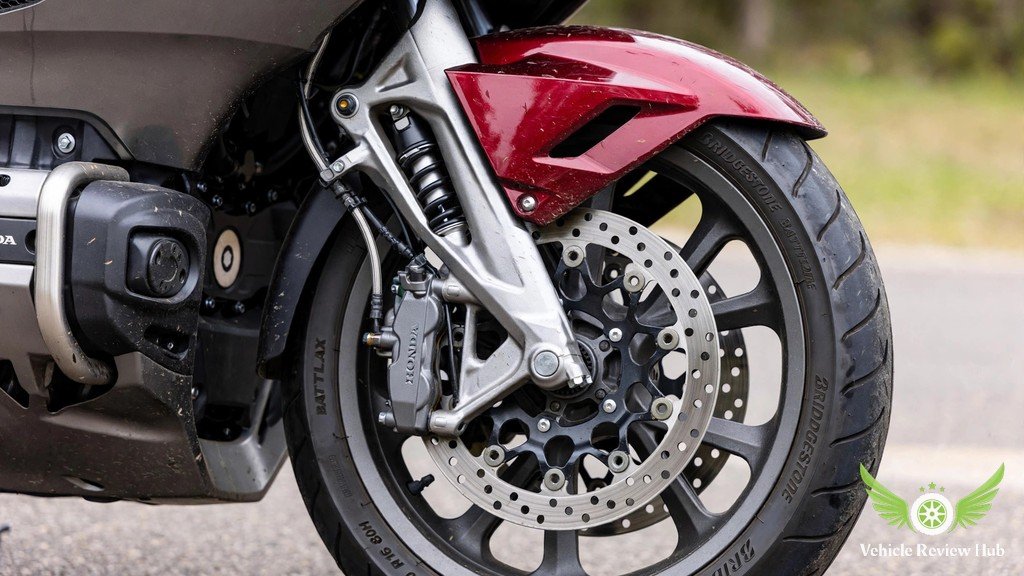
Air Cleaner at 16,000 Miles and Fluid Change Intervals
Air cleaner at 16,000 miles and fluid change intervals are the surprise bills in Honda Gold Wing reliability, and buyers should hear about them before a dealer invoice tells them. The air cleaner falls every 16,000 miles, but reaching it requires significant bodywork removal, so labour dwarfs the part — budget for the job, not the filter. Brake fluid, coolant, and final-drive oil run on time intervals as well as mileage, so a low-mileage bike still needs them on schedule; a five-year-old bike with 6,000 miles and original fluids is overdue, not pampered. Cycle World’s Tour DCT dyno test also records the bike’s measured braking performance, with 60–0 mph in 126.6 ft on the 2020 Tour DCT.
Brake Pads, Suspension Checks and Shaft-Drive Care
Brake pads, suspension checks, and shaft-drive care complete the Honda Gold Wing reliability chassis list. Pads first: check thickness at every service on the dual 320 mm front and single 316 mm rear discs, and remember Combined ABS means both controls work both ends. Suspension second: the double-wishbone front end is a Honda Gold Wing reliability strength on the road, but its fork seals and linkages are a specialist job, not a conventional fork-seal swap, and crash damage there is expensive to repair. Shaft-drive care third: change the final-drive oil on its interval, check for weeping seals, and listen for whining under load — the shaft is why Gold Wing owners never think about chains, and why they should still think about oil.
Honda Gold Wing Maintenance and Ownership Costs
Ownership costs are where Honda Gold Wing reliability pays off in cash — and where it stops being cheap. Fuel is reasonable, routine servicing is modest for the class, and the only large bills are the ones a skipped service creates. No US model-specific servicing-cost figure has been published, so this Honda Gold Wing reliability guide gives no invented American quote.
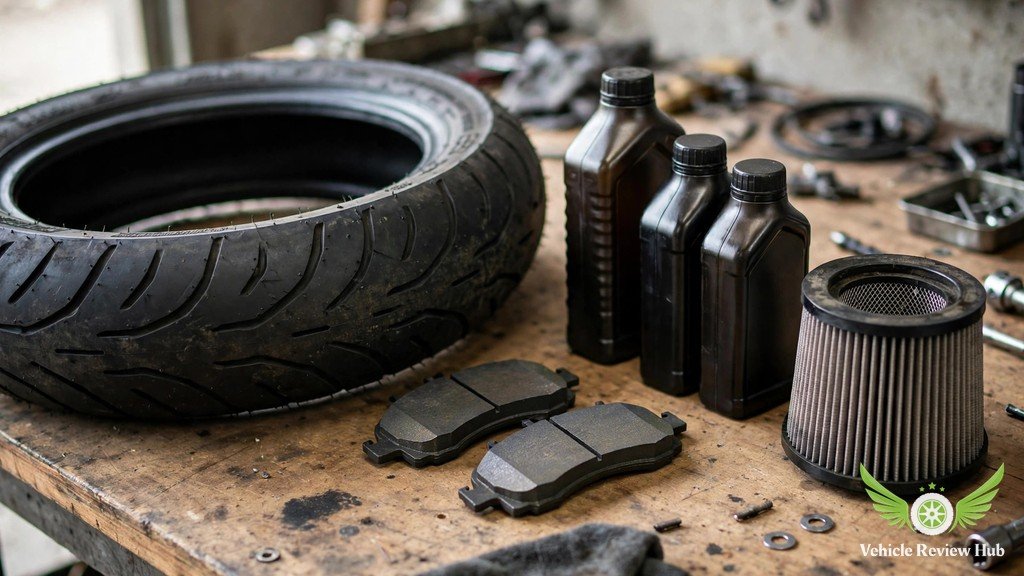
Fuel, Routine Servicing, Tires and Replacement Parts
Fuel first for Honda Gold Wing reliability budgeting: Cycle World’s 2019 manual-bike comparison test returned 37.1 mpg, and the 5.5-gallon tank gives roughly 204 miles at that figure by arithmetic — a planning number, not a promise, since touring loads and speeds move it both ways. Routine servicing follows the 8,000-mile rhythm above; tyres are the big consumable, with the wide 200/55-16 rear wearing faster than the front under two-up loads. Parts are a qualified strength in Honda Gold Wing reliability: consumables are common Honda parts through a nationwide dealer network, model-specific bodywork takes longer to source, and air-filter labour is the cost to budget rather than the part. For the buying decision in full, including used prices, see our Honda Gold Wing buying guide.
Three-Year Unlimited-Mile Warranty and HondaCare to Eight
Three-year unlimited-mile warranty and HondaCare to eight is the warranty story for Honda Gold Wing reliability — and it needs its label, because the second half is not confirmed from a current Honda source. The standard warranty is confirmed: three years, unlimited mileage, transferable, on Honda’s own spec sheets. HondaCare extended coverage exists, but the doc’s claim that it runs to eight years could not be confirmed against a current Honda source in this pass — so this Honda Gold Wing reliability guide says “HondaCare extension available; confirm the current maximum term with a dealer” rather than asserting eight years as fact. For an American buyer, the translation is simple: the factory warranty is genuinely generous, the extension’s terms are a dealer question, and neither follows a bike whose recalls were never completed — paperwork first, warranty second.
| Cost item | Figure | Label |
|---|---|---|
| Fuel economy (tested) | 37.1 mpg (Cycle World, 2019 manual) | ~204 miles per 5.5-gal tank by arithmetic |
| Routine service rhythm | Every 8,000 miles / 12 months | First service at 4,000 miles |
| Tyres | 130/70-18 front, 200/55-16 rear | Rear is the big consumable |
| Recall repairs | Free of charge at dealers | VIN check proves completion |
| Factory warranty | 3 years, unlimited mileage | Transferable; HondaCare term unconfirmed |
| US servicing cost | No published figure found | No invented American quote given |
| Summary | Modest routine costs, labour-heavy air filter | Skipped services create the big bills |
How to Keep a Honda Gold Wing Reliable
Keeping a Gold Wing reliable means doing the simple things on time. Nothing in Honda Gold Wing reliability requires exotic tools — just a calendar, an 8,000-mile habit, a service book, and the recall check done by VIN before money changes hands.
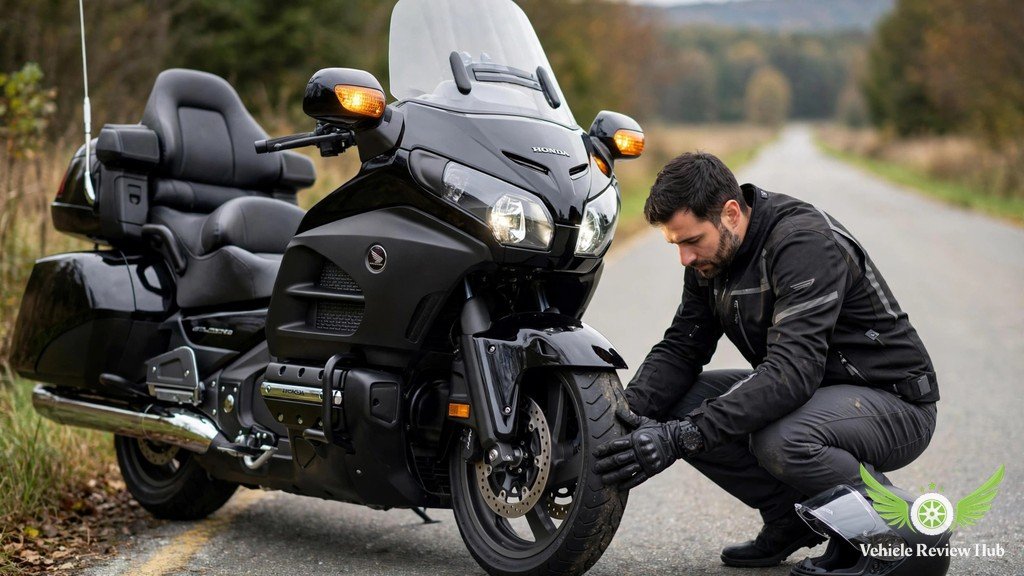
Preventive Maintenance, Service Records and Regular Inspections
Preventive maintenance, service records, and regular inspections are the three habits that define Honda Gold Wing reliability. Preventive maintenance means the 8,000-mile oil habit, the 16,000-mile plug and air-cleaner visits, the 24,000-mile valve inspection, and fluids on their time intervals. Keep every receipt: a complete service book is worth real money at resale, and a gap in it is a negotiation. Regular inspections mean a two-minute pre-ride check — tyres, brakes, lights, oil level, final-drive weeping — plus a seasonal look at fork seals, pads, battery, and luggage latches. Rust is a minor note on a Gold Wing, but fasteners, exhaust, and underside still deserve a look in wet climates.
Fuel Pump Recall Spans 2018 to 2024: VIN Check Is Essential
Fuel pump recall spans 2018 to 2024: VIN check is essential — and that heading needs its label first, because the span is broadly right but the campaign structure is not one blanket recall. The fuel-pump issue, NHTSA 24V-113 family, is an improperly moulded impeller that can deform, leaving the pump inoperable and the engine stalled or unable to start. US coverage is split: 2018–2020 GL1800 bikes under Honda campaign KQ0, plus 2020–2024 under KQ1A/KQ1B. Never cite a single campaign number for all years, and never quote India’s parallel campaign dates for a US bike. The remedy is free inspection and replacement, and the check is the NHTSA recall lookup against the actual VIN — the first rule of Honda Gold Wing reliability buying. Webbikeworld’s fuel-pump recall background explains the impeller defect.
The video below in this Honda Gold Wing reliability guide is an ownership overview from Royer Biker, covering reliability, maintenance, recalls, and used 2018–2021 buying advice — honestly an ownership perspective, not a maintenance tutorial.
Honda Gold Wing Reliability FAQs
Direct answers to the Honda Gold Wing reliability questions buyers ask most, with every recall and interval labelled by year and source.
Is the Honda Gold Wing reliable?
Yes. For Honda Gold Wing reliability, the record shows a proven flat-six with no chronic engine failure, high-mileage examples past 150,000 miles with routine maintenance, and three recalls with free remedies as the only major blemishes.
What are the common problems on a Gold Wing?
For Honda Gold Wing reliability shoppers, the watch items are the three recalls (drive-gear bolt, manual-only ECU stall, fuel pump), tyre and brake-pad wear, final-drive seal weeping, battery care on stored DCT bikes, and the labour-heavy air-filter job.
Which recalls affect the Gold Wing?
For Honda Gold Wing reliability checks, three: 24V-820 / KQ9 (2018–2021, 18,196 units, drive-gear bolt); 22V-449 (2020–2022 manual only, 1,740 units, ECU reprogram); and the 24V-113 fuel-pump family (2018–2024 span, split KQ0 and KQ1A/KQ1B campaigns). VIN-first, always.
Does the ECU recall affect DCT Gold Wings?
No. For Honda Gold Wing reliability buyers, recall 22V-449 covers manual-transmission bikes only; DCT bikes are unaffected, and the fix on manuals is a free ECU reprogram with no parts. RideApart’s report on the manual-only recall confirms the 1,740-unit scope.
What is the Gold Wing service schedule?
For Honda Gold Wing reliability: first service at 4,000 miles (no 600-mile service exists), oil and filter every 8,000 miles or 12 months, plugs and air cleaner every 16,000 miles, and valve-clearance inspection every 24,000 miles.
When does the Gold Wing need its valves checked?
For Honda Gold Wing reliability, every 24,000 miles. The inspection is the requirement — adjustment only if a clearance has moved. Never use the older generation’s 32,000-mile figure for a 2018-on bike.
How often should the Gold Wing air filter be changed?
For Honda Gold Wing reliability, every 16,000 miles — and budget for labour, since reaching the filter requires significant bodywork removal. It is the surprise bill in Gold Wing ownership.
How long do Gold Wing tires last?
For Honda Gold Wing reliability budgeting, no single figure is published: the wide 200/55-16 rear wears faster than the 130/70-18 front under two-up loads, and date codes matter as much as tread.
Does the Gold Wing have a chain to maintain?
No. For Honda Gold Wing reliability readers, the final drive is a shaft — no chain to lube or adjust — but its oil still needs changing on interval, and a weeping seal is a real fault.
Is the Gold Wing expensive to maintain?
For Honda Gold Wing reliability budgeting, routine costs are modest for the class on the 8,000-mile rhythm, but no published US servicing-cost figure exists, so no American quote is given here. Tyres and air-filter labour are the costs to plan for.
What warranty does the Gold Wing have?
For Honda Gold Wing reliability buyers, three years with unlimited mileage, transferable, from Honda. HondaCare extended coverage exists; confirm its current maximum term with a dealer rather than trusting an unconfirmed eight-year claim.
Is buying a used Gold Wing worth it?
Yes, says this Honda Gold Wing reliability guide, when the bike is clean, recall-cleared by VIN — especially the 24V-820 bolt repair on 2018–2021 bikes — and backed by a complete service book. Buy on paperwork, not shine.