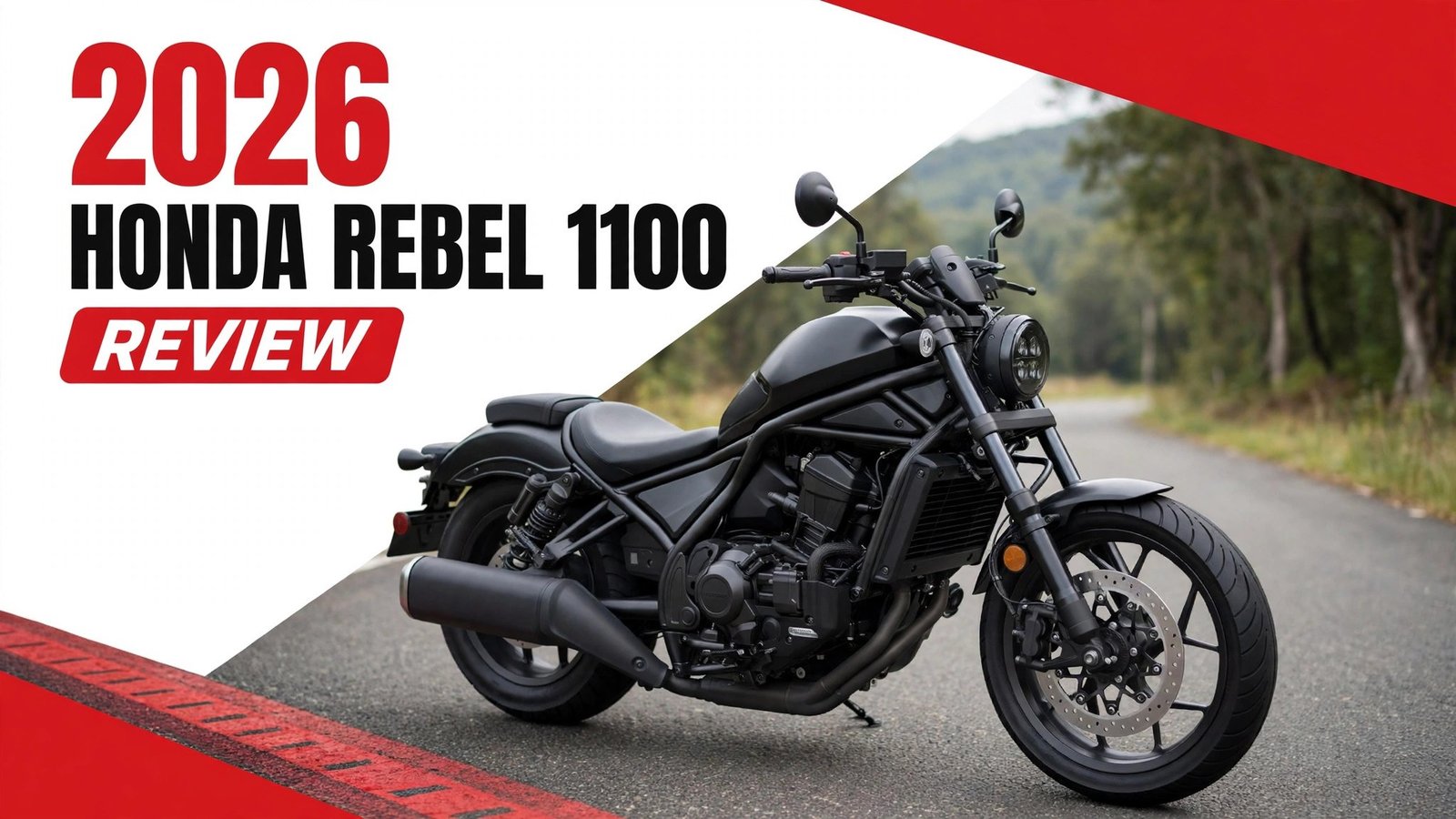
This Honda Rebel 1100 review covers the full 2026 lineup, verified specifications, and what the bike is actually like to ride. Headline numbers: the 2026 Honda Rebel 1100 starts at $9,699 plus a $775 destination charge, uses a 1084cc parallel-twin engine derived from the Africa Twin and retuned for cruiser duty, and comes in five trims, three with Honda’s dual-clutch transmission. The seat is 27.9 inches high, the manual weighs 497 pounds, and since 2025 it has a 5-inch TFT display with Honda RoadSync. If you want a light, modern big cruiser rather than a heavy V-twin, this Honda Rebel 1100 review recommends a test ride.
Honda Rebel 1100 Overview and Model-Year Updates
The Rebel 1100 is Honda’s flagship cruiser. This Honda Rebel 1100 review starts with what it is, who it suits, and how it has changed.
What Is the Honda Rebel 1100 and Who Is It Designed For?
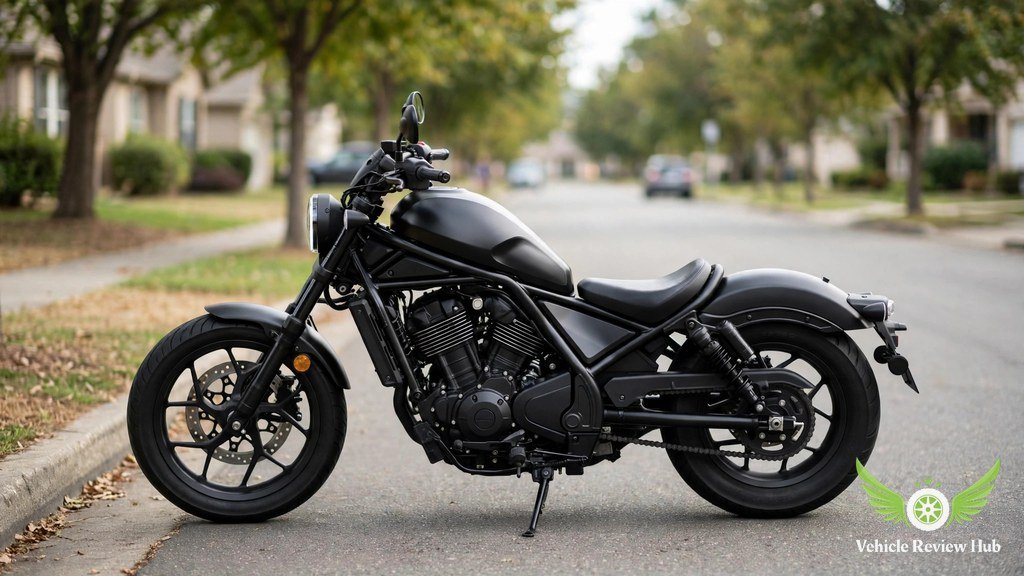
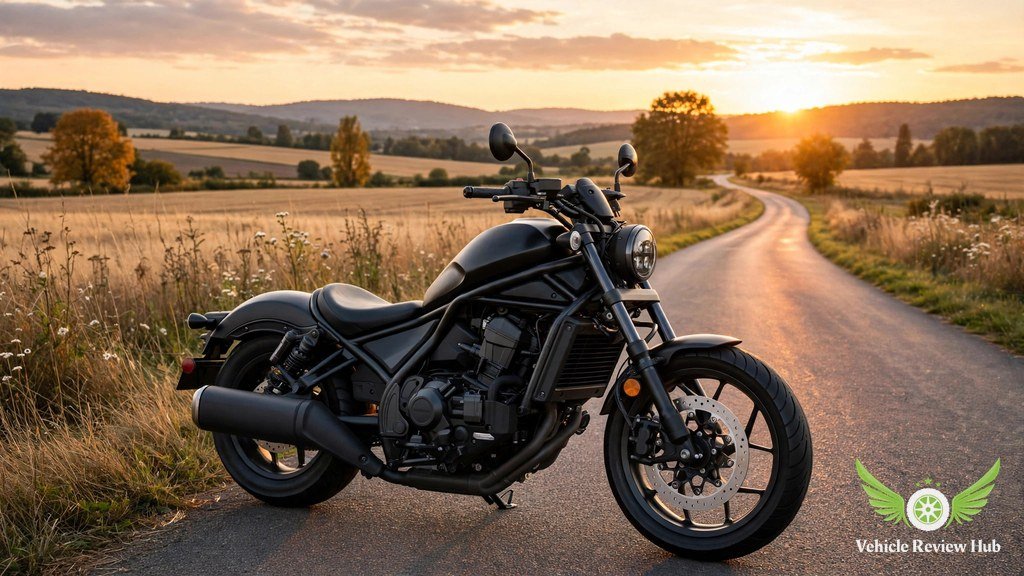
The Honda Rebel 1100 is a mid-size bobber-styled cruiser: a low, narrow frame, teardrop tank, fat tires, and almost no bodywork. It uses mid-mounted foot controls and a riding position putting most riders’ feet flat on the ground. Honda aimed it at riders stepping up from a smaller bike for highway power, and experienced riders who like cruiser looks without a 700-plus-pound motorcycle. It works as a commuter and weekend bike, but the standard bike has no fairing, screen, or luggage. This Honda Rebel 1100 review treats it as a modern, lightweight big cruiser, not a traditional heavyweight. The engine is the story: Honda took the 1084cc parallel twin from the Africa Twin adventure bike and retuned it with revised valve timing, ignition timing, a 270-degree crankshaft, and about 20 percent more flywheel mass: the engine story in this Honda Rebel 1100 review is strong low-rev torque with Honda refinement.
US History 2021 to 2026: 1100T Bagger in 2023 and the 2025 Update
The Rebel 1100 reached the United States for 2021 as a six-speed manual at $9,299 or a dual-clutch automatic (DCT) at $9,999, in Metallic Black or Bordeaux Red Metallic. For 2023 Honda added the touring Rebel 1100T, with a batwing fairing and lockable hard saddlebags. The biggest change came for 2025: footpegs moved forward two inches, a more cushioned seat, sharper throttle response, compression raised from 10.1:1 to 10.5:1, a 5-inch TFT screen with Honda RoadSync replacing the old round display, and a factory-accessorized DCT SE at $11,099. For 2026, this Honda Rebel 1100 review notes, the bike is essentially a carryover with new colors and a $100 price rise per trim, due at dealers in December 2025. For used buyers in this Honda Rebel 1100 review, a 2021-2024 bike has the old display and riding position, while a 2025 or 2026 bike has the TFT, better seat, and ergonomics.
Honda Rebel 1100 Engine and Specifications
Weight and seat-height figures differ between Honda’s tables and independent measurements. This Honda Rebel 1100 review gives the verified 2026 specifications.
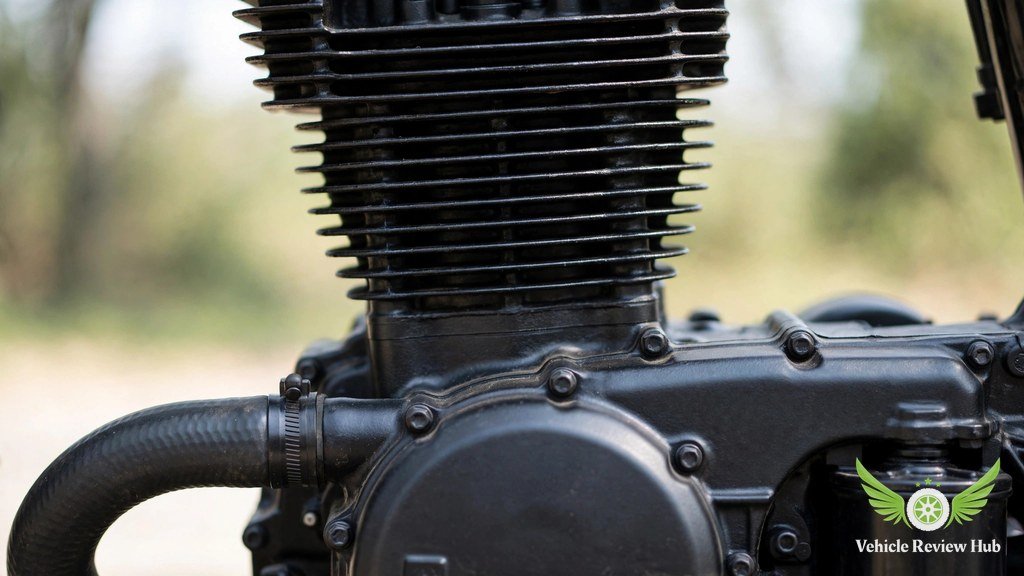
1084cc Unicam Parallel-Twin Engine, Manual Gearbox and DCT Options
The engine is a 1084cc liquid-cooled parallel twin with Honda’s Unicam single-overhead-cam design, four valves per cylinder, 92.0 x 81.5mm bore and stroke, and PGM-FI fuel injection with a 46mm throttle body. Honda USA publishes no horsepower figure; the UK claims 86 bhp with about 72 lb-ft of torque. Independent rear-wheel dyno tests cluster lower, as expected: Cycle World measured 81.02 horsepower at 7,010 rpm and 67.90 lb-ft at 5,010 rpm, and Rider’s 2021 run recorded 82 horsepower and 70 lb-ft. Treat those as one consistent band, and this Honda Rebel 1100 review never mixes crankshaft claims with rear-wheel results. For this Honda Rebel 1100 review, the gearbox is a six-speed manual with an assist-and-slipper clutch, or Honda’s six-speed dual-clutch transmission; final drive is a #525 O-ring chain (16T/42T). Braking is a 330mm front disc (radial-mount four-piston caliper) and a 256mm rear disc, both with two-channel ABS; suspension is a 43mm fork (5.5 inches) and dual Showa shocks (3.7 inches). Honda’s 2026 Rebel 1100 specifications confirm the engine, chassis, and curb-weight figures used in this Honda Rebel 1100 review.
Weight Conflict in Honda Tables, Seat Height and Specification Details
Weight is where this Honda Rebel 1100 review finds Rebel 1100 spec sheets disagreeing: different sources measure different things in different years. Honda’s 2026 US spec pages list curb weight (full tank, all fluids): 497 (manual), 518 (DCT), and 519 (DCT SE) pounds; the touring T versions are 528/549 pounds, and those are T figures. By contrast, 2021 launch coverage quoted claimed wet weights of 487/509 pounds, Cycle World’s scales read 489/512, and the UK press lists 223 kg (492 pounds). Seat height has the same year problem: Honda’s spec pages list 27.5 inches for 2021–2025 bikes and 27.9 inches for 2026, while Cycle World measured 27.9 inches on its 2022 DCT test bike; quote the figure for the year you are buying. Treat aggregator tables showing 27.2 inches as variance. The rest of the 2026 chassis spec is stable: 59.8-inch wheelbase, 28.0-degree rake, 4.3-inch trail, 3.6-gallon tank, 130/70-18 front and 180/65-16 rear tires, 35-degree lean angle, and a transferable one-year unlimited-mileage warranty.
| Weight figure | Source and year | Value |
|---|---|---|
| Claimed wet | 2021 claims | 487 / 509 lb |
| Measured | Cycle World, 2021 | 489 / 512 lb |
| Curb | Honda USA, 2026 | 497 / 518 / 519 lb |
| Curb, T (T data) | Honda USA, 2026 | 528 / 549 lb |
Honda Rebel 1100 Price and Market Availability
For 2026 the Rebel 1100 is a five-trim range, every trim carrying the same $775 destination charge. This Honda Rebel 1100 review walks through all five trims and the colors.
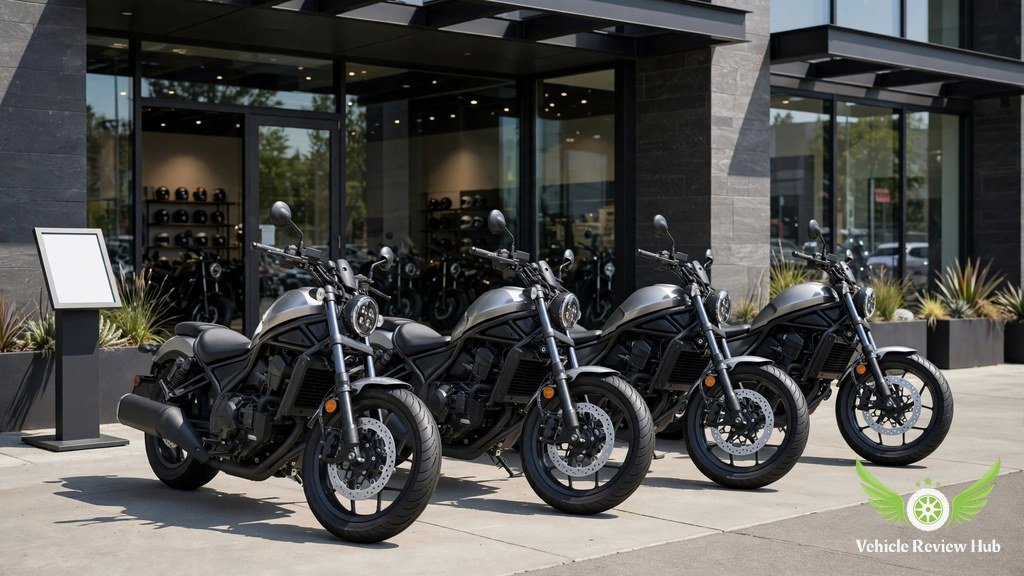
Honda Rebel 1100 Price by Trim in the USA for 2026: Five Trims Explained
The 2026 range starts with the standard manual at $9,699, and the DCT costs exactly $700 more at $10,399. The DCT SE, adding a factory kit (short fender, bar-end mirrors, fork boots, custom seat, color-matched cowl), is $11,199. The touring T versions are $10,899 (manual T) and $11,599 (T DCT), buying the batwing fairing and 35-liter lockable hard saddlebags. With the $775 destination charge, this Honda Rebel 1100 review puts the base manual at $10,474 before tax, title, and dealer fees. The 2026 prices are $100 higher than 2025 across the board ($9,599 / $10,299 / $11,099 / $10,799 / $11,499). Against 2021 launch prices ($9,299 / $9,999), the 2026 base bike costs $400 more, modest for five model years. This Honda Rebel 1100 review counts the DCT premium as fair value for traffic-heavy riding, but the manual is lighter, cheaper, and more engaging.
| 2026 trim | MSRP | With destination |
|---|---|---|
| Rebel 1100 | $9,699 | $10,474 |
| Rebel 1100 DCT | $10,399 | $11,174 |
| Rebel 1100 DCT SE | $11,199 | $11,974 |
| Rebel 1100T | $10,899 | $11,674 |
| Rebel 1100T DCT | $11,599 | $12,374 |
| Price spread | $1,900 | $1,900 |
Colours by Trim and Official US Dealer Availability
The 2026 colors are restrained: Matte Black Metallic or Matte Silver Metallic on the standard and DCT, Deep Pearl Gray only on the DCT SE, and Gray Metallic only on both T versions. For comparison, 2025 offered Matte Black Metallic or Pearl Hawkeye Blue on the base/DCT, Flare Orange Metallic on the SE, and Gray Metallic on the T. Availability in this Honda Rebel 1100 review’s check is straightforward: a regular Honda USA model sold through dealers nationwide, with 2026 bikes due in December 2025. Because color is tied to trim, check dealer stock first: the SE exists only in its one gray. The 2026 Rebel lineup announcement confirms the five trims, colors, and December 2025 availability in one place, and this Honda Rebel 1100 review uses it as the cleanest single source for the current range.
Honda Rebel 1100 Design, Features and Technology
The Rebel 1100 looks like a classic bobber, but its electronics are thoroughly modern, and the 2025 update is the dividing line. This Honda Rebel 1100 review separates 2025 arrivals from launch equipment.
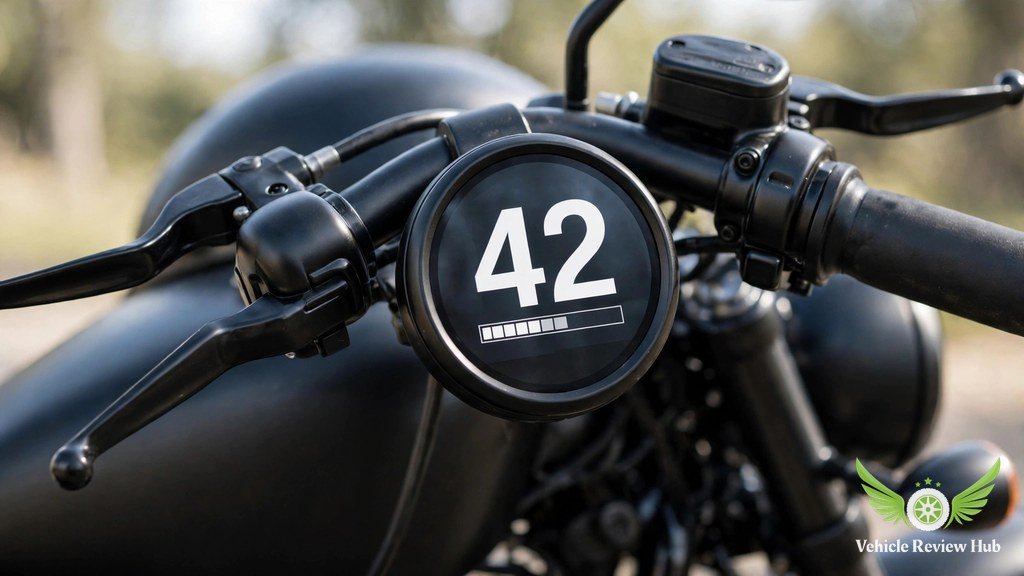
5-Inch TFT and Honda RoadSync From 2025, USB-C and Cruise Control
From 2025 onward, this Honda Rebel 1100 review notes, the Rebel 1100 carries a 5-inch TFT display with Honda RoadSync, connecting by Bluetooth for navigation, music, weather, and calls. It is a genuine step up from the pre-2025 round reverse-image digital LCD. The USB-C port moved with the update: from under the seat (pre-2025) to up by the instruments, where a bar-mounted phone can reach it. Cruise control is not a 2025 addition: Honda’s 2021 launch material states every Rebel 1100 comes equipped with ABS and cruise control. Note that one 2025 SE review describes the display as 4.7 inches; Honda’s material calls it a 5-inch TFT, and this Honda Rebel 1100 review uses Honda’s figure. Ultimate Motorcycling’s 2025 SE review is the source of the 4.7-inch description and USB-C relocation detail, flagged here rather than hidden.
Ride Modes, HSTC With Wheelie Control and Why There Is No IMU
This Honda Rebel 1100 review counts three preset ride modes (Standard, Sport, Rain) plus user-customizable settings. Honda Selectable Torque Control (HSTC) manages rear-wheel traction with selectable levels, and three-level wheelie control reads the same wheel-speed sensors. What the bike does not have is an inertial measurement unit (IMU), and that absence matters: without one it cannot measure lean angle, so its ABS is conventional two-channel ABS, not lean-sensitive cornering ABS, and traction control cannot adapt to lean. Treat any aggregator sheet claiming a six-axis IMU and cornering ABS with suspicion: the same sheet lists a single-shock rear end, different suspension travel, and a different seat height, contradicting Honda’s specs. Honda’s own feature pages describe wheel-speed-sensor HSTC, with no IMU claim. For most cruiser riding this limit is academic, since the bike leans only 35 degrees, but as this Honda Rebel 1100 review states plainly, buyers from modern adventure or sportbikes should know the electronics are simpler than the spec-sheet arms race suggests.
Honda Rebel 1100 Riding Experience and Comfort
On the road the Rebel 1100 feels smaller and lighter than its engine size suggests. This Honda Rebel 1100 review covers position, low-speed manners, highway comfort, and the T.
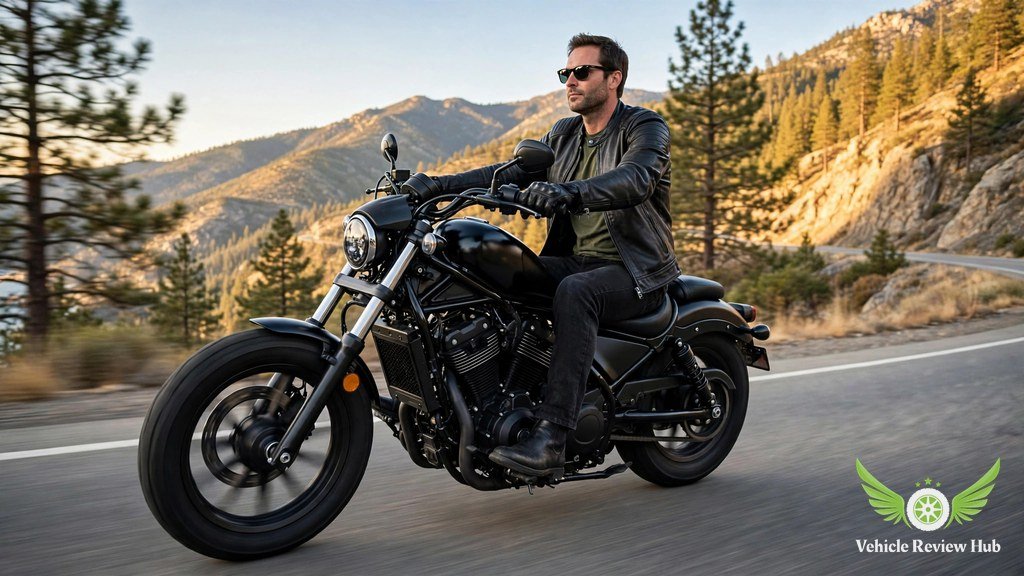
Riding Position, Handling and Low-Speed Maneuverability
The riding position is upright and relaxed: mid-mounted foot controls, wide flat handlebar, and a low seat letting most riders plant both feet. The 2025 update moved footpegs forward two inches and added a more cushioned seat for taller riders. Handling is the pleasant surprise in this Honda Rebel 1100 review: low center of gravity, 59.8-inch wheelbase, and 28-degree rake give neutral steering, and reviewers note the bike feels far lighter than the scales say. Lean angle is 35 degrees: plenty for a cruiser. The honest limit is the rear suspension: dual Showa shocks with only 3.7 inches of travel can skip on sharp mid-corner bumps, noted in MCN’s Rebel review. The video below is Modern Classic Motorcycle News’ Honda Rebel 1100 buyer’s guide, walking through the standard bike’s styling, riding position, engine, controls, and technology, so this Honda Rebel 1100 review places it here as a fair picture of the bike.
Highway Comfort, 1100T Touring Use and Everyday Practicality
On the highway, this Honda Rebel 1100 review finds the engine is the bike’s best feature: the big twin pulls cleanly from low revs. Comfort is more mixed: no wind protection means full wind blast at highway speed, and the pre-2025 seat drew complaints for numbing riders after about 50 miles. The 2025 seat and peg changes target that complaint, but this remains a naked bobber, not a tourer. The 3.6-gallon tank also limits range, so plan fuel stops generously; Honda USA publishes no MPG figure. For genuine touring duty, the 1100T adds the batwing fairing and lockable hard bags to the same engine and chassis, at the cost of extra weight (528/549 pounds), figures that belong to the T. For everyday use the standard bike is easy: light in the garage, narrow in traffic, with a chain needing regular lubrication, unlike a belt. This Honda Rebel 1100 review counts that chain as the running cost traditional cruiser buyers sometimes forget, but it also keeps the bike light and affordable.
Honda Rebel 1100 Review: Pros, Cons and Verdict
After weighing price, specifications, and riding evidence, the Rebel 1100 emerges as one of the most sensible big cruisers on sale. This Honda Rebel 1100 review sums up strengths, weaknesses, and the Rebel 500 comparison.
Main Advantages and Limitations of the Honda Rebel 1100
The advantages in this Honda Rebel 1100 review start with weight and price: at 497 pounds and $9,699, the manual bike is far lighter and cheaper than most large cruisers, yet offers a strong 1084cc twin, standard cruise control, three ride modes, traction and wheelie control, and DCT. The low 27.9-inch seat suits shorter riders, the 2025 TFT and RoadSync bring it up to date, and Honda build quality and the one-year warranty add confidence. The limitations are equally clear: short-range 3.6-gallon tank, no wind protection on the standard bike, firm short-travel suspension, chain maintenance, and no IMU, hence no lean-sensitive ABS or traction control. The pre-2025 seat issue is real on used bikes: test a 2021-2024 example thoroughly first. None of these limitations is a deal-breaker, and this Honda Rebel 1100 review rates the bike a strong buy for riders valuing light weight, modern electronics, and honest value over V-twin tradition and touring range.
Who Should Consider the Honda Rebel 1100 Over the Rebel 500?
The Rebel 500 comparison is the decision most Honda cruiser shoppers face. The Rebel 500 is lighter (414 pounds), cheaper ($6,799 plus $600 destination), and easier for a new rider, with a lower 27.2-inch seat and about half the power: 40.83 rear-wheel horsepower against 81.02 for the 1100 (Cycle World). Base-to-base, the out-the-door gap is about $3,075 ($10,474 against $7,399). Choose the 500 if you are a newer rider, ride mostly in town, or value budget and weight most. Choose the 1100 for highway riding, passengers, DCT, or the passing power only the bigger twin delivers. Both share the same bobber character and low-seat accessibility, so this Honda Rebel 1100 review says the choice comes down to experience and use, not style. For a rider with a year or more of experience wanting one bike for commuting, weekends, and touring, this Honda Rebel 1100 review calls the Rebel 1100 the better long-term buy.
Honda Rebel 1100 Review FAQs
These direct answers cover the questions buyers ask most in this Honda Rebel 1100 review: price and trims, engine, electronics, and the Rebel 500 difference.
What is the 2026 Honda Rebel 1100 price?
In this Honda Rebel 1100 review, the 2026 prices are $9,699 (manual), $10,399 (DCT), $11,199 (DCT SE), $10,899 (T), and $11,599 (T DCT). Every trim adds a $775 destination charge, so the base manual costs $10,474 before tax and fees.
How many trims does the 2026 Honda Rebel 1100 have?
This Honda Rebel 1100 review counts five trims for 2026: standard, DCT, DCT SE, 1100T, and 1100T DCT, three with dual-clutch automatic transmission.
Is the Honda Rebel 1100 DCT worth the $700 premium?
The DCT costs exactly $700 more than the manual. This Honda Rebel 1100 review says it is worth it for heavy traffic or avoiding a clutch lever, while the manual stays lighter and more engaging.
What is the Honda Rebel 1100 seat height?
Honda’s 2026 US pages list 27.9 inches; 2021–2025 material lists 27.5 inches. This Honda Rebel 1100 review advises quoting the figure for the year you are buying.
How much does the Honda Rebel 1100 weigh?
Honda’s 2026 curb weights (full tank, all fluids) are 497 (manual), 518 (DCT), and 519 (DCT SE) pounds; the T versions are 528 and 549. This Honda Rebel 1100 review stresses checking whether any figure is claimed, measured, or curb.
What engine does the Honda Rebel 1100 have?
It has a 1084cc liquid-cooled parallel twin with Unicam valve gear, four valves per cylinder, and a 270-degree crankshaft, derived from the Africa Twin and retuned for cruiser use. Honda USA publishes no horsepower figure; the UK claims 86 bhp, and this Honda Rebel 1100 review cites rear-wheel dyno tests around 81-82 horsepower.
Which Honda Rebel 1100 years have the TFT display?
The 5-inch TFT display with Honda RoadSync arrived for 2025 and continues for 2026. Earlier bikes (2021-2024) use a round reverse-image digital LCD without the TFT’s color layouts or connectivity, and this Honda Rebel 1100 review notes their USB-C port sits under the seat.
Does the Honda Rebel 1100 have cruise control?
Yes, cruise control is standard on every Rebel 1100, including the 2021 launch bikes. This Honda Rebel 1100 review corrects the common error presenting it as a 2025 addition.
Does the Honda Rebel 1100 have an IMU or cornering ABS?
No. The Rebel 1100 has no inertial measurement unit, so its ABS is conventional two-channel ABS and traction and wheelie control work from wheel-speed sensors only. This Honda Rebel 1100 review advises ignoring aggregator sheets claiming a six-axis IMU and cornering ABS.
What is the difference between the Rebel 1100 and the Rebel 1100T?
The 1100T is the touring version, adding a batwing fairing and 35-liter lockable hard saddlebags to the same engine and chassis. The T is heavier (528 manual, 549 DCT), and this Honda Rebel 1100 review prices it at $10,899 and $11,599.
Should I buy a Honda Rebel 1100 or a Rebel 500?
Buy the Rebel 500 if you are a newer rider, ride mostly in town, or want the lightest, cheapest option at $6,799. Buy the 1100 for highways, passengers, DCT, or roughly double the power: this Honda Rebel 1100 review puts the dyno gap at 81.02 against the 500’s 40.83.
What warranty does the Honda Rebel 1100 come with?
Honda covers the Rebel 1100 with a transferable one-year, unlimited-mileage warranty. Extended coverage is available through HondaCare, and this Honda Rebel 1100 review notes a used bike’s terms depend on its in-service date.