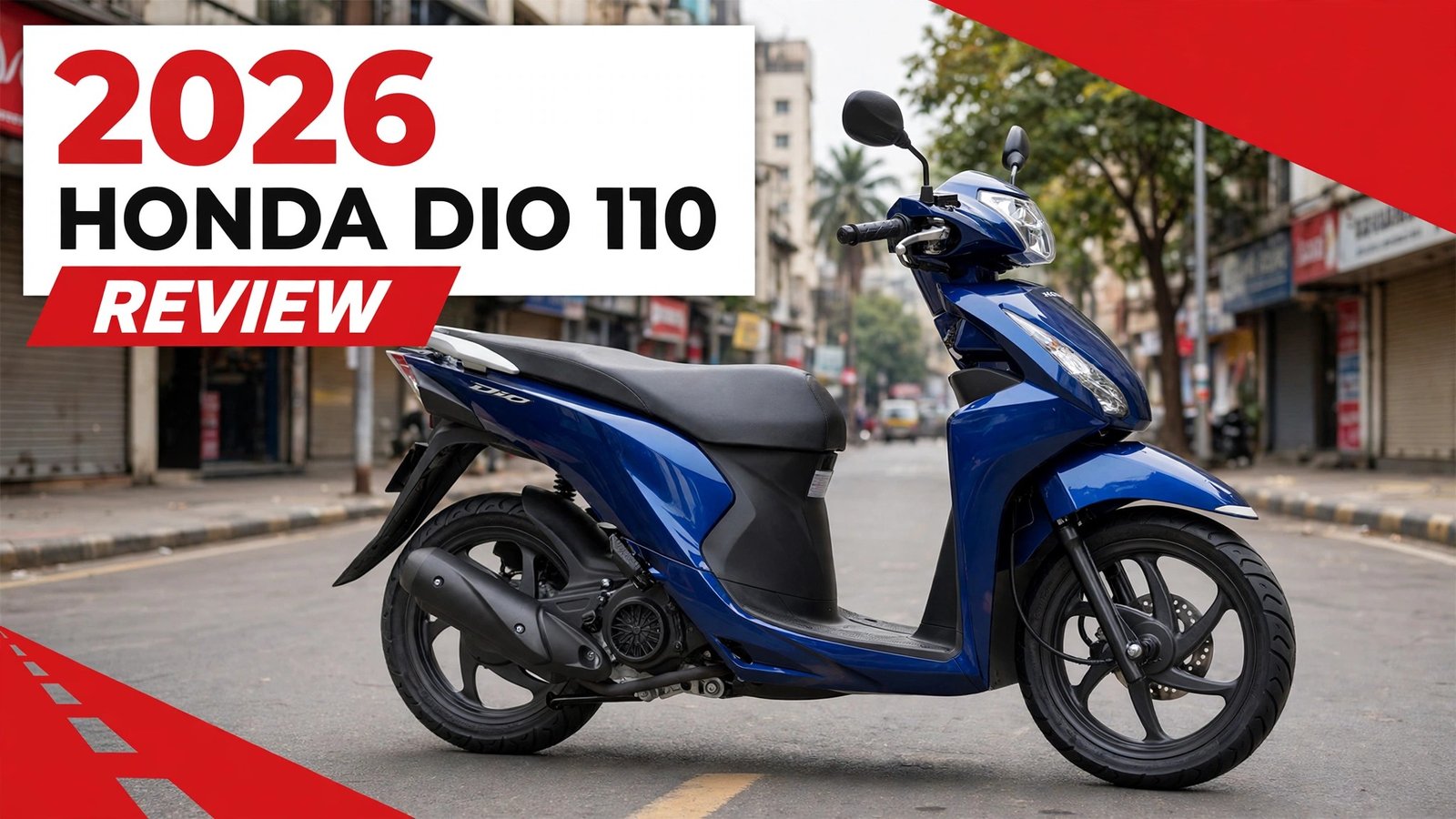
Short answer: this Honda Dio 110 review finds a sharp, light city scooter that no American rider can buy new — because Honda has never sold the Dio 110 in the United States. Every figure in this Honda Dio 110 review comes from India, where the Dio has been a youth-market staple since 2002: a 109.51cc fuel-injected single, drums at both ends with combined braking, a 5.3-litre tank, and a 2026 ex-showroom price from ₹71,085. If you are shopping in the USA, this Honda Dio 110 review still earns its keep — it explains why the bike is not here, what the badge confusion is, and which real US scooters fill the gap.
One framing fact belongs at the top of this Honda Dio 110 review: do not trust any page quoting a US price for this scooter. There is no US price, dealer network, test data, or recall record — because there is no US model. The Dio 110 is built and sold by Honda Motorcycle & Scooter India (HMSI) for India and neighbouring markets, so every figure below is Indian, in rupees and kilometres, with conversions shown, never hidden.
Honda Dio 110 Overview and Model-Year Updates
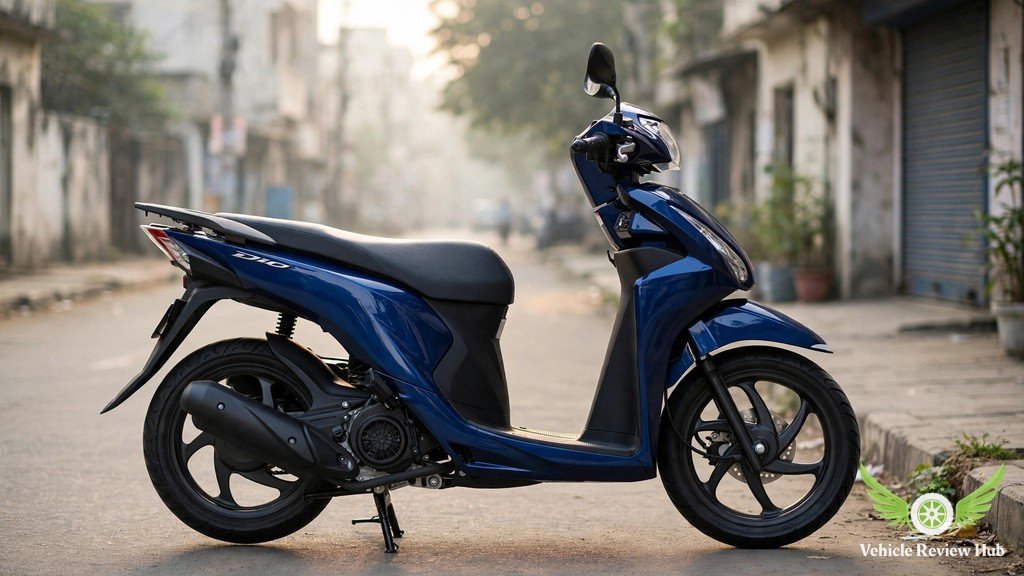
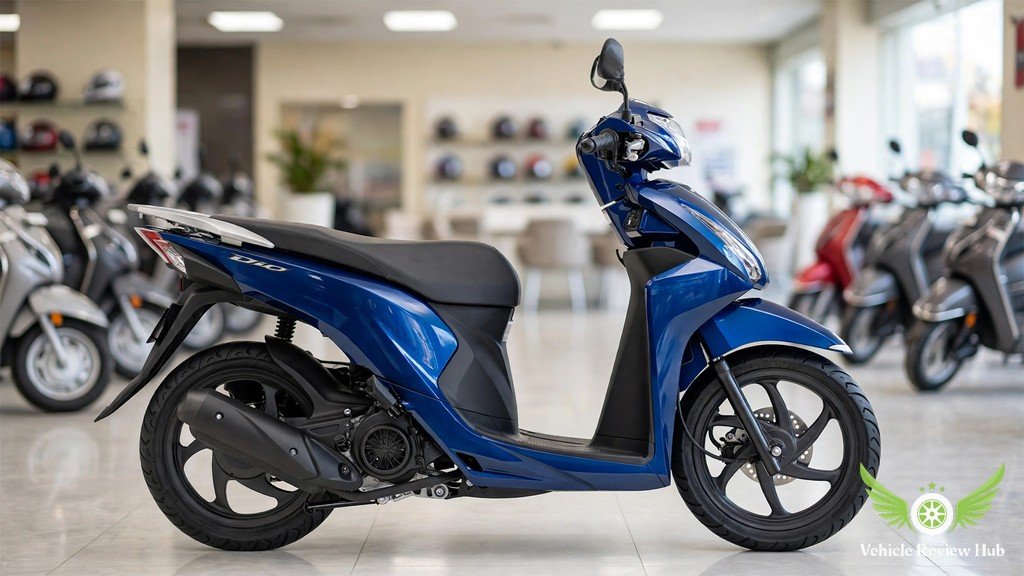
The overview of this Honda Dio 110 review starts with the bike’s identity: a sporty, lightweight, underbone-frame scooter aimed at students and commuters, sharing its 109.51cc engine family with India’s best-selling Activa but wearing sharper styling. The current bike is the BS6.2 generation in STD and DLX trims, judged in this Honda Dio 110 review on Indian evidence only.
Never Sold in the USA: No US Model Exists at All
Never sold in the USA: no US model exists at all is the sentence this Honda Dio 110 review repeats because it changes every other claim on the page. Honda USA’s line runs from the Metropolitan through the Navi, ADV160 and PCX — the Dio name appears nowhere in it. That absence also explains the recall picture: no NHTSA record names the Dio 110 — “never sold here”, not “proven safe”. A US buyer who finds a “Dio” for sale stateside is looking at a grey import, usually a 50cc Japanese-market machine, or a parts bike — never a US-market Dio 110. For the closest Honda-built alternative sold here, see our Navi review.
India History: 2002 Launch, BS6 Generation From 2020
India history: 2002 launch, BS6 generation from 2020 is the timeline this Honda Dio 110 review stands behind. Honda launched the Dio in India in 2002 as a “moto-scooter” — a sportier take on the scooter formula — with a 102cc engine. The bike grew into today’s 109.51cc engine, and the current BS6 generation launched on February 11, 2020, at ₹59,990 ex-showroom Delhi — historical only, never today’s price. The OBD2 update followed on June 12, 2023, bringing the Smart variant with Honda Smart Key. A separate Dio 125 launched in India on July 13, 2023 — a bigger 123.92cc bike, not this scooter, whose features must never transfer onto the 110.
Honda Dio 110 Engine and Specifications
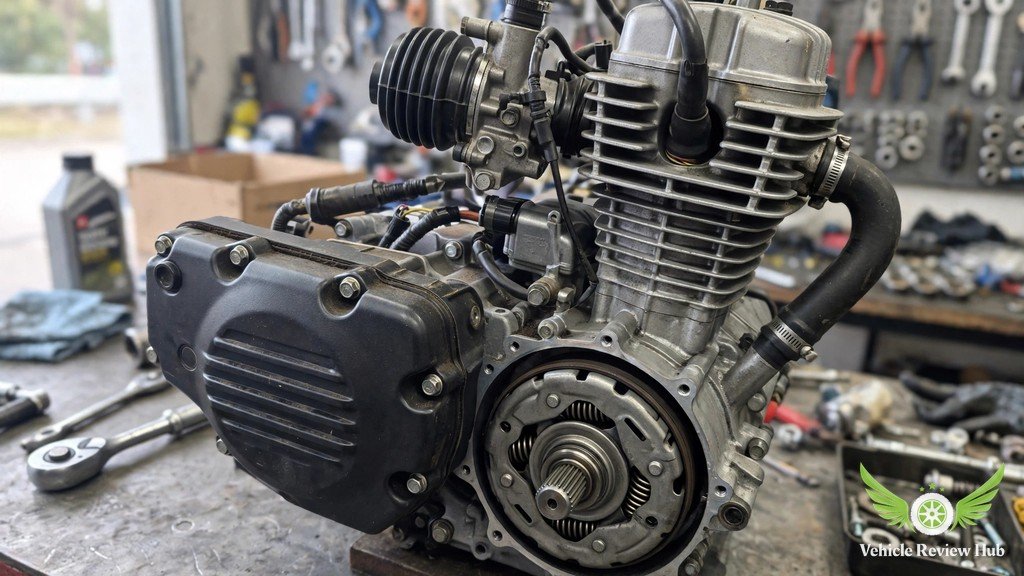
The engine section of this Honda Dio 110 review is short on drama and long on honesty: a small, proven, fuel-injected single with no dyno figure anywhere, because no independent dyno test was found. What exists are Honda India claims and aggregator listings, each labelled below in this Honda Dio 110 review.
India Spec: 109.51cc Air-Cooled at 47.0 by 63.121mm
India spec: 109.51cc air-cooled at 47.0 by 63.121mm is the engine fact this Honda Dio 110 review prints with confidence — a 47.0mm bore and 63.121mm stroke give 109.5cc. The engine is a fan/air-cooled four-stroke single with Honda’s eSP package, driving the rear wheel through a CVT automatic. Compression is 10.0:1. There is no manual gearbox, no clutch lever, and no chain: twist and go, which is why this class suits first-time riders in Indian traffic. The tank holds 5.3 litres, the seat sits at 765mm (30.1 inches), the wheelbase is 1,260mm (49.6 inches), and kerb weight is 106 kg in current listings — older 103–105 kg figures are year-labelled history.
PGM-FI and 7.84 PS Claimed by Honda India
PGM-FI and 7.84 PS claimed by Honda India is the heading this Honda Dio 110 review keeps verbatim — and the copy underneath it must be honest about a spread of figures, not one clean number. Honda India’s claim, as carried in the doc, is 5.85 kW — 7.95 PS converted. ZigWheels’ current Dio page lists 7.95 PS at 8,000 rpm and 9.03 Nm at 5,500 rpm, and its prose puts the OBD-2B motor at 7.85 PS — the figure the doc’s “7.84 PS” heading rounds. Autocar India, meanwhile, lists 7.75 bhp at 8,000 rpm and 9.03 Nm at 5,250 rpm. So the honest statement is this: power sits around 7.8–7.95 PS depending on the source, torque is 9.03 Nm everywhere, and the torque peak is disputed between 5,250 and 5,500 rpm — never blended into one invented specification, and this Honda Dio 110 review prints no dyno figure because none exists. PGM-FI fuel injection is standard — the current Dio 110 has never been carbureted, unlike its cousin the Navi, which still uses a carburetor in the USA.
Honda Dio 110 Price and Market Availability
Price is where this Honda Dio 110 review must be most careful: rupee prices drift by year and listing. Every price below is ex-showroom Delhi, year-labelled, in rupees only — never converted into a pretend US price.
| Year / source | Variant | Ex-showroom Delhi |
|---|---|---|
| 2026, ZigWheels current page | STD | ₹71,085 |
| 2026, ZigWheels current page | DLX | ₹83,512 |
| 2023 OBD2 launch, HMSI | STD / Deluxe / Smart | ₹70,211 / ₹74,212 / ₹77,712 |
| 2020 BS6 launch, historical only | Launch price | ₹59,990 |
| Summary | Honda Dio 110 review: DLX premium ₹12,427 | DLX adds USB charging, mileage indicator, brightness control |
No US Price Exists: Anyone Quoting One Is Inventing It
No US price exists: anyone quoting one is inventing it is the warning this Honda Dio 110 review puts in plain language. Search results and aggregator pages sometimes attach dollar figures to the Dio name — those figures belong to other bikes, to grey imports, or to nothing at all. There is no US MSRP, no US destination charge, and no US dealer invoice for a Dio 110, because Honda never type-approved it for the American market. An American reader of this Honda Dio 110 review should look at the real US alternatives instead: the 2026 Honda Metropolitan at $2,649 plus $300, the Navi at $2,199 or $2,349 plus $300, the Yamaha Zuma 125 at $3,799 plus $460, and the Honda PCX at $4,349 plus $600 — verified 2026 US prices for bikes you can actually buy.
India Price: DLX 83,512 Rupees Ex-Showroom Delhi
India price: DLX 83,512 rupees ex-showroom Delhi is the current figure this Honda Dio 110 review confirms — ZigWheels’ 2026 Dio page lists the STD at ₹71,085 and the DLX at ₹83,512, both ex-showroom, and the DLX figure matches the doc exactly. The DLX costs ₹12,427 more than the STD and adds a USB charging port, a real-time mileage indicator, and display brightness control. One caution: some listings still show the stale 2023 range of ₹70,211–₹77,712, and one aggregator shows ₹75,026–₹86,881 — older snapshots, not the current 2026 listing of ₹71,085–₹83,512 treated as current here. On-road prices run higher with insurance and registration, and vary by Indian state. For the full buying picture, including the import rules that block a US purchase, see our Dio 110 buying guide when it goes live.
Honda Dio 110 Design, Features and Technology
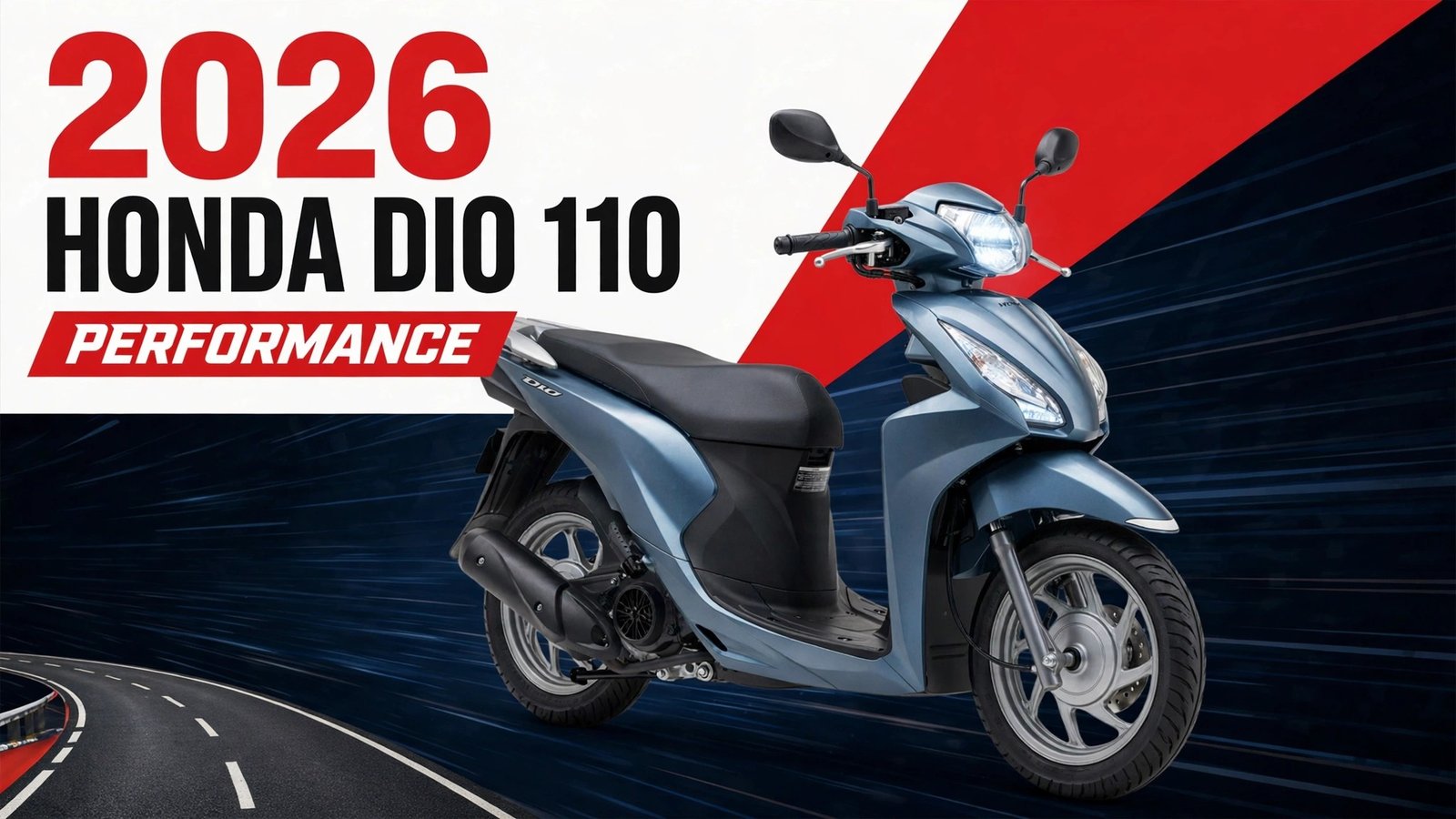
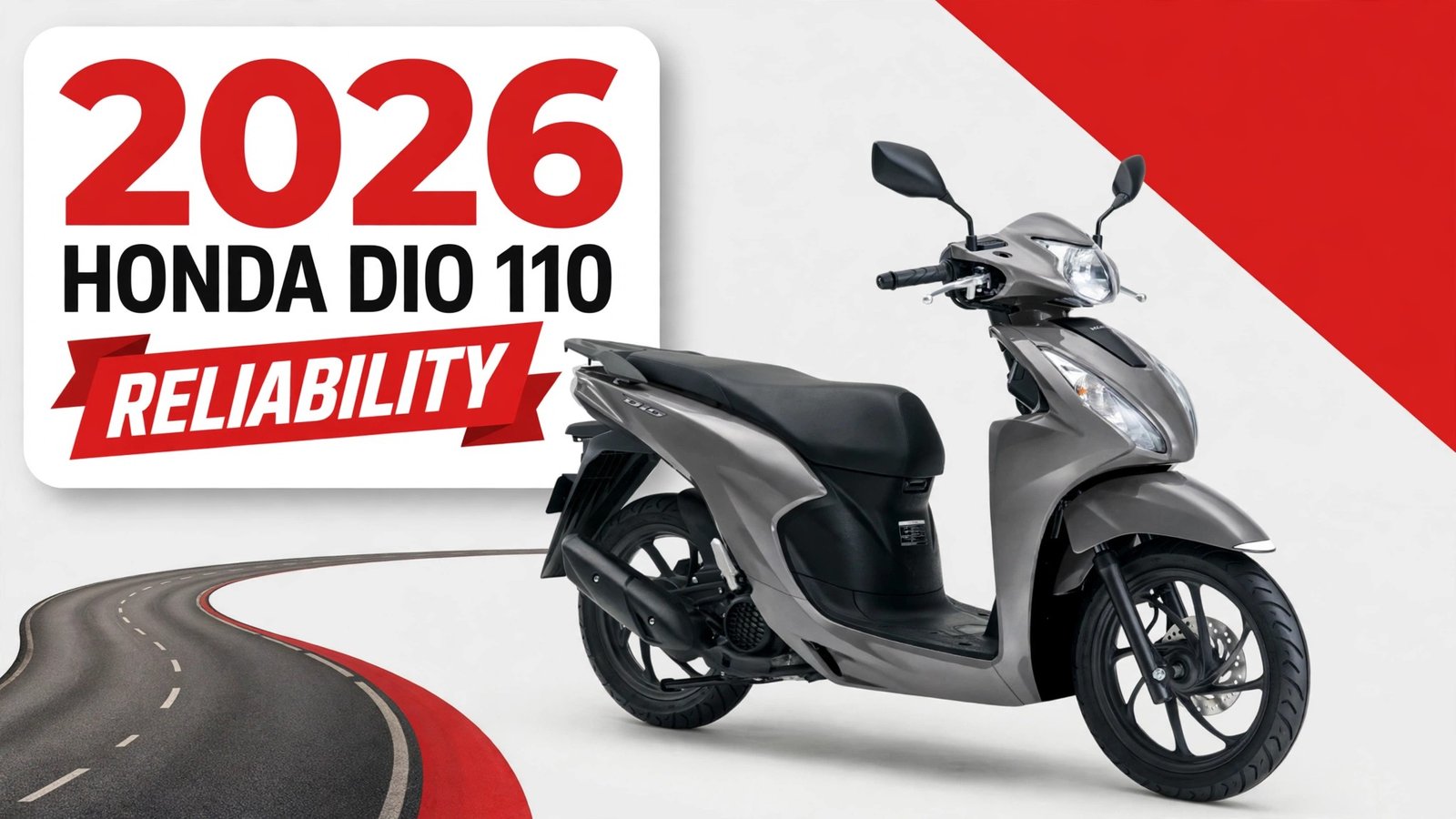
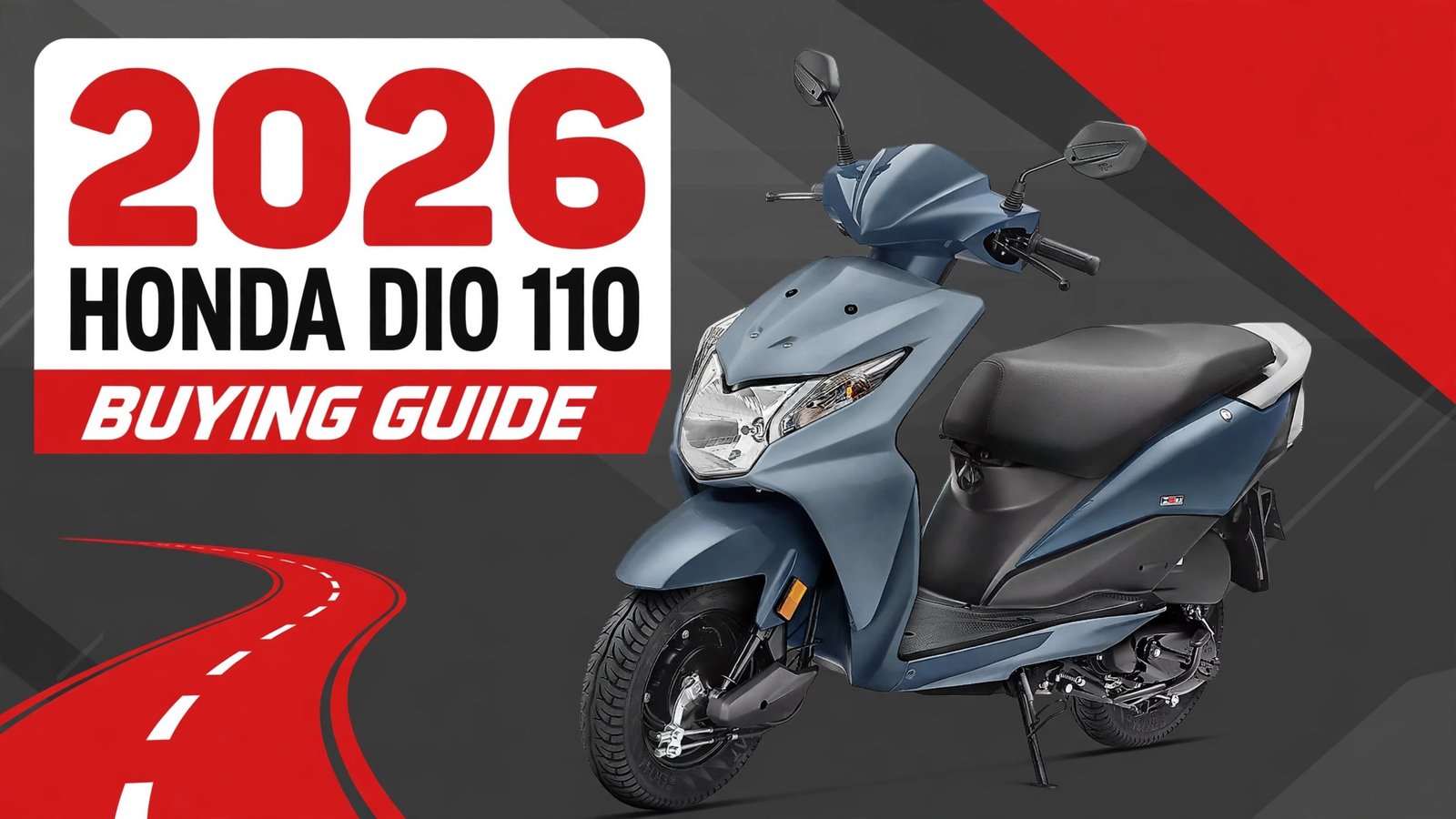
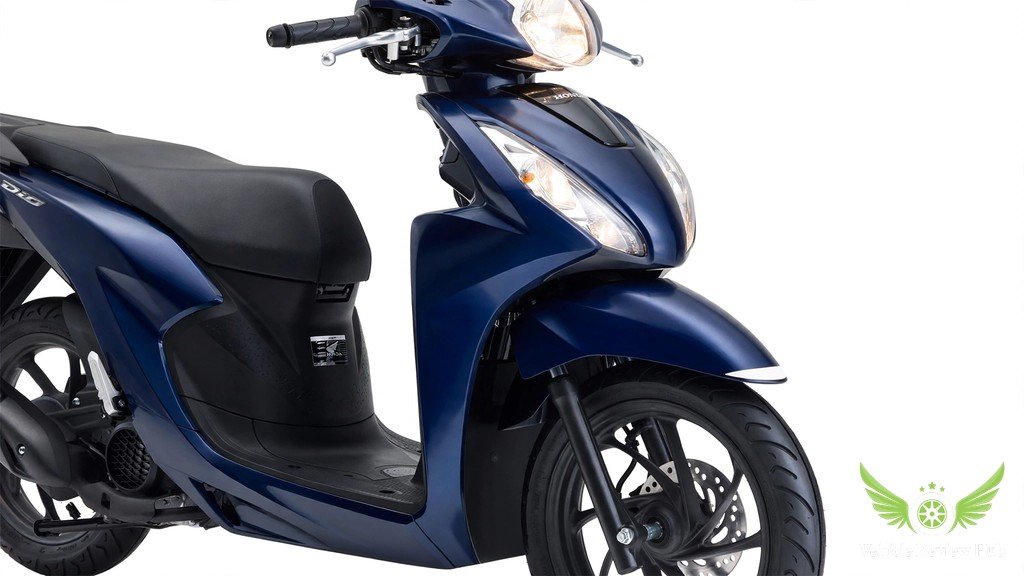
Design is the Dio’s whole reason for existing, and this Honda Dio 110 review gives it full credit: where the Activa is deliberately anonymous, the Dio is deliberately sharp — edgy bodywork and a sporty front apron. Current colours, per ZigWheels’ 2026 page: Pearl Igneous Black with Pearl Deep Ground Gray, Pearl Igneous Black, Mat Marvel Blue, Mat Axis Gray Metallic, Imperial Red Metallic.
CBS With Drums at Both Ends and a 12-Inch Front Wheel
CBS with drums at both ends and a 12-inch front wheel is the braking and wheel fact this Honda Dio 110 review states without embellishment. The Dio 110 uses Honda’s Combined Braking System: the left (rear) lever also applies the front brake, helping inexperienced riders stop straight. Both ends are 130mm drum brakes — no ABS on any Dio 110, and no front disc, so any page claiming a 190mm front disc for this bike is describing the Dio 125 DLX, not the 110. The front wheel is 12 inches with a 90/90-12 tubeless tyre, the rear a 10-inch wheel with a 90/100-10 — the larger front wheel is part of why the Dio steers more confidently than 10-inch-both-ends scooters. Practical features: an external fuel filler (no need to open the seat), underseat storage, and, on the DLX, the USB charging port and real-time mileage indicator. Meter fact, year-labelled: the current DLX has a TFT meter per Honda India, the Standard an analogue meter — the Dio 125 DLX’s TFT is another bike’s fitment, and this Honda Dio 110 review does not transfer it.
The US Elite Is Not a Dio: the Canada-Only Dio SR Story
The US Elite is not a Dio: the Canada-only Dio SR story is the name-confusion heading this Honda Dio 110 review keeps verbatim, because it explains half the bad information on the internet about this badge. From 1992 to 2001, Honda sold the Dio SR in Canada — model code SK50, AF27 Super Dio platform, a 49.4cc air-cooled two-stroke single making roughly 5.6 hp. It succeeded the Elite R in Canada and was the last two-stroke scooter Honda sold there. The United States never got it: America got the Elite SR and Elite LX (SA50) instead. So a “Dio” in North America is almost always that 1990s Canadian 50cc two-stroke, or a Japanese-market 50cc grey import — never the India-market 110 — and none of its specifications may leak into an article about the 110 — a distinction this Honda Dio 110 review keeps sharp.
Honda Dio 110 Riding Experience and Comfort
Riding experience is where this Honda Dio 110 review must be disciplined: with no American test ride to quote, every impression below comes from Indian owners and Indian press, labelled as such. What they describe, consistently, is a light, nimble, city-first scooter, easy to live with, with limits on rough roads and at sustained speed.
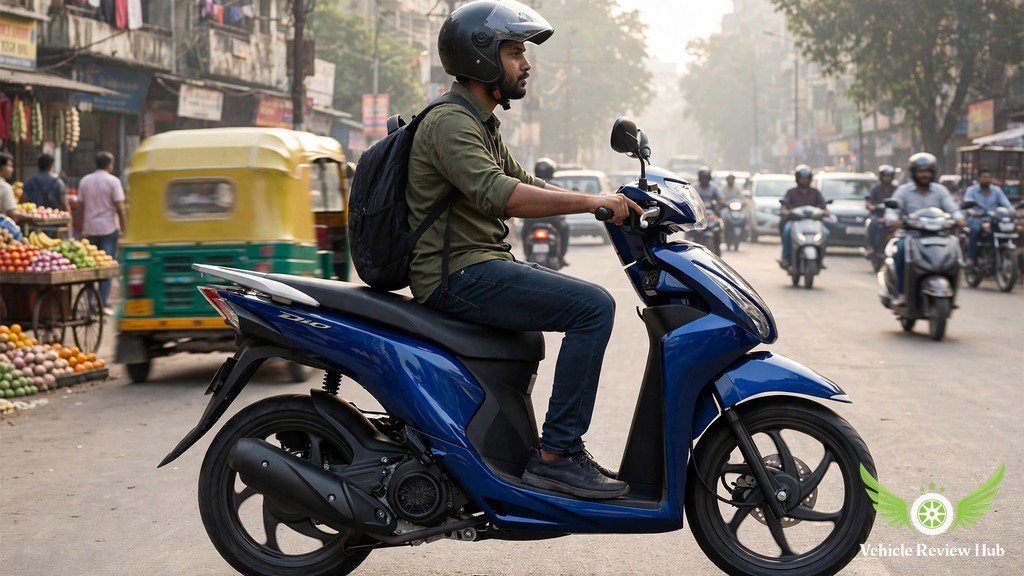
The video below in this Honda Dio 110 review is an India-market review of the 2022 Dio Sports edition — honestly labelled as an India review of the 110 platform, not a US test, and useful for seeing the bike’s size and road presence in real traffic.
Riding Position, Handling and Low-Speed Maneuverability
Riding position, handling and low-speed maneuverability are the Dio’s genuine strengths in this Honda Dio 110 review. The riding position is upright and relaxed, the 765mm seat suits shorter riders, and at 106 kg the bike is light enough to paddle through traffic. Owner feedback on ZigWheels rates the bike 4.8 out of 5 from 9 owner ratings as of November 2026 — a small sample, stated honestly — while BikeWale’s larger Dio page aggregate shows 4.6 out of 5 across 612 reviews and 2,175 ratings. The same owner record gives this Honda Dio 110 review the honest limits: firm suspension on broken roads, a pillion footrest taller passengers dislike, and handlebars that can brush a tall rider’s knees on sharp U-turns.
What US Review Data Exists: None, India Tests Only
What US review data exists: none, India tests only is the heading this Honda Dio 110 review closes the riding section on, because it is the rule for the whole article. No American magazine has instrumented a Dio 110 — no 0–60, quarter-mile, braking distance, or US fuel-economy test — because the bike cannot legally be sold or registered here yet. The figures that do exist are Indian: a listed top speed of 83 km/h (51.6 mph), and mileage at 46–48 km/L in owner reports against a 50 km/L ARAI listing figure. This Honda Dio 110 review converts those honestly — 50 km/L is about 117.6 mpg US, 48 km/L about 112.9 — method shown, not hidden. For the performance story in full, including the torque-peak conflict and the 60 km/L claim from a 2013 ad for an older model, see our Dio 110 performance guide when it goes live, and for the closest US-riding comparison, our PCX125 review.
Honda Dio 110 Review: Pros, Cons and Verdict
The verdict of this Honda Dio 110 review is two-sided by necessity: as a scooter, the Dio 110 is an easy recommendation in its home market; as a purchase for an American reader, it is not a purchase at all today.
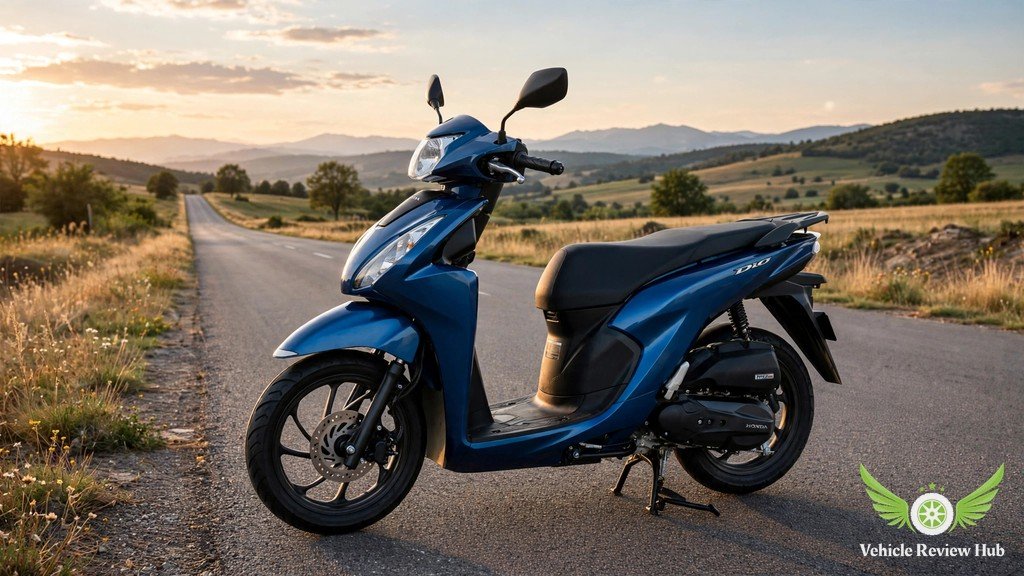
Main Advantages and Limitations of the Honda Dio 110
Main advantages and limitations of the Honda Dio 110, stated with equal weight in this Honda Dio 110 review. Advantages: sharp youth-focused styling; a proven 109.51cc fuel-injected engine shared with the Activa family; light 106 kg weight and low 765mm seat; a 12-inch front wheel that helps handling; CBS braking that forgives beginner mistakes; external fuel filling and underseat storage; and a price from ₹71,085 ex-showroom in India. Limitations: drums at both ends and no ABS; firm suspension on broken roads; a small 5.3-litre tank; a top speed around 83 km/h that rules out sustained highway work; owner mileage below the 50 km/L listing figure; and, for the American reader, the decisive one — no US sale, support, or registration path for a new bike, with the 25-year rule putting a 2020 BS6 Dio’s eligibility in 2045. The India warranty, listed by ZigWheels as 3 years or 36,000 km, must never be described as American coverage.
Cousin, Not Twin: the Navi Uses an Older Engine Layout
Cousin, not twin: the Navi uses an older engine layout is the comparison this Honda Dio 110 review ends on, because it is the most useful fact for an American reader. The Honda Navi sold in the USA is the Dio’s cousin, not its twin: older carbureted 109cc layout, drums with CBS, no ABS — simpler and cheaper at $2,199 or $2,349 plus $300 for 2026 — while the Dio 110 uses the newer PGM-FI eSP engine. The Navi is the honest American answer to “I want something like a Dio”: it is smaller, more toy-like, and less polished, but it is real, registered, and supported here. The Grom 125, at $3,599 plus $300 for 2026, is the step up for riders who want a geared miniMOTO instead of twist-and-go — see our Grom 125 review. And for riders who want a full-size Honda scooter experience in the USA, the ADV160 at $4,499 plus $600 is the next rung — see our ADV160 buying guide when it goes live. The Dio 110 itself remains what this Honda Dio 110 review found: a good scooter in the wrong country for American buyers, for now.
Honda Dio 110 Review FAQs
Direct answers to the Honda Dio 110 review questions readers ask most.
Is the Honda Dio 110 sold in the USA?
No, says this Honda Dio 110 review — Honda has never sold the Dio 110 in the United States, and there is no US price, dealer, or registration path for one.
How much does the Honda Dio 110 cost in India?
From ₹71,085 for the STD to ₹83,512 for the DLX, ex-showroom Delhi, per ZigWheels’ 2026 Dio page, says this Honda Dio 110 review — rupees only.
What engine does the Honda Dio 110 have?
A 109.51cc fan/air-cooled four-stroke single with PGM-FI and a CVT automatic, says this Honda Dio 110 review — bore 47.0mm, stroke 63.121mm, compression 10.0:1.
How much power does the Honda Dio 110 make?
Around 7.8–7.95 PS depending on the source, with 9.03 Nm of torque, says this Honda Dio 110 review — Honda India’s claim is 5.85 kW (7.95 PS); the torque peak is disputed between 5,250 and 5,500 rpm.
Does the Honda Dio 110 have ABS?
No, says this Honda Dio 110 review — 130mm drum brakes at both ends with Honda’s Combined Braking System, and no front disc. The 190mm front disc belongs to the Dio 125.
What is the top speed of the Honda Dio 110?
83 km/h (51.6 mph) across Indian listings, says this Honda Dio 110 review — India figure, never a US test.
What mileage does the Honda Dio 110 give?
A 50 km/L ARAI listing figure against owner reports at 46–48 km/L, says this Honda Dio 110 review — about 117.6 mpg US at 50 km/L.
Is the Honda Dio 110 fuel-injected?
Yes, says this Honda Dio 110 review — PGM-FI fuel injection is standard on the current BS6.2 bike, unlike the carbureted US Navi.
What is the difference between the Dio 110 and the Dio 125?
The Dio 125 is a different, bigger bike launched in India in July 2023 with a 123.92cc engine, says this Honda Dio 110 review — its 190mm front disc never transfers to the 110; the current 110 DLX has its own TFT meter.
What is the Canada Dio SR?
A 1992–2001 Canadian 49.4cc two-stroke scooter on the AF27 platform, says this Honda Dio 110 review — a name coincidence, not the India Dio 110, never sold in the USA.
Can I import a Honda Dio 110 to the USA?
Not a new one, says this Honda Dio 110 review — under the 25-year rule, a 2020 BS6 Dio becomes import-eligible in 2045, and under-25 grey imports cannot be federally registered.
What should I buy instead in the USA?
The Navi at $2,199 or $2,349 plus $300, the Metropolitan at $2,649 plus $300, the Zuma 125 at $3,799 plus $460, or the PCX at $4,349 plus $600, all 2026 prices, says this Honda Dio 110 review — real US scooters you can register.