Short answer: Honda Rebel 1100T performance is the standard Rebel 1100’s easy speed, carrying a fairing and hard bags. Cycle World’s dyno gives 78.9 rear-wheel horsepower, the factory limiter holds top speed around 100 mph, and the two reputable fuel tests disagree: Rider’s DCT test returned 46.4 mpg, RevZilla’s manual test bike needed fuel every 145 miles. This guide to Honda Rebel 1100T performance separates T-specific test data from standard-bike figures and crank claims from rear-wheel dyno numbers.
Honda Rebel 1100T Engine Performance and Power Delivery
The engine is the familiar part of Honda Rebel 1100T performance. The T uses the same liquid-cooled 1,084cc Unicam parallel twin as the standard Rebel 1100, retuned for cruiser duty with its own mapping and a heavier flywheel. Its 270-degree crank gives a V-twin-like pulse, and ride-by-wire unlocks three preset ride modes (Standard, Sport, Rain), two user modes, switchable traction control, and cruise control. For Honda Rebel 1100T performance, that package matters more than any peak figure: the bike pulls cleanly from low revs, spins to an 8,000 rpm redline, and stays calm in traffic.

Cycle World Dyno 78.9 HP at 7,220 RPM for the 2025 Manual Model
For Honda Rebel 1100T performance, the one instrumented power figure that actually belongs to the T comes from Cycle World’s dyno test: the 2025 Rebel 1100T produced 78.9 hp at 7,220 rpm and 66.0 lb-ft of torque at 4,940 rpm at the rear wheel, on a Dynojet 250i. That the test bike was the manual is confirmed by the article itself, which cites the $10,799 MSRP — the 2025 manual price, not the $11,499 DCT price. The same article weighed the bike at 527 pounds on Cycle World’s scales, against Honda’s 520-pound claim. For Honda Rebel 1100T performance, two comparisons keep this figure honest. First, the standard bike made 81.02 hp at 7,010 rpm on Cycle World’s earlier dyno run, so the T sits just under its sibling — same engine family, different test days, so treat that as the same ballpark. Second, the UK claim of 87 hp at 7,250 rpm and 72 lb-ft at 4,750 rpm is a crankshaft figure, before drivetrain losses. Honda USA publishes no horsepower or torque figure for the T at all, so any US article quoting 87 hp as an American Honda number repeats the UK claim.
Manual and DCT Shifting, Ride Modes and Power Delivery
For Honda Rebel 1100T performance, buyers choose between a six-speed manual with an assist-and-slipper clutch and Honda’s six-speed Dual-Clutch Transmission, and the choice changes feel more than outright speed. The manual is lighter and cheaper: Honda’s tables put the 2026 manual at 528 pounds curb against 549 for the DCT (22 on 2025 tables). The DCT removes the clutch lever and foot shifter entirely: Drive shifts itself, Sport holds gears longer and sharpens response, and Manual mode gives full control through the left-grip paddles. The video below, a full test and review of the 2023 Rebel 1100T, shows how that package feels on the road.
For Honda Rebel 1100T performance, the practical conclusion is simple: the manual rewards riders who like to shift and want the lightest T, the DCT rewards riders who want to think about the road instead of the gearbox, and neither is meaningfully slower in real riding. The twin spins at 4,500 rpm holding 75 mph in top gear, right in the engine’s lively midrange, though footpeg vibrations from around 6,000 rpm prompt a shift.
Honda Rebel 1100T Top Speed and Acceleration
Acceleration is where Honda Rebel 1100T performance needs the most discipline, because the internet is full of numbers that do not belong to this bike. The T is quick — midrange, low seat, and roughly 525-pound measured weight give it strong roll-on pace — but quick is not tested, and no major outlet has published an instrumented acceleration test of the T itself.
Top Speed Restricted to Around 100 MPH by the Factory Limiter
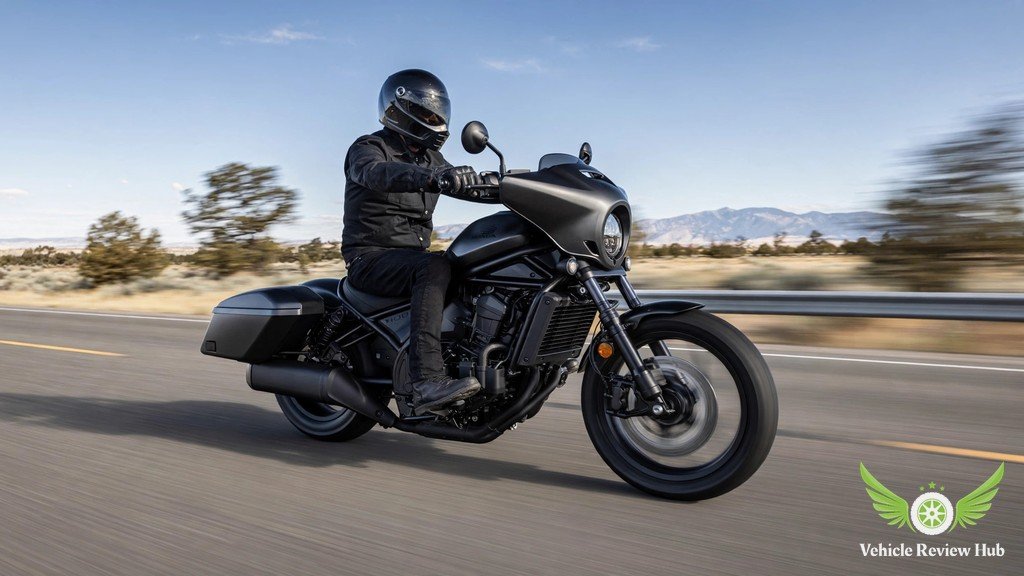
Top speed is where Honda Rebel 1100T performance gets a frank correction to internet folklore. The bike is electronically limited to around 100 mph: on the T, Ultimate Motorcycling’s T test reports the rev limiter intervenes at 6,000 rpm in sixth gear, well below the roughly 8,000 rpm redline. One aggregator’s 110 mph speedo-indicated claim is also unverified — a speedometer reading is not an instrumented test, and Honda publishes no top-speed figure. For Honda Rebel 1100T performance, the honest line is that the limiter, not the engine, sets the ceiling — and on a touring-paced bike that ceiling rarely matters.
Why No Instrumented 0-60 or Quarter Mile Test Exists for the T
For Honda Rebel 1100T performance, the absence of a T acceleration test is itself a finding worth stating plainly. Cycle World published a dyno run for the T, not an acceleration test; Rider’s 2023 T review published fuel economy and specifications, not acceleration times; RevZilla’s 2026 T review published ride impressions and a 145-mile fill-up average, not instrumented acceleration. Most importantly, the standard bike’s numbers must not be transferred: Cycle World’s 2022 comparison measured the standard DCT at 0-60 in 3.92 seconds and the quarter mile in 12.52 seconds. The T is heavier, and its fairing helps the rider, not the stopwatch. Until a major outlet instruments a T, Honda Rebel 1100T performance has a dyno figure and a limiter, but no verified acceleration time.
| Tested figure | Number | Source and basis |
|---|---|---|
| Rear-wheel dyno, 2025 T manual | 78.9 hp @ 7,220 rpm; 66.0 lb-ft @ 4,940 rpm | Cycle World, Dynojet 250i |
| Rear-wheel dyno, standard bike (context) | 81.02 hp @ 7,010 rpm; 67.90 lb-ft @ 5,010 rpm | Cycle World, earlier standard-bike test |
| Claimed crank output (UK) | 87 hp @ 7,250 rpm; 72 lb-ft @ 4,750 rpm | Honda UK claim, not a US Honda figure |
| 0-60 mph, T-specific | No instrumented test published | Standard DCT 3.92 s is NOT a T figure |
| Quarter mile, T-specific | No instrumented test published | Standard DCT 12.52 s is NOT a T figure |
| Top speed | Around 100 mph, electronically limited | Limiter intervenes at 6,000 rpm in 6th (T test) |
Honda Rebel 1100T Mileage and Fuel Economy
Fuel economy is the weakest part of Honda Rebel 1100T performance, and it is entirely a consequence of the small tank, not of a thirsty engine. Two reputable tests disagree by a wide margin, and understanding why matters more than picking one number.

Rider Tested 46.4 MPG and Around 167 Mile Range on the DCT
For Honda Rebel 1100T performance, the best fuel-economy figure attached to the T comes from Rider’s 2023 T DCT test on Tennessee roads, including the Foothills Parkway and the Tail of the Dragon. The DCT touring model averaged 46.4 mpg over that test, for about 167 miles from the 3.6-gallon tank (46.4 × 3.6 = 167.0). That is a touring-model result at a touring pace, on a DCT bike with a fairing that cuts wind drag; it must never be quoted as the standard bike’s economy, but for Honda Rebel 1100T performance it is legitimate T data.
Honda USA Publishes No MPG Figure and the 3.6-Gallon Tank
For Honda Rebel 1100T performance, the other side of the fuel story is RevZilla’s 2026 test of the manual T: over 850 logged miles, the reviewer averaged 145 miles between fill-ups. RevZilla states the fill-up gap, not a miles-per-gallon figure; dividing 145 miles by the 3.6-gallon tank gives about 40 mpg, but that is this guide’s arithmetic, not a RevZilla-measured mpg. Honda USA publishes no MPG figure for the T, so no official number settles the argument. The practical rule for Honda Rebel 1100T performance is to plan fuel stops at 130 to 145 miles: the 3.6-gallon tank includes a 1.1-gallon reserve, so the low-fuel light leaves roughly 40 miles of grace at touring pace, less when ridden hard.
| Riding scenario | MPG | Range on 3.6 gallons |
|---|---|---|
| Rider touring test, 2023 T DCT | 46.4 mpg | About 167 miles |
| RevZilla 2026 manual T, 850 miles logged | About 40 mpg (arithmetic from 145-mile fill-up gaps) | 145 miles between fill-ups |
| Cycle World mixed testing, standard bike (context) | 37.1 mpg | About 134 miles to empty |
| Planning rule for the T | 40–46 mpg depending on pace | Fill up by about 130–145 miles |
Honda Rebel 1100T Real-World Riding Performance
Test numbers tell only half the story of Honda Rebel 1100T performance. The other half is how the bike behaves in traffic, on a highway on-ramp, and on a two-lane road with the bags loaded — where the T’s light weight and compact chassis matter as much as its horsepower.

City Riding, Traffic Performance and Everyday Acceleration
In the city, Honda Rebel 1100T performance feels effortless rather than intimidating. The 270-degree crank twin makes its torque low, so the bike pulls cleanly from low revs without downshifting, and the low seat — 27.5 inches on 2023–2025 bikes, 27.9 on the 2026 — lets most riders flat-foot at lights even on the DCT version. For Honda Rebel 1100T performance, the DCT shines here: no clutch work in stop-and-go traffic, no stall risk on a hill start, and paddle control when a gap opens. Two city caveats deserve mention: RevZilla found Sport mode slightly snatchy for urban traffic and preferred Standard in town, and the fairing and bags add width and weight that make tight filtering less easy than on the standard bike.
Highway Riding, Overtaking Ability and RevZilla 145 Mile Fill-Up Gaps
On the highway, Honda Rebel 1100T performance is strong up to the limiter and honest about its limits beyond it. The twin spins at 4,500 rpm holding 75 mph in top gear, right in its lively midrange, so roll-on overtaking usually needs no downshift — and Sport mode sharpens throttle response further. That is where the touring version’s fairing earns its keep and shows its limit: RevZilla’s 2026 test found the short fairing directs wind at the rider’s helmet, bearable under 75 mph but a neck workout above it, and recommended an aftermarket touring windscreen for serious interstate work. For Honda Rebel 1100T performance, the highway verdict is that the T tours well at a touring pace and punishes only sustained speeds above 75 mph.
Honda Rebel 1100T Handling, Braking and Stability
Handling is where Honda Rebel 1100T performance most clearly breaks from bagger tradition. Most baggers feel heavy, vague, and reluctant to lean; the T feels light, neutral, and willing, thanks to its compact chassis: a 59.8-inch wheelbase, 28-degree rake, and 4.3-inch trail, carried over from the standard bike.
Extra Weight on Standard Suspension, Fairing, Tires and Cornering
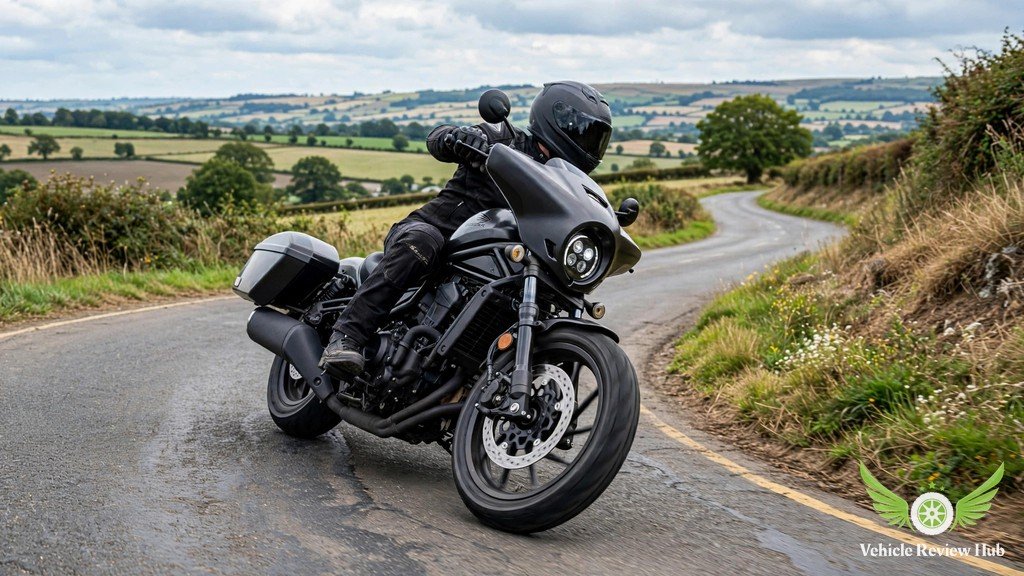
For Honda Rebel 1100T performance, the suspension question is simple: the hardware is unchanged from the standard bike, and the T is heavier. The front end is a 43mm Showa fork with 5.5 inches of travel on current specification pages, paired with dual Showa piggyback shocks offering 3.7 inches of rear travel, both preload-adjustable only. Honda’s own 2026 tables put the T 31 pounds over the equivalent standard trim (528 versus 497 manual, 549 versus 518 DCT), so the same springs and damping carry more mass. The real cornering limit is clearance, not grip — RevZilla reported hard parts grating before the chassis ran out of ability. Tires are the standard bike’s Dunlop D428 set, 130/70-18 front and 180/65-16 rear; the extra weight wears the rear tire faster, so check rear tread depth more often on a T.
Braking Hardware Shared With the Standard Bike and Two-Channel ABS
For Honda Rebel 1100T performance, braking hardware is a single radial-mount four-piston Nissin caliper gripping a floating 330mm front disc, with a single-piston caliper on a 256mm disc at the rear, both with ABS. The ABS is a conventional two-channel system, not lean-sensitive: no inertial measurement unit, so no cornering ABS or lean-sensitive traction control. No T-specific 60-0 mph braking test has been published, so this guide does not quote one: the standard bike’s tested 130.38 feet is platform context only, not a T measurement, and the T’s extra 31 pounds means longer stops should be expected from the same single front disc. RevZilla’s verdict still holds for Honda Rebel 1100T performance: the single-disc front end provides impressive stopping power, believable precisely because the bike is light for a bagger.
Honda Rebel 1100T Performance Compared With Other Light Baggers
Comparisons are where Honda Rebel 1100T performance either justifies its price or does not, and on tested evidence it mostly does. The rivals are the Indian Super Scout and the Triumph Speedmaster: both more traditional cruisers with bigger engines and higher prices. For Honda Rebel 1100T performance, the T does not win every category, but it wins the ones that matter to a rider who actually rides rather than poses.
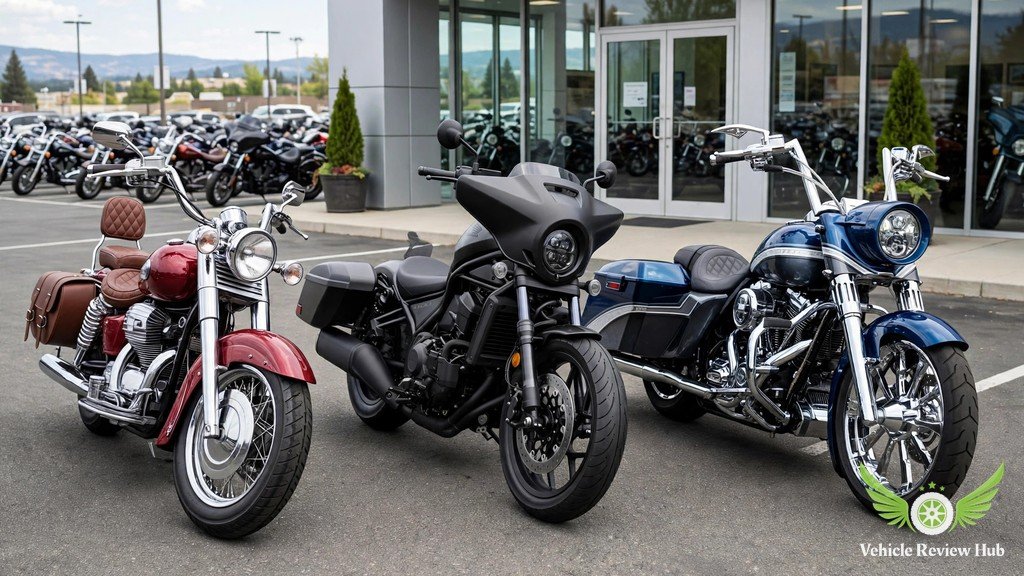
Honda Rebel 1100T vs Indian Super Scout and Triumph Speedmaster
For Honda Rebel 1100T performance, the price gap is the headline. The 2026 T manual costs $10,899 plus $775 destination, while the 2026 Indian Super Scout starts at $16,999 plus $725 destination — about $6,050 more out the door before taxes and fees — for a 1,250cc V-twin making 105 horsepower. The Triumph Speedmaster, at $14,795 for 2026 with a 1,200cc twin making 77 horsepower, sits between them: $3,896 more than the T manual on MSRP, with less power than the Honda’s dyno-verified 78.9 rear-wheel horsepower. On Honda Rebel 1100T performance alone, the T’s case is that it is the quickest-handling, lightest, and cheapest of the three, with the only automatic gearbox. Full pricing and used values are covered in the companion Rebel 1100T buying guide.
Is the Honda Rebel 1100T Suitable for Touring and Daily Riding?
For Honda Rebel 1100T performance, the touring answer is yes, with the fuel tank as the main condition. The 35-litre locking hard bags (16/19 litres per RevZilla’s measurement) swallow a long weekend’s gear, the batwing fairing takes the edge off highway wind below 75 mph, and cruise control is standard. The daily answer is also yes: the 59.8-inch wheelbase and light steering make city riding easy, the DCT removes traffic stress, and the low seat flatters shorter riders — though RevZilla warned that anyone over six feet will find the cockpit too compact. Long-term costs and service intervals are covered in the companion Rebel 1100T reliability guide. For a rider whose weekends mean canyon roads and whose touring means a long day rather than a long week, the T’s limits rarely bite, and Honda Rebel 1100T performance suits both jobs better than any traditional bagger near its price.
Honda Rebel 1100T Performance FAQs
Direct answers to the most common questions about Honda Rebel 1100T performance, covering power, acceleration, top speed, fuel economy, handling, braking, and rivals.
How much horsepower does the Honda Rebel 1100T make?
On Cycle World’s dyno, the 2025 manual Rebel 1100T made 78.9 hp at 7,220 rpm at the rear wheel. The UK claim of 87 hp is a crankshaft figure, and Honda USA publishes no power figure. Understanding that gap is key to Honda Rebel 1100T performance.
What is the Honda Rebel 1100T 0-60 time?
No instrumented 0-60 test of the T has been published by a major outlet. The standard DCT’s 3.92-second comparison figure is standard-bike data, not a T figure. That absence defines Honda Rebel 1100T performance honestly.
What is the top speed of the Honda Rebel 1100T?
Around 100 mph, electronically limited, with the limiter intervening at 6,000 rpm in sixth gear on the T test bike. Higher aggregator figures are estimates, not measurements, and Honda publishes no top-speed figure. For Honda Rebel 1100T performance, the limiter is the whole top-speed story.
What MPG does the Honda Rebel 1100T get?
Rider’s 2023 DCT touring test averaged 46.4 mpg for about 167 miles of range. RevZilla’s 2026 manual test averaged 145 miles between fill-ups over 850 miles, implying about 40 mpg by arithmetic. Plan on 40–46 mpg depending on pace for Honda Rebel 1100T performance.
Is the 46.4 MPG figure for the standard Rebel 1100?
No. That figure comes from Rider’s test of the 1100T touring model, which averaged 46.4 mpg for about 167 miles of range. It is touring-model data at a touring pace, not a standard-bike result. Labelling T data correctly keeps Honda Rebel 1100T performance honest.
How far can a Honda Rebel 1100T go on a tank?
Plan fuel stops at 130 to 145 miles. The tank holds 3.6 gallons including a 1.1-gallon reserve, so the low-fuel light leaves roughly 40 miles of grace at touring pace. That small tank shapes Honda Rebel 1100T performance on long days.
Does the Honda Rebel 1100T have cornering ABS?
No. The bike has two-channel, non-lean-sensitive ABS and no inertial measurement unit, so no cornering ABS or lean-sensitive traction control. That honesty about electronics matters for Honda Rebel 1100T performance.
Is the Honda Rebel 1100T good for touring?
Yes, with conditions: the 35-litre locking bags and batwing fairing make it a genuine light tourer, but the 3.6-gallon tank sets a 130–145-mile fuel rhythm, and wind protection above 75 mph disappoints. The T exists because Honda Rebel 1100T performance alone does not make a tourer — the luggage and fairing complete it.
Is the Honda Rebel 1100T suitable for daily riding?
Yes. A low seat, light steering, and an available DCT make it easy in traffic, and the bags swallow daily gear. Riders over six feet should test-ride first: RevZilla found the cockpit too compact for taller riders. That combination is why Honda Rebel 1100T performance suits daily riding.