Short answer: Honda Rebel 300 performance is modest, honest, and exactly right for its job. The 286cc liquid-cooled single puts a Cycle World-measured 25.01 horsepower to the rear wheel, reaches 60 mph in 7.85 seconds, and tops out at an indicated 91 mph — while returning a tested 57.8 mpg worth roughly 173 miles from its small 3.0-gallon tank. Honda Rebel 300 performance will not thrill an experienced rider, but it will carry a new rider through city traffic, back roads, and short highway hops without intimidation.
The key distinction in Honda Rebel 300 performance is between what Cycle World measured and what Honda claims — and this guide uses the measured figure for comparisons.
Honda Rebel 300 Engine Performance and Power Delivery
Honda Rebel 300 performance starts with one of the friendliest engines Honda sells in the United States: a 286cc liquid-cooled single with double overhead cams, four valves, programmed fuel injection, and a counterbalancer. Refined since the 2017 relaunch, its smooth, forgiving character matters more than its peak output.
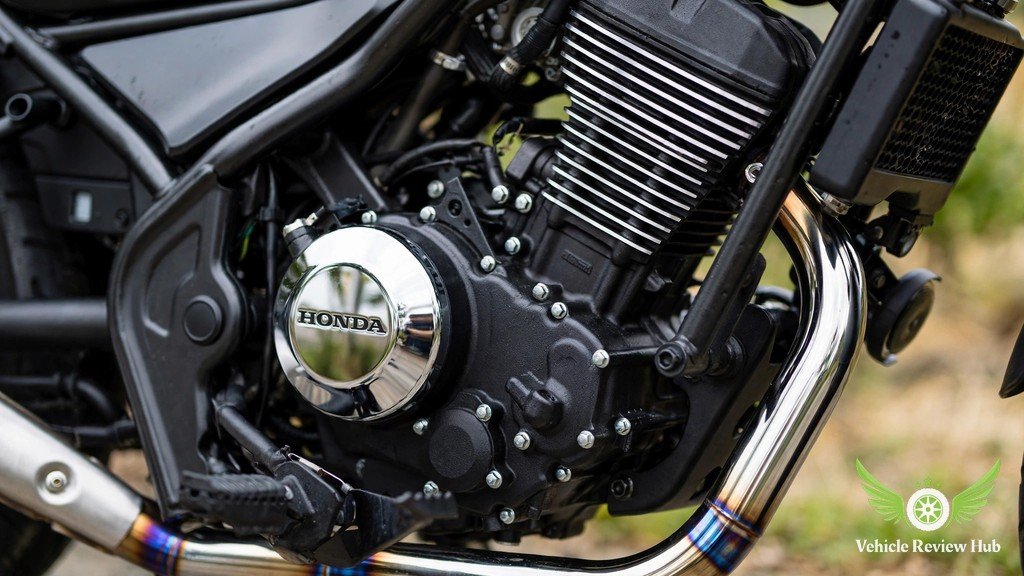
Cycle World Dyno 25.01 HP at 7,640 RPM and 17.59 lb-ft at 7,320 RPM
The most trustworthy power figures for Honda Rebel 300 performance come from Cycle World’s 2021 Rebel 300 ABS test on its Dynojet 250i rear-wheel dynamometer: 25.01 horsepower at 7,640 rpm and 17.59 pound-feet of torque at 7,320 rpm. Rear-wheel numbers run lower than crankshaft claims because the gearbox, chain, and tire absorb power first. Honda’s own materials claim roughly 27 horsepower and 27 Nm (19.9 pound-feet) at the crankshaft; the gap is drivetrain loss and measurement method. The curve shape matters as much as the peak for Honda Rebel 300 performance: Cycle World noted a roughly 10 percent midrange dip before torque climbs to its late peak at 7,320 rpm, then falls toward the 10,400-rpm rev limiter. In practice the Rebel 300 pulls cleanly from low revs, feels flat midrange, and sings toward the top.
| Figure | Value | Source |
|---|---|---|
| Rear-wheel power | 25.01 hp at 7,640 rpm | Cycle World dyno |
| Rear-wheel torque | 17.59 lb-ft at 7,320 rpm | Cycle World dyno |
| Crankshaft claim | About 27 hp / 19.9 lb-ft | Honda claim, not a US measurement |
Six-Speed Gearbox, Slipper Clutch to 2025 and E-Clutch From 2026
For Honda Rebel 300 performance in everyday riding, the six-speed gearbox matters as much as the engine. First gear suits clean launches and slow-speed maneuvering, while sixth is a genuine cruising gear. Honda fitted an assist-and-slipper clutch from the 2020 update onward, lightening the lever and preventing rear-wheel hop on aggressive downshifts — a real benefit for new riders still learning rev-matching. For 2026, Honda replaced the conventional clutch with its E-Clutch system on the only Rebel 300 sold in the United States, the Rebel 300 E-Clutch at $5,349 plus $600 destination. The E-Clutch lets the rider shift without touching the clutch lever, and acts as a quick-shifter for clutchless full-throttle changes, while still allowing fully manual clutch control. For Honda Rebel 300 performance, the E-Clutch is a beginner aid rather than a performance upgrade: it removes stalling anxiety at launch and in traffic, but it does not add power. One honest caveat: the E-Clutch is new to the 300 for 2026, so no long-term reliability record exists for it yet.
Honda Rebel 300 Top Speed and Acceleration
Honda Rebel 300 performance at the top end is where expectations need the most adjustment. a 364- to 379-pound cruiser with roughly 25 rear-wheel horsepower pushing an upright rider through the air, and physics sets a firm ceiling. Cycle World’s instrumented testing gives the only trustworthy acceleration numbers for Honda Rebel 300 performance, and they are respectable for the class without being quick in any absolute sense.
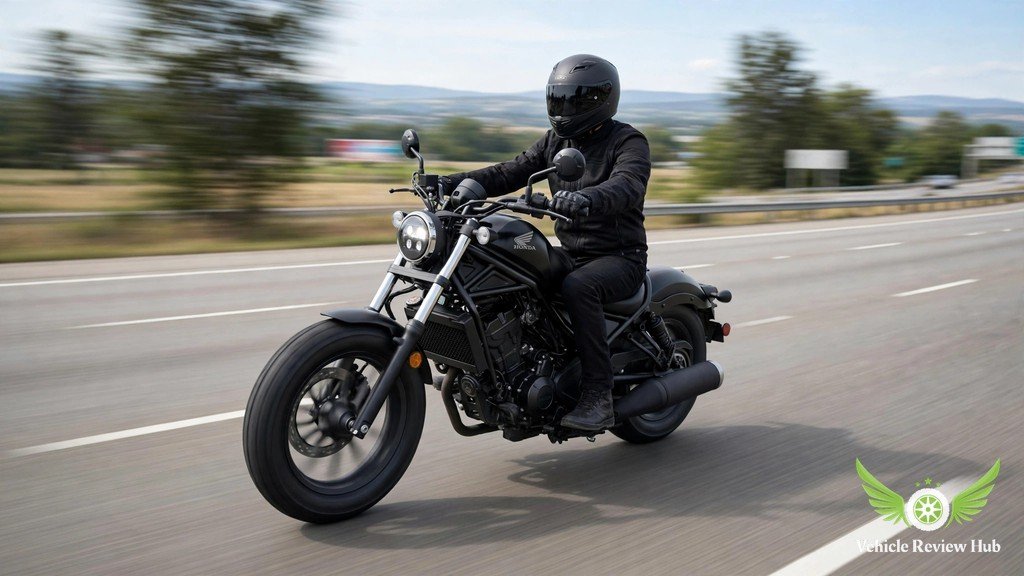
Cycle World Tested 0-60 in 7.85 Seconds and Quarter Mile in 16.53 Seconds
Cycle World’s 2021 test recorded a 0-60 mph time of 7.85 seconds and a quarter-mile time of 16.53 seconds at 75.93 mph for Honda Rebel 300 performance. Those numbers put the Rebel 300 ahead of most economy cars off the line, as Cycle World noted, and ahead of its closest cruiser rival in the same comparison test. For a new rider, 7.85 seconds to 60 mph means freeway merging is possible but not relaxed: brisk to about 40 mph, then tapering as drag builds. The quarter-mile trap speed of 75.93 mph tells the same story as the top-speed figure below: the Rebel 300 runs out of steam in the mid-70s to low-80s.
Highest Speed Seen 91 MPH on the Speedometer and No GPS Test Exists
During its 2021 test, Cycle World saw a high of 91 mph indicated on the Rebel 300’s LCD dash — stated exactly as Cycle World did: indicated, not GPS-verified. No major United States outlet has published a GPS-verified top speed for Honda Rebel 300 performance, and motorcycle speedometers commonly read a few percent optimistic, so the true figure is almost certainly below 91. Other outlets have seen less: TopSpeed’s 2023 test bike reached 86 mph. The honest range is therefore roughly 86 to 91 mph indicated, with the true GPS figure unmeasured and likely in the mid-80s. That keeps up with California freeway traffic, as Cycle World put it, with a small reserve for passing — but not enough for comfortable sustained riding at 80 mph, where the engine is near its limit and wind blast becomes tiring. Any website quoting a precise GPS top speed for Honda Rebel 300 performance is inventing a test that does not exist.
Honda Rebel 300 Mileage and Fuel Economy
If top speed is the Rebel 300’s weakest suit, Honda Rebel 300 performance in fuel economy is one of its strongest. A tiny 286cc single and a 364- to 379-pound curb weight mean the bike sips fuel, with respectable range despite a tank of only 3.0 gallons. The confusion in Honda Rebel 300 performance fuel figures comes from three numbers that all circulate online, and this section separates them.

Cycle World Tested 57.8 MPG Average and Around 173 Miles per Tank
Cycle World’s test recorded an average of 57.8 mpg in real-world riding for Honda Rebel 300 performance. Multiplied by the 3.0-gallon tank, that gives about 173 miles per tank — this guide’s planning number. The tank includes a 0.6-gallon reserve, so plan fuel stops at roughly 170 miles and treat anything beyond that as reserve riding. Context matters: Cycle World’s test loop mixed city streets, back roads, and freeway stretches, including full-throttle acceleration testing — harder-than-average use rather than gentle commuting.
Old 78 MPG Honda Estimate vs 71 MPG Reports: Which Figure to Trust
The 78 mpg figure attached to Honda Rebel 300 performance is Honda’s estimated fuel consumption — an estimate, not a measured test result. The roughly 71 mpg figure comes from the other direction: owner-reported data, including Fuelly logs summarized in owner comparisons putting Rebel 300 owners at about 72 mpg on average, and beginner-bike guides reporting owners seeing up to 71 mpg with easy cruising. So which figure should a buyer trust? Use Cycle World’s 57.8 mpg for mixed riding, the low-70s owner band for gentle commuting, and Honda’s 78 mpg as the optimistic ceiling only. The practical advice is simple: plan fuel stops at 170 miles, expect 200-plus miles on a gentle tank, and do not plan a 234-mile leg on Honda’s estimate.
Honda Rebel 300 Real-World Riding Performance
Honda Rebel 300 performance is best judged where the bike actually spends its time: town streets, back roads, and short highway hops. It is light, low, narrow, and easy to balance at walking speed, with power delivery that flatters new riders instead of intimidating them.

City Riding, Traffic Performance and Everyday Acceleration
Around town, Honda Rebel 300 performance feels right-sized: the 27.2-inch seat lets most riders put both feet flat at stops, the low center of gravity makes U-turns effortless, and the smooth low-end torque pulls away from traffic lights without drama. Cycle World noted the engine can be ridden a gear high without bucking — a forgiving trait for a new rider still learning clutch control. Everyday acceleration for Honda Rebel 300 performance is adequate up to about 45 mph, covering nearly all urban traffic, and the narrow profile and upright position make it easy to see over cars in congestion. For commuting, Honda Rebel 300 performance is genuinely pleasant — light, cheap to run, and easy to park anywhere.
Highway Riding With Minimal Reserve and Long-Distance Limitations
On the highway, the honest assessment of Honda Rebel 300 performance is that the bike is capable but has minimal reserve: it will hold 65 to 70 mph on flat ground, and Cycle World’s testers kept up with California freeway traffic with a small amount of power in reserve for passing. But that reserve is small: above 75 mph the engine works hard and the unfaired riding position means the rider takes the full wind blast. The video below tests exactly this question — a Rebel 300 MPG and highway test asking whether the little cruiser can keep up — worth watching before judging Honda Rebel 300 performance on highway ability, since it shows real freeway speeds rather than a spec sheet.
Long-distance limitations follow directly: the 3.0-gallon tank means fuel stops every 170 to 210 miles, the soft rear suspension bottoms on larger bumps when loaded, and there is no wind protection, cruise control, or luggage beyond what the rider straps on. A 200-mile day is comfortable; a 400-mile day is not. Buyers who regularly ride long highway distances should step up to a larger bike; buyers whose highway use is a short hop between towns will find Honda Rebel 300 performance entirely adequate.
Honda Rebel 300 Handling, Braking and Stability
In corners and under braking, Honda Rebel 300 performance comes from a chassis that favors stability and forgiveness over precision. The steel diamond-type frame, low center of gravity, and 58.7-inch wheelbase give a planted, easygoing character, with deliberately simple suspension: a 41mm telescopic fork up front and twin shocks at the rear. That simplicity is the right trade — but Honda’s own published suspension figures disagree with each other, and this section says so plainly.

41mm Fork Travel Conflict on Honda Pages, Shocks, Tires and Cornering
Here is the conflict in Honda Rebel 300 performance suspension figures, stated plainly rather than resolved by silently picking one number. Honda’s 2025 specification page lists the 41mm fork with 4.8 inches of travel and dual rear shocks at 3.7 inches. Honda’s 2026 Rebel 300 E-Clutch specification material lists the same 41mm fork with 5.5 inches of travel, with the rear shocks still at 3.7 inches. Earlier pages add a third wrinkle: the 2022 specification summary lists 4.8 inches up front but 3.8 inches at the rear. Honda has not explained the change as a hardware revision, and fork diameter, rake (28 degrees), trail (4.3 inches), and wheelbase are unchanged across those pages — so check the specification sheet for the exact year you are buying. Ride character does not change: the fork is non-adjustable, the rear shocks are preload-adjustable only, and Cycle World found the rear shocks bottom on larger bumps while small-bump compliance stays good. Tires are 130/90-16 front and 150/80-16 rear on cast aluminum wheels, and cornering for Honda Rebel 300 performance is neutral and predictable at moderate lean, with cruiser-limited ground clearance (5.9 inches) setting the lean limit before the tires do.
296mm Front Disc, 60-0 Braking in 141.3 Feet and ABS by Model Year
Braking is a genuine strength of Honda Rebel 300 performance: a Nissin caliper grips a single 296mm front disc and a single 240mm rear disc, and Cycle World recorded 141.3 feet from 60 mph to zero and 35.27 feet from 30 mph to zero, beating the Meteor 350 in the same comparison. ABS history matters for Honda Rebel 300 performance buyers because it changed by year: ABS was a $300 option from 2017 through 2024 (2021: $4,599/$4,899 ABS; 2022: $4,699/$4,999 ABS; 2024: $4,849/$5,149 ABS), disappeared for 2025 (non-ABS only, model codes CMX300/CMX300S at $4,849 — no ABS variant was sold, so check the model code before paying any ABS premium), and became standard for 2026 on the E-Clutch model at $5,349 plus $600 destination. That year-by-year ABS story is the single most important specification check for a used Rebel 300 shopper.
Honda Rebel 300 Performance Compared With Other Beginner Cruisers
Honda Rebel 300 performance looks different depending on what it is compared with, so this section puts the bike against its two closest beginner-cruiser rivals on verified figures with year-scoped prices. The Rebel 300 is the cheapest and lightest of the three — and it gives up displacement and highway comfort to do it.

Honda Rebel 300 vs Kawasaki Eliminator and Royal Enfield Meteor 350
Against the Kawasaki Eliminator, Honda Rebel 300 performance is smaller, simpler, and cheaper. The 2026 Eliminator starts at $6,499 with a 451cc liquid-cooled parallel twin — roughly $1,150 more than the Rebel 300 E-Clutch’s $5,349 before destination — with genuinely stronger acceleration and highway passing power, while the Rebel 300 counters with a lower seat and lighter weight. Against the Royal Enfield Meteor 350, the comparison for Honda Rebel 300 performance is closer: the 2026 Meteor 350 starts at $4,899, undercutting the Rebel 300 E-Clutch by $450, but Cycle World’s 2021 comparison test showed the Honda making more power (25.01 hp against the Meteor’s 17.9 hp) while the Meteor delivered more low-end torque (18.2 pound-feet at 2,800 rpm against the Honda’s 17.59 at 7,320 rpm). The Meteor is also heavier (421 pounds against the Rebel’s 372) but carries a larger 4.0-gallon tank. In short: the Meteor feels torquier off the line and goes farther per tank, while the Rebel 300 is quicker, lighter, and stops shorter — the Meteor 350 remains the value pick on sticker price alone, but the Rebel 300 wins the instrumented comparison.
| Model (2026) | Engine | Price | Seat height | Tank |
|---|---|---|---|---|
| Honda Rebel 300 E-Clutch | 286cc single, E-Clutch | $5,349 + $600 destination | 27.2 in | 3.0 gal |
| Kawasaki Eliminator | 451cc parallel twin | From $6,499 | 28.9 in | 3.4 gal |
| Royal Enfield Meteor 350 | 349cc single | $4,899 | 30.1 in | 4.0 gal |
| The Rebel 300 is the lightest of the three and the only one with an electronic clutch. | ||||
Is the Honda Rebel 300 Suitable for New Riders and Daily Riding?
For new riders, Honda Rebel 300 performance is close to ideal: a 27.2-inch seat, 364 to 379 pounds depending on year, gentle predictable power, a light clutch (or automatic, on the 2026 E-Clutch), and the lowest price of any Honda cruiser. A new rider can learn clutch control, shifting, braking, and balance without fighting the bike. The Rebel 300 review walks through the 2020 LED and slipper-clutch update that still shapes this bike. For daily riding, it suits commutes of city streets and short highway hops: fuel costs are trivial and parking is easy. It suits daily riding less well when the commute is a long high-speed freeway run, where the small tank, wind blast, and minimal reserve become daily annoyances. The honest verdict for Honda Rebel 300 performance: one of the best beginner and commuter motorcycles sold in the United States — provided the buyer’s riding fits inside its envelope.
Frequently Asked Questions About Honda Rebel 300 Performance
These direct answers cover the Honda Rebel 300 performance questions buyers ask most often — horsepower, top speed, fuel range, highway ability — using the same figures as the main guide.
How much horsepower does the Honda Rebel 300 make?
Cycle World measured 25.01 horsepower at 7,640 rpm at the rear wheel on a 2021 Rebel 300 ABS for Honda Rebel 300 performance. Honda claims roughly 27 horsepower at the crankshaft.
What is the 0-60 time of the Honda Rebel 300?
Cycle World tested 0-60 mph in 7.85 seconds for Honda Rebel 300 performance, with a quarter-mile time of 16.53 seconds at 75.93 mph.
What is the top speed of the Honda Rebel 300?
The highest speed seen in testing for Honda Rebel 300 performance is 91 mph indicated on the LCD dash. No GPS-verified top-speed test exists, and other outlets have seen around 86 mph.
What is the real fuel economy of the Honda Rebel 300?
Cycle World averaged 57.8 mpg in testing for Honda Rebel 300 performance, worth about 173 miles from the 3.0-gallon tank. Gentle owners report around 71-72 mpg, worth about 213 miles.
Is Honda’s 78 mpg figure realistic?
For Honda Rebel 300 performance, 78 mpg is Honda’s estimate, not a test result. Treat it as an optimistic ceiling: plan fuel stops at 170 miles, expecting 200-plus miles only with gentle riding.
Does the Honda Rebel 300 have a slipper clutch or E-Clutch?
Both, by year: Honda Rebel 300 performance models used an assist-and-slipper clutch from the 2020 update through 2025, and the 2026 model uses Honda’s E-Clutch, shifting without the clutch lever.
Does the Honda Rebel 300 have ABS?
For Honda Rebel 300 performance, ABS was a $300 option through 2024, was not offered for 2025 (non-ABS only, model codes CMX300/CMX300S), and it is standard on the 2026 Rebel 300 E-Clutch. Check the model code on any pre-2026 bike before paying an ABS premium.
How far can the Honda Rebel 300 go on a tank?
About 173 miles on Cycle World’s tested 57.8 mpg for Honda Rebel 300 performance, or about 213 miles at owner-reported 71 mpg, from the 3.0-gallon tank with a 0.6-gallon reserve.
Is the Honda Rebel 300 good on the highway?
Adequate for short highway hops at 65 to 70 mph but marginal for sustained high-speed freeway riding, where Honda Rebel 300 performance has minimal reserve and no wind protection.
Is the Honda Rebel 300 good for beginners?
Yes, Honda Rebel 300 performance makes it one of the best beginner motorcycles available: a 27.2-inch seat, 364- to 379-pound weight, gentle predictable power, and the lowest price of any Honda cruiser.