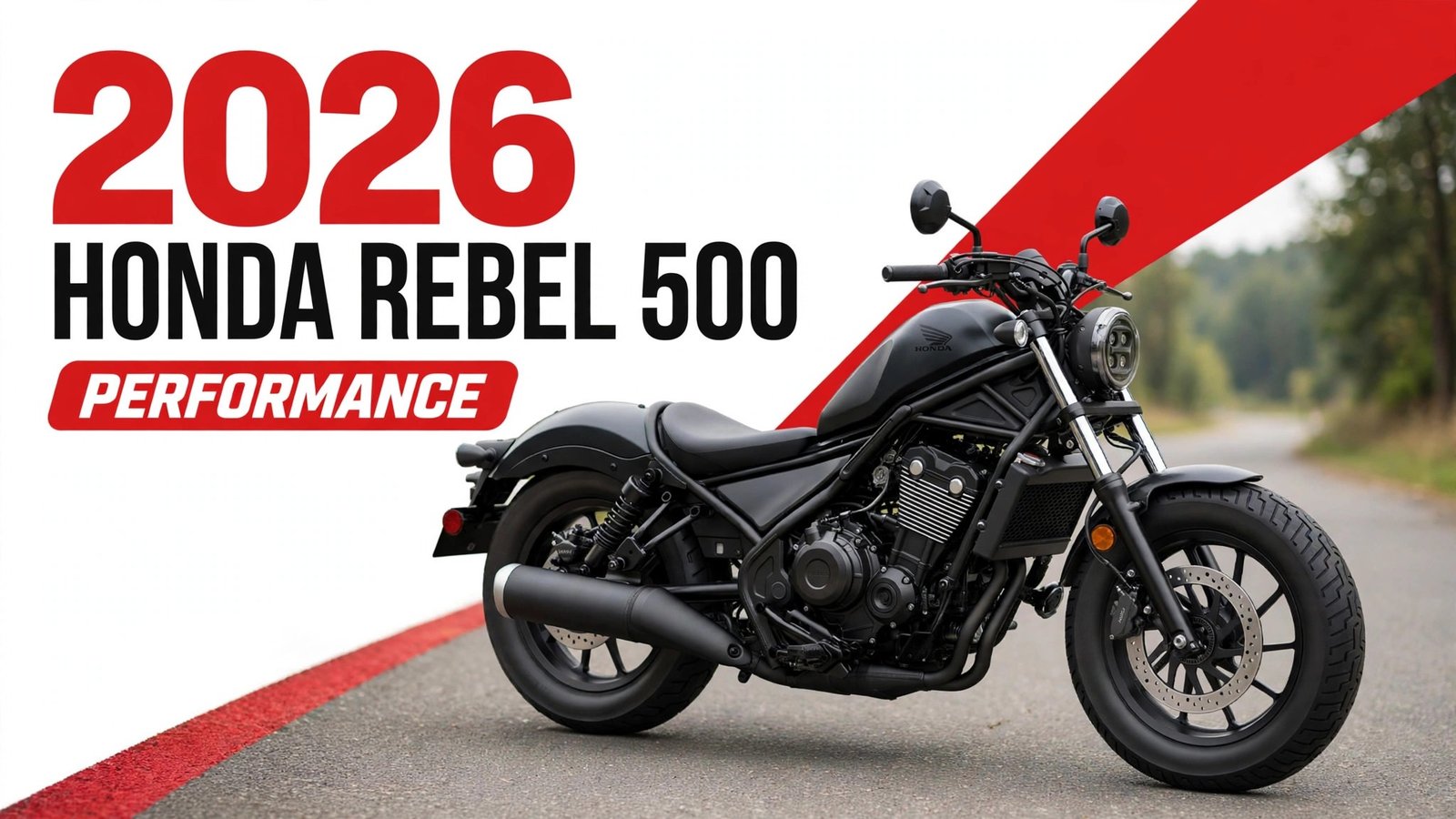
Short version first: Honda Rebel 500 performance is friendly, honest, and deliberately unintimidating. On Cycle World’s dyno, a 2020 Rebel 500 made 40.83 horsepower at 7,880 rpm at the rear wheel, while Honda’s European claim of 46 horsepower is a crankshaft figure, not a wheel figure. Rider Magazine’s road test recorded 49.2 mpg on average, 64.3 best, 43.1 worst, working out to roughly 148 miles from the 3.0-gallon tank. There is no verified instrumented 0-60 mph or quarter-mile time from a major American outlet, and the often-quoted 95 to 105 mph top speed is an estimate from owner reports, not a measured test. None of that makes Honda Rebel 500 performance slow where it matters: its 471cc twin pulls cleanly from just above 2,000 rpm and cruises happily at 65 to 75 mph.
Honda Rebel 500 Engine Performance and Power Delivery
The engine is the whole story of Honda Rebel 500 performance: the same 471cc liquid-cooled parallel twin used across Honda’s 500 lineup, retuned for cruiser duty with revised fuel-injection mapping and Rebel-specific valve and ignition timing, trading top-end fireworks for low-end and midrange muscle.
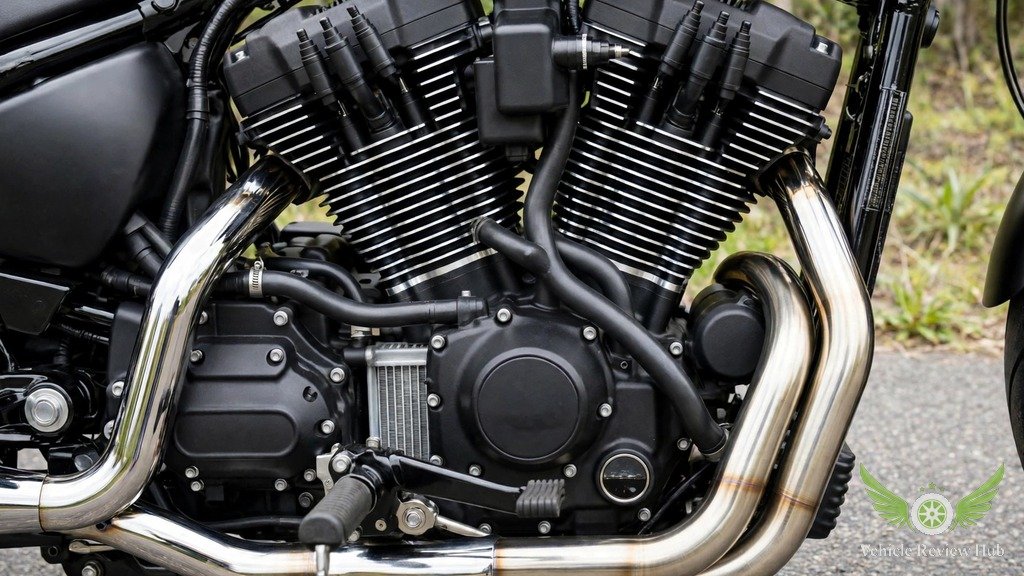
Cycle World Dyno 40.83 HP at 7,880 RPM and EU Claim 46 HP Explained
In this Honda Rebel 500 performance guide, Cycle World ran a 2020 Honda Rebel 500 on its in-house dyno and recorded 40.83 horsepower at 7,880 rpm and 29.91 pound-feet of torque at 6,300 rpm at the rear wheel. That is the number to quote for Honda Rebel 500 performance, because it is a measured wheel figure, not a brochure claim. More useful than the peak is the curve: about 26 pound-feet is available just above 2,000 rpm, with torque broad and flat through the midrange.
The 46 horsepower figure in European specifications is a different kind of number. Honda’s European material lists 34.0 kW, or 46.2 PS (45.6 hp), at 8,500 rpm, with 43.3 Nm (31.9 pound-feet) at 6,000 rpm. Those are crankshaft claims, and Cycle World’s 40.83 rear-wheel horsepower sits about 11 percent below them, a normal driveline loss. Honda’s American site publishes no horsepower figure at all: compare wheel figures with wheel figures and crank claims with crank claims. Cycle World’s full report is published in its test of how much power the 2020 Honda Rebel 500 makes.
Six-Speed Gearbox, Slipper Clutch and Torque Delivery
The six-speed gearbox is a quiet contributor to Honda Rebel 500 performance. Ratios are spaced for relaxed cruising, with sixth dropping the revs for highway cruising without making the engine feel flat. Drive reaches the rear wheel through an O-ring chain (15-tooth front, 40-tooth rear), and the cruiser tuning pulls willingly from low revs even in a taller gear. The assist-and-slipper clutch, added in 2020, lightens lever pull in traffic and keeps the rear tire settled on downshifts; pre-2020 bikes used a heavier conventional clutch. One honest gap: with no tachometer, only a simple round LCD display, you judge revs by sound and feel, and vibration above 6,000 rpm signals you are revving it out.
Honda Rebel 500 Top Speed and Acceleration
Straight-line speed needs the most careful reading in Honda Rebel 500 performance: online numbers look precise but are not test results, and Honda publishes no top speed for this bike.
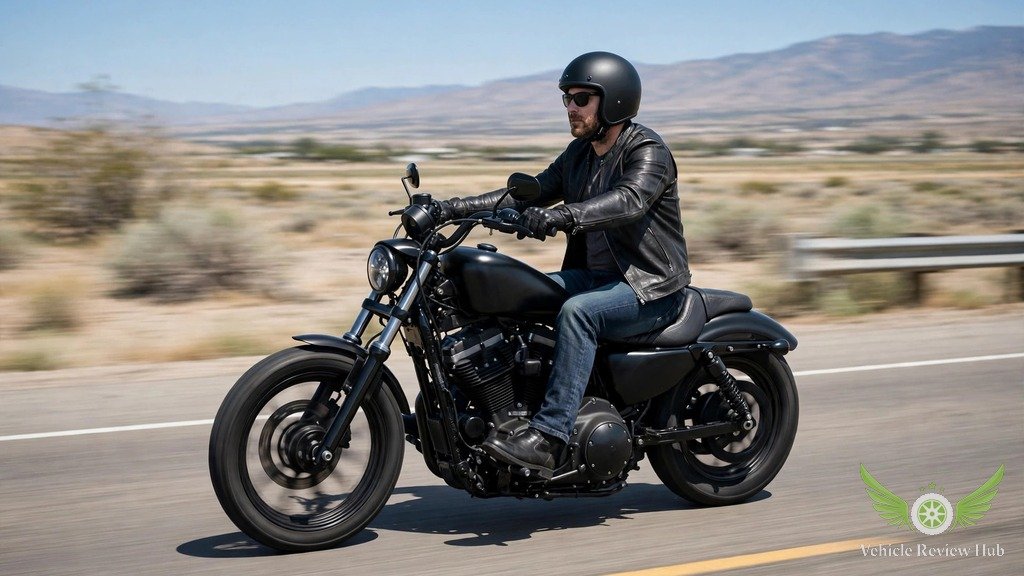
Why No Instrumented 0-60 or Quarter Mile Test Could Be Verified
In this Honda Rebel 500 performance guide, we searched Cycle World, Rider Magazine, and Motorcycle.com for an instrumented 0-60 mph or quarter-mile figure, and we could not verify one. Cycle World publishes dyno numbers but no acceleration runs, and Rider’s 2020 road test publishes no timed acceleration. Two figures circulate on secondary websites, both to be treated with caution: one enthusiast site quotes roughly 4.8 seconds to 60 mph with no test named, and an Indian specification site lists about 5.9 seconds for 0-100 km/h with no test behind it. The two disagree by more than a second, which is what happens when figures are estimated rather than measured. Until a major outlet publishes an instrumented run, the honest statement is that straight-line Honda Rebel 500 performance is quick enough for city traffic and highway merging, but its 0-60 and quarter-mile times are unverified.
Top Speed Around 95 to 105 MPH Labelled as Estimates, Not Tests
In this Honda Rebel 500 performance guide, the top speed band of 95 to 105 mph is an estimate, and it should always be labelled as one. It comes from owner reports, not a GPS-verified test: most owners report about 90 to 98 mph, with some claiming brief runs slightly above 100 mph downhill or with a tailwind. One secondary page claims 109 mph from a 2025 specification sheet, but no Honda publication we could check lists a top speed, so that figure is unverified. Physics supports the owner band: about 41 horsepower at the wheel, 414 pounds, and an upright rider with no windscreen mean drag grows brutally above 80 mph. What matters more is comfort: it cruises at 65 to 75 mph, holds 80 mph briefly, and above 80 mph vibration becomes the limiting factor. For Honda Rebel 500 performance, the practical conclusion is simple: enough top speed for any American highway limit, but not a bike for sustained triple-digit riding.
Honda Rebel 500 Mileage and Fuel Economy
Fuel economy is where Honda Rebel 500 performance surprises people, but only if you read the right numbers. Honda claims 67 mpg; Rider Magazine’s test averaged 49.2 mpg. The tested figure is the one to plan around.
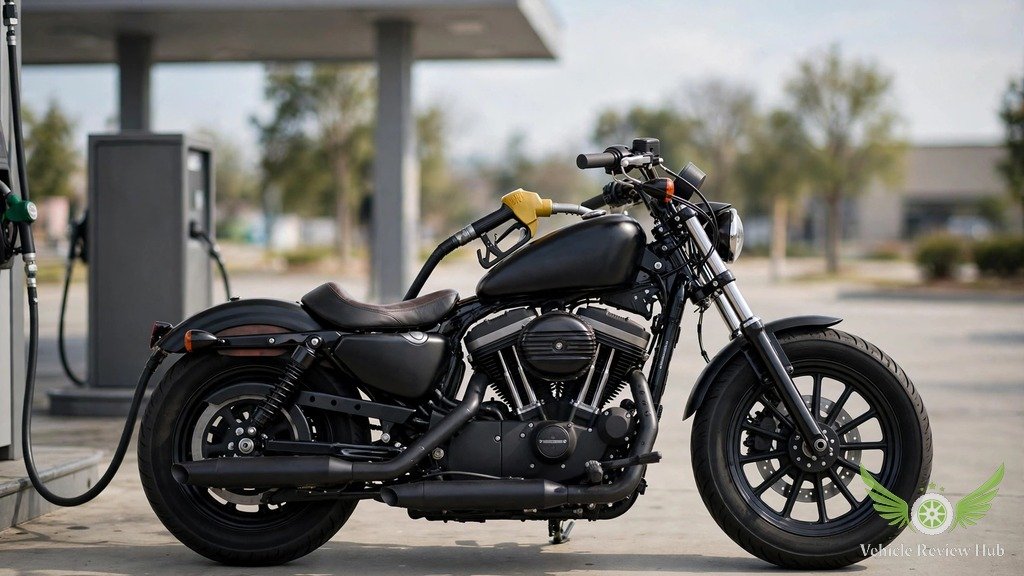
Rider Tested 49.2 MPG Average, 64.3 High and 43.1 Low Explained
Here is the provenance check in this Honda Rebel 500 performance guide, stated plainly. The figures 49.2 mpg average, 64.3 mpg high, and 43.1 mpg low come from Rider Magazine’s road test of the 2020 Honda Rebel 500 ABS, published in its specification box as fuel economy on 86-octane minimum fuel. They are genuine magazine test figures from Rider’s own test bike, not a Fuelly owner average. That distinction matters because a previous Honda outline figure labelled “Rider Tested” turned out to be a Fuelly average instead; in this case the label is accurate, and Rider’s test bike weighed 418 pounds as tested. For Honda Rebel 500 performance, these are the most trustworthy fuel numbers available.
Why does Honda claim 67 mpg while Rider averaged 49.2 mpg? Honda’s figure is a standardized-cycle estimate, close to the European WMTC figure of 3.6 liters per 100 km, roughly 65 mpg in American gallons. Rider’s 49.2 mpg covers mixed test riding; its 43.1 mpg low shows what hard riding does, and its 64.3 mpg high shows what gentle riding can achieve. Owner logs sit between the two: Fuelly data for the 2018 CMX500 Rebel averages about 56.4 mpg. The honest planning figure for Honda Rebel 500 performance is therefore a band: roughly 50 mpg mixed, more when ridden gently, less when ridden hard. Rider’s full road test is published in Rider Magazine’s 2020 Honda Rebel 500 ABS road test review.
3.0-Gallon Tank, Around 148 Miles to Empty and 120 to 130 Practical
In this Honda Rebel 500 performance guide, Honda’s current American specification page lists the Rebel 500’s fuel capacity at 3.0 gallons, or 11.2 liters. Some older sheets list 2.9 gallons, and one buying guide lists 2.96 gallons with a 0.6-gallon reserve, so a slightly different figure is a rounding difference. Rider’s test notes that the low-fuel warning light comes on with the last 0.58 gallon remaining. The arithmetic is straightforward: 49.2 mpg times 3.0 gallons gives 147.6 miles, about 148 miles to empty at the tested average. At Rider’s tested low of 43.1 mpg, the same tank gives 129.3 miles, which is where the practical 120 to 130 mile planning band comes from: plan fuel stops at around 120 miles. For everyday Honda Rebel 500 performance, the small tank is the bike’s main touring limitation, not its engine.
Honda Rebel 500 Real-World Riding Performance
Numbers tell only half the story of Honda Rebel 500 performance. On the road, the bike’s character is defined by how little effort it demands: early torque, a light clutch, a 27.2-inch seat, and 414 pounds with ABS.
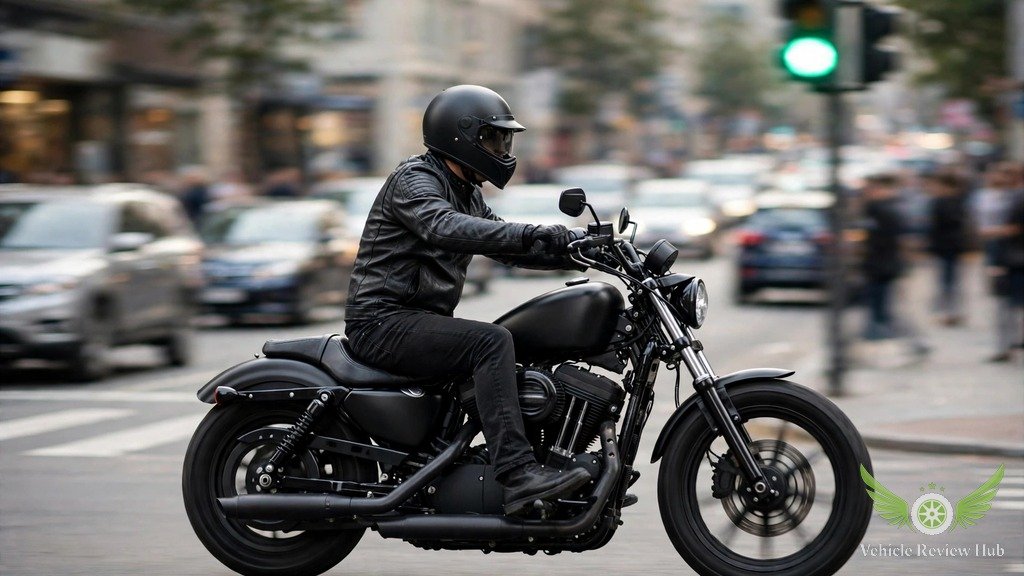
City Riding, Traffic Performance and Everyday Acceleration
In the city, Honda Rebel 500 performance feels stronger than its horsepower figure suggests. About 26 pound-feet just above 2,000 rpm means the bike pulls away from a light cleanly without a big handful of throttle, and the flat midrange makes 30 to 50 mph roll-on feel immediate. Filtering is easy because the bike is narrow, and the 414-pound weight lets a rider paddle it at walking pace without strain. The light assist clutch pays off in stop-and-go traffic, and the low seat helps at every stop because both feet reach the ground flat for most riders. The main city limitation for Honda Rebel 500 performance is only the small tank on a long commute.
Highway Riding, Overtaking Ability and Long-Distance Limitations
On the highway, Honda Rebel 500 performance is capable but clearly bounded. The bike merges confidently, holds 70 mph in sixth gear without strain, and has enough roll-on response for overtaking, though a downshift to fifth makes overtakes quicker. FortNine’s review reached a similar verdict, calling it a great city bike while declining a long highway ride, and noting engine buzz above 6,000 rpm through bars and seat. That vibration, plus the upright position with no windscreen and a firm stock seat, limits long-distance comfort more than any shortage of speed; about 90 minutes in the saddle is when the seat complains. For a 30-minute commute or a weekend ride with fuel stops every 120 miles, Honda Rebel 500 performance is genuinely good; for regular 300-mile interstate days, a larger, faired machine such as the Africa Twin is the honest alternative. The video below shows the bike’s real-road pace on quiet rural roads.
Honda Rebel 500 Handling, Braking and Stability
Handling is the quiet strength of Honda Rebel 500 performance. Its low center of gravity, short 58.7-inch wheelbase, and 28-degree rake with 4.3 inches of trail give steering that is stable without feeling slow, and the 414-pound weight means direction changes take little effort.
Fork Travel Conflict in Honda and Test Figures, Shocks and Cornering
This section names a genuine conflict in Honda Rebel 500 performance figures rather than silently picking one number. Honda’s current American pages for the 2025 and 2026 Rebel 500 list the 41mm fork with 5.5 inches of front travel and dual rear shocks with 3.7 inches. Older figures say something different: Cycle World’s tested specifications for the 2021 model list the same 41mm fork with 4.8 inches of travel, and independent summaries for the 2020 model list 121 mm (4.8 inches) front and 96 mm (3.8 inches) rear. Honda has never announced a travel change, and the 2020 update is documented as a spring-rate stiffening, not a travel change, so the two sets of figures cannot both describe the same hardware the same way. The most likely explanation is a reporting revision, but that is only an inference. This Honda Rebel 500 performance guide uses Honda’s current 5.5-inch front and 3.7-inch rear figures as headline numbers, while flagging the older figures. Honda’s current figures are on Honda Powersports’ 2026 Rebel 500 specifications page, noting that Honda’s site blocks some automated checks.
Whatever the travel figure, the suspension is consistent: non-adjustable fork, dual rear shocks with five-step preload adjustment, and a firm ride. Cornering clearance is modest, as on any low cruiser, but the chassis stays neutral at cruiser lean angles. The tires, a 130/90-16 front and a 150/80-16 rear, give a large contact patch and slow, stable steering. For Honda Rebel 500 performance, the suspension is good enough for the bike’s purpose and honest about its limits.
296mm Front and 240mm Rear Discs With ABS Features
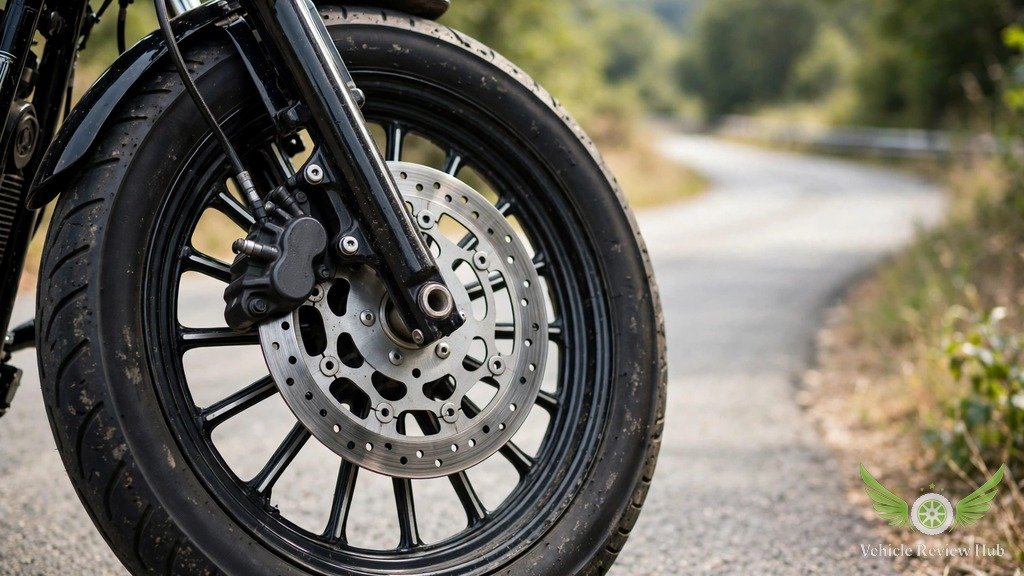
Braking comes from a single 296mm front disc gripped by a Nissin two-piston floating caliper and a single 240mm rear disc with a Nissin one-piston caliper, with two-channel ABS on ABS-equipped bikes. Cycle World’s testers described stopping power as adequate: the brakes stop the bike confidently in normal riding and emergency stops, but they lack a sportbike’s bite, and the single front disc means hard repeated braking from highway speed will fade sooner than a dual-disc setup would. ABS was a paid trim until 2025 and is standard on both 2026 trims, base and SE. For used buyers, ABS is worth seeking out: the Rebel 500 is a common first bike, and ABS matters most in a panic stop. The system has no linked braking and no cornering ABS. The brakes are one area where Honda Rebel 500 performance is entirely adequate, provided the tires are in good condition and properly inflated.
Honda Rebel 500 Performance Compared With Other Midsize Cruisers
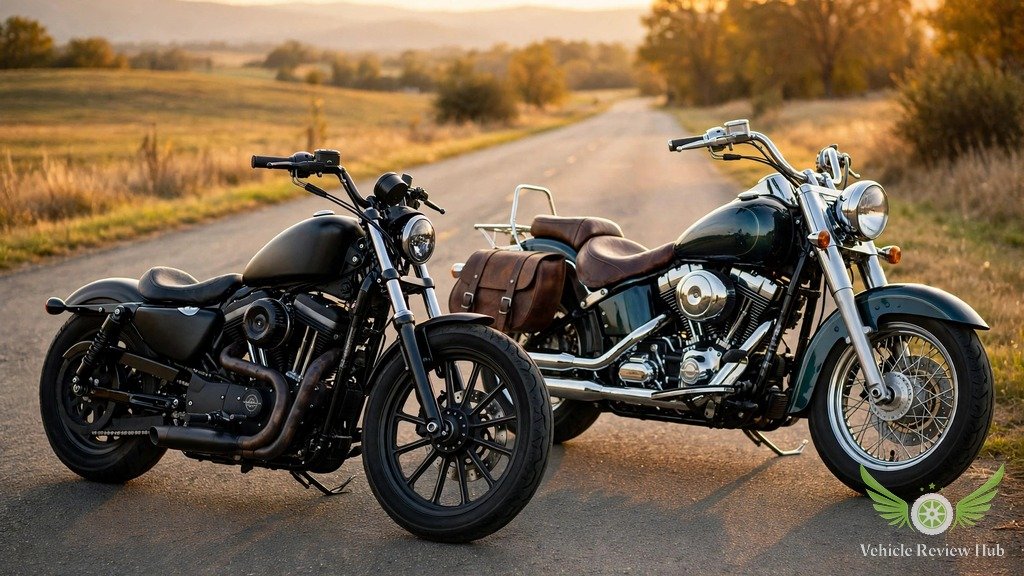
No bike exists in a vacuum, and Honda Rebel 500 performance makes most sense against two cross-shop rivals: the lighter, revvier Kawasaki Eliminator, and the bigger, heavier, more traditional Royal Enfield Super Meteor 650. The Rebel sits between them: easier and lighter than the Royal Enfield, more relaxed and lower than the Kawasaki.
Honda Rebel 500 vs Kawasaki Eliminator and Royal Enfield Super Meteor 650
The Kawasaki Eliminator is the closest Honda Rebel 500 performance rival. Its 451cc Ninja-based parallel twin is listed by Motorcycle.com at 51 horsepower at 10,000 rpm, above the Rebel’s 46 horsepower crankshaft claim, and it revs higher and harder than the Honda. But the Eliminator is lighter (385.9 pounds without ABS, 388.1 with ABS, against the Rebel’s 414), with a larger 3.4-gallon tank, a taller 28.9-inch seat, and a larger 310mm front disc. A rider who values top-end energy and a lighter feel will prefer the Eliminator; a rider who values low-end torque, a lower seat, and Honda’s dealer network will prefer the Rebel.
The Royal Enfield Super Meteor 650 plays a different game. Its 648cc parallel twin makes about 47 horsepower and 38.6 pound-feet of torque, and at 531.3 pounds wet it is more than 100 pounds heavier than the Rebel 500, with a 29.1-inch seat and a 4.15-gallon tank. For 2026 it is listed at $7,899 plus a $545 destination charge, about $1,100 above the Rebel 500’s base price, with a three-year warranty against Honda’s one-year coverage. The extra weight gives more highway stability, but it is harder to paddle around a parking lot and less forgiving for shorter or newer riders, and its weight erases much of its torque advantage in town. The table below keeps each Honda Rebel 500 performance figure’s basis explicit. Full Super Meteor specifications are published in Motorcycle.com’s 2026 Super Meteor 650 specification listing.
| Specification (2026 unless noted) | Honda Rebel 500 | Kawasaki Eliminator | Royal Enfield Super Meteor 650 |
|---|---|---|---|
| Engine | 471cc parallel twin | 451cc parallel twin | 648cc parallel twin |
| Power (basis stated) | 40.83 hp at the wheel (Cycle World dyno); 46 hp crank claim | 51 hp manufacturer spec | About 47 hp manufacturer spec |
| 2026 MSRP | $6,799 base; $6,999 SE, plus destination | $6,499; $6,799 ABS, plus $650 destination | $7,899, plus $545 destination |
Is the Honda Rebel 500 Suitable for New and Returning Riders?
For new and returning riders, Honda Rebel 500 performance is close to ideal, with two honest caveats. The case for it is strong: the 27.2-inch seat lets most riders put both feet down, the 414-pound weight is easy to manage at a stop, torque arrives early, the clutch is light, and ABS is now standard. In Europe the same bike is sold as the CMX500, simply the Rebel 500’s model code, and its 35 kW output makes it A2-licence friendly there. The caveats are the missing tachometer, forcing new riders to learn revs by ear and vibration, and the firm seat and wind exposure, which punish long highway days. Returning riders will find the Rebel 500 familiar and forgiving, while experienced riders wanting a second bike for city use will find it competent but eventually limiting on power.
Honda Rebel 500 Performance: Frequently Asked Questions
These Honda Rebel 500 performance FAQs collect the direct answers from this guide: tested numbers, estimates, and practical limits of Honda Rebel 500 performance.
What is the Honda Rebel 500 performance dyno figure?
40.83 horsepower at 7,880 rpm and 29.91 pound-feet at 6,300 rpm at the rear wheel (Cycle World, 2020 model).
Why is the European claim 46 hp?
The 46 hp figure is a crankshaft claim; Honda Rebel 500 performance at the wheel runs about 11 percent lower.
What is the Honda Rebel 500 performance 0-60 time?
No instrumented test from a major outlet could be verified, so any precise figure quoted online is an estimate.
What is the top speed?
Honda Rebel 500 performance tops out at an estimated 95 to 105 mph based on owner reports, not a GPS-verified test.
What is the real-world Honda Rebel 500 performance fuel economy?
Rider’s test recorded 49.2 mpg average, 64.3 best, and 43.1 worst on its 2020 test bike.
How far does a tank go?
About 148 miles to empty at the tested average; plan on 120 to 130 practical miles for Honda Rebel 500 performance.
Is Honda Rebel 500 performance good for beginners?
Yes. Early torque, a light clutch, a 27.2-inch seat, and standard 2026 ABS make it forgiving and confidence-inspiring.
Is the Rebel 500 good on the highway?
On highways, Honda Rebel 500 performance cruises comfortably at 65 to 75 mph, but vibration and wind exposure limit long days.
What is the Honda Rebel 500 performance fork travel conflict?
Current Honda pages list 5.5 inches front and 3.7 rear; older figures list 4.8 front and 3.8 rear, with no announced change.
Does the Rebel 500 have ABS?
Yes. Honda Rebel 500 performance braking uses 296mm front and 240mm rear discs, with ABS standard on both 2026 trims.
How does Honda Rebel 500 performance compare with the Eliminator?
The Eliminator revs higher and weighs less, while the Rebel offers stronger low-end torque, a lower seat, and a lower ABS price.