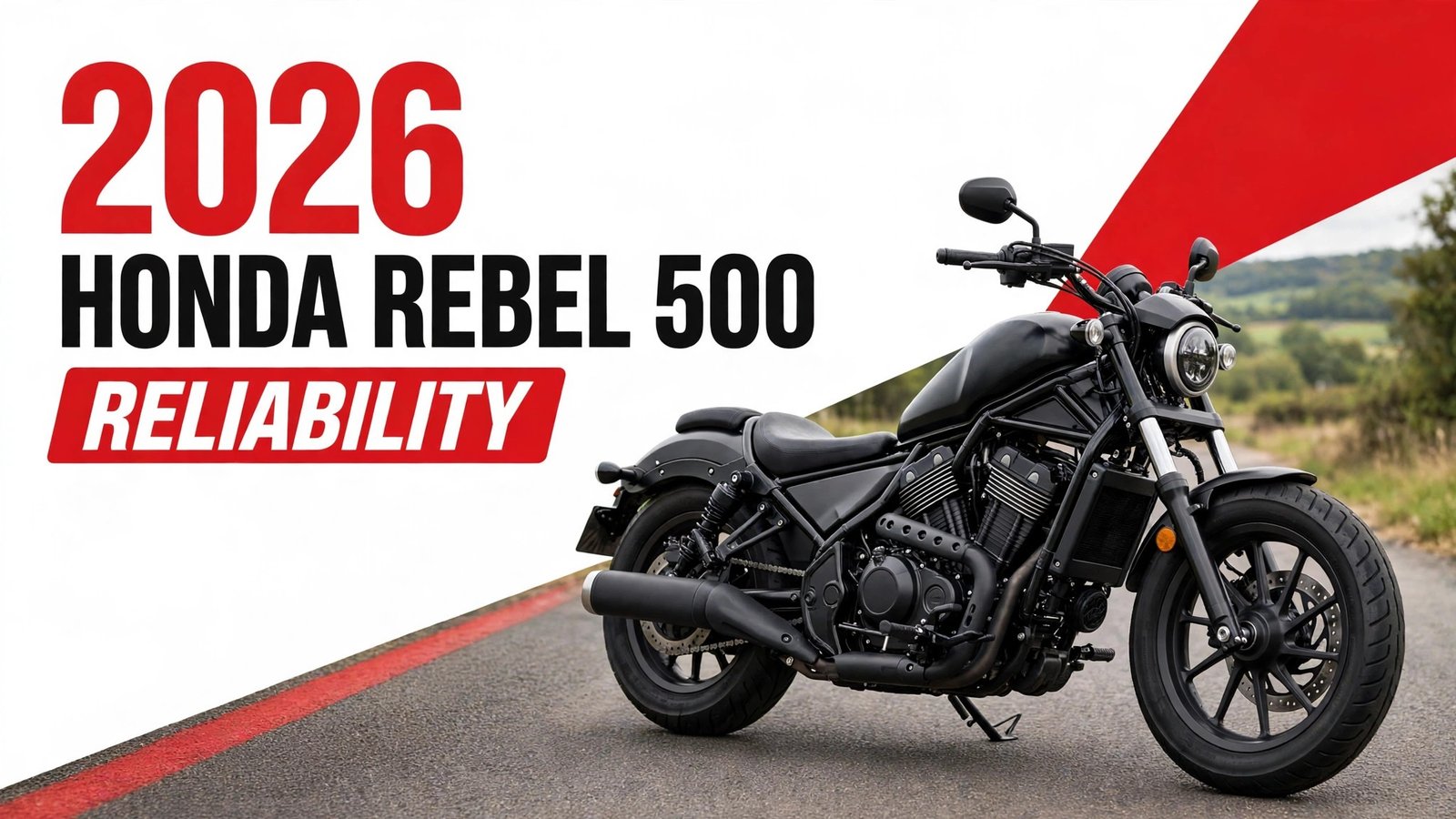
Short answer: Honda Rebel 500 reliability is strong where it matters most — the engine and gearbox. The 471cc twin comes from Honda’s proven CB500 platform, and MCN owners rate it 4.6 out of 5 for 2017–2019 bikes and 4.1 out of 5 for 2020-on bikes. Three US recalls touch the Rebel 500, all with free fixes — so check the VIN before buying.
Honda Rebel 500 Reliability Overview
The Honda Rebel 500 reliability story starts with a simple fact: Honda did not invent a new engine for this bike. The 471cc liquid-cooled parallel twin behind Honda Rebel 500 reliability is the CB500 unit, retuned for low-end torque. The rest of the bike is deliberately simple.

MCN Owners 4.6 Out of 5 for 2017-2019 and 4.1 for 2020-On Explained
MCN, the UK’s Motor Cycle News, runs separate owner-review pages for the two Rebel 500 generations. The 2017–2019 page shows an owners’ reliability rating of 4.6 out of 5, based on 8 owners who reviewed their 2017–2019 Honda CMX500 Rebel (CMX500 is the Rebel 500’s model code). The 2020-on page shows 4.1 out of 5, based on 7 owners who reviewed their 2020-on Honda CMX500 Rebel. Both numbers carry warnings: small samples, so one unhappy reviewer moves the average a lot, and UK pages, though the motorcycle is the same machine. What both pages agree on matters most: no owner group reports engine or gearbox failure, and the 2020-on dip is driven by finish complaints, not breakdowns. One distinction also matters: the Rebel 300 has no MCN owner rating at all, so any “MCN rating” quoted for a 300 is borrowed from the 500 and should be ignored.
How Mileage, Maintenance History and Previous Use Affect Reliability
Mileage alone tells you very little about Honda Rebel 500 reliability. A 20,000-mile bike with a full service history and a clean chain beats a 3,000-mile bike that sat outside for three winters on its original oil. What actually ages these bikes is sitting: stale fuel, moist brake fluid, hardened tires, rusted chains, dead batteries. That is why a cold start matters on a viewing — and why a seller who insists the bike “was just running” deserves skepticism. The video below shows a Rebel 500 rescued after months parked.
For Honda Rebel 500 reliability, maintenance history beats low mileage.
Honda Rebel 500 Common Problems and Wear Items
No motorcycle is trouble-free, and Honda Rebel 500 reliability is no exception — but its problem list is short. The engine and gearbox are the reliable part of Honda Rebel 500 reliability, while the finish and the wear items are where the money goes. That is the practical side.

Paint Chipping and Corrosion Reports From 2020-On Owners
The clearest complaint in the Honda Rebel 500 reliability record is cosmetic, and it comes from the 2020-on owner group. MCN’s summary of its 2020-on owner reviews says the 2020 bike’s reviews include “a couple of less-than-happy owners,” with complaints including paint chipping off and, in MCN’s words, “a huge amount of corrosion.” These are owner reports, not a Honda-acknowledged defect, and no recall covers paint or corrosion on the Rebel 500. Expect chips on the tank and fenders, rust on fasteners and the triple tree, and corrosion on the shock mounts and shift linkage. Surface rust on bolts is a bargaining point; frame rust signals a bike that lived outside unprotected. That is the cosmetic side of Honda Rebel 500 reliability.
Clutch, Chain, Sprockets, Battery and Electrical Checks
The mechanical wear items affecting Honda Rebel 500 reliability are predictable, which is good news for owners. The clutch is cable-operated with an assist-and-slipper mechanism from 2020 onward, and its main need is freeplay adjustment — 10–20 mm at the lever, per the manual. The chain and sprockets are the most frequent expense: inspect, clean and lubricate every 600 miles at 25–35 mm of slack, since a dry or slack chain eats sprockets quickly. The battery is maintenance-free, but terminals still corrode and batteries still die after winter storage. One long-term owner reported handlebar switches malfunctioning, especially the kill switch, which could cause a no-start even in the run position. For Honda Rebel 500 reliability, the electrical system is simple enough that most faults are contacts and connectors, not computers.
Honda Rebel 500 Maintenance Schedule and Servicing
The Rebel 500’s service schedule is a selling point: long intervals, simple jobs, no expensive surprises except the valve check. Headline intervals every owner should know: first service 600 miles, oil every 8,000 miles or one year, valves 16,000 miles, plugs 32,000 miles, chain 600 miles, brake fluid two years. A full Honda Rebel 500 review covers specifications; this section sticks to Honda Rebel 500 reliability.
First Service at 600 Miles, Oil Every 8,000 Miles or One Year
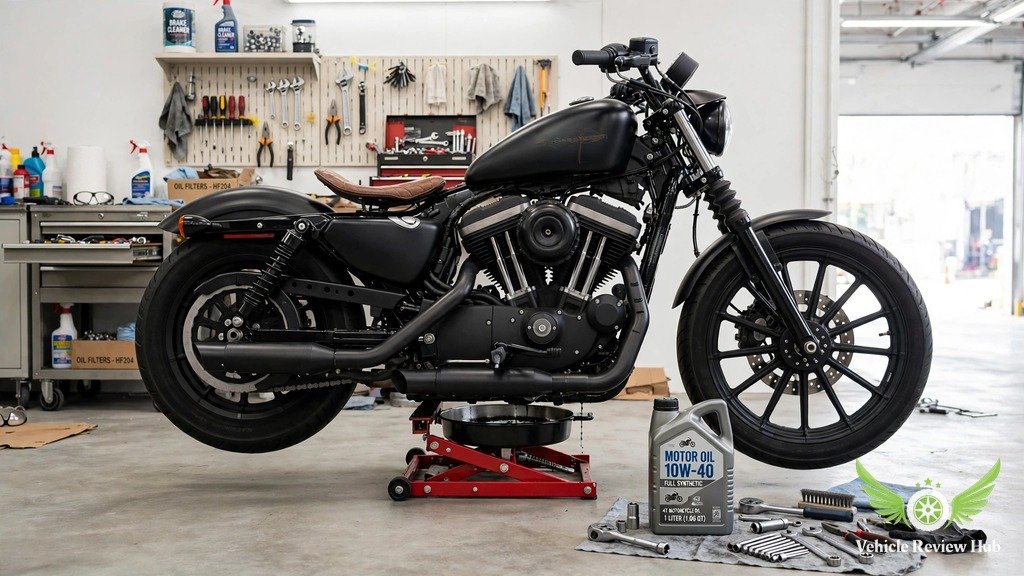
The first service at 600 miles is the most important visit for Honda Rebel 500 reliability: the first oil and filter change, a fastener and control check, and a chain inspection. After that, engine oil and filter fall every 8,000 miles or one year, using Pro Honda GN4 10W-30 or an equivalent JASO MA oil. Capacity is 2.9 quarts with a filter change and 2.6 without. Many owners change oil more often than required, and receipts every 4,000–5,000 miles show care, not waste. What should worry you is the opposite: no oil record at all, or oil that looks black and thin on the sight glass. For Honda Rebel 500 reliability, fresh oil on time is the cheapest insurance.
Valve-Clearance Inspection Every 16,000 Miles and Plugs at 32,000
The valve-clearance inspection every 16,000 miles is the big service for Honda Rebel 500 reliability, and the one buyers most often forget to ask about. The 471cc twin uses shim-under-bucket valves, so checking means removing the tank, airbox and valve cover — a dealer job for most owners. Tight valves do not make noise; they just quietly lose performance and can eventually burn. Spark plugs are easier: the standard NGK CPR8EA-9, gapped at 0.80–0.90 mm, is replaced at 32,000 miles. When buying used, ask whether the 16,000-mile valve service has been done and whether there is a receipt — that question tells you more about Honda Rebel 500 reliability on that bike than the odometer does.
| Service item | Interval (manual) | Notes |
|---|---|---|
| First service | 600 miles | Oil and filter, fastener and control check, chain inspection |
| Engine oil and filter | Every 8,000 miles or 1 year | GN4 10W-30; 2.9 qt with filter, 2.6 qt without |
| Drive chain | Every 600 miles | Inspect, clean, lubricate; slack 25–35 mm |
| Valve clearance | Every 16,000 miles | Shim-under-bucket; dealer job for most owners |
| Spark plugs | Every 32,000 miles | NGK CPR8EA-9, gap 0.80–0.90 mm |
| Brake fluid | Every 2 years | DOT 4; replacement requires mechanical skill |
| Coolant | Every 3 years | Pro Honda HP Coolant, 50/50 pre-mixed |
Honda Rebel 500 Tires, Brakes and Suspension Maintenance
Tires, brakes and suspension are where Honda Rebel 500 reliability shows its age first, because they are also where a previous owner’s habits show up. The bike runs fat 16-inch tires — 130/90-16 front, 150/80-16 rear — with single discs front and rear and ABS on most US bikes from 2020 onward. Suspension is basic for Honda Rebel 500 reliability: a non-adjustable 41mm fork and preload-only twin shocks.

Tire Condition, Pressure, Tread Wear and Replacement
Tire checks for Honda Rebel 500 reliability belong in every pre-ride routine: pressure, tread depth, sidewall condition and age. Pressures are on the bike’s tire label and in the manual — check them cold. The stock Dunlops draw consistent owner criticism: one 2019 owner wrote that the original Dunlops “aren’t great,” following every line in the road and feeling slippery on white lines, while another owner switched to Michelin Commander II tires for a much smoother ride. Age matters as much as tread: a five-year-old date code means hardened rubber, replaced regardless of tread. For Honda Rebel 500 reliability, tires are also a safety item: the bike’s single front disc needs all the grip they give.
Brake Pads, Brake Fluid Every Two Years, Forks and Shock Checks
Brake maintenance for Honda Rebel 500 reliability follows the manual: pad wear inspected regularly, brake fluid replaced every two years, brake system inspected at each service. The two-year fluid interval is time-based, so it applies even to low-mileage bikes. One year split matters: 2017–2019 bikes used a 264mm front disc, while 2020-on bikes use a 296mm front disc with a 240mm rear disc. Several owners call the stock suspension soft and under-damped on rough roads — a comfort complaint, not a reliability fault — but a leaking fork seal or dead shock changes braking and handling, and should come off the price.
Honda Rebel 500 Maintenance and Ownership Costs
The Rebel 500 is cheap to own, and that is a large part of the Honda Rebel 500 reliability story — when servicing is inexpensive, owners actually do it. No verified US dealer price list exists to quote, and this guide will not invent one. MCN lists an annual servicing cost of £130 for the 2017–2019 bike on its UK owner page, with individual owners reporting £50 to £150 a year depending on DIY work. The costs that test Honda Rebel 500 reliability — fuel, tires and the chain — are all predictable.
Fuel, Routine Servicing, Tires and Replacement Parts
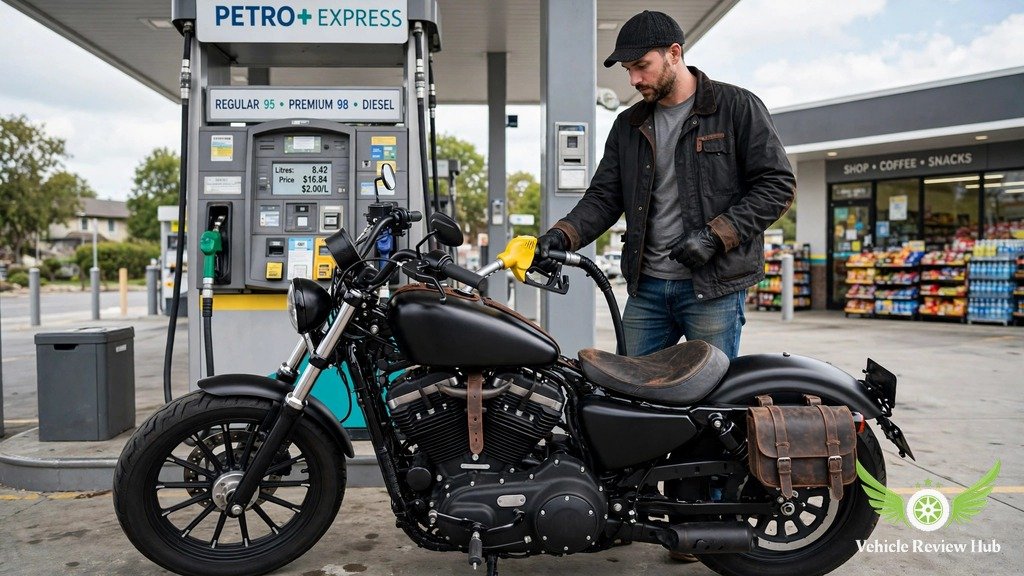
Fuel is the Rebel 500’s smallest running cost. The tank holds 3.0 gallons, and at roughly 50 mpg mixed riding — a planning figure, not a Honda claim — a tank gives roughly 150 miles. Tires are the largest single consumable for Honda Rebel 500 reliability, but the fat 16-inch sizes are common, so replacements are easy. Replacement parts are a strength for Honda Rebel 500 reliability: the engine, brakes and electrics are shared with the CB500F, CBR500R and CB500X, so dealers stock common parts and the aftermarket is deep. The parts that cost more are unique to the Rebel’s styling: tanks, fenders, seats and SE trim such as the diamond-stitch seat and headlight cowl.
Repair Expenses, Parts Availability and Long-Term Ownership Costs
Long-term ownership costs for Honda Rebel 500 reliability stay low as long as the big service is not deferred. The valve-clearance check at 16,000 miles is the only service with significant labor. Skipping it does not save money: tight valves can burn, turning a service bill into an engine repair. Beyond that service, the Honda Rebel 500 reliability repair list is short: chains and sprockets, a battery every few years, brake pads and fluid, tires, and the odd switch or cable. The long-term cost risk is cosmetic, not mechanical: a bike that lived outside will need paint, fasteners and possibly a seat cover. That is the normal Honda Rebel 500 reliability experience for owners who garage, wash and service on time.
How to Keep a Honda Rebel 500 Reliable
Keeping Honda Rebel 500 reliability high is mostly a matter of doing the small jobs on time and checking the bike over regularly. The Honda Rebel 500 reliability schedule is not demanding: chain 600 miles, oil 8,000 miles or yearly, valves 16,000 miles. A clean, correctly tensioned chain protects the sprockets and your wallet, while a regular walk-around catches paint chips, loose fasteners and weeping seals before they become repairs.

Preventive Maintenance, Chain Care Every 600 Miles and Inspections
Preventive maintenance for Honda Rebel 500 reliability starts with the chain: the manual calls for it every 600 miles — more often than any other job. The routine is simple: check slack (25–35 mm), clean the chain and sprockets with an O-ring-chain cleaner, wipe dry, and lubricate with Pro Honda HP Chain Lube or an equivalent. Beyond the chain, the Honda Rebel 500 reliability pre-ride inspection covers tires, brakes, lights, steering, fuel and oil level. For winter-ridden bikes, wash road salt off promptly — salt turns cosmetic corrosion structural.
Recall Checks: Reflector 21V-382 and Handlebar Screw 26V-146 and 26V-500
Three US safety recalls name the Rebel 500, all with free remedies — but only a VIN check can tell you whether a particular bike is included, since every one covers only certain bikes. All three campaigns do name the CMX500, so no correction to the heading is needed. The reflector recall, 21V-382 (KM3), covers certain 2020–2021 Rebel 500s in a 28,528-unit multi-model campaign: the rear reflector may not meet FMVSS 108, and dealers replace it free; letters went out July 7, 2021. The two handlebar recalls share one defect — a lock screw that may loosen and detach, interfering with steering — and one free remedy: a new screw with thread lock. The earlier 26V-146 (KUO) covers certain 2023–2025 CMX500s, plus the CMX300 and CL500, in a 19,406-unit campaign (letters June 15, 2026); the later 26V-500 (KU8) expands it to certain 2017–2023 and 2025 CMX500s, plus the CMX300 and SCL500, in a 43,913-unit campaign (letters late September 2026). Two quirks: a 2024 Rebel 500 falls under 26V-146 only, not 26V-500; and NHTSA’s lookup returns no 26V-500 record for 2019 specifically, though the campaign summary spans 2017–2023 — scope follows production dates, so check any 2019 bike by VIN. Year by year: 2017–2018, 26V-500 only; 2019, none returned; 2020–2021, 21V-382 plus 26V-500; 2022, 26V-500 only; 2023 and 2025, both handlebar campaigns; 2024, 26V-146 only; 2026, none returned. A full NHTSA check across 2017–2026 returns no other CMX500 campaigns. Before buying, run the VIN through NHTSA’s recall lookup and get the dealer to confirm recall status in writing; checks and fixes are free, and an unrepaired recall is the easiest Honda Rebel 500 reliability problem here to eliminate. For the full inspection checklist, see the companion Rebel 500 buying guide; for the smaller bike, see the Rebel 300 reliability picture — remembering the 300 has no MCN rating of its own.
| Recall | Rebel 500 scope | Defect and remedy |
|---|---|---|
| 21V-382 (KM3) | Certain 2020–2021 | Dim rear reflector, FMVSS 108; free reflector replacement; 28,528-unit multi-model campaign |
| 26V-146 (KUO) | Certain 2023–2025 | Handlebar lock screw may loosen; free screw replacement with thread lock; 19,406-unit campaign |
| 26V-500 (KU8) | Certain 2017–2023, 2025 | Handlebar lock screw may loosen; free screw replacement with thread lock; 43,913-unit campaign, expands 26V-146 |
Honda Rebel 500 Reliability FAQs
Direct answers about Honda Rebel 500 reliability.
Is the Honda Rebel 500 reliable?
Yes. The Honda Rebel 500 reliability record is strong: its 471cc twin comes from Honda’s proven CB500 platform, and MCN owners rate it 4.6 out of 5 for 2017–2019 bikes and 4.1 out of 5 for 2020-on bikes.
What are the most common problems on a Honda Rebel 500?
Honda Rebel 500 reliability complaints start with paint chipping and corrosion on 2020-on bikes, reported by owners on MCN’s 2020-on page, plus normal wear items: chains, sprockets, tires, brake pads, batteries after winter storage, and switchgear niggles such as a kill switch that needs cleaning.
How often does a Honda Rebel 500 need servicing?
First service at 600 miles, then oil and filter every 8,000 miles or one year, chain care every 600 miles, valves every 16,000 miles, plugs at 32,000 miles, brake fluid every two years and coolant every three years, per the manual schedule for Honda Rebel 500 reliability.
How much does it cost to service a Honda Rebel 500?
No verified US dealer price list exists to quote, so this guide does not invent one. MCN lists an annual servicing cost of £130 for the 2017–2019 bike in the UK, with owners reporting £50 to £150 depending on DIY work.
Does the Honda Rebel 500 have any recalls?
Yes, three US recalls name the CMX500: 21V-382 for certain 2020–2021 bikes, 26V-146 for certain 2023–2025 bikes, and 26V-500 for certain 2017–2023 and 2025 bikes. All three have free remedies; check by VIN before purchase.
Is the 2024 Honda Rebel 500 affected by the handlebar recall?
Yes, but only one: a 2024 CMX500 falls under 26V-146 (Honda KUO) and not under 26V-500, so check both Honda Rebel 500 reliability campaigns by VIN rather than assuming the newer recall covers your bike.
What is the Honda Rebel 500 valve service interval?
For Honda Rebel 500 reliability, valve-clearance inspection falls every 16,000 miles, per the owner’s manual. The 471cc twin uses shim-under-bucket valves, so adjustment is a dealer job for most owners.
How long do Honda Rebel 500 tires last?
For Honda Rebel 500 reliability, tire life depends on riding style and compound; no official figure exists. Owners report the stock Dunlops wearing and feeling vague, with several switching to Michelin Commander II tires for better feel and long life.
Does the Honda Rebel 500 rust?
It can, cosmetically — Honda Rebel 500 reliability has a rust footnote, not a rust problem. Owners report rust spots on fasteners, joints, the triple tree, shock mounts and shift linkage, and 2020-on owners report paint chipping and corrosion. Garage storage, washing and touch-up paint keep them under control.
Is a high-mileage Honda Rebel 500 worth buying?
Often yes, if the service history is complete: Honda Rebel 500 reliability rewards maintenance over low mileage. A 20,000-mile bike with oil changes on time and the valve service done beats a low-mileage bike that sat neglected.
What should I check before buying a used Honda Rebel 500?
For Honda Rebel 500 reliability, start the bike cold, work every switch, and watch the LCD for cut-outs. Check chain slack and sprocket wear, tire age and tread, brake pad thickness and fluid age, fork seals, shocks, paint chips and corrosion, and the valve-service record. Finally, run the VIN through NHTSA’s recall lookup for 21V-382, 26V-146 and 26V-500.
How does Honda Rebel 500 reliability compare with the Rebel 300?
Honda Rebel 500 reliability is better documented: MCN owner ratings of 4.6 out of 5 (2017–2019, 8 owners) and 4.1 out of 5 (2020-on, 7 owners), while the Rebel 300 has no MCN owner rating at all. The 500’s twin is also less stressed than the 300’s single, and its parts are shared across the high-volume CB500 family.