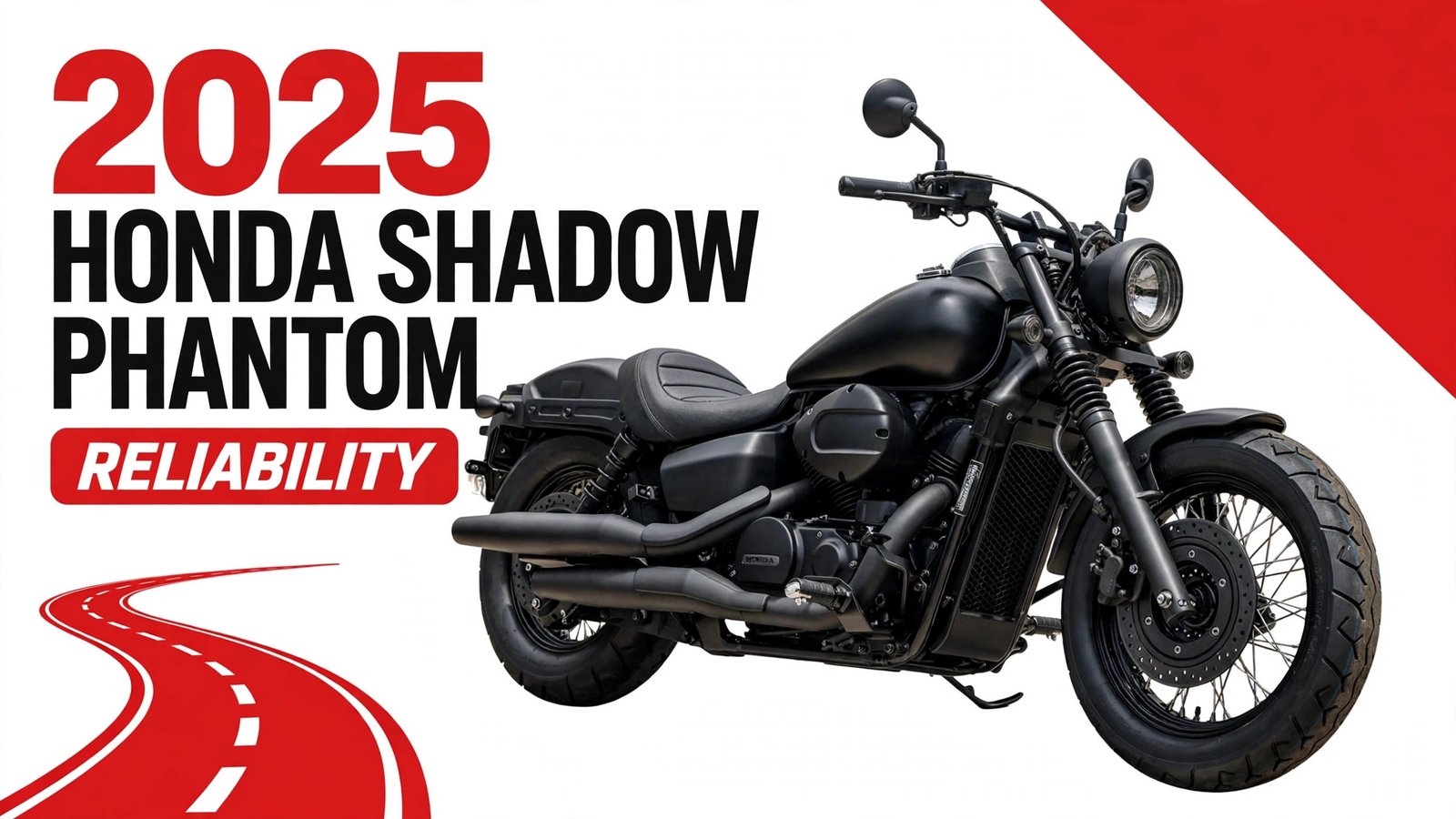
The Honda Shadow Phantom has been around since 2010, and its reputation keeps buyers coming back. Beneath the blacked-out bobber styling sits a 745cc liquid-cooled V-twin Honda has barely changed in decades, a five-speed gearbox, and a shaft final drive. That simple recipe explains Honda Shadow Phantom reliability: very little on this motorcycle goes wrong, but the 8,000-mile valve checks and the 2026 fuel pump recall are worth understanding first. The current model is the 2025 Phantom at $8,699 plus a $600 destination charge, and Honda lists no 2026 model.
Honda Shadow Phantom Reliability Overview
The Phantom has no deep pool of model-specific reliability statistics, so the case for Honda Shadow Phantom reliability rests on a small owner survey, Honda’s recall record, and the VT750 engine family.

MCN VT750 Family Data From Five Owners and Its Limits Explained
The most quoted owner rating for this family comes from MCN, and needs careful reading. MCN’s page for the 2004 to 2015 VT750 Shadow range rests on just five owners, who gave the range 4.4 out of 5 overall, with reliability and build quality at 4.8 out of 5. So the headline for Honda Shadow Phantom reliability is encouraging but thin: five owners of the wider VT750 family, not a Phantom-specific survey. Treat it as a supporting signal for Honda Shadow Phantom reliability rather than proof. One 2024 owner review rated the bike 5 out of 5, at 56 US mpg naked and 62 with a windshield.
How Mileage, Maintenance History and Previous Use Affect Reliability
Mileage alone tells you little about a Phantom. Owners report examples passing 85,000 miles before major repairs, believable for an understressed, liquid-cooled twin. What matters more for Honda Shadow Phantom reliability is whether the 8,000-mile services were done, especially the valve checks. A low-mileage bike is not automatically safe: one sat unridden for years can need fresh tires, a new battery, and flushed brake fluid. When judging Honda Shadow Phantom reliability on a used example, ask for service records, check the VIN against Honda’s recall database, and weigh maintenance history above mileage. Our Shadow Phantom review explains the model-year changes that help you tell a 2024-on bike from an earlier one.
Honda Shadow Phantom Common Problems and Wear Items
No motorcycle is fault-free, and the Phantom’s short complaint list explains its strong Honda Shadow Phantom reliability record. The items below are owner-reported watch points, not verified factory defects — a distinction that matters for Honda Shadow Phantom reliability.
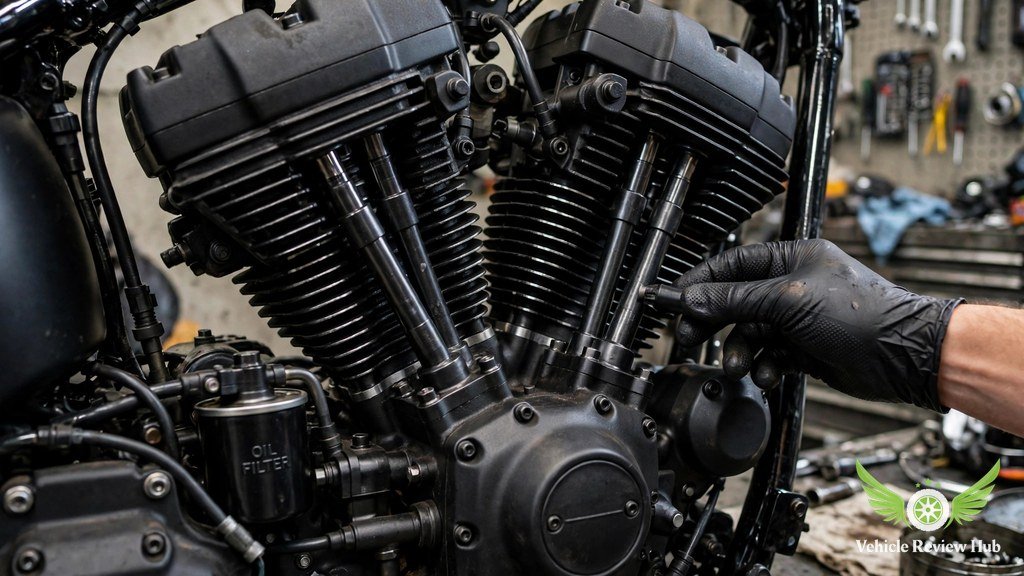
Known Watch Items, Storage Issues and Aging-Bike Checks
TopSpeed’s owner reports mention a clunky-feeling gearbox, worn stators and regulators, and oil weeping around the cylinder head gasket on high-mileage examples. Storage causes more trouble than riding, and that matters for Honda Shadow Phantom reliability: fuel goes stale, batteries drain, tires flat-spot and crack, and brake fluid absorbs moisture. A bike with sound fork seals, rear shock damping and steering head bearings, and valve services on record, is a strong used buy for Honda Shadow Phantom reliability, and the Shadow Phantom buying guide walks through the full inspection.
Fuel Pump Recall 26V633 for 2024-2025 Bikes, Parts Expected Jan 2027
The most serious item for Honda Shadow Phantom reliability on recent bikes is safety recall 26V633, and the details matter because early coverage mixed the Phantom up with the Fury. The campaign covers 3,386 certain 2024 to 2025 VT750 motorcycles, alongside 820 Fury VT1300CX models for a 4,206 total — the Phantom sits inside the VT750 portion, not the Fury’s 820, under Honda codes KU9, KV0 and KV1. The defect is in fuel pump part 16700-HN8-6011-M1: worn surfacing equipment left phenol fragments in the commutator slits, which can stop the pump and stall the engine. Honda declared the defect on September 24, 2026, with a stop sale on certain new and used 2024 to 2025 VT750s until repaired. The filing carries Do Not Drive and Park Outside advisories. Owner letters roll out in phases from November 27, 2026. Honda’s bulletin states VT750CBS/C2B parts are expected in January 2027 — the correct expectation for the Phantom’s codes — with a free dealer replacement that protects Honda Shadow Phantom reliability. The TopSpeed report and the NHTSA acknowledgement for 26V633 confirm the scope and free remedy.
Watch this used 2020 Phantom walkaround before inspecting any bike for Honda Shadow Phantom reliability.
Honda Shadow Phantom Maintenance Schedule and Servicing
The Phantom’s service schedule is short and regular, which is a large part of Honda Shadow Phantom reliability. Honda’s manual sets an initial service at 600 miles or one month, then servicing every 8,000 miles or 12 months.

First Oil Service at 600 Miles, Then Every 8,000 Miles or 12 Months
The first service at 600 miles covers the engine oil and filter. After that, engine oil and filter are replaced together every 8,000 miles or 12 months, the rhythm that sustains Honda Shadow Phantom reliability. Honda specifies Pro Honda GN4 10W-30: 2.7 US quarts with a filter change, 2.6 quarts for oil only. The drain bolt torque is 21 lbf·ft and the filter torque is 19 lbf·ft. Some online summaries quote 4,000 miles, but the manual schedule is 600 miles first, then every 8,000 miles — the interval this guide follows for Honda Shadow Phantom reliability.
Valve Inspection Every 8,000 Miles and Four Spark Plugs to Service
The valve clearance check is the Phantom’s most involved routine job, and it shapes Honda Shadow Phantom reliability more than any other service. The twin has three valves per cylinder, six clearances in total, on simple screw-and-locknut adjusters. Honda calls for inspection every 8,000 miles, and the job takes two to four hours because the tank must come off. Owners and mechanics widely report the clearances rarely need adjustment after the first check. Honda’s three-valve dual-plug combustion chamber means two plugs per cylinder, four in total. The specified plug is NGK DPR7EA-9, gapped to 0.8–0.9 mm, replaced at 12,000 and 24,000 miles. Pair the plug change with the valve check to save duplicate labor.
| Service item | Interval | Specification |
|---|---|---|
| First service | 600 miles / 1 month | Oil and filter |
| Engine oil and filter | Every 8,000 miles / 12 months | GN4 10W-30, 2.7 US qt with filter |
| Valve clearances | Every 8,000 miles | 6 clearances, screw-and-locknut, 2–4 hours |
| Spark plugs | Inspect 4k/8k/16k/20k, replace 12k/24k | NGK DPR7EA-9, gap 0.8–0.9 mm, 4 plugs |
| Air cleaner and coolant | Air cleaner 12k/24k, coolant 24k then 2-yearly | More often in rain or dust |
| Brake fluid and final-drive oil | Fluid every 2 years, final-drive oil 24k | DOT 4 fluid; hypoid SAE 80, 5.4 US oz |
Honda Shadow Phantom Tires, Brakes and Suspension Maintenance
Tires, brakes and suspension are the parts of Honda Shadow Phantom reliability you feel on every ride, and the parts most often neglected on a used cruiser. The running gear is simple — tubed tires, a single front disc, a non-adjustable 41mm fork and preload-only rear shocks — so upkeep is inspection and replacement on schedule rather than adjustment.

Final-Drive Oil Around 24,000 Miles, Tires and Pressure Checks
The shaft final drive is one of the quiet strengths behind Honda Shadow Phantom reliability, and it is also the easiest to get wrong by overfilling. Honda calls for the final-drive oil to be replaced at 24,000 miles with hypoid gear oil SAE 80, just 5.4 US ounces, filled to the lower edge of the fill hole with a fresh O-ring. Overfilling can push oil out of the vent, which looks like a leak but is usually a service error. Tires are tubed: a 120/90-17 front and a 160/80-15 rear. Honda’s pressures are 29 psi front and 29 psi rear below a 200 lb load, rising to 36 psi above it — check them cold, since soft tires feel vague and wear unevenly. Tire age matters as much as tread for Honda Shadow Phantom reliability: replace tires older than about five years even if tread looks fine, and inspect sidewalls for cracks on any stored bike.
Brake Pads, Brake Fluid Every Two Years, Forks and Shock Checks
Braking, a core part of Honda Shadow Phantom reliability, changed with the 2024 update, so check which system your bike has before ordering parts. Pre-2024 Phantoms used a rear drum; from 2024 the rear is a disc, ABS optional in 2024 and standard on the single 2025 trim, while the front stays a single 296mm disc. Honda calls for DOT 4 brake fluid replacement every two years, regardless of mileage, because old fluid absorbs moisture and softens the lever. Check pad thickness at every service and replace pads before they score the discs. The fork is non-adjustable, so check its seals for weeping and its oil for age; the rear shocks offer five preload positions, so set preload for your load rather than the softest setting. Worn shocks show up as wallowing over bumps and a rear tire that wears in scallops. Keeping these checks on schedule is unglamorous Honda Shadow Phantom reliability work, but it keeps a heavy cruiser stopping straight.
Honda Shadow Phantom Maintenance and Ownership Costs
The Phantom is cheap to run by cruiser standards, and Honda Shadow Phantom reliability benefits from a short service schedule, parts shared across the long-lived VT750 family, and modest fuel use. The costs below are the ones that actually recur; there are no expensive surprises hiding in the schedule, apart from the valve-check labor — a reassuring part of Honda Shadow Phantom reliability.

Fuel, Routine Servicing, Tires and Replacement Parts
Fuel is the smallest bill. The 3.9-gallon tank and mid-50s mpg reported by owners give a real-world range well over 200 miles, so even regular commuting costs little per week, which helps Honda Shadow Phantom reliability feel affordable in daily use. TopSpeed’s owner sources put routine yearly dealer maintenance at $150 to $350, fitting a bike needing one oil service a year for most riders, plus a valve check every 8,000 miles. Tires are the other recurring cost: a tubed pair is a moderate expense, and fitting often costs nearly as much as the tires, so budget for a pair every few years. Parts availability is a genuine strength for Honda Shadow Phantom reliability — the VT750 family has been in production for decades, so consumables, brake parts and bodywork remain easy to find.
Repair Expenses, Parts Availability and Long-Term Ownership Costs
The priciest routine job is the valve inspection: two to four hours of labor for a tank-off job, and one 2024 MCN owner called a $500 valve check after a few hundred miles excessive — get a quote first, and combine it with the plug change. Beyond that, repair bills stay modest: stators, regulators and wheel bearings are the wear items most likely at high miles, and none requires engine removal — good news for Honda Shadow Phantom reliability at high miles. The warranty is a one-year transferable Honda warranty, with an optional HondaCare Protection Plan for longer cover. No Phantom-specific insurance figure is published, so get quotes rather than trusting an average — age, location and riding history move the number more than the model does. Over a decade, the pattern behind Honda Shadow Phantom reliability is consistent: low fuel and servicing costs, occasional mid-priced wear parts, and no known catastrophic failure mode outside the 26V633 recall on recent bikes.
How to Keep a Honda Shadow Phantom Reliable
Keeping a Phantom reliable is mostly doing scheduled work on time and treating storage with respect. That routine is the everyday side of Honda Shadow Phantom reliability.

Preventive Maintenance, Battery Care and Regular Inspections
The single most effective habit for Honda Shadow Phantom reliability is following the 8,000-mile schedule without skipping valve checks, because that service protects long-term engine health. Between services, a short pre-ride routine covers the rest: cold tire pressures, brake feel, lights, coolant level, and final-drive oil level. A Phantom left for weeks will slowly drain its battery, and repeated deep discharges shorten battery life, so a tender during storage is the cheapest reliability purchase you can make. Keep terminals clean and tight, replace the battery when cranking turns slow, and for longer storage fill the tank, add stabilizer, change the oil before laying the bike up, and run the tender. None of this is exotic: Honda Shadow Phantom reliability is maintained by ordinary diligence, not specialist knowledge or expensive products.
Older Recalls 15V874 Bank-Angle Sensor and 15V439 Starter Relay by VIN
Two older recalls still matter when buying used, and both are checked by VIN. Recall 15V874, Honda code JW7, covers 22,142 motorcycles in North America, including 2010 to 2016 VT750C2B Phantoms. Engine vibration can rub bank-angle sensor wiring on the harness joint connector, eventually creating an open circuit that stalls the engine without warning. The free remedy is to relocate the joint connector and replace the sensor; Honda’s line is 1-800-999-1009. Do not confuse it with a separate 2011 R80 campaign for a different sensor defect. Recall 15V439, Honda codes JS9 and JT0, is a multi-model campaign of 47,168 units — never quote that total as a Phantom figure. The Phantom portion is certain 2014 to 2015 VT750 models: VT750C and CA, VT750C2, VT750C2B, and VT750C2F. Sealant was incorrectly applied to the starter relay switch, which can raise resistance at the main fuse and cut power. The remedy is a free lot-number inspection and replacement where needed; Honda’s line is 1-866-784-1870. Note the revised bulletin: the VT750CS and VT750C2S are not affected. Before buying used, run the VIN through NHTSA’s recall lookup and ask for completion paperwork — a small Honda Shadow Phantom reliability habit that stops you inheriting an open recall. Our Shadow Phantom performance article covers the engine figures behind this reliability record.
Honda Shadow Phantom Reliability FAQs
These are the questions buyers ask most about Honda Shadow Phantom reliability, answered from owner data and the NHTSA recall record.
Is the Honda Shadow Phantom a reliable motorcycle?
Yes: the VT750 family scores 4.8 out of 5 for reliability in MCN’s owner data, but that is five owners of the wider 2004 to 2015 range, not a Phantom-specific survey. The simple shaft-drive design supports the same verdict for Honda Shadow Phantom reliability.
What is the biggest problem with the Shadow Phantom?
On recent bikes, fuel pump recall 26V633: certain 2024 to 2025 VT750s can stall if the pump fails, under a stop sale plus Do Not Drive and Park Outside advisories. On older bikes, stator and regulator wear and head-gasket weeping at high miles are most reported, both relevant to Honda Shadow Phantom reliability.
Is my 2024 or 2025 Phantom included in recall 26V633?
Only certain bikes are included, so check your VIN on NHTSA.gov. The campaign covers 3,386 certain 2024 to 2025 VT750 motorcycles, with VINs searchable since October 8, 2026. Checking the VIN is the first step in protecting Honda Shadow Phantom reliability on a recent bike.
When will fuel pump recall parts be available for the Phantom?
Honda’s bulletin states VT750CBS and C2B parts, the Phantom’s codes, are expected in January 2027; VT750C and S parts were expected in November 2026 and Fury parts in April 2027. Certain 2024 VT750 owners receive interim letters first, so Honda Shadow Phantom reliability for them depends on that January date.
How often does the Shadow Phantom need an oil change?
The first oil service is at 600 miles or one month, then every 8,000 miles or 12 months, with the filter replaced each time. Honda specifies Pro Honda GN4 10W-30, 2.7 US quarts with the filter. Following the manual schedule is basic Honda Shadow Phantom reliability practice.
How often do the valves need checking on a Shadow Phantom?
Valve clearances are inspected every 8,000 miles. The twin has three valves per cylinder, six clearances in total, on screw-and-locknut adjusters, and the job takes two to four hours because the tank must come off. Skipping the inspection risks burned valves and real damage to Honda Shadow Phantom reliability.
How many spark plugs does a Shadow Phantom have?
Four. Honda’s three-valve dual-plug chamber puts two plugs in each cylinder. The specified plug is NGK DPR7EA-9, gapped to 0.8–0.9 mm, inspected at 4,000, 8,000, 16,000 and 20,000 miles, replaced at 12,000 and 24,000. Pairing the plug change with the valve check supports Honda Shadow Phantom reliability.
Does the Shadow Phantom have a chain or a shaft drive?
A shaft drive, on every model year. There is no chain to clean, lubricate, tension or replace, and no belt either. The only drivetrain service is replacing final-drive oil at 24,000 miles with 5.4 US ounces of hypoid gear oil SAE 80. That freedom from chain chores is a core reason for Honda Shadow Phantom reliability.
Does the Shadow Phantom have ABS?
It depends on the year. Pre-2024 US Phantoms have no ABS. For 2024, Honda added a rear disc brake and made ABS optional; for 2025, the range became a single ABS-only trim. ABS status does not change Honda Shadow Phantom reliability, but it matters for parts ordering.
What should I check on a used Shadow Phantom?
Service records for the 8,000-mile valve checks, the VIN against all three recalls (26V633, 15V874, 15V439), tire age and tread, pad thickness, and battery condition. Working through that list is how you verify Honda Shadow Phantom reliability before buying.
How do I look after the battery on a Shadow Phantom?
Use a battery tender whenever the bike sits for weeks, keep terminals clean and tight, and replace the battery when cranking turns slow. The tender is the cheapest purchase you can make for Honda Shadow Phantom reliability.
How much does it cost to run a Shadow Phantom?
Fuel is cheap at mid-50s mpg from a 3.9-gallon tank, routine dealer servicing is estimated at $150 to $350 per year by TopSpeed’s owner sources, and parts are plentiful. The valve inspection every 8,000 miles is the priciest routine job because it is labor. No Phantom-specific insurance figure is published. Low running costs are part of the appeal of Honda Shadow Phantom reliability.