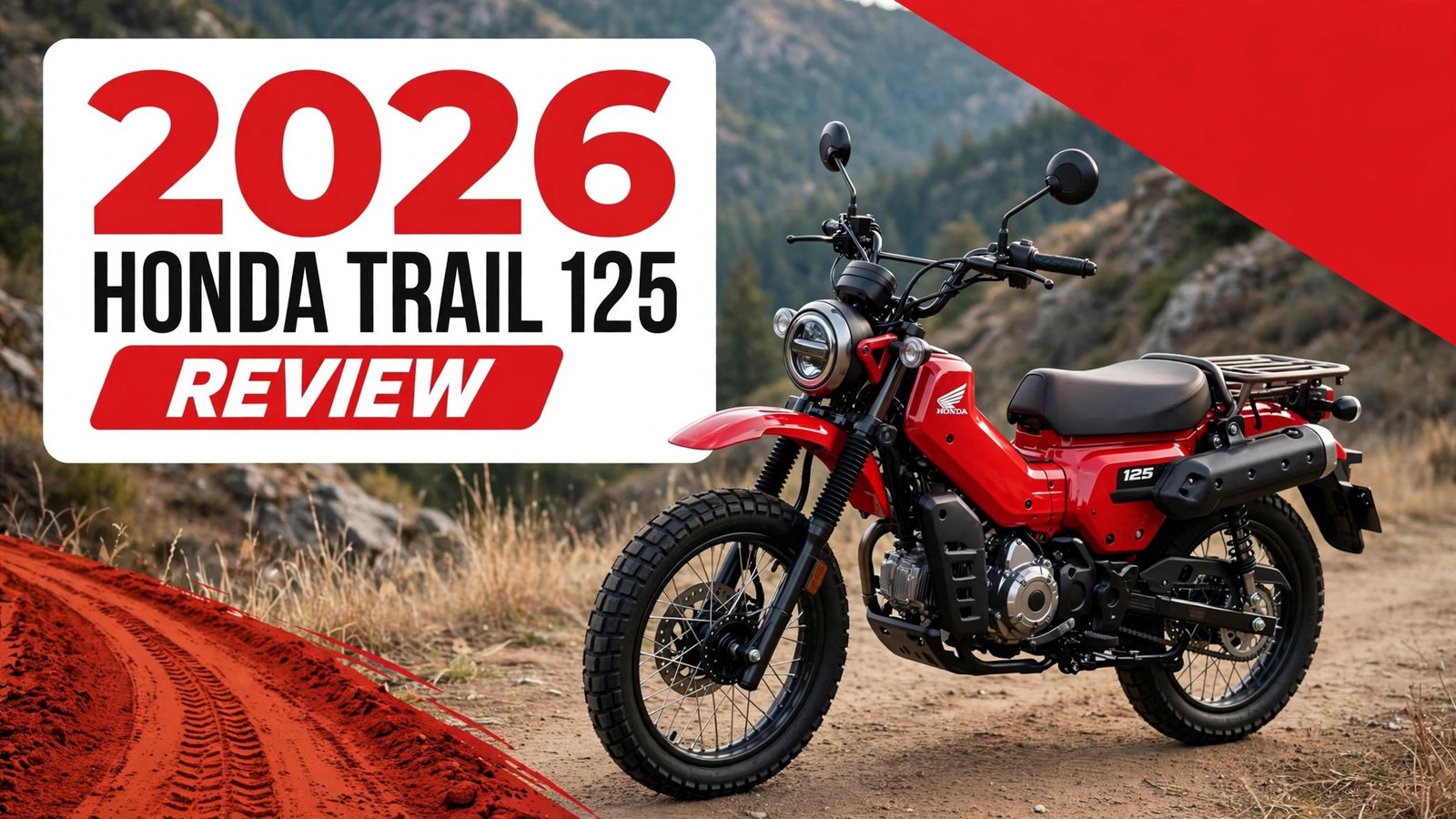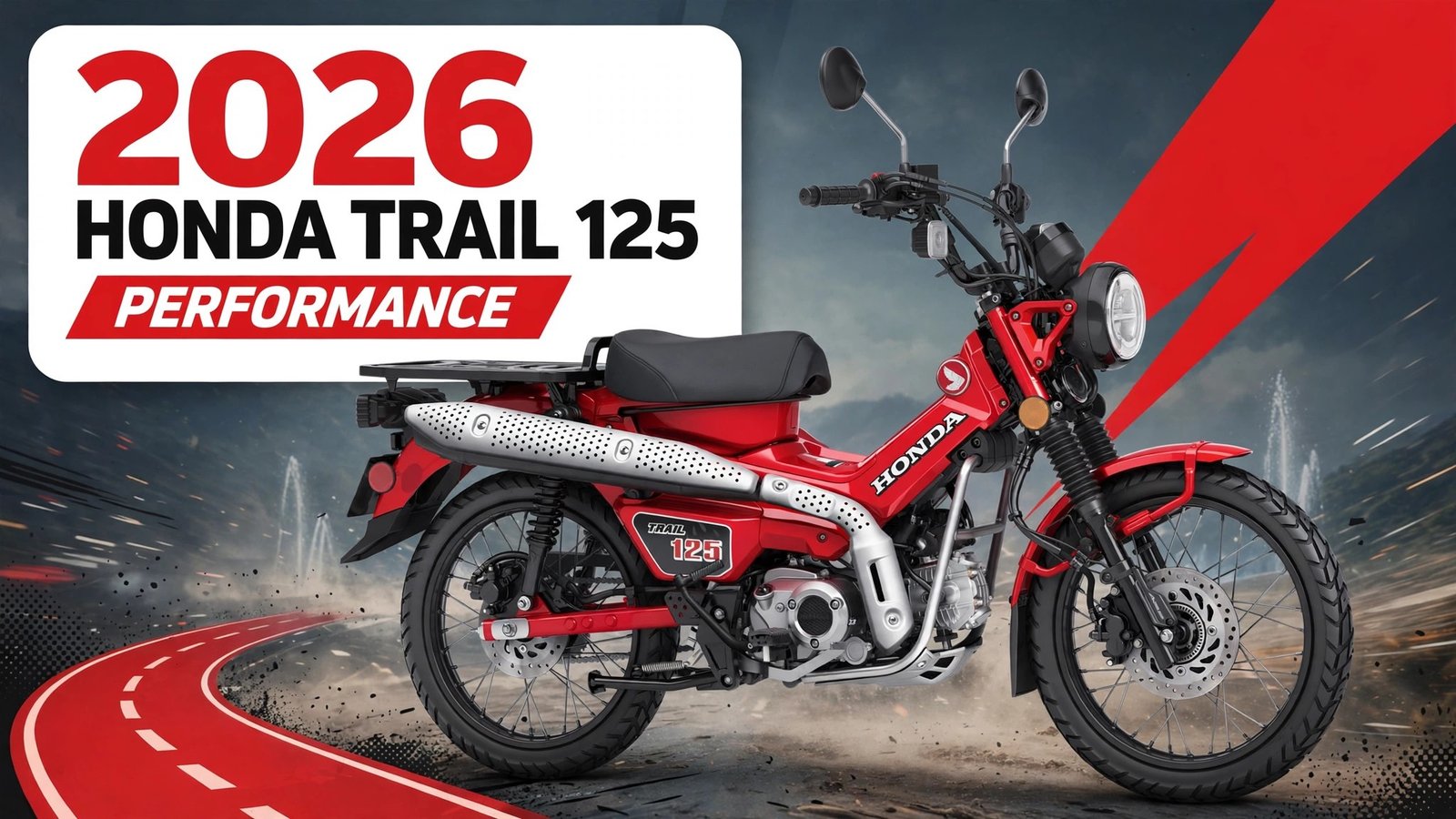
Short answer: Honda Trail 125 performance is small-bike performance with a utility job — a 124cc air-cooled single with a four-speed semi-automatic gearbox, a real-world top speed around 55 mph flat-out, and fuel economy that embarrasses nearly every other motorcycle on sale. This Honda Trail 125 performance guide starts with the framing that matters: the Trail is Honda’s utility step-through miniMOTO, the modern heir of the CT90 and CT110, judged here by back-road speed, light-trail ability, and miles per gallon, not by freeway numbers it was never built to chase. The 2026 bike costs $4,199 plus $300 destination.
One framing fact belongs up front in this Honda Trail 125 performance guide: Honda USA publishes no horsepower or torque figure for the Trail, and no dyno or instrumented test exists for the 2023-on Gen 2 engine. Every power number here therefore carries its source and generation label, every top-speed figure its test, and every MPG figure its measurement. For the full model story, see our Honda Trail 125 review.
Honda Trail 125 Engine Performance and Power Delivery
Engine performance on the Trail is about delivery, not output: modest power, a clean pull from a stop, and a gearbox that asks nothing of the left hand. This Honda Trail 125 performance guide treats the two generations separately, because they are different engines.
Cycle World Dyno, Gen 1: 7.9 HP at 5,710 RPM
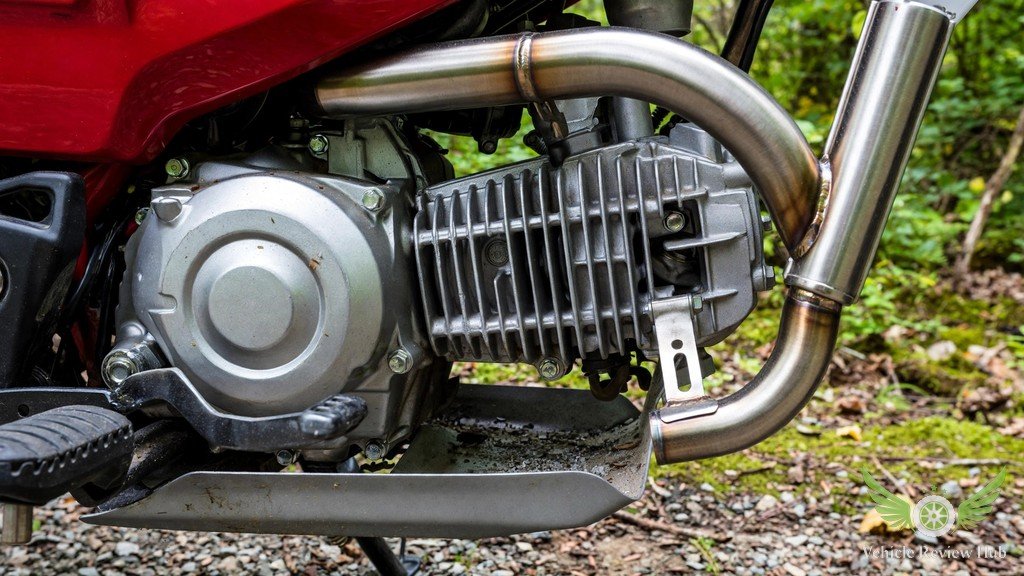
Cycle World dyno, Gen 1: 7.9 HP at 5,710 RPM is the only verified dyno figure in this Honda Trail 125 performance guide, and it is worth stating exactly. Cycle World ran a 2021 Gen 1 bike on its in-house dyno and measured 7.9 horsepower at 5,710 rpm and 7.4 lb-ft of torque at 4,650 rpm. The engine behind that figure is the Gen 1 unit: a 124.9cc air-cooled SOHC two-valve single, 52.4 by 57.9 mm, 9.3:1 compression, fed by PGM-FI fuel injection, with a four-speed semi-automatic gearbox and a #420 chain. Honda USA publishes no horsepower or torque figure for any Trail year, so this Honda Trail 125 performance guide never prints a Honda power number. In practice: the Trail pulls cleanly away from a stop, feels willing to about 40 mph, and then runs out of breath exactly where a 124cc utility bike should.
Honda’s 8.8 HP Is a Claim, Not a Tested Figure
Honda’s 8.8 HP is a claim, not a tested figure is the correction this Honda Trail 125 performance guide insists on, because the 8.8 figure is quoted constantly without its source. Press coverage of Honda’s claim puts it at about 8.7 to 8.8 horsepower — the variance is press rounding of one claim, not two different figures. The two numbers must never be averaged: Cycle World’s 7.9 hp is a measured rear-wheel figure on a Gen 1 bike, and 8.8 hp is a claim. This Honda Trail 125 performance guide uses 7.9 hp whenever a measured figure is needed and labels 8.8 hp as a claim whenever it appears. The Gen 2 engine, from 2023, is a different unit — 124cc, 50.0 by 63.1 mm, 10.0:1 compression, the Super Cub’s long-stroke engine — with no Gen 2 dyno to prove it. For the service habits behind that delivery, see our Honda Trail 125 reliability guide.
| Engine item | Gen 1 (2021–2022) | Gen 2 (2023–present) |
|---|---|---|
| Displacement / bore × stroke | 124.9cc / 52.4 × 57.9 mm | 124cc / 50.0 × 63.1 mm |
| Compression / gearbox | 9.3:1 / 4-speed semi-automatic | 10.0:1 / 4-speed semi-automatic |
| Verified dyno (Cycle World) | 7.9 hp @ 5,710 / 7.4 lb-ft @ 4,650 | No Gen 2 dyno exists |
| Summary | Honda Trail 125 performance: Gen 1 measured | Gen 2 output untested, reported the same |
Honda Trail 125 Top Speed and Acceleration
Top speed and acceleration are the two questions every buyer asks first about Honda Trail 125 performance, and both have the same honest answer: tested numbers are modest, and no Gen 2 test exists to update them.

Cycle World Pinned It at 55 MPH on the Gen 1 Bike
Cycle World pinned it at 55 MPH on the Gen 1 bike is the attributed top-speed line this Honda Trail 125 performance guide stands behind. Cycle World pinned the throttle on a straightaway, in fourth gear, and recorded 55 mph on the Gen 1 bike — a tested figure, never presented here without the Gen 1 label. Owner and forum consensus fills in the rest of the picture: the Trail is happiest at 40 to 45 mph, 55 mph only flat-out, and 60 mph is not a Trail speed. The freeway verdict follows: the Trail is street-legal everywhere in the US, but sustained 55 mph running sits at the bike’s limit, and this Honda Trail 125 performance guide calls it freeway-shy throughout.
No Dyno or Test Exists for the 2023-On Engine
No dyno or test exists for the 2023-on engine is the negative finding this Honda Trail 125 performance guide states plainly, because it is the easiest fact in this guide to get wrong by omission. No dyno, no instrumented top-speed test, and no instrumented 0-60 test for the Gen 2 engine was found as of November 2026. Tester reports say the Gen 2 engine’s peak output is the same as the Gen 1’s, but a report is not a test, and this Honda Trail 125 performance guide will not convert it into one. Verified acceleration feel: willing off the line in town traffic, steady through the short gears, slow to wind out after that. The fourth gear on the Trail does not make it fast — it makes fourth gear a calmer cruising gear, which is the more useful gain for Honda Trail 125 performance in daily use. Motorcyclist’s MC Commute review of the 2021 bike reaches the same verdict from the saddle: a pleasing ride around town, with the engine’s limits honestly on display.
Honda Trail 125 Mileage and Fuel Economy
Mileage is the Trail’s superpower with a catch: a small tank, a sipping engine, and a range answer that depends entirely on which figure you believe. This Honda Trail 125 performance guide keeps all three figures separate.

Cycle World Measured 112 MPG Over 60.5 Miles
Cycle World measured 112 MPG over 60.5 miles is the heading this Honda Trail 125 performance guide keeps verbatim, because the figure is measured and its limits must stay visible. Cycle World burned 0.541 gallon over 60.5 miles on the Gen 1 bike — 112 mpg by division, with a 159-mile range to empty at that rate. On the 1.4-gallon tank, that measured rate is the honest planning number. This Honda Trail 125 performance guide never uses the Grom’s 160.5 mpg figure, the Monkey’s 162.6 mpg figure, or the Dax’s 106.7 mpg estimate for the Trail, and never averages the Trail’s figures with anyone else’s. Honda’s 2026 Trail page confirms the spec list, including what it does not publish.
Honda Publishes No MPG: 220 Miles Is a Range Claim
Honda publishes no MPG: 220 miles is a range claim is the heading this Honda Trail 125 performance guide keeps verbatim — with the same honest labelling as the dyno heading. Honda’s spec sheets print “TBD MPG” for the Trail: no published MPG figure exists. What Honda does advertise is range: “up to 220 miles per fill-up.” Divide 220 by the 1.4-gallon tank and you get about 157 mpg of implied math — but that is division, not a Honda MPG figure, and this Honda Trail 125 performance guide never writes “Honda says 157 mpg.” Owner reports cluster around 110 to 115 mpg, and rough terrain or a heavy load drops range toward about 110 miles per tank. Practically: the Trail runs on regular gas, the 1.4-gallon tank costs a few dollars to fill, and riders plan fuel stops around 110 to 150 miles, not the claim’s 220-mile math.
| Fuel figure | Number | Honda Trail 125 performance note |
|---|---|---|
| Honda published MPG | None (“TBD MPG”) | No Honda MPG figure exists to quote |
| Honda range claim | Up to 220 miles per fill-up | Claim only; ~157 mpg by division, never a Honda figure |
| Cycle World measured (Gen 1) | 112 mpg over 60.5 miles | 0.541 gal burned; 159-mile range to empty |
| Summary | Honda Trail 125 performance: plan on 110–150 miles | Never Grom, Monkey, or Dax MPG |
Honda Trail 125 Real-World Riding Performance
Real-world riding is where Honda Trail 125 performance earns its reputation — the bike is not fast, and does not pretend to be. Its proof is a thousand miles of gravel, not a dyno sheet.

RevZilla’s Alaska Trip Returned Over 110 MPG
RevZilla’s Alaska trip returned over 110 MPG is the durability proof this Honda Trail 125 performance guide leans on, because it is a real ride, not a laboratory number. RevZilla rode a 2021 Trail over 1,000 miles from Anchorage toward Deadhorse through gravel, dirt, rain, and mud, and the bike returned over 110 mpg for the trip. The Trail finished; the comparison CT90 died a quarter-mile from the goal. But the win was efficiency and reliability, not speed. RevZilla’s first ride of the 2021 bike makes the same point at smaller scale: an easy, charming, unhurried machine. For the buying decision behind this verdict, see our Honda Trail 125 buying guide.
Front ABS Caution on Rock and Gravel Descents
Front ABS caution on rock and gravel descents is the doc heading, kept verbatim — and this Honda Trail 125 performance guide attributes it as tester experience, never as a Honda warning. The Trail’s ABS is front-wheel only and non-switchable, with no IMU: the front 220 mm disc gets anti-lock protection, the rear 190 mm disc does not. On loose downhill descents, testers report the front ABS activating in a way that feels alarming at first — the lever pulses hard on gravel and rock. One tester describes it as initially alarming but ultimately saving the rider on a loose descent. The honest reading for Honda Trail 125 performance is that the system works as designed on pavement and behaves differently on loose surfaces, where a rider used to a rear brake and engine braking must adapt. It is a handling note, not a defect, and it belongs in every test ride on gravel.
Honda Trail 125 Handling, Braking and Stability
Handling on the Trail is light, low, and forgiving — the foundation of Honda Trail 125 performance at 256 pounds and a 31.5-inch seat. But the suspension is the honest limit of the whole bike.

Rear Brake Is a 190mm Disc Every Year: Not a Drum
Rear brake is a 190mm disc every year: not a drum is the heading this Honda Trail 125 performance guide keeps verbatim, because the error it corrects is everywhere. Aggregator guides misprint the Trail’s rear brake as a drum, sometimes on the same page that lists the disc correctly. Honda’s spec pages for every year say the same thing: a single 190 mm rear disc, no ABS, behind a single 220 mm front disc with front-wheel-only, non-switchable ABS and no IMU. This Honda Trail 125 performance guide never writes “rear drum” for the Trail. Chassis: 27 mm fork, twin shocks with 3.4 inches of travel, 80/90-17 tires, 27-degree rake, 3.1-in trail, 49.5-in wheelbase on 2025–2026 sheets, 6.5 inches of clearance. Fork travel carries a year variance worth labelling: 3.9 inches on Gen 1 and 2023 sheets, 4.3 inches on 2025–2026 sheets — this Honda Trail 125 performance guide prints the year-sheet figure for the year discussed and never smooths the difference away.
It Bottoms Hard If Pushed per ADVPulse Testing
It bottoms hard if pushed per ADVPulse testing is the doc heading, kept verbatim — and this Honda Trail 125 performance guide keeps the attribution attached. ADV Pulse’s review puts it plainly: if you ride it hard, it will bottom hard. The context is travel: 3.4 inches at the rear and 4.3 inches up front on current sheets is roughly a third of the travel on a similar-weight motocross bike, so whoop-bombing and hard jumps are not what this chassis is for. The Trail’s suspension is tuned for dirt roads, farm tracks, and light trails at modest speed, where it is comfortable and composed. Push it like a dirt bike and the stops arrive early and hard. For Honda Trail 125 performance, that is the line between the bike’s real job and its fantasy job — and the bike is honest about which one it does.
Honda Trail 125 Performance Compared With Other Small Dual Sports
Comparison is where Honda Trail 125 performance becomes a buying decision. The Trail’s rivals expose its limits quickly.

Honda Trail 125 vs Yamaha TW200 at $4,999
Honda Trail 125 vs Yamaha TW200 at $4,999 is a close fight on paper and a clearer one in the showroom, once prices are year-labelled. The 2026 Trail costs $4,199 plus $300 destination — $4,499 before tax — against the 2026 TW200 at $4,999, an $800 gap in the Trail’s favor before destination. The Trail answers with fuel injection against the TW200’s Mikuni 28 mm carburetor, a four-speed semi-automatic gearbox with no clutch lever against a five-speed manual clutch, and $800 less. The TW200 answers with a 196cc engine against 124cc, fat tires against the Trail’s 80/90-17 dual-sport rubber, and a real clutch for riders who want one. The video below is Motorcyclist’s MC Commute review of the 2021 Trail — honestly labelled as a ride review of the Gen 1 bike, not a Gen 2 test, and the clearest demonstration of what this Honda Trail 125 performance guide covers.
| Small bike (2026, year-labelled) | Price | Honda Trail 125 performance verdict |
|---|---|---|
| 2026 Honda Trail 125 | $4,199 + $300 | 4-speed semi-auto, FI, ~55 mph flat-out, 112 mpg measured (Gen 1) |
| 2026 Yamaha TW200 | $4,999 | 196cc, 5-speed manual clutch, carbureted, fat tires |
| 2026 Honda Monkey ABS 125 | $4,399 + $300 | 5-speed manual, solo seat, street retro, $200 more |
| 2026 Honda Dax 125 | $4,199 + $300 | Same price, different bike: bench seat, street style, 1.0-gal tank |
| Summary | Honda Trail 125 performance: utility per dollar, not speed | No maker here publishes power to rank |
Is the Honda Trail 125 Suitable for Beginner Riders? Yes
Is the Honda Trail 125 suitable for beginner riders? Yes — with the freeway and weight caveats this Honda Trail 125 performance guide has carried throughout. The case is strong: a 31.5-inch seat, 256 pounds, no clutch to learn, a gearbox that is nearly impossible to stall, and gentle, forgiving power. A motorcycle endorsement is required — the Trail is a full-class road motorcycle, not a scooter and not an off-road bike. Cycle News’ 2021 CT125 review agrees: about as unintimidating a motorcycle as you can buy. Two caveats ride along: freeway running is at the bike’s limit, and riders near the 265-pound maximum capacity must count gear. For the Dax’s own story, see our Honda Dax 125 performance guide. The last word on Honda Trail 125 performance is simple: the easiest, most charming way to ride a real motorcycle onto dirt roads without learning a clutch — as long as those roads are not freeways.
Honda Trail 125 Performance FAQs
Direct answers to the Honda Trail 125 performance questions buyers and new riders ask most, with every figure labelled by source and generation.
How much horsepower does the Honda Trail 125 make?
Cycle World measured 7.9 hp at 5,710 rpm on a Gen 1 bike, says this Honda Trail 125 performance guide. Honda USA publishes no figure, and the 8.8 hp figure is a claim, not a measurement. No Gen 2 dyno exists.
What is the Honda Trail 125 top speed?
55 mph flat-out on the Gen 1 bike per Cycle World, says this Honda Trail 125 performance guide — happiest at 40 to 45 mph, and 60 mph is not a Trail speed.
What is the Honda Trail 125 0-60 time?
No instrumented 0-60 test exists, says this Honda Trail 125 performance guide. No tested 0-60 mph figure exists for either generation, and none is printed here.
What MPG does the Honda Trail 125 get?
Cycle World measured 112 mpg over 60.5 miles on the Gen 1 bike, says this Honda Trail 125 performance guide. Honda publishes no MPG figure — its “up to 220 miles” is a range claim, not an MPG figure.
How far can a Trail go on a tank?
About 159 miles at Cycle World’s measured 112 mpg, says this Honda Trail 125 performance guide — measured math from the 1.4-gallon tank, not Honda’s 220-mile claim. Plan fuel stops around 110 to 150 miles.
Does the Trail have a clutch lever?
No, says this Honda Trail 125 performance guide — a four-speed semi-automatic gearbox with a centrifugal automatic clutch and a heel-toe foot shifter. There is nothing for the left hand to do.
Is the Trail semi-automatic or manual?
Semi-automatic, says this Honda Trail 125 performance guide. The rider shifts gears with a foot lever, but the clutch engages automatically — never call it a manual gearbox.
Does the Trail have ABS?
Yes on the front wheel only, says this Honda Trail 125 performance guide — a single 220 mm front disc with non-switchable ABS, no IMU, and no ABS on the 190 mm rear disc.
Does the Trail have a rear drum brake?
No, says this Honda Trail 125 performance guide — the rear brake is a 190 mm disc every year. Aggregator guides that print “rear drum” are wrong.
Is the Trail good for beginners?
Yes, says this Honda Trail 125 performance guide, with the freeway and weight caveats: a 31.5-inch seat, light weight, no clutch, and gentle power make it a genuine first bike for town, back-road, and light-trail riding.
Is the Trail street legal?
Yes, says this Honda Trail 125 performance guide — a full-class road motorcycle, street-legal everywhere in the US with a motorcycle endorsement. It is not an off-road-only bike and not a scooter.
How much does the 2026 Trail cost?
Honda Trail 125 performance value starts at $4,199 for the 2026 bike plus $300 destination — $4,499 total — in Glowing Red or Black Metallic, against the TW200 at $4,999.