Yes, the Honda Transalp XL750 is reliable — with two qualifications. Its 755cc twin, gearbox and frame come from Honda’s proven middleweight platform, and the expensive failures owners fear most are rare — but soft suspension and an exposed sump on 2024–2025 bikes are real weaknesses, and one recall needs a VIN check. This guide to Honda Transalp XL750 reliability covers owner data, known problems, service schedule, tires and brakes, costs, and the recall to check.
The short version of Honda Transalp XL750 reliability is simple: buy on history and paperwork, not on a star rating. A service file, a suspension test, a sump inspection and a VIN lookup tell you more about Honda Transalp XL750 reliability on one bike than any averaged score.
Honda Transalp XL750 Reliability Overview
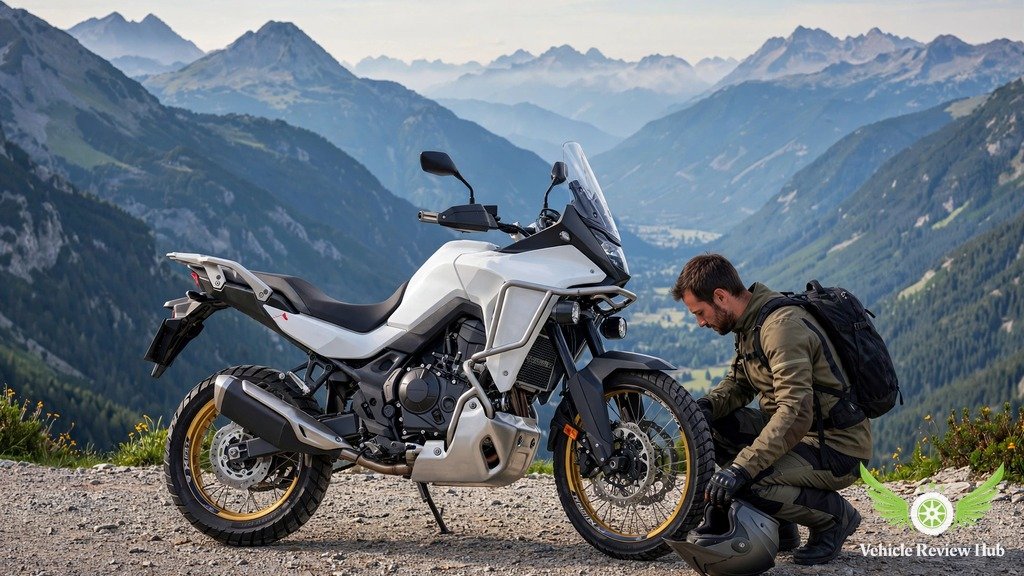
Honda Transalp XL750 reliability starts from a strong base: the 755cc Unicam parallel twin with a 270-degree crankshaft, the six-speed gearbox and the steel diamond frame are shared with the CB750 Hornet platform in production since 2023, with the Transalp adding long-travel suspension, a 21-inch front wheel and adventure bodywork. For Honda Transalp XL750 reliability, the powertrain is the least of your worries; suspension, sump and tubed tires deserve the attention.
MCN Reliability 4.4 Out of 5 From Only 14 Owners Explained
MotorCycle News lists an owners’ reliability rating of 4.4 out of 5 for the Honda XL750 Transalp — but only 14 owners had reviewed the bike on MCN’s platform. Fourteen reviews cannot support a decimal-point score, and one unhappy owner joining tomorrow would move the figure. That is why this guide refuses to present 4.4 out of 5 as a measurement of Honda Transalp XL750 reliability: it is a small-sample snapshot, not a verdict. For Honda Transalp XL750 reliability, treat any quoted owner score as a hint until the sample reaches the dozens at least. MCN’s own long-term test is more useful: its 2023 test bike covered 4,576 miles over a year of mixed riding, praising the bike’s all-round ability while noting the suspension’s limits, and MCN lists annual servicing at £140, a UK figure. The full Transalp review covers the ride.
Watch a real-world comparison on Transalp running costs. The video below compares the 2026 Transalp E-Clutch with the Africa Twin DCT, with chapters on maintenance and tubed versus tubeless wheels — useful Honda Transalp XL750 reliability context, though a comparison test, not a guide.
How Mileage, Maintenance History and Previous Use Affect Reliability
Mileage alone tells you little about Honda Transalp XL750 reliability: a 30,000-mile Transalp with dealer stamps every 8,000 miles, valve receipts at 16,000 miles and a completed recall check is usually safer than a 5,000-mile bike that sat unridden and missed services. Service history matters more than the odometer because the expensive items — valve checks, fork work, suspension upgrades — are interval-driven, so ask for receipts. Previous use matters too: touring bikes show even wear, hard off-road bikes show bent levers, dented rims and a scraped sump. For Honda Transalp XL750 reliability, the file beats the odometer every time.
Honda Transalp XL750 Common Problems and Wear Items
Honda Transalp XL750 reliability has no single defining engine fault: its known problems are chassis and equipment items — soft suspension, an unprotected sump, tubed tires and fussy electronics — plus one genuine recall.
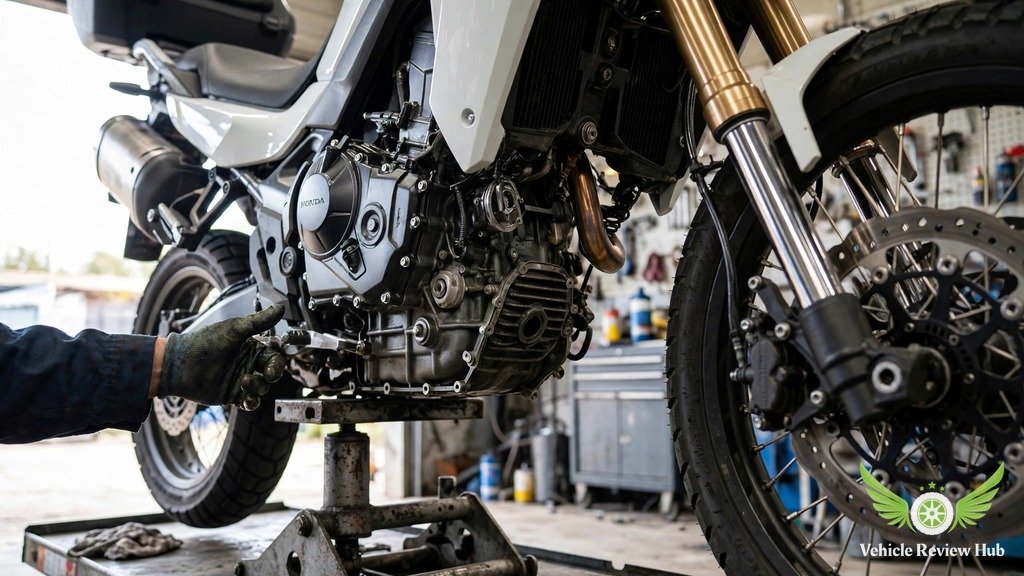
Soft Preload-Only Suspension on 2024-2025 and Exposed Sump Before 2026
The suspension is the best-documented Transalp weakness for Honda Transalp XL750 reliability. On 2024–2025 bikes the 43mm Showa SFF-CA fork and Pro-Link shock adjust for preload only — fork through 15 turns with a 19mm wrench, shock through 7 positions — with no compression or rebound damping adjustment at all. Testers consistently found the setup soft once the pace rises off-road, with the rear shock the primary complaint: riders report near-maximum preload still feeling marginal on rough back roads. That softness is a comfort and control issue, not a failure, but it drives the most common Transalp purchase after the bike itself: an aftermarket shock. The 2026 model answers it directly, with compression and rebound damping adjusters front and rear, as Rider’s 2026 preview confirms. The sump tells a similar year-split story: before 2026 it sits exposed, and reviewers flagged a guard as a necessary accessory, while for 2026 Honda fits a 2.5mm aluminum skid plate as standard. For Honda Transalp XL750 reliability, the buying rule is plain: on a 2024–2025 bike, check the sump for dents and budget for a guard; on a 2026 bike, check the plate is still fitted and undamaged.
Chain, Sprockets, Tubed Tires, Battery and Electrical Checks
The chain affects day-to-day Honda Transalp XL750 reliability more than any engine part: Honda calls for lubrication and slack checks every 600 miles, with slack at 50–55mm measured from the upper chain run to the end of the slider. A dry or uneven chain wears sprockets fast, so replace chain and sprockets as a set. The tubed tires are the other everyday item: the 21-inch front and 18-inch rear spoked wheels use tube-type tires, so a puncture cannot be plugged at the roadside the way a tubeless tire can — the wheel must come off. Owners who ride far from help commonly carry spare tubes and levers, and some pay for an expensive Africa Twin tubeless rim swap. Electrically, check battery condition, all lights and indicators, horn, and the TFT display’s menus: testers call the interface busy, and switching traction control and ABS off for dirt is a chore that must be repeated after every key cycle. Other niggles include a soft, wrongly shaped seat, a weak headlight throw, a plastic heat shield that can snag clothing, and no cruise control on any year including 2026. For Honda Transalp XL750 reliability, none of these strands the bike, but all belong on a used-bike checklist.
Honda Transalp XL750 Maintenance Schedule and Servicing
The factory schedule is the backbone of Honda Transalp XL750 reliability. It is a simple, long-interval schedule — oil every 8,000 miles, valves every 16,000 — which is part of why the bike’s running costs stay low.

First Service at 600 Miles, Oil Every 8,000 Miles and Routine Checks
Engine oil changes fall every 8,000 miles or 1 year, whichever comes first, after an initial service at 600 miles: the single most important habit for Honda Transalp XL750 reliability. The manual specifies Pro Honda GN4 10W-30, the oil filter changes at 600, 16,000 and 32,000 miles — not at every oil change — and each service’s checklist covers fuel lines, throttle and clutch free play, cooling, brakes, suspension, lights, bearings and fasteners. See the XL750 Transalp maintenance schedule compiled from the owner’s manual. Skipped oil services are the fastest way to damage Honda Transalp XL750 reliability, and dusty or wet riding shortens every interval in practice.
| Item | Interval | Notes |
|---|---|---|
| First service | 600 miles | Initial service |
| Engine oil | Every 8,000 miles or 1 year | Pro Honda GN4 10W-30 |
| Oil filter | 600 / 16,000 / 32,000 miles | Not every oil change |
| Valve clearance | Every 16,000 miles | Adjust if needed |
| Air filter | Every 16,000 miles | More often if dusty / wet |
| Spark plugs | Inspect 16,000; replace 32,000 miles | NGK SILMAR8A9S, gap 0.8–0.9 mm |
| Chain lube + slack | Every 600 miles | Slack 50–55 mm, upper run to slider |
| Brake fluid | Every 2 years | Honda DOT 4 |
| Radiator coolant | Every 3 years | Replace |
Valve-Clearance Inspection Every 16,000 Miles and Air Filter Changes
Valve clearance is the small camshaft-to-valve gap, which changes slowly as valves and seats wear; the manual calls for inspection every 16,000 miles, with no time-based component, adjusting only valves outside specification. Treat a used Transalp approaching 16,000 or 32,000 miles without a valve receipt as a bike with a bill coming. The air filter is replaced every 16,000 miles too — more often after dusty or wet riding — and access requires fuel-tank removal, which is why one long-term tester found the second service pricier than expected. Spark plugs are inspected at 16,000 miles and replaced at 32,000. Valve and filter receipts at the right intervals tell you more about Honda Transalp XL750 reliability on one bike than any advert.
Honda Transalp XL750 Tires, Brakes and Suspension Maintenance
Tires, brakes and suspension maintenance is where Honda Transalp XL750 reliability becomes safety: spoked wheels, long-travel suspension and big discs all need checks done on time.
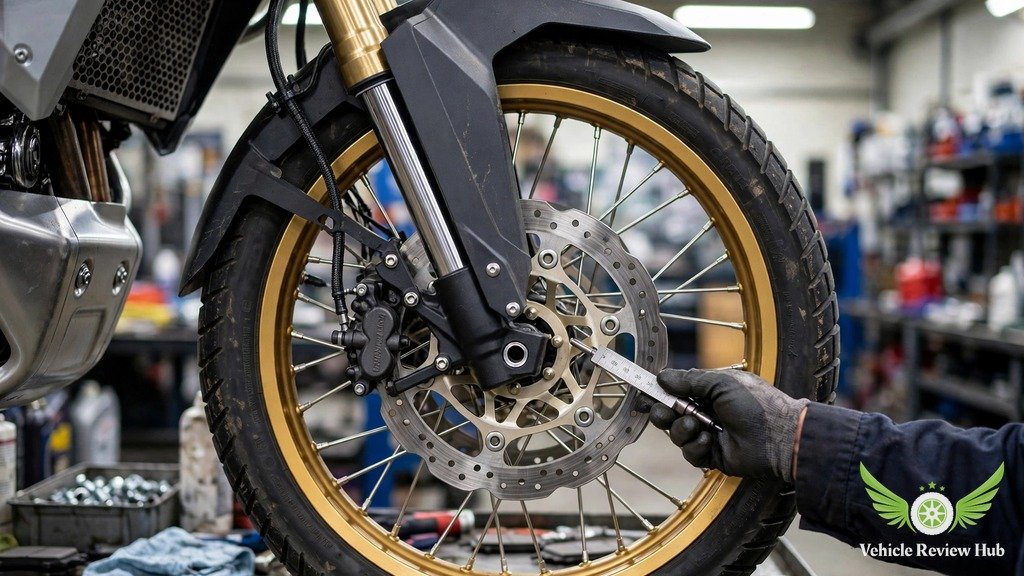
Tire Condition, Pressure, Tread Wear and Tube Replacement
Pressures run 33 psi front and 36–41 psi rear (cold), with the rear rising with load, and should be checked cold before every long ride — critical for Honda Transalp XL750 reliability when the bike carries luggage. Stock rubber is the Metzeler Karoo Street or the Dunlop Mixtour, and condition should be checked at every service, including the inner tube when a tire is changed. On tube-type wheels, replace tires with a tube inspection — a pinched tube at fitting is a known error — and check spokes for looseness and rims for dents at the same time. The MCN Transalp review confirms the tube-type setup and 21-inch front wheel. For Honda Transalp XL750 reliability, worn tubes and underinflated tires are the most common avoidable problems.
Brake Pads, Brake Fluid Every Two Years, Forks and Shock Checks
Brake fluid is replaced every 2 years regardless of mileage, because it absorbs moisture, which lowers its boiling point and corrodes internals; the manual specifies Honda DOT 4. Brake pad wear is checked at every service, with 1mm as the minimum pad thickness. The dual 310mm front discs and single 256mm rear disc stop strongly, but scored discs or a stuck caliper slide pin should be caught early. Forks and shock are checked for leaks, seal condition and correct action at each service; on 2024–2025 bikes confirm preload matches rider weight, and on 2026 bikes confirm the new adjusters move freely. For Honda Transalp XL750 reliability, fork seals and shock condition surprise buyers: a weeping seal is cheap if caught, expensive if ignored.
Honda Transalp XL750 Maintenance and Ownership Costs
Ownership costs are a genuine strength of Honda Transalp XL750 reliability: a simple schedule, shared platform parts, and a big dealer network keep routine costs lower than European rivals.
Fuel, Routine Servicing, Tires and Replacement Parts
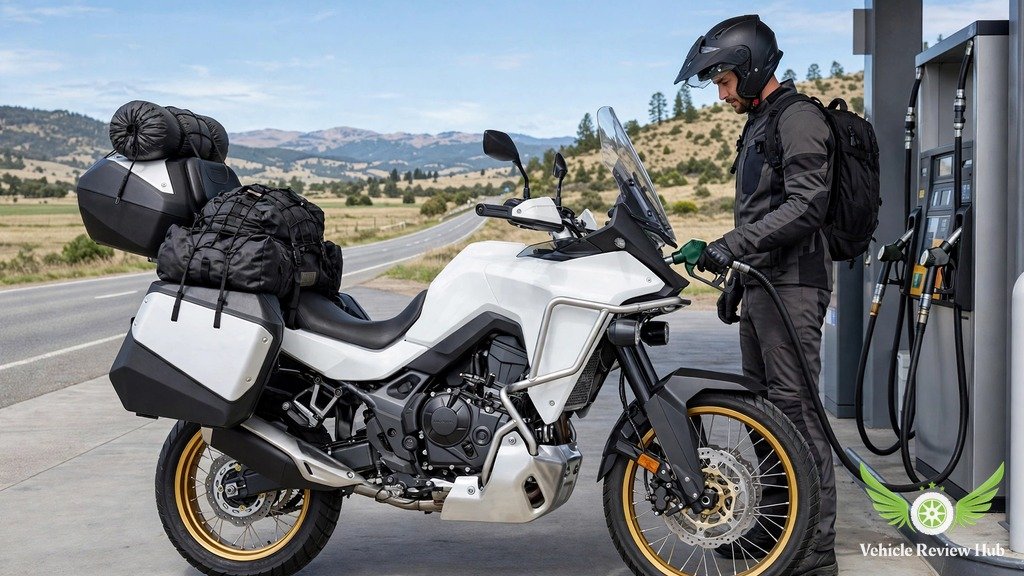
Honda USA publishes no MPG for the Transalp, so work fuel cost from owner reports: long-term testers have averaged around 50 mpg (US equivalent, converted from about 21 km/l) on mixed riding, giving roughly 200 miles with reserve from the 4.5-gallon US tank — a guide, not a guarantee, because the Transalp performance figures show how much riding style moves the number. Routine servicing runs a few hundred dollars at a US dealer per visit, with the 16,000-mile valve service the pricier one; MCN’s £140 figure is a UK number, not a US price. Tires are the recurring consumable: budget for a set plus tubes roughly every 8,000–12,000 miles. For Honda Transalp XL750 reliability, the cost message is consistent: cheap to service, moderate on tires, no exotic parts.
Repair Expenses, Parts Availability and Long-Term Ownership Costs
Long-term Honda Transalp XL750 reliability is helped by parts commonality: the 755cc engine and many chassis parts are shared with the CB750 Hornet, so consumables are widely stocked. The expensive repairs are owner-caused by neglect: a dented sump that cracks the casing, a chain run to failure, or a valve service skipped until clearances close. A 2024 Transalp bought new for $9,999 holds its value well against the 2026 E-Clutch price of $10,199 plus $600 destination, so depreciation is gentle. For Honda Transalp XL750 reliability, the long-term bill is dominated by tires, chains and the 16,000-mile services — all predictable.
How to Keep a Honda Transalp XL750 Reliable
Keeping a Transalp reliable is a short list: oil on time, chain every 600 miles, pressures before every ride, recall check before every purchase.

Preventive Maintenance, Chain Care Every 600 Miles and Inspections
Preventive maintenance for Honda Transalp XL750 reliability means following the schedule exactly plus three habits: chain lubrication and slack checks every 600 miles, cold tire pressures before every long ride, and a pre-ride walk-around for oil weeps, coolant level, brake feel and fork seal leaks. Wash the bike after muddy or salty rides, fit a sump guard on 2024–2025 bikes, and use a tender if it sits for weeks. The chain habit deserves emphasis: a well-lubed chain with correct slack is the cheapest way to protect Honda Transalp XL750 reliability, and the most skipped one. Keep a service log even for DIY work — receipts and dates are what a future buyer trusts.
Recall Check: Crankcase Bolt Oil Leak 25V358 and VIN Confirmation
The recall that matters for Honda Transalp XL750 reliability is NHTSA 25V358, the crankcase sealing-bolt oil leak. Certain 2024 XL750 Transalps were covered: a 22mm sealing bolt (oil pressure switch sealing bolt, part number 90048-MFL-000) was improperly machined, so oil can seep past it and splash onto the rear tire, reducing traction. American Honda issued a stop-sale on May 27, 2025, with owner letters in July 2025; bikes built on or after February 17, 2025 have correct parts. The remedy is free sealing-bolt replacement at a Honda Powersports dealer, under Honda campaign KS2. One figure must be quoted carefully: the roughly 1,016 motorcycles in the recall population is the multi-model total across the CB750, XL750, CMX1100, CRF1100 and NT1100 combined — not a Transalp-only count. RideApart’s recall coverage confirms the multi-model scope and the July 2025 letters. For Honda Transalp XL750 reliability, the only answer that counts for a given bike is its VIN: check it on Honda’s recall lookup or with a dealer before money changes hands, and confirm any open recall is closed in writing. The Transalp buying guide walks through the full used-bike checklist, and the Africa Twin reliability record shows the same recall-check habit on Honda’s bigger adventure twin.
Honda Transalp XL750 Reliability FAQs
These answers cover what buyers ask about Honda Transalp XL750 reliability — recall, suspension, service costs, tires and model years.
Is the Honda Transalp XL750 reliable?
Yes, on the evidence available for Honda Transalp XL750 reliability: its powertrain and frame come from Honda’s proven 755cc platform, owner feedback is positive, and no widespread engine defect has emerged. The caveats are soft 2024–2025 suspension, the exposed pre-2026 sump, tubed tires and the 25V358 recall check — all manageable, none a reason to avoid the bike.
What is the MCN reliability rating for the Transalp?
MotorCycle News lists 4.4 out of 5 for owners’ reliability, but from only 14 owners — too small to treat as a measurement. Treat it as a positive hint for Honda Transalp XL750 reliability, and judge any individual bike by its service history and a VIN recall check instead.
What is recall 25V358 on the Transalp?
Recall 25V358 covers certain 2024 XL750 Transalps with an improperly machined 22mm crankcase sealing bolt that can leak oil onto the rear tire. The fix is a free bolt replacement under Honda campaign KS2. The roughly 1,016-unit figure is the multi-model total, not Transalp-only. For Honda Transalp XL750 reliability, check any bike’s VIN before buying.
Does the Transalp have tubeless tires?
No. The 21-inch front and 18-inch rear spoked wheels use tube-type tires, so a puncture needs the wheel removed and the tube repaired or replaced — for Honda Transalp XL750 reliability on long trips, carry tubes and levers, or budget for a tubeless rim conversion.
How often does the Transalp need an oil change?
Every 8,000 miles or 1 year, whichever comes first, after the initial 600-mile service, using Pro Honda GN4 10W-30 — the single most important habit for Honda Transalp XL750 reliability. The oil filter changes at 600, 16,000 and 32,000 miles.
When does the Transalp need a valve clearance check?
Every 16,000 miles, with no time component — inspection at 16,000 and 32,000 miles, adjusting only valves outside specification. A used bike near those mileages without a valve receipt has a bill coming, and that receipt is part of Honda Transalp XL750 reliability on any used example.
Is the 2024–2025 suspension really too soft?
For road touring and light gravel it is fine, but testers found it soft off-road, with the rear shock the main complaint, and it adjusts for preload only. If you ride rough terrain, budget for an aftermarket shock, or choose the 2026 model with fully adjustable suspension — the cleanest fix for Honda Transalp XL750 reliability off-road.
What changed on the 2026 Transalp for reliability?
Three things that matter for Honda Transalp XL750 reliability: E-Clutch as standard, fully adjustable suspension front and rear, and a 2.5mm aluminum skid plate as standard protecting the previously exposed sump. The 2026 price is $10,199 plus $600 destination, with a 468 lb curb weight.
How much does Transalp servicing cost?
Routine dealer visits run a few hundred dollars in the US, with the 16,000-mile valve service the pricier one. MCN’s £140 figure is a UK number, not a US price. Tires and chains are the main recurring consumables for Honda Transalp XL750 reliability.
Does the Transalp have cruise control?
No — cruise control is absent on every Transalp year, including 2026, and it cannot be retrofitted from Honda; it is a comfort gap, not a Honda Transalp XL750 reliability issue.
What should I check before buying a used Transalp?
Five checks: 25V358 recall status by VIN, a full service file including valve receipts, sump condition on 2024–2025 bikes, chain and sprocket wear, and a suspension test for bottoming. A clean file on all five is the best predictor of Honda Transalp XL750 reliability.
How long will a Transalp engine last?
With on-schedule oil changes, valve checks and chain care, the 755cc twin should comfortably exceed 50,000 miles and often far more — Honda’s middleweight twins have a long high-mileage record, helped by the Transalp’s low-stress tuning. Frame, suspension and electrics will need attention long before the engine does — which is why Honda Transalp XL750 reliability is really a chassis story.