Short answer: the Honda XR650L is the last of the old-school big dual-sports — a 644cc air-cooled single, a carburetor, a five-speed gearbox, and almost nothing electronic — and this Honda XR650L review judges it on exactly those terms. The 2025 model costs $6,999 plus a $600 destination charge, carries a 37.0-inch seat, weighs 346 pounds with a full tank, and has been on sale in the United States since 1993 with barely a change. If you want modern electronics, a low seat, or a big fuel tank, this Honda XR650L review will tell you to look elsewhere. If you want a simple, street-legal dirt bike that you can fix with hand tools, the XR650L is still one of the few new motorcycles that fits that description.
Honda XR650L Overview and Model-Year Updates
This Honda XR650L review starts with what the bike is, because its name invites confusion with two very different Hondas.
What Is the Honda XR650L and Who Is It Designed For?
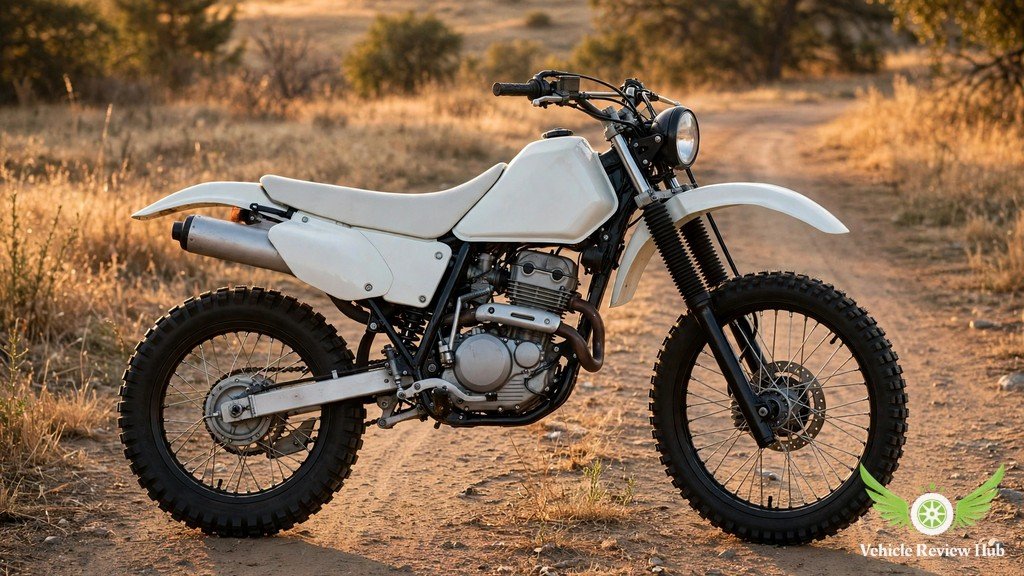
The Honda XR650L is a street-legal dual-sport motorcycle: a dirt bike with lights, mirrors, turn signals, a horn, a license-plate light, and a speedometer, so it can be ridden to the trail legally and ridden home again. It is designed for riders who split their time between pavement and dirt — fire roads, desert two-track, and back roads — and who value simplicity over speed. The engine is a big single cylinder, which means strong low-end pull, noticeable vibration, and a narrow powerband compared with a modern twin. This Honda XR650L review is written for the buyer who already knows what a dual-sport is and wants to know whether this particular dinosaur still makes sense in 2025. It is not a beginner’s first motorcycle in the usual sense: the 37-inch seat alone rules out many shorter riders, and the 346-pound weight is a lot to pick up on a trail. It is, however, one of the easiest big bikes to own, because there is so little on it that can break.
US History Since 1993: Almost Unchanged and No 2026 Model
The XR650L arrived in the United States for the 1993 model year at $4,399, and this Honda XR650L review can confirm the remarkable part of that story: the 2025 bike is, in mechanical terms, the same motorcycle. Dirt Bike Magazine’s 2025 test wrap puts it bluntly — same carburetor, same motor, same frame — with only a colour change and some minor second-year details separating the new bike from the original. Honda combined the dirt-only XR600R chassis with the electric-start 644cc engine from the NX650 Dominator to create the XR650L, and then, in Dirt Bike’s phrase, never altered the tooling in 32 years. Colours rotated between red and white over the years, and the bike is still built in Japan, which is unusual at this price. One point this Honda XR650L review states carefully: Honda’s current United States listing is the 2025 model, and no 2026 XR650L was announced in the sources checked for this article, which matches the doc heading’s “No 2026 Model” claim. If Honda later adds a 2026 bike, it would almost certainly be the same motorcycle again, and this Honda XR650L review’s conclusions would still apply.
Honda XR650L Engine and Specifications
The specification sheet of this Honda XR650L review is short, because Honda has had three decades to stop changing it.

644cc Air-Cooled Dry-Sump RFVC Single With a 42.5mm Carburetor
At the heart of this Honda XR650L review is a 644cc air-cooled single-cylinder four-stroke with Honda’s Radial Four-Valve Combustion Chamber, or RFVC, head — four valves arranged radially around the combustion chamber, operated by a single overhead camshaft. Bore and stroke are 100.0mm by 82.0mm, compression is a relaxed 8.3:1, and fuel is delivered by a 42.5mm diaphragm-type CV carburetor, not fuel injection. The gearbox is a five-speed manual, and final drive is a #520 O-ring-sealed chain with 15-tooth front and 45-tooth rear sprockets. The engine is a dry-sump design, which matters for the next section: the oil lives in the frame, not in a sump under the engine. Honda publishes no horsepower figure for the XR650L, so this Honda XR650L review presents none as a factory claim. Web figures of roughly 40 horsepower and 47 pound-feet of torque circulate widely — RevZilla’s 30-year retrospective says the bikes “produce roughly 40 horsepower” — but those are unlabelled estimates, not Honda numbers, and this Honda XR650L review treats them that way. What matters more than the peak figure is the character: a big single with a gear-driven counterbalancer, tuned for torque at low revs, happy to lug along a trail in a tall gear.
37-Inch Seat Height, 13-Inch Clearance and 346 lb Curb Weight
The numbers that define daily life with this bike are the tall ones. Seat height is 37.0 inches, ground clearance is 13.0 inches, wheelbase is 57.3 inches, and curb weight is 346 pounds including all fluids and a full tank — all from Honda’s own 2025 specification page. The fuel tank holds just 2.8 gallons, which is the bike’s most obvious practical limit and the reason most owners fit a larger aftermarket tank. Suspension travel is genuinely generous: an 11.6-inch 43mm Showa cartridge fork up front and an 11.0-inch Pro-Link Showa single shock at the rear, both adjustable. Brakes are a single 256mm front disc with a twin-piston caliper and a single 220mm rear disc, with no ABS. Tires are 3.00-21 front and 4.60-18 rear. Rake is 27.0 degrees with 4.0 inches of trail. Warranty is a transferable one-year limited warranty, with HondaCare extended coverage available. This Honda XR650L review notes the trade the numbers describe: huge clearance and travel, bought with a seat that many riders cannot flat-foot and a tank that needs frequent stops.
| Specification | 2025 Honda XR650L |
|---|---|
| Engine | 644cc air-cooled SOHC single, RFVC 4-valve head |
| Fuel delivery | 42.5mm CV carburetor (no fuel injection) |
| Gearbox / final drive | 5-speed manual / #520 O-ring chain, 15T/45T |
| Seat height | 37.0 inches |
| Ground clearance | 13.0 inches |
| Curb weight | 346 lb (full tank) |
| Fuel capacity | 2.8 gallons |
| Suspension travel | 11.6 in front / 11.0 in rear |
| Brakes | 256mm front / 220mm rear discs, no ABS |
| MSRP + destination | $6,999 + $600 |
Those figures frame this Honda XR650L review’s value case: a mechanically simple motorcycle whose specification sheet has not needed rewriting since the 1990s.
Honda XR650L Price and Market Availability
Price is the XR650L’s second-biggest selling point after its simplicity, and this Honda XR650L review starts with the current sticker price.

Honda XR650L Price in the USA: $6,999 for 2025 Plus $600 Destination
Honda’s 2025 United States pricing, confirmed on the manufacturer’s own specification page for this Honda XR650L review, is $6,999 plus a $600 destination charge — $7,599 before tax, title, and dealer fees. That price has been strikingly stable: the bike was $6,999 in 2021, 2023, and 2025, and Dirt Bike Magazine notes that in real money the 2025 bike is actually cheaper than the $4,399 original from 1993. At $6,999 it remains the most affordable new Honda over 500cc, and one of the cheapest street-legal dual-sports of any size. Shoppers should still read the destination line carefully, since some dealer advertisements fold freight and setup into an “all-in” price, and discounted leftover 2025 bikes have been advertised below MSRP in November 2026 listings checked for this Honda XR650L review. For the full performance picture behind that price, see our companion XR650L performance coverage.
White Only Since 2022 and Official US Dealer Availability
For 2025, Honda lists the XR650L in White only, a single colour for a single trim — there are no trim levels to choose between. Earlier years rotated through red and white schemes, and the white-only run since 2022 fits the bike’s no-options character: you pick the bike, not a package. Availability is straightforward: it is a current, regular-production Honda sold through official United States dealers, and leftover 2025 stock was still being advertised by dealers in November 2026 while this Honda XR650L review was researched. Because the bike has barely changed, a leftover new bike and a current-year bike are effectively the same purchase, which makes end-of-year discounts worth chasing. Our companion XR650L buying guide covers used prices and inspection in detail.
Honda XR650L Design, Features and Technology
Design is where this Honda XR650L review finds the bike most alien to a modern rider — and most appealing to its fans.

Steel Frame Doubles as the Oil Tank and There Is No Oil Cooler
The XR650L’s steel-tube frame does double duty as the engine’s oil tank, which is what “dry-sump” means in practice on this bike: oil is stored in the frame and pumped to the engine, rather than sitting in a sump underneath it. That keeps the engine compact vertically and protects the oil supply on rough ground, but it also means the oil level must be checked by Honda’s specific procedure — a point our companion XR650L reliability coverage explains in full. There is no oil cooler: the air-cooled engine sheds heat through its fins and the frame, which is adequate for trail and back-road riding but one reason the bike is not a high-speed touring machine. The frame also carries the emissions “octopus” — an air pump for emissions control that several companies sell eliminator kits for, though Dirt Bike Magazine notes it has no effect on performance. The exhaust carries a USFS-approved spark arrestor from the factory, which matters for riding on government land. Everything about the chassis says 1993: steel where modern bikes use aluminum, a conventional fork where modern bikes use inverted forks, and bodywork that is minimal because there was never anything to cover up.
Electric Start Only: No ABS, No Fuel Injection, No Ride Modes, Ever
The instrument panel in this Honda XR650L review is an analog speedometer with an odometer on the left and warning lamps on the right. There is no tachometer, no fuel gauge beyond a reserve tap, no digital display of any kind, and no ride modes, traction control, or ABS — ever, on any year of the XR650L. Starting is by electric starter only: there is no kick starter, a deliberate break from the XR600R that donated the chassis, and a sealed battery provides the cranking power. Fuel delivery is the 42.5mm carburetor with a manual choke lever that must be used until the engine warms up, which Dirt Bike Magazine’s 2025 testers found takes a while. That simplicity is the whole point for this Honda XR650L review’s buyer: there are no sensors to fail, no software to update, and no rider aids to diagnose. The cost is equally plain: cold starts need patience, altitude changes need carburetor attention, and braking in the wet is entirely the rider’s job.
Honda XR650L Riding Experience and Comfort
On the road and the trail, this Honda XR650L review finds a motorcycle that feels like 1993 in ways both good and bad.

Riding Position, Tall Seat and Low-Speed Trail Manners
The riding position is tall, upright, and unmistakably from another era: a wide, deep, cushy saddle that climbs steeply over the tank, a low steel handlebar, and high footpegs. Dirt Bike Magazine’s 2025 testers describe the position as “nothing like a modern bike,” and this Honda XR650L review agrees — the ergonomics reward a tall rider and punish a short one. At low speed on a trail, the bike’s virtues show: the big single pulls cleanly from low revs, the long-travel suspension absorbs rocks and ruts, and the 13 inches of clearance let it cross obstacles that stop lower dual-sports. The vices show just as quickly: the footpegs are about an inch wide and can be felt through boots, the stock dual-sport tires are street-biased and should be replaced for serious dirt work, and the 346-pound weight is hard to manhandle in soft ground or when picking the bike up. Passenger duty is possible — Honda fits a grab strap, folding passenger pegs, and a long saddle — but this Honda XR650L review treats it as occasional transport, not touring comfort.
Highway Comfort, Vibration and Everyday Dual-Sport Practicality
Highway comfort in this Honda XR650L review starts with an honest limit: the bike will hold freeway speed, but it is not a comfortable place to spend hours. The big single vibrates, there is no wind protection beyond a small headlight shroud, and the 2.8-gallon tank means fuel stops come often — the planning range is roughly 100 to 120 miles, covered in detail in our companion XR650L performance coverage. The video below shows a loaded XR650L tackling Highway 1 South — raw highway footage, not a review, but a fair picture of the bike at the pace it actually travels.
Everyday practicality is where the XR650L earns its keep in this Honda XR650L review: it is street-legal, narrow enough for traffic, simple enough to service in a home garage, and cheap to run, with parts shared across three decades of production. Commuting on it means accepting the tall seat at every stoplight and the small tank on every route, but it also means a motorcycle that starts with a button, shrugs off rough roads, and can turn off the pavement whenever the rider wants. For daily long-distance highway work, a bigger adventure bike is the honest recommendation; for mixed pavement-and-dirt use, the XR650L’s simplicity is a genuine advantage.
Honda XR650L Review: Pros, Cons and Verdict
The verdict of this Honda XR650L review: buy the XR650L for simplicity and longevity, not for comfort or technology.
Main Advantages and Limitations of the Honda XR650L
The advantages stack up quickly in this Honda XR650L review. A 2025 bike costs $6,999 plus $600 destination, the engine is proven over three decades with parts available everywhere, the suspension travel and ground clearance are genuinely off-road capable, the bike is street-legal with a factory spark arrestor, and there are no electronics to fail. The limitations are equally plain: the 37.0-inch seat excludes shorter riders, the 2.8-gallon tank limits range, there is no ABS, fuel injection, tachometer, or wind protection, the carburetor needs choke and warm-up patience, and the 346-pound weight is heavy for a dirt bike. None of those disqualifies it for its intended buyer, but all argue against buying it as a first motorcycle, a commuter for a short rider, or a long-distance tourer. This Honda XR650L review also notes the weight warning from Dirt Bike Magazine’s 2025 test: a modern dual-sport can be legitimately 80 pounds lighter, and that weight affects everything from trail handling to loading the bike into a truck.
Who Should Consider the Honda XR650L Over the Suzuki DR650S?
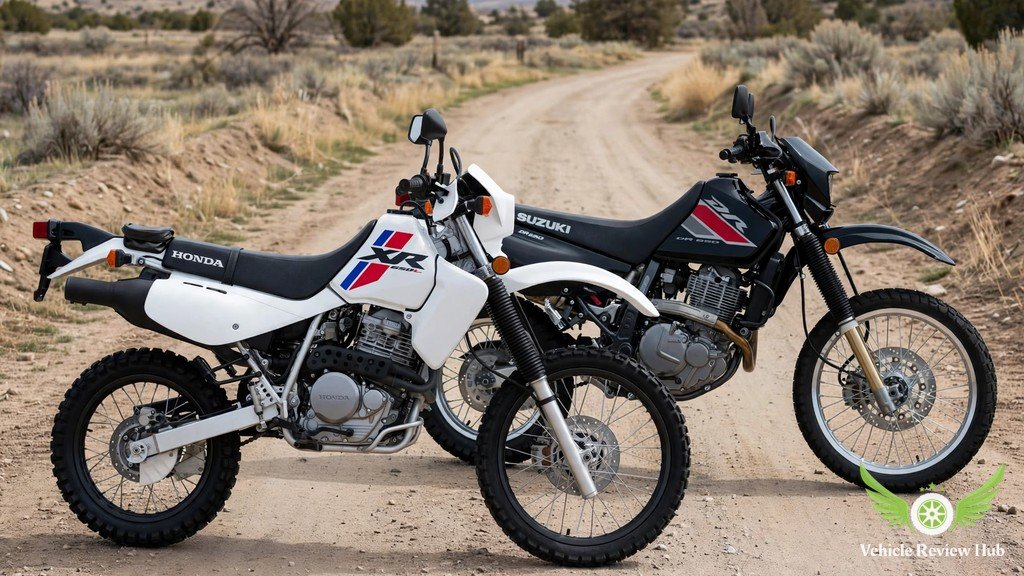
Choose the XR650L over the Suzuki DR650S if you want the taller, lighter, more dirt-capable bike of the two. The DR650S, priced at $7,299 for 2026 plus a $600 destination charge per Motorcycle.com’s specification listing, is 20 pounds heavier at 366 pounds, sits 2.2 inches lower at 34.8 inches, carries 3.4 gallons instead of 2.8, and gives up 2.6 inches of ground clearance. The Suzuki is the easier bike to live with for a shorter rider and the better commuter; the Honda is the better trail bike and the simpler machine, with a longer production run behind it. Our companion XR650L performance coverage compares the two in detail. The verdict of this Honda XR650L review is simple: if a tall, simple, carbureted dual-sport with three decades of parts and knowledge behind it appeals to you, and you understand that it is a 1993 motorcycle still being sold in 2025, the XR650L is the right buy.
Honda XR650L Review FAQs
Direct answers in this Honda XR650L review, covering price, specs, history, and riding.
What is the Honda XR650L?
A street-legal dual-sport motorcycle with a 644cc air-cooled single-cylinder engine, a carburetor, and a five-speed gearbox, per this Honda XR650L review.
How much does a 2025 Honda XR650L cost?
$6,999 plus a $600 destination charge, per this Honda XR650L review.
Is there a 2026 Honda XR650L?
No 2026 model was announced in the sources checked for this Honda XR650L review; Honda’s current United States listing is the 2025 model.
What engine does the Honda XR650L have?
A 644cc air-cooled SOHC single with an RFVC four-valve head, a 42.5mm CV carburetor, and a dry-sump design, per this Honda XR650L review.
How much horsepower does the Honda XR650L make?
Honda publishes no figure. Web estimates of roughly 40 horsepower are unlabelled, not factory claims, per this Honda XR650L review.
What is the Honda XR650L seat height?
37.0 inches, per this Honda XR650L review.
How much does a Honda XR650L weigh?
346 pounds curb weight with a full tank, per this Honda XR650L review.
How big is the Honda XR650L fuel tank?
2.8 gallons, per this Honda XR650L review.
Does the Honda XR650L have ABS or fuel injection?
No. It has neither, on any model year, per this Honda XR650L review.
Does the Honda XR650L have a kick starter?
No. Starting is by electric starter only, per this Honda XR650L review.
Is the Honda XR650L the same as the XR650R?
No. The XR650R was a liquid-cooled, dirt-only race bike; the XR650L is the air-cooled, street-legal dual-sport, per this Honda XR650L review.
What colours does the 2025 Honda XR650L come in?
White only, per this Honda XR650L review.
Is the Honda XR650L good for beginners?
Only for tall beginners. The 37-inch seat and 346-pound weight are demanding, though the engine itself is gentle, per this Honda XR650L review.
Should I buy the XR650L or the DR650S?
Buy the XR650L for dirt capability and simplicity; buy the DR650S for a lower seat, a bigger tank, and easier commuting, per this Honda XR650L review.