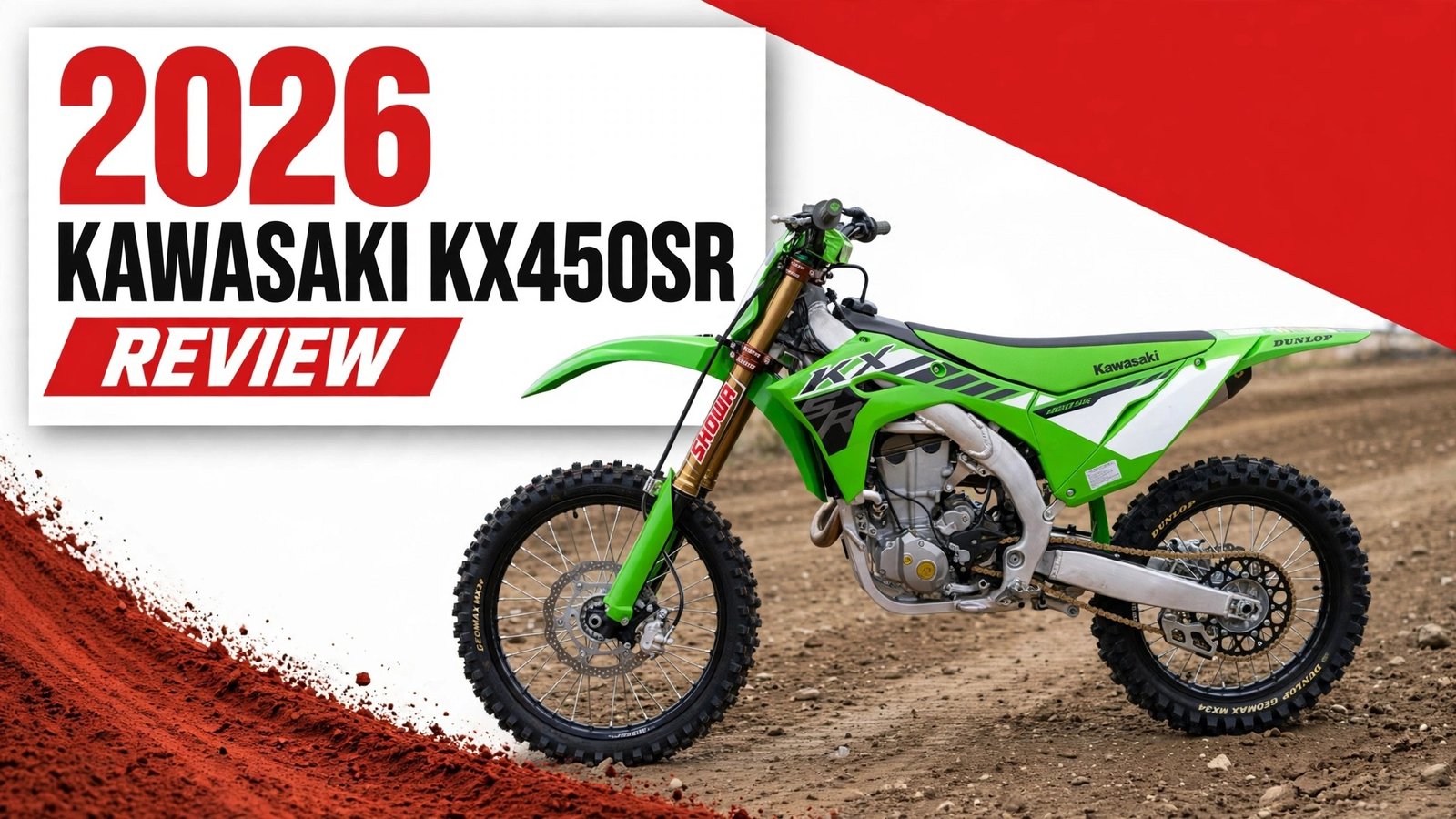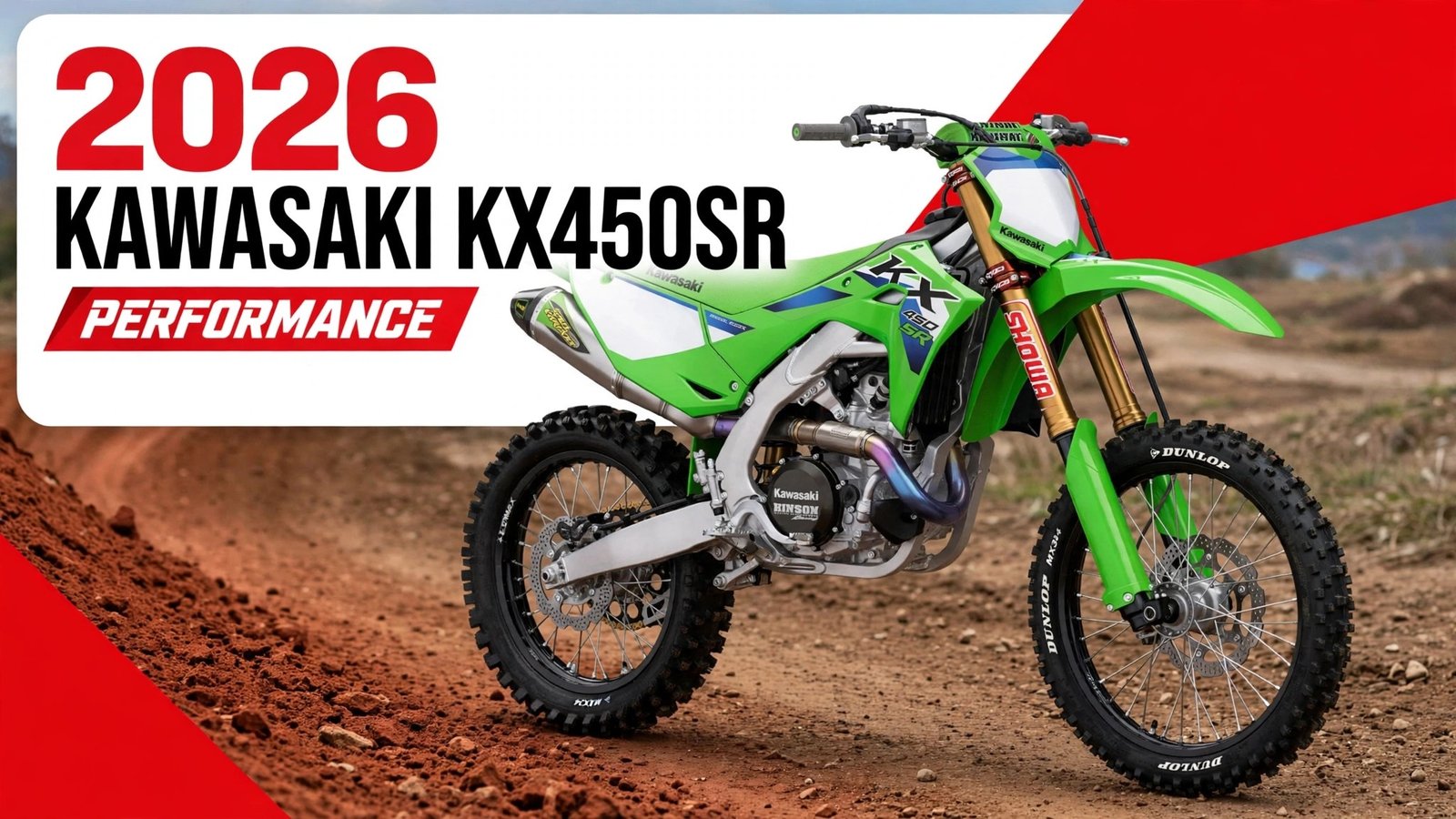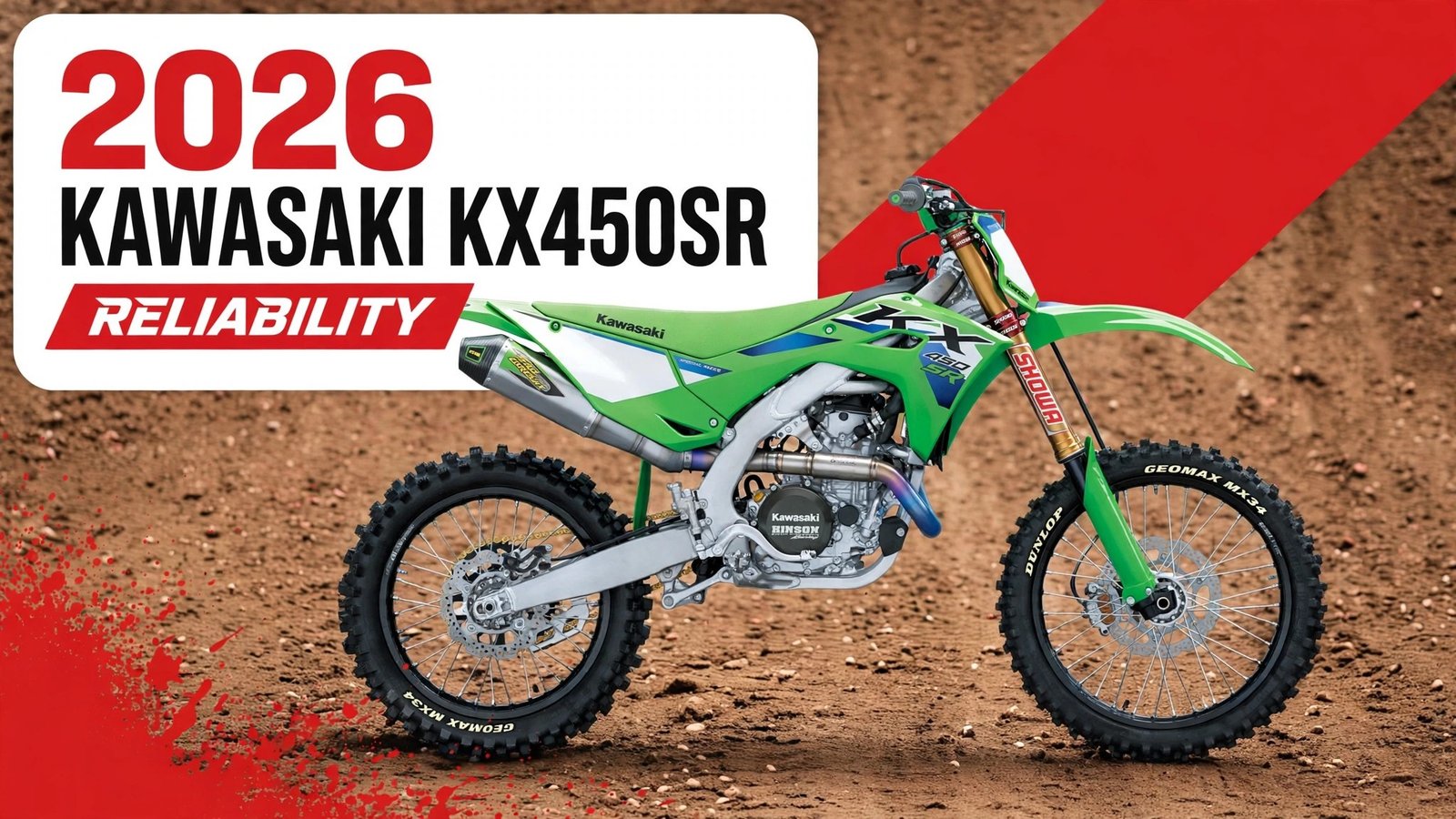
The Kawasaki KX450SR is a limited-edition factory racer, sold as-is with no warranty, and that changes what reliability means for it. There is no dealer warranty to fall back on, no SR-specific owner’s manual to open, and only one recall in its four-year run — but that one recall names the 2025 bike precisely. This Kawasaki KX450SR reliability guide works from the verified record: the CPSC recall text, the KX450 family maintenance chart, and the testers who lived with the bike.
The SR ran in 2022, 2023, 2025 and 2026 only, with a one-year hiatus in 2024, and the only recall in its history covers the 2025 bike. Its own service chart is not public, so this Kawasaki KX450SR reliability guide uses the KX450 family chart and labels it as the family figure every time.
Kawasaki KX450SR Reliability Overview
Reliability on a closed-course 450 race bike is measured in hours, not miles, and the SR is a race bike first. It is a modified stock KX450 — polished ports, titanium exhaust, Xtrig clamps, D.I.D rims, gold chain, Hinson clutch cover and coated suspension — sold as-is, with no warranty on any spec sheet. That is the context for every reliability judgement in this Kawasaki KX450SR reliability guide.
25-238 Names the 2025 SR
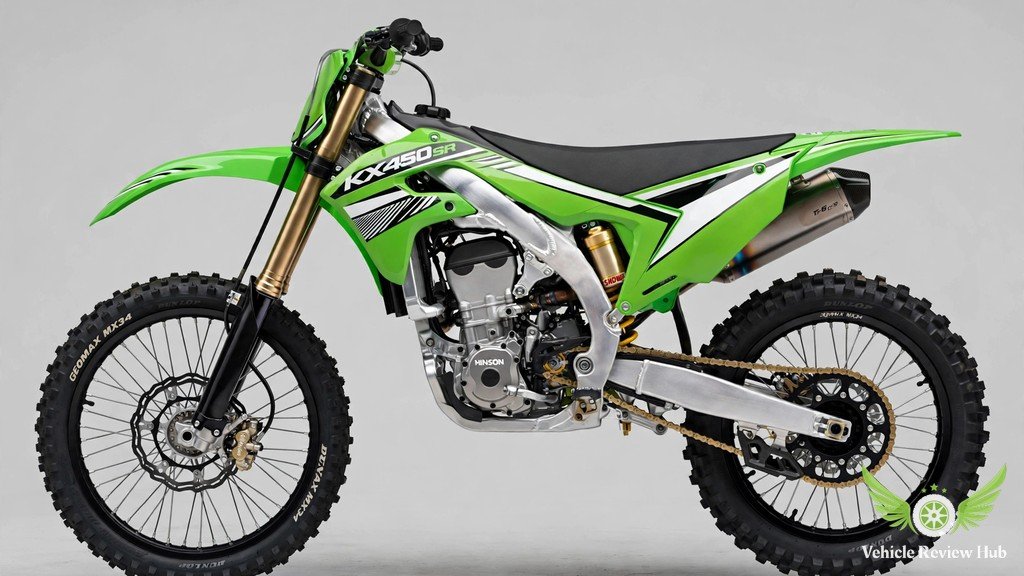
CPSC recall 25-238 names the 2025 KX450SR precisely, by model code and by VIN. The recall covers the 2025 KX450, KX450SR and KX450X — about 3,400 units across all three models combined — and it was announced on April 24, 2025. The 2025 SR’s model code is KX450PSFNN, and its VIN range is JKAKXGPCSA000012 to JKAKXGMCSA000971. Any 2025 SR must be checked against that range, and the repair confirmed.
The defect is the crankshaft primary gear. In the CPSC’s own words, “the surface durability of the primary gear for the crankshaft may be insufficient. Continuous use in this condition may result in failure of the primary gear.” Kawasaki found irregular wear during in-house dyno testing, issued an immediate stop-sale notice, and the remedy is a free primary-gear replacement at an authorized Kawasaki dealer. A repaired 2025 SR is a fixed bike, and this Kawasaki KX450SR reliability guide treats the recall as a reason to verify the VIN, not a reason to avoid the model.
| Recall detail | CPSC 25-238 |
|---|---|
| Announced | April 24, 2025 |
| Units covered | About 3,400 (2025 KX450, KX450SR and KX450X combined) |
| 2025 KX450SR model code | KX450PSFNN |
| 2025 KX450SR VIN range | JKAKXGPCSA000012 to JKAKXGMCSA000971 |
| Defect | Surface durability of the primary gear for the crankshaft may be insufficient; the gear can fail |
| Remedy | Free repair — replace the primary gear — at an authorized Kawasaki dealer |
| Sold | June 2024 to March 2025, $10,500 to $13,600 |
| Injuries | None reported |
Note: Every figure in this table comes from the CPSC recall text for 25-238. No recall names any 2022, 2023 or 2026 KX450SR, and this Kawasaki KX450SR reliability guide never implies otherwise.
How Mileage, Storage and Previous Care Affect Reliability
Race bikes are measured in hours, not miles, and a used SR’s hour count matters more than its odometer, which does not exist on a closed-course bike. A 2025 SR with the recall repair documented is a safer buy than a lower-hour bike with no paperwork, because the repair is the one known failure mode with a factory fix. A buyer reading this Kawasaki KX450SR reliability guide should ask for the service history, the hour meter reading if one was fitted, and proof of the recall repair before money changes hands.
Storage and previous care show up fast on a race bike. A bike stored with stale fuel, a dead battery or no air-filter care will cost its next owner in cleaning and parts before it ever reaches a track, and the SR is electric-start only in every year — there is no kick starter to fall back on if the battery dies. This Kawasaki KX450SR reliability guide treats a full service record as the best reliability evidence a used bike can carry.
Kawasaki KX450SR Common Problems and Wear Items
No SR-specific complaint pattern was found after a targeted search. What exists is the KX450 family’s record, which the SR shares as the same platform with the same suspension and bar mounts. This Kawasaki KX450SR reliability guide labels every family issue as a family issue. Two family problems are not SR problems at all: the pre-2021 clutch plates, fixed for 2021, and the 2024 frame cracks — the SR starts in 2022 and skipped 2024.
Primary Gear Can Fail
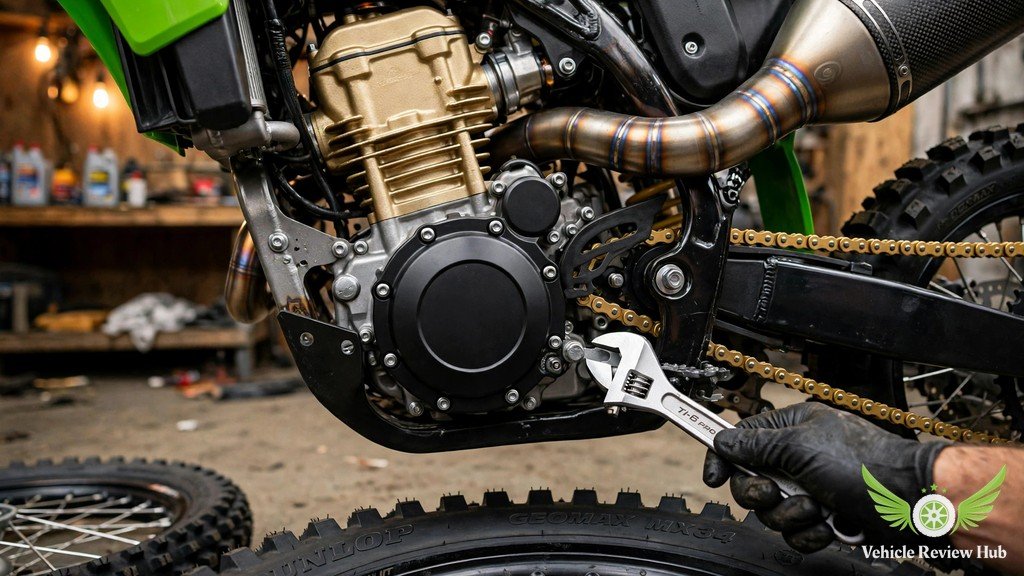
The primary gear is the one real failure mode in the SR’s record, and it belongs to the 2025 bike only — the central fact of this Kawasaki KX450SR reliability guide. CPSC 25-238 says the surface durability of the primary gear for the crankshaft may be insufficient, and continuous use in that condition may result in failure of the primary gear. Kawasaki found irregular wear on the gear during in-house dyno testing, and the failure is a crash hazard if it happens on track. The fix is the factory remedy: a free primary-gear replacement at an authorized Kawasaki dealer, with a stop-sale notice issued to dealers while the repair was prepared.
Motocross Action reported in March 2025 that its three fleet bikes, each with more than 25 hours on them, had not shown the issue — so the failure is not universal, and a repaired 2025 SR is a fixed bike. What this Kawasaki KX450SR reliability guide insists on is the check: a 2025 SR buyer confirms the VIN against the range JKAKXGPCSA000012 to JKAKXGMCSA000971 and confirms the repair before buying. The class action over the same issue, Melendez v. Kawasaki (Case No. 8:25-cv-00910, filed May 1, 2025), exists and is noted here as existing; this guide does not adopt the law firm’s “over-torqued crankshaft bolts” claim, because the CPSC text says surface durability, not bolt torque.
Some Sites Wrongly Say No Recall
Some recall-aggregator sites list the KX450SR — and the KX450 family — as having no recalls at all. That is a database gap, not a fact. Competition bikes do not appear in NHTSA’s database, so a “no recalls” result from an NHTSA-based lookup proves nothing about this bike. CPSC 25-238 is real, it names the 2025 SR by model code and VIN range, and it is the only recall that has ever named this bike.
The same gap explains why a buyer should never trust a single aggregator page. Check the VIN against the CPSC range above and ask the dealer for the recall-repair record. Only two KX-naming CPSC recalls exist in total, 01-065 from 2001 and 25-238, and the 2001 recall is not an SR recall.
Kawasaki KX450SR Maintenance Schedule and Servicing
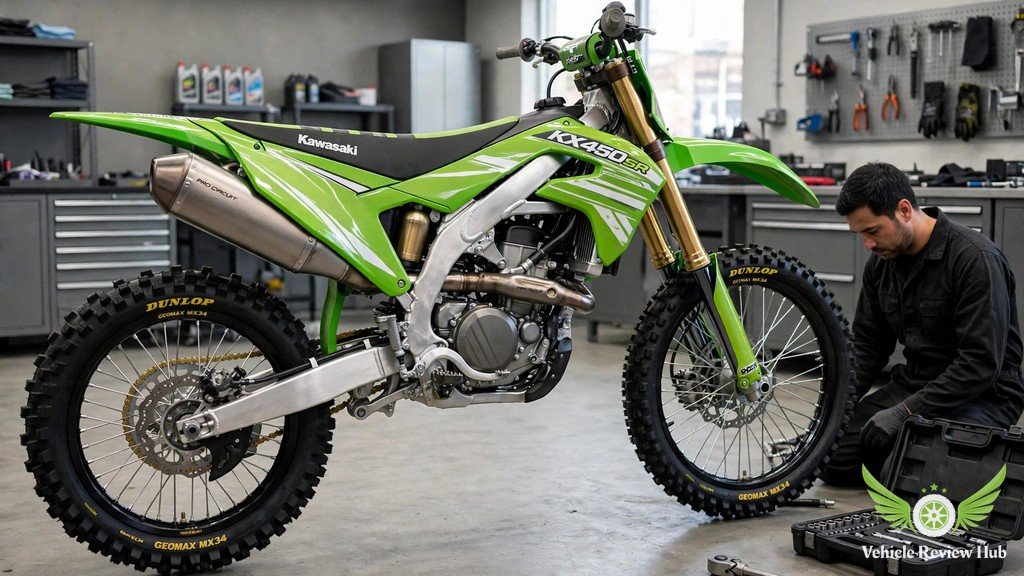
The SR’s own service chart is not public. Kawasaki publishes the SR’s specifications, but no SR-specific owner’s manual or maintenance schedule was found. So this Kawasaki KX450SR reliability guide uses the KX450 family chart — the 2018 KX450F owner’s manual, cross-checked against the 2013 manual and the 2006 service manual chart — and labels every figure from it as the family figure. The chart’s frequency columns are after each race (2.5 hours), every 3 races (7.5 hours), every 6 races (15 hours) and every 12 races (30 hours).
Its Own Chart Is Not Public
The family chart’s headline interval is the piston: piston, piston ring and piston pin are replaced every 6 races, or 15 hours, confirmed four ways. Valve clearance is inspected every 3 races, or 7.5 hours, with the standard at exhaust 0.17 to 0.22 mm and intake 0.10 to 0.15 mm. Those are the KX450 family figures, and this Kawasaki KX450SR reliability guide prints them as family figures, never as the SR’s own published interval.
| Service item | Interval (KX450 family chart) |
|---|---|
| Piston, piston ring and piston pin — replace | Every 6 races / 15 hours |
| Valve clearance — inspect | Every 3 races / 7.5 hours (Ex 0.17–0.22 mm / In 0.10–0.15 mm) |
| Throttle cable, throttle body, clutch, spark plug, air cleaner, cylinder head, crankshaft, exhaust — inspect | After each race / 2.5 hours |
| Brake fluid — change | Every 2 years |
| Brake master-cylinder cup and dust cover, caliper seals | Every 2 years |
| Brake hoses | Every 4 years |
| Fuel hose | Every 5 years |
| Air-cleaner element | Replace if damaged |
Note: Every interval in this table is the KX450 family figure from the owner’s manual periodic-maintenance chart, not the SR’s own published interval — the SR’s own chart is not public. This Kawasaki KX450SR reliability guide carries the family figure across generations and labels it as such.
Retailer Intervals Are Guidance
Retailer and aftermarket service-interval pages publish their own hour figures for the KX450 family. Those are guidance, not Kawasaki’s chart — and this Kawasaki KX450SR reliability guide prints the manual’s figures above and labels any retailer figure as guidance, never as the manual’s interval. The distinction matters most on oil: the piston is verified at 15 hours, but the oil-change interval is not verified as a manual figure, because the 2018 manual’s replacement chart does not place the engine-oil change in the 15-hour column. So this guide does not print “oil at 15 hours” as the manual’s interval. Oil changes on a race 450 are frequent, race-interval servicing in general terms.
The same caution applies to the suspension: fork-oil and rear-shock-oil change hour figures were not verified, so no hour figure for fork or shock oil is printed here.
Kawasaki KX450SR Tires, Brakes and Suspension Maintenance
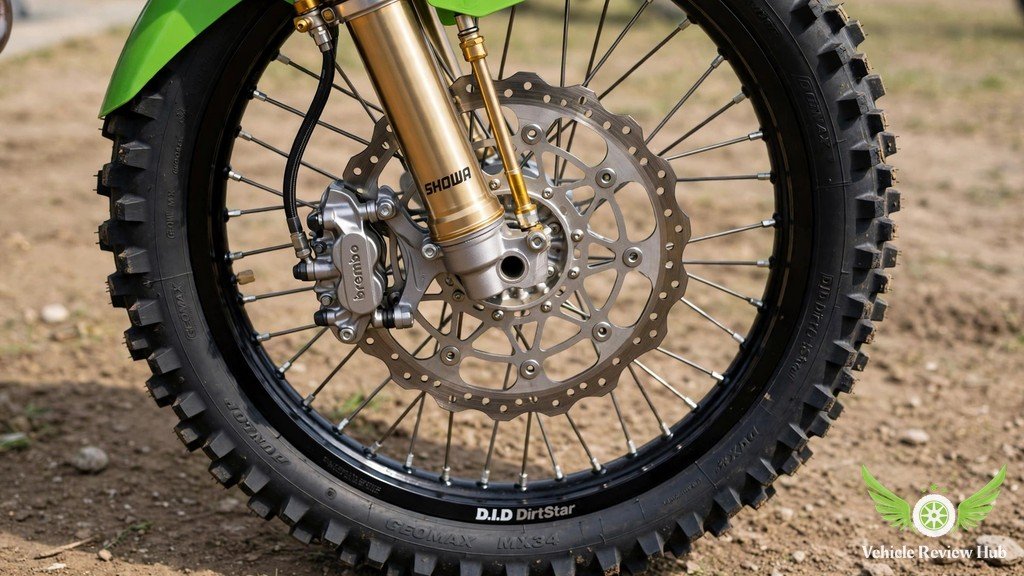
The SR’s tyres, brakes and suspension are where the $3,100 premium shows up as hardware — and where the running costs live. The tyres are Dunlop Geomax MX33 on the 2022 and 2023 bikes and MX34 on the 2025 and 2026 bikes — 80/100-21 front, 120/80-19 rear. The brakes split by year: Nissin calipers at both ends on 2022 and 2023, a Brembo front with a 270 mm petal disc and a Nissin rear with a 240 mm petal disc on 2025 and 2026. There is no Brembo rear caliper on any SR. This Kawasaki KX450SR reliability guide keeps the two ends and the two years separate, because the hardware is different.
Three Parts Alone Cost $1,975
The heading above is the document’s heading, kept verbatim — but the figure in it is not verified, and this Kawasaki KX450SR reliability guide will not print it as a fact. An exact-phrase search plus a grep of every saved evidence file returned zero hits. No source states that three SR parts cost $1,975. What the verified record does offer is the parts maths from the magazines, and this guide uses those figures with attribution instead.
Cycle News’s 2023 review puts similar aftermarket upgrades — a full exhaust system, rims, triple clamps, clutch cover and drivetrain alone — at up to approximately $3,000, before the head mods, ECU tune or suspension coatings. Dirt Bike Test’s 2025 first ride estimated the retail value of the whole upgrade package at over $5,500, depending on how prices are calculated and whether labour is counted. Vital MX’s 30-hour test says the parts bill is significantly higher than the price difference if you were to purchase and install everything yourself. The honest summary is that the premium buys more than it costs — and the $1,975 figure is not part of that summary.
| Parts-maths figure | Amount | What it covers |
|---|---|---|
| Cycle News 2023 | Up to approximately $3,000 | Exhaust, rims, triple clamps, clutch cover and drivetrain alone (not head mods, ECU tune or suspension coatings) |
| Dirt Bike Test 2025 | Over $5,500 | Whole upgrade package, depending on pricing and whether labour is counted |
| Vital MX 2026 | Significantly higher than the $3,100 premium | Buying and installing everything separately |
| Xtrig clamps + PHDS (Dirt Rider 2025) | $833.20 | Xtrig ROCS-TECH clamps plus PHDS bar mounts, retail from Kawasaki |
Note: Every figure in this table is attributed to its source. None of them is the $1,975 figure — that figure was not found in any source, and this Kawasaki KX450SR reliability guide does not print it as a verified fact.
Tire, Brake and Suspension Checks That Matter
Tyres wear fast on a motocross bike, and the check is visual: knob tearing and sidewall cracking on the MX33 or MX34, plus a pre-ride pressure check — no Kawasaki tyre-pressure figure was verified for this bike. The front tyre is an 80/100-21 and the rear a 120/80-19 on every SR year, and knobby motocross tyres are not road-legal.
Brakes and suspension follow the family chart: brake fluid changed every 2 years, master-cylinder cup and dust cover plus caliper seals every 2 years, brake hoses every 4 years. The 2025 and 2026 front brake is repeatedly praised — Motocross Action’s 2025 test says the magazine never thought any of the Big Four would be brave enough to spec a Brembo front brake, and they love it. On suspension, the 2022 bike runs a 48 mm KYB fork and the 2023 and later bikes a 49 mm Showa coil-spring fork and the SR’s dedicated valving makes it firmer than the standard bike’s fork — though testers still adjust it. This Kawasaki KX450SR reliability guide treats the fork’s softness as the family’s recurring complaint, firmer on the SR but never fully gone.
Kawasaki KX450SR Maintenance and Ownership Costs
Owning an SR costs more than owning a standard KX450. The 2026 SR lists at $13,699 plus a $650 destination charge, $14,349 delivered — a $3,100 premium over the standard bike — and the running costs follow the race-bike schedule: a piston every 15 hours, valve checks every 7.5 hours and tyres that wear fast. This Kawasaki KX450SR reliability guide prices the ownership honestly, with the verified numbers only.
Fuel, Routine Servicing, Tires and Replacement Parts
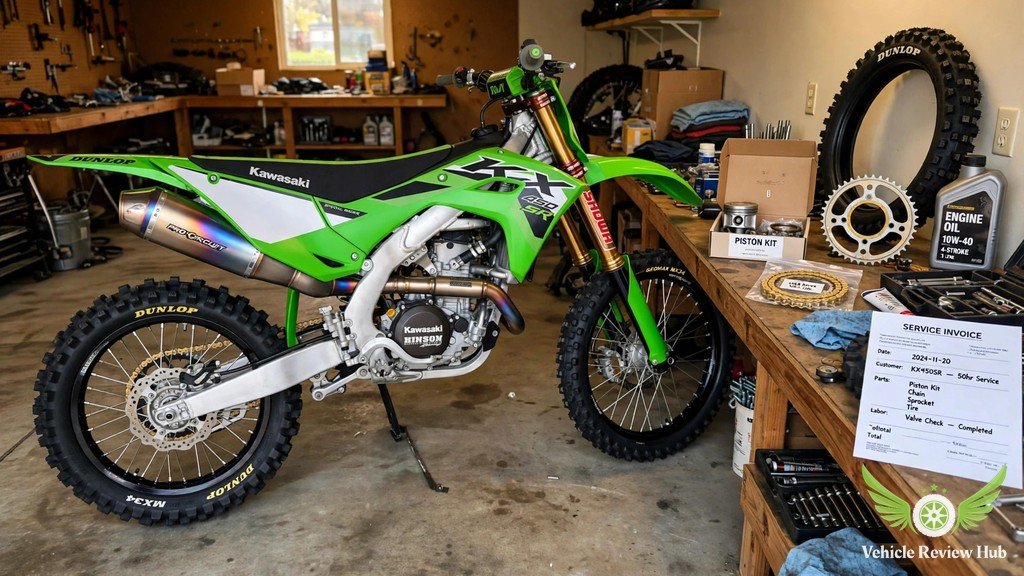
Fuel is the smallest line. The tank holds 1.64 gallons in every year, and there is no official MPG figure for a closed-course motocross bike — Kawasaki publishes no fuel-economy rating for it, and no publication has tested its fuel economy. Routine servicing is the bigger line in this Kawasaki KX450SR reliability guide: oil changes are frequent, race-interval servicing in general terms, air filters are cleaned after every ride, and the piston, ring and pin come out every 6 races or 15 hours under the family chart.
For the piston itself, the verified aftermarket price is the Pro X piston kit for the KX450 and KX450X, 2024 to 2026, at $199.76 from RevZilla. The 2024-and-later bike’s OEM piston part number and price are not verified, so this Kawasaki KX450SR reliability guide does not print one. The roughly $171 figure sometimes quoted is the 2021 to 2023 OEM piston, part 13001-0816 — the previous generation. Budget for the Pro X kit price, not the old OEM figure: the piston job is a 15-hour job on the family chart, not a once-a-season job.
Check the Model Code First
Before any money changes hands on a used SR, this Kawasaki KX450SR reliability guide says check the model code first. The 2025 SR is model code KX450PSFNN and the 2026 SR is KX450PTFNN; a bike advertised as a 2025 SR must carry the PSFNN code, a 2026 SR the PTFNN code. The code is the first filter against a standard KX450 dressed up as an SR, and the first filter for the recall: only the 2025 bike, PSFNN, falls inside CPSC 25-238. The standard KX450’s own reliability record is covered in the KX450 reliability guide, and the SR shares its platform, its family maintenance chart and its family issues — but the SR’s price, its parts and its recall are its own.
The model code is not the only check. The SR hardware is visible: Xtrig clamps with PHDS mounts, the Pro Circuit Ti-6 Pro exhaust, the Hinson clutch cover, D.I.D ST-X rims, the gold chain and the magnesium-gold head cover. The VIN’s tenth character is the model-year code — S for 2025, T for 2026 — and this Kawasaki KX450SR reliability guide treats code, VIN and hardware together as the identity check, never any one alone.
How to Keep a Kawasaki KX450SR Reliable
Keeping an SR reliable is mostly discipline: follow the family chart, keep records, and never let a small job slide into a big one. This Kawasaki KX450SR reliability guide ends with the habits that keep the bike healthy and the paperwork that protects its value.
Preventive Maintenance, Records and Regular Inspections
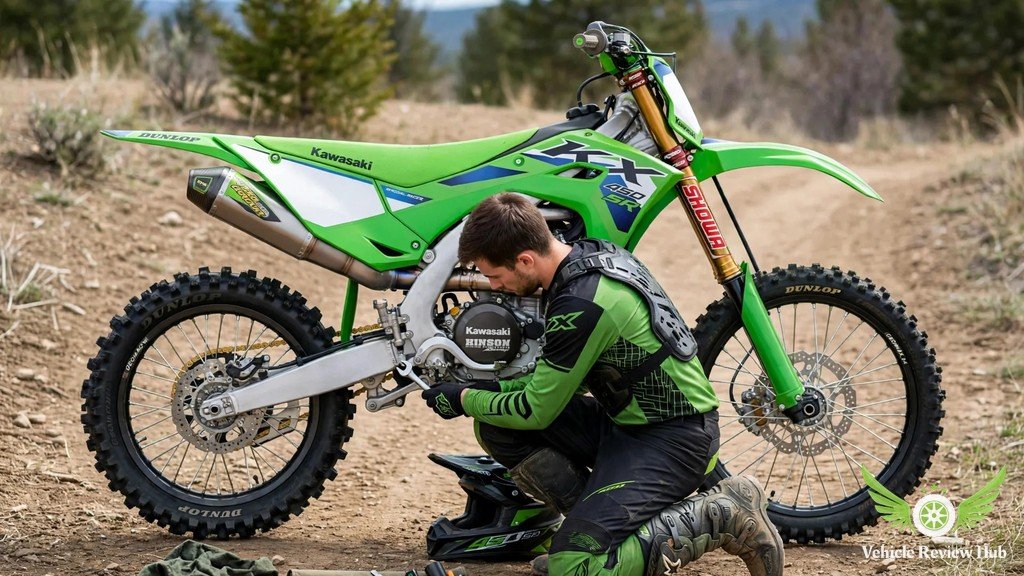
Preventive maintenance in this Kawasaki KX450SR reliability guide starts with the family chart and ends with the pre-ride check. Air filters are cleaned after every ride, oil changes are frequent race-interval servicing, and the weak rubber bar mounts get a look after every drop — the family’s bar-mount inserts are known to break after a single drop, and the SR uses the same Renthal FatBar arrangement with Xtrig PHDS mounts on top.
Records are the second half of the habit: keep the hour count, the piston changes, the valve checks and the recall-repair proof in one place, because a used SR with a full record is worth more than the same bike without one. Regular inspections catch what the chart misses, including the soft-fork feel the KX450 family is known for. The SR’s fork is firmer than the standard bike’s, but it is still the family’s soft fork at heart, and this Kawasaki KX450SR reliability guide treats a regular inspection as the cheapest repair there is.
Genuine SR: Check the VIN
The final check in this Kawasaki KX450SR reliability guide is the VIN, and it settles two questions at once: is it a genuine SR, and is it a recalled one. The 2025 SR’s VIN range under CPSC 25-238 is JKAKXGPCSA000012 to JKAKXGMCSA000971, and a 2025 bike inside that range needs its repair confirmed. The tenth character of the VIN is the model-year code — S for 2025, T for 2026 — and the model code on the bike must match the year: KX450PSFNN for 2025, KX450PTFNN for 2026. A bike whose VIN and paperwork disagree on the year, or whose model code does not match its year, is a bike to walk away from.
The KX450SR review covers what the $3,100 premium buys and the KX450SR performance guide covers the 55.3 hp Dirt Rider dyno figure; this Kawasaki KX450SR reliability guide covers what keeps it running. Check the code, check the VIN, confirm the repair, follow the family chart — and the SR is a reliable race bike, because its one known failure has a factory fix and its maintenance is a schedule, not a mystery.
Kawasaki KX450SR Reliability FAQs
The questions buyers actually ask about the SR’s reliability, answered with the figures from this Kawasaki KX450SR reliability guide.
Is there a recall on the KX450SR?
Yes — one. CPSC 25-238 covers the 2025 KX450SR (model KX450PSFNN, VIN JKAKXGPCSA000012 to JKAKXGMCSA000971), plus the 2025 KX450 and KX450X, about 3,400 units in total: the crankshaft primary gear can fail. The remedy is a free primary-gear replacement at a Kawasaki dealer. No recall names any 2022, 2023 or 2026 SR, and this Kawasaki KX450SR reliability guide never implies otherwise.
How do I check if a 2025 KX450SR is recalled?
By VIN. The 2025 SR range is JKAKXGPCSA000012 to JKAKXGMCSA000971. Confirm the repair was done before buying; a repaired bike is a fixed bike, and this Kawasaki KX450SR reliability guide treats the recall as a reason to verify, not a reason to avoid the model.
When do I replace the piston?
Every 6 races or 15 hours — piston, piston ring and piston pin — per the KX450 owner’s manual periodic-maintenance chart. That is the KX450 family figure: the SR’s own service chart is not public, so the family chart is used and labelled as such every time in this Kawasaki KX450SR reliability guide.
How often do I check the valves?
Valve clearance inspection every 3 races or 7.5 hours, with the standard at exhaust 0.17 to 0.22 mm and intake 0.10 to 0.15 mm, per the owner’s manual chart. That is the family figure too, and this Kawasaki KX450SR reliability guide labels it as such.
What does “three parts alone cost $1,975” mean?
Nothing verified. The $1,975 figure was not found in any source and must not be printed as a fact. The verified parts-maths figures in this Kawasaki KX450SR reliability guide are Cycle News’s “up to approximately $3,000” for exhaust, rims, clamps, clutch cover and drivetrain, and Dirt Bike Test’s “over $5,500” for the whole upgrade package.
Does the KX450SR have a kick starter?
No — electric-start only in every year. A dead battery means no bump-start fallback, so this Kawasaki KX450SR reliability guide counts battery care as part of the pre-ride check.