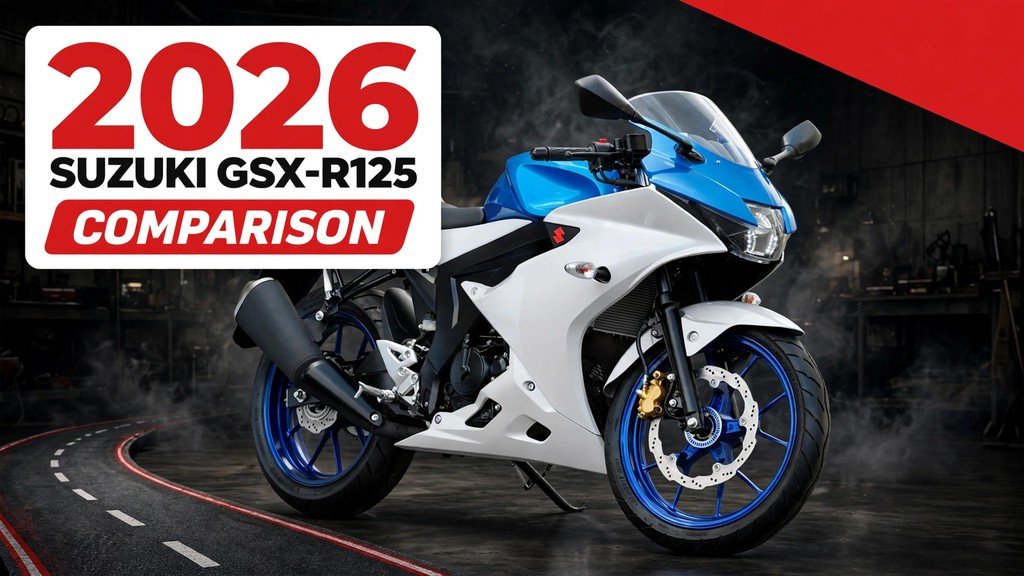
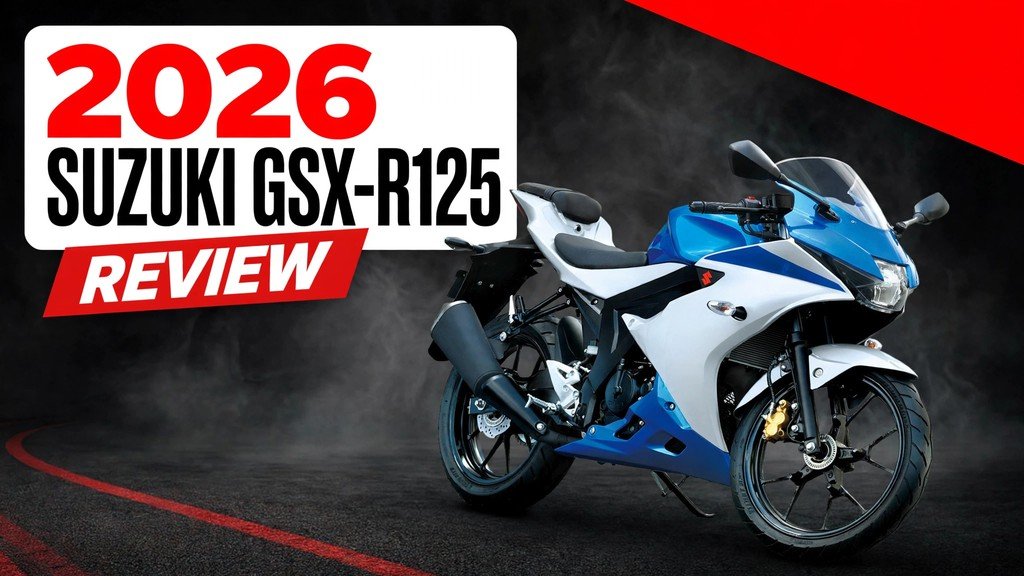
This Suzuki GSX-R125 performance guide answers the only questions that matter about how fast the little Suzuki really is — and it starts with an honest warning. The 125 makes 15 PS, because European law caps A1 learner bikes at 11 kW, and no named outlet has ever put one on a dyno. There is no rear-wheel horsepower figure, no GPS-verified top speed and no instrumented 0–60 time for this bike anywhere. And for American readers, one more honest fact: the GSX-R125 was never sold in the United States, so there is no US price, no US dealer and no US spec — every figure in this Suzuki GSX-R125 performance guide is a UK or European one. What does exist is a set of labelled, tested numbers: 69 mph in MCN’s spec box, 72.75 mph on the speedometer in MCN’s group test, and 117.7 mpg UK officially — with 71 mpg UK measured on track. Suzuki GSX-R125 performance is best understood as a weight story, not a power story: at 137 kg it is the lightest faired 125 in its class, and that lightness is what makes 15 PS feel like plenty.
Suzuki GSX-R125 Engine Performance and Power Delivery
Suzuki GSX-R125 performance starts with the engine, a 124.4cc liquid-cooled DOHC single that was built to sit just under a legal limit — and that limit shapes everything the bike does on the road.

15 PS Is a Licence Cap, Not a Dyno Result
Suzuki GSX-R125 performance is defined by the A1 licence cap before it is defined by anything Suzuki engineered. European law limits an A1 motorcycle to 125cc and 11 kW, so every bike in the class is built to sit just under that ceiling — and the GSX-R125’s 15 PS is 11 kW with rounding. Torque splits by spec: Euro 4 bikes made 11.5 Nm at 8,000 rpm, Euro 5 bikes make 11 Nm. The whole point of Suzuki GSX-R125 performance is that every 125 in the class makes the same 15 PS, so the Suzuki wins by being lighter — 11 kW pushing 137 kg gives it, in MCN’s words, the best power-to-weight ratio in the class, ahead of the Yamaha’s 142 kg.
No Dyno From Any Named Outlet Exists
Anyone shopping on Suzuki GSX-R125 performance figures will look for a dyno chart first — and there is not one to find. MCN, Visordown, SportsBikeShop, MoreBikes, BikeSocial, Cycle World, Motorcycle.com, SuperBike, MCNews, AMCN and 44Teeth were all searched, and none of them has published a rear-wheel dyno figure for the GSX-R125. No Suzuki GSX-R125 performance dyno chart exists from any named outlet, so this guide prints no rear-wheel horsepower number at all — any figure you see online claiming to be one is an estimate, not a measurement. Visordown’s verdict was that “power delivery is linear, and abundant up until the 11,500 redline”, and SportsBikeShop found the engine “needs to stay above 8000 rpm to remain in the sweet spot” — which is the character of the bike in one line. The full GSX-R125 review covers the engine’s specification in detail, including the Euro 4 and Euro 5 torque split.
| Suzuki GSX-R125 performance at a glance | Figure | How it was measured |
|---|---|---|
| Claimed power | 15 PS (11 kW class) | Crankshaft claim, A1 licence cap |
| Torque | Euro 4: 11.5 Nm; Euro 5: 11 Nm @ 8,000 rpm | Manufacturer claim, labelled by spec |
| Rear-wheel dyno | None published | No named outlet has dynoed the bike |
| Top speed | 69 mph box; 72.75 mph speedo | MCN spec box and group test, labelled |
| 0–60 mph | No instrumented test | MCN quarter-mile cell is blank |
| Fuel economy, official | 117.7 mpg UK | Suzuki UK current page |
| Fuel economy, tested | 71 mpg UK | SportsBikeShop, full day thrashed on track |
| Kerb weight | 137 kg (current Euro spec) | Suzuki claim; 134 kg on 2017/Japan spec |
Suzuki GSX-R125 performance figures are claimed or tested exactly as labelled in the table above — nothing here is a GPS measurement or a dyno result, and nothing has been filled in from an aggregator.
Suzuki GSX-R125 Top Speed and Acceleration
Top speed is where Suzuki GSX-R125 performance gets argued about most — because the two best numbers disagree with each other, and neither one is a GPS reading.

The video below is a 0–70 mph performance test by GILLYBIKES — but it is the naked GSX-S125, the GSX-R125’s unfaired sibling, not the faired bike, and it is not a dyno run. The closest filmed Suzuki GSX-R125 performance test we could verify uses that naked sibling, because no filmed top-speed test of the faired bike itself was found with a verifiable video ID. The two bikes share the same 124cc engine and the same 15 PS cap, so the acceleration behaviour transfers; the fairing difference does not change the engine’s output.
MCN: 69 MPH Boxed, 72.75 on the Speedo
MCN publishes two Suzuki GSX-R125 performance numbers for top speed, and the honest thing is to print both with their labels attached. The first is the figure in MCN’s spec box: 69 mph — not labelled GPS-verified anywhere on the page, so this guide does not call it a GPS figure. The second comes from MCN’s group test: “We hit 72.75 mph on a group test” — a speedometer reading, with an indicated 80 mph possible tucked in. Suzuki GSX-R125 performance at the top end is best stated as a range: about 69 mph true, 72–73 mph on the speedo, an indicated 80 mph possible tucked in.
No Instrumented 0-60 Test Exists
Suzuki GSX-R125 performance from a standstill has never been timed by a named tester. MCN’s spec table leaves the quarter-mile cell blank — “1/4 mile acceleration | –” — and searches for a zeroto60times entry or any instrumented 0–60 mph or 0–100 km/h test returned nothing from any outlet. Any Suzuki GSX-R125 performance 0–60 claim you find online is an aggregator guess, and the guesses do not even agree with each other: ThinkDaily claims 0–100 km/h in 14 seconds, Maxabout claims “around 10 seconds” for the same run, and a parts-store page claims 0–60 km/h in about 5 seconds. None of those is sourced, and this guide prints none of them as a result. What the testers did say is consistent: MCN calls acceleration “more than adequate for a bike of this size”, and Carole Nash agrees it “gets up to 60 mph fairly quickly but flattens out in the higher gears”. The full GSX-R125 reliability guide covers what happens when the bike is ridden hard for years, including the gearbox niggle that shows up when shifting down.
Suzuki GSX-R125 Mileage and Fuel Economy
Fuel economy is the one Suzuki GSX-R125 performance area with real tested numbers — and the gap between the official figure and the tested figure tells you how the bike is actually ridden.

SportsBikeShop Tested 71 MPG in the UK
The hardest-tested Suzuki GSX-R125 performance MPG figure comes from SportsBikeShop, which recorded 71 mpg UK after a full day with the bike being thrashed on track at Silverstone Stowe — a one-mile infield circuit with a 300-metre longest straight, ridden by a 95 kg tester. That is a worst-case figure, not a commuting figure: 71 mpg UK is 3.98 litres per 100 km, or 59.1 mpg US. The same SportsBikeShop article gives the better real-world guide from the same engine: the naked GSX-S125 sibling managed 83 mpg UK on the road, “again at thrashing point”, which is 3.40 litres per 100 km or 69.1 mpg US. The honest range is therefore wide: around 70 mpg UK thrashed on track, 83 mpg UK on a hard road ride, and approaching 100 mpg UK in normal use.
Official EU Figure Is 117.7 MPG UK
The official Suzuki GSX-R125 performance economy figure today is 117.7 mpg UK, printed on Suzuki UK’s own model page alongside “Power 15PS, Torque 11Nm, Engine Capacity 124cc”. That converts to 2.40 litres per 100 km and 98.0 mpg US; every MPG figure here is mpg UK unless labelled US. But the figure changed, and the change has to be stated: at launch in 2017–18 Suzuki claimed 122.8 mpg UK, which is 2.30 litres per 100 km or 102.3 mpg US. Visordown and MoreBikes both quoted the launch claim of 122.8 mpg UK. Launch-era Suzuki GSX-R125 performance claims quoted 122.8 mpg UK, and the current page says 117.7 mpg UK; no source states why the figure moved, so this guide does not attribute it to the Euro 4 to Euro 5 change, even though that re-homologation is the likely cause. One database figure must be flagged and not used: MotorcycleDB lists 1.90 litres per 100 km for the 2024 bike, which converts to 148.7 mpg UK — far above Suzuki’s own 117.7 and every road test, so it is treated here as a database error. There is no Fuelly owner average for the GSX-R125, so no Fuelly figure is cited anywhere in this guide.
| Fuel economy figure | mpg UK | L/100 km | Source |
|---|---|---|---|
| Official, current (Suzuki UK) | 117.7 | 2.40 (converted) | Suzuki UK model page |
| Official, launch claim (2017–18) | 122.8 | 2.30 (converted) | Visordown, MoreBikes |
| Tested, track thrash (GSX-R125) | 71 | 3.98 (converted) | SportsBikeShop, Silverstone Stowe |
| Tested, road thrash (GSX-S125 sibling) | 83 | 3.40 (converted) | SportsBikeShop, same test team |
| Track (GSX-R125) | 70.6 | 4.0 (measured) | ZA Bikers |
| MCN published average | 122 | — | MCN specs table |
| Tank range | 296 miles | 11 L tank | MCN spec box |
All Suzuki GSX-R125 performance MPG figures are mpg UK (Imperial gallons) unless labelled US — 1 mpg UK equals 0.833 mpg US.
Suzuki GSX-R125 Real-World Riding Experience
On the road, Suzuki GSX-R125 performance feels quicker than the numbers suggest, because the bike asks so little of its rider.

MCN Rated It Four Stars of Five
MCN’s Suzuki GSX-R125 performance verdict is 4 out of 5 overall, with the two scores that matter most for a learner bike both at the maximum: ride and brakes 5 out of 5, engine 5 out of 5, reliability 4 out of 5, value 4 out of 5 and equipment 4 out of 5. The praise is consistent across every outlet that rode it. MCN calls the handling “brilliant” and the bike “among the quickest 125s around in real-world situations”, and its owners rate the engine 4.8 out of 5 — the highest-rated part of the bike. The four MCN owners rate it 4.2 out of 5 overall — an overall rating on a thin sample, not a reliability score (reliability is 3.8 out of 5).
Brakes and Suspension Trail the Yamaha
On hardware, Suzuki GSX-R125 performance trails the Yamaha R125 — and MCN says so plainly, noting that “its brakes and suspension aren’t as impressive as the latest from both Yamaha and Aprilia, either. But then the Suzuki’s also cheaper than those two”. The gap is in the specification sheet: the Yamaha carries a 41 mm upside-down KYB fork, while the Suzuki runs conventional telescopic forks up front and a link-type shock at the rear, both non-adjustable. Visordown called the Suzuki’s suspension “well-damped, but unfortunately un-adjustable”, and SportsBikeShop noted the conventional forks against rivals’ upside-down units. But Suzuki GSX-R125 performance in braking was praised by every tester who actually used the brakes. MCN wrote that “stopping power is also impressive, with the single waved front disc and lightweight two-channel Bosch ABS unit offering a reassuringly progressive bite”. Visordown called the brakes “sharp and progressive”, and SportsBikeShop found the Bosch ABS “refusing to intrude even when deliberately taunted”.
Suzuki GSX-R125 Handling, Braking and Stability
Suzuki GSX-R125 performance in corners comes from lightness, not grip — 137 kg, a short wheelbase and quick steering do the work that power cannot.

Handling, Braking and Stability at A1 Speeds
At A1 speeds Suzuki GSX-R125 performance is about stability a learner can trust, and the chassis numbers explain why the bike feels the way it does. A 25.5-degree rake, 93.3 mm of trail and a 1,300 mm wheelbase keep the steering quick without making it nervous, and the 785 mm seat puts the rider low in the bike rather than perched on it. Visordown called the steering “incredibly easy, lightweight steering” and found “getting a knee down is surprisingly easy”. SportsBikeShop, riding it on the tight Stowe circuit, was “impressed with its light weight and easy handling on such a tight circuit”, and noted that “most 125s sink under a heavier rider. The GSX-R doesn’t” — their tester weighed 95 kg. The stability story has one honest limit: the bike is physically small, so riders much above 5 ft 8 in should try it for size first, and the gearbox can be stubborn clicking into first from neutral — MCN and one owner both report it, and it is a niggle rather than a failure.
Lightweight Chassis at Legal Speeds
The chassis is where Suzuki GSX-R125 performance wins its class, because Suzuki spent the weight budget where a learner feels it. The 137 kg kerb weight is the lightest in the 125 sportbike class — against the Yamaha’s 141 kg, the Aprilia’s 144 kg and the Kawasaki’s 149 kg — and the 10-spoke cast aluminium wheels, the slim Dunlop D102 tyres and the single-cylinder engine all keep unsprung and overall mass down. What the chassis does not have is adjustment: fork and shock are both non-adjustable, the real trade against the Yamaha’s and Aprilia’s upside-down forks.
Suzuki GSX-R125 Performance Compared With Other 125s
Suzuki GSX-R125 performance against its rivals is a weight contest, not a power contest — all four bikes make the same 15 PS, so the differences are weight, electronics, chassis, tank and price.
Suzuki GSX-R125 vs Yamaha YZF-R125
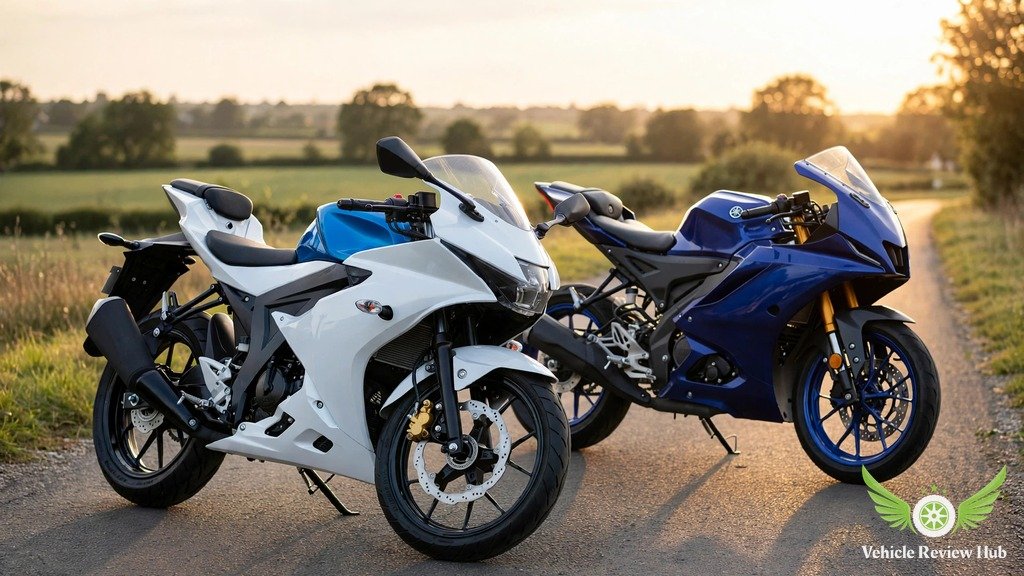
The Yamaha YZF-R125 — now sold simply as the R125 — is the best-equipped rival, and the comparison shows exactly what the Suzuki’s £1,502 price advantage buys and what it gives up. The Yamaha costs £5,501 on the road against the Suzuki’s £3,999, and for that money it brings a 5-inch colour TFT dash with Bluetooth and the MyRide app, traction control, an assist and slipper clutch, a 41 mm upside-down KYB fork, and pre-wiring for an optional quickshifter. Its engine is a 125cc single with Variable Valve Actuation (124.7cc); the bigger-capacity VVA engine belongs to the YZF-R15, a different bike sold in India and Asia. But Suzuki GSX-R125 performance still wins on power-to-weight: the Yamaha weighs 141 kg against the Suzuki’s 137 kg, and its seat is 820 mm against the Suzuki’s 785 mm, so the Suzuki is the lighter, lower bike. On top speed the Yamaha has the only GPS-verified figure in the class — Bennetts’ reviewer recorded about 79 mph on a phone GPS app — from a different test than the Suzuki’s figures, so this guide does not present it as a head-to-head win. The full GSX-R125 comparison puts all four rivals side by side on price, equipment and value.
Is the Suzuki GSX-R125 Suitable for Beginner Riders?
For a beginner, Suzuki GSX-R125 performance is exactly right — and the testers are unanimous about it. MCN calls the bike “low enough and light enough to be unintimidating to novices, yet is perfectly capable of being pushed to its limits”, with a light clutch that makes low-speed manoeuvres “a doddle” and a gear indicator that is “useful for novices”. The caveats are small and honest: the bike is physically small, so riders much above 5 ft 8 in should try it for size first; the engine needs revs above 8,000 rpm to stay in its sweet spot; the gearbox can be stubborn into first from neutral; and there are no rider modes or traction control — just ABS. The GSX-8R review covers the natural step up when a rider outgrows the 125 class.
| Bike | Power | Weight | Seat height | UK price |
|---|---|---|---|---|
| Suzuki GSX-R125 | 15 PS @ 10,000 rpm | 137 kg | 785 mm | £3,999 |
| Yamaha YZF-R125 (R125) | 15 PS @ 10,000 rpm | 141 kg | 820 mm | £5,501 |
| Kawasaki Ninja 125 | 15 PS @ 10,000 rpm | 149 kg | 785 mm | £4,699 |
| Aprilia RS 125 | 15 hp @ 10,500 rpm | 144 kg | 820 mm | £5,230 |
Suzuki GSX-R125 performance in this table is measured against bikes with the same 15 PS cap — the Suzuki is the lightest and the cheapest, the Yamaha is the best equipped, the Kawasaki is the heaviest, and the Aprilia has the biggest tank at 14.5 litres.
Suzuki GSX-R125 Performance: Frequently Asked Questions
Direct answers to the questions riders ask about Suzuki GSX-R125 performance.
What is the top speed of the Suzuki GSX-R125?
About 69 mph true, 72–73 mph on the speedo. MCN’s spec box lists 69 mph and MCN’s group test recorded 72.75 mph on the speedometer, with an indicated 80 mph possible tucked in. No GPS-verified top speed exists. Suzuki GSX-R125 performance at the top end is best stated as that labelled range, not as a single number.
Does the GSX-R125 have a dyno figure?
No. No rear-wheel dyno figure exists from any named outlet, and this guide prints none. The 15 PS figure is the A1 licence cap — 11 kW at the crankshaft — not a measured result. No Suzuki GSX-R125 performance dyno chart exists to quote.
What MPG does the GSX-R125 get?
Officially 117.7 mpg UK today (98.0 mpg US); the launch claim was 122.8 mpg UK. Tested, SportsBikeShop recorded 71 mpg UK after a full day thrashed on track, and the naked sibling managed 83 mpg UK on the road. Realistically, expect around 70 mpg UK when ridden hard and approaching 100 mpg UK in normal use. The official Suzuki GSX-R125 performance economy figure is 117.7 mpg UK.
How fast is the GSX-R125 0–60?
No instrumented 0–60 mph or 0–100 km/h test exists from any named outlet, and MCN’s quarter-mile cell is blank. Aggregator claims conflict — 10 seconds and 14 seconds are both quoted for 0–100 km/h — and neither is sourced.
Is the GSX-R125 good for beginners?
Yes — testers are unanimous. It is light, low and unintimidating, with a light clutch, a gear indicator and handling that forgives novice mistakes while rewarding good habits. Caveats: small size (try it first if much above 5 ft 8 in), an engine that needs revs above 8,000 rpm, and a gearbox that can be stubborn into first from neutral. Suzuki GSX-R125 performance is beginner-friendly because the bike is light, not because it is slow.
How much power does the GSX-R125 make?
15 PS, which is 11 kW — the A1 licence maximum. Torque is 11 Nm at 8,000 rpm on Euro 5 bikes (11.5 Nm on Euro 4 bikes from 2017 to 2021). Those are crankshaft claims, not dyno measurements.
How does the GSX-R125 compare with the Yamaha R125 for performance?
Both make the same 15 PS, so the Suzuki wins on weight (137 kg against 141 kg) and price (£3,999 against £5,501) while the Yamaha wins on equipment — a 5-inch TFT dash, traction control, a slipper clutch and a 41 mm upside-down fork.
What is the fuel tank range?
MCN lists a 296-mile tank range from the 11-litre tank. The arithmetic matches the launch economy figure: 11 litres at 2.30 litres per 100 km is 297 miles, while at the current 2.40 litres per 100 km it is 285 miles.
Does the GSX-R125 have traction control or riding modes?
No. There is no traction control, no riding modes and no quickshifter. The only electronic rider aid is the two-channel Bosch ABS 10 unit, and the dash is a full-LCD panel, not a TFT. Keyless ignition is standard.
Is the GSX-R125 faster than the Kawasaki Ninja 125?
There is no instrumented head-to-head test between the two. Both make 15 PS; the Suzuki is 12 kg lighter (137 kg against 149 kg) and £700 cheaper (£3,999 against £4,699). Listed top speeds for the Ninja 125 range from 75 to 81 mph, but none comes from an instrumented test.
What tyres does the GSX-R125 use, and do they limit performance?
Dunlop D102 tyres — 90/80-17 front and 130/70-17 rear on 10-spoke cast wheels. SportsBikeShop lacked faith to lean hard on them; SuperBike found “mountains of grip” on track.
Can the GSX-R125 keep up on a motorway?
It can hold motorway speed, but it is not a motorway bike — with a top speed around 69 mph true, there is little in reserve at 70 mph. It is happiest on A-roads, B-roads and in town.