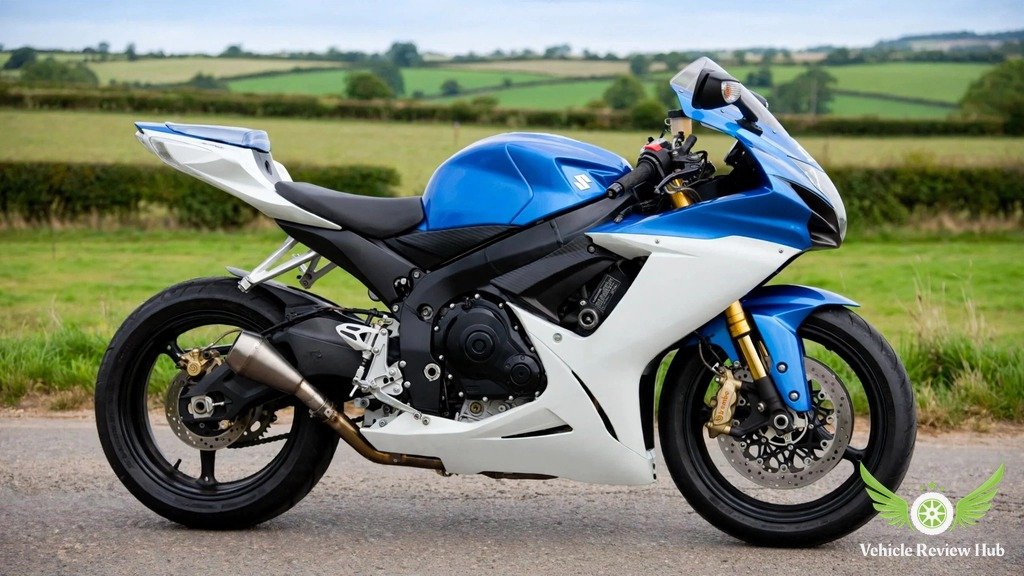
The short answer first: the 2027 Suzuki GSX-R600 is no longer the value pick it was in 2011. The Kawasaki Ninja ZX-6R now undercuts it by $865 delivered, the Yamaha YZF-R9 costs exactly the same on MSRP and $50 more delivered, and the Honda CBR600RR is $1,050 cheaper delivered in its non-ABS form. What the Suzuki still holds is the lightest, simplest package in the class, and a chassis that won Motorcycle.com’s 2011 shootout. This Suzuki GSX-R600 comparison puts the 2027 bike against the three supersports a US buyer can actually buy new, on price, power, electronics and value.
Suzuki GSX-R600 Overview and Its Closest Rivals
The GSX-R600 is the last analogue 600 in the class. The GSX-R600 review covers the full specification sheet; this Suzuki GSX-R600 comparison is about what the bike is up against in 2027. All three are newer designs than the 2011 platform the Suzuki still rides on.
Why These Three Rivals: Survivor, Benchmark, New Wave
The three rivals are three different stories. The Honda CBR600RR is the survivor: the same basic bike America has bought since 2013, still on sale as a 2026 model, with no traction control, no IMU and no TFT — the only rival as analogue as the Suzuki, and the only one cheaper than it. The Kawasaki Ninja ZX-6R is the benchmark: the bike that beat the Suzuki in Cycle World’s 2011 head-to-head and has held the class’s performance standard ever since, now with a 636cc engine, a quickshifter and a TFT dash, for less money than the Suzuki. The Yamaha YZF-R9 is the new wave: an 890cc triple with a six-axis IMU and the full modern electronics suite, launched for 2026 and now in its second year, at exactly the Suzuki’s MSRP.
How the Four Bikes Differ at a Glance
The table below is the whole comparison in one place. Two things jump out before any detail: the Suzuki is the lightest bike here by 7 lb over the next-lightest rival, and it is the only one with no rider aids beyond two engine maps. The video below is Motorcycle.com’s 2011 Supersport Street Shootout, GSX-R600 against the CBR600RR, the ZX-6R and the YZF-R6. The fourth bike in that test is the R6, not the R9 — the R9 did not exist in 2011 — but the shootout is still the only head-to-head that put the Suzuki against two of its three current rivals on the same day, and the Suzuki won it.
| Item | 2027 Suzuki GSX-R600 | 2026 Honda CBR600RR | 2027 Kawasaki Ninja ZX-6R | 2027 Yamaha YZF-R9 |
|---|---|---|---|---|
| MSRP | $12,499 | $11,499 ($12,499 ABS) | $11,599 ($12,599 ABS) | $12,499 |
| Delivered total | $13,149 | $12,099 ($13,099 ABS) | $12,284 ($13,284 ABS) | $13,199 |
| Engine | 599cc inline-four | 599cc inline-four | 636cc inline-four | 890cc inline-three |
| Power | 102.2 hp rear wheel (Motorcycle.com 2011 dyno) | No US figure published; EU 119 hp @ 14,250 rpm | 127 hp @ 13,000 rpm (Kawasaki) | 117 hp @ 10,000 rpm; 69 lb-ft @ 7,000 rpm |
| Curb / wet weight | 412 lb curb | 419 lb curb (434 lb ABS) | 432.2 lb curb | 430 lb wet |
| Seat height | 31.9 in | 32.4 in | 32.7 in | 32.7 in |
| Rider aids | S-DMS two maps, slipper clutch only | Optional Combined ABS only; no TC, IMU or TFT | 3-mode TC, quickshifter, 4 ride modes, 4.3-in TFT | 6-axis IMU, cornering ABS, 9-level TC, quickshifter, 5-in TFT |
Suzuki GSX-R600 vs Honda CBR600RR
The Honda is the closest thing to a mirror of the Suzuki: another 599cc inline-four, another bike with no traction control and no IMU, another machine that has been on sale in essentially the same form for over a decade.

Engine, Specs and Performance Side by Side
Both bikes are 599cc inline-fours, and on paper they are the two closest engines in this Suzuki GSX-R600 comparison. The Suzuki’s measured power is 102.2 hp at the rear wheel at 13,700 rpm on Motorcycle.com’s 2011 dyno, with Cycle World recording 103.3 hp and 44.2 lb-ft on its own dyno the same year — no peak rpm stated for the Cycle World figures. Honda publishes no horsepower figure for the US CBR600RR at all; the European Honda figure for the same engine is 119 hp at 14,250 rpm, which is a claimed crank figure, not a rear-wheel measurement, so the two numbers cannot be compared directly. The hardware split is in the brakes and suspension: the Suzuki carries Brembo monobloc calipers on 310 mm floating discs and a Showa Big Piston Fork, both from its 2011 redesign; the Honda runs its own Nissin calipers and Showa fork with Honda’s HESD electronic steering damper. Neither bike has a quickshifter, and neither has traction control or an IMU — the only rider aid on the Honda is optional electronic Combined ABS, which the Suzuki does not offer at any price.
Price, Equipment and Which Suits Which Rider
On price the Honda wins, and it is not close. The US 2026 CBR600RR is $11,499, or $12,499 with ABS, plus a $600 destination charge — $12,099 delivered without ABS, $13,099 with it — against the 2027 Suzuki at $12,499 plus a $650 destination charge, $13,149 delivered. The non-ABS Honda undercuts the Suzuki by $1,000 on MSRP and $1,050 delivered; even the ABS Honda, which has the one safety feature the Suzuki cannot offer, is $50 cheaper delivered than the Suzuki. The catch is the future: the 2027 CBR600RR has been announced for Europe and the UK only, at £10,999, with Fireblade-derived Nissin four-piston calipers, a three-setting ABS module, a 5-inch TFT display and a refreshed nose — and American Honda has not announced US pricing or availability, though a CARB filing and a Honda NHTSA filing suggest it may come. Until Honda announces it, the honest comparison is the US 2026 Honda against the 2027 Suzuki — and on that basis, the rider who wants the cheapest analogue 600 buys the Honda, the rider who wants the lighter bike with the better brakes and the proven chassis buys the Suzuki, and the rider who wants modern electronics buys neither.
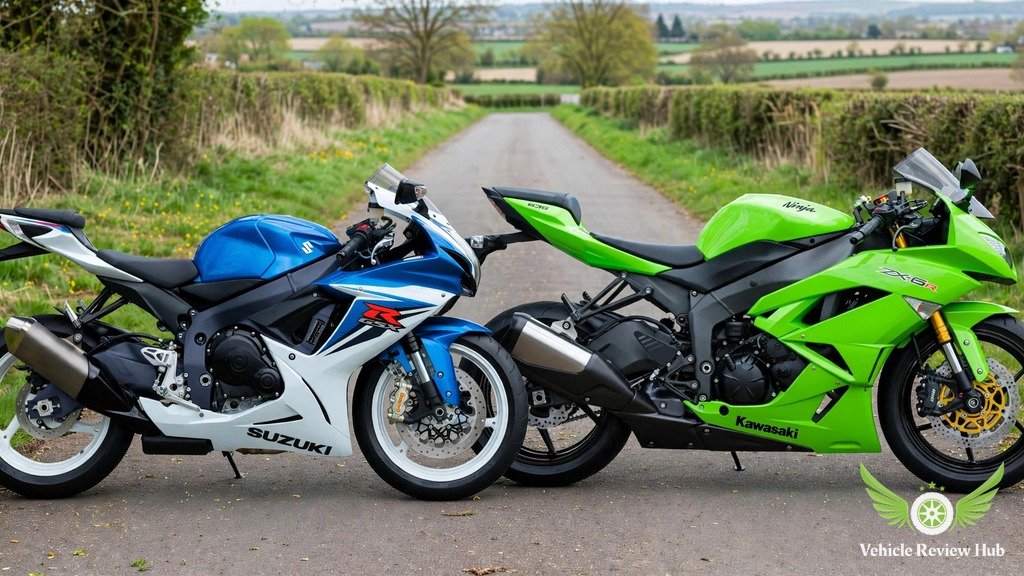
Suzuki GSX-R600 vs Kawasaki Ninja ZX-6R
The ZX-6R is the rival that matters most. It beat the Suzuki in Cycle World’s 2011 head-to-head, it still undercuts the Suzuki on price in 2027, and it is the only rival that is faster, better equipped and cheaper all at once.
Engine, Specs and Performance Side by Side
The performance gap is real and it is measured, not guessed. The GSX-R600 performance guide works through the dyno numbers in full; the short version is that the Kawasaki’s 636cc inline-four made 110.7 hp at 13,900 rpm on Motorcycle.com’s 2011 dyno and 112 hp at 13,770 rpm on Cycle World’s, against the Suzuki’s 102.2 hp at 13,700 rpm and 103.3 hp on the same two dynos — roughly 9 hp more on either machine. Kawasaki claims 127 hp at 13,000 rpm for the current bike; Suzuki publishes no claimed figure at all, and the 123 hp number in spec databases is Motorcycle.com’s own crankshaft figure, never a Suzuki-published one. On the track the gap showed up the same way: in Cycle World’s August 2011 comparison the ZX-6R lapped 1:54.65 against the Suzuki’s 1:55.72, and Cycle World gave its verdict to the Kawasaki. But the same test also showed why the Suzuki won Motorcycle.com’s shootout: the Suzuki was 387 lb dry, 12 lb lighter than the ZX-6R, and Cycle World praised its mid-corner direction changes as fantastic, with braking just about equal. The electronics gap is the real difference in 2027: the ZX-6R carries three-mode traction control, an upshift-only quickshifter, four ride modes and a 4.3-inch TFT dash, with ABS on the ABS trim; the Suzuki has two engine maps and a slipper clutch.
Price, Equipment and Which Suits Which Rider
The price gap has flipped since 2011, and that is the story of this pairing. In 2011 the Suzuki cost $11,599 against the ZX-6R’s $9,999 — $1,600 more, a gap Cycle World flagged with an exclamation mark. In 2027 the non-ABS ZX-6R is $11,599 plus a $685 destination charge, $12,284 delivered, against the Suzuki at $12,499 plus $650, $13,149 delivered — the Kawasaki now undercuts the Suzuki by $900 on MSRP and $865 delivered. Which suits which rider is straightforward: the rider who wants the fastest, best-equipped, cheapest bike buys the ZX-6R; the rider who wants the lightest bike and the analogue experience buys the Suzuki — and should ride both first.
Suzuki GSX-R600 vs Yamaha YZF-R9
The R9 is the newest rival and the strangest one to compare against the Suzuki, because it is not really a 600 at all. It is an 890cc triple with the electronics of a litre bike, priced exactly the same as the Suzuki —

Engine, Specs and Performance Side by Side
The engines are different animals. The Suzuki’s 599cc inline-four makes 102.2 hp at the rear wheel and needs to be kept above 8,000 rpm to make power; the R9’s 890cc CP3 triple makes 117 hp at 10,000 rpm and 69 lb-ft at 7,000 rpm, with the torque spread across the rev range that the Suzuki simply does not have. The real difference is the electronics: the R9 carries a six-axis IMU, cornering ABS, nine-level traction control, slide and lift control, launch control, cruise control, a quickshifter, ride-by-wire and a 5-inch TFT dash. The Suzuki has two engine maps and a slipper clutch. On the figures, the R9 is faster everywhere except the very top of the rev range, and it is easier to ride fast because its electronics cover the mistakes the Suzuki punishes.
Price, Equipment and Which Suits Which Rider
On price the two bikes are the same bike, almost to the dollar, and that is the clearest split in this Suzuki GSX-R600 comparison. The 2027 YZF-R9 is $12,499 MSRP — confirmed for 2027 by Yamaha USA’s November 2026 pricing announcement, unchanged from 2026 — exactly the same as the 2027 GSX-R600’s $12,499. The delivered totals are $50 apart, not identical: the R9’s $700 destination charge makes $13,199 delivered, against the Suzuki’s $650 charge and $13,149. Which suits which rider is the clearest split in this Suzuki GSX-R600 comparison: the rider who wants the most modern bike for the money, the most torque and the most safety net buys the R9; the rider who wants the lightest bike, the analogue experience and the cheapest running costs buys the Suzuki —
Suzuki GSX-R600 Price and Value Compared
Price is where the Suzuki’s case is weakest in this Suzuki GSX-R600 comparison, and it is worth laying out plainly before the verdict.

| Bike | MSRP | Destination | Delivered total |
|---|---|---|---|
| 2027 Suzuki GSX-R600 | $12,499 | $650 (dealer-verified) | $13,149 |
| 2027 Suzuki GSX-R600Z 40th Anniversary | $12,699 | $650 (dealer-verified) | $13,349 |
| 2026 Honda CBR600RR | $11,499 ($12,499 ABS) | $600 | $12,099 ($13,099 ABS) |
| 2027 Kawasaki Ninja ZX-6R | $11,599 ($12,599 ABS) | $685 | $12,284 ($13,284 ABS) |
| 2027 Yamaha YZF-R9 | $12,499 | $700 | $13,199 |
The ZX-6R Now Undercuts the Suzuki on Price
The reversal is the single most important fact in this Suzuki GSX-R600 comparison. In 2027 the Suzuki is $12,499 and the ZX-6R $11,599: the Kawasaki is now $900 cheaper on MSRP and $865 cheaper delivered, and it is the faster, better-equipped bike. Suzuki’s 2027 press release confirms the $12,499 MSRP, and the $650 destination charge is dealer-verified — Suzuki publishes MSRP only, never a destination figure. The 40th Anniversary Z, at $12,699 plus $650, $13,349 delivered, is the most expensive bike in this comparison after the ABS ZX-6R.
Running Costs and Resale Value Compared
Running costs are where the Suzuki fights back, and the GSX-R600 reliability guide works through the full service chart. The schedule is simple and cheap: oil at every interval, a filter at 600 and 11,000 miles only, a valve inspection at 14,500 miles, plugs on an inspect-replace pattern, coolant every four years and brake fluid every two. No dealer labour figure is published for any of these jobs, so the guide prints none rather than inventing one. Fuel is the compiled 43.3 mpg figure, which gives about 195 miles from the 4.5-gallon tank as a labelled estimate, not a tested range. On resale, sixteen years of the same platform means parts are plentiful and every shop knows the bike — but no verified resale figure exists for any of the four bikes, so this guide prints none. The warranty is the same story as the price: twelve months with unlimited mileage, per Suzuki’s 2027 brochure, with Suzuki Extended Protection as an extra-cost option.
Suzuki GSX-R600 Comparison Verdict and US Alternatives
The verdict of this Suzuki GSX-R600 comparison is not that the Suzuki is a bad bike — it is that the Suzuki is a bike for a specific buyer, and the class has moved on around it. The 2011 Supersport Shootout that the Suzuki swept is still the best evidence for what it does well: the lightest chassis, the friendliest handling, the bike every tester got up to speed on fastest.

R6 Is Gone From the Street, R9 Costs the Same
Two facts close the book on the old class. The Yamaha YZF-R6 — the fourth bike in the 2011 shootout, and the Suzuki’s closest rival for a decade — is gone from the street: 2020 was the last street model year in the USA, and Yamaha discontinued it after that year, keeping only a track-only R6 Race in Europe. Its replacement in Yamaha’s range is the R9, and the R9 costs the same as the Suzuki: $12,499 MSRP for 2027, confirmed by Yamaha USA’s November 2026 pricing announcement and TopSpeed’s 2027 first look, with a $700 destination charge making $13,199 delivered against the Suzuki’s $13,149 — $50 apart. The Suzuki’s case is the analogue experience: the lightest bike here, the simplest service schedule, the chassis that won a shootout. The R9’s case is everything else: more torque, more electronics, more safety net.
RS 660 and Daytona 660 Alternatives
Two more bikes sit just outside this comparison, and both are worth naming because they are cheaper than the Suzuki and better equipped. The Aprilia RS 660 is a 659cc parallel twin making 105 hp at 10,400 rpm, weighing 403 lb wet, with a six-axis IMU, cornering ABS, traction control, wheelie and launch control, cruise control and a bidirectional quickshifter — the full modern suite — for $11,849 base, $14,149 for the Factory. There is no single official destination figure for the RS 660; dealer listings show $999 and $1,175, so the delivered total is a range of about $12,848 to $13,024, never a single figure. The Triumph Daytona 660 is the cheapest bike in this whole comparison: a 660cc triple making 94 hp at 11,250 rpm and 50.9 lb-ft at 8,250 rpm, 443 lb wet, with ABS, switchable traction control, three ride modes, ride-by-wire and a standard up-and-down quickshifter, for $9,395 base plus a $725 freight charge — $10,120 delivered, more than $3,000 less than the Suzuki. The US 2026 Daytona has no IMU — reports of a refreshed trio with one come from the Philippines, not the US bike. Riders cross-shopping the modern twin-cylinder alternative inside Suzuki’s own range should read the GSX-8R review, and riders who want more power from the same analogue family should look at the GSX-R750 review.
| Item | 2027 Suzuki GSX-R600 | 2026 Aprilia RS 660 | 2026 Triumph Daytona 660 |
|---|---|---|---|
| MSRP | $12,499 | $11,849 ($14,149 Factory) | $9,395 |
| Delivered total | $13,149 | About $12,848–$13,024 (destination varies) | $10,120 |
| Engine | 599cc inline-four | 659cc parallel twin | 660cc inline-three |
| Power | 102.2 hp rear wheel (dyno) | 105 hp @ 10,400 rpm | 94 hp @ 11,250 rpm |
| Wet weight | 412 lb curb | 403 lb wet | 443 lb wet |
| Electronics | S-DMS two maps, slipper clutch only | 6-axis IMU, cornering ABS, TC, quickshifter | ABS, TC, 3 ride modes, quickshifter; no IMU (US) |
Suzuki GSX-R600 Comparison: Frequently Asked Questions
Direct answers to the comparison questions riders ask about the Suzuki GSX-R600.
Which is better, the Suzuki GSX-R600 or the Kawasaki Ninja ZX-6R?
On outright performance and equipment, the ZX-6R: about 9 hp more, a quicker lap, traction control, a quickshifter and a TFT dash, for $865 less delivered. On feel, weight and the analogue experience, the Suzuki — 20 lb lighter and the bike the Motorcycle.com testers loved. Ride both before deciding.
How much cheaper is the ZX-6R than the GSX-R600?
The 2027 non-ABS ZX-6R is $11,599 plus $685 destination, $12,284 delivered, against the GSX-R600 at $12,499 plus $650, $13,149 delivered — $900 less on MSRP and $865 less delivered. The ABS ZX-6R, at $13,284 delivered, costs $135 more than the Suzuki.
Is the Yamaha YZF-R9 the same price as the GSX-R600?
On MSRP, yes: both are $12,499 for 2027. Delivered, the R9 is $50 more — $13,199 with its $700 destination charge against the Suzuki’s $13,149 with a $650 charge.
Is the Honda CBR600RR cheaper than the GSX-R600?
Yes. The US 2026 CBR600RR is $11,499 plus $600 destination, $12,099 delivered — $1,050 less than the Suzuki. The ABS version is $13,099 delivered, $50 less than the Suzuki. The updated 2027 CBR600RR is Europe-only so far; American Honda has not announced US pricing or availability.
Which bike won the 2011 supersport shootout?
The GSX-R600 won both halves of Motorcycle.com’s 2011 Supersport Shootout — track and street — against the CBR600RR, ZX-6R and YZF-R6. Cycle World’s separate two-bike comparison gave its verdict to the ZX-6R instead, on lap time and power.
Does the Suzuki GSX-R600 have ABS?
No. The GSX-R600 has no ABS in any year, not even as an option. Its only rider aids are the two S-DMS engine maps and a slipper clutch. The CBR600RR offers optional ABS, the ZX-6R offers it as a trim, and the R9 has cornering ABS as standard.
Is the 2027 Suzuki GSX-R600 the same bike as the 2011 model?
Mechanically, yes. The 2027 bike is the 2011 (L1) platform — same 599cc engine, Showa BPF fork and Brembo brakes — with colours and trim changes only. That is why sixteen years of parts and knowledge still fit the bike on sale today.
How much horsepower does the Suzuki GSX-R600 make?
102.2 hp at the rear wheel at 13,700 rpm on Motorcycle.com’s 2011 dyno, and 103.3 hp on Cycle World’s 2011 dyno. The 123 hp figure in spec databases is a claimed crankshaft number from Motorcycle.com’s database, not a Suzuki-published figure.
Will the 2027 CBR600RR come to the US?
Not confirmed. American Honda has not announced US pricing or availability for the updated 2027 bike, which is on sale in Europe and the UK at £10,999. A CARB executive order and a Honda NHTSA filing listing the new model code are strong signs it may come, but until Honda announces it, the US bike remains the 2026 model. Motorcycle.com’s report on the filings explains the evidence in full.
What is the cheapest bike in this comparison?
The Triumph Daytona 660, at $9,395 plus $725 freight, $10,120 delivered — more than $3,000 less than the Suzuki. Of the four inline-four and triple supersports, the Honda CBR600RR is cheapest at $12,099 delivered without ABS.
Is the Suzuki GSX-R600 good for beginners?
No. It makes 102 hp at the rear wheel, needs revs above 8,000 rpm to make power, and has no ABS or traction control. A new rider should start on something like the SV650 and work up to a supersport.
Which bike should I buy: GSX-R600, ZX-6R or R9?
Buy the ZX-6R for the fastest bike with the most equipment at the lowest price, the R9 for the most torque and the fullest electronics suite at the same MSRP, and the GSX-R600 for the lightest, simplest, most analogue bike in the class — if that is what you actually want, and only after riding all three.