The short answer first: the 2027 Suzuki GSX-R600 is the same 599cc supersport Suzuki introduced in 2011, still on sale new in the USA with no ABS, no traction control and no quickshifter — just a high-revving inline-four, a Showa Big Piston Fork and Brembo monobloc brakes. It costs $12,499 before destination, or $13,149 delivered. This Suzuki GSX-R600 review covers the 2027 bike’s specs, prices, design and riding experience.
Suzuki GSX-R600 Overview and Model-Year Updates
The GSX-R600 is the middleweight of Suzuki’s GSX-R family, sitting between the 750 and the 1000, and the bike on sale today is the fifth generation — the L1 platform introduced for 2011. That redesign brought a new engine, the Showa BPF fork, Brembo monobloc calipers and a lighter chassis, carried over mechanically unchanged ever since. The 2027 model year brings new colours and a 40th Anniversary edition.
The video below is a spec-based overview of the 2026 bike, compiled from publicly available information — not a hands-on ride test.
Latest Year Is 2027: the 2011 Bike, Still Going
Suzuki released the 2027 GSX-R600 and GSX-R750 on 7 August 2026, confirming the 2027 bike carries over the compact, high-revving inline-four, the lightweight chassis and the analogue character of the 2011 machine. Cycle World, re-testing the same platform in 2023, put it plainly — the 600 has not been updated since 2011. The only changes since then have been colours and trim, which makes the GSX-R600 unusual in 2027: every rival has been redesigned, replaced or discontinued, while Suzuki keeps selling the same bike. The platform is proven — fifteen years of production means every weakness is known and parts are plentiful. This Suzuki GSX-R600 review treats the 2027 bike as what it is: a 2011 supersport, still new, still fast, and deliberately old-fashioned.
Europe Lost It to Euro 4 in 2017, Not Euro 5
The GSX-R600 disappeared from European showrooms because of Euro 4, not Euro 5: the 600 and the 750 were dropped in Europe over Euro 4 at the end of 2017, with the 1000 following later over Euro 5 in 2022. Euro 4 limits took effect on 1 January 2017, the 600 was never made Euro 4-compliant, and Suzuki sold remaining European stock only under the two-year “end of series” derogation, with the last UK sales in 2018. It stayed on sale in the USA and other markets. That history matters for a US buyer: Suzuki stopped developing the bike for Europe, its biggest supersport market, and kept building it for the markets that still wanted it — so the 2027 US bike is a genuine continuation, not a revival, while its European rivals moved on to Euro 5 machines. The 2011 Motorcycle.com shootout that first tested this generation is still the best record of what the platform was built to do.
Suzuki GSX-R600 Engine and Specifications
The engine is a 599cc liquid-cooled inline-four with dual overhead cams, fuel injection with Suzuki’s SDTV throttle bodies, and a six-speed gearbox driving the rear wheel through a chain — the same basic unit Suzuki has built since 2011, with a 67.0 by 42.5 mm bore and stroke and 12.9:1 compression. Suzuki publishes no claimed power, torque or MPG figure for this bike anywhere in its 2027 brochure — any horsepower number for the GSX-R600 comes from a third-party dyno, never from Suzuki. The GSX-R600 performance guide covers the two named 2011 dyno results in full.

| Specification | 2027 Suzuki GSX-R600 |
|---|---|
| Engine | 599cc liquid-cooled inline-four, DOHC, fuel injection |
| Bore × stroke | 67.0 × 42.5 mm |
| Compression ratio | 12.9:1 |
| Claimed power / torque | Not published by Suzuki |
| Transmission | 6-speed, chain final drive |
| Front brakes | Twin floating 310 mm discs, Brembo monobloc calipers |
| Front suspension | Showa Big Piston Front Fork (BPF), inverted |
| Seat height | 31.9 in |
| Curb weight | 412 lb |
| Wheelbase | 1,385 mm (54.5 in) |
| Tyres | Front 120/70ZR17, rear 180/55ZR17, tubeless |
| Fuel tank | 4.5 US gal (4.2 gal CA model) |
| Warranty | 12-month unlimited-mileage limited warranty |
599cc, S-DMS Two Maps and a Slipper Clutch
The GSX-R600’s only electronic rider aid is S-DMS, Suzuki’s drive mode selector, offering push-button selection of two racing-developed engine control maps — the 2027 brochure‘s “Electronic Rider Aids” section names nothing else. The trap to avoid is the old three-map figure: pre-2011 GSX-R600s had three S-DMS settings, but the 2011-on bike has two. The other rider aid is mechanical: the SCAS back-torque-limiting clutch, a slipper clutch that smooths downshifts and corner entry. Together the two maps and the slipper clutch are all the help the bike gives you — no wheelie control, no launch control and no engine-braking control. The rider manages all of that with the throttle and the clutch, which is exactly the point for the buyers who still choose this bike.
No ABS, TC, Quickshifter or IMU in Any Year
No GSX-R600 in any year has ABS, traction control, a quickshifter or an IMU. The 2027 brochure mentions none of them anywhere, and the instrument cluster is an analogue tachometer with an LCD display — no colour TFT screen. That absence is the defining fact of this Suzuki GSX-R600 review, and it cuts both ways. On a track day, nothing intervenes when the rear tyre steps out or the front wheel lifts; the bike rewards smooth inputs and punishes sloppy ones, which is why experienced riders call it honest. On the road, it means no safety net in the rain, no ABS when a car pulls out, and no quickshifter for clutchless upshifts in traffic. Every 2027 rival — the ZX-6R, the YZF-R9, the CBR600RR — offers at least ABS and traction control, most offer far more. Suzuki’s own bigger sibling, the GSX-R750 review bike, shares the same analogue character — and a buyer who wants electronics should not buy this bike hoping for a software update, because there is none coming.
Suzuki GSX-R600 Price and Market Availability
The 2027 GSX-R600 costs $12,499, and the 40th Anniversary GSX-R600Z costs $12,699 — Suzuki’s MSRPs from the 7 August 2026 press release, $300 more than the 2026 model year. Suzuki prints MSRP only, so the delivered totals below use the $650 destination charge that dealer listings agree on. The bike is on sale in the USA now, in two trims.

| Trim / year | MSRP | Destination | Delivered total |
|---|---|---|---|
| 2027 GSX-R600 | $12,499 | $650 | $13,149 |
| 2027 GSX-R600Z 40th Anniversary | $12,699 | $650 | $13,349 |
| 2026 GSX-R600 | $12,199 | $600 | $12,799 |
Suzuki GSX-R600 Price in the USA: $12,499 for 2027
The $12,499 base price is confirmed twice: Suzuki’s own press release and the TopSpeed 2027 first look, which notes the $300 rise over 2026. The delivered total of $13,149 adds the $650 destination charge found on dealer listings — Stamford Motorsports, Advantage Powersports and Cycle Motion all show the same $650. Suzuki’s MSRP footnote excludes destination freight and delivery charges, so the $650 is dealer-verified, not Suzuki-printed, and this Suzuki GSX-R600 review says so plainly. One dealer figure to ignore is a $750 freight charge shown by one Florida dealer — a dealer-added number, not the $650 the other dealers agree on. All totals are before tax, title, registration and dealer fees. The 2026 delivered total of $12,799 uses motorcycle.com’s spec-database destination figure of $600, because dealer listings for 2026 varied from $650 to $950. At launch in 2011 the bike cost $11,599 — $1,600 more than the 2011 ZX-6R at $9,999 — and the 2027 price means the bike has risen only $900 in sixteen years, which is part of why it still sells.
40th Anniversary Z at $12,699, Destination $650
The GSX-R600Z 40th Anniversary Edition costs $12,699, exactly $200 more than the base bike, with the same $650 destination charge for a $13,349 delivered total. The Z wears Pearl Vigor Blue and Pearl Tech White paint with 40th Anniversary graphics and logos, a 40th Anniversary logo on the fuel tank and a 3-D Suzuki emblem on the fork’s upper bracket. Mechanically it is the same bike — same 599cc engine, same BPF fork, same Brembo brakes, same two S-DMS maps — so the $200 buys the livery and the anniversary badging, nothing else. The base bike comes in three paint schemes, and Suzuki’s brochure does not name them. A buyer choosing between the two trims is really choosing whether the anniversary graphics are worth $200, since nothing else changes. The Suzuki 2027 press release lists both MSRPs side by side.
Suzuki GSX-R600 Design, Features and Technology
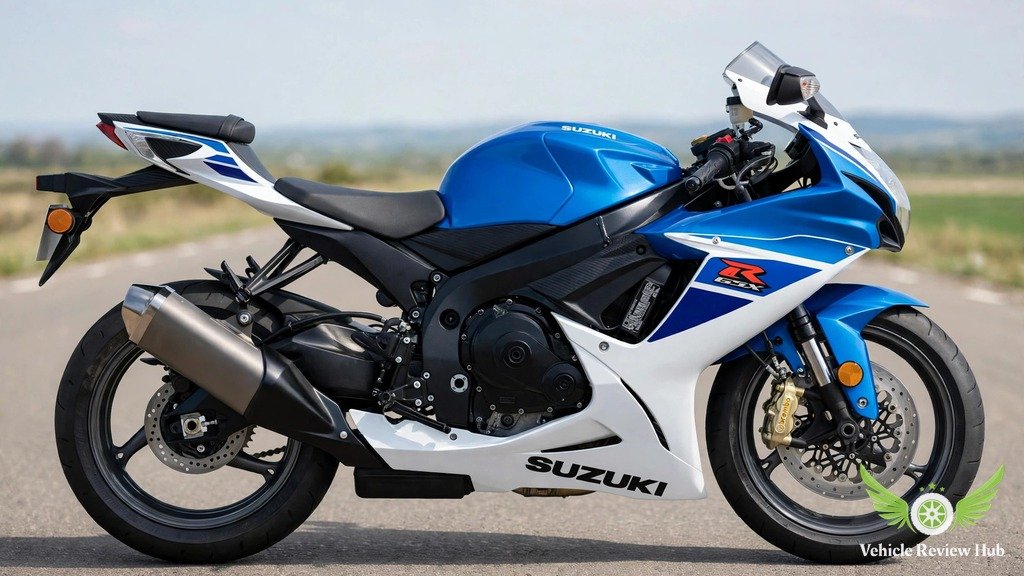
In this Suzuki GSX-R600 review, the design dates from the 2011 redesign: a full fairing with dual headlights, a sharp stacked upper fairing, a compact tail and a short right-side muffler. There are no aerodynamic winglets and no TFT dash bulge — the fairing wraps a conventional braced swingarm, a chain drive on the left and an inverted fork up front, with an analogue tachometer and LCD display. It is a design that has aged well precisely because it predates the current fashion for winglets and screens.

Brembo Monoblocs and Showa BPF From the 2011 Redesign
The two hardware upgrades that defined the 2011 redesign are still the bike’s best features. Up front are fully floating 310 mm discs with radial-mount four-piston Brembo monobloc calipers — one-piece calipers that were a genuine step up from the Tokico units they replaced. Motorcycle.com’s first ride at Barber called the Brembos fade-free over a 30-minute session, while noting they lack the strong initial bite some riders prefer. Visordown said the monobloc Brembos and the big-piston forks had the braking “licked” and that no bike begged the rider to brake later and deeper. The rear brake is a Nissin single-piston caliper on a single disc; Suzuki does not publish the rear disc diameter. The front suspension is the Showa Big Piston Front Fork, an inverted telescopic fork, with a single Showa rear shock on a link-type mount, adjustable for rebound, compression, preload and ride height. Testers found the BPF close to right from the crate — one launch report called it “a gem” through hard braking.
The Steering Damper Is Electronic, Not Conventional
The steering damper on the GSX-R600 is electronically controlled, not a conventional hydraulic unit. Suzuki’s 2027 brochure describes it as providing light resistance at slower road speeds with greater damping force at higher speeds — the damping changes with speed rather than staying fixed. That matters because a conventional damper stiff enough for high speed makes low-speed steering heavy, while one light enough for town does little at triple-digit speeds. The electronic damper sidesteps the compromise, and it is one of the few genuinely modern touches on an otherwise analogue bike. It is not an IMU-linked system — there is no inertial measurement unit feeding it lean-angle data, so it responds to speed, not to lean — and riders notice it most at motorway speeds, where the front end stays calm without the bars feeling wooden around town.
Suzuki GSX-R600 Riding Experience and Comfort
Riding the GSX-R600 is an exercise in revs, and that shapes the rest of this Suzuki GSX-R600 review. The seat is 31.9 inches high, the curb weight is 412 lb, and the riding position is a committed supersport crouch — low clip-ons, high rearsets, and a tank shaped to lock the rider’s knees in. It is not a comfortable bike for long motorway stretches. What it offers instead is a chassis that testers have called gloriously well balanced and confidence generating, with handling that lets a rider get up to speed quickly — though the GSX-S1000GT is the Suzuki to buy if the riding position here is too much.

Riding Position, Handling and Low-Speed Maneuverability
The riding position is pure supersport: the rider sits on top of the bike rather than in it, weight on the wrists at low speed, and the 31.9-inch seat lets most riders get both feet down. At 412 lb wet, the bike is light for its class, and Cycle World’s 2011 comparison measured it at 387 lb dry — 12 lb lighter than the ZX-6R it was tested against. That lightness shows in the handling: Cycle World praised its ability to change direction mid-corner as fantastic, Motorcycle.com’s testers found instant familiarity that let them get up to speed quickly, and MCN called it completely stable, saying a rider would be hard-pushed to get it anywhere near out of shape even on track. The caveats are narrow: Cycle World found slightly less front-end feedback than the ZX-6R, said the Suzuki did not feel as planted, and noted the bike was 9 hp down on top. At low speed the bike is manageable for a supersport, but the committed position and the tall first gear mean stop-start traffic is the bike’s least happy place.
An Engine That Needs Revs: Every Tester Agrees
Every tester who has ridden this engine says the same thing: it needs revs. Cycle World put it directly — the engines are not exactly peaky, but they do crave revs, especially the GSX-R — and the 2023 re-test of the same platform was blunter: below 8,000 rpm, the GSX-R600 produces little power and torque. Motorcycle.com’s 2011 dyno work found the same shape — the claimed low- and mid-range improvement over the 2009 bike did not show on the dyno, and the peak of 102.2 hp at 13,700 rpm on the rear wheel was, in their words, a bit sobering against the claimed 123 hp at the crank. But the same testers praised the delivery: a linear pull that rivals the Ninja, and the best-in-class power from 4,800 to 7,000 rpm. That is the engine’s character — weak below 8,000 rpm, strong and linear from the mid-range to a 13,700 rpm peak, always asking the rider to keep it spinning. A rider coming from a twin or a bigger four will find the bottom end thin; a rider who holds gears and uses the revs will find it fast and forgiving.
Suzuki GSX-R600 Review: Pros, Cons and Verdict
The verdict of this Suzuki GSX-R600 review is simple: the 2027 GSX-R600 is the best analogue supersport still on sale, and the worst-equipped one. It wins on chassis, brakes, price stability and proven reliability, and it loses on electronics, low-end power and modern features. A track-day rider who values feel over aids will love it; a commuter who wants ABS and a quickshifter should buy something else.

| Pros | Cons |
|---|---|
| Brembo monobloc brakes, fade-free on track | No ABS, traction control, quickshifter or IMU in any year |
| Showa BPF fork, near-right from the crate | Engine weak below 8,000 rpm — needs revs |
| $13,149 delivered; only $900 more than 2011 launch | ZX-6R undercuts it by $865 delivered, with electronics |
Main Advantages and Limitations of the Suzuki GSX-R600
The advantages start with the chassis and brakes. The Brembo monoblocs and the Showa BPF fork were class-leading in 2011 and remain genuinely good hardware in 2027 — fade-free on track, precise on the road, and adjustable enough to suit most riders without aftermarket parts. The chassis is light and balanced, the steering is quick without being nervous, and the electronic steering damper adds high-speed calm. The price is the other advantage: $13,149 delivered is modest for a new supersport, and fifteen years of production means parts are cheap and every common fault is documented — the GSX-R600 reliability guide covers the service schedule and the five recalls in full. The limitations are equally clear: no rider aids beyond two engine maps and a slipper clutch — no ABS, no traction control, no quickshifter, no IMU, no TFT — and an engine weak below 8,000 rpm, so the bike feels slow in traffic and only comes alive when ridden hard. The dash is analogue, the fairing is a 2011 design, and the riding position punishes long days. The GSX-R600 comparison puts these trade-offs against the ZX-6R, the CBR600RR and the YZF-R9, which all offer the electronics this bike lacks.
Twelve-Month Unlimited-Mileage Warranty
The 2027 GSX-R600 is covered by Suzuki’s 12-month, unlimited-mileage limited warranty — the same wording Suzuki uses on its 2026 product page and in the 2027 brochure. Unlimited mileage matters on a bike like this, because a track-day rider can cover serious miles in a year without worrying about a mileage cap voiding the cover. Longer coverage with other benefits is available through Suzuki Extended Protection, Suzuki’s extended warranty programme, but that is an extra-cost option, not standard cover. Twelve months is short by modern standards — many rivals offer two years — but it matches a simple bike with few electronics to fail. Buyers should read the warranty terms at the dealer, since the limited warranty has the usual exclusions for wear items, track use and modifications.
Suzuki GSX-R600 Review: Frequently Asked Questions
Direct answers to the questions riders ask most in this Suzuki GSX-R600 review.
How much does a 2027 Suzuki GSX-R600 cost?
The 2027 GSX-R600 costs $12,499, and the 40th Anniversary GSX-R600Z costs $12,699. With the $650 destination charge that dealer listings agree on, the delivered totals are $13,149 for the base bike and $13,349 for the Z.
Is the 2027 GSX-R600 the same bike as the 2011 model?
Mechanically, yes. The 2027 bike is the fifth-generation L1 platform introduced in 2011, carried over unchanged except for colours and trim — the same engine, frame, Showa BPF fork, Brembo brakes and electronics the 2011 bike launched with. Suzuki’s 2027 announcement confirms the carry-over.
Does the Suzuki GSX-R600 have ABS?
No. No GSX-R600 in any year has ABS, and there is no ABS option on the 2027 bike. It also has no traction control, no quickshifter and no IMU — the only rider aids are the two S-DMS engine maps and the slipper clutch.
What is S-DMS on the GSX-R600?
S-DMS is Suzuki’s drive mode selector, offering push-button selection of two racing-developed engine control maps — the bike’s only electronic rider aid. Pre-2011 bikes had three maps, so any source claiming three maps for the 2011-on bike is describing the older generation.
How much horsepower does the GSX-R600 make?
Suzuki publishes no claimed power figure. The named third-party results are Motorcycle.com’s 2011 dyno at 102.2 hp at 13,700 rpm on the rear wheel, and Cycle World’s 2011 dyno at 103.3 hp and 44.2 lb-ft, with no peak rpm stated. Motorcycle.com’s specs database lists a claimed crank figure of 123 hp, but that is Motorcycle.com’s figure, not a Suzuki number.
What is the top speed of the GSX-R600?
No instrumented top-speed test of the 2011-on bike from a US magazine was found. The 157 mph figure commonly listed is a compiled figure from aggregator sites, not a test result, and a conflicting aggregator lists 161.6 mph.
What MPG does the GSX-R600 get?
Suzuki publishes no MPG figure, and there is no EPA rating — motorcycles are exempt from EPA fuel-economy testing. The 43.3 US mpg figure sometimes quoted is compiled, not a Suzuki or EPA figure.
Why was the GSX-R600 dropped in Europe?
It was dropped over Euro 4, not Euro 5. Euro 4 limits took effect on 1 January 2017, the bike was never made Euro 4-compliant, and Suzuki sold remaining European stock only under a two-year derogation, with the last UK sales in 2018. It stayed on sale in the USA and other markets.
What is the GSX-R600Z 40th Anniversary Edition?
The Z is a $12,699 trim of the 2027 bike — $200 more than the base — in Pearl Vigor Blue and Pearl Tech White with 40th Anniversary graphics and logos, a 40th Anniversary logo on the fuel tank and a 3-D Suzuki emblem on the fork’s upper bracket. Mechanically it is identical to the base bike.
Is the GSX-R600 good for beginners?
No. It is a 599cc supersport with a committed riding position, an engine that needs revs, and no ABS or traction control — a poor first bike. Suzuki’s own SV650 is the beginner-friendly Suzuki to start on instead.
What is the warranty on the GSX-R600?
A 12-month, unlimited-mileage limited warranty, with no mileage cap. Longer coverage is available through Suzuki Extended Protection at extra cost. Twelve months is short by modern standards, but it matches a simple bike with few electronics to fail.
Should I buy a GSX-R600 or a ZX-6R?
Buy the GSX-R600 if you want the most analogue supersport still on sale — the lightest chassis, the simplest ownership, and a proven platform at $13,149 delivered. Buy the ZX-6R if you want modern electronics and more power for less money: the 2027 ZX-6R costs $11,599 plus $685 destination, or $12,284 delivered — $865 less than the Suzuki, with traction control, a quickshifter and a TFT dash.