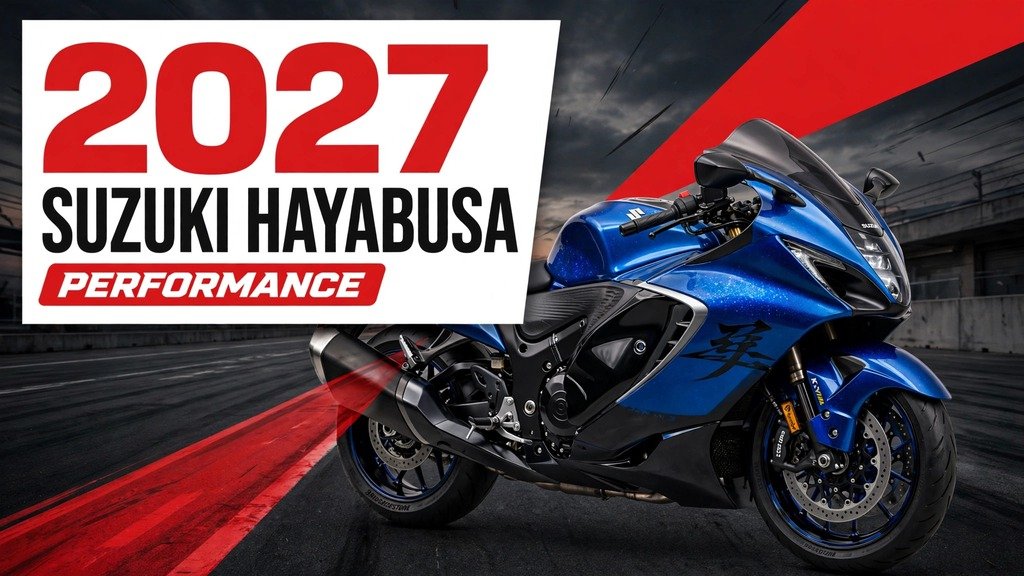
The fastest Suzuki ever built is also one of the most misunderstood, and this Suzuki Hayabusa performance guide sorts the measured numbers from the myths. A Gen 3 ran a 9.89-second quarter-mile in Bennetts’ hands, hit 2.69 seconds to 60 mph, and averaged 38 mpg over Rider Magazine’s 1,700-mile road test — while the 194 mph figure belongs to the 1999 original only, and the Gen 3 is limited to 186 mph. This Suzuki Hayabusa performance guide covers the dyno runs, the acceleration, the top speed, the fuel economy and the handling.
Suzuki Hayabusa Engine Performance and Power Delivery
Suzuki Hayabusa performance starts with the engine: the Gen 3’s headline number went down while the bike got faster where it counts. The 1,340cc inline-four peaks at 9,700 rpm and pulls hardest through the midrange. The numbers below are the ones this Suzuki Hayabusa performance guide uses throughout, every one with its source.

Rider Dyno: 173 HP at the Rear Wheel
Rider Magazine put its 2022 Gen 3 on Jett Tuning’s dyno during a road test of about 1,700 miles, and the rear wheel showed 173 hp at 9,800 rpm and 106 lb-ft at 6,900 rpm. That wheel figure comes from the same bike that did the fuel-economy test. Torque peaks at 6,900 rpm, just below the claimed 7,000 rpm peak. Rider Magazine’s road test is the source for both the dyno run and the 38 mpg fuel test — the same motorcycle on the same trip. Bennetts’ test at RPM Bikes measured 178.5 bhp at the rear wheel; the Gen 2 made 180 bhp on the same dyno. The gap is a dyno-to-dyno difference; Bennetts notes under 5% of crank power is lost in the transmission.
Gen 3 Claim Fell to 188 HP From 194
The claimed peak fell from 194 hp on the Gen 2 to 190 PS on the Gen 3. Suzuki Global rates the Gen 3 at 140 kW, or 190 PS at 9,700 rpm, with 150 Nm at 7,000 rpm. Converted to US units that is 187.7 hp and 111 lb-ft — the same claim in a different unit — and 187.7 rounds to 188 hp, the figure this Suzuki Hayabusa performance guide uses. Suzuki USA publishes no horsepower figure, so any US number is a conversion or a dyno run. Never write “190 hp”: 190 is the metric PS figure. The drop from 194 to 188 has two causes: Euro 5 rules forced changes to the exhaust and fuelling, and Suzuki retuned the engine for midrange rather than peak. The result is a bike faster where it matters: Bennetts’ 0–60 of 2.69 seconds is the fastest their tester had set in 30 years, and Suzuki’s 0–200 km/h claim is 6.8 seconds against the Gen 2’s 6.9. The full Hayabusa review covers the engine, chassis and electronics in detail.
| Figure | Gen 3 Hayabusa | Source |
|---|---|---|
| Claimed power | 190 PS @ 9,700 rpm (187.7 hp) | Suzuki Global |
| Claimed torque | 150 Nm / 111 lb-ft @ 7,000 rpm | Suzuki Global |
| Rider dyno, rear wheel | 173 hp @ 9,800 rpm, 106 lb-ft @ 6,900 rpm | Rider Magazine, Jett Tuning |
| Bennetts dyno, rear wheel | 178.5 bhp (Gen 2: 180 bhp, same dyno) | Bennetts / RPM Bikes |
| 0–60 mph, Suzuki claim | 3.2 s (Gen 2: 3.4 s) | Suzuki |
| 0–60 mph, measured | 2.69 s | Bennetts |
| Quarter-mile, measured | 9.89 s @ 146.3 mph | Bennetts |
| Top speed | 186 mph, electronically limited | Gentlemen’s agreement |
| Fuel economy, tested | 38 mpg average over ~1,700 mi | Rider Magazine |
The table above is the quick reference this Suzuki Hayabusa performance guide uses.
Suzuki Hayabusa Top Speed and Acceleration
Suzuki Hayabusa performance is most often judged on two numbers — the quarter-mile and the top speed — and the fastest figures belong to different generations. The Gen 3 has a measured quarter-mile, but the 194 mph top speed is not its number.

Bennetts Timed 9.89 Seconds for Gen 3
Bennetts’ BikeSocial test timed the Gen 3 at 9.89 seconds over the quarter-mile at 146.3 mph, with a 0–60 mph run of 2.69 seconds — the fastest 0–60 their tester had set in 30 years. That is a real, instrumented quarter-mile for the Gen 3 — it settles a claim that used to appear in print, that no magazine test existed. It did exist, and this Suzuki Hayabusa performance guide uses it as the Gen 3’s figure. Bennetts’ review is the source for the 9.89-second run, the 2.69-second 0–60 and the 178.5 bhp dyno figure, all from the same test. The same page records 169.5 mph in 0.52 miles — not a true top speed, the runway ran out. No US magazine has published a Gen 3 quarter-mile time. Cycle World’s only Gen 3 datapoint is a VBox GPS low-10s pass at 145 mph at 4,400 feet — explicitly not an official time. Unofficial datapoints only: BikeWorld 10.1 seconds, ZigWheels 10.78 against a Gen 2’s 11.16 on a wet airstrip, CarWow 10.4 against an Aventador SVJ’s 10.7 — none a magazine-timed quarter-mile, and this Suzuki Hayabusa performance guide keeps them labelled.
194 MPH Belongs to the 1999 Original
The 194 mph figure belongs to the 1999 original only, and it was measured, not claimed. Cycle World’s June 1999 “Birds of Pray” test ran the Gen 1 to 194 mph on a Stalker radar gun, unrestricted, before the agreement took effect — with a 0–60 of 2.6 seconds, a quarter-mile of 9.86 at 145.80 mph, a dyno reading of 160.5 hp and 99.9 lb-ft, and 32 mpg. From 2000 the agreement capped every big bike at 186 mph, and the Gen 2 and Gen 3 are both limited to 186 mph (300 km/h; 299 km/h is 185.8 mph). No US outlet has tested a Gen 3 top speed. A second-hand Motorrad report puts the limiter cut-out at a true 295 km/h (183 mph) — labelled, not the 186 mph limit in the spec table. If a seller claims a Gen 3 does 194 mph, it is borrowing the 1999 bike’s number — the top-speed trap this Suzuki Hayabusa performance guide flags most. The Gen 3 is limited, the Gen 2 was limited, and only the 1999 original ever ran unrestricted.
| Generation | Test | Quarter-mile | Trap speed |
|---|---|---|---|
| Gen 1 (1999) | Cycle World | 9.86 s | 145.80 mph |
| Gen 2 (2008) | Cycle World | 9.70 s | 148.48 mph |
| Gen 3 | Bennetts | 9.89 s | 146.3 mph |
| Gen 2 (2012) | Motorcycle.com shootout | 9.81 s | ZX-14R 9.69 s in the same test |
The quarter-mile table above is the generation-by-generation record this Suzuki Hayabusa performance guide stands on.
Suzuki Hayabusa Mileage and Fuel Economy
Suzuki Hayabusa performance is not only about speed — a bike that does 38 mpg over 1,700 miles is a bike you can actually ride somewhere, and the fuel figures here are all from named tests. The Gen 3 is thirstier than the Gen 2, and the tested numbers in this Suzuki Hayabusa performance guide show how much that costs in range.
Rider Tested 38 MPG Over 1,700 Miles
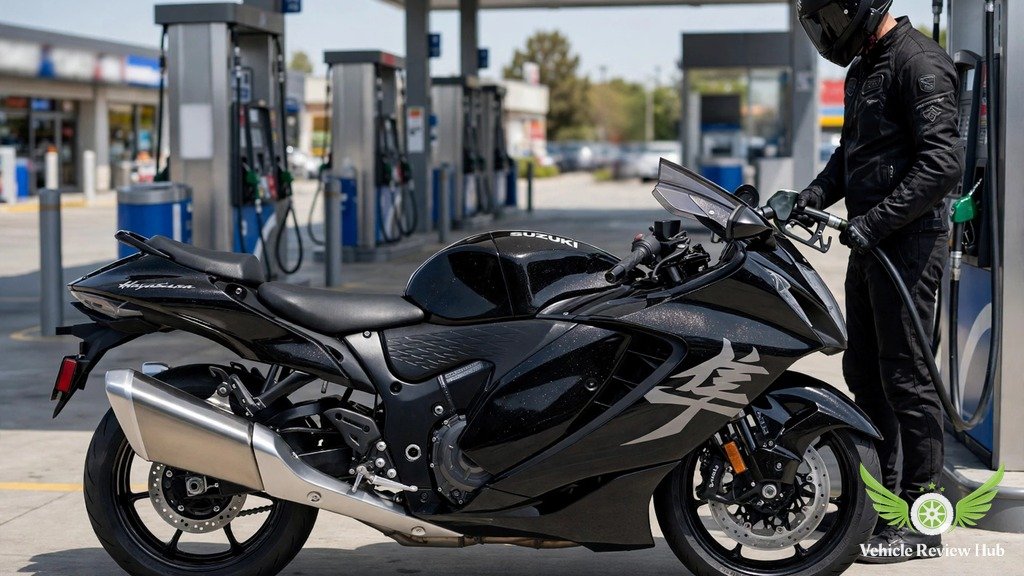
Rider Magazine’s 2022 road test averaged 38 mpg over about 1,700 miles, burning roughly 44 gallons of premium fuel. The spread: a high of 42 mpg ridden gently, a low of 31 mpg pushed hard, a 201.5-mile range from the 5.3-gallon tank. That 38 mpg is the figure this Suzuki Hayabusa performance guide uses. Motorcycle.com’s 2012 shootout, same day and same riders, backs it up: the Gen 2 Hayabusa returned 37.1 mpg against the ZX-14R’s 31.0. Bikesales saw 6.5 litres per 100 km (43.3 mpg Imperial) after about 130 km. An Imperial gallon is bigger than a US gallon, so this guide keeps them labelled. This guide does not use the India-market 17–18 km/l claim that circulates online — it is not a US number.
Suzuki Publishes No MPG Figure
Suzuki USA publishes no MPG figure for the Hayabusa — the full spec page lists the tank, 20.0 litres or 5.3 gallons, and nothing about consumption. That is why every fuel figure in this Suzuki Hayabusa performance guide comes from a magazine test. Suzuki says consumption rose from 5.7 to 6.7 litres per 100 km against the Gen 2 — the cost of Euro 5 and the midrange retune. For a buyer doing the sums, the honest range is the Rider figure: about 200 miles from a full tank. The Hayabusa reliability guide covers the fuel bill across a year of ownership.
| Source | Figure | Note |
|---|---|---|
| Rider Magazine, 2022 | 38 mpg average | ~1,700 mi; high 42, low 31; 201.5-mi range |
| Bennetts | ~41.1 mpg Imperial | Average; fuel light at 135 mi |
| Cycle World launch ride | 31.4 mpg Imperial (26.2 US) | Short TFT sample, hard riding |
| Motorcycle.com, 2012 | 37.1 mpg | Same-day test; ZX-14R 31.0 mpg |
| Suzuki USA | No MPG published | Tank only: 20.0 L / 5.3 gal |
The fuel table above is the full tested record this Suzuki Hayabusa performance guide relies on.
Suzuki Hayabusa Real-World Riding Experience
Suzuki Hayabusa performance on paper is one thing; the way the bike behaves on a real road is another. Reviewers keep coming back to the same words — big, comfortable, stable, fast, easy to ride fast — and the drag-strip story that made headlines in 2021 is worth telling straight, because the published numbers are not the ones most people remember.

Edmunds Pitted It Against a Tesla Plaid
Edmunds put the Hayabusa against a Tesla Model S Plaid and a ZX-14R in September 2021, with pro drag racer Chris Moore riding the stock 2022 Hayabusa and the stock 2021 ZX-14R. The article publishes only the Tesla’s numbers: 0–60 mph in 2.3 seconds, quarter-mile 9.4 seconds at 150.8 mph. It publishes no Hayabusa time at all — no elapsed time, no trap speed. That is the honest record this Suzuki Hayabusa performance guide states plainly: the Hayabusa’s quarter-mile was never published. Edmunds’ article is the source, and the gap in it is the point. Two traps follow. First, do not print a “0–60 in 2.3 seconds” for the Hayabusa — that is the Tesla’s figure. Second, do not call the event a Hayabusa defeat or win on the basis of an unpublished time. The Gen 3’s measured quarter-mile is the Bennetts 9.89 seconds.
Gen 2 Ran 9.70 at 148 MPH in 2008
The Gen 2’s quarter-mile record is the benchmark for the Gen 3 in this Suzuki Hayabusa performance guide, and it still stands as the quickest of the three generations. Cycle World’s February 2008 “Hayabusa By the Numbers” ran the Gen 2 to 9.70 seconds at 148.48 mph — a production-bike best — with a dyno reading of 171.4 hp at 9,650 rpm and 102.0 lb-ft at 7,200 rpm, 552 lb without fuel, top speed limited to 186 mph. Cycle World’s 2008 test is the source for the 9.70-second run. Side by side: Gen 1 9.86 at 145.80 mph (1999), Gen 2 9.70 at 148.48 mph (2008), Gen 3 9.89 at 146.3 mph (Bennetts). The Gen 3 is a tenth and a half slower than the Gen 2 — the Gen 2’s extra peak power shows at the far end, the Gen 3’s midrange at the start. The paired 2012 Motorcycle.com shootout put the ZX-14R at 9.69 seconds against the Hayabusa’s 9.81, the ZX-14R’s dyno at 188.1 hp against the Hayabusa’s 171 hp. Motorcycle.com’s 2012 shootout is the source, and the two figures must stay paired.
The video below is a 2022 Gen 3 review from Rider Magazine, with riding footage on the road — not a dyno video, and not a drag race. The dyno and fuel figures in this Suzuki Hayabusa performance guide come from Rider’s written road test.
Suzuki Hayabusa Handling, Braking and Stability
Suzuki Hayabusa performance at 582 pounds is a handling question as much as a power question, and the Gen 3 answers it better than any Hayabusa before it. The bike is big and heavy, and no reviewer pretends otherwise — but it handles well for its size, and the brakes are the best the model has ever had. This Suzuki Hayabusa performance guide covers what the tests actually measured, and what they only praised.

Handling, Braking and Stability at 582 Pounds
The Gen 3 weighs 264 kg, or 582 lb, ready to ride — the US curb figure, not the 262 kg European figure — and the seat is 800 mm, or 31.5 inches, high. Suzuki calls the Gen 3 the most agile Hayabusa ever — about 2 kg lighter than the Gen 2. Bennetts calls it “a big, comfortable, stable, fast motorcycle” that is “very easy to ride fast”, Motorcyclist says it “handles well for its size”, and Rider calls it “a big bike… but it is also a very capable one”. That agreement is the handling verdict in this Suzuki Hayabusa performance guide: weight and agility both real. The twin-spar aluminium frame, fully adjustable 43 mm inverted KYB fork and KYB rear shock, 1,480 mm wheelbase, 23 degrees of rake and 90 mm of trail explain the stability at speed. On braking, one fact must be stated plainly: no instrumented Gen 3 braking distance exists from any named outlet, so this Suzuki Hayabusa performance guide prints no feet number. Up front, Brembo Stylema four-piston calipers grip twin 320 mm discs, with a Nissin single-piston caliper and a 260 mm disc at the rear, tied together by the Motion Track Brake System with cornering ABS. Bennetts calls the braking “very good”, Motorcyclist calls the brakes “superb”.
Tire, Brake and Suspension Checks That Matter
The parts that make the performance numbers work are the parts a buyer should check first — they wear, and they cost. The cast aluminium 17-inch wheels wear Bridgestone Battlax Hypersport S22 tyres — 120/70ZR17 front and 190/50ZR17 rear — at 36 psi front and 42 psi rear, and a used bike with squared-off or mismatched tyres will not handle the way the tests describe. The brakes deserve the closest look: the front-brake campaigns dominate the Gen 3’s recall history, and the 3A04 campaign must be performed even if the earlier 2A99 fix was already done — the Hayabusa reliability guide covers it in full. The suspension is fully adjustable at both ends, so a used bike may arrive set up for someone else’s weight and style; check and reset the fork and shock settings before judging the handling. The chain is a 530 O-ring item, and the quickshifter’s two modes plus OFF sit in the SIRS suite. For a used bike, tyres, brakes and suspension settings are the three checks that decide whether the performance in this Suzuki Hayabusa performance guide is the performance you actually buy.
Suzuki Hayabusa Performance Compared With Other Bikes
Suzuki Hayabusa performance only means something against the bikes it actually runs against: the ZX-14R is the historical rival, the GSX-R1000R is the in-house superbike, and the Gen 3’s older brothers are the yardstick. The full Hayabusa comparison puts the Hayabusa against the ZX-14R, the Ninja H2 SX SE and the GSX-R1000R in full; this section covers the performance side.

Suzuki Hayabusa vs Kawasaki Ninja ZX-14R
The ZX-14R is the bike the Hayabusa has been measured against since 2012, and the paired test from that year is still the cleanest comparison either bike has. Motorcycle.com’s 2012 shootout, same day and same riders, put the ZX-14R at 9.69 seconds against the Hayabusa’s 9.81, with the ZX-14R’s dyno at 188.1 hp against the Hayabusa’s 171 hp, and the fuel test going the other way — the Hayabusa at 37.1 mpg against the ZX-14R’s 31.0. The ZX-14R’s 2025 price was $17,599 plus $840 destination, against the 2027 Hayabusa’s $19,699 plus $750 ($20,449 delivered) — the Kawasaki undercuts the Suzuki by about $2,100 before fees. The Gen 3’s Bennetts 9.89 seconds sits behind the ZX-14R’s 9.69 from the paired 2012 test, but the runs are from different tests, so this Suzuki Hayabusa performance guide does not present them as a head-to-head result. The in-house alternative is the GSX-R1000R at $17,939 plus $750 — a 999cc track superbike, lighter and sharper but far less comfortable over distance — and the GSX-R1000R performance guide covers its numbers, with the GSX-R1000 performance guide covering the base superbike. On performance alone, the ZX-14R wins the drag strip; on the whole package — comfort, fuel economy, electronics — the Hayabusa’s case is stronger.
Is the Suzuki Hayabusa Suitable for Beginner Riders? No
No. At 582 lb with 187.7 hp and a 186 mph limiter, the Hayabusa is far too much motorcycle for a new rider, and no riding mode changes that. The power modes and 10-mode traction control can soften the delivery, but they cannot change the weight, the size or the speed. That is the firm answer in this Suzuki Hayabusa performance guide. A new rider should start on a smaller Suzuki: the GSX-8R is the sensible step, lighter, cheaper and far more forgiving, and the Hayabusa review covers that step. The Hayabusa is for a rider who already knows what 190 PS feels like — not a bike to learn on.
Suzuki Hayabusa Performance: Frequently Asked Questions
Direct answers to the questions riders ask about this Suzuki Hayabusa performance guide.
How fast is the Suzuki Hayabusa?
Bennetts timed the Gen 3 at 9.89 seconds over the quarter-mile at 146.3 mph, 0–60 mph in 2.69 seconds, top speed limited to 186 mph — the measured figures this Suzuki Hayabusa performance guide uses.
What is the top speed of the Gen 3 Hayabusa?
186 mph, electronically limited under the gentlemen’s agreement. The 194 mph figure belongs to the 1999 original only, measured unrestricted by Cycle World with a radar gun.
How much horsepower does the Hayabusa make at the rear wheel?
Rider Magazine measured 173 hp at the rear wheel on a Jett Tuning dyno, with 106 lb-ft of torque. Bennetts measured 178.5 bhp on a different dyno — the gap is a dyno-to-dyno difference, and this Suzuki Hayabusa performance guide quotes both, with their sources.
Why is the Gen 3 claim lower than the Gen 2?
Euro 5 rules forced changes to the exhaust and fuelling, and Suzuki deliberately retuned the engine for midrange rather than peak. The claimed peak fell from 194 hp to 190 PS — 187.7 hp — but the Gen 3 is quicker to 60 mph and to 200 km/h than the Gen 2, which is why this Suzuki Hayabusa performance guide calls the retune a win.
What is the Hayabusa’s quarter-mile time?
9.89 seconds at 146.3 mph for the Gen 3, timed by Bennetts. The Gen 2 ran 9.70 at 148.48 mph in 2008, the Gen 1 ran 9.86 at 145.80 mph in 1999 — and the Bennetts test is the Gen 3 figure this Suzuki Hayabusa performance guide uses.
Did the Hayabusa beat the Tesla Plaid?
Nobody can say from the published record. Edmunds publishes only the Tesla’s numbers — 0–60 mph in 2.3 seconds, quarter-mile 9.4 seconds at 150.8 mph — and no Hayabusa time at all. The 2.3-second 0–60 is the Tesla’s figure, not the Hayabusa’s.
What MPG does the Hayabusa get?
Rider Magazine tested 38 mpg over about 1,700 miles — high 42, low 31. That 38 mpg is the figure this Suzuki Hayabusa performance guide uses for fuel economy.
Does Suzuki publish an MPG figure for the Hayabusa?
No. Suzuki USA publishes no MPG figure — the spec page lists the tank, 20.0 litres or 5.3 gallons, and nothing about consumption. Every fuel figure in this Suzuki Hayabusa performance guide comes from a magazine test.
How far can the Hayabusa go on a tank?
About 201.5 miles from the 5.3-gallon tank at Rider’s 38 mpg average — the range figure this Suzuki Hayabusa performance guide uses — less if the riding is hard, more if it is gentle.
Is the Hayabusa good in corners for its weight?
Yes, for its size. Bennetts calls it very easy to ride fast, Motorcyclist says it handles well for its size, and Rider calls it very capable. Suzuki calls the Gen 3 the most agile Hayabusa ever — the handling verdict of this Suzuki Hayabusa performance guide.
How good are the Hayabusa’s brakes?
The brakes are the best the model has ever had — Brembo Stylema calipers with twin 320 mm discs, cornering ABS, and no fade reported on track. But no instrumented Gen 3 braking distance exists from any named outlet, so this Suzuki Hayabusa performance guide prints no feet number.
Is the Hayabusa suitable for a beginner?
No. At 582 lb with 187.7 hp and a 186 mph limiter, it is far too much motorcycle for a new rider, and no riding mode changes that. Start smaller — the GSX-8R is the sensible step.