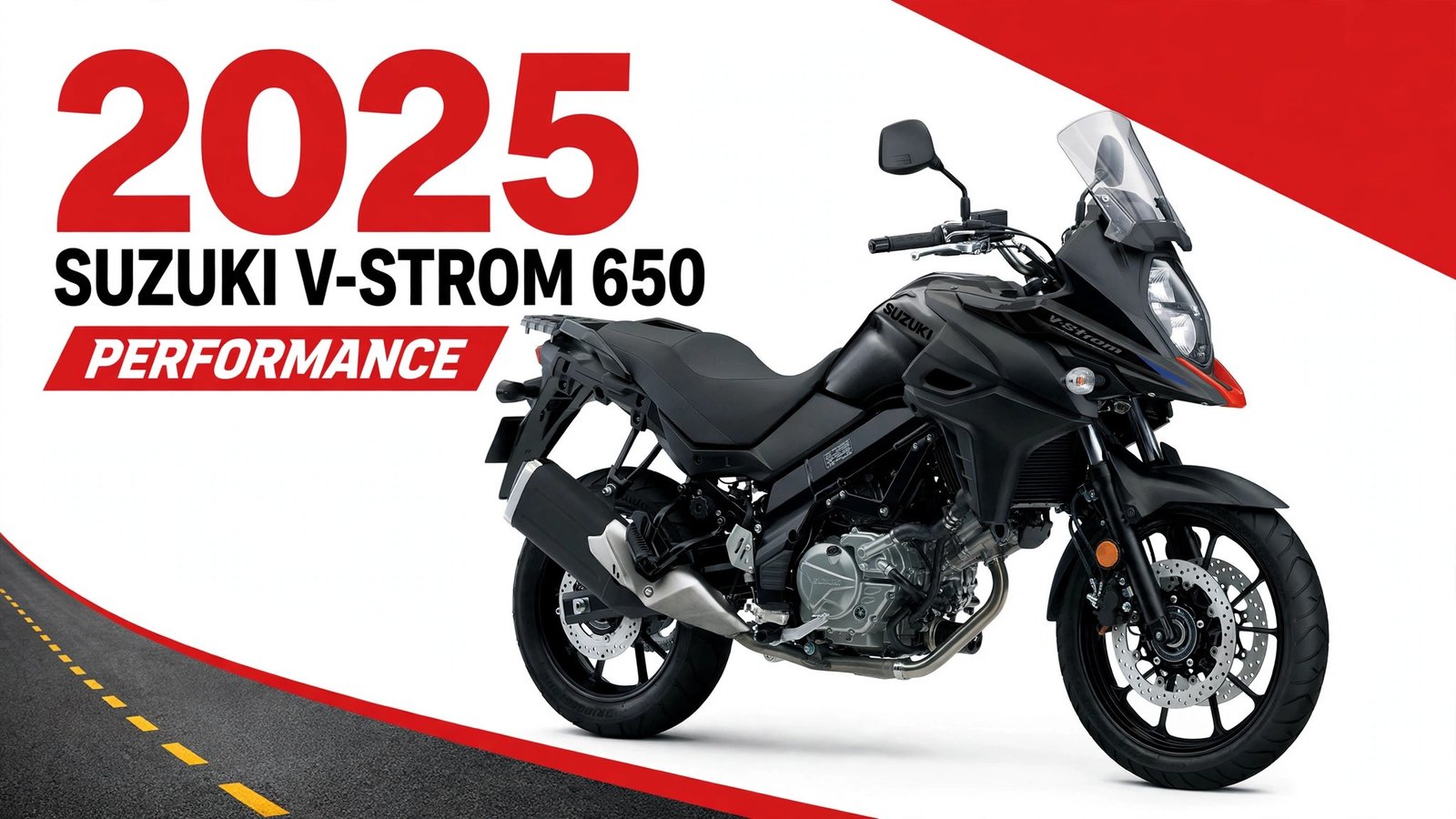
The Suzuki V-Strom 650 has never been the fastest bike in its class, and that was never the point. What matters is how the 645cc V-twin delivers its power, how far a tank of fuel takes you, and how the bike behaves when the road turns rough. This Suzuki V-Strom 650 performance guide puts numbers to all of it: two measured dyno runs, the only instrumented top-speed test, two sets of tested fuel-economy figures, and the service checks that keep the performance honest. The short answer: the 650 is quick enough for any road, frugal enough for long tours, and honest about what it cannot do.
Suzuki V-Strom 650 Engine Performance and Power Delivery
Power delivery is where Suzuki V-Strom 650 performance starts. The 645cc V-twin has been measured on a dyno in every generation, and the numbers behind Suzuki V-Strom 650 performance tell a consistent story.
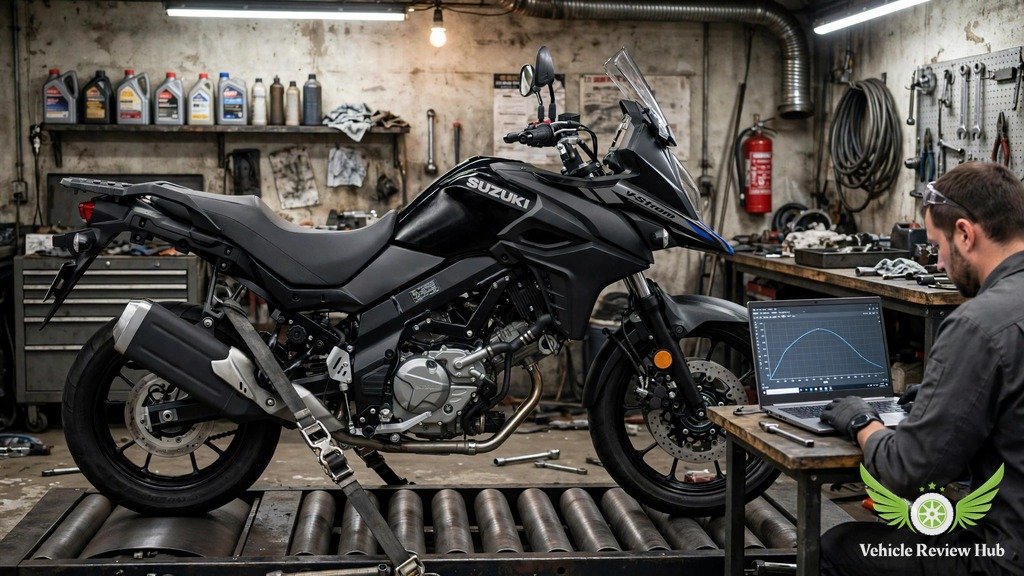
Cycle World Dyno 2023: 66.85 HP at 9,210 RPM
Cycle World strapped a 2023 XT Adventure to its Dynojet 250i and measured 66.85 hp at 9,210 rpm and 43.04 lb-ft at 6,560 rpm at the rear wheel. That is the only instrumented US figure for Suzuki V-Strom 650 performance on a current-generation bike, and this Suzuki V-Strom 650 performance guide treats it as the headline number. Cycle World called the torque curve flat, which is why the bike pulls cleanly from low revs. The test bike was an XT Adventure, the heaviest trim, so a base bike would show the same Suzuki V-Strom 650 performance numbers on the same dyno. Suzuki USA publishes no horsepower or torque figure, so the Cycle World dyno is the number buyers should trust — not the claimed figures from Japan (69 PS) or Europe (71 hp).
Rider Dyno 2017: 68.7 HP on the Third Generation
Rider Magazine put a 2017 base bike on Jett Tuning’s dyno and measured 68.7 hp at 9,100 rpm and 44.2 lb-ft at 6,500 rpm at the rear wheel. That is slightly higher than Cycle World’s 66.85 hp, and the difference is the dyno, not the bike: different dynamometers read differently, and the two tests were six years apart. Both tests land in the same narrow band — roughly 67 to 69 hp at the wheel — and this Suzuki V-Strom 650 performance guide uses that band. Rider’s test also beat the 2017 Kawasaki Versys 650 on the same dyno: the Versys made 61.2 hp at 8,300 rpm and 42 lb-ft at 7,300 rpm. The V-Strom’s advantage in Suzuki V-Strom 650 performance is not just peak power; it is where the power lives. Peak torque arrives at 6,500 rpm, a full 800 rpm sooner than the Versys, which is why the Suzuki feels stronger in everyday riding.
| Generation | Test | Power (rear wheel) | Torque (rear wheel) |
|---|---|---|---|
| Gen 1 (2006) | Cycle World | 62.4 bhp @ 9,050 rpm | 41.1 lb-ft @ 7,560 rpm |
| Gen 1 (2011) | Rider / Jett Tuning | 63.5 hp | 41.2 lb-ft |
| Gen 2 (2012) | Rider / Jett Tuning | 66.2 hp | 43.0 lb-ft |
| Gen 3 (2017) | Rider / Jett Tuning | 68.7 hp @ 9,100 rpm | 44.2 lb-ft @ 6,500 rpm |
| Gen 3 (2023 XT Adventure) | Cycle World / Dynojet 250i | 66.85 hp @ 9,210 rpm | 43.04 lb-ft @ 6,560 rpm |
| Measured range, all tests | Different dynos | 62.4–68.7 hp | 41.1–44.2 lb-ft |
Suzuki V-Strom 650 Top Speed and Acceleration
Top speed is the part of Suzuki V-Strom 650 performance where the honest answer is twofold: the first generation was properly tested, and the current generation was not.
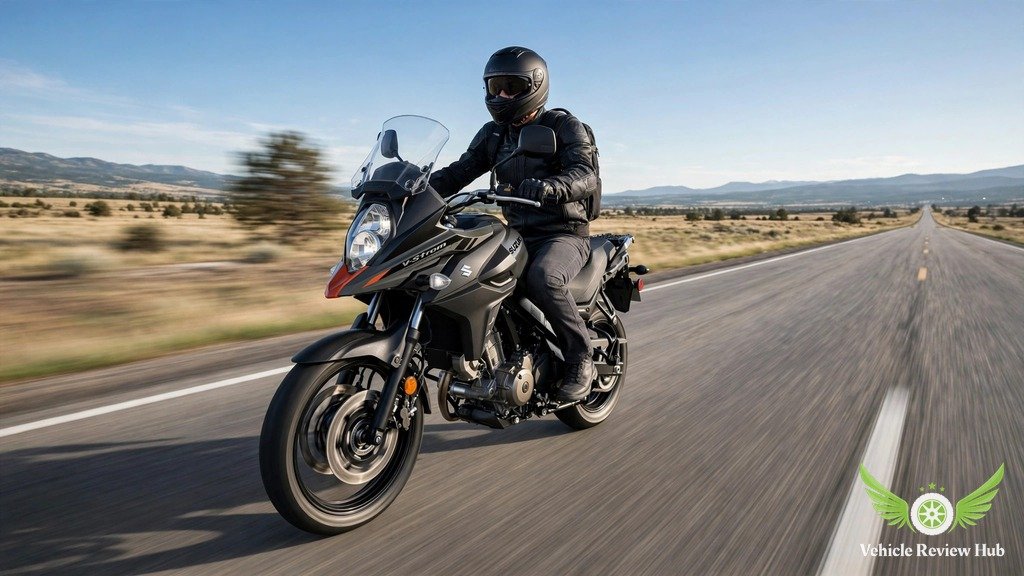
First Generation Tested: 109 MPH and 12.65 Seconds
Cycle World tested a 2006 DL650 in September 2006: 109 mph top speed, 0–60 mph in 4.1 seconds, and a quarter-mile of 12.65 seconds at 100.27 mph. Those are measured figures from a magazine instrumented test, and they are first-generation Suzuki V-Strom 650 performance figures only. A second Cycle World test of a 2007/08 DL650 recorded 105.1 mph and a 12.57-second quarter-mile at 102.0 mph. Two tests, two top speeds — conditions differ, so this Suzuki V-Strom 650 performance guide presents both with their test labels.
No Instrumented Gen 3 Run Exists: Estimates Labelled
For the current third-generation bike, no instrumented US 0–60 or quarter-mile run exists. MCN’s specification table lists top speed and quarter-mile acceleration as blank for the 2017-on 650XT, leaving a hole in Suzuki V-Strom 650 performance data. The only instrumented gen-3 acceleration figure found anywhere is from ZigWheels in India, which timed a 2019 V-Strom 650 XT at 0–100 km/h in 4.99 seconds — an India-market test, in metric units, on the XT trim. Top speed is estimates only: aggregators list 185 km/h (115 mph) from the spec sheet, TopSpeed estimates about 125 mph, and motoplanete lists about 180 km/h (111.8 mph). The honest range is 111–125 mph, and every number in it is an estimate, not a test. Ignore the AI-generated pages claiming 120 mph and 0–60 in 3.8 seconds; the 3.8-second claim contradicts Cycle World’s measured 4.1 seconds, and no gen-3 run exists at all.
Suzuki V-Strom 650 Mileage and Fuel Economy
Fuel economy is the V-Strom 650’s quiet superpower, and it is also where Suzuki V-Strom 650 performance is most often misquoted. Two separate Rider Magazine tests produced two different sets of figures, and this Suzuki V-Strom 650 performance guide keeps them apart.
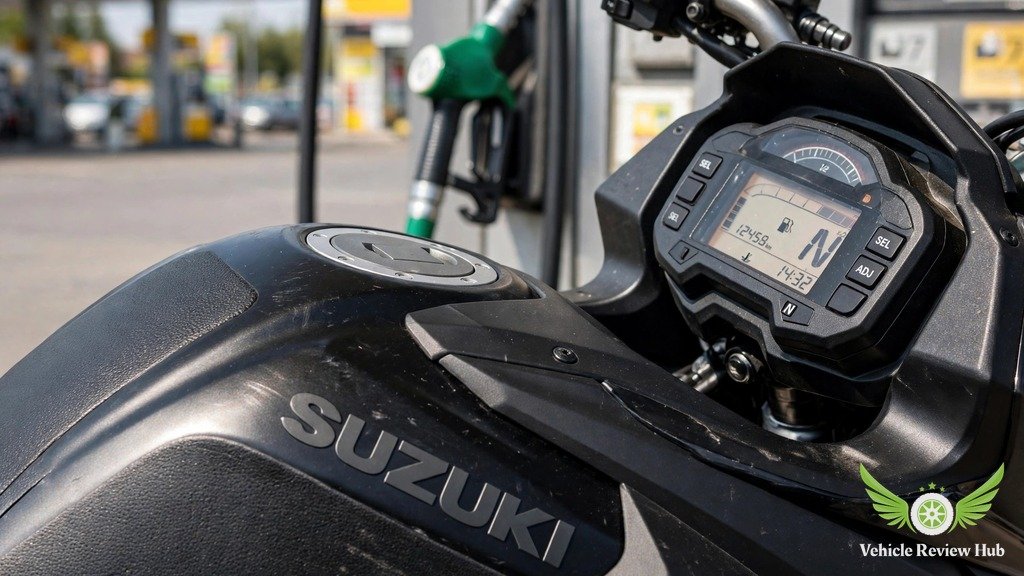
Rider Tested 41.0 Low, 46.9 Average, 58.5 High MPG
Rider Magazine’s 2017 comparison test of the V-Strom 650 against the Kawasaki Versys 650 LT recorded 41.0 mpg low, 46.9 mpg average, and 58.5 mpg high for the Suzuki, with a 248-mile estimated range from its 5.3-gallon tank — the touring side of Suzuki V-Strom 650 performance. The figures came from a two-day, 500-mile ride in the southern Sierra Nevada: 41.0 low from aggressive mountain riding, 58.5 high from gentle stretches. Note the source: these numbers come from Rider’s comparison test, not the standalone road test. The same comparison gave the Versys 40.5 low, 51.3 average, and 56.0 high, so the Suzuki’s advantage was in the worst case. One coincidence to flag: Fuelly owner data for the 2004 DL650 shows one bike averaging 46.9 mpg — the same number as Rider’s test average, but a different measurement, and this Suzuki V-Strom 650 performance guide does not conflate the two.
Suzuki USA Publishes No MPG Figure at All
Suzuki USA publishes no fuel-economy figure for the V-Strom 650 — the 2025 specification table has no MPG line at all, a gap in official Suzuki V-Strom 650 performance data. That leaves tested figures and owner data as the only honest sources. Rider’s second test, the 2018 comparison of the 650XT against the 1000XT, recorded a different set: 47.5 low, 50.5 average, 70.6 high, and a 268-mile range. Two Rider tests, two MPG sets — different bikes and different rides. The gen-2 bike averaged 45.1 mpg in Rider’s 2012 test, the gen-1 bike 53.4 mpg in Cycle World’s 2006 test, and owners commonly report 45 to 50 mpg. The range math follows: 5.3 gallons at 46.9 mpg is about 249 miles, matching Rider’s 248-mile estimate, and at 50.5 mpg about 268 miles, matching the 2018 estimate. Those are estimates from tested averages, and this Suzuki V-Strom 650 performance guide labels them as such.
| Source | Bike / test | Low MPG | Average MPG | High MPG |
|---|---|---|---|---|
| Rider Magazine, 2017 comparison | 2017 base, 500-mile ride | 41.0 | 46.9 | 58.5 |
| Rider Magazine, 2018 comparison | 2018 650XT | 47.5 | 50.5 | 70.6 |
| Rider Magazine, 2012 test | 2012 gen-2 | — | 45.1 | — |
| Cycle World, 2006 test | 2006 gen-1 | — | 53.4 | — |
| Fuelly owner data (US) | 2004 DL650, 49 bikes | — | 48.12 | — |
Suzuki V-Strom 650 Real-World Riding Experience
Dyno numbers and MPG figures only matter if the bike feels right on the road — and that feel is the heart of Suzuki V-Strom 650 performance. This section draws its riding picture from published tests, with every verdict attributed to the test that made it.
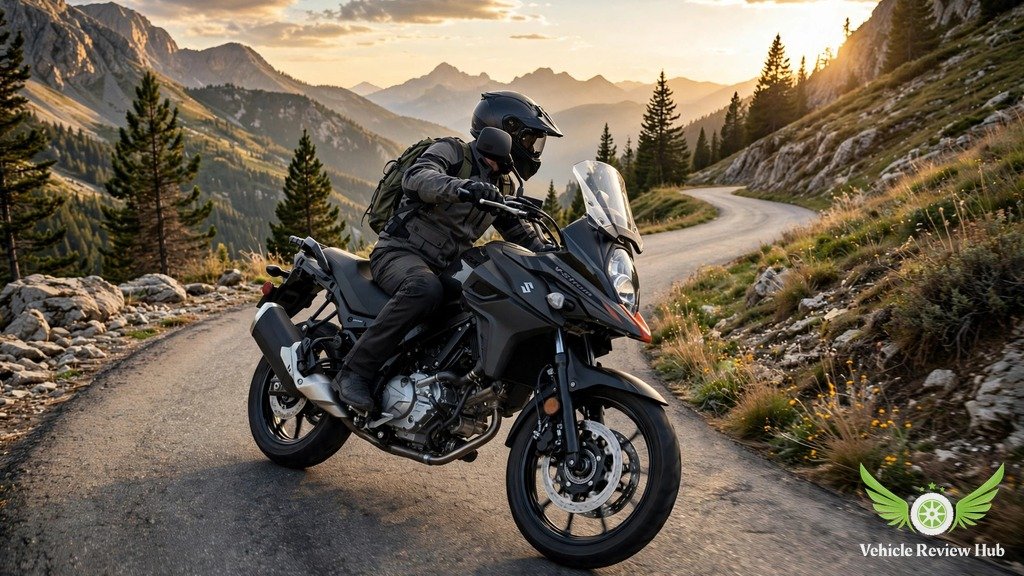
RevZilla: a Sport-Tourer First, Off-Road Last
RevZilla’s 2017 first ride put the Suzuki V-Strom 650 performance verdict plainly: the standard model is primarily an asphalt adventure tourer that can handle the occasional smooth dirt road. ADV Pulse agreed, calling it a well-mannered, easy-to-ride, economical adventure tourer. Rider Magazine’s 2017 road test agreed, saying the bike never feels skittish or unpredictable. The same test was honest about the limits: budget-spec suspension, brakes that are not especially powerful, and a seat that could support all-day riding better. Against the Versys 650 in the 2017 comparison, the V-Strom was the more spacious bike, and Rider’s verdict was blunt — if they had to choose one and only one, the adventure-ready, canyon-carving, freeway-flying, fuel-sipping 2017 V-Strom 650 would be it. That is the core of Suzuki V-Strom 650 performance on the road: a sport-tourer first, and an off-road bike a distant second. The video below is evo India’s 2018 test ride of the XT — the same third-generation bike.
Windscreen Buffeting Improved With Each Generation
Windscreen buffeting was a well-known complaint on the first generation, and aftermarket screens were sold specifically to fix it above 50 mph. The second generation improved it: Rider’s 2012 test noted the reshaped screen noticeably reduced wind noise and buffeting. The third generation improved it again — Suzuki made the screen 0.35 inches taller with the same three-way adjustment. RevZilla’s first ride, with a 6-foot-2 tester, found the airflow just fine, with wind at the helmet but no side-to-side shaking. Rider’s first ride in Slovenia found ample protection with little buffeting, although it was a bit noisy. ADV Pulse’s 6-foot-2 tester found it good enough to redirect most of the wind to the top of his head. The honest framing is that buffeting got better in every generation but was never eliminated: tall riders still get wind at the helmet, the screen is still noisy, and aftermarket touring screens remain a popular fix for riders who want quieter Suzuki V-Strom 650 performance.
Suzuki V-Strom 650 Handling, Braking and Stability
Handling is the other half of Suzuki V-Strom 650 performance. The chassis numbers behind it are modest on paper — a 43 mm fork, basic brakes, a 61.4-inch wheelbase — yet every test calls the bike stable and easy.
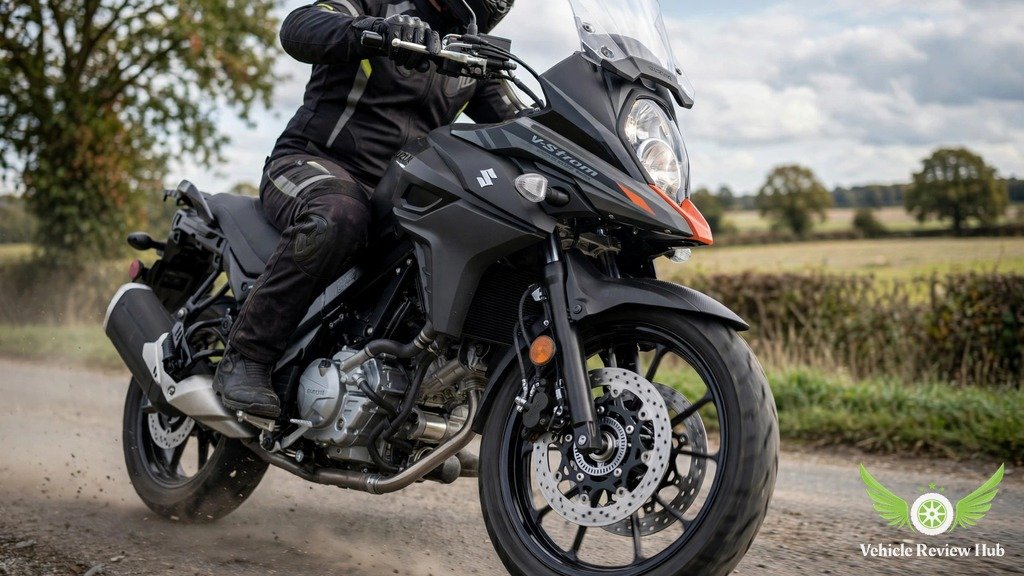
ABS Is Standard and Cannot Be Switched Off
ABS is standard on every V-Strom 650, and it cannot be switched off — a fact Rider Magazine verified three times, in the 2012 test, the 2017 road test, and the 2018 comparison. That is a real off-road limitation for Suzuki V-Strom 650 performance, because ABS on loose gravel can extend stopping distances. Rider’s 2018 comparison documented a workaround: remove the seat and pull one of the ABS fuses — a few seconds — and the warning light reminds you to put the fuse back. This Suzuki V-Strom 650 performance guide presents that as a documented workaround, not a Suzuki feature. The brakes are Tokico two-piston calipers on twin 310 mm front discs, Nissin single-piston rear on a 260 mm disc. Rider’s 2018 comparison called the front calipers short on bite and the brakes just adequate, while ADV Pulse noted good street braking that takes a firm two-finger squeeze for aggressive stops.
Brake Pads, Suspension Linkage and Bearing Checks
The performance of a V-Strom 650 depends on maintenance, and the owner’s manual schedules the checks that matter. The first service is at 600 miles, then every 3,500 miles or 12 months. Brakes, including the pads, are inspected at every service; brake hoses are replaced every four years, and brake fluid every two years. The front forks and rear suspension are inspected at 7,500 and 14,500 miles, the steering-head bearings at 600, 7,500, and 14,500 miles, and chassis bolts are tightened at every service. The chain is checked before every ride and lubricated every 600 miles. Valve clearances are inspected at 14,500 miles. One caution: the manual’s chart has no line item called “suspension linkage” and no separate wheel-bearings row, so this Suzuki V-Strom 650 performance guide does not invent one. The heading groups the real checks — pads, forks, shock, steering-head bearings, and lubrication points — that keep the bike’s handling and braking honest. The suspension itself is basic: a 43 mm preload-only fork with 5.9 inches of travel and a link-type rear shock with rebound damping and hand-operated preload, 6.3 inches of travel. Rider’s 2018 comparison noted the 650 is more nimble in tight turns, but the 1000 is more stable on bumpy roads.
Suzuki V-Strom 650 Performance Compared With Other Adventure Bikes
A Suzuki V-Strom 650 performance figure means little without a rival next to it. This section of the Suzuki V-Strom 650 performance guide puts the 650 against its bigger Suzuki sibling and answers the beginner question with the same measured tone.
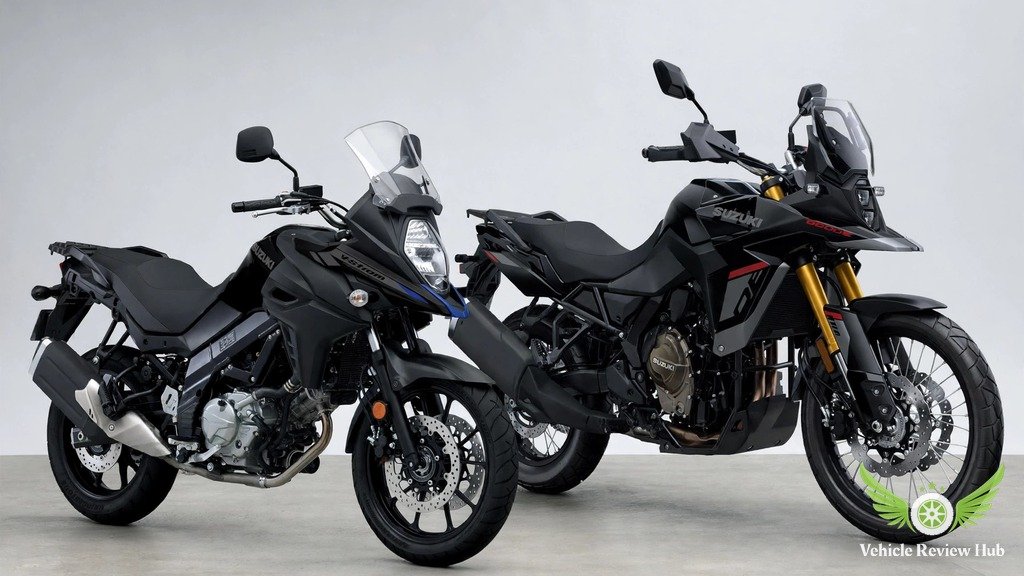
Suzuki V-Strom 650 vs Suzuki V-Strom 800DE
The 800DE is the genuinely dirt-capable bike in Suzuki’s range, and it costs $2,410 more than the base 650: the 2025 800DE lists at $11,709 against the 650’s $9,299. Its 776cc parallel twin makes a commonly published 83 hp at 8,500 rpm and 57.5 lb-ft at 6,800 rpm, against the 650’s measured 66.85 hp and 43.04 lb-ft — the headline Suzuki V-Strom 650 performance gap. The chassis differences are bigger than the engine gap: a 21-inch front wheel, 220 mm of fully adjustable Showa suspension travel front and rear, 8.7 inches of ground clearance, and adjustable ABS the 650 lacks. The 650 answers with 470 pounds against 507, a 32.9-inch seat against 33.7 inches, and $2,410 less. One ownership difference matters: the 800DE’s wire-spoke wheels run tube-type tires, while the 650XT’s spokes are tubeless — a puncture on the 800DE means a tube change, on the 650XT a roadside plug. The Suzuki V-Strom 800DE review covers the bigger bike in full, and the Suzuki V-Strom 650 review covers the 650’s value case. The verdict of this Suzuki V-Strom 650 performance guide: buy the 800DE for dirt, buy the 650 for the road. Note the price trap: some articles quote $11,799, but that is the 2026 price — the 2025 MSRP is $11,709.
Is the Suzuki V-Strom 650 Suitable for Beginner Riders? Yes
Yes — with honest limits. The case for beginners in Suzuki V-Strom 650 performance starts with the numbers: a 32.9-inch seat, a 470-pound curb weight, Low RPM Assist, and a smooth, predictable V-twin with switchable traction control. Rider Magazine called the bike user-friendly, reassuring and easy, and a willing and confident mount. The limits matter too: a 19-inch front wheel and 470 pounds are still a lot for a first bike, the ABS cannot be switched off for dirt, the suspension is soft, and the power runs short when the bike is loaded two-up. One UK owner view put it bluntly — the bike “runs out of puff above 70 mph” — an owner opinion, not a test. For a first adventure bike, the 650’s forgiveness outweighs its limits, and that is why this Suzuki V-Strom 650 performance guide answers yes.
Suzuki V-Strom 650 Performance FAQs
These are the questions riders ask most often about Suzuki V-Strom 650 performance, answered from the tested figures in this guide.
How much horsepower does the Suzuki V-Strom 650 make?
Suzuki USA publishes no figure. The measured Suzuki V-Strom 650 performance numbers are 66.85 hp (Cycle World) and 68.7 hp (Rider), both at the rear wheel.
What is the top speed of the Suzuki V-Strom 650?
The first generation was tested at 109 mph by Cycle World in 2006 — the only measured Suzuki V-Strom 650 performance top speed. No gen-3 test exists; estimates run 111–125 mph.
How fast is the Suzuki V-Strom 650 from 0 to 60 mph?
Cycle World tested the first generation at 0–60 mph in 4.1 seconds, the only measured Suzuki V-Strom 650 performance acceleration figure. An India test timed the 2019 XT at 0–100 km/h in 4.99 seconds.
What MPG does the Suzuki V-Strom 650 get?
Rider Magazine’s 2017 comparison test recorded 41.0 low, 46.9 average, and 58.5 high mpg for Suzuki V-Strom 650 performance. The 2018 XT test recorded 47.5 low, 50.5 average, and 70.6 high mpg.
How far can the Suzuki V-Strom 650 go on a tank?
About 248 miles on Rider’s 2017 average of 46.9 mpg — the touring range of Suzuki V-Strom 650 performance — and about 268 miles on the 2018 average of 50.5 mpg, from the 5.3-gallon tank.
Is the Suzuki V-Strom 650 faster than the Kawasaki Versys 650?
On the same dyno in 2017, the V-Strom made 68.7 hp against the Versys’ 61.2 hp, with peak torque 800 rpm sooner. In Suzuki V-Strom 650 performance terms, the V-Strom is the quicker of the two.
Can you turn off the ABS on the Suzuki V-Strom 650?
No — there is no ABS switch, a known Suzuki V-Strom 650 performance limitation off-road. Rider Magazine documented a workaround: pulling one ABS fuse with the seat removed, which is not a Suzuki feature.
What is the quarter-mile time of the Suzuki V-Strom 650?
Cycle World tested the first generation at 12.65 seconds in 2006 and 12.57 seconds later. No gen-3 quarter-mile test exists in Suzuki V-Strom 650 performance testing.
Is the Suzuki V-Strom 650 good for beginners?
Yes, with limits. The 32.9-inch seat, 470-pound weight, Low RPM Assist, and predictable V-twin make Suzuki V-Strom 650 performance forgiving for a first rider.
How does the V-Strom 650 compare with the V-Strom 800DE?
The 800DE makes about 83 hp, has a 21-inch front wheel, 220 mm travel, and adjustable ABS, and costs $2,410 more. In Suzuki V-Strom 650 performance terms, the 650 is lighter, lower, and cheaper.
Does the Suzuki V-Strom 650 have traction control?
Yes — traction control is part of Suzuki V-Strom 650 performance: Mode 1, Mode 2, and Off, standard since 2017. The setting is remembered at restart, including Off.
What fuel does the Suzuki V-Strom 650 use?
Regular unleaded gasoline, 87 PON minimum, per Rider Magazine’s test spec box. Cheap fuel is part of Suzuki V-Strom 650 performance value.