
The Suzuki V-Strom 650 has earned its reputation the slow way: by racking up miles without drama. Owners routinely report 50,000-plus miles with minimal trouble, some passing 100,000 miles without a major repair. This Suzuki V-Strom 650 reliability guide puts numbers to that reputation — owner ratings, the real maintenance chart, the four US recalls by number, and the verified costs of keeping the bike going. The short answer on Suzuki V-Strom 650 reliability: the 650 is one of the most dependable middleweight adventure bikes you can buy, provided you service it on schedule and check the few known weak points before you buy.
Suzuki V-Strom 650 Reliability Overview
Suzuki V-Strom 650 reliability starts with a simple fact: the same basic 645cc V-twin has been in production since 2004, tested by two decades of owners harder than any laboratory could. The engine is understressed and the electronics are simple — no ride-by-wire throttle or TFT display to fail.

MCN Owners Rate All Three Generations 4.3 or Above
Motorcycle News owner ratings give every generation of the V-Strom 650 a reliability score of 4.3 or above out of 5. The first generation (2004-2010) scores 4.3 for reliability and 4.6 overall from 32 owner reviews. The second generation (2011-2016) scores 4.4 for reliability and 4.6 overall from 40 reviews, and MCN rates it 5 out of 5. The third generation XT (2017-on) also scores 4.4 for reliability and 4.6 overall from 12 reviews, with an engine score of 4.8. MCN’s verdict on the first generation calls it an “immensely dependable motorcycle” with a “totally trustworthy engine, solid gearbox, durable clutch” — the clearest verdict on Suzuki V-Strom 650 reliability anywhere.
How Mileage, Storage and Previous Care Affect Reliability
High mileage alone is not a warning sign in Suzuki V-Strom 650 reliability. Bikes regularly pass 50,000 miles with no malfunction, and some owners report 85,000 to 104,000 miles without major issues. What matters far more for Suzuki V-Strom 650 reliability is how the bike was kept: stored indoors, serviced on schedule and ridden regularly, it will outlast a low-mileage bike that sat for years with old fuel and a flat battery. Before buying used, check the service history — oil changes every 3,500 miles, a valve check at 14,500 miles, and a stator replacement on 2012-2016 bikes if the recall applied.
Suzuki V-Strom 650 Common Problems and Wear Items
No bike is fault-free, and Suzuki V-Strom 650 reliability is best understood by knowing the handful of problems owners actually report — and which ones are real recalls and which are not. Most are cheap wear items; one is a genuine recall on 2012-2016 bikes, and knowing which is which is half of Suzuki V-Strom 650 reliability.
Early Stator Failures Are Owner-Reported, Not a Recall
The best-known problem in Suzuki V-Strom 650 reliability is the stator, the part of the alternator that charges the battery — and the distinction between what was recalled and what was not is the key point. A Stromtrooper poll of 571 riders found stator failure reports in 27 of 2004-2007 bikes (4.73 percent), 63 of 2008-2011 bikes (11.03 percent), and 46 of 2012-2016 bikes (8.06 percent) — zero on 2017-on bikes. Suzuki fitted a claimed 400W alternator from 2008, yet 2008-2011 bikes still failed most. Only the 2012-2016 bikes were recalled for the stator — recall 16V878, covered below — despite one 2011 owner’s NHTSA argument that 2008-2011 bikes use the same stator. If you own a 2008-2011 bike, a stator failure is an owner-reported risk, not a recall: watch for a battery that will not hold charge. For 2012-2016 owners, the recall fix was free at the dealer, and that difference is the single most misunderstood fact in Suzuki V-Strom 650 reliability.
Chain, Sprockets, Tires, Fork Seals, Brakes and Electrical Checks
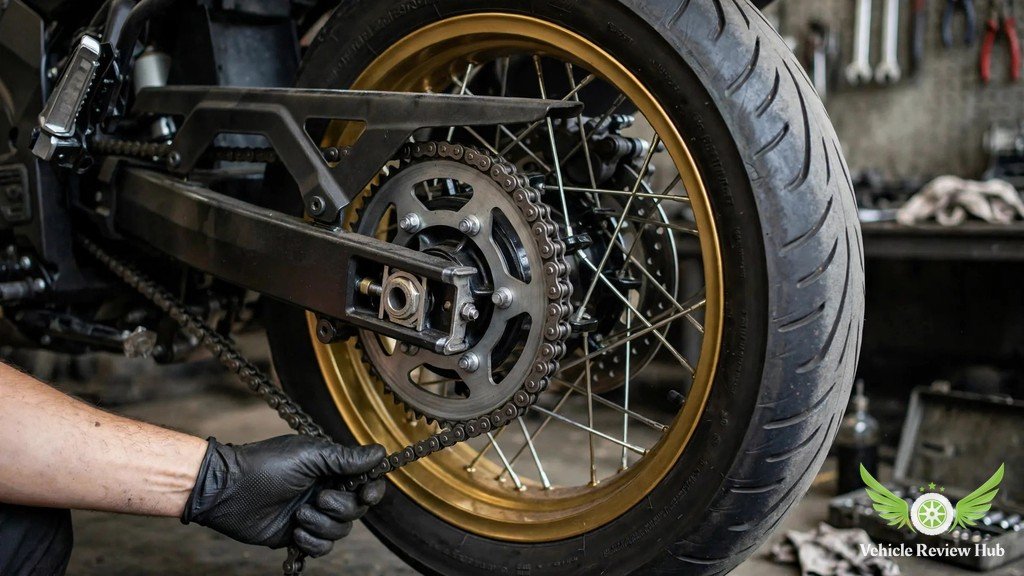
The rest of the common-problems list is ordinary wear, and Suzuki V-Strom 650 reliability holds up well once you know what to watch. The chain and sprockets are the biggest running cost in Suzuki V-Strom 650 reliability: check slack (20-30 mm) before every ride, lube every 600 miles, and expect about 20,000 miles from a well-maintained kit. The first generation’s biggest issue, according to MCN, is the headlight wiring — a habit of frying the wiring when full beam is on, with owners reporting melted wires under the tank and headlights lost mid-ride. High-mileage first-generation bikes can develop cam-chain slap as the tensioner and chain wear; one case at 62,500 miles needed a new chain at about $126 plus labour. Owners also report clutch slip, water pump leaks, fork seals and rear shock wear at high mileage, and notchy steering-head bearings. Check the fork seals and brake pads at every service — the checks in the next section protect Suzuki V-Strom 650 reliability.
Suzuki V-Strom 650 Maintenance Schedule and Servicing
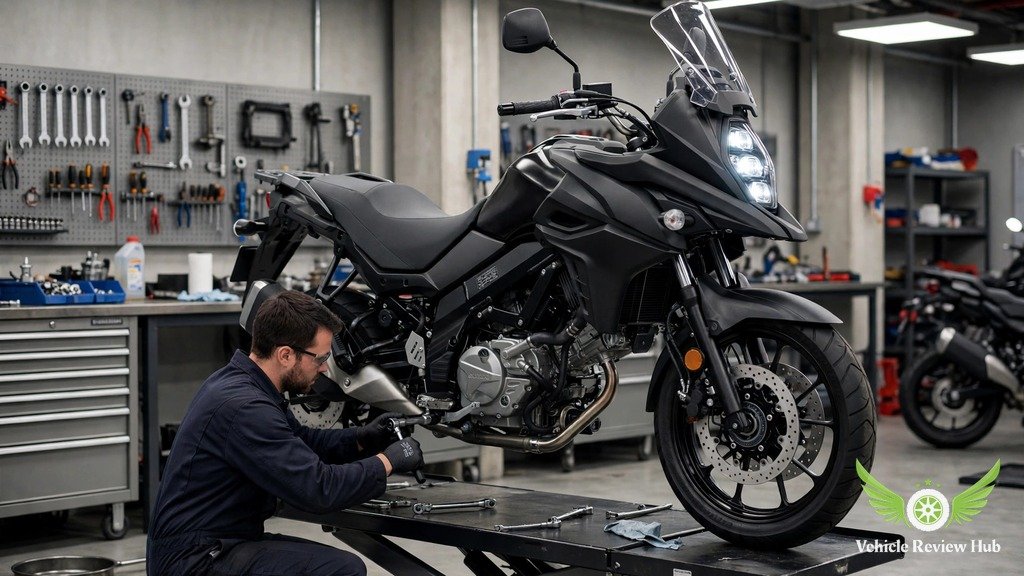
The maintenance schedule is where Suzuki V-Strom 650 reliability is made or lost. The manual chart runs on intervals of 600, 4,000, 7,500, 11,000 and 14,500 miles (or 2, 12, 24, 36 and 48 months), whichever comes first — and the 2008 and 2017 manuals agree.
| Service item | 600 mi | 4,000 mi | 7,500 mi | 11,000 mi | 14,500 mi |
|---|---|---|---|---|---|
| Engine oil (10W-40, JASO MA) | Replace | Replace | Replace | Replace | Replace |
| Oil filter | Replace | — | — | Replace | — |
| Air cleaner | — | Inspect | Inspect | Replace | Inspect |
| Spark plugs | — | Inspect | Replace | Inspect | Replace |
| Valve clearance | — | — | — | — | Inspect |
| Brakes incl. pads | Inspect | Inspect | Inspect | Inspect | Inspect |
| Forks / rear suspension | — | — | Inspect | — | Inspect |
| Chain (slack 20-30 mm) | Check | Check | Check | Check | Check |
First Service at 600 Miles, Oil Every 3,500 Miles
The first service lands at 600 miles, and for Suzuki V-Strom 650 reliability it matters more than it looks: the break-in oil and filter come out, the brakes, steering and throttle are inspected, and the chassis bolts are tightened. After that, engine oil is replaced at every interval — every 3,500 miles or 12 months — using SAE 10W-40 oil meeting JASO MA. The oil filter is replaced at 600 and 11,000 miles. Oil capacity is approximately 2.7 to 3.1 litres with a filter change — an approximate figure, not an exact Suzuki specification — so check the sight glass rather than trusting a number. Throttle valve synchronization is checked at 600, 7,500 and 14,500 miles — the check that cures a rough idle on first-generation bikes. MCN notes the first generation needs basic servicing every 3,500 miles, twice as often as some rivals, which is the one place Suzuki V-Strom 650 reliability asks a little more of its owner. The full manual chart is published at maintenanceschedule.com, and the Suzuki V-Strom 650 performance guide shows what the engine delivers when it is looked after this way.
Valve Clearance Inspection at 14,500 Miles Exactly
The valve clearance check is the signature job in Suzuki V-Strom 650 reliability, and the interval is exact: inspect at 14,500 miles (24,000 km) on second- and third-generation bikes, with no time interval. Do not confuse it with the first-generation manual, which lists the valve check every 24,000 km (15,000 miles, 48 months) — the generations differ, and this guide labels each by generation. Clearances are intake 0.10-0.20 mm and exhaust 0.20-0.30 mm, set to the middle (0.15 mm intake, 0.25 mm exhaust). Valves usually run tight-side, and once set they rarely move again — one owner needed no re-adjustment in over 95,000 km after the first adjustment at 25,000 km. It is a shim-under-bucket job that takes a home mechanic an afternoon or a dealer three to six hours — the biggest single job in Suzuki V-Strom 650 reliability. The video below shows the full adjustment on a DL650.
Suzuki V-Strom 650 Tires, Brakes and Suspension Maintenance
Tires, brakes and suspension are the parts that keep Suzuki V-Strom 650 reliability safe as well as dependable. They are inspected on a fixed rhythm in the manual, and none of it is complicated. That is the safety side of Suzuki V-Strom 650 reliability.
Spark Plugs Replaced at 7,500-Mile Intervals
Spark plugs are inspected at 4,000 miles and replaced at 7,500, inspected at 11,000 and replaced at 14,500 — every 7,500 miles. The plug differs by generation: first- and second-generation bikes take NGK CR8E (second generation CR8EIA-9); the third generation requires NGK MR8E-9. The popular CR8EIX iridium plug is a common swap, but the manual specifies the MR8E-9 for the current bike. Spark plug torque is 11 Nm. Worn plugs show up as hard starting and a lumpy idle, and at the price of a plug set they are the cheapest insurance for Suzuki V-Strom 650 reliability.
Coolant Four Years and Brake Fluid Two Years
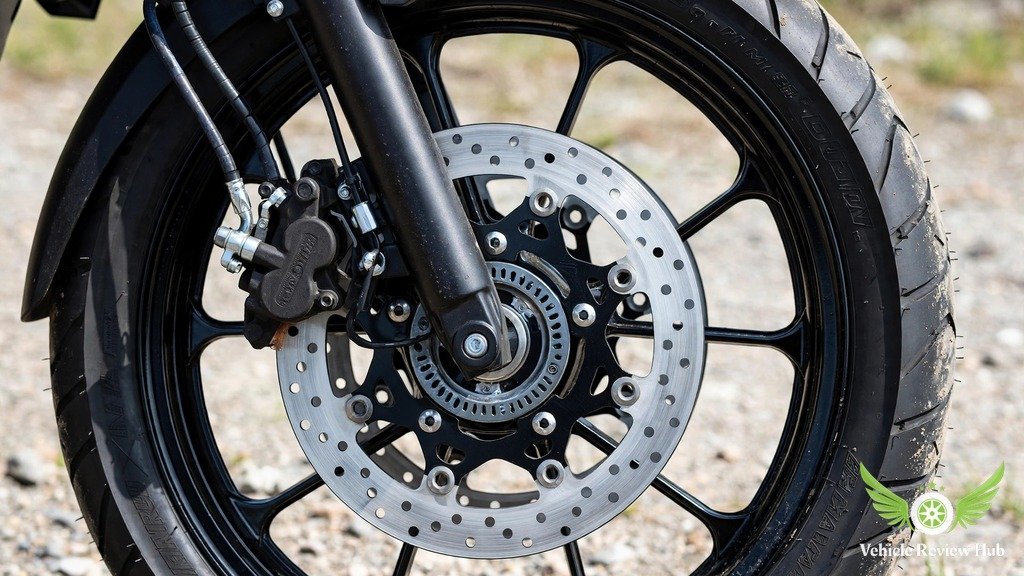
Coolant and brake fluid run on time, not mileage, and that is why they get forgotten. Suzuki Super Long Life Coolant is replaced at four years, ordinary coolant every two years or 7,500 miles. Brake fluid (DOT 4) is replaced every two years, brake hoses every four years, and the brakes — including the pads — are inspected at every service. Front forks, rear suspension and steering follow the same inspection rhythm — the inspections that protect Suzuki V-Strom 650 reliability. The Suzuki V-Strom 650XT review covers the spoked-wheel trim, whose tubeless spokes are inspected at every service just like the base bike’s cast wheels.
Suzuki V-Strom 650 Maintenance and Ownership Costs
Suzuki V-Strom 650 reliability is cheap to own. The bike runs on regular unleaded fuel, the jobs are simple, and the only big bill is the valve check — the shape of Suzuki V-Strom 650 reliability. What follows is what the bike actually costs to keep, in verified figures.

Fuel, Routine Servicing, Tires and Replacement Parts
Fuel is the smallest cost: regular unleaded at 87 PON minimum, with owners commonly reporting 45 to 50 mpg from the 5.3-gallon tank. Routine servicing for Suzuki V-Strom 650 reliability is modest: MCN lists annual servicing at about 250 pounds for the first generation and 160 pounds for the third-generation XT. In the USA the big job is the valve adjustment: three to six hours of labour, about $450 to $900, while a Suzuki-specialist major service with valve adjustment is listed at $950 flat in Fullerton, California. Tires are the other regular cost — front 110/80R19 at 33 psi, rear 150/70R17 at 36 psi (42 psi with a passenger) — and a chain and sprocket kit runs about $240 to $266 in the USA, lasting around 20,000 miles. The US valve-adjustment cost guide and the chain kit prices back those figures, and against the Kawasaki Versys 650 review the V-Strom’s running costs sit in the same modest bracket. The Suzuki V-Strom 800DE review shows the bigger sibling costs more to feed and maintain.
Exactly Four NHTSA Recalls Name the DL650
Exactly four NHTSA recalls name the DL650, confirmed against the NHTSA flat files updated in September 2026 — none covers a 2019-2025 bike. The NHTSA recalls database is the place to check any individual bike by its VIN. The four recalls are the complete record of Suzuki V-Strom 650 reliability as the safety authorities see it.
| Recall | Date | Bikes affected | Defect |
|---|---|---|---|
| 12V038000 | Feb 2012 | 2012 DL650 built before Dec 2011 | Brake light switch may fail |
| 15V852000 | Dec 2015 | 2012-2014 DL650 | Excessive tappet and camshaft wear |
| 16V878000 | Dec 2016 | 2012-2016 DL650 (8,613) | Alternator stator may short circuit |
| 18V694000 | Oct 2018 | 2017-2018 DL650A/XA | Fuel pump O-ring may leak |
The stator recall, 16V878, matters most for Suzuki V-Strom 650 reliability: 8,613 bikes from 2012-2016, with a stator that may have insufficient heat resistance, short-circuiting the wires so the battery stops charging. The dealer replaces the stator free, a job Suzuki’s letter puts at about two hours. The earliest recall, 12V038000 from February 2012, covers 2012 bikes built before December 17, 2011, where a lever-mounted brake light switch may fail — 1,396 units across the DL650 and two scooters. The 15V852000 recall covers 2012-2014 bikes for excessive tappet and camshaft wear, and 18V694000 covers 2017-2018 DL650A and XA bikes for a fuel pump O-ring that can leak. The 2012 model year appears in three of the four recalls. No recall names any DL650 from 2019 through 2025 — the cleanest stretch in the history of Suzuki V-Strom 650 reliability.
How to Keep a Suzuki V-Strom 650 Reliable
Keeping Suzuki V-Strom 650 reliability high is mostly a matter of doing the small jobs on time. The bike asks for frequent, simple servicing rather than rare, expensive work.
Preventive Maintenance, Records and Regular Inspections
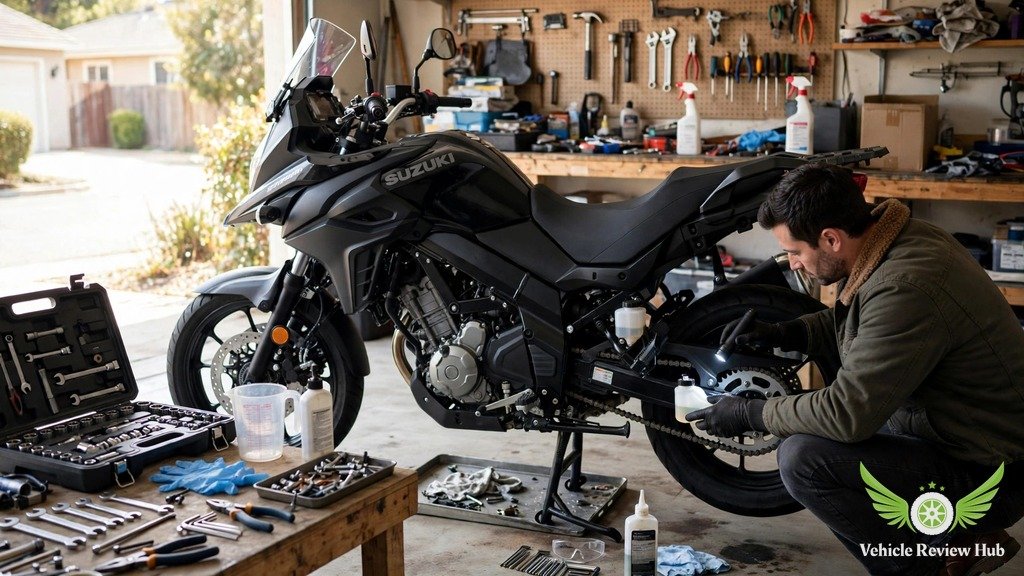
The preventive routine for Suzuki V-Strom 650 reliability is short enough to fit on a card. Change the oil every 3,500 miles or 12 months, check the chain before every ride and lube it every 600 miles, keep the tires at 33 psi front and 36 psi rear, replace the brake fluid every two years and the coolant every four, and do the valve check at 14,500 miles. Keep every receipt and stamp the service book: a documented history is worth real money at resale. Inspect the bike yourself — fork seals, the radiator for corrosion, the headlight wiring on first-generation bikes, and the battery voltage on 2008-2011 bikes. The warranty is a 12-month limited warranty, and Suzuki’s published terms state no mileage cap — so this guide phrases it exactly that way rather than calling it unlimited mileage. A V-Strom 650 that gets this routine will keep delivering the Suzuki V-Strom 650 reliability the owner ratings promise.
The Rectifier Recall Is Not This Bike: Do Not Transfer It
One warning deserves its own section in any Suzuki V-Strom 650 reliability guide, because several websites get it wrong. The regulator/rectifier recalls — 11V108000 from February 2011, covering 73,426 motorcycles, and 16V018000 from January 2016 — name the DL1000, the GSX-R600 and 750, and the Hayabusa. They do not name the DL650 at all. The DL650’s charging-system recall is the stator, 16V878, a different component entirely. One thin competitor page wrongly lists rectifier and regulator overheating as a V-Strom 650 issue, and this guide does not repeat that error. Owner-reported regulator failures on earlier generations may exist, but there is no DL650 rectifier recall. Check the four recalls above by VIN, confirm the stator fix on 2012-2016 bikes, and judge Suzuki V-Strom 650 reliability on its own record — a strong one by every measure in this guide.
Suzuki V-Strom 650 Reliability FAQs
These are the questions riders ask most often about Suzuki V-Strom 650 reliability, answered from the figures and the manual chart in this guide.
How reliable is the Suzuki V-Strom 650?
Very reliable: MCN owner ratings give every generation 4.3 or above out of 5, and Suzuki V-Strom 650 reliability is backed by owners reporting 50,000-plus miles.
How many miles will a Suzuki V-Strom 650 last?
Owners regularly report 50,000-plus miles with no malfunction, and some cite bikes at 85,000 to 104,000 miles without major issues.
What are the common problems with the Suzuki V-Strom 650?
The main ones are stator failure (especially 2008-2011), headlight wiring frying on full beam on first-generation bikes, chain and sprocket wear, and fork seals.
Does the Suzuki V-Strom 650 have stator problems?
Yes, on some years — the year is the key fact in Suzuki V-Strom 650 reliability. An owner poll found stator failure reports in 11.03 percent of 2008-2011 bikes, 8.06 percent of 2012-2016 bikes, and none on 2017-on bikes. Only 2012-2016 was recalled; 2008-2011 failures are owner-reported, not a recall.
How many recalls does the Suzuki V-Strom 650 have?
Exactly four NHTSA recalls name the DL650, and that is the whole recall story in Suzuki V-Strom 650 reliability: 12V038000 (brake light switch, 2012), 15V852000 (tappet and camshaft wear, 2012-2014), 16V878000 (stator, 2012-2016), and 18V694000 (fuel pump O-ring, 2017-2018). None covers a 2019-2025 bike.
Was my Suzuki V-Strom 650 recalled for the stator?
Only if it is a 2012-2016 model — recall 16V878 covers 8,613 of those bikes, and the dealer replaces the stator free. Check your VIN in the NHTSA recalls database to confirm; it settles Suzuki V-Strom 650 reliability for your bike.
Does the rectifier recall apply to the Suzuki V-Strom 650?
No — and this is the most repeated mistake in Suzuki V-Strom 650 reliability. The rectifier recalls 11V108000 and 16V018000 name the DL1000, GSX-R models and the Hayabusa — not the DL650. The DL650’s charging-system recall is the stator (16V878), a different component.
When should valve clearances be checked on a Suzuki V-Strom 650?
At 14,500 miles (24,000 km) on second- and third-generation bikes, with no time interval — the headline number in Suzuki V-Strom 650 reliability. The first-generation manual lists it every 15,000 miles or 48 months — a generation split worth knowing in Suzuki V-Strom 650 reliability.
How much does a Suzuki V-Strom 650 valve adjustment cost?
US valve-adjustment prices run about $450 to $900, and a Suzuki-specialist major service with valve adjustment lists at $950 flat in Fullerton, California. It is a three- to six-hour shim-under-bucket job, the biggest bill in Suzuki V-Strom 650 reliability.
How often should I change the oil on a Suzuki V-Strom 650?
Every 3,500 miles or 12 months, whichever comes first, using SAE 10W-40 oil meeting JASO MA. The first change is at the 600-mile service; the oil filter is replaced at 600 and 11,000 miles.
How often do the spark plugs need replacing on a Suzuki V-Strom 650?
Every 7,500 miles — replaced at 7,500 and 14,500, inspected at 4,000 and 11,000 — the plug rhythm in Suzuki V-Strom 650 reliability. Third-generation bikes take NGK MR8E-9; earlier bikes take NGK CR8E.
What should I check when buying a used Suzuki V-Strom 650?
Check the service history first, because Suzuki V-Strom 650 reliability is written in it — oil every 3,500 miles and a valve check at 14,500 — then the stator fix on 2012-2016 bikes, the headlight wiring on first-generation bikes, fork seals, chain wear, and corrosion on the radiator and fasteners.