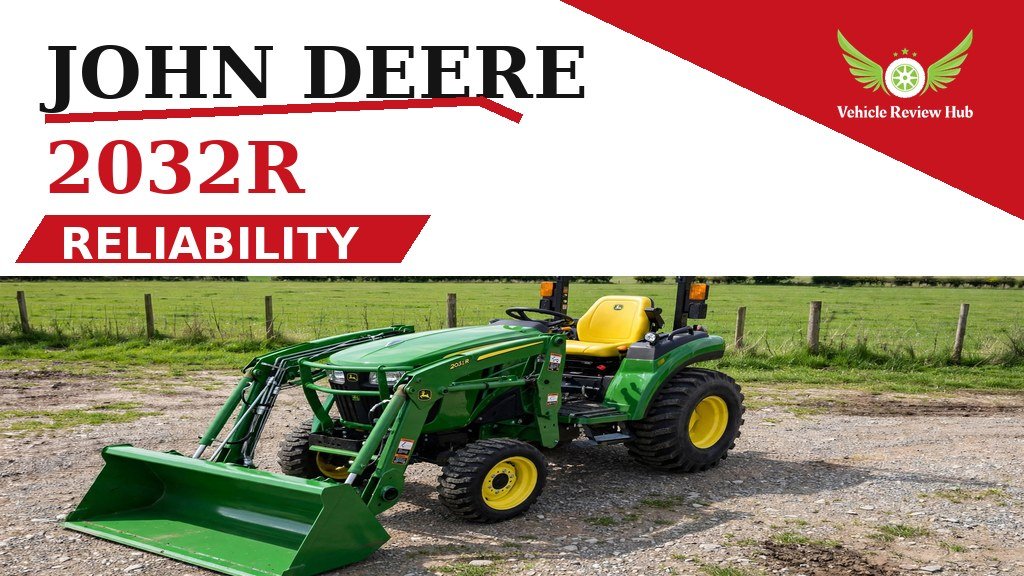
The short answer: John Deere 2032R maintenance is straightforward, but it has one feature that sets it apart from smaller Deere compacts — a diesel particulate filter (DPF) in its Final Tier 4 exhaust aftertreatment system. The 2032R runs a 30.7-gross-hp three-cylinder Yanmar diesel at 2,500 rpm with 24.2 PTO horsepower, a two-range hydrostatic transmission, and an 8.6-gallon fuel tank. Deere calls for engine oil and filter every 200 hours or annually, hydraulic filters every 400 hours (after a first change at 50 hours), transmission oil every 1,200 hours with Hy-Gard, and a coolant flush every two years. Most routine John Deere 2032R maintenance is within reach of a careful owner, parts are available at any dealer, and well-serviced tractors routinely deliver a decade or more of dependable work.
This guide covers the full John Deere 2032R maintenance schedule and service costs, the reliability record of the 2R platform, the most commonly reported problems and warning signs, DPF regeneration explained, model-specific recall status, and a used-tractor safety checklist. Intervals come from Deere service guidance; owner problems are attributed to the forums and repair guides that documented them.
John Deere 2032R Maintenance Schedule and Service Costs
The John Deere 2032R maintenance schedule follows Deere’s compact-tractor rhythm: daily checks, a 50-hour break-in service, then repeating 200-hour, 400-hour, 600-hour, and 1,200-hour cycles, plus annual and two-year items. Deere backs the machine with a 6-year/2,000-hour powertrain limited warranty, so dated service records protect both coverage and resale value.
Engine Oil, Filters, Cooling System and Routine Service
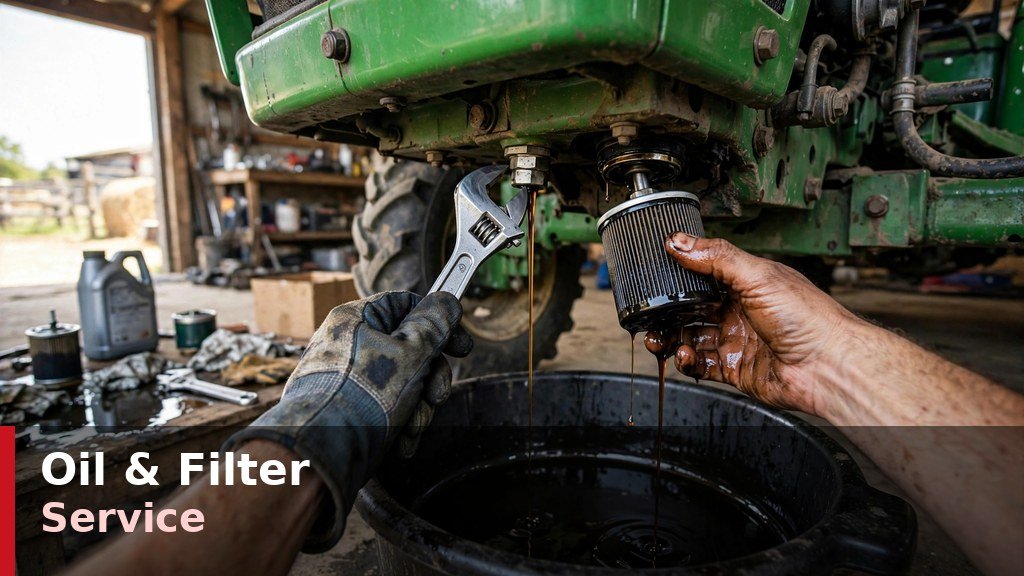
Engine oil and the oil filter are due every 200 hours or annually, whichever comes first, with the crankcase holding roughly 3.4 liters. Change the oil with the engine warm, refill to the dipstick mark, and check for leaks after a short run. Skipping this interval is the fastest way to shorten the life of any diesel — the one piece of John Deere 2032R maintenance owners should never stretch.
The video below shows an engine oil and filter change on a 2032R with over 1,000 hours — a core John Deere 2032R maintenance job most owners can do at home:
Air and fuel filters deserve steady attention in any John Deere 2032R maintenance routine: the dual-element air cleaner has an electronic restriction indicator that tells you when service is needed, and the fuel filter sediment bowl should be checked and cleaned regularly, with the fuel filter replaced on the manual’s interval (commonly around 400 hours or annually).
Flush and refill the cooling system with John Deere COOL-GARD coolant every two years or about 2,000 hours, and keep the grille screens and radiator fins clear of grass and chaff between flushes — a clogged radiator is the most common cause of overheating reports on any compact. A seasonal check of the alternator belt, battery terminals, and hoses rounds out routine John Deere 2032R maintenance. The service table below collects the key intervals in one place.
| Service Interval | What to Do |
|---|---|
| Daily / every 10 hours | Check engine oil, coolant, hydraulic oil level; inspect for leaks; clean grille screens |
| After first 50 hours | Change hydraulic oil filter; change engine oil and filter; check wheel hardware |
| Every 200 hours or annually | Change engine oil and filter; service air filter elements as indicated; check battery and belts |
| Every 400 hours or annually | Replace hydraulic suction and HST filters; replace fuel filter; grease all fittings |
| Every 1,200 hours | Change transmission/hydraulic oil (with Hy-Gard); oil analysis recommended every 400 hrs |
| Every 2 years or 2,000 hours | Flush cooling system and refill with COOL-GARD coolant; service fuel injection nozzles |
Hydraulic Fluid, Transmission, Greasing and Inspections
The shared transmission/hydraulic system gets special attention in John Deere 2032R maintenance: the hydraulic oil filter is changed after the first 50 hours, then the suction and HST filters are replaced every 400 hours, while the transmission oil itself can run to 1,200 hours when using John Deere Hy-Gard (with oil analysis every 400 hours or yearly per the manual). Use Hy-Gard or Low-Viscosity Hy-Gard as specified for your serial range. Low fluid or an overdue filter is the usual suspect behind weak loader lift, slow hydrostatic response, or a jerky pedal.
The open-center system runs dual gear pumps delivering 9.1 gpm total — 5.2 gpm to implements, 3.9 gpm to steering — at 2,500 psi. A dedicated 2032R problems guide with troubleshooting steps documents the suction screen (part M803024) inside the transmission sump as a known clog point on machines that sat idle — worth knowing before you blame the pump.
Greasing is the quiet hero of John Deere 2032R maintenance: hit every fitting on the loader arms, bucket linkage, steering spindles, MFWD driveshaft, and mower-deck spindles on schedule. Five-minute daily checks — oil level, coolant, tire pressure, fresh leaks, safety interlock switches — prevent most surprise breakdowns. Routine John Deere 2032R maintenance is affordable: a DIY oil and filter change runs roughly $40–$70 in parts (estimate), a dealer 200-hour service typically $250–$450 depending on region (estimate), and that math is part of the long-term picture in our 2032R ownership cost guide.
John Deere 2032R Reliability and Long-Term Durability
The 2032R has a strong reliability record across more than a decade of production. The Yanmar diesel is a proven industrial unit, the two-range hydrostatic drivetrain is a mature Deere design, and the heavier 2R frame — roughly 2,900 pounds (approximate) — gives the machine a planted, durable feel owners praise. Most owner complaints are minor annoyances or emissions-system learning curve, and tractors with 1,000-plus hours of documented John Deere 2032R maintenance still do daily work.
Engine, Hydrostatic Transmission and Hydraulic System
At the core of John Deere 2032R maintenance discussions sits the Yanmar 3TNV88C-NJT — a three-cylinder, 1.642-liter naturally aspirated diesel rated at 30.7 gross horsepower at 2,500 rpm, with 24.2 PTO horsepower per Deere’s spec. Unlike the smaller 1 Series machines, the 2032R meets Final Tier 4 with a diesel oxidation catalyst (DOC) plus diesel particulate filter (DPF) aftertreatment system, as described on Deere’s 2R series page. The system runs automatically: most soot burns off passively in normal work, the ECU triggers active cleaning when needed, and a parked cleaning cycle (about 30 minutes) is only requested if automatic cycles were interrupted.
The two-range hydrostatic transmission with Twin Touch pedals delivers infinite speed control, and the wet-disk brakes and differential lock are built for years of service on clean fluid. Owners who change filters on schedule and use the correct oil report few hydraulic complaints; the problems that surface — weak lift, slow response, whining — almost always trace to low fluid, an overdue filter, or a clogged suction screen rather than a failed pump.
Factors Affecting Reliability and Service Life
How a 2032R is used matters as much as how it is serviced — and the DPF adds one new rule to John Deere 2032R maintenance: work the tractor. Machines run regularly under moderate load keep the exhaust hot enough for passive filter cleaning; tractors used only for short, light-duty puttering are the ones that see parked-regeneration requests.
Load discipline is the other half of John Deere 2032R maintenance longevity: proper rear ballast for loader work, implements sized to the 24.2-hp PTO, and no continuous maximum-load cycles beyond the machine’s class. Our 2032R performance and fuel usage guide covers what it handles comfortably and where its limits sit. Compared with the smaller 1 Series, the 2032R asks a bit more emissions-system awareness in exchange for more power — our 1025R maintenance and reliability guide shows the simpler, DPF-free routine on the smaller frame. Neglect shortens the life of these machines more than any design weakness.
John Deere 2032R Common Problems and Warning Signs
No machine is perfect, and the 2032R has a well-documented set of owner-reported quirks — most diagnosable with basic tools and cheap to fix when caught early. The sections below summarize the problems owners report most often (not a claim that every tractor develops them) and the warning signs that separate a five-minute fix from a dealer visit during John Deere 2032R maintenance.

Engine, Electrical, Hydraulic and Transmission Symptoms
DPF and regeneration complaints top owner discussions of John Deere 2032R maintenance: interrupted or insufficient regen cycles lead to soot buildup, derate warnings, and parked-cleaning requests — almost always on tractors used for short, light-duty runs. The fix is operational, not mechanical: let automatic cleanings finish, work the tractor under real load, and perform a parked cleaning promptly when the display requests it, per the operator’s manual.
Hard starting is the next most talked-about complaint: a weak 500-CCA battery, corroded terminals, a clogged fuel filter, or stale fuel. If the tractor clicks but won’t crank, check the battery and connections first; if it cranks but won’t catch, check the fuel shutoff valve, drain the water separator, and replace the fuel filter before suspecting anything expensive. The dual-element air cleaner with its restriction indicator makes intake problems easy to spot.
Hydraulic complaints follow a familiar pattern in John Deere 2032R maintenance: a loader that won’t lift or tilts slowly, weak power steering, or an unresponsive rockshaft — usually a quick coupler not fully seated (shut down, relieve pressure with the joystick, then firmly reconnect), a clogged hydraulic filter, or a sludged suction screen on machines that sat idle. Electrical niggles include blown fuses and, per one owner report, a failed electric deck lift repaired under warranty.
Diagnosing Problems and Evaluating Repair Needs
The smartest approach to John Deere 2032R maintenance troubleshooting is symptom-first: start with what you actually see — no crank, hard start, regen warning, hydraulic weakness, overheating, warning lights, unusual noise — and work from the simplest cause outward. The 2032R’s onboard diagnostics display fault codes and service reminders, and dealers can dig deeper with the ServiceADVISOR system. Deere’s operator manual has separate troubleshooting charts for the engine, electrical system, and machine — and the 2032R operator’s manual is the reference every owner should bookmark.
Learn the line between DIY and dealer work: filters, fluids, greasing, blades, belts, batteries, and regen-cycle management are safe home jobs; fuel injection, DPF ash service, hydrostatic internals, and complex electrical diagnosis belong to the dealer. A good owner rule: if a repair quote exceeds about half of one year’s depreciation on a comparable new machine and the rest of the tractor is tired, price a replacement — otherwise fix it. Stop using the tractor immediately for fuel leaks, hydraulic leaks under pressure, overheating, loss of braking, or major driveline noise.
John Deere 2032R Recalls and Safety Checks
Here is the honest recall picture for John Deere 2032R maintenance: as of this writing, there is no model-specific CPSC safety recall covering the 2032R. The widely reported September 2024 brake-linkage recall — about 147,900 tractors in the US — covers only the 1023E, 1025R, and 2025R; the 2032R is not included. That distinction matters for John Deere 2032R maintenance planning, because used-2032R shoppers sometimes confuse the two. Checking recall status by serial number is still a ten-minute job worth doing on any used machine.
Checking Model-Specific Recall Status and Repairs
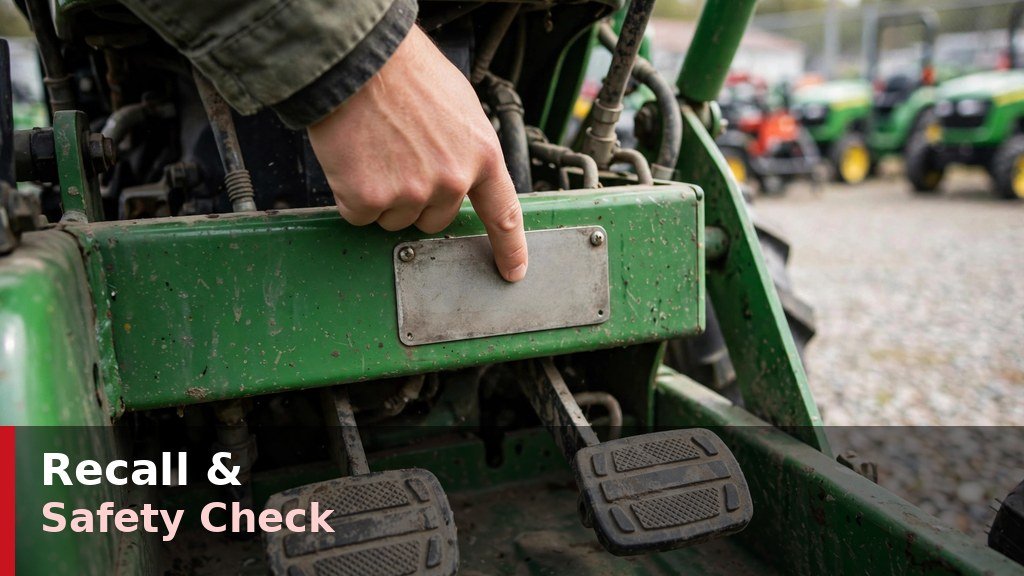
To verify any 2032R, find the serial number on the frame (front-right side near the engine on most 2R machines), enter it in the recall lookup under Parts & Service on Deere’s website, or call Deere & Company at 800-537-8233. If a future campaign ever covers your serial range, stop using the tractor and schedule the free dealer repair. When buying used, make the recall check part of your John Deere 2032R maintenance checklist — ask the seller directly whether any campaigns were completed and for the paperwork.
One related note: an older front-loader campaign (ballasting information correction) listed certain 2032R serials paired with 120R-series loaders — a paperwork-level correction, not a mechanical defect, but worth confirming with the dealer if the used tractor comes with a loader. The sibling 2038R maintenance and reliability guide shares the same 2R-platform inspection approach for buyers cross-shopping the turbocharged sibling.
Inspecting Safety Components Before Buying Used
John Deere 2032R maintenance history starts with the hour meter and service records: a 600-hour tractor with full documentation beats a 300-hour machine with none. Ask for receipts for oil changes, filter replacements, and any DPF-related dealer service. Our 2032R review and buying guide covers realistic new and used price bands so you can judge the asking price against hours and condition.
Walk the tractor with a checklist: cold-start it and watch for excessive smoke or regen warnings on the display; run the loader through full lift, curl, and dump watching for cylinder drift or weeping seals; engage the PTO and listen for bearing noise; check the range selector, front hubs, and brake pedals; test every safety switch, light, and gauge; inspect the ROPS for damage; and check tire wear. Ask how the previous owner used it — a tractor worked regularly under load will have a healthier DPF than one used for ten-minute puttering.
Frequently Asked Questions About John Deere 2032R Maintenance
These are the John Deere 2032R maintenance questions owners and shoppers ask most often, answered from Deere service guidance and documented owner experience.
How often should I change the oil in my John Deere 2032R?
Change the engine oil and filter every 200 hours or once a year, whichever comes first. The crankcase holds roughly 3.4 liters. This is the single most important item in John Deere 2032R maintenance, so do not stretch the interval even if the tractor sits unused for months.
Does the 2032R have a DPF, and what does regeneration involve?
Yes. Unlike the smaller 1 Series, the 2032R meets Final Tier 4 with a diesel oxidation catalyst plus diesel particulate filter. Most soot burns off passively during normal work; the ECU triggers active cleaning automatically when needed. If automatic cycles were interrupted, the display may request a parked cleaning — about 30 minutes, per the operator’s manual. Regular loaded work keeps the system healthiest.
When is the hydraulic filter due on a 2032R?
The hydraulic oil filter gets its first replacement after 50 hours, then the suction and HST filters are replaced every 400 hours. The transmission/hydraulic oil itself can run to 1,200 hours when using John Deere Hy-Gard, with oil analysis every 400 hours or yearly per the manual. An overdue filter often shows up as weak loader lift or jerky hydrostatic response — symptoms owners sometimes mistake for serious transmission trouble.
Was the 2032R included in the September 2024 brake recall?
No. The September 2024 CPSC brake-linkage recall covered the 1023E, 1025R, and 2025R only — the 2032R was not included. Still, verify any used 2032R by entering its serial number in Deere’s recall lookup or calling 800-537-8233.
Can I do my own maintenance without voiding the warranty?
Doing your own John Deere 2032R maintenance — oil changes, filter swaps, greasing, and inspections — does not void coverage as long as you use proper parts and fluids and keep dated records, which is exactly what the 6-year/2,000-hour powertrain limited warranty expects to see. Save receipts and log hours. For DPF ash service, fuel injection, hydrostatic, and electrical work, most owners are better off with the dealer’s tools and training.
What should a dealer 200-hour service cost on a 2032R?
Expect roughly $250–$450 at a dealer for the 200-hour service, depending on region and what else they find (estimate). The 2R runs slightly more than the 1 Series because of the larger filters and fluid volumes. Either way, disciplined John Deere 2032R maintenance is cheaper than the repair the skipped service was meant to prevent.