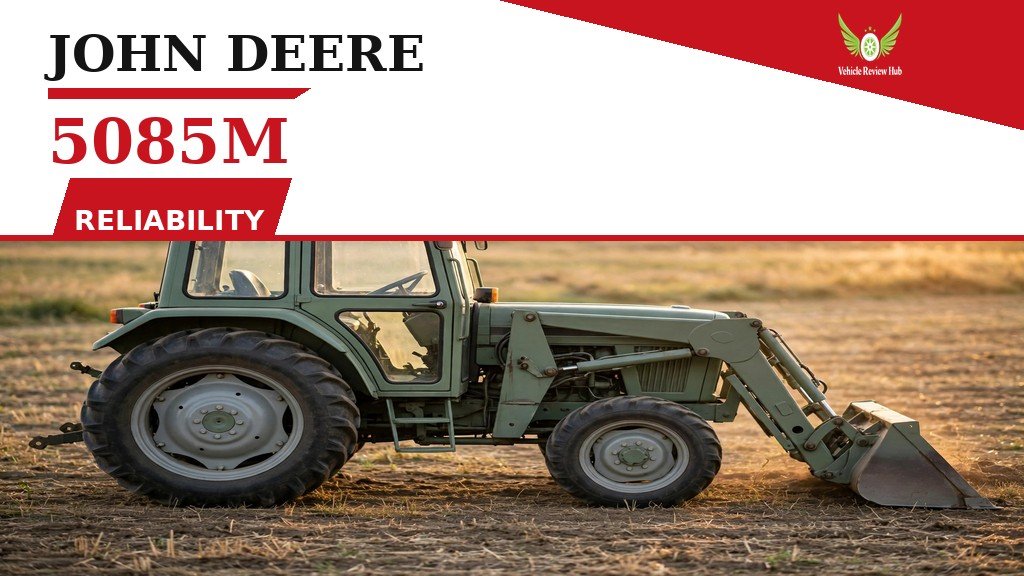
The short answer on John Deere 5085M maintenance is that this is a straightforward utility tractor to look after, if you respect the service intervals and your tractor’s generation. The 5085M has been sold across several generations since 2008, from simple Tier 3 machines with no aftertreatment to current MY22+ models with DOC/SCR aftertreatment and DEF, and the two generations do not share the same service schedule. This John Deere 5085M maintenance guide covers the schedule for both generations, the real service costs, the 4.5-liter PowerTech engine’s long-term durability, the common problems owners actually report, and the used-tractor inspection that separates a good 5085M from an expensive one.
One framing note: hours and service history matter far more than model year. A 5085M with documented John Deere 5085M maintenance and 5,000 hours usually beats a 3,000-hour tractor with no records, skipped fuel filters, and a lit exhaust-filter warning. Kept on schedule, these tractors routinely work past 8,000 hours; ignore the transmission-hydraulic system and the aftertreatment, and repair bills end the bargain.
John Deere 5085M Maintenance Schedule and Service Costs
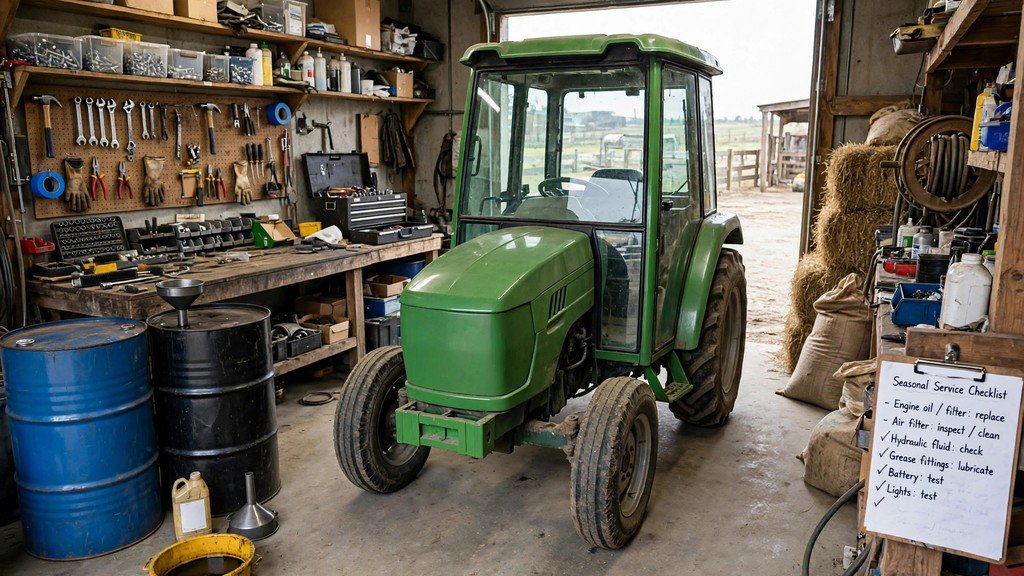
The John Deere 5085M maintenance schedule follows the 5M pattern: daily checks, a 100-hour break-in service, engine oil and filter on a short interval, fuel filters at 500 hours, the transmission-hydraulic filter at 600 hours, and air filters at 1,200 hours. This section of the John Deere 5085M maintenance guide walks through each job with the part numbers and intervals Deere publishes for the 5M line.
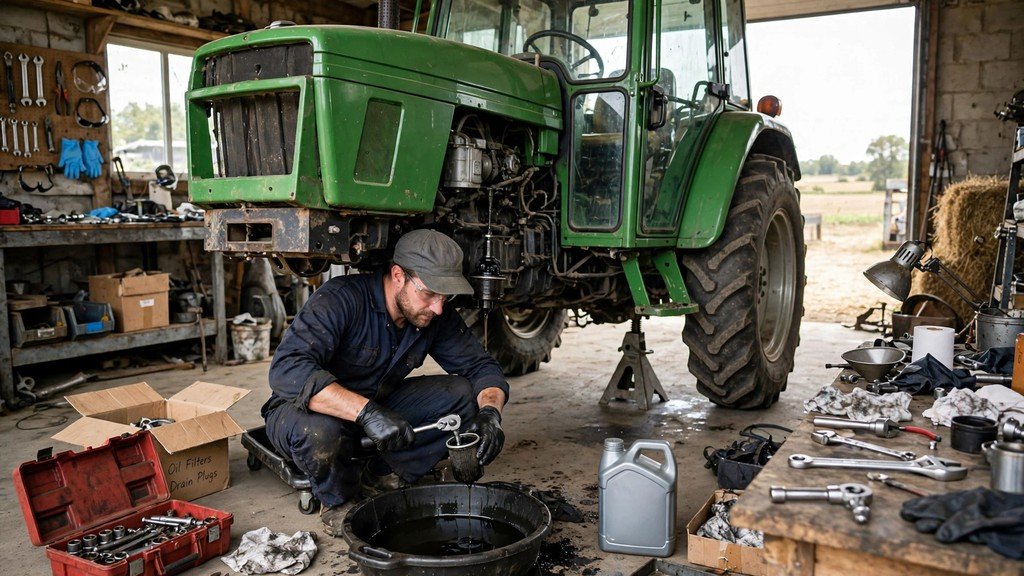
The video below shows the hands-on side of this schedule on a real 5085M — an oil-filter change and a two-fuel-filter change with no primer pump, exactly the jobs this John Deere 5085M maintenance guide describes:
Engine Oil, Fuel Filters, Air Cleaner and Cooling System
Engine oil is the single most important item in John Deere 5085M maintenance. The 4.5-liter four-cylinder holds about 8.8 quarts. New engines ship filled with break-in oil, changed after the first 100 hours — or after a second 100 hours of break-in oil under light-load use. After break-in, the oil filter (RE504836) goes every 250 to 300 hours per your manual revision, or every 500 hours with Plus-50 II 15W-40 oil and a John Deere filter. In John Deere 5085M maintenance, that oil interval is the one owners stretch most often, and it is the one that costs the most when stretched: the 4045 runs a turbocharger and common-rail injection, and both punish dirty oil.
Fuel filters follow their own rhythm in John Deere 5085M maintenance. The primary (RE551507) and secondary (RE551508) fuel filters are serviced after 10 hours and replaced every 500 hours. The dry two-stage air cleaner needs its primary element (SU20768) serviced every 1,200 hours or annually, secondary (RE253519) on the same schedule — sooner in dust. The cooling system holds about 12 quarts; keep radiator and oil-cooler fins clear of chaff and check hoses at every service. In John Deere 5085M maintenance, cooling care is cheap insurance against a scored engine.
Transmission, Hydraulic Fluid, Axles and PTO Service
The transmission-hydraulic system is the second half of John Deere 5085M maintenance, and it is the system most owners under-service. The open-center hydraulic system runs Hy-Gard oil, about 11.9 gallons on first-generation models, with pump output of 24.7 gpm (PowrReverser) or 25.6 gpm (PowrQuad PLUS/Powr8) on current-generation tractors. The transmission-hydraulic filter (SJ11784) goes after 100 hours, then every 600 hours. Transmission-hydraulic oil itself typically goes around 1,200 hours, subject to your manual’s conditions. In John Deere 5085M maintenance, check the transmission-hydraulic level before heavy hydraulic work, and treat any change in look or smell as information: milky means water, burnt-smelling means clutch trouble.
John Deere 5085M maintenance also means greasing the hitch, steering, and axle pivot points on schedule, checking MFWD front-axle and differential oil levels, and checking wheel-bolt torque twice in the first ten hours, then weekly or every 50 hours, and after every wheel removal. Cab tractors add fresh-air (RE198488) and recirculation (RE195491) filters, cleaned every 600 hours or annually. On current MY22+ models, the DEF dosing-unit filter (RE554498) goes within the first five years and every 4,500 hours. Generation note: the current 5085M uses DOC/SCR with DEF and has no DPF; first-generation Tier 3 tractors have no aftertreatment at all. How each transmission feels in the field is covered in the transmission driving impressions.
| Service item | Interval (5M schedule) | Notes for the 5085M |
|---|---|---|
| Break-in engine oil + filter | After first 100 hours | Break-in oil; light-load use adds 100 hours |
| Engine oil + oil filter (RE504836) | Every 250–300 hours | 500 hours with Plus-50 II oil + Deere filter |
| Fuel filters (RE551507 + RE551508) | Service after 10 hours; replace every 500 hours | Both filters |
| Transmission-hydraulic filter (SJ11784) | After 100 hours, then every 600 hours | Hy-Gard oil system |
| Cab air filters (RE195491 + RE198488) | Clean every 600 hours or annually | Cab tractors only |
| Primary air filter (SU20768) | Every 1,200 hours or annually | Sooner in dust |
| Transmission-hydraulic oil | Typically around 1,200 hours | Follow your manual’s conditions |
| DEF dosing-unit filter (RE554498) | Within 5 years, then every 4,500 hours | Current MY22+ models only |
Service costs stay modest for routine John Deere 5085M maintenance: most jobs are fluids and filters. As planning estimates for 2026 US shop rates, a DIY oil service runs roughly $150–$250, a dealer annual service $500–$900, and a transmission-hydraulic service $600–$1,100. Those numbers argue for staying on schedule — and for pricing overdue services into your offer.
John Deere 5085M Reliability and Long-Term Durability
Reliability comes from proven components: the 4045 diesel, an open-center hydraulic system, and mature transmissions. Owner feedback is broadly positive on engine strength and versatility.
PowerTech Diesel Engine and Transmission Care
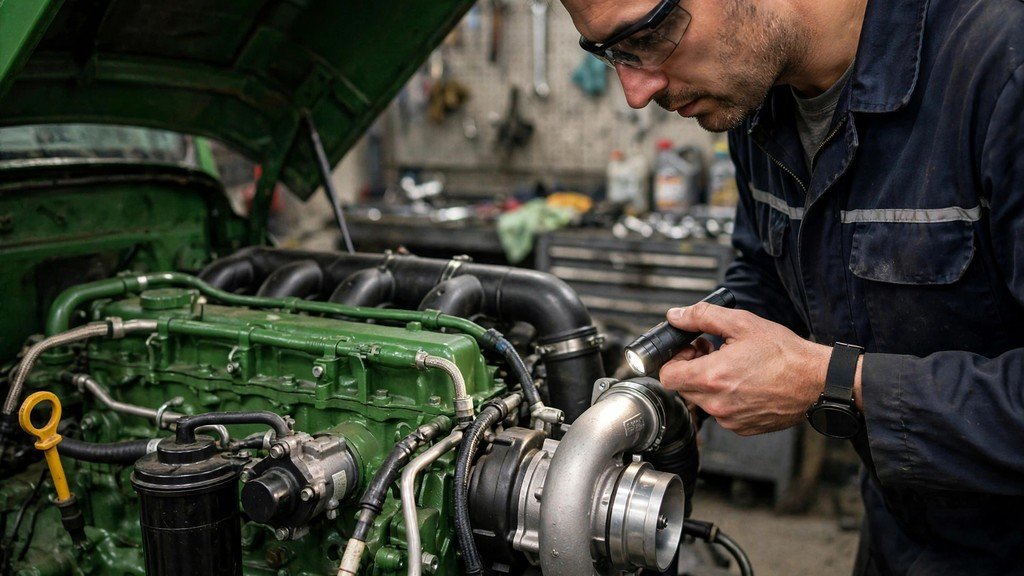
The PowerTech 4045 is a four-cylinder turbocharged and aftercooled diesel, 276 cubic inches (4.5 liters). Both generations rate 85 horsepower at 2,200 rpm: the first-generation (2008–2013, Tier 3) PowerTech M 4045, and the current MY22+ 4045 EWL with about 70 PTO horsepower. Published torque varies by generation — about 331 lb-ft at 1,600 rpm on first-generation models, 281 lb-ft with a 4 percent IPM boost (to about 88.9 horsepower) on current MY22+ models — so compare like with like. Nebraska Tractor Test 1960 (first-generation 16-speed 4WD, October 2009) measured 74.07 PTO horsepower on 4.6 gallons per hour, above the claimed 70. That spread between claimed and tested output is normal, and it is why John Deere 5085M maintenance advice focuses on condition over brochure numbers: a healthy 4045 with good compression, clean injectors, and a working turbo does its rated work.
Engine care in John Deere 5085M maintenance is mostly about oil, air, fuel, and heat. Keep oil fresh, the air filter clean, and cooling fins clear, and the 4045 routinely passes 8,000 hours in utility work. Let the turbo idle a minute or two after hard work before shutdown so it cools with oil flowing. Transmission care in John Deere 5085M maintenance splits by gearbox. On current-generation tractors, the standard PowrReverser (16/16) needs clean Hy-Gard oil and a healthy shuttle, while PowrQuad PLUS (16/16) and Powr8 (32/16, creeper optional) add push-button range shifting owners rate as a genuine improvement. First-generation tractors used SyncShuttle, PowrReverser, and PowrReverser Plus instead. Which transmission suits your farm is covered in the transmission comparison.
How Hours, Workload and Service History Affect Longevity
Four factors decide how long a 5085M lasts, and all four sit inside John Deere 5085M maintenance. First, annual hours: 500 loader hours wear faster than 200 hours of light mowing. Second, workload: constant heavy draft or loader work ages the transmission faster. Third, duty cycle on current-generation models: short runs and long idling keep the SCR system below working temperature and invite DEF-system faults. Fourth, the previous owner’s habits, where John Deere 5085M maintenance records earn their value: receipts for oil, filters, and DEF work beat a low reading on a neglected tractor.
Parts remain widely available, since the 5M Series sold in large numbers and shares its engine family across the 5075M to 5115M. The expensive failures — a transmission split, an engine overhaul, an aftertreatment system neglected until derate — are cheaper to prevent than to fix, and announce themselves early — the practical payoff of John Deere 5085M maintenance.
John Deere 5085M Common Problems and Warning Signs
The 5085M’s problems are well documented in owner forums after years in second ownership. The good news for John Deere 5085M maintenance is that most problems announce themselves early — a slow crank, a clunky cold shift, a new whine, a warning light, or a changed fluid color — and most have a simple first check.
Starting, Cooling, Fuel-System and DPF Symptoms
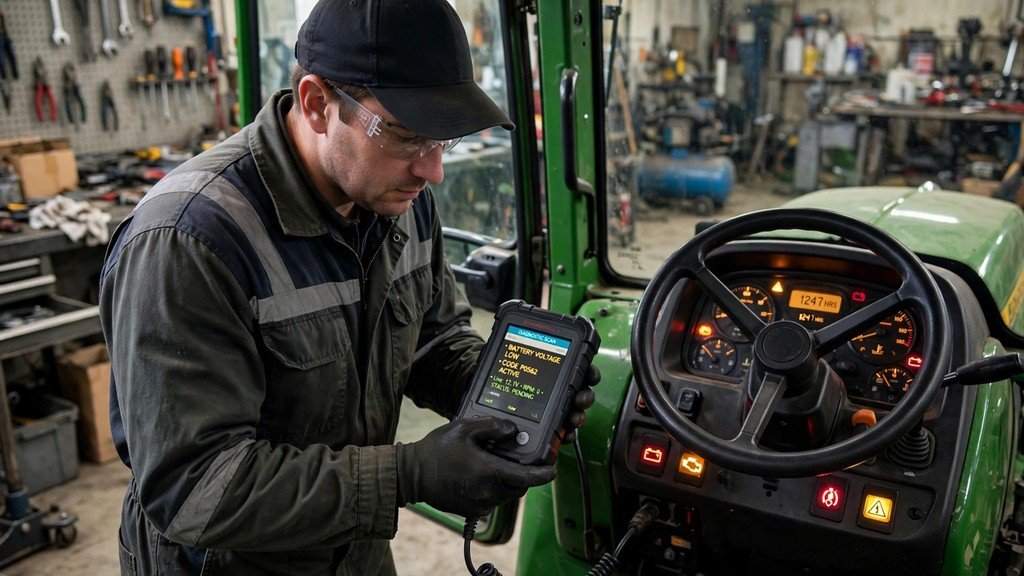
Starting trouble is among the most reported 5085M complaints, and John Deere 5085M maintenance troubleshooting starts with the same short list: a charged 12-volt battery with clean terminals (925 CCA), clean fuel filters, and air-free delivery. One specific no-crank fault: a dead dash neutral light points at the neutral-start switch or relay, not the starter. Old fuel is the leading culprit after storage: untreated diesel grows contamination that plugs filters and starves the pump. Cranks-but-won’t-catch means fuel delivery trouble; won’t crank at all means battery, cable, fuse, relay, or neutral-start trouble. Low power under load points at the air filter, turbo, or injectors, in that order.
In John Deere 5085M maintenance, a 5085M that runs hot usually has a clogged radiator or oil cooler, a tired thermostat, or a slipping fan belt, and the fix is cleaning and parts. Aftertreatment needs a generation note, because the outline heading mentions DPF symptoms: the current MY22+ 5085M uses DOC/SCR with DEF and has no DPF to regenerate, while first-generation Tier 3 tractors have no aftertreatment at all. What owners often describe as DPF symptoms — a warning light, rising fuel use, or a derate — on a current-generation tractor trace to the SCR/DEF system instead: low or poor-quality DEF, a clogged dosing filter, or a sensor fault, and the fix is a dealer diagnosis, not continued work. If any exhaust or DEF warning is already lit on a tractor you are considering, price a dealer aftertreatment job into the deal first.
Transmission Shifting, Hydraulic Performance and PTO Checks
Transmission trouble is where John Deere 5085M maintenance gets expensive if ignored. The most common complaint is clunky cold shifting on the PowrReverser shuttle: check oil level and condition first, and let the transmission warm before judging it. Slipping or harsh shifts when warm usually trace to low clutch pressure, a clogged filter, or worn packs; pressure-test against the manual first. Hydraulic leaks are the second recurring report: check oil level, filters, hoses, and couplers, then pump output — never check a pinhole leak with your hand. A hitch that drifts down, slow loader or remote response, or a whining pump all point at low system pressure or a tired pump, and the 5085M’s open-center pump delivers roughly 24.7 to 25.6 gallons per minute depending on transmission, with about 20 gallons per minute available at a single rear SCV.
Electrical faults round out the list in John Deere 5085M maintenance: intermittent battery, wiring, and dash-circuit issues are reported more often than outright engine failures, so check every light and switch, and read stored codes. A PTO that will not disengage usually means a sticking clutch pack or faulty valve: a safety problem, never work around it. In John Deere 5085M maintenance, any PTO, brake, or steering fault outranks every other job.
John Deere 5085M Used-Tractor Inspection
A used 5085M can be excellent value, but only if inspection backs up the price. As planning bands from recent listing summaries, rough or high-hour tractors trade below about $30,000, average working examples roughly $30,000–$55,000, and clean low-hour cab MFWD tractors with a loader up to about $65,000 or more — a 2015 example with 5,451 hours near $36,400, a low-hour 2014 cab tractor near $65,000. These are planning bands, not verified listings, and this section turns the service schedule into a buyer’s checklist.

Checking Engine Condition, Error Codes and Service Records
Start with records and fluids: John Deere 5085M maintenance history is the best predictor of what you are buying. Ask for receipts showing break-in service, oil changes, fuel-filter changes, and any DEF or aftertreatment work, and check the hour meter against condition: a battered 3,000-hour tractor has lived hard, a 6,000-hour tractor with clean fluids may be better. Check blow-by warm: remove the oil filler cap and watch for steady, heavy vapor pulsing out, pointing at worn rings. Check every fluid: engine oil dark but not milky or gritty, transmission-hydraulic oil clear reddish, coolant clean, not oily or rusty. Any fluid failing that look test is a negotiating point or a walk-away sign.
For John Deere 5085M maintenance, a cold engine should start promptly without excessive smoke, idle smoothly, and show no oil leaks once warm. Persistent blue smoke, knocking, or turbo shaft play all point at undisclosed work. Read the CommandCenter display for stored fault codes, aftertreatment codes in particular, and ask whether any exhaust or DEF warning has ever stayed on. Check radiator fins, fan belt, and battery cables, and ask about the last valve and cooling service. Prices and repair costs are compared in the ownership cost comparison.
Testing MFWD, Brakes, Hitch, PTO and Hydraulic Remotes
In John Deere 5085M maintenance inspections, drive through every gear and range: PowrReverser shifts should be positive with no grinding, PowrQuad PLUS and Powr8 smooth without slipping. Test brakes separately and together, including the parking brake on a slope (hydraulic wet-disc brakes): a weak side is a safety fault. Raise the hitch with a load if available and watch for drift, run the remotes through full stroke, and cycle the PTO to confirm release. On MFWD tractors, engage four-wheel drive and check for noise, vibration, non-disengaging axles, and front-axle leaks. One pricing trap: fresh paint and new tires do not fix a slipping transmission, a tired engine, or a lit aftertreatment warning, so price on mechanical condition, not shine, and use every genuine defect as a negotiating point, priced against the repair it needs. That discipline is the heart of buying well.
John Deere 5085M Maintenance: Frequently Asked Questions
These are the questions 5085M owners actually ask about keeping their tractor running, answered from this John Deere 5085M maintenance guide.
How often should I change the oil on a John Deere 5085M?
John Deere 5085M maintenance calls for an oil and filter change after the first 100 hours of break-in, then every 250 to 300 hours, or every 500 hours when Plus-50 II oil and a John Deere filter are used. The engine holds about 8.8 quarts.
How often should I change the fuel filters?
John Deere 5085M maintenance services the primary and secondary fuel filters after 10 hours and replaces both every 500 hours.
How often should I change the transmission-hydraulic filter?
John Deere 5085M maintenance replaces the transmission-hydraulic filter after 100 hours and then every 600 hours, with the oil itself typically changed around 1,200 hours under the manual’s conditions.
Does the John Deere 5085M use DEF?
Current MY22+ models do: John Deere 5085M maintenance on those tractors includes the DEF system and its dosing-unit filter, replaced within five years and every 4,500 hours. First-generation Tier 3 tractors have no DEF system at all.
Does the John Deere 5085M have a DPF?
No, not on the current generation: John Deere 5085M maintenance on MY22+ tractors covers a DOC/SCR system with DEF and no DPF, so there is nothing to regenerate. An exhaust or DEF warning on those tractors means a DEF, dosing, or sensor fault — get a dealer diagnosis promptly, since the tractor can derate. First-generation Tier 3 tractors have no aftertreatment at all.
What engine does the John Deere 5085M have?
John Deere 5085M maintenance covers the PowerTech 4045: a four-cylinder turbocharged and aftercooled diesel of 276 cubic inches (4.5 liters), rated at 85 horsepower at 2,200 rpm.
How much horsepower does a John Deere 5085M have?
John Deere 5085M maintenance references 85 engine horsepower and about 70 PTO horsepower claimed, with Nebraska Tractor Test 1960 measuring 74.07 PTO horsepower at maximum power.
Why is my 5085M hard to start?
John Deere 5085M maintenance checks the battery and cables, fuel filters, and fuel delivery first, then the neutral-start switch if the dash neutral light stays dark and the starter never engages.
Why does my 5085M shift clunky when cold?
John Deere 5085M maintenance usually traces cold clunky shifting to cold Hy-Gard oil in the PowrReverser shuttle. Warm the transmission before judging it; persistent harsh shifting when warm points at oil condition, clutch pressure, or wear.
Why is my 5085M losing hydraulic power?
John Deere 5085M maintenance checks oil level, filter condition, and hose and coupler leaks first, then pump output. Slow hitch or loader response with a whining pump points at low pressure or a tired pump.
How much does annual 5085M maintenance cost?
John Deere 5085M maintenance done yourself costs a few hundred dollars a year in fluids and filters for a typical season; a dealer annual service runs roughly $500–$900. Budget more in transmission-oil years and on current-generation models with DEF service.
What should I check first when buying a used 5085M?
John Deere 5085M maintenance history comes first: ask for oil, filter, and aftertreatment records, then check blow-by, every fluid’s color and smell, cold start, gear engagement, brakes, hitch drift, PTO release, MFWD function, and stored fault codes before agreeing a price.
Is the John Deere 5085M reliable long-term?
Yes, with steady John Deere 5085M maintenance: the 4045 engine and the 5M transmissions routinely pass 8,000 hours when fluids, filters, cooling, and aftertreatment stay on schedule. Neglect of the hydraulic system or the exhaust system ends most 5085Ms early, not age alone.