John Deere 6110M maintenance is straightforward if you follow Deere’s published service intervals: engine oil and filter every 500 hours, fuel filters every 500 hours, transmission-hydraulic filter elements every 750 hours, and transmission-hydraulic oil plus front-axle oil every 1,500 hours or two years. The 110-hp PowerTech EWL 4.5L diesel runs DOC and SCR aftertreatment with DEF — there is no DPF and no parked regeneration on the US Final Tier 4 model — and Deere backs the tractor with a 24-month/2,000-hour base warranty (whichever comes first), with paid PowerGard extended plans available.
This John Deere 6110M maintenance guide walks through the full service schedule with the figures from Deere’s 6M operator manual, realistic service costs, the reliability record of the 4.5L engine and Quad transmissions, the owner-reported problems to watch for, and a used-tractor inspection checklist. If you are still shopping, our John Deere 6110M review covers specs, pricing, and the competition, and the 6110M performance and fuel usage guide breaks down real-world consumption.
John Deere 6110M Maintenance Schedule and Service Costs
The John Deere 6110M maintenance schedule comes from Deere’s 6-series operator manual, and it is built around long intervals: 500 hours for engine oil, 750 hours for transmission-hydraulic filters, and 1,500 hours for the big fluid changes. At typical farm usage of 300–500 hours a year, that means one major service annually and a mid-year filter check. The table below summarizes the intervals that matter most in John Deere 6110M maintenance.
| Service item | Interval | Notes |
|---|---|---|
| Check engine oil, coolant; drain water/sediment from fuel filter | Daily / 10 hours | Five-minute walkaround habit |
| Check transmission-hydraulic oil level, MFWD axle oil, battery | 50 hours | Lubricate front axle pivot at the same time |
| Change engine oil and filter (Plus-50 II, 4.5 gal) | 500 hours | Change fuel filters at the same stop |
| Replace transmission-hydraulic filter elements | 750 hours | Check cab mounting screws at the same time |
| Change transmission-hydraulic oil (15.9 gal) and FWD axle oil | 1,500 hours or 2 years | Also change cab air filters and crankcase vent separator |
| Change engine air cleaner secondary (safety) element | 4,500 hours | Primary element serviced as required |
| Change engine coolant (5.3 gal system) | 6,000 hours or 6 years | Test coolant with strips annually |
| Annual jobs regardless of hours | Once a year | Seat belt check, coolant test strips, hydraulic hose inspection, cab air filters |
Engine Oil, Fuel Filters, Air Filters and Cooling System
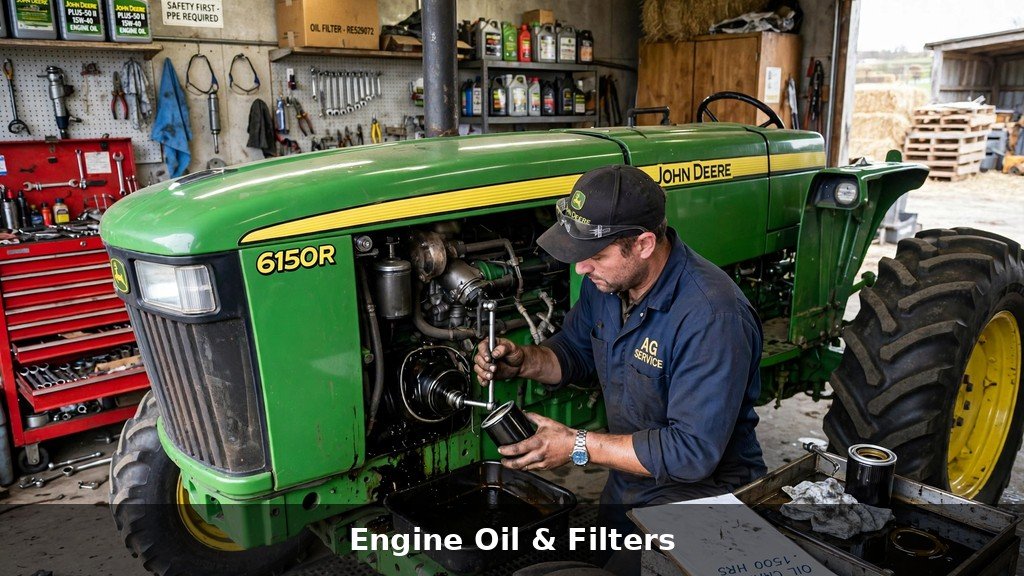
Engine oil is the 500-hour heartbeat of John Deere 6110M maintenance. The 4.5L crankcase holds 4.5 gallons, and Deere specifies Plus-50 II engine oil, changed with the filter every 500 hours. Fuel filters change on the same 500-hour stop, and the manual’s daily item — draining water and sediment from the fuel filter — is the single most skipped job that causes starting and power-loss complaints. The air cleaner primary element is serviced as required (the restriction indicator tells you when), with the secondary safety element on a 4,500-hour change. Cooling system service is refreshingly simple: annual coolant test strips and hose inspection, with a full coolant change at 6,000 hours or six years. The video below shows a 100-hour service on the sibling 6120M — the same EWL engine family and the same basic procedure as your 6110M:
The aftertreatment side of John Deere 6110M maintenance is DEF, not DPF. The US Final Tier 4 6110M uses a diesel oxidation catalyst plus selective catalytic reduction with DEF — there is no diesel particulate filter and no parked regeneration to plan around. Keep DEF fresh from sealed containers, keep the filler neck clean, and never run the tank dry; contaminated or stale DEF is the most common cause of SCR fault codes and derate warnings on these tractors.
Transmission, Hydraulic Oil, Axles and Lubrication
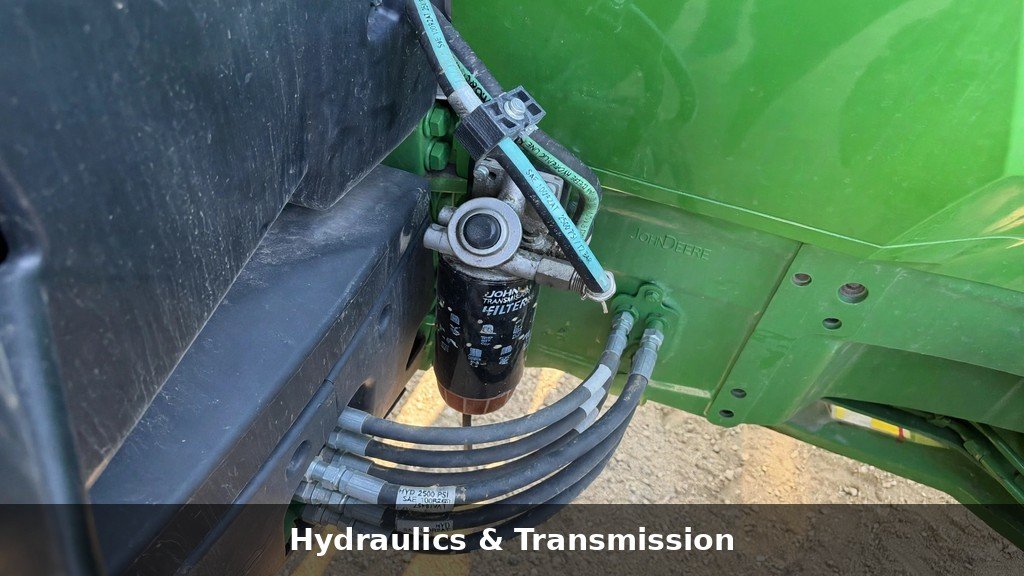
The transmission-hydraulic system is shared oil on the 6110M, holding 15.9 gallons on PowrQuad Plus and AutoQuad Plus machines. Filter elements come out every 750 hours; the oil itself plus the front-axle oil goes every 1,500 hours or two years. At the 50-hour check, verify the transmission-hydraulic oil level and the MFWD axle oil level, and lubricate the front axle pivot pin and steering spindles. Deere’s published 6110M specifications confirm the 500/1,500-hour service intervals that make John Deere 6110M maintenance one of the longer-interval routines in its class. In real money, a DIY annual John Deere 6110M maintenance service — oil, all filters, grease — runs roughly $400–$600 in parts, while a dealer full service typically lands between $900 and $1,500 depending on labor rates and what the inspection finds. Those are estimates; your dealer’s shop rate decides the top end. For the long-term picture, see our 6110M ownership cost guide.
John Deere 6110M Reliability and Long-Term Durability
The 6110M’s reliability story is a good one, and it is what keeps John Deere 6110M maintenance simple: a wet-sleeved 4.5L engine with decades of Deere lineage, Quad-family transmissions proven across the 6M line, and a steel bridge-frame chassis built in Mannheim, Germany. Owner reports consistently describe the 6110M as a tractor that shrugs off deferred cosmetic care and keeps working — but the same reports are clear that skipped fluid and filter service is what eventually bites. This section of our John Deere 6110M maintenance guide looks at what holds up and what wears.
4.5L Engine, Transmission and Hydraulic System Reliability
The PowerTech EWL 4.5L single-turbo four-cylinder — 110 rated horsepower, 122 max, 130 with Intelligent Power Management, and 84 PTO horsepower — is the reliability anchor of the 6110M and the reason John Deere 6110M maintenance is mostly fluids and filters. Wet-sleeved cylinder liners make it rebuildable, and the engine’s service record across the 6M line is strong: owners report thousands of hours with nothing more than scheduled service, provided the oil, fuel filters, and air cleaner get their due. The DOC+SCR aftertreatment (no DPF) is simpler than the systems on higher-horsepower machines, which is one reason the 6110M sees fewer emissions-related shop visits than its bigger siblings.
The transmissions — PowrQuad Plus 16/16 or 24/24, AutoQuad Plus, CommandQuad Plus, or the AutoPowr IVT — are proven designs, and the closed-loop shared hydraulic system (21 gpm standard, 30 gpm optional) is straightforward to service. The most common reliability complaint is not a design flaw but a maintenance one: slow or weak hydraulics that trace back to low fluid, overdue filters, or a plugged suction screen. A well-documented TractorByNet thread about a used 6110 bought from a repo lot tells the story — the tractor moved slowly and the loader barely lifted, and the fix was a complete service: hydraulic and transmission filter and fluid change, air, oil, coolant, and a thorough grease job. The machine had simply never been serviced.
Factors Affecting Service Life, Downtime and Repair Costs
Three factors decide how long a 6110M lasts and what John Deere 6110M maintenance costs over its life. First, fluid and filter discipline: the 500/750/1,500-hour intervals are not suggestions, and dusty conditions call for shorter air-cleaner and oil service. Second, DEF hygiene: fresh sealed DEF, a clean filler, and prompt attention to derate warnings keep the SCR system out of the shop. Third, load management: the 6110M is a 12,522-lb tractor rated for serious work, but chronic overloading — especially on the 600R loader at full reach — accelerates front-axle, clutch, and hydraulic wear. Downtime is rarely about catastrophic failure on these machines; it is about deferred John Deere 6110M maintenance catching up at the worst moment. Budget-conscious owners who want the full financial picture should read our 6M Series maintenance guide alongside this John Deere 6110M maintenance article, since the whole 6M family shares the same service philosophy.
John Deere 6110M Common Problems and Warning Signs
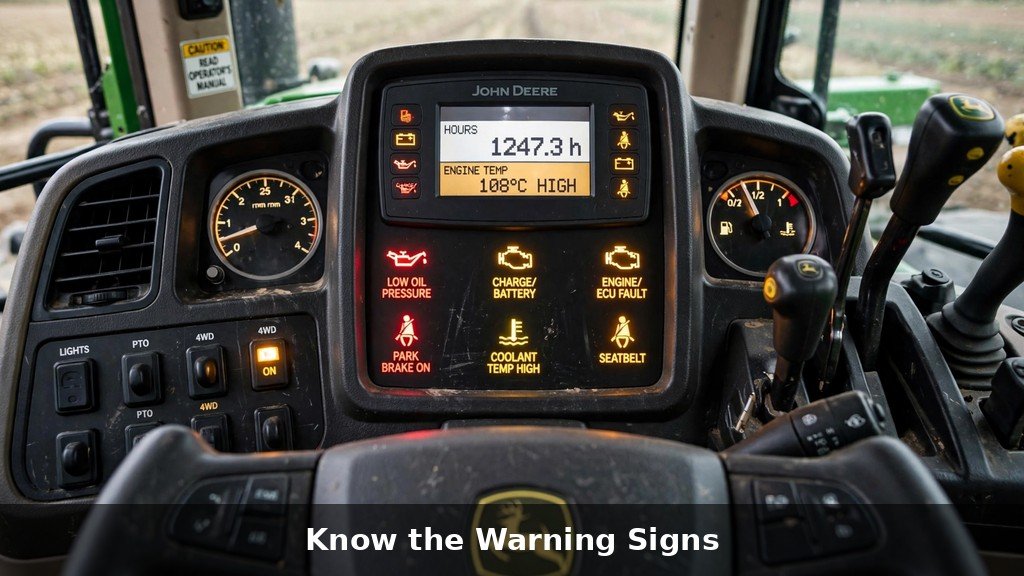
No tractor is trouble-free, and John Deere 6110M maintenance means watching for a few known quirks. The important framing: the problems below are owner-reported patterns gathered from forums and dealer techs, not factory defect lists, and most of them are maintenance-related rather than design-related. Knowing the warning signs is what separates a $200 filter job from a $2,000 component replacement in John Deere 6110M maintenance.
Engine, Electrical, Hydraulic and Transmission Symptoms
Slow or weak hydraulics is the most reported 6110M complaint. Symptoms: sluggish loader, slow three-point response, steering that feels heavy. The causes owners and techs cite are almost always low hydraulic fluid, air in the system, overdue filters, or a plugged suction screen — exactly the repo-lot 6110 case above. Check the fluid level first, then the filter service history, before suspecting the pump.
Electrical gremlins come next: faulty sensors, battery and charging issues, and error codes on the cornerpost display. Deere techs note that dirty batteries and corroded connections cause a surprising share of no-start and code complaints, and a discharged battery during storage is common — keep it on a maintainer. Transmission shifting difficulty, particularly hard or delayed shifts under load, usually traces to low transmission fluid or worn shuttle-shift components; the shuttle-shift solenoid can wear when hot on high-hour machines. Engine power loss most often means clogged fuel filters or a restricted air intake — the daily fuel-filter drain and the air-cleaner restriction indicator exist precisely to prevent this. Stale-DEF derates round out the list: machines that sit for months can throw SCR fault codes from old DEF, fixed by draining and refilling with fresh fluid.
Diagnosing Faults and Evaluating Repair Needs
Sound John Deere 6110M maintenance means working the diagnostic chain from cheap to expensive. Warning light on? Read the code on the display and check the operator’s manual before calling the dealer — many codes point to fluid levels, filters, or DEF quality. Hydraulic problem? Fluid level, then filter age, then suction screen, then pump. Electrical code? Battery voltage and ground connections first; Deere’s own troubleshooting charts in the operator manual (available at manuals.deere.com) walk through the hydraulic, engine, and electrical trees step by step. A dealer diagnostic session typically runs one to two hours of shop time, so arriving with the code, the service history, and the basics already checked saves real money. If the tractor needs professional help, a certified Deere tech with the diagnostic software is the right call for computer, IVT, and aftertreatment faults — this is not the place for guess-and-replace parts swapping.
John Deere 6110M Safety Checks and Used-Tractor Inspection
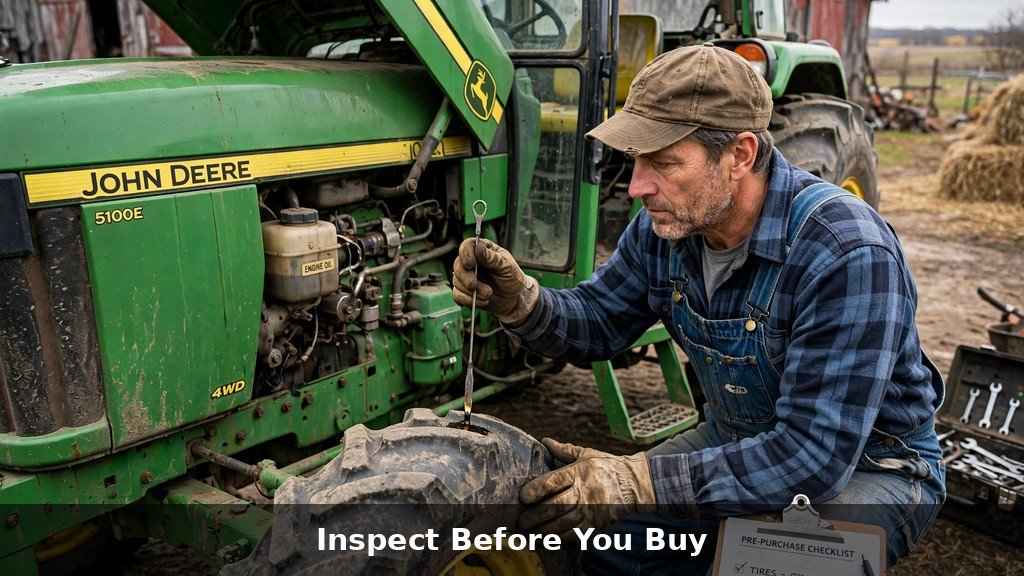
Buying a used 6110M is where John Deere 6110M maintenance knowledge pays for itself: the inspection is really an audit of the previous owner’s service discipline. Used 6110M prices run roughly $62,500 to $135,500 depending on year, hours, and equipment, and a well-documented 2,000-hour machine is a better buy than a 1,000-hour machine with no records. Check the service history before you check the paint.
Checking Service History, Software Updates and Applicable Recalls
Ask for receipts: oil changes at 500-hour intervals, fuel filters, the 750-hour transmission-hydraulic filter services, and the 1,500-hour fluid changes — the complete John Deere 6110M maintenance record. Gaps in the records are a negotiating point, not a dealbreaker — but price a full catch-up service into your offer. Ask the dealer to confirm the tractor’s software is current; transmission and engine control updates are routine and free at the dealer. On recalls: this John Deere 6110M maintenance guide could not verify any 6110M-specific CPSC safety recall. The widely reported September 2024 brake-linkage recall covered the 1023E, 1025R, and 2025R compacts only — not the 6M line. Run the serial number through the recall lookup under Parts & Service on Deere’s website, or call 800-537-8233; the check costs nothing and a dealer can confirm all applicable campaigns were applied.
Inspecting Brakes, Tires, Hydraulics and Transmission Operation
Start the used-tractor John Deere 6110M maintenance inspection cold. Check all fluid levels — engine oil, coolant, transmission-hydraulic oil, front-axle oil — before the engine warms up; low fluids on arrival tell you how the machine was kept. Work every hydraulic function through its full range: loader lift and curl, three-point hitch, steering, and each remote — listening for cavitation and watching for drift or creep. Run the transmission through all ranges and gears under light load; Quad boxes should shift cleanly with no slipping or harsh engagement. Check the brakes, including the park brake, and inspect tires for uneven wear that hints at alignment or ballast issues. Look at the DEF filler area for crystallization or contamination, check the battery terminals for corrosion, and verify every light and the display powers up without stored fault codes. The detailed 6110M specification data is worth having open during the inspection so you can confirm the configuration matches what the seller claims. If the inspection turns up deferred service rather than damage, our 5090M maintenance guide shows the same service logic on the smaller 5M platform for comparison.
Frequently Asked Questions About John Deere 6110M Maintenance
These are the questions 6110M owners ask most often about John Deere 6110M maintenance: service intervals, costs, and the problems that actually show up in the field — answered from Deere’s published manuals and documented owner experience.
How often does the John Deere 6110M need an oil change?
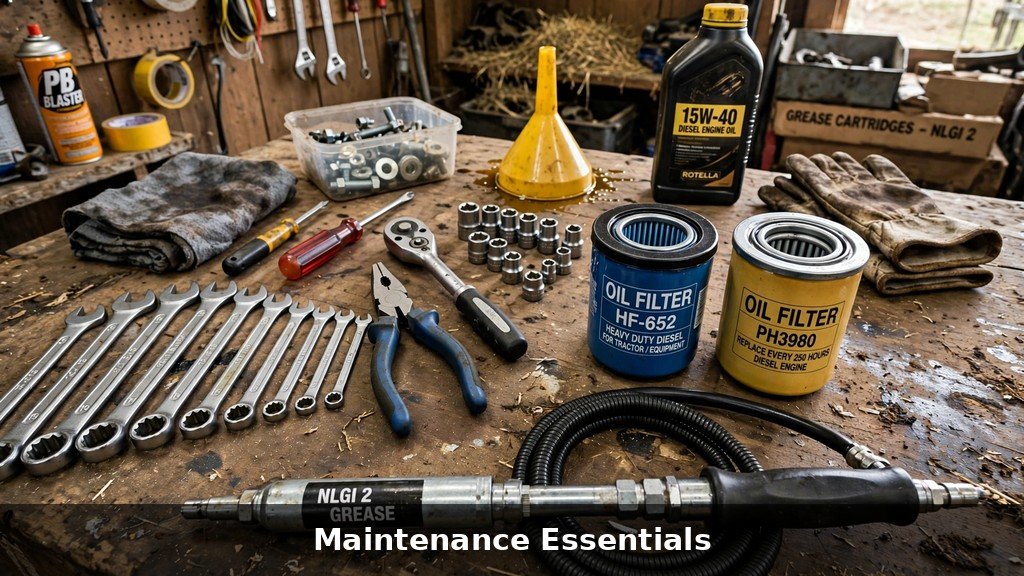
Every 500 hours, with the oil filter, using Plus-50 II engine oil — the crankcase holds 4.5 gallons. That 500-hour oil change is the core routine of John Deere 6110M maintenance. Fuel filters change on the same 500-hour stop. In dusty conditions or with frequent short-trip use, Deere advises servicing more often than the book interval.
Does the 6110M have a DPF?
No. The US Final Tier 4 6110M uses DOC and SCR aftertreatment with DEF — no diesel particulate filter and no parked regeneration. Keep DEF fresh from sealed containers and never run the tank dry; stale or contaminated DEF is the leading cause of SCR fault codes on these tractors.
What are the most common 6110M problems?
Owner-reported patterns include slow or weak hydraulics (usually low fluid, overdue filters, or a plugged suction screen), electrical issues (sensors, batteries, display codes), hard shifting under load (low transmission fluid or worn shuttle components), power loss from clogged fuel filters, and stale-DEF derates on machines that sit. Most are maintenance-related, not design defects.
How much does 6110M maintenance cost per year?
At 300–500 hours of annual use, expect roughly $400–$600 a year in parts doing it yourself (oil, all filters, grease), or $900–$1,500 for a dealer full service — those are estimates and labor rates vary. DEF adds a small running cost on top. The 500/750/1,500-hour interval structure means one major John Deere 6110M maintenance service a year for most owners.
What is the 6110M’s warranty?
John Deere’s agricultural warranty on the 6110M is 24 months or 2,000 hours of base coverage, whichever comes first — not the 6-year/2,000-hour figure that applies to Deere’s compact utility tractors. Confirm the exact terms with your dealer, as coverage starts at the delivery date.
Are there any recalls on the John Deere 6110M?
We could not verify any 6110M-specific CPSC safety recall. The widely reported September 2024 brake-linkage recall covered the 1023E, 1025R, and 2025R compacts only. Check any used 6110M’s serial number through Deere’s recall lookup or by calling 800-537-8233 before you buy.