The John Deere 7R Series is built for one thing above all: turning diesel into acres as efficiently as possible. In independent DLG PowerMix testing, the 7R 330 recorded 375 grams of diesel per kWh plus 17 g/kWh of DEF — the best combined fluid figure ever measured for a tractor above 250 hp. That is the headline number behind John Deere 7R Series performance: not just 210 to 330 rated horsepower, but horsepower delivered with class-leading fuel economy, a 40 percent torque rise that keeps the engine pulling at 1,600 rpm, and transmissions engineered to hold road and field speed at low engine rpm.
This guide breaks down John Deere 7R Series performance in practical terms — fuel use by task, runtime per tank, how the models compare under load, handling and comfort across long days, and what owners actually report. Lab-verified figures are labeled as such; figures from owner reports are labeled owner-reported.
John Deere 7R Series Fuel Consumption and Runtime
Fuel is the largest operating expense on a row-crop tractor, and the 7R’s engineering reflects it. Every model meets Final Tier 4 with a DOC, DPF and SCR aftertreatment package and a 6.9-gallon DEF tank, which lets the engine run a fuel-efficient calibration while the SCR system handles NOx. Understanding how John Deere 7R Series performance translates into gallons per hour across different jobs is what separates a good buying decision from a great one.
Fuel Use During Fieldwork, PTO Operation and Transport
Start with the hard number: the DLG test center’s 14-cycle PowerMix program measured the 7R 330 at 375 g/kWh of diesel plus 17 g/kWh of DEF — beating the next-best competitor over 250 hp by 8 g/kWh of diesel and 28 g/kWh of DEF. Deere’s reporting equated that to roughly €1.50–€2 per hour in transport work versus average competitors, a saving that flows straight to cost per acre for US operations.
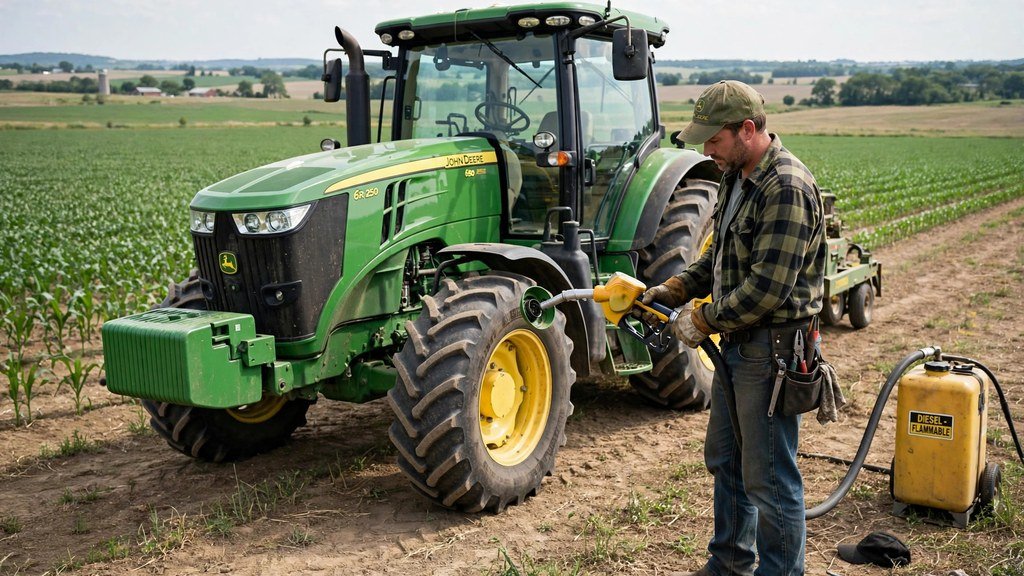
In gallons per hour, John Deere 7R Series performance looks like this in owner-reported terms (all owner-reported, not engineering data): light PTO work and road transport run about 5–7 gph, row-crop tillage and planting 7–10 gph, and heavy draft — deep ripping, big discs, loaded grain carts — 10–14 gph on the 9.0L models. The 6.8L models (7R 210–270) generally burn 1–2 gph less than the 9.0L models on equivalent work, which is a genuine reason smaller 7Rs dominate mixed operations.
Transport is where John Deere 7R Series performance engineering pays off. The e23 PowerShift’s 23 forward gears, evenly spaced 15 percent apart, plus its Efficiency Manager automatically hold road speed at reduced engine rpm — mechanical-transmission efficiency with IVT-like ease. Owners report that a 7R holding 26 mph at 1,600–1,700 rpm sips fuel compared to older powershifts that needed 2,100 rpm for the same road speed.
How Model, Workload and Transmission Affect Fuel Economy
Model choice moves the fuel needle on John Deere 7R Series performance. The 7R 210–270 run the PowerTech 6.8L six-cylinder (415 cu in); the 7R 290–330 step up to the PowerTech PVS 9.0L six-cylinder (549 cu in), per the dealer specification sheets. On identical tillage work the 9.0L drinks more per hour but finishes acres faster, so fuel per acre can actually favor the bigger tractor when the implement matches its power. The 6.8L wins on light and medium work where a 9.0L would loaf; the 9.0L wins where drawbar pull is the limit.
Transmission choice matters for John Deere 7R Series performance too. The e23 PowerShift (standard 26 mph, optional 31 mph) suits steady, full-load draft work, while the IVT (26 or 31 mph) trims fuel in variable-load jobs — headland turns, grain-cart cycles, loader work — by holding the engine at its sweet spot while ground speed varies independently. On constant-load tillage, the two are essentially equal on fuel.
Runtime per tank is the practical payoff of John Deere 7R Series performance engineering. With a 122-gallon tank on e23 models and 135 gallons on IVT models, a blended 8 gph day delivers roughly 15 to 17 hours between fill-ups (an estimate). That is genuine all-day-plus capability: fill in the morning, forget about fuel until the next morning. The 6.9-gallon DEF tank lasts far longer than a fuel tank — DEF use runs about 4–5 percent of diesel — so DEF refills are an afterthought.
John Deere 7R Series Performance for Farm Work
Seven models, one philosophy behind John Deere 7R Series performance: match the tractor to the implement. All run wet-sleeve six-cylinders rated at 2,100 rpm with a 40 percent PTO torque rise and a 10 percent PTO power bulge, so the engine digs in when load spikes instead of dying. For the full specification story — prices, configurations, and the 7R versus 6R and 8R — see our John Deere 7R Series review and specs guide.
Tillage, Mowing, Hay Work and Heavy Implement Operation
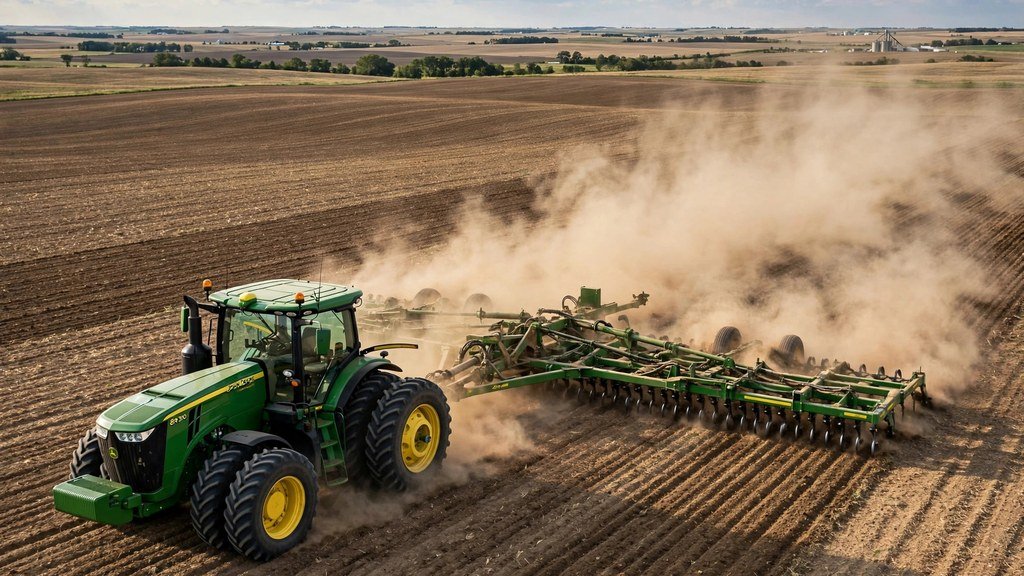
In primary tillage, John Deere 7R Series performance is defined by torque, not the headline horsepower. The 7R 210 makes 725 lb-ft at 1,600 rpm, the 7R 290 makes 1,002 lb-ft, and the 7R 330 makes 1,139 lb-ft — all with the 40 percent torque rise that lets the engine pull down and keep digging instead of forcing a downshift. Intelligent Power Management adds up to 30 hp in transport and mobile PTO applications, so the tractor effectively grows when the job demands it.
The implement interface is sized for big tools: Category 3/3N rear hitch lifting 12,000 lb (Cat 3) and 15,200 lb (Cat 3N), closed-center PFC hydraulics at 43 gpm standard and 59 gpm optional, four rear SCVs standard (up to six), and 35 gpm at a single rear SCV. That flow runs large planters, air seeders with hydraulic fans, and big folding implements without the pump running dry. In hay and forage work the 6.8L models are the sweet spot — a 7R 230 or 250 handles a large square baler, a 15-foot batwing and a merger with 189–205 PTO hp and the same torque rise keeping the driveline happy in thick windrows.
Drawbar Pull, Hauling and High-Load Performance
The drawbar is where John Deere 7R Series performance shows Deere’s big-tractor experience. The standard Category 3 drawbar (Category 4 heavy-duty option on larger models) transfers 9.0L torque to implements that overwhelm smaller frames — big chisel plows, 40-foot-plus air seeders, heavy grain carts. Base weights run from about 22,000 lb (e23, TLS) to 25,700 lb in heavy IVT configurations, and with ballast rated up to 145 lb per SAE PTO hp, the 7R converts power into pull instead of wheel slip.
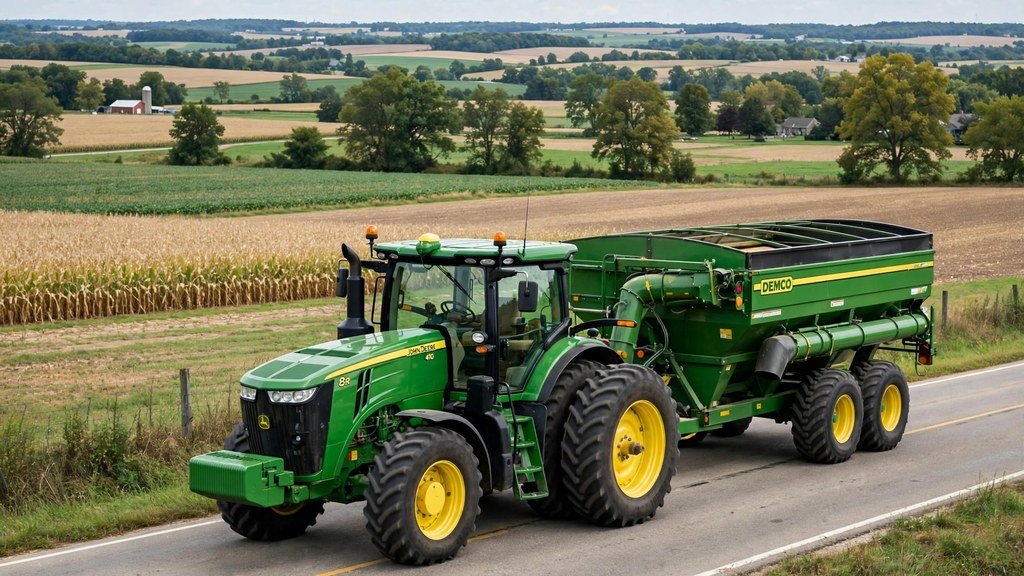
Hauling is the 7R’s quiet strength and a core part of John Deere 7R Series performance on real farms. The 31-mph transmission options, standard front brakes with the 50 km/h package, and the TLS suspended front axle make grain-cart and silage-wagon work fast and stable. Owners upgrading from older 7R or 8000-series tractors consistently report the current 7R feels planted at road speed — the 115.2-inch wheelbase and suspended front axle soak up the pitch that used to punish operators on rough county roads.
John Deere 7R Series Handling, Comfort and Operating Limits
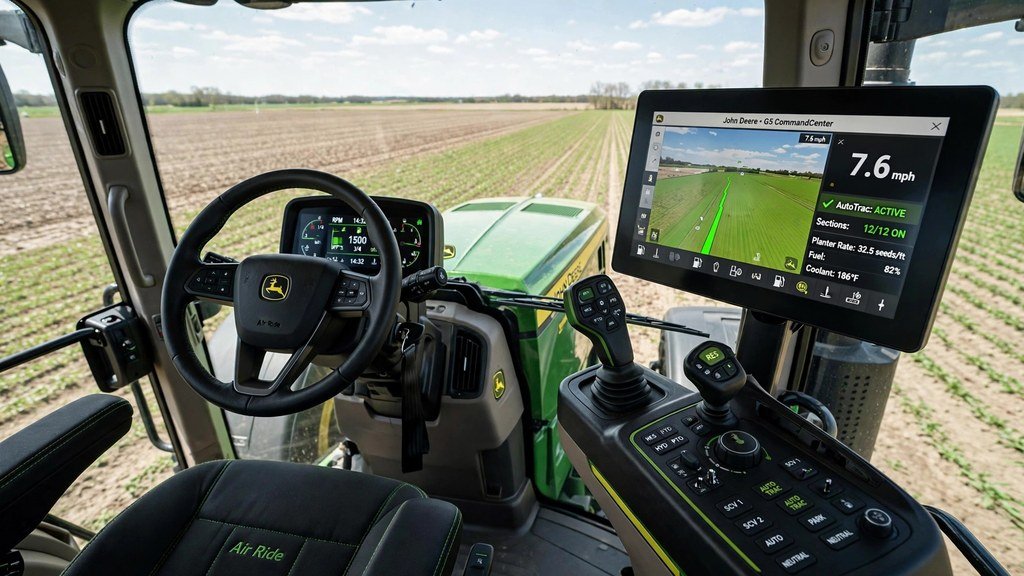
A tractor that runs 14-hour days must be livable, and the 7R’s CommandView cab is among the quietest and best-laid-out in the class — the first thing most owners mention after upgrading. That comfort is part of John Deere 7R Series performance too: a fresh operator at hour twelve makes better decisions than a tired one. Cab suspension is optional, the TLS front axle smooths the ride, and the CommandPRO joystick (IVT models) puts transmission, hydraulics and guidance in one hand. The honest limits: this is a 22,000-plus-pound machine, and its size constrains small fields and tight farmsteads.
Cab Comfort, Controls and Ease of Operation
The CommandView cab offers three visibility packages, a swivel air-ride seat, and the Gen 4 CommandCenter display that owners describe as intuitive once learned, and easy controls are part of daily John Deere 7R Series performance. The e23’s Efficiency Manager is the standout ease-of-use feature on the powershift side: it automatically picks the gear that holds target speed at the lowest efficient engine rpm, so the operator sets a speed and the tractor manages the rest. The sloped hood and high seating position give a clear view to the drawbar, and optional ActiveCommand Steering cuts headland effort. Cab noise stays low enough that most operators run the radio at conversational volume — a small thing that matters enormously by hour twelve.
Traction, Stability, Ballast and Field Conditions
Getting 330 hp to the ground takes setup — traction is where John Deere 7R Series performance either happens or it doesn’t. The MFWD front axle with optional TLS, proper ballasting (roughly 120–145 lb per PTO hp for heavy draft, less for transport), and duals or wide singles up to 710/70R42 on the larger models are what make the rated power usable. Tire pressure management — low for the field, high for the road — is the cheapest performance upgrade available, and it matters more on a 7R than on smaller tractors because the weight involved is so large.
The operating limits are honest. At 218 inches long and over 22,000 lb before ballast, the 7R will not turn inside a small barnyard, and duals need wide gates. In wet conditions even ballasted 7Rs can rut soft ground — timing fieldwork to soil conditions matters more than horsepower. And like every modern diesel, tractors that idle extensively or run long hours at very light load face more frequent DPF regeneration; operators who work the tractor hard rarely see parked regens.
John Deere 7R Series Real-World Owner Experience
Spec sheets sell tractors; owner reports keep them. Across forums, dealer feedback and video reviews, a consistent picture of John Deere 7R Series performance emerges: strong, fuel-efficient power; a cab owners genuinely enjoy; and a short list of recurring complaints about cost and complexity rather than fundamental reliability. This section synthesizes the patterns that repeat across sources — no invented seat time, just what owners report.
Owner-Reported Benefits, Complaints and Trade-Offs
The benefits owners repeat most: fuel economy (the DLG results track with field experience — many report beating their old tractors’ fuel bills on the same acres), pulling power (the torque rise and IPM boost make the tractor feel bigger than its rating), cab comfort on long days, and resale value that leads the segment — covered in our John Deere 7R Series ownership cost and resale guide.
The complaints are equally consistent. Purchase price and option cost top every list — even the 7R 210 costs well above smaller utility tractors like the 6R Series. Complexity is second: DOC, DPF, SCR, EGR, multiple ECUs and precision-ag systems mean some repairs need dealer diagnostics, and support quality varies by area. DPF regeneration draws occasional complaints on lightly worked tractors. And size: several owners admit the 7R is too big for their smaller fields and wish they’d kept a mid-frame tractor like the 6110M for tight work. For service intervals and what breaks, see the 7R Series maintenance and reliability guide.
The video below collects real farmer reviews of the 7R in action — worth watching before you spec one:
Choosing the Right Model and Transmission for Your Work
Model choice comes down to implement sizing — matching the tractor to the implement is the heart of John Deere 7R Series performance. The 7R 210 and 230 (6.8L) suit mixed crop-livestock operations and grain farms running planters and carts — big-tractor comfort without 9.0L fuel bills. The 7R 250 and 270 are the row-crop workhorses: enough power for most tillage and planting trains with better economy than the 9.0L models. The 7R 290, 310 and 330 (9.0L) are for heavy tillage, big air seeders and large grain carts — if your implement list includes 40-foot-plus tools, start here.
Transmission choice is simpler than it looks, and both transmissions deliver the full John Deere 7R Series performance envelope — the choice is about your work mix, not about power. Pick the e23 PowerShift for steady, full-load draft work, operators who prefer mechanical transmissions, or a lower purchase price. Pick the IVT for mixed work with frequent speed changes, grain-cart cycles, and PTO work at varying ground speeds. Both come at 26 or 31 mph — the 31-mph option pays for itself on farms with long transport legs. Either way, spec the 85 cc / 59 gpm hydraulic pump if you run hydraulic-fan planters: the standard 43 gpm pump is adequate, but the big pump future-proofs the tractor.
Frequently Asked Questions About John Deere 7R Series Performance
Quick answers to the questions buyers and operators ask most about John Deere 7R Series performance in the field, at the pump and on the road.
How much fuel does a John Deere 7R use per hour?
The independent DLG PowerMix test measured the 7R 330 at 375 g/kWh diesel plus 17 g/kWh DEF — the best result ever above 250 hp, and the benchmark for John Deere 7R Series performance. In owner-reported terms: roughly 5–7 gph on light PTO work and transport, 7–10 gph on tillage and planting, and 10–14 gph on heavy draft with the 9.0L models. The 6.8L models generally run 1–2 gph under those figures. Treat owner-reported figures as planning ranges, not guarantees.
Does the John Deere 7R use DEF?
Yes. John Deere 7R Series performance is built on a Final Tier 4 package with DOC, DPF and SCR aftertreatment, and every model carries a 6.9-gallon DEF tank. DEF consumption runs about 4–5 percent of diesel use, so a DEF tank lasts far longer than a fuel tank.
What is the fuel tank size and runtime of a 7R?
E23 models carry 122 gallons; IVT models carry 135 gallons. At a blended 8 gph, that is roughly 15 to 17 hours of runtime — all-day-plus capability that is a genuine John Deere 7R Series performance advantage on big operations.
Which 7R transmission is better, e23 or IVT?
Neither transmission is universally better for John Deere 7R Series performance. The e23 PowerShift (23 forward gears at 15 percent spacing, Efficiency Manager) costs less and excels at steady, full-load draft work. The IVT suits mixed work with frequent speed changes and is simpler to operate. Both come at 26 or 31 mph. Full 7R 330 specifications confirm the shared platform details.
What is Intelligent Power Management (IPM) on the 7R?
IPM — Intelligent Power Management — is a signature John Deere 7R Series performance feature: an electronic power boost of up to 30 hp in transport and mobile PTO applications — pulling a loaded grain cart up a grade, or running a PTO implement at transport speed — without the fuel penalty of a permanently larger engine. Maximum power with IPM reaches 363 hp on the 7R 330.
Can a 7R handle a large square baler or a 40-foot air seeder?
Yes — matching model to implement is exactly what John Deere 7R Series performance is about. A 7R 230 or 250 handles a large square baler and most hay tools comfortably. A 40-foot air seeder wants the 9.0L models — 7R 290 and up — with the 59 gpm hydraulic pump and proper ballast. Always size the tractor to the implement’s published power requirements.