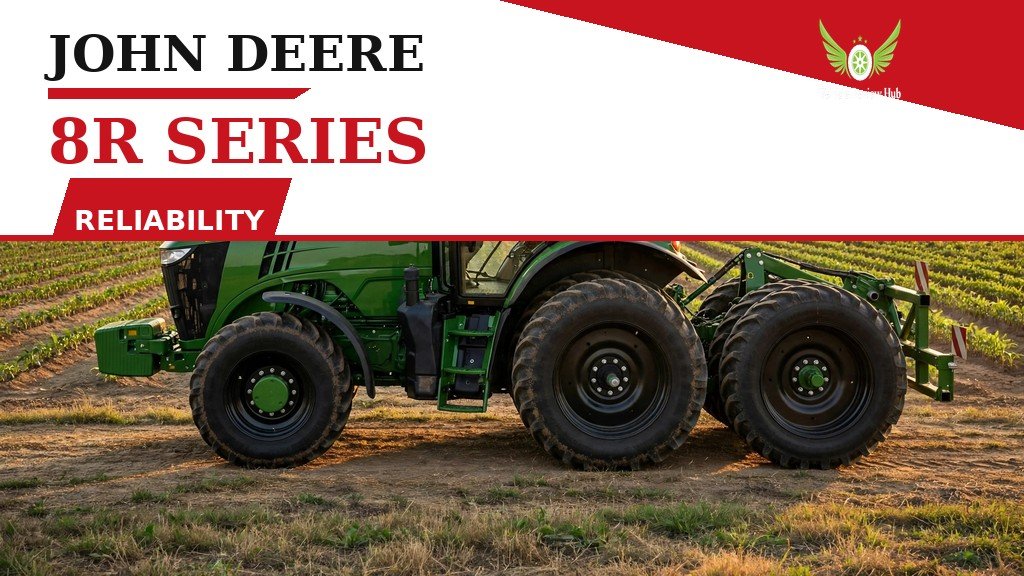
Keeping a John Deere 8R Series tractor in top working order comes down to one discipline: respect the John Deere 8R Series maintenance schedule. Engine oil and fuel filters every 500 hours, transmission and hydraulic filters at 750 hours, transmission-hydraulic oil at 1,500 hours, and coolant at 6,000 hours or six years. That schedule is the difference between a 230- to 410-horsepower row-crop tractor that runs 8,000 hours on routine work and one that stacks repair bills.
This John Deere 8R Series maintenance guide walks through the complete service schedule and what each job costs, how reliable the 8R really is over the long haul, the common problems owners report with the warning signs to watch for, and how to inspect a used 8R before you buy. Every figure below is sourced from Deere documentation, dealer listings, or owner reports.
John Deere 8R Series Maintenance Schedule and Service Costs
The 8R Series carries one of the most generous service schedules in the row-crop world. Engine oil and filter changes stretch to 500 hours with Plus-50 II oil and genuine filters, transmission-hydraulic oil runs 1,500 hours, and coolant is good for 6,000 hours or six years. The John Deere 8R Series maintenance intervals below come from the Deere operator manual — the backbone of any John Deere 8R Series maintenance plan.
Engine Oil, Fuel Filters, Cooling System and Routine Service
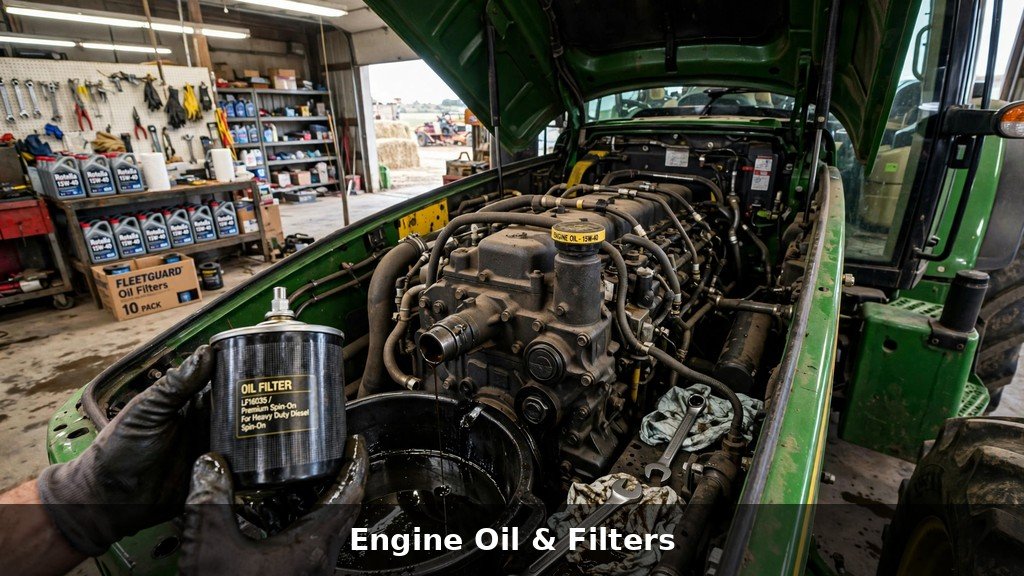
The engine service rhythm in John Deere 8R Series maintenance is the same on every 8R, from the 8R 230 to the 8R 410. Change engine oil and filter every 500 hours or annually with sub-15-ppm-sulfur diesel, Plus-50 II oil, and a genuine Deere filter — 250 hours if any condition is not met. The crankcase holds 6.8 to 7.3 gallons; the two-stage fuel filters (primary and secondary, with water separator and service indicator) go at the same 500-hour point. Drain the water separator every 50 hours — cheap insurance that John Deere 8R Series maintenance routines too often skip.
Cooling runs COOL-GARD II pre-mix, serviced every 6,000 hours or six years with an annual freeze-point check. Clean the primary air-cleaner element as the dust indicator demands; replace the secondary safety element on schedule. Keep radiator screens and oil cooler fins clean — clogged stacks are a top cause of high-temperature derates in dusty tillage, per owner reports on TractorByNet.
One aftertreatment note shapes every John Deere 8R Series maintenance budget: the 9.0-liter PowerTech runs DOC, DPF, and SCR with a 9.8-gallon DEF tank. Regeneration is automatic and mostly invisible during field work; if a cycle is interrupted, the CommandCenter requests a parked cleaning. Always let parked cleaning finish — repeated aborts plug the DPF. DPF ash service is a long-horizon, dealer-level job; the operator manual gives the interval, well past 4,000 hours.
The video below shows a real 8R 280 oil and filter change in progress — a perfect visual for the 500-hour John Deere 8R Series maintenance service:
DIY cost for the 500-hour service runs roughly $400 to $600 in genuine parts and Plus-50 II. A dealer typically charges $1,200 to $2,000 depending on labor rates and whether they add a full inspection, per published dealer service menus. At typical row-crop usage, budget one 500-hour service per year — the John Deere 8R Series maintenance cost baseline.
Transmission, Hydraulic Oil, Axles and Lubrication
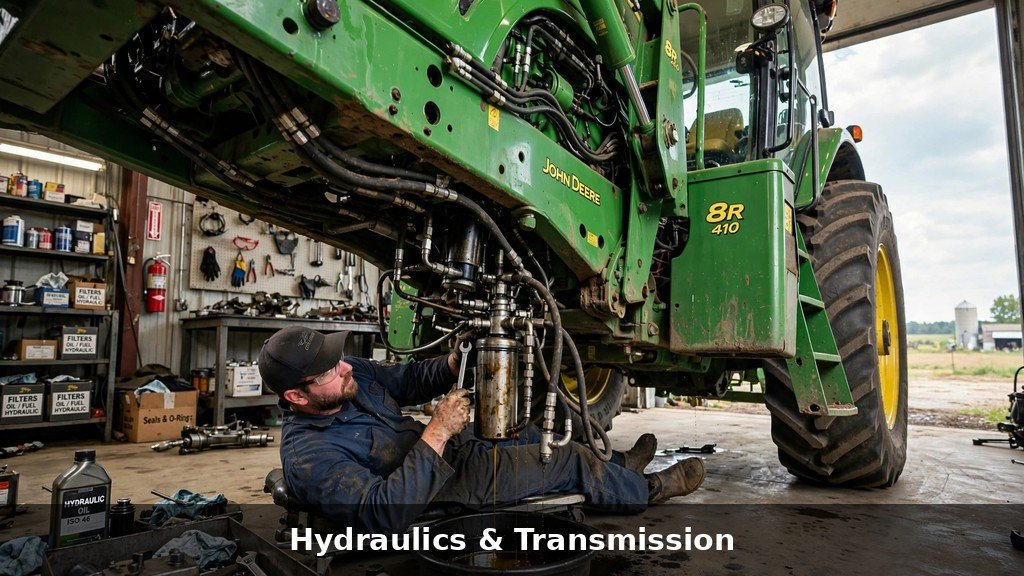
Transmission and hydraulic filter elements are replaced every 750 hours; the transmission-hydraulic oil itself is changed every 1,500 hours or two years. The system holds 47.7 to 54.7 gallons depending on axle configuration, making this the most expensive scheduled service — plan for it. The MFWD front axle and final drives get fresh oil at the same 1,500-hour point.
Grease points — hitch, drawbar, PTO stub shaft, rear axle bearings, steering spindles — follow the John Deere 8R Series maintenance grease chart, typically at 50-hour intervals on high-use points. The closed-center PFC hydraulics run 60 gpm standard or 84 gpm with the optional dual pump, feeding up to six rear SCVs. Keeping filters on schedule protects that investment.
| Service item | Interval | Notes |
|---|---|---|
| Engine oil + filter | 500 hrs / annually | Plus-50 II + genuine filter; 250 hrs if conditions not met |
| Fuel filters (primary + secondary) | 500 hrs | Water separator drained every 50 hrs |
| Air filter elements | As needed / scheduled | Clean primary as indicator demands; replace secondary on schedule |
| Transmission/hydraulic filters | 750 hrs | Filter elements only |
| Transmission/hydraulic oil | 1,500 hrs / 2 years | 47.7–54.7 gal depending on axle configuration |
| MFWD front axle + final drives | 1,500 hrs | Same interval as trans-hyd oil |
| Engine coolant | 6,000 hrs / 6 years | COOL-GARD II; check freeze point annually |
| DPF ash service: long-horizon, dealer-level — see the operator manual for the exact interval on your model year | ||
John Deere 8R Series Reliability and Long-Term Durability
The 8R Series has one of the strongest long-term reputations in the high-horsepower segment, and it is earned: the wet-sleeve PowerTech 9.0-liter is built for rebuildability, the e23 and 16-speed transmissions are proven Deere hardware, and the CommandView electronics have had generations to mature. But Tier 4 emissions hardware means reliability now depends as much on John Deere 8R Series maintenance discipline as on iron.
Engine, Transmission and Hydraulic System Reliability
The PowerTech 9.0-liter six-cylinder (PVS on smaller 8Rs, PSS on larger ones) is a wet-sleeve engine: liners can be replaced without boring the block, the durability detail that matters at 7,000-plus hours. Rated speed is 2,100 rpm, peak torque at 1,600 rpm, 40% PTO torque rise, 10% PTO power bulge. Dual turbochargers in series plus cooled EGR and common-rail injection are proven in Deere service. Owners on TractorByNet report 9.0L engines past 8,000 hours before in-frame work.
The e23 PowerShift (40K/50K with Efficiency Manager) is a straightforward full-powershift unit with a long history; the 16-speed PowerShift on older 8R generations is equally proven. The AutoPowr IVT is hydro-mechanical — comfortable and efficient, but its hydraulics reward strict 750-hour filter service. The closed-center PFC hydraulic system is robust when filters stay on schedule, and the Cat 4N/3 rear hitch (15,000 lb standard, 20,000 lb heavy-lift) shows little wear drama.
Warranty context: John Deere’s agricultural warranty statement covers tractors for 24 months or 2,000 hours, whichever comes first. The 60-month/2,000-hour powertrain extension applies only to the 5E Series — do not assume it on an 8R. PowerGard extended plans are a paid option worth pricing as part of your John Deere 8R Series maintenance planning, and our John Deere 8R Series ownership cost guide covers what warranty and extended coverage mean for total cost.
Factors Affecting Service Life, Downtime and Repair Costs
Three factors dominate 8R service life: hours per year, John Deere 8R Series maintenance discipline, and emissions-system care. A 500-hour-per-year row-crop machine serviced on time will reach 8,000 hours far more gracefully than a 1,200-hour-per-year custom operation stretching oil changes. Downtime is the hidden cost driver — a machine in this class sitting during planting season costs far more than the service it skipped.
Emissions-system care is the new discipline in John Deere 8R Series maintenance. Use only certified DEF, keep the 9.8-gallon tank topped, and let parked regeneration complete. Machines that idle extensively or work only in light loads generate most DPF complaints in owner forums; the 8R regenerates passively during normal heavy work. For storage, park on a battery maintainer, treat fuel for storage, and keep DEF within shelf life — stale DEF is a top cause of SCR fault codes. These points mirror our John Deere 7R Series maintenance guide, and the emissions architecture is the same family.
John Deere 8R Series Common Problems and Warning Signs
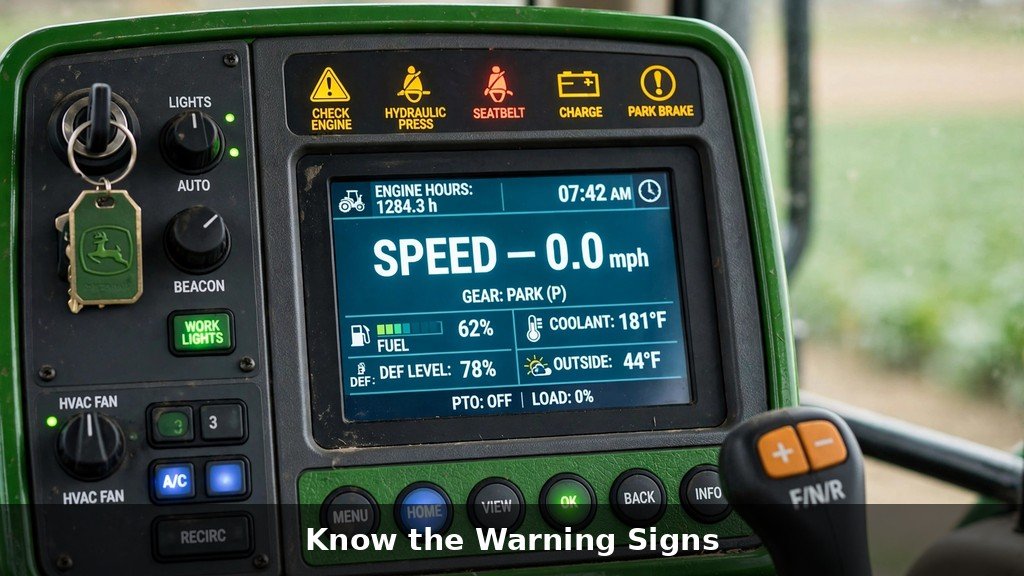
No tractor this complex is trouble-free, and the 8R’s problem list is dominated by emissions hardware and electronics rather than iron. What follows comes from owner reports and dealer technicians — real patterns shaping John Deere 8R Series maintenance decisions.
Engine, Electrical, Hydraulic and Transmission Symptoms
DEF and SCR faults. The most reported complaint cluster in John Deere 8R Series maintenance discussions. Symptoms: derate warnings, exhaust-filter fault codes, parked-regen requests that will not complete. Usual culprits: stale or contaminated DEF, a failed DEF injector or NOx sensor, short-cycling work that blocks passive regen. A NOx sensor is a few hundred dollars; a failed SCR catalyst is a dealer-level four-figure job.
DPF regen interruptions. Operators who shut down during active regen repeatedly eventually face a plugged DPF needing dealer service. The CommandCenter gives clear warnings — heed them. In John Deere 8R Series maintenance terms, repeated regen requests on a hard-working machine usually point to a sensor or injector fault, not the DPF itself.
Electrical and software glitches. Generation 4 CommandCenter displays, JDLink telematics, and the control units (BCU, ECU, transmission controller) generate the usual modern-electronics issues: intermittent codes, display freezes, failed sensors. Most are fixed with software updates, not hardware — one reason checking software currency belongs in every John Deere 8R Series maintenance inspection of a used 8R.
Hydraulic leaks and SCV issues. High-pressure hydraulics leak at fittings and SCV couplers on high-hour machines: slow implement response, visible oil at couplers, topping up the 47-plus-gallon reservoir. The 84-gpm dual-pump system works hoses harder than the standard 60-gpm unit. The John Deere 8R Series maintenance manual calls for annual hose inspection.
Turbo, EGR, and transmission wear. At high hours, the variable-geometry turbo and EGR cooler are wear items on the 9.0L: lost boost, black smoke under load, EGR fault codes. On the e23, hard or delayed shifts and Efficiency Manager faults usually mean sensor or solenoid issues; on the IVT, creep or shudder at low speed points to calibration or skipped filter service. None are common on well-maintained machines — they are high-hour problems that disciplined John Deere 8R Series maintenance prevents.
Diagnosing Faults and Evaluating Repair Needs
The 8R’s electronics are both the problem and the solution: the CommandCenter stores diagnostic trouble codes for every system, and reading them is the first step. A cheap fix can look identical to a scary one on the dashboard — the difference is usually a technician with Service ADVISOR software and an hour of diagnosis. Reference specs: MachineryLink’s 8R 230 page and Greenway’s 8R 250 listing.
For buyers, the hierarchy of concern: emissions system (expensive, dealer-only), transmission (expensive, dealer-only), hydraulics (moderate, often field-serviceable), electrical (usually software or sensors), engine hard parts (rare on the wet-sleeve 9.0L before high hours). A used 8R showing active derates on a test drive should be priced with a dealer emissions diagnosis — or walked away from. The next section’s John Deere 8R Series maintenance checklist covers the in-person inspection.
John Deere 8R Series Safety Checks and Used-Tractor Inspection
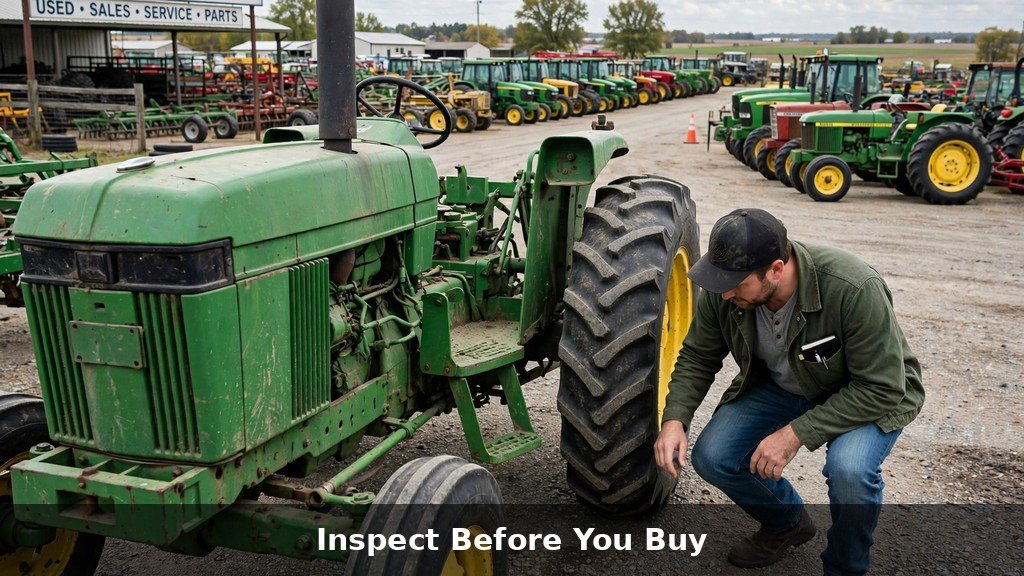
An 8R is a $150,000 to $400,000 purchase on the used market, so the inspection has to match the stakes. This John Deere 8R Series maintenance checklist covers the points that separate a well-kept machine from one about to hand you its deferred maintenance.
Checking Service History, Software Updates and Applicable Recalls
Start with paperwork. A used 8R should come with service records, or a dealer JDLink printout if it was on a connected plan. Verify the 500-hour John Deere 8R Series maintenance oil services, the 750-hour trans-hyd filter changes, and the 1,500-hour oil changes happened on schedule. Check the CommandCenter software version against current releases; a machine several generations behind will show its age in glitches.
On recalls: we could not verify any CPSC recall specifically covering the 8R Series — some sources report brake and safety campaigns on Deere tractors, but without a verifiable release we treat those as reported rather than confirmed. The September 2024 CPSC brake recall covered only the compact 1023E, 1025R, and 2025R. Run the serial number through Deere’s recall lookup and call 800-537-8233 before buying.
Inspecting Brakes, Tires, Hydraulics and Transmission Operation
Brakes: stop from road speed — pedal travel should be firm and even, with no pull. A pedal that fades under sustained pressure is a red flag. Tires: a full set of row-crop rubber runs into five figures, so check tread depth, sidewall damage, and rim leaks; match ballast to the manual’s tables.
Hydraulics: cycle every SCV with an implement attached, watching for chatter and leaks at couplers. Check trans-hyd oil level and condition — milky oil means water, burnt-smelling oil means overheating. Inspect hoses for cracking, especially the dual-pump plumbing on 84-gpm machines. Transmission: run the e23 through gears under light load for hard shifts or flaring; on the IVT, check smooth speed changes with no neutral creep. Test the 1,000-rpm PTO under load if possible — engagement should be smooth; rated PTO output runs 182 to 310 hp across the range.
Finally, run the machine through a full cycle: cold start, work under load, shutdown. Watch the stack for smoke — brief black haze under sudden load is normal, sustained blue or white is not — and confirm no active derates on the CommandCenter. That hour of John Deere 8R Series maintenance inspection tells you more than any spec sheet. Our John Deere 8R Series performance guide describes normal 8R operation.
Frequently Asked Questions About John Deere 8R Series Maintenance
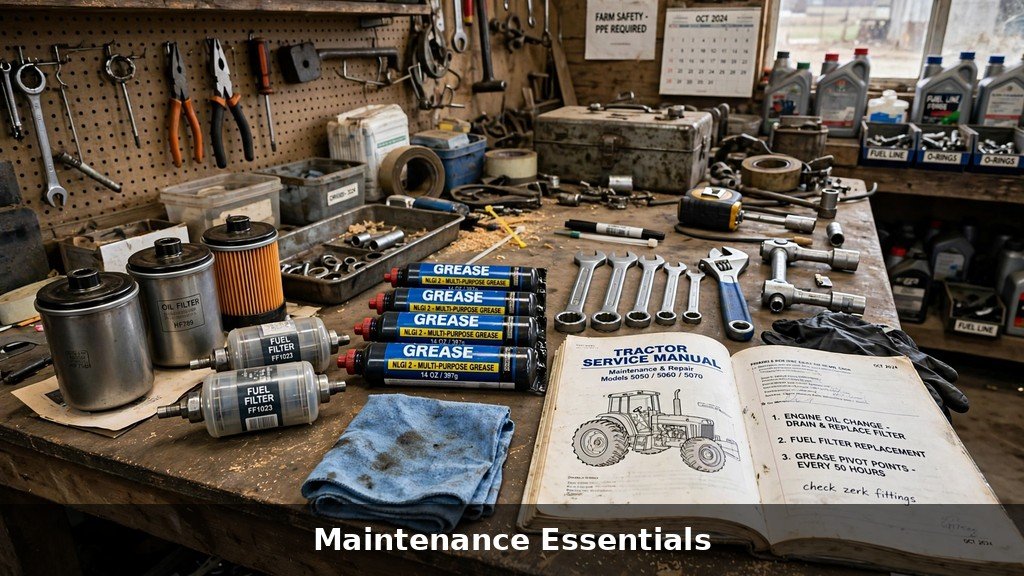
The questions below cover what 8R owners and buyers ask most about John Deere 8R Series maintenance. Each answer reflects Deere documentation or documented owner experience.
How often does a John Deere 8R need an oil change?
Every 500 hours or annually with Plus-50 II oil, a genuine filter, and sub-15-ppm-sulfur diesel — 250 hours if any condition is not met. The crankcase holds 6.8 to 7.3 gallons, and fuel filters go at the same 500-hour John Deere 8R Series maintenance service.
Does the John Deere 8R need DPF regeneration?
Yes. Every US Final Tier 4 8R runs DOC plus DPF plus SCR with DEF — there is no non-DPF 8R. Regeneration is automatic during normal work. If the CommandCenter requests a parked cleaning, always let it finish. Ash service is a dealer-level job landing well past 4,000 hours; the operator manual gives the interval.
What is the most common problem on a John Deere 8R?
Owner reports point to the DEF/SCR system — stale or contaminated DEF, failed NOx sensors, interrupted regens — as the top complaint cluster in John Deere 8R Series maintenance discussions, followed by electrical and software glitches usually fixed with updates. The 9.0-liter block and e23 transmission have strong long-term records; expensive failures are almost always emissions or electronics on neglected machines.
What does the 1,500-hour service on an 8R cost?
The 1,500-hour John Deere 8R Series maintenance service changes 47.7 to 54.7 gallons of transmission-hydraulic oil plus filters and the MFWD front axle oil. Parts alone run into the high hundreds of dollars; dealer pricing typically lands between $2,000 and $3,500. It is the most expensive scheduled service on the machine — budget for it.
Are there any recalls on the John Deere 8R Series?
We could not verify any CPSC recall specifically covering the 8R Series in original CPSC records. The September 2024 brake recall covered only the compact 1023E, 1025R, and 2025R — not row-crop tractors. Run any used 8R’s serial number through Deere’s recall lookup or call 800-537-8233 before buying.
How long will a John Deere 8R last?
With the schedule followed — 500-hour oil services, 750-hour trans-hyd filters, 1,500-hour oil changes, disciplined DEF and emissions care — owners routinely report 8,000-plus hours on the wet-sleeve 9.0-liter before major work, and many go further. The machines that die young are the ones that skipped services or ignored emissions warnings. That John Deere 8R Series maintenance record is what makes a documented used 8R worth a premium.