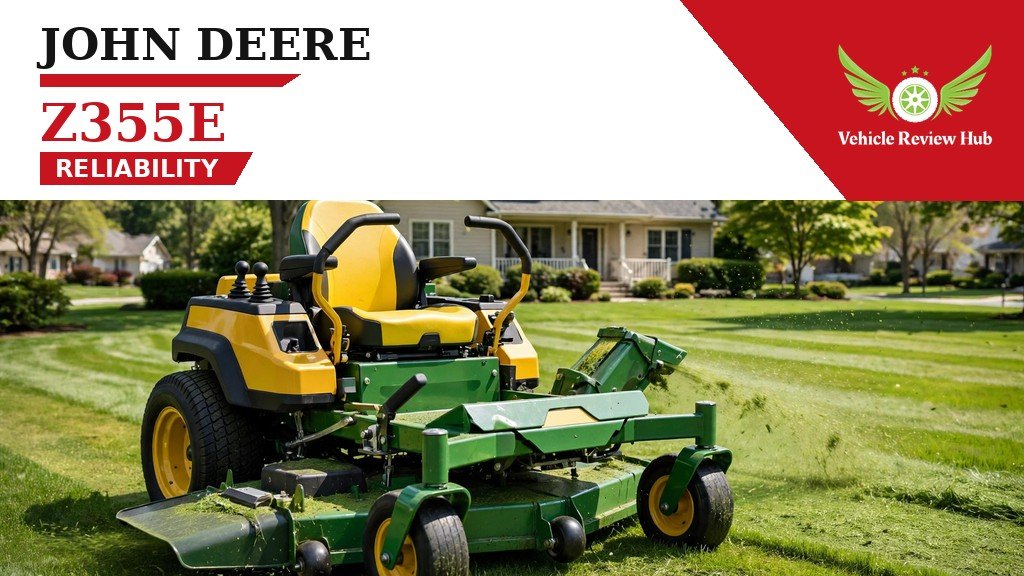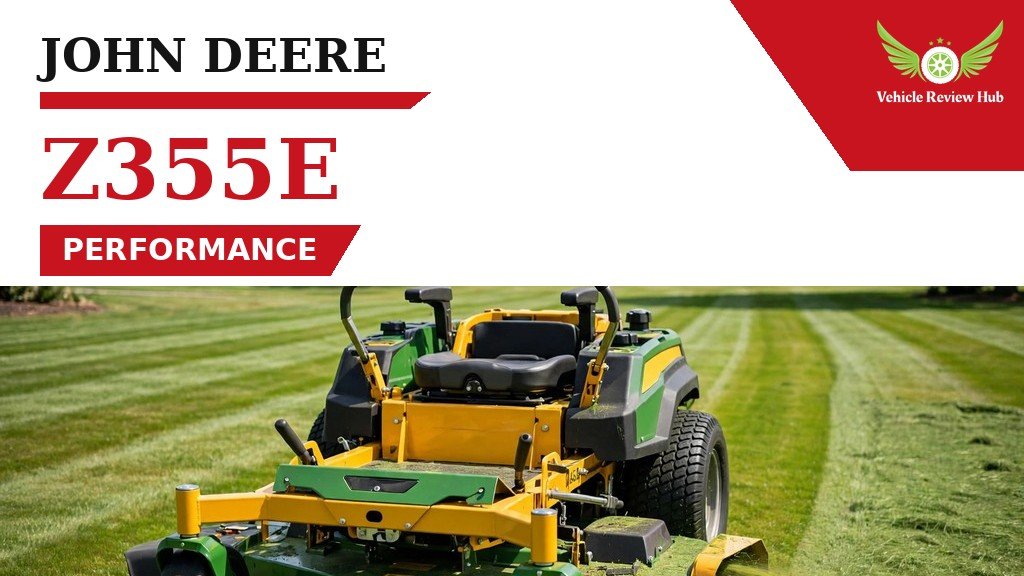
The short answer on John Deere Z355E performance is simple: a fast, nimble residential zero-turn cutting a 48-inch path at up to 7 mph, finishing a 2-acre lawn in well under half the time of a lawn tractor. The trade-offs are just as clear: a small 2.1-gallon tank means refueling on bigger properties, a firm ride on rough ground, and steep or wet slopes off-limits. This guide to John Deere Z355E performance covers cut quality, mowing speed, fuel use and runtime, handling, comfort, and the slope and traction limits that matter before you buy.
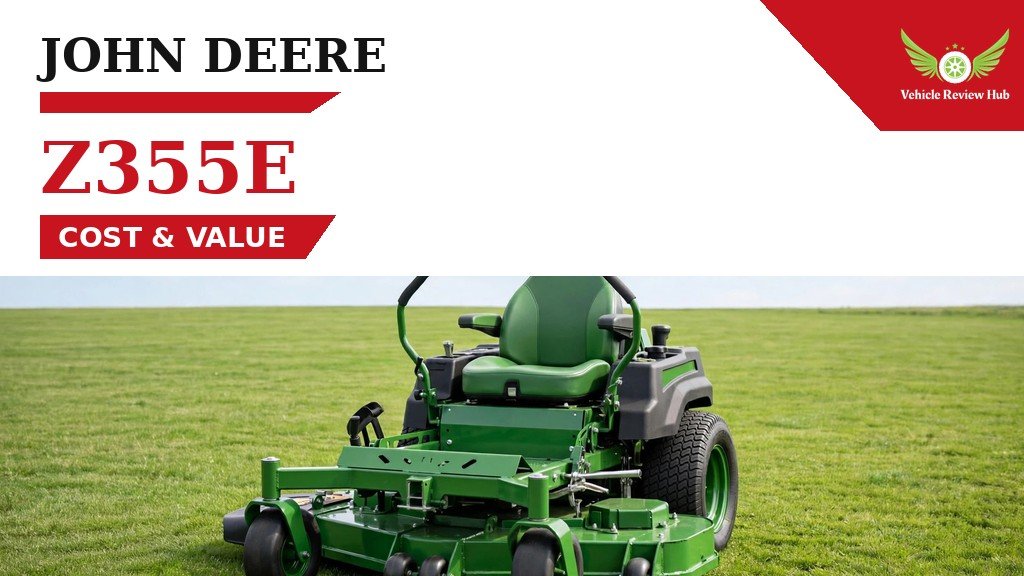
One framing note for this John Deere Z355E performance guide: the Z355E is a residential machine from Deere’s earlier Z300 generation, not a commercial mower and not a lawn tractor. Its 22-hp Briggs & Stratton V-twin, 48-inch Accel Deep deck, and dual Hydro-Gear EZT transaxles are sized for estate lawns of roughly 1 to 3 acres. Everything below measures John Deere Z355E performance against that job, not against commercial zero-turns that cost twice as much.
John Deere Z355E Mowing Performance and Cutting Quality
The headline of John Deere Z355E performance is speed with a clean finish: a wide deck, strong blade speed from the V-twin, and true zero-turn steering that removes the three-point turns a lawn tractor needs around trees and beds.
48-Inch Deck, Grass Discharge and Lawn-Finish Quality
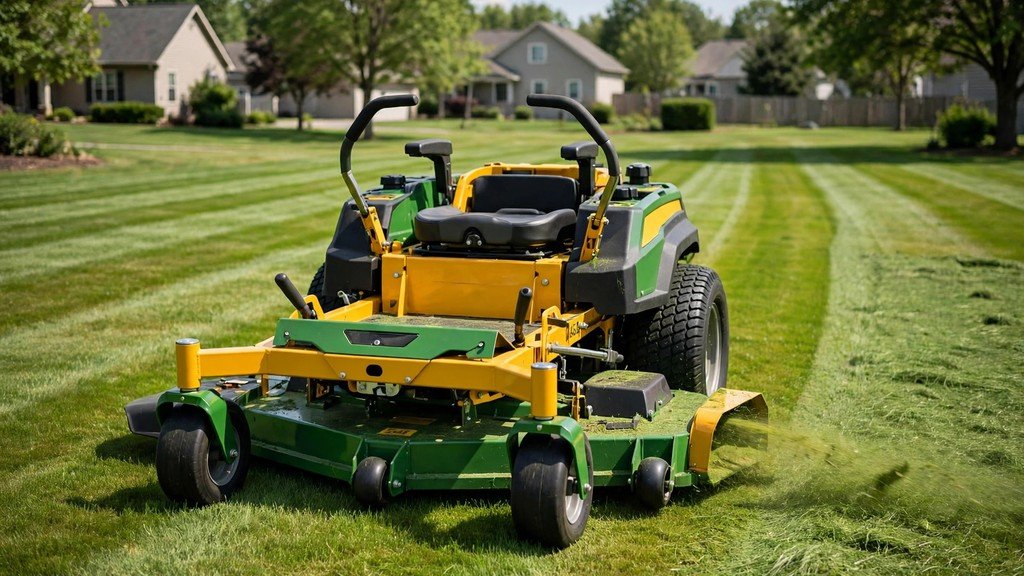
The 48-inch Accel Deep deck is the heart of John Deere Z355E performance. Its deep shell lifts grass upright before the three blades cut it, giving a level finish on weekly mowing at normal height. The deck cuts from 1 to 4 inches in quarter-inch steps for an exact height setting, and the wash port makes underside cleaning a hose job instead of a scrape job.
Discharge is to the right through a side chute, and planning your mowing pattern around it is part of getting good John Deere Z355E performance. Mow so clippings blow onto already-cut grass rather than driveways and beds, and overlap each pass slightly so the deck edge never leaves a strip. On weekly cuts where you remove only the top third of the blade, the finish is genuinely good for a residential mower. Where John Deere Z355E performance drops off is tall, wet, or overgrown grass: the deck can clump clippings and bog the engine at full speed and full width. The fix is standard: raise the deck, slow down, take a narrower pass, and make a second pass if needed.
The deck is mulch-capable with Deere’s optional MulchControl kit, which blocks the discharge opening and fits mulching blades. That matters because, on this model, bagging is not the fallback: dealer documentation notes that a rear bagger is not available for the Z355E, Z355R, or Z365R, and Consumer Reports likewise lists the model as not capable of bagging. So your clipping choices are side discharge or mulching, and John Deere Z355E performance is best judged on those two modes. For most suburban lawns, side discharge on a regular schedule is the practical answer, and mulching suits owners who mow weekly and want clippings returned to the turf.
Mowing Speed, Turning and Cutting Around Obstacles
Top travel speed is 7.0 mph forward and 3.5 mph in reverse, and that speed is where John Deere Z355E performance pulls away from lawn tractors, which typically top out around 5 to 5.5 mph. In theory, a 48-inch deck at 7 mph covers about 3.4 acres per hour, but nobody mows at full speed with full-width passes around trees, beds, and fences. A realistic pace of 5 to 6 mph with normal overlap puts real-world John Deere Z355E performance at roughly 2 to 2.5 acres per hour on open ground, less among obstacles. Even so, a 2-acre property is roughly an hour of seat time, a 1-acre lawn closer to half an hour.
Zero-turn steering is the other half of John Deere Z355E performance. Twin lap bars drive the left and right wheels independently through the Hydro-Gear EZT transaxles, so the mower pivots in place with a zero-inch turning radius. Around trees, mailboxes, play equipment, and garden beds, that means trimming time drops sharply compared with a lawn tractor, and you can cut close on the left (trim) side of the deck. New owners should expect a learning curve of a few mows: the bars are sensitive, and jerky inputs scalp turf. Smooth, small lever movements and slower turns at first are the fastest way to good John Deere Z355E performance, and the tracking adjustment corrects any drift at full stick.
The video below is a grass-cut test of the Z355E, showing the 48-inch deck cutting in real lawn conditions:
John Deere Z355E Fuel Usage and Runtime
Fuel is the weakest part of John Deere Z355E performance, and it comes down to one number: the tank holds just 2.1 gallons. A small tank means planning refuels into any mow over about 2 acres, and this section separates Deere-published facts from owner-reported estimates, because Deere publishes no gallons-per-hour rating.
Fuel Use During Routine Lawn Mowing
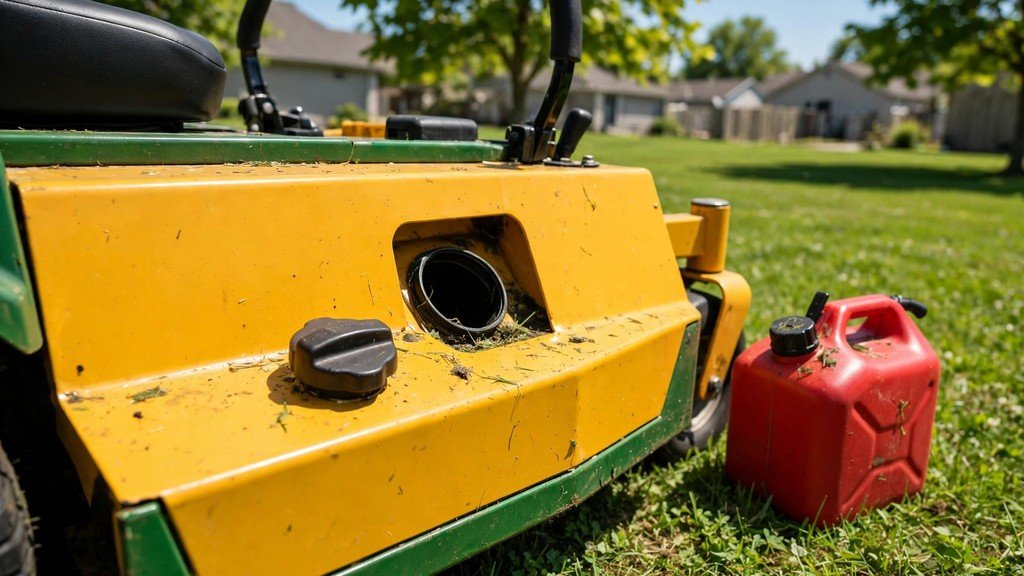
Deere’s published figures for John Deere Z355E performance cover tank size, not burn rate: 2.1 U.S. gallons of gasoline, with a low-fuel warning light on the dash so you are not caught by surprise, as shown on Deere’s Z355E sales sheet. For burn rate, the honest numbers are owner-reported planning estimates, not factory ratings. Owners of this 22-hp V-twin and its close sibling models generally report roughly 1.0 to 1.5 gallons per hour in routine mowing, with about 1.2 gallons per hour a reasonable mid-point for normal weekly grass. Treat that range as a planning estimate, not a Deere specification.
At those rates, the runtime math for John Deere Z355E performance is straightforward: a full 2.1-gallon tank lasts roughly 1.5 to 2 hours, covering roughly 2 to 3 acres per tank on open ground. A 1-acre lawn is comfortably one tank with fuel to spare, but a 3-acre property will usually need a top-up, so keep a fuel can at the shed. The practical habit is simple: start every mow with a full tank of fresh fuel, since stale fuel is a common cause of rough running on seasonal machines.
| Mowing situation | Planning burn rate | Runtime per 2.1-gal tank | Acres per tank (approx.) |
|---|---|---|---|
| Weekly cut, normal grass | ~1.0–1.2 gal/hr | ~1.75–2 hours | ~2–3 acres |
| Tall or thick grass, full deck load | ~1.3–1.5 gal/hr | ~1.4–1.6 hours | ~1.5–2 acres |
| Light trimming, partial throttle | ~0.9–1.1 gal/hr | ~1.9–2.3 hours | ~2–3 acres |
| Planning rule | Deere publishes no gal/hr rating | Refuel before the light comes on | Start every mow full |
How Grass Height, Deck Load and Terrain Affect Fuel Consumption
Three things move John Deere Z355E performance at the fuel pump most: grass height, ground speed, and terrain. Tall grass forces the engine and deck to work harder, so burn rate climbs and mowing speed has to drop. Wet grass is worse: it clumps under the deck, adds load, and tempts you to re-cut, burning more fuel for the same lawn. Mowing weekly at the right height is the cheapest fuel-saving habit on this mower, and it keeps John Deere Z355E performance at its best for cut quality.
Terrain matters too. Flat, open ground gives the best fuel numbers, while rolling ground, frequent turns, and stop-start trimming all raise consumption, since every acceleration from a turn costs fuel. Slopes add load as well, and they cost speed for safety reasons covered below. The takeaway for John Deere Z355E performance is to budget fuel by the worst part of your lawn, not the best: if half your property is thick, tall, or hilly, plan on the higher burn rate and a mid-mow refuel.
John Deere Z355E Handling, Comfort and Terrain Limits
Handling is where a zero-turn either wins you over or wears you out, and John Deere Z355E performance splits the difference: superb maneuverability and a comfortable seat, but a firm ride and real slope limits you must respect.
Zero-Turn Maneuverability, Steering Levers and Operator Comfort
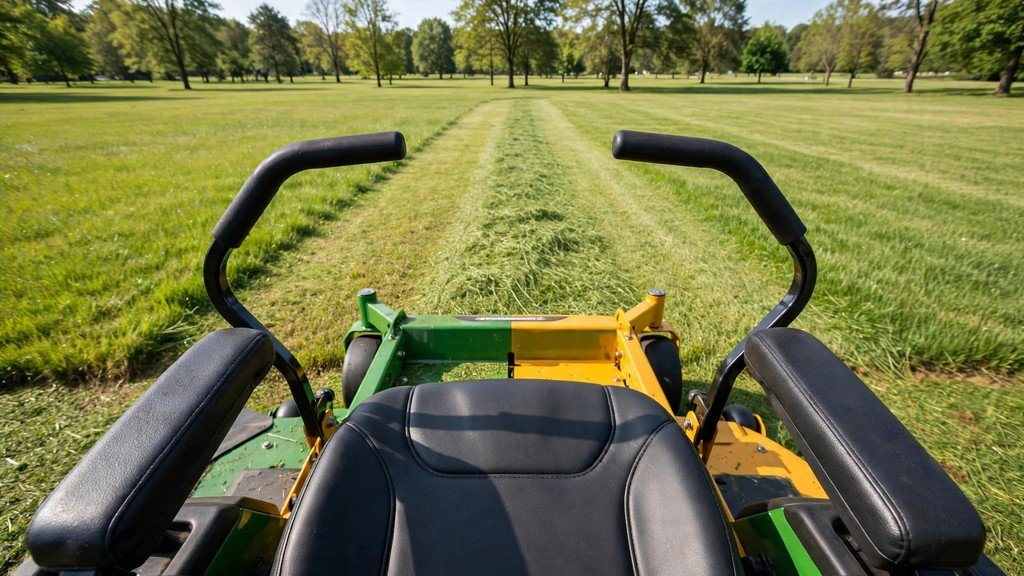
The twin-stick controls define John Deere Z355E performance. Push both bars forward to go straight, pull one back to turn, and push one forward while pulling the other back to pivot in place. The levers adjust to the operator, and a shock absorber damps lever movement for smooth inputs. Compared with a lawn tractor’s steering wheel and pedals, the learning curve is real but short, and most owners find the controls second nature within a few mows. The flip-up foot platform opens service access without tools, a small detail that makes routine care easier.
Comfort on the Z355E is good for its class but honestly basic. The 15-inch medium-back seat has spring suspension and adjustable armrests with about 3 inches of fore-aft travel, plus a cup holder and a covered storage compartment, a comfortable perch for an hour on smooth ground. What the Z355E lacks is any suspension beyond those seat springs, so rough ground transmits straight through the frame and long sessions on uneven turf will tire you out. The sibling Z355R answers that complaint partly with an 18-inch high-back seat, tool-free seat adjustment, and floor mats, while sharing the same engine, deck, and transaxles, as the Z300 series lineup comparison confirms, so buyers who prioritize comfort should compare the two. For John Deere Z355E performance as a whole, comfort is a strength on smooth lawns and a limitation on rough ones.
Slopes, Wet Grass and Traction Limitations
Slope limits are the most important safety numbers in this John Deere Z355E performance guide. Deere’s ZTrak manual guidance puts rollover risk as low on slopes of 10 degrees or less, rising as the angle increases, and states plainly: never operate above 15 degrees. That 15-degree ceiling is the hard line for John Deere Z355E performance, and wet grass, loose soil, or attachments shrink the safe margin further. Measure any slope you are unsure about before mowing it, and if you feel uneasy on a hillside, do not mow it.
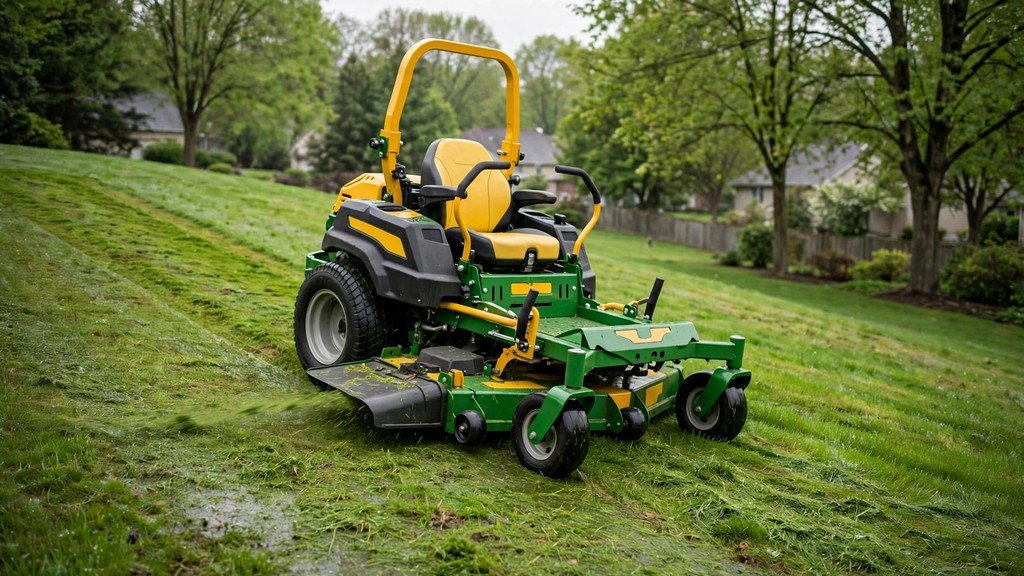
Traction is the related limit. The Z355E drives through two rear turf tires (20×9.0-10) with front caster wheels (13×5.0-6), and turf tires are built to protect grass, not to grip mud. On wet grass, the mower can slide rather than steer, especially when turning or stopping on a slope, and a zero-turn’s caster front end gives no steering grip to recover with. That is why John Deere Z355E performance on wet or sloped ground demands slow, gradual movements and no sudden turns or stops on the slope itself. If your property has significant slopes, a lawn tractor or a walk-behind for the steep sections is the safer pairing, and the Z355E should stick to flatter ground.
John Deere Z355E Real-World Owner Experience
Owner experience is where John Deere Z355E performance earns its reputation: owners praise the time saved and the clean cut, while complaints cluster around the small tank, the firm ride, and the learning curve. This section weighs those honestly, then covers the speed and height choices that matter day to day.
Residential Mowing Benefits and Operating Limitations
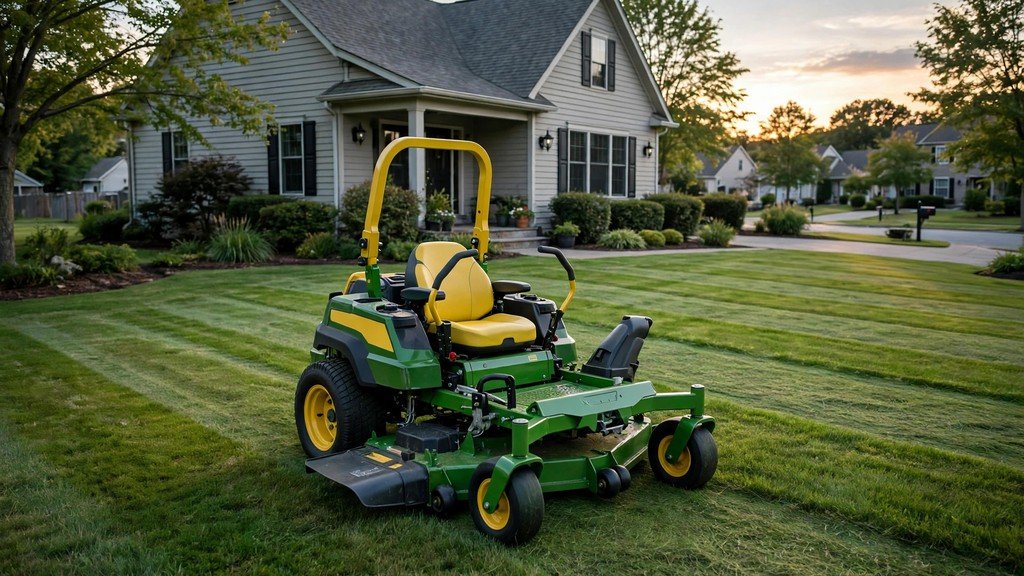
The biggest residential benefit in John Deere Z355E performance is time. A lawn that took 90 minutes behind a lawn tractor often takes under an hour on the Z355E, because the 48-inch deck, 7-mph top speed, and zero-turn steering all stack in the same direction. Trimming time drops too, since the mower pivots around trees and beds instead of circling them. The electric PTO clutch, hour meter, and color-coded controls keep operation simple, and at 566 pounds with a full tank and 76 inches long, the machine is easy to store and trailer. For 1- to 3-acre properties, that is why John Deere Z355E performance still draws buyers despite the earlier-generation model.
The limitations are equally consistent. The 2.1-gallon tank is the most common complaint, forcing a refuel on larger lawns. The ride is firm on rough ground, with only seat springs for suspension. The lap bars take a few mows to master, and beginners can scalp turf with jerky turns until their hands learn the feel. And the mower is mowing-only: no loader, no snow blower, no ground-engaging work, unlike a garden tractor. What those limits mean for running costs is worth pricing out, and the blade, belt, and drive care that keeps John Deere Z355E performance from fading with hours matters just as much. Buyers comparing machine types should also read the 100 Series performance guide for the lawn-tractor alternative and the X700 Signature Series performance guide for the garden-tractor step up.
Choosing the Right Mowing Speed and Cutting Height
Speed and height are the two levers controlling John Deere Z355E performance on any given day. For a weekly cut on normal grass, around 5 to 6 mph with the deck at 3 to 3.5 inches gives the best balance of finish and pace. For tall or thick grass, slow to 3 to 4 mph, raise the deck half an inch, and accept a second pass rather than forcing one fast pass that clumps and bogs. For the first cut of spring or after rain, the same rule applies: slower and higher beats faster and lower, and John Deere Z355E performance rewards patience with a cleaner lawn and less strain on engine and belts.
Cutting height deserves the same care. The one-third rule, never removing more than a third of the grass blade in one cut, keeps turf healthy and John Deere Z355E performance consistent week to week. Cool-season lawns generally do best at 3 to 4 inches, and cutting shorter to save a mow usually backfires: it stresses grass, invites weeds, and overloads the deck. Set the height with the quarter-inch dial, check the deck is level, and keep blades sharp, since a dull blade tears grass. The full Z355E review covers the engine, deck, and specifications behind these recommendations.
John Deere Z355E Performance: Frequently Asked Questions
These are the questions buyers actually ask about John Deere Z355E performance, answered directly from the specifications, fuel math, and handling limits covered above.
How fast does the John Deere Z355E mow?
John Deere Z355E performance tops out at 7.0 mph forward and 3.5 mph in reverse. A realistic mowing pace is 5 to 6 mph, which covers roughly 2 to 2.5 acres per hour on open ground with normal overlap and turns.
How much fuel does the John Deere Z355E use per hour?
Deere publishes no gallons-per-hour rating, so John Deere Z355E performance fuel figures are owner-reported planning estimates: roughly 1.0 to 1.5 gallons per hour in routine mowing, with about 1.2 gallons per hour a reasonable mid-point for normal weekly grass.
How long does a tank of fuel last on the Z355E?
With a 2.1-gallon tank and the planning burn rates above, John Deere Z355E performance gives roughly 1.5 to 2 hours per tank, or about 2 to 3 acres on open ground. Larger properties will usually need a mid-mow refuel.
What size lawn is the Z355E best for?
John Deere Z355E performance suits lawns of roughly 1 to 3 acres best. Smaller lawns may not justify a zero-turn, and properties above 3 acres will feel the small tank and the firm ride on long sessions.
Does the Z355E cut well in tall or wet grass?
John Deere Z355E performance is good on weekly cuts at normal height but drops off in tall or wet grass, where the deck can clump and the engine can bog. Raise the deck, slow down, and make a second pass if needed.
Can the Z355E bag grass clippings?
No, not according to dealer documentation and Consumer Reports: a rear bagger is not available for the Z355E, Z355R, or Z365R. John Deere Z355E performance for clipping management means side discharge or the optional MulchControl kit.
What is the difference between the Z355E and Z355R?
John Deere Z355E performance is essentially identical to the Z355R: same 22-hp engine, same 48-inch deck, and same Hydro-Gear EZT transaxles. The Z355R differs only by comfort: an 18-inch high-back seat instead of the 15-inch seat, tool-free seat adjustment, and floor mats, typically for about $180–$200 more, and it is the current-production model.
How steep a slope can the Z355E mow?
Deere’s ZTrak guidance puts rollover risk as low at 10 degrees or less and never above 15 degrees. John Deere Z355E performance on slopes demands slow, gradual movements, and wet grass or attachments shrink the safe margin further.
Is the Z355E comfortable for long mowing sessions?
John Deere Z355E performance for comfort is good on smooth ground, with a spring-suspension seat and adjustable armrests, but firm on rough ground, where there is no suspension beyond the seat springs.
How hard is it to learn zero-turn steering?
Most owners find the twin lap bars natural within a few mows. John Deere Z355E performance for beginners improves fastest with smooth, small lever inputs and slower turns at first, since jerky inputs scalp turf.
What cutting height should I use on the Z355E?
John Deere Z355E performance is best at 3 to 3.5 inches for most turf, set in quarter-inch steps from the 1- to 4-inch range, never removing more than a third of the blade in one cut. Taller grass should be cut higher and slower.
Does the Z355E handle wet grass well?
Wet grass reduces John Deere Z355E performance two ways: the deck clumps more, and the turf tires lose grip, especially on slopes. Wait for dry grass when you can, and mow slower with a higher deck when you cannot.
What engine does the Z355E use?
John Deere Z355E performance comes from a 22-hp Briggs & Stratton V-twin (Intek M44, 724 cc), air-cooled, with cast-iron liners and full-pressure lubrication.
Is the Z355E faster than a lawn tractor?
Yes. John Deere Z355E performance at 7 mph top speed and zero-turn steering finishes a 2-acre lawn noticeably faster than a lawn tractor, which typically tops out around 5 to 5.5 mph and needs wider turns.