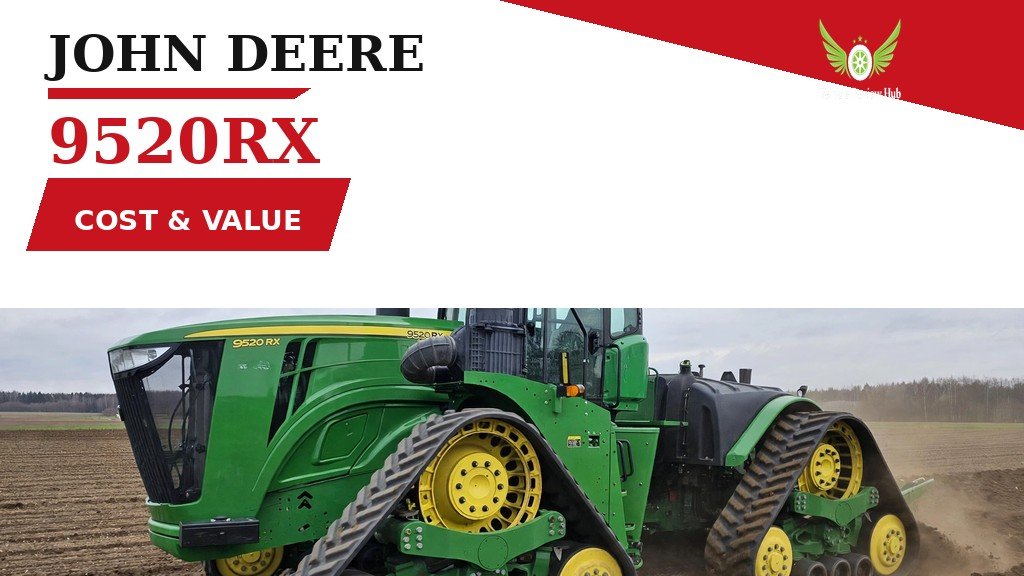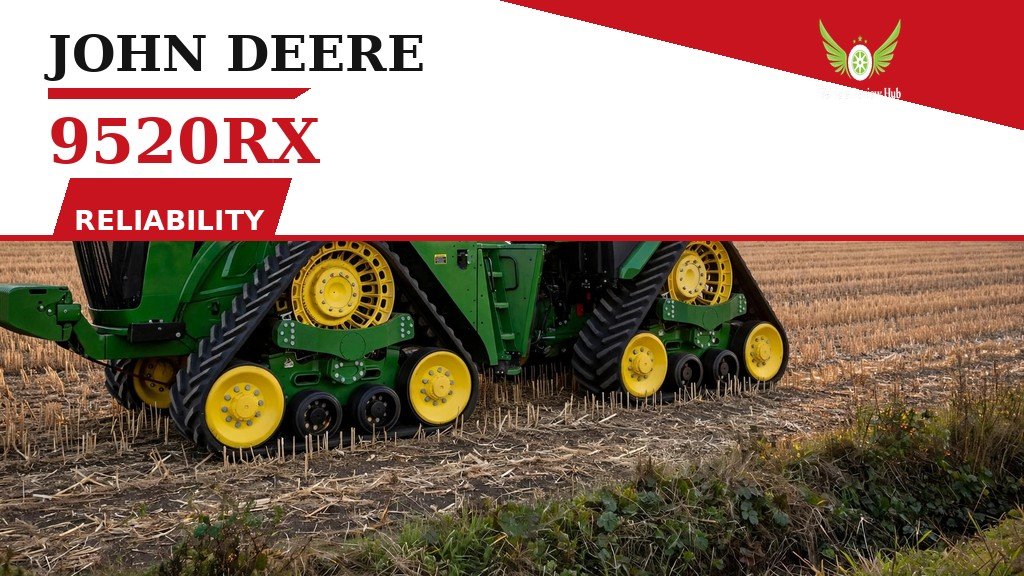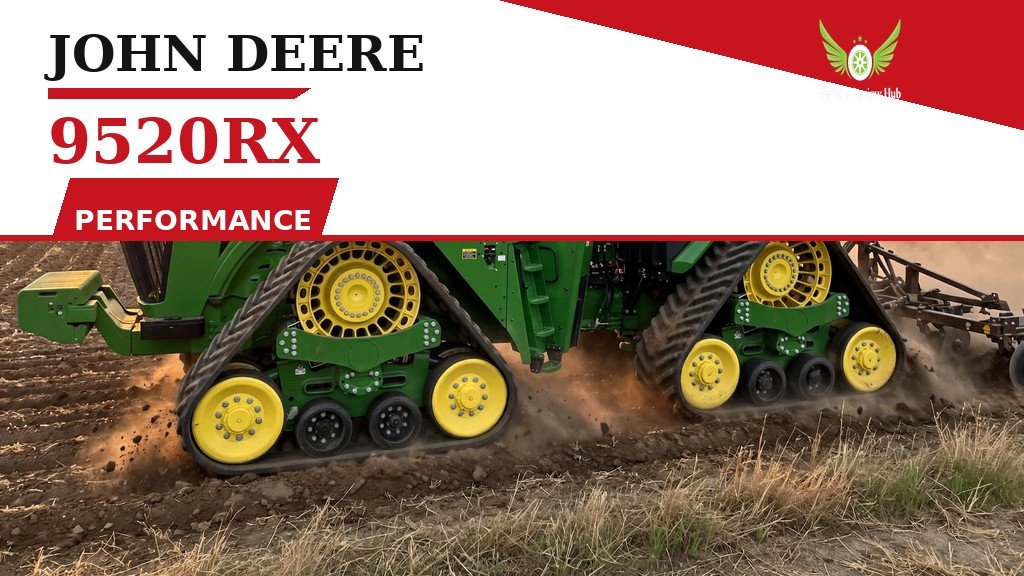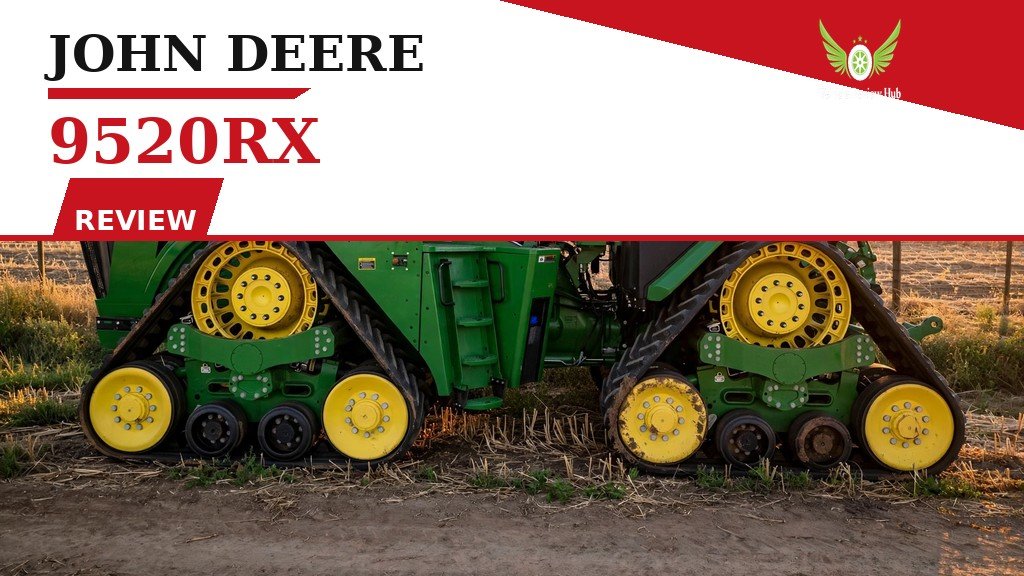
John Deere 9RX Series performance is built around a simple idea: put up to 913 horsepower to the ground through four rubber belt tracks so nothing goes to waste as slip. The 9RX 710, 770 and 830 run Deere’s own JD18 18.0-liter six-cylinder, an e21 21-speed PowerShift and a 515-gallon fuel tank, with no DEF fluid to handle. This guide covers John Deere 9RX Series performance in the detail a working buyer needs: verified fuel consumption numbers, what each model pulls in the field, how the four-track chassis handles, and what owners report after real seasons. Every figure below is verified — nothing is guessed.
The headline is that four tracks change the traction equation. In an independent profi test, a 9RX 830 pulling a 9-meter cultivator more than 30 cm deep converted over 900 horsepower into forward pull with less than 3% track slip, burning 165 liters (about 43.6 gallons) per hour at full song. Yet the same program’s mixed-work average was 1,000 liters per 15 hours — about 17.6 gallons per hour. That spread is the story: fuel use follows the load.
John Deere 9RX Series Fuel Consumption and Runtime
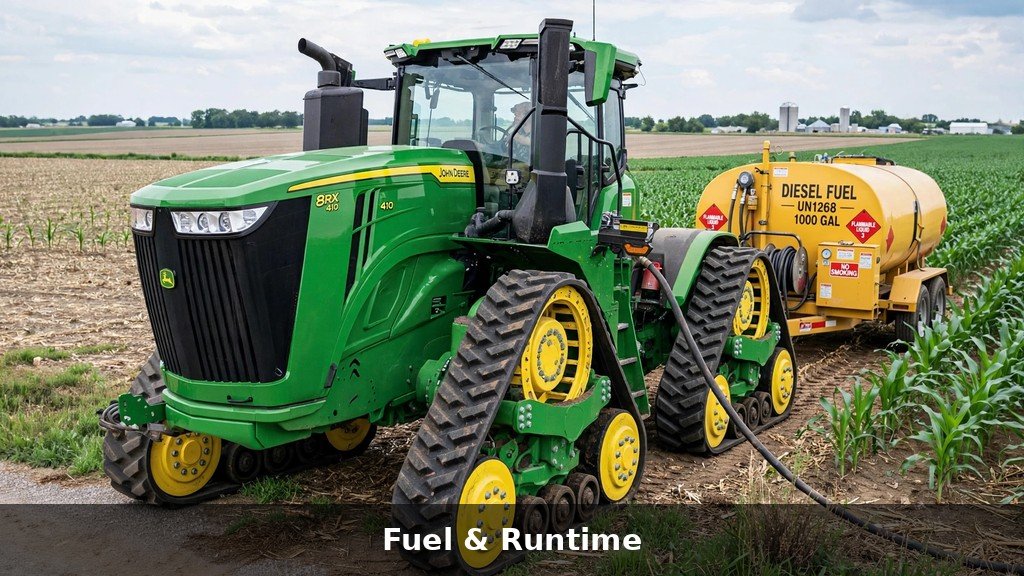
The 9RX carries 1,949 liters (515 gallons) of diesel, and refilling it with the optional Fast Fill System takes under four minutes at 568 liters (150 gallons) per minute. That capacity exists so the machine stays in the field through a full shift rather than queueing at the nurse tank.
Fuel Use During Heavy Tillage, Seeding and Transport
The best verified numbers for John Deere 9RX Series performance under load come from profi magazine’s instrumented test of the 9RX 830. Pulling a 9.0-meter Kockerling Vector cultivator more than 30 cm deep at up to 12 km/h (7.5 mph), the tractor covered nearly 11 hectares (about 27 acres) per hour while burning 165 liters per hour — roughly 43.6 gallons per hour. Per acre that is about 15 liters per hectare — competitive for this type of work, per the testers. At that pace the machine had no trouble converting more than 900 horsepower into tractive pull with under 3% slip.
A longer-term average from the same testing program put the 9RX 830’s mixed-work consumption at 1,000 liters per 15 hours — about 66.7 liters (17.6 gallons) per hour. That figure blends transport, headland turns and lighter work with full-draft pulls — a more realistic planning number than the full-song figure. Seeding and planting sit between the two extremes: a 100-foot air drill at 8–9 mph loads the engine hard but not flat-out, at roughly 25–32 gallons per hour on the 830 (owner-reported). Transport drops into the mid-teens per hour as the e21’s Efficiency Manager holds the most economical speed.
How Model, Workload and Transmission Affect Fuel Economy
The three models share the same JD18 architecture but breathe differently at the top end. The 9RX 710 (710 rated hp) does its heaviest work at a slightly lower absolute burn than the 830 simply because it moves less fuel through the injectors at rated power — owners running the 710 on big grain carts and secondary tillage describe John Deere 9RX Series performance in the 18–26 gallon-per-hour band. The 9RX 770 sits in the middle, and the 830 runs 25–35 gph in heavy tillage, rising toward the mid-40s only at sustained maximum draft.
The e21 transmission matters more than buyers expect. Its 21 closely spaced gears and Efficiency Manager keep the engine near its torque peak (1,400 rpm, where the 770 makes 2,897 lb-ft and the 830 makes 4,234 Nm — about 3,123 lb-ft) instead of screaming at rated speed. Hydraulic Intelligent Power Management feeds up to 40 extra horsepower to the implement hydraulics on demand rather than holding a higher engine baseline. With the 515-gallon tank, a 9RX 830 averaging 30 gallons per hour runs about 17 hours between fills, while at the 43.6-gph full-song rate it still stretches past 11 hours. For buyers comparing configurations, our 9RX Series review and specs guide breaks down what each model costs to own.
John Deere 9RX Series Performance for Large-Scale Farming
The 9RX exists for one customer: the farm running 60-foot air seeders, 40-foot high-speed discs and deep rippers across thousands of acres. Every part of John Deere 9RX Series performance — the 18-liter engine, the 1,200 mm drive sprockets, the triple-pump hydraulics — is sized so the tractor, not the implement, sets the work rate.
Tillage, Planting, Seeding and Heavy Implement Operation
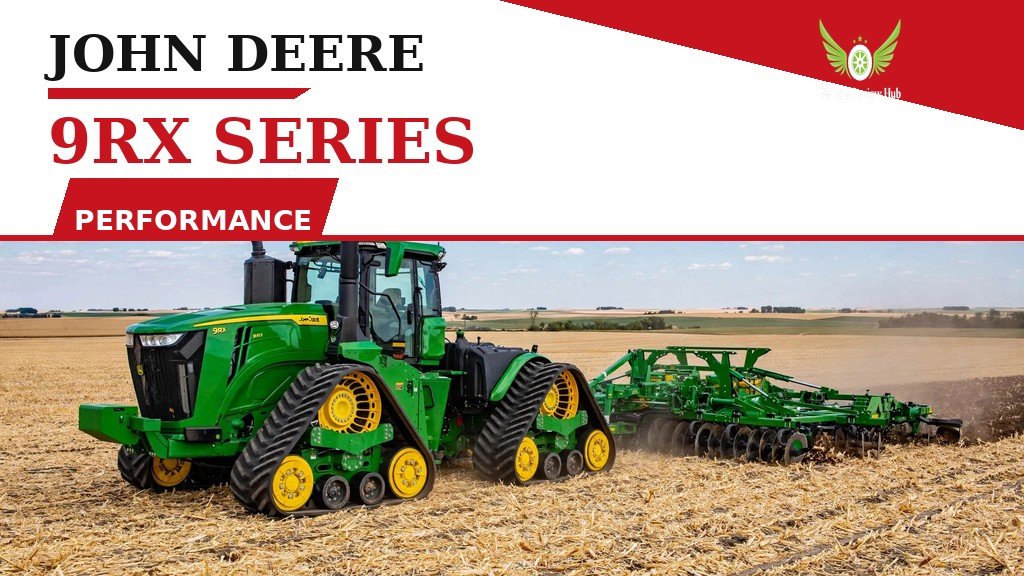
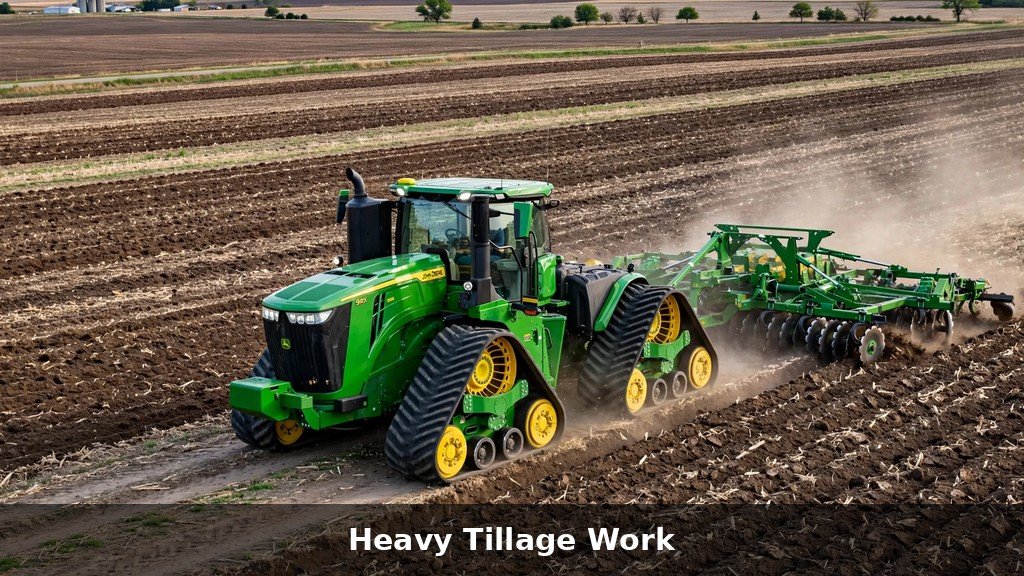
In primary tillage, John Deere 9RX Series performance shows in sustained ground speed where wheeled machines start to spin. The profi test’s 12 km/h at 30+ cm depth with sub-3% slip is the benchmark: four tracks and 35.5 tonnes (ballasted) hold the implement in the ground at speeds that would have a wheeled tractor clawing at 10–15% slip. Owners pulling tile plows, 14-shank rippers and 100-foot air seeders report the same theme — acres per hour, not just horsepower. A South African demo had the 830 pulling a 14-shank ripper at 800 mm depth without the revs climbing into the red.
The hydraulics are what extend John Deere 9RX Series performance to the biggest modern implements rather than merely the heaviest. The triple-pump option delivers up to 636 liters (168 gallons) per minute through six rear electrohydraulic SCVs, with the hydraulic IPM option adding 40 hp on demand for hydraulic-driven fans and meters. That matters for 100-foot air carts and large planters whose hydraulic demand rivals their draft demand. The video below — bigtractorpower’s fall-tillage footage of an 830-hp 9RX 830 at work — shows the pace this John Deere 9RX Series performance delivers in real conditions:
Grain-cart and slurry work lean on a different John Deere 9RX Series performance strength: the 1,400-rpm torque peak. The 830’s 4,234 Nm (about 3,123 lb-ft) arrives low and stays flat thanks to the 38% PTO torque rise, so the tractor lugs heavy loads at 1,500–1,600 rpm instead of holding rated speed. Operators describe John Deere 9RX Series performance in cart work as “quiet and unbothered” — the engine note barely changes when the cart fills. The 25-mph road speed on the e21 keeps cycle times respectable between field and bin.
Drawbar Pull, Four-Track Traction and High-Load Performance
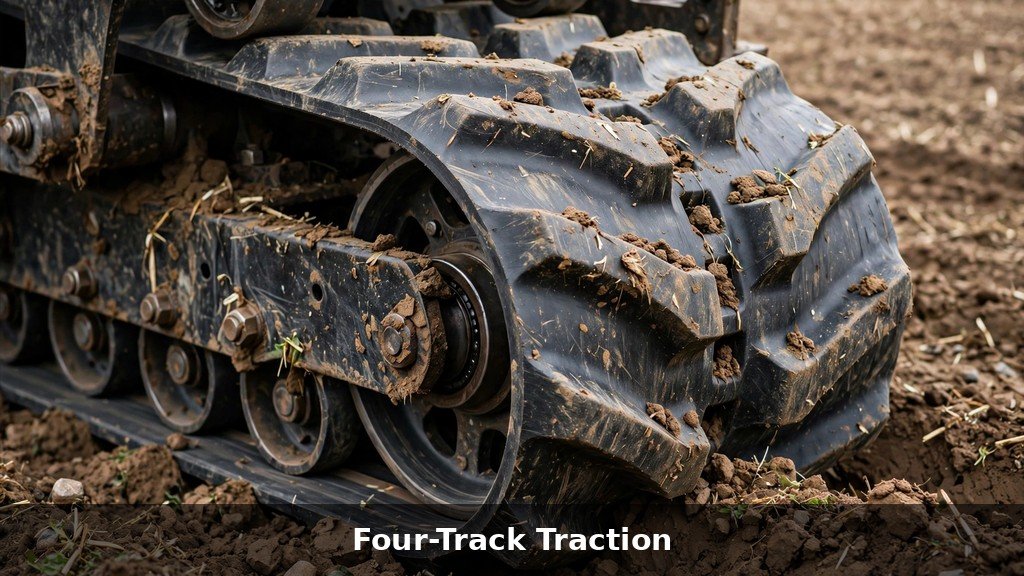
Traction is the whole argument for four tracks — and the foundation of John Deere 9RX Series performance. The new undercarriage’s 1,200 mm drive sprockets with a 110-degree wrap angle and 7.5 drive-lug engagement put more belt on the ground with less internal friction than the previous generation. Deere quotes minimum ground pressure as low as 0.58 kg/cm². At the profi test’s 35.5-tonne operating weight the 830 converted its full output at under 3% slip; when the testers dropped below 10 km/h, slip climbed past 6% — a reminder that even John Deere 9RX Series performance has physics limits, and that ground speed is part of the traction recipe.
The 10% power bulge and hydraulic IPM mean John Deere 9RX Series performance digs deeper into its reserves when the load spikes rather than asking the operator to downshift. On the 770, that is 847 max hp against a 770-hp rating; on the 830, 913 max hp against 830 rated. Deere’s internal field comparison put the 9RX 13% ahead: a 9RX 830 pulling a 45-foot high-speed disc at 13.4 mph versus a 9RX 640 (the previous generation’s top four-track model) pulling a 40-foot disc at 11.9 mph, same 4-inch depth in corn stalks. For buyers weighing the tracked 9RX against the wheeled 9R Series, the rule of thumb owners give is simple: tracks win wherever flotation and year-round timeliness matter; wheels win on road transport and tight headlands. The 8RX Series covers the 310–410 hp tracked niche below the 9RX range.
John Deere 9RX Series Handling, Comfort and Operating Limits
An 8.8-meter-long, 3.8-meter-tall machine on four tracks sounds like a handful, but the handling story behind John Deere 9RX Series performance is about manageability: articulated steering, a cab built for 16-hour days, and track geometry that keeps the footprint narrow enough for a sub-3-meter transport width in Europe.
Cab Comfort, Controls and Operator Visibility
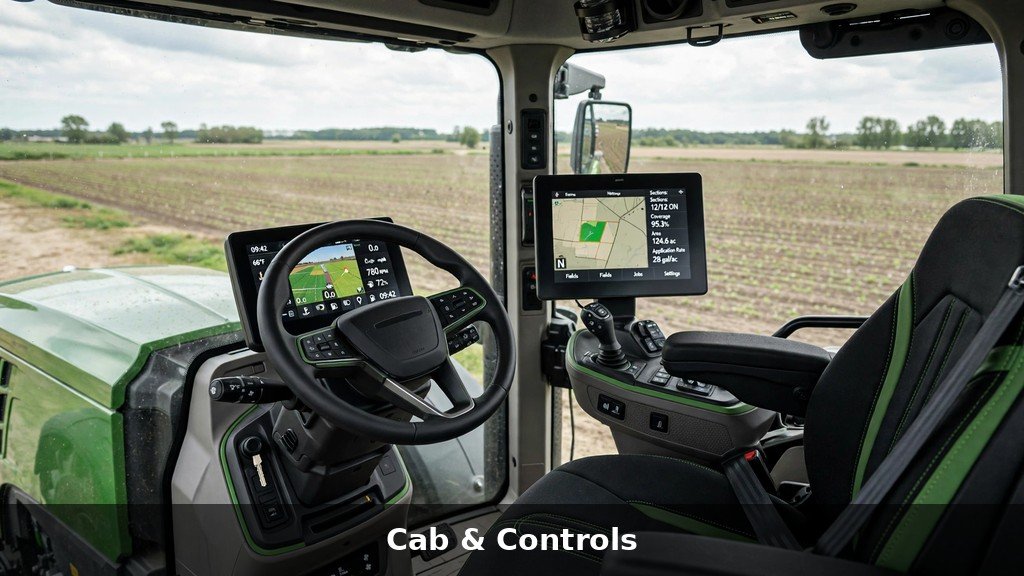
The CommandView 4 Plus cab is new for this generation of John Deere 9RX Series performance and noticeably roomier: removing the right-hand fender (a wheeled-tractor carryover) freed 15% more floor space, and right-side visibility improved 20% with the extra glass. Four-point cab suspension and a calmer in-cab environment are aimed at 14–16 hour days in planting and harvest windows. The G5Plus CommandCenter display runs guidance, implement control and machine diagnostics from one 12.8-inch screen, with AutoTrac and the full precision-ag stack integrated rather than bolted on.
Controls follow the familiar Deere logic behind John Deere 9RX Series performance — CommandARM armrest, configurable joystick, e21 shift logic with Efficiency Manager — familiar to any operator stepping up from an 8R or 8RX. The reversible cooling fan (interval or on-demand) keeps the radiator pack clear in high-residue conditions, which owners cite as a genuine uptime feature in corn stalks. ActiveCommand-style steering calibration keeps the articulated chassis tracking straight at road speed, where a machine this long could otherwise feel vague.
Track Width, Soil Conditions, Turning and Field Limitations
The four-track layout behind John Deere 9RX Series performance trades some agility for flotation. Track options run from 18-inch to 36-inch belts; the Van Wall listing for a 2025 9RX 830 shows 36-inch tracks on wide spacing, while the profi test machine ran 76 cm (30-inch) tracks for an overall width just under 3 meters. Wider belts and the 0.58 kg/cm² minimum ground pressure are the reason the 9RX can work ground that would mire a wheeled tractor of equal power — spring tillage on soft soils is a core use case.
The limits are real. Articulated four-track steering scuffs more on headland turns than a wheeled tractor, so operators plan passes to minimize sharp turns. Transport width and the 76,000-lb base weight demand proper trailers and route planning — this is not a machine that moves farms on a whim. And while four tracks spread the load, they do not repeal compaction: running at the 42.2-tonne maximum fighting weight on wet ground still compresses soil structure, so matching ballast to the implement is part of getting John Deere 9RX Series performance without the downside. Track belt replacement is the single biggest wear item on any tracked machine — budget for it, as our 9RX Series ownership cost guide details.
John Deere 9RX Series Real-World Owner Experience
Strip away the spec sheet and the reputation behind John Deere 9RX Series performance rests on three things owners repeat: it pulls whatever is behind it, it does so on less fuel per acre than the horsepower suggests, and the diesel-only JD18 (no DEF, no DPF, no SCR) simplifies life. The complaints are equally consistent: price, size and the cost of feeding it.
Owner-Reported Benefits, Complaints and Operating Trade-Offs
The benefits owners cite most for John Deere 9RX Series performance are drawbar pull and timeliness. “It just doesn’t slow down” — 4,234 Nm of torque at 1,400 rpm, four tracks and 35+ tonnes means the implement, not the tractor, is the limit. The no-DEF JD18 earns praise: one fluid to buy, one tank to fill, no regen interruptions, no winter DEF headaches. Cab comfort over long days and the G5Plus display’s integration also score well, as does the Fast Fill system’s sub-four-minute refuel.
Complaints about John Deere 9RX Series performance center on cost and scale. A new 9RX 830 lists around $1.23 million before options, and even low-hour used 2025 models sit in the $925,000–$945,000 band — serious money that demands serious acreage to justify. Fuel bills are the other shock: 35–45 gallons per hour at full song adds up fast, even if per-acre figures are competitive. Some operators note it is overkill below about 3,000–4,000 acres, and that the electronic complexity makes dealer support more important than on simpler tractors. None of these are reliability scandals — they are the trade-offs of running the biggest tractor Deere builds. Our 9RX Series maintenance and common problems guide covers what actually needs attention.
Choosing the Right Model and Track Setup for Your Work
Choosing for John Deere 9RX Series performance comes down to implement size and growth plans. The 9RX 710 (710 rated / 781 max hp) suits big grain operations running 60-foot planters, large grain carts and secondary tillage — plenty of tractor for 3,000–6,000 acres. The 9RX 770 (759 SAE / 770 PS rated, 847 max) is the volume seller for heavy tillage on big acreage. The 9RX 830 (830 rated / 913 max) is for the deepest draft work: tile plows, deep rippers and the largest air seeders on 6,000+ acre operations, where the extra torque earns its keep.
Track setup matters as much as horsepower. Narrower belts (18–24 inch) suit row-crop work and road transport; 30–36 inch belts maximize flotation for soft soils and minimum compaction. The triple-pump 168-gpm hydraulics are worth ordering if air seeders or hydraulic-driven implements are in the plan, and the Scraper Special variants (710 and 770) exist for earthmoving buyers. Buyers stepping up from the previous 9RX 470–620 generation gain roughly 100+ horsepower per model step and the simpler no-DEF aftertreatment — a meaningful upgrade in both output and daily hassle. Either way, size the tractor to the implement you will run in five years, not the one you run today.
Frequently Asked Questions About John Deere 9RX Series Performance
Quick answers to the questions buyers ask most about John Deere 9RX Series performance in real field work.

How much fuel does a John Deere 9RX 830 use per hour?
It depends on the load. An independent profi test measured 165 liters (about 43.6 gallons) per hour pulling a 9-meter cultivator more than 30 cm deep at 12 km/h — full-song heavy draft. The same program’s mixed-work average was 1,000 liters per 15 hours, about 17.6 gallons per hour. Plan on 25–35 gph for heavy tillage and the mid-teens for transport.
Does the 9RX need DEF fluid?
No. The JD18 18.0-liter engine meets Final Tier 4 and Stage V emissions with cooled EGR alone — no DEF, no SCR, no DPF. It runs on diesel only, which simplifies fueling and eliminates regen interruptions and DEF quality issues.
What is the top speed of the John Deere 9RX?
The e21 PowerShift is rated for 40 km/h (25 mph) with 21 forward and 11 reverse gears. Efficiency Manager automatically selects the most economical gear for the target speed, which keeps fuel burn reasonable on road work.
How much can a 9RX 830 pull?
Deere rates the 830 at 830 hp with 913 max hp and about 3,123 lb-ft of torque at 1,400 rpm. In the profi test it converted over 900 hp into forward pull at under 3% slip. Realistically it handles 60-foot air seeders, 40-foot high-speed discs and 14-shank deep rippers at full working depth.
How heavy is the John Deere 9RX 830?
Base weight runs about 74,000–76,000 lbs, and it can ballast to 38,100 kg (about 84,000 lbs). The profi test machine worked at 35.5 tonnes (about 78,000 lbs) ballasted, with a maximum fighting weight of 42.2 tonnes available.
Is the 9RX better than the wheeled 9R?
For traction and flotation, yes — that is where John Deere 9RX Series performance wins: four tracks put more power down with less slip and lower ground pressure (as low as 0.58 kg/cm²). The wheeled 9R wins on road transport, purchase price and tight headlands. Choose tracks where timeliness on soft ground pays; choose wheels where transport and maneuverability dominate.