The John Deere 9520RX is a used-market-only tractor, so John Deere 9520RX maintenance is not a side question — it is the whole buying decision. Keep the PSS 13.5L engine on its 500-hour oil services, change the transmission-hydraulic oil every 1,500 hours, respect the DOC/DPF/SCR aftertreatment, and inspect the four-track undercarriage daily, and a 9520RX will work hard for many more seasons. Skip the aftertreatment and track care, and you will be the one writing the repair check.
This John Deere 9520RX maintenance guide covers the full service schedule with real intervals, what each service costs (labeled estimates), how reliable the 13.5L engine, e18 transmission and hydraulic system really are, the common problems owners report, and a used-tractor inspection checklist. The 9520RX was built from 2015 through 2018 as the second model in Deere’s original four-track 9RX launch (9470RX, 9520RX, 9570RX, 9620RX), so every machine on the market has hours on it — the original factory warranty is long expired, and what matters now is service history.
John Deere 9520RX Maintenance Schedule and Service Costs
The John Deere 9520RX maintenance schedule is a predictable service ladder: 50- and 250-hour inspections, 500-hour engine services, 1,500-hour transmission-hydraulic services, and a 6,000-hour coolant change. Follow it with the right fluids and the tractor stays out of the shop; stretch the intervals and the 13.5L will let you know.
Engine Oil, Fuel Filters, Air Filters and Cooling System
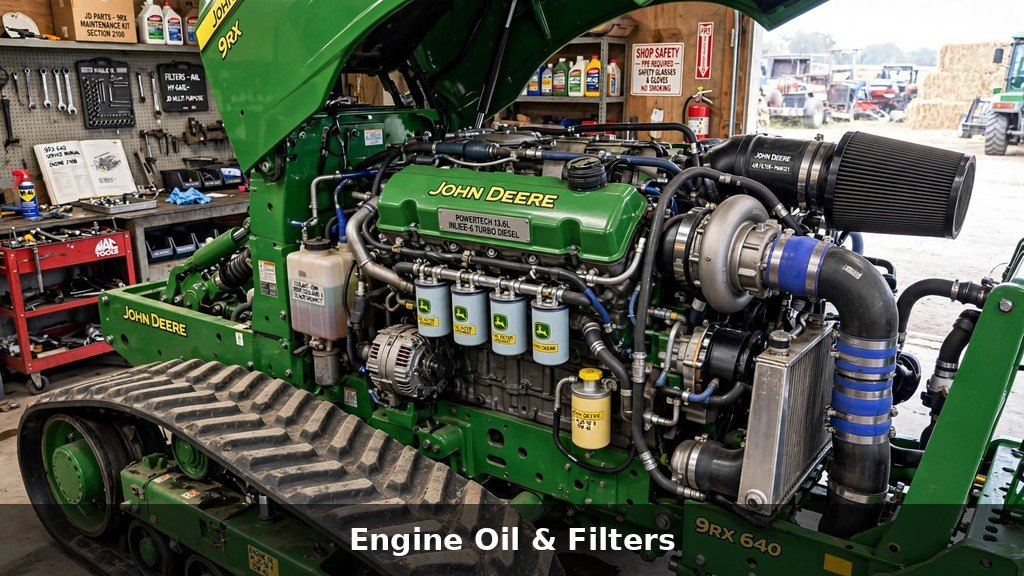
Engine oil and filter changes come every 500 hours with approved John Deere Plus-50 II oil and a Deere oil filter — the interval Deere dealer spec pages list for the 9.0L and 13.5L engines. Run any other CJ-4 oil and the interval drops to 250 hours, and only ultra-low sulfur diesel goes in the tank (CJ-4, ACEA E9 or ACEA E6 oil), because the exhaust filter depends on it. Useful detail: the factory fills the engine with Break-In Plus oil, so the old 100-hour initial change is not required on this generation — a small but real saving in John Deere 9520RX maintenance.
Fuel filter elements also change every 500 hours, and the fuel water separator needs regular service — water in the fuel is the fastest way to damage the 13.5L’s high-pressure injection system. The primary air filter is inspected from the left-hand platform and replaced annually or as conditions demand; it is aspirated, spinning out more than 95 percent of dust before it reaches the element. Coolant goes 6,000 hours (COOL-GARD), with periodic condition tests in between.
The aftertreatment system needs its own line in any John Deere 9520RX maintenance plan. The US Final Tier 4 9520RX runs a cooled-EGR engine with DOC + DPF + SCR aftertreatment (engine family JJDXL13.5310, shared with the same-era 9520RT) and a 31.7-gallon DEF tank. Deere’s regeneration management handles DPF cleaning automatically — the operator gets a notification during active regen, with an override if needed. Owners should keep DEF fresh (stale DEF is a leading cause of SCR derate codes), remember DEF freezes after about three hours below 12.2°F, and budget for dealer-level exhaust-filter ash service at high hours — typically around 4,000 hours or later depending on duty cycle (estimate). DEF use runs roughly 1–3 percent of diesel consumption on Deere Final Tier 4 engines.
Transmission, Hydraulic Oil, Tracks and Lubrication
The shared transmission-hydraulic-axle oil and filter change every 1,500 hours, unless a filter restriction code fires first. John Deere 9520RX maintenance means checking the level daily or every 10 hours at the sight glass with the tractor off on level ground; hot oil reads higher, so check consistently. At 50 hours, inspect the tracks and lubricate the hinge pins; at 250 hours, check brakes, the neutral-start and park systems, and lubricate the telescoping driveshafts.
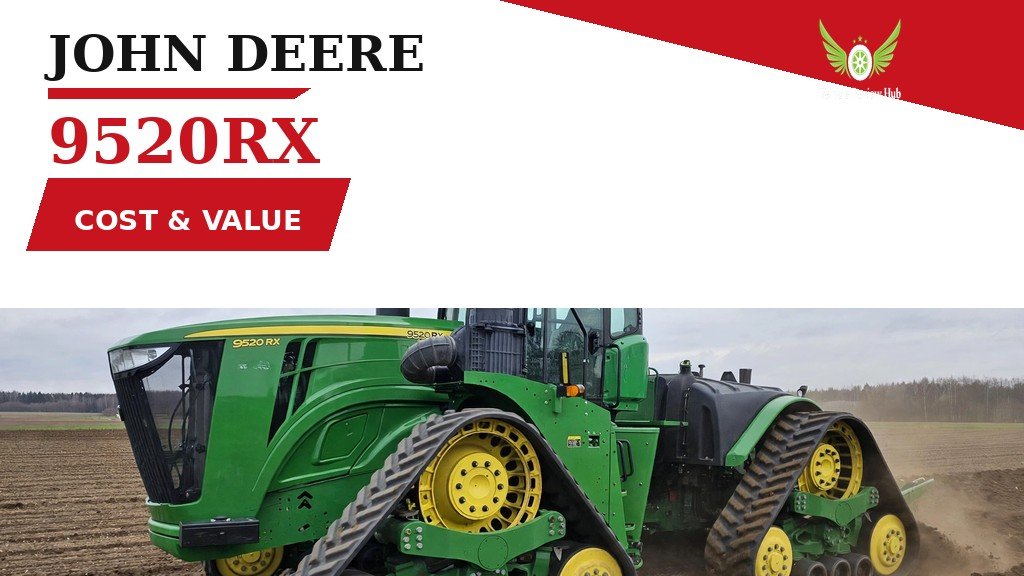
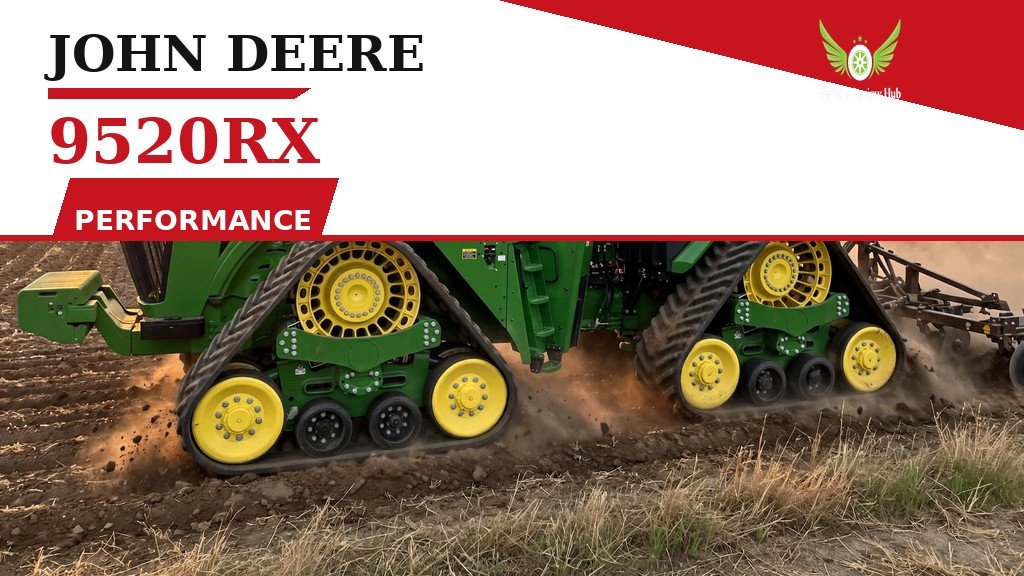
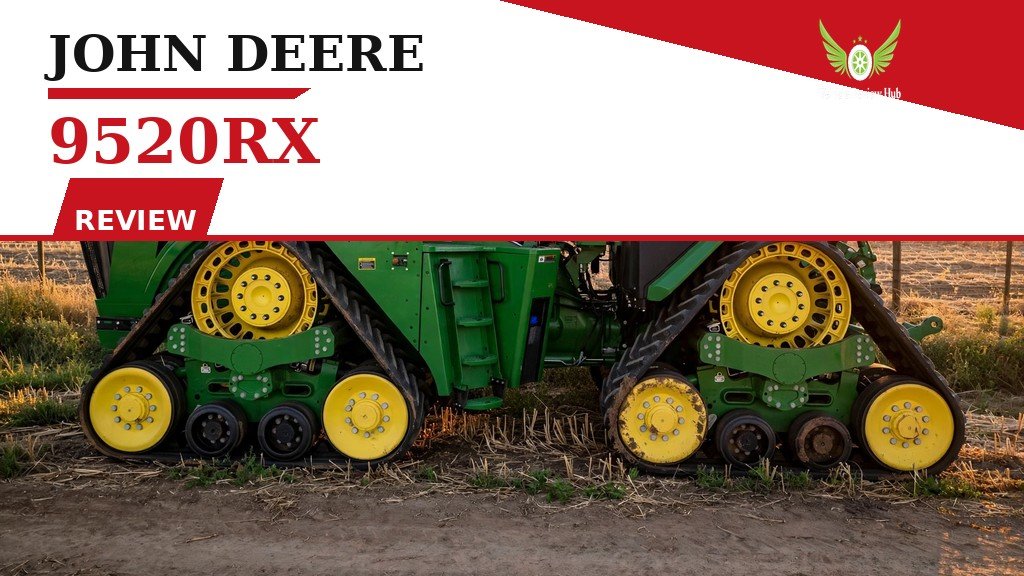
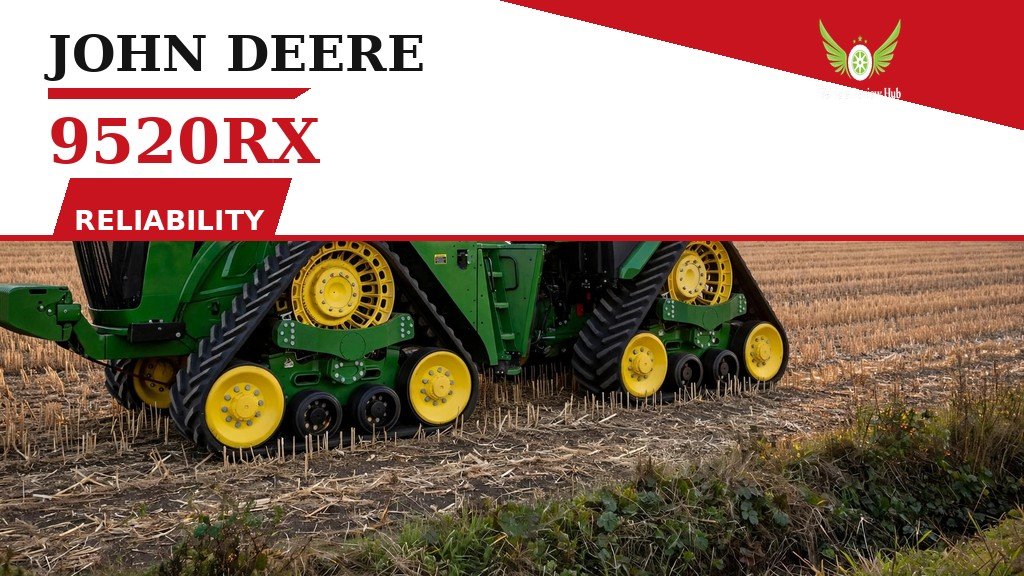
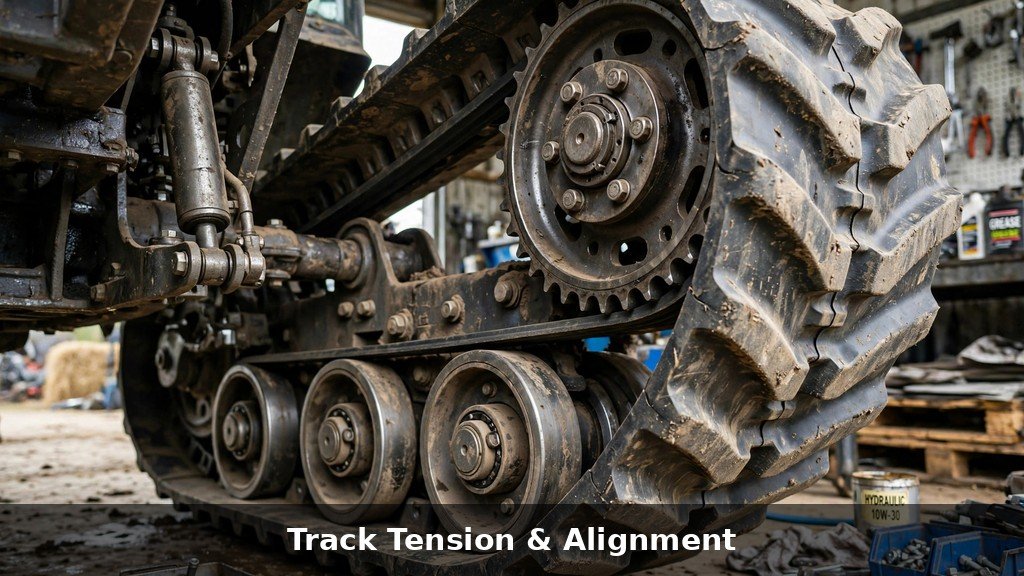
Track care is a daily ritual and the most overlooked part of the routine: walk all four corners for cuts, chunking and uneven wear on the Camso Duradrive 3500/6500 belts, verify belt tension, and clear packed debris. Avoid unnecessary roading — belts wear far faster on pavement — and avoid spot turns and counter-rotation, which grind the belts and stress drive lugs. The Parallel Plane Four-Bar Linkage undercarriage gives about four inches of vertical travel, but its bushings and pins wear, so check for play at every service.
What does John Deere 9520RX maintenance cost? A dealer 500-hour engine service typically runs about $1,800–$3,000; a careful DIY service with genuine filters and Plus-50 II runs roughly $700–$1,200 (estimates). A 1,500-hour transmission-hydraulic service is a bigger job — figure roughly $3,000–$5,000 at dealer rates (estimate). The number that surprises first-time track owners is belt replacement: on the order of $10,000–$15,000 or more per belt installed (estimate), so a full four-corner refresh is a $40,000-plus event — which is why the used-buying inspection later in this John Deere 9520RX maintenance guide spends so much time on the undercarriage.
John Deere 9520RX Reliability and Long-Term Durability
The 9520RX has the better part of a decade of field history behind it, and that history is mostly kind. The PSS 13.5L and e18 PowerShift are proven — the same architecture that worked in the wheeled 9R and two-track 9RT — and owners who stay on the John Deere 9520RX maintenance schedule report high-hour machines still earning their keep.
13.5L Engine, e18 Transmission and Hydraulic System
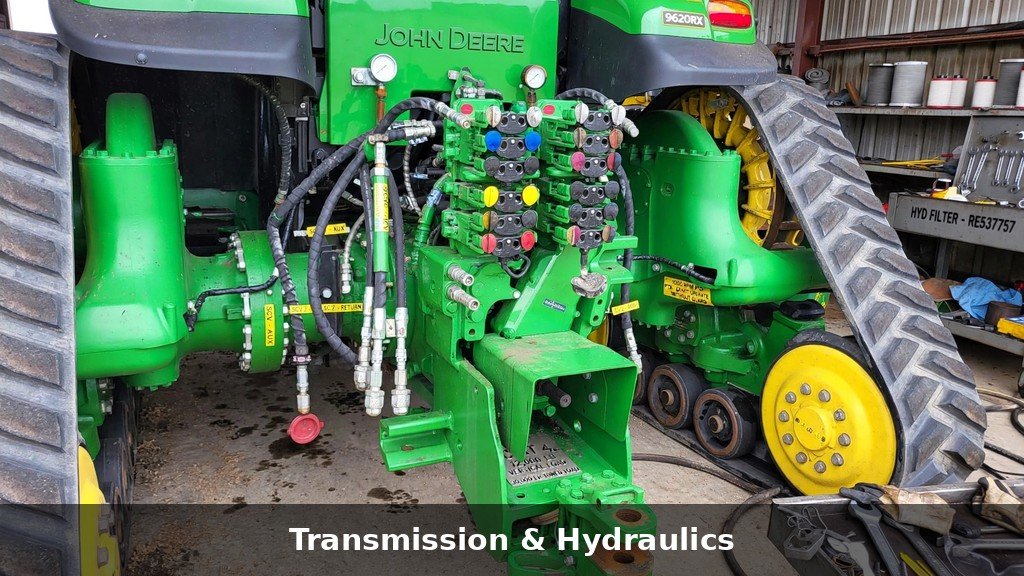
The PowerTech PSS 13.5L is a wet-sleeve, 4-valve inline-six with dual series turbos, air-to-air aftercooling and cooled EGR, rated 520 gross hp at 2,100 rpm and B20 compatible. With clean fuel, correct oil and a functioning aftertreatment, owners routinely report 8,000–12,000 hours before major work (owner-reported; results vary). Cooling, fuel filtration and aftertreatment are the three things that decide whether a 13.5L reaches those hours happily — which is why disciplined John Deere 9520RX maintenance matters more than low hours on the meter.
The e18 18-speed PowerShift with Efficiency Manager is one of Deere’s most durable transmissions — fully mechanical, good for 25 mph, and not a common failure item; when shift quality degrades, a dealer recalibration usually restores it. The closed-center PFC hydraulics deliver 58 gpm standard or 115 gpm with Hi-Flow, with four to six (optionally eight) rear SCVs. The system is robust; the recurring owner complaint in John Deere 9520RX maintenance circles is weeping SCV couplers and chafed hoses — nuisance leaks rather than pump failures. For the wheeled equivalent’s maintenance picture, see our 9R Series maintenance and common problems guide, which covers the same engine family in the wheeled chassis.
Factors Affecting Service Life, Downtime and Repair Costs
Hours tell only part of the story. A 5,000-hour machine with documented 500-hour services is a better bet than a 3,000-hour machine with spotty records. Ask what the tractor did: heavy draft work, scraper duty (a 9520RX Scraper Special existed for earthmoving) and high road mileage wear different things. Maintenance records are the single most valuable document in the transaction.
Software is the quiet factor in modern John Deere 9520RX maintenance: controllers get updated over time, and a machine that never saw a dealer may carry old calibrations affecting regen behavior and shift quality. A pre-purchase dealer inspection with a software check and fault-code history pull is money well spent — and the best first step in your John Deere 9520RX maintenance routine. Storage matters too — machines parked outside for years suffer seal, hose and electrical degradation no hour meter shows. And ballast history matters: a 52,000-lb base machine run at its 62,000-lb maximum for years shows more undercarriage and drivetrain wear than one run light.
John Deere 9520RX Common Problems and Warning Signs
No tractor this size is trouble-free, and the 9520RX has known patterns that every John Deere 9520RX maintenance plan should account for. Every item below is owner-attributed — things to check during John Deere 9520RX maintenance and inspection, not reasons to walk away.
Engine, Electrical, Hydraulic and Transmission Symptoms
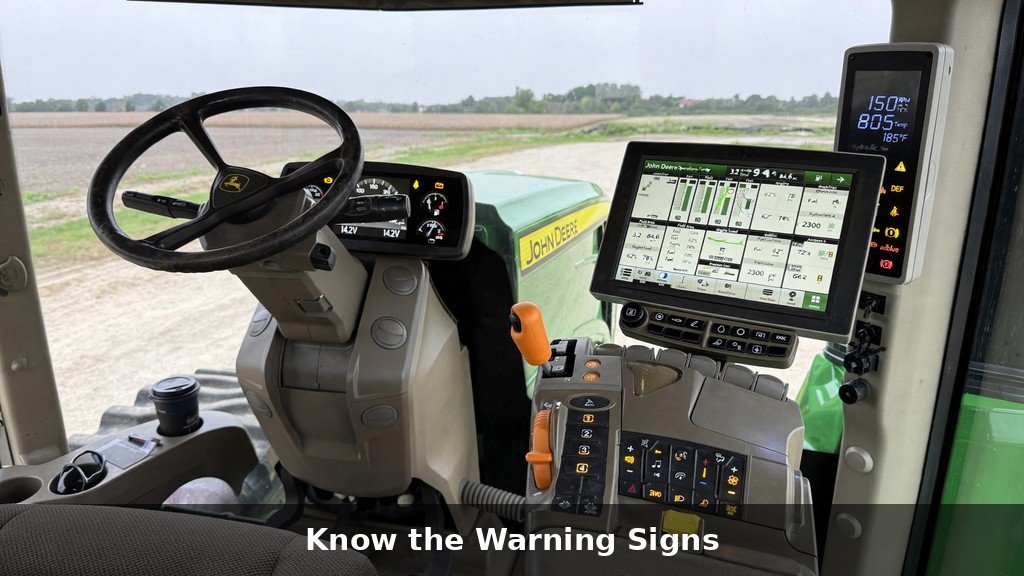
Aftertreatment faults top the list. SCR derate codes with reduced power usually trace to stale DEF, failed NOx sensors or a clogged DEF filter — cheaper to fix early, before the derate hardens. DPF problems show up as frequent or interrupted regenerations; a tractor that only idles or does light work may never get hot enough for passive regen, loading the filter until a dealer ash service is needed. Watch the dash for exhaust warnings and do not clear-and-ignore them — that single habit prevents the costliest John Deere 9520RX maintenance surprises.
Electrical gremlins are the second pattern: software code cascades from one failed sensor, corroded connectors after years of washdowns, and batteries dying in storage — the 9520RX carries big 12V batteries (2,775 CCA) that should be replaced as a matched set. Hydraulically, expect weeping SCV couplers and chafed hoses, plus occasionally slow remotes tracing to a tired coupler or filter restriction. The e18’s signature complaint is harsh or flared shifts, usually fixed by calibration rather than hardware. Low boost on the 13.5L points at intercooler hose leaks or the wastegate actuator before the turbo itself. For the newer four-track generation’s issues, our 9RX Series maintenance guide covers the JD18-powered machines.
Track Wear, Alignment and Undercarriage Inspection
The undercarriage is where 9520RX ownership gets expensive — and where John Deere 9520RX maintenance pays for itself — so learn its language. Normal belt wear is even tread loss; abnormal wear is everything else — cupping or one-sided wear means alignment problems, while cuts and chunking come from rocks, debris and roading, the fastest way to eat belts. Check tension against the operator manual spec: loose belts can derail, overtight belts accelerate wear everywhere. Inspect drive sprockets for hooked drive lugs and mid-rollers/idlers for flat spots, seal leaks and play.
Check the four-bar linkage bushings for play — uneven stance or clunks over rough ground during the test drive are telltales — and clean packed debris before judging anything. The video below, a track maintenance walkthrough from Leading Edge Equipment that doubles as a visual John Deere 9520RX maintenance lesson, shows what proper undercarriage inspection looks like on a John Deere track tractor:
Budget with open eyes: owner-reported Camso belt life runs roughly 3,000–5,000-plus hours depending on soil, roading and care (estimate), and a single installed belt runs on the order of $10,000–$15,000 or more (estimate). A used 9520RX with 70-percent belts is a very different purchase than the same tractor with 20-percent belts — price the difference before negotiating, not after — that is John Deere 9520RX maintenance budgeting at its most practical.
John Deere 9520RX Safety Checks and Used-Tractor Inspection
Every 9520RX for sale is used, so inspection is not a formality — it is the purchase. What you are really buying is a documented John Deere 9520RX maintenance history, so plan on at least an hour on the machine plus a dealer code pull, and do not let a shiny wash override what the undercarriage tells you.
Checking Service History, Repairs and Applicable Recalls
Start with paperwork: complete John Deere 9520RX maintenance records showing 500-hour engine services, 1,500-hour transmission-hydraulic services, coolant changes and any aftertreatment work. Gaps are not automatically disqualifying on a 10-year-old tractor, but they shift risk to you — price accordingly. If the tractor ran JDLink, ask the dealer to pull machine history: hours, idle time, fault codes, sometimes location. Compare the hour meter against wear — pedal pads, seat and belts should roughly match the hours shown.
On recalls: we could not verify any 9520RX-specific CPSC recall in published records. The well-documented September 2024 brake recall covered only the 1023E, 1025R and 2025R compacts, not the 9RX line. Treat any 9520RX recall claim as reported rather than confirmed, and check the serial number through Deere’s recall lookup or 800-537-8233. On warranty: original factory coverage expired years ago on every 9520RX. Ask the selling dealer about Deere PowerGard extended plans for used machines — they cost real money and are worth pricing against your risk tolerance, especially for aftertreatment and undercarriage coverage.
Inspecting Tracks, Steering, Hydraulics and Transmission Operation
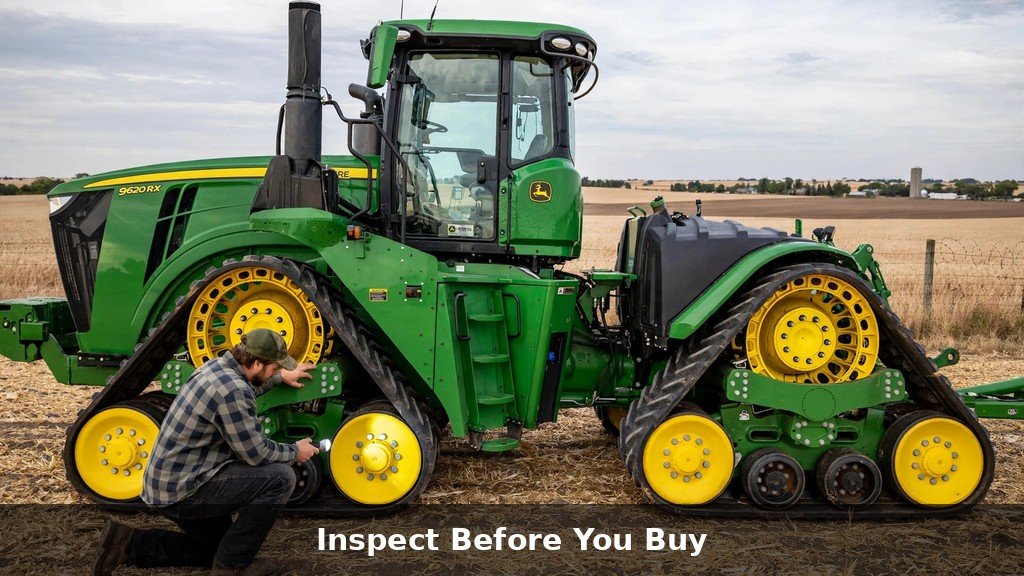
Work the undercarriage first — it is the most expensive thing to fix. Measure remaining tread on all four corners and note the worst corner, not the average. Check tension and alignment, look for cuts, chunking and exposed cords, and inspect sprockets, mid-rollers and idlers for wear and play. Then check the articulated steering: cycle lock to lock and watch the hinge for binding, leaking cylinders or excessive pin play.
Exercise every hydraulic remote under load and watch for leaks, drift and slow cycle times. Run the e18 through all 18 gears both directions, confirm Efficiency Manager engages and the park system holds on a grade. Test the PTO and three-point hitch if equipped — both were optional on the 9520RX, so verify per machine. Check lights, the CommandCenter display, AutoTrac hardware and air conditioning. Then drive it: listen for driveline noise, feel for vibration that signals track or alignment issues, and confirm the brakes stop 52,000-plus pounds confidently. Our 9520RX ownership cost and buying guide turns these inspection findings into dollars and cents, and the 8RX Series maintenance guide is useful background on four-track undercarriage care.
Frequently Asked Questions About John Deere 9520RX Maintenance
Quick answers to the John Deere 9520RX maintenance questions shoppers ask most.
What is the engine oil change interval on a John Deere 9520RX?
Every 500 hours with John Deere Plus-50 II oil and a Deere oil filter, per Deere’s service guidance for the 13.5L engine. With any other CJ-4 oil the interval drops to 250 hours. The factory Break-In Plus fill means no 100-hour initial change is required.
Does the 9520RX need DEF fluid?
Yes. Unlike the newest JD18-powered 9RX machines (EGR-only, no DEF), the 9520RX’s 13.5L runs DOC + DPF + SCR aftertreatment with a 31.7-gallon DEF tank. Keep DEF fresh, expect roughly 1–3 percent DEF use relative to diesel, and do not ignore SCR derate warnings — they get expensive.
How long do the track belts last on a 9520RX?
Owner-reported Camso belt life runs roughly 3,000–5,000-plus hours depending on soil, roading and care (estimate). Replacement runs on the order of $10,000–$15,000 or more per belt installed (estimate), so remaining belt life is a major factor in any used 9520RX price — and in your John Deere 9520RX maintenance budget.
What should I check first on a used 9520RX?
The undercarriage: belt condition, tension, alignment, sprockets, mid-rollers and idlers on all four corners. Then service history, hour meter versus visible wear, aftertreatment and DEF health (fault-code pull), and e18 operation through all gears. These four areas decide whether the tractor is a bargain or a project.
Are there any recalls on the John Deere 9520RX?
We could not verify a 9520RX-specific recall in published CPSC records. Treat any claim as reported rather than confirmed, and check the serial number through Deere’s recall lookup or 800-537-8233. The documented September 2024 brake recall applied only to 1023E, 1025R and 2025R compacts.
Is a used 9520RX a good buy compared to a new 9RX?
Often, yes — if the undercarriage and aftertreatment check out. A 2018 9520RX with around 3,500 hours recently listed near $280,000, roughly a quarter of a new 9RX 710’s price, and the 13.5L/e18 powertrain has a long record. Price in remaining belt life and potential aftertreatment work, and get a dealer fault-code pull before committing. Our 9520RX review and specs guide covers the full model picture, and smart John Deere 9520RX maintenance is what protects that value after you buy.