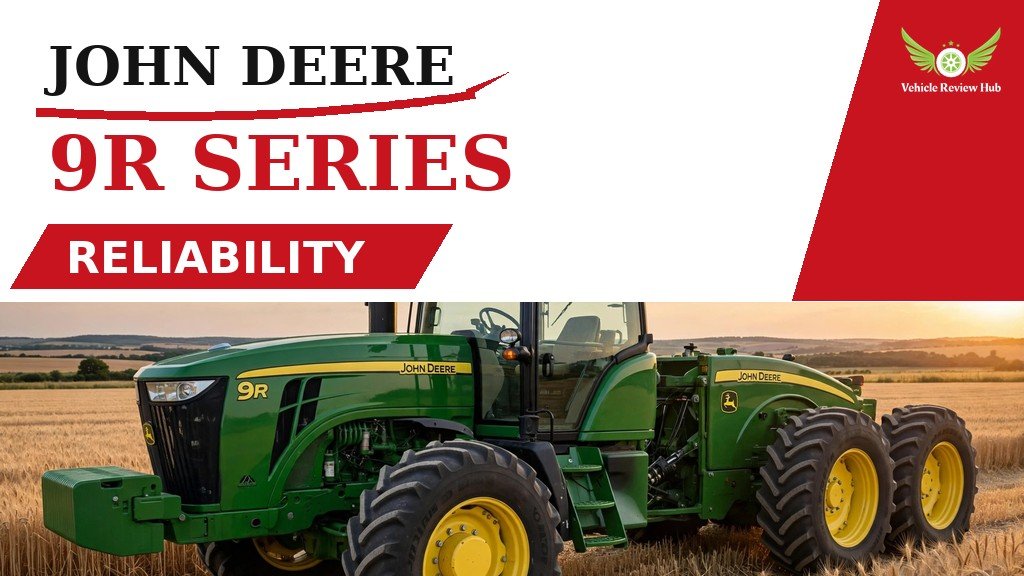
The John Deere 9R Series is a wheeled articulated four-wheel-drive tractor line, six models from the 9R 390 to the 9R 640, built for the heaviest tillage and planting work. For a machine that logs hundreds of hours per season under full load, John Deere 9R Series maintenance decides whether the tractor stays productive or turns into an expensive repair bill. Dealer spec sheets list engine oil at 500 hours, transmission-hydraulic oil at 1,500 hours, and coolant at 6,000 hours.
This John Deere 9R Series maintenance guide covers the service schedule, realistic costs, long-term reliability, common problems owners report, and what to check on a used machine. Following the John Deere 9R Series maintenance schedule below keeps warranty coverage intact and protects resale value. Figures come from Deere documentation or dealer spec sheets; estimates are labeled.
John Deere 9R Series Maintenance Schedule and Service Costs
A sound John Deere 9R Series maintenance schedule starts with Deere’s own published intervals. All six models (9R 390–640) share the John Deere JD14 13.6L six-cylinder and the e18 18-speed PowerShift, so one John Deere 9R Series maintenance schedule covers the range. With 16.9 gallons of engine oil and about 60 gallons of transmission-hydraulic oil, every service is a bigger job than on a row-crop tractor — plan it and do not stretch the intervals.
Engine Oil, Fuel Filters, Cooling System and Routine Service
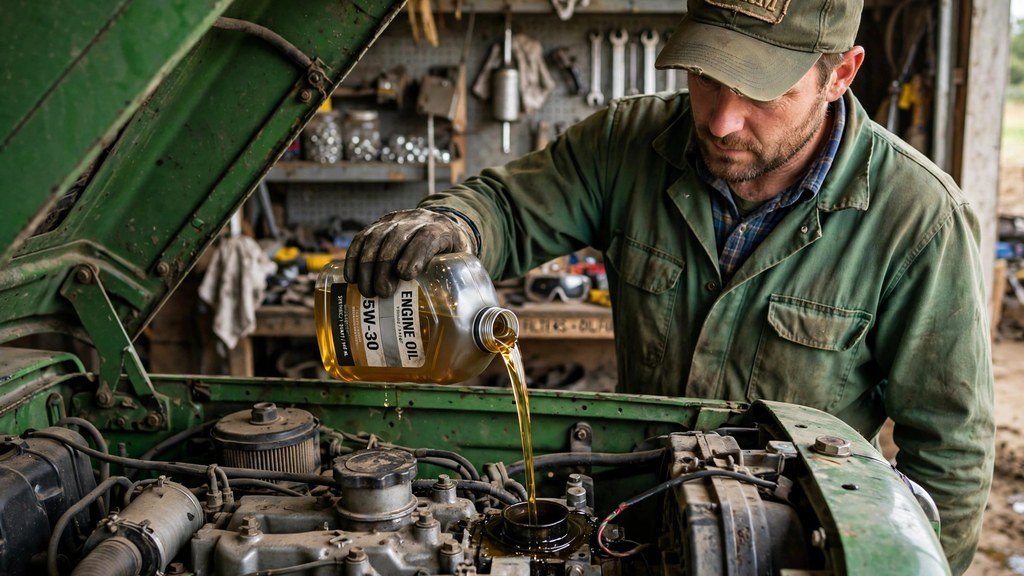
The core of John Deere 9R Series maintenance is the JD14 engine: 13.6 liters (827 cu in), inline six, wet-sleeve liners, four valves per head, with a single wastegated turbo on smaller models or dual series turbos on the bigger ones. Deere lists the oil change at 500 hours with approved oil and a genuine filter — and at 16.9 gallons of crankcase capacity, that service alone uses more oil than some compact tractors hold in total, which is why budgeting for John Deere 9R Series maintenance starts with fluid volume. Dealer spec sheets for the 9R 540 confirm the 500-hour interval alongside the 400-gallon fuel tank and 31.7-gallon DEF tank. Daily John Deere 9R Series maintenance checks should cover oil level, coolant level, and the fuel water separator — the 400-gallon tank gives contamination room to hide.
Fuel filters follow the 500-hour rhythm in most John Deere 9R Series maintenance plans, sooner in dusty conditions. One point owners often misunderstand: US-spec 9Rs meet Final Tier 4 with a diesel oxidation catalyst (DOC) plus selective catalytic reduction (SCR) using DEF — there is no DPF on this engine, so there is no ash service and no parked regeneration to schedule. The 31.7-gallon DEF tank needs fresh fluid; stale or contaminated DEF is a leading cause of SCR fault codes. Service air cleaner elements as the restriction indicator demands, replacing them annually. Check coolant condition every 600 hours; the change interval is 6,000. A dealer 500-hour John Deere 9R Series maintenance service runs roughly $1,800 to $3,000 (estimate), driven by fluid volume; DIY parts cost roughly $700 to $1,200 (estimate).
Transmission, Hydraulic Oil, Axles and Lubrication
The e18 PowerShift shares its sump with the hydraulics — about 60 gallons of transmission-hydraulic oil — and the John Deere 9R Series maintenance interval for changing it is 1,500 hours, filter on the same schedule. Use only specified Hy-Gard oil: the e18’s wet clutch packs depend on it. The closed-center, pressure-and-flow-compensated hydraulics run 55 gpm standard or 110 gpm optional, so dirty oil degrades both shifting and implement control — the reason John Deere 9R Series maintenance centers on the 1,500-hour service.
Articulated steering is the one John Deere 9R Series maintenance item a rigid-frame tractor does not have. Grease the center hinge pin regularly and inspect the steering cylinders and rod seals for leaks or scoring at every major service. A worn hinge joint or weeping cylinder left alone becomes frame-level wear — and at 40,660–46,680 lb base weight (up to 67,000 lb fully ballasted on the 9R 590), nothing on this driveline is cheap to ignore. Check wheel bolt torque after the first 50 hours and periodically after. Check the full-locking differential and final-drive oil levels at the 50-hour checks. Tire pressure deserves its own ritual in any John Deere 9R Series maintenance program: wrong pressure costs traction and tire life, and corners on this class cost thousands. Tracked-sibling buyers can compare notes in our John Deere 9RX Series maintenance guide.
John Deere 9R Series Reliability and Long-Term Durability
The 9R has a long reputation as a machine that will work 8,000 to 12,000 hours or more with proper care — the kind of tractor that earns its keep on the second or third owner’s farm. That reputation rests on the powertrain — and on John Deere 9R Series maintenance being done on time. But John Deere 9R Series reliability is a managed outcome, and what breaks is usually what was ignored longest.
Engine, Transmission and Hydraulic System Reliability
The JD14 (engine family MJDXL13.5334) is the foundation of John Deere 9R Series reliability. Wet-sleeve liners are rebuild-friendly, rated speed is a moderate 2,100 rpm, and peak torque arrives at just 1,550 rpm — 1,328 lb-ft on the 390, 1,668 on the 490, 1,838 on the 540, 2,008 on the 590, and 2,179 on the 640. Rated output runs 385 to 640 hp SAE with a 10 percent power boost and 38 percent PTO torque rise, per dealer spec sheets for the 9R range. With no DPF, owners skip ash-cleaning bills and interrupted regens; the DOC/SCR setup is hands-off provided the DEF stays fresh.
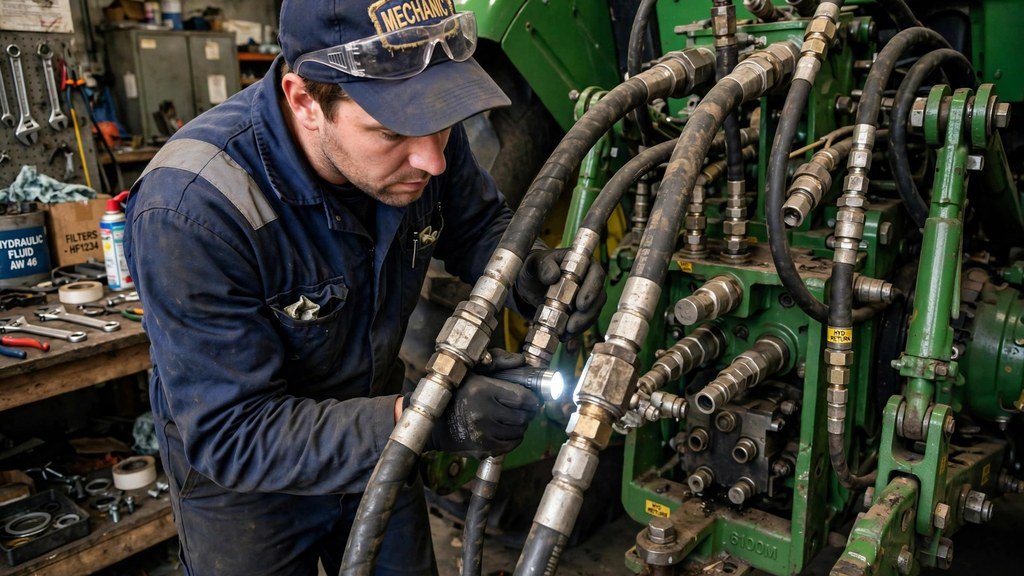
The e18 PowerShift is fully mechanical, which technicians generally prefer for longevity in this power class. It shifts under load, runs 40 km/h (25 mph), and Efficiency Manager picks the economical gear. The hydraulics — 55 gpm standard, 110 gpm optional, up to eight rear SCVs — are stout when John Deere 9R Series maintenance keeps the oil clean. The high-hour pattern is consistent: engines and transmissions rarely fail outright, while pumps, seals, and SCV couplers wear with oil condition and heat. For the 9.0L take on the same emissions philosophy, see our John Deere 8R Series maintenance guide.
Factors Affecting Service Life, Downtime and Repair Costs
Four things decide how a 9R ages, and John Deere 9R Series maintenance covers all four: oil discipline, heat management, ballast discipline, and software currency. Oil discipline — the heart of John Deere 9R Series maintenance — means never skipping the 500-hour service: dirty transmission-hydraulic oil is the fastest way to wear an e18. Heat management means keeping the cooling package clean; in dusty tillage a mid-season compressed-air blowout is worth the downtime. Ballast discipline means matching working weight to the implement: too little ballast and tires slip and overheat, too much overloads bearings and the hinge joint.
Downtime on a 9R hurts because the machine usually pulls the farm’s highest-acreage implement — which is why John Deere 9R Series maintenance planning often includes a paid PowerGard plan once factory coverage (24 months or 2,000 hours, whichever first) ends. Note the warranty detail: Deere’s ag warranty statement covers tractors for 24 months or 2,000 hours; the 60-month / 2,000-hour powertrain extension in that statement applies specifically to the 5E Series, not the 9R. Get any extended coverage in writing. History shows up in resale: a 2024 9R 590 with 493 hours recently listed at $559,900 against $365,000 for a 2022 with 2,033 hours — the market prices future repair risk into every missing record. Those numbers feed directly into our John Deere 9R Series ownership cost guide.
John Deere 9R Series Common Problems and Warning Signs
No tractor this complex is trouble-free. The good news is that the most common John Deere 9R Series maintenance problems owners report are diagnostic and peripheral — sensor faults, software gremlins, wear items — and most give clear warning signs first. What follows comes from owner discussions and dealer experience: watch-list items, not certainties.
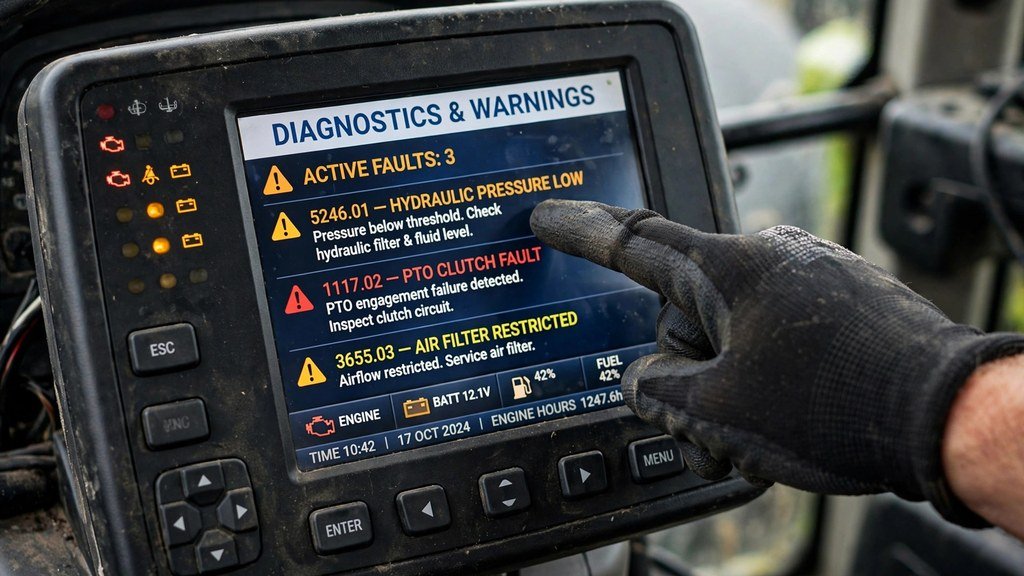
Engine, Electrical, Hydraulic and Transmission Symptoms
The most reported John Deere 9R Series maintenance headache is emissions and electrics: DEF-related derates. Symptoms start as a DEF-quality or SCR-fault warning, then power limiting if the code is ignored. Usual causes are stale DEF, a contaminated tank, or a failed NOx sensor — fixable, but a derated tractor at planting time is a breakdown in every sense that matters. Electrical complaints often trace to software: fault-code cascades that clear after an update. Keep software current at every dealer visit — cheap John Deere 9R Series maintenance that prevents expensive confusion.
Hydraulic warning signs include slow SCV response, a hitch that drifts down overnight, or oil that runs hot. Older-generation 9Rs drew owner complaints about cab heat from hydraulic reservoir placement — a 2014 NewAgTalk thread describes the cab’s right side becoming a heat radiator, worth knowing when shopping used. A hitch that will not hold points to lift-cylinder seal leakage; milky oil means water contamination needing a full change, not just a filter. Transmission symptoms are usually calibration: harsh shifts that smooth out after clutch recalibration. Genuine e18 mechanical trouble is rare but expensive — exactly why the 1,500-hour John Deere 9R Series maintenance service exists. For power behavior under load, see our John Deere 9R Series performance and fuel usage guide.
Diagnosing Faults and Evaluating Repair Needs
Diagnosis starts at the CommandCenter display — the 12.8-inch G5Plus (or Gen 4 4600 on earlier builds) shows active codes in plain language. Photograph them before clearing anything; intermittent codes tell the technician where to look. Many apparent problems are single-sensor failures: one bad NOx sensor can light up half the dash. A dealer can read code history, verify software versions, and run calibration routines for the e18 clutches and hydraulics.
Evaluate repairs in three tiers. Tier one is consumables and sensors — filters, seals, DEF parts — a few hundred to a couple thousand dollars with an obvious fix. Tier two is component work: SCV rebuild, steering cylinder reseal, alternator or starter — the 9R’s 250-amp alternator and 2,775-CCA battery bank make electrics pricier than on a utility tractor. Tier three is big iron: engine or transmission work reaching five figures. A 9R with a clean John Deere 9R Series maintenance record earns tier-three repairs back — used 9R 590s still command $365,000-plus at 2,000 hours, so a major repair usually pencils out against replacement. Get a written dealer diagnostic quote first. For model-by-model context, see our John Deere 9R Series review.
John Deere 9R Series Safety Checks and Used-Tractor Inspection
Buying a used 9R means buying someone else’s maintenance habits. A 2022 with 2,033 hours has done several seasons of heavy tillage; the difference between good and bad is almost entirely documented care. These John Deere 9R Series maintenance checks take about an hour with a flashlight and a notepad.
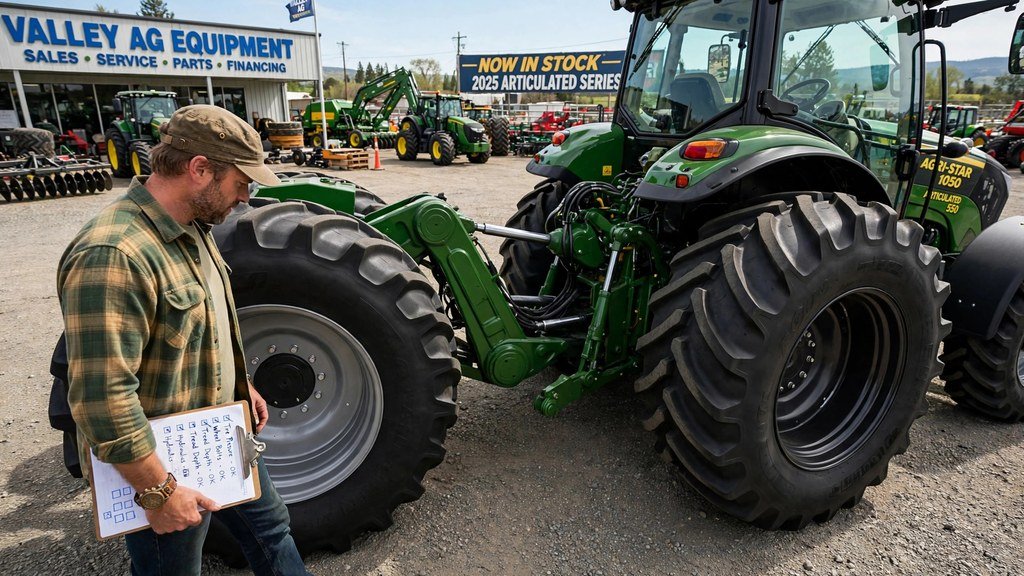
Checking Service History, Software Updates and Applicable Recalls
Ask for the complete service history first: oil change receipts, filter part numbers, transmission-hydraulic records, dealer work orders. A 2,000-hour tractor with no paperwork is a gamble. Verify the 500-hour engine services and 1,500-hour transmission-hydraulic services — every John Deere 9R Series maintenance interval — were done on time: a skipped interval on 60 gallons of shared oil is exactly how e18 problems start. Confirm software is current; outdated calibrations are a known source of phantom fault codes, and the fix is a dealer update, not parts.
On recalls: we could not verify any 9R-Series-specific CPSC recall in original CPSC releases. The widely reported September 2024 Deere brake-linkage recall covers compact utility tractors (1023E, 1025R, 2025R), not the 9R. Treat other reported campaigns as unconfirmed unless a dealer confirms them. Have a John Deere dealer run the serial number — it shows every campaign and bulletin applied to that machine — or call Deere at 800-537-8233. Also confirm the generation: current 9R 390–640 machines run the JD14 13.6L, while the older 9360R–9560R era used Cummins QSX 14.9L or John Deere PSS 13.5L engines with different parts and intervals.
Inspecting Tires, Steering, Hydraulics and Transmission Operation
Start at the tires. Check every tire for stubble damage, sidewall cuts, and uneven wear, and confirm duals or triples match across each axle — mismatched circumferences fight the driveline. With the engine running, work the steering lock to lock and watch the articulation joint: smooth movement, no clunking, cylinders extending evenly, no oil weeping at rod seals. Knocking from the tractor’s center under steering load is a walk-away signal unless the price reflects a hinge rebuild.
Run the hydraulics through their full range: cycle every SCV, raise and lower the Category 4N/4 hitch fully, and watch for smooth motion — jerky or creeping movement means air, contamination, or internal leakage. Dark, burnt-smelling, or milky hydraulic oil tells you the 1,500-hour John Deere 9R Series maintenance service was missed. Engage the 1,000-rpm PTO (1.75-inch shaft) and listen for bearing noise. Then drive and shift the e18 through all 18 gears: shifts crisp without banging or slipping, holding on a grade in every range. The video below walks through a 9 Series axle inspection — final drives take enormous loads on a 67,000-lb-ballasted articulated tractor, so this check belongs on every John Deere 9R Series maintenance inspection list.
Finish with cab and electrics: all work lights functioning, air conditioning strong under load, no active fault codes on the CommandCenter. The John Deere 7R Series maintenance guide applies the same pre-purchase philosophy to the smaller row-crop platform.
Frequently Asked Questions About John Deere 9R Series Maintenance
Quick answers to the most common John Deere 9R Series maintenance questions.
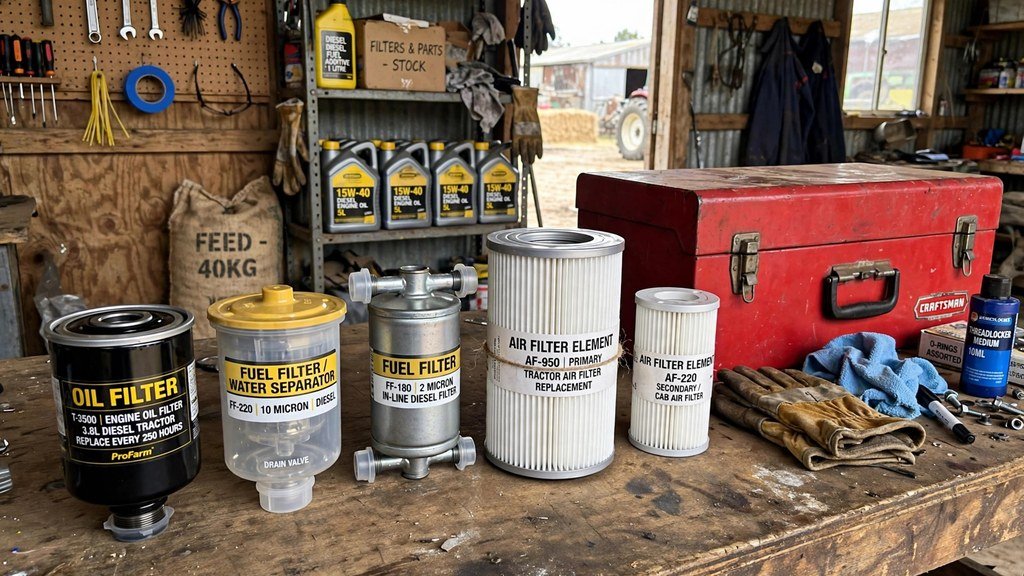
What is the engine oil change interval on a John Deere 9R Series?
Deere’s spec sheets list 500 hours for the 9R 390 through 9R 640 with approved oil and a genuine filter. The JD14 holds 16.9 gallons; daily fluid checks still apply between services.
Does the John Deere 9R Series have a DPF, and does it need parked regeneration?
No. US-spec 9Rs meet Final Tier 4 with DOC plus SCR using DEF — no diesel particulate filter, so no ash service and no parked regeneration. Keep the 31.7-gallon DEF tank filled with fresh DEF; stale or contaminated DEF is the top cause of SCR fault codes and derates.
How often should transmission and hydraulic oil be changed on a 9R?
The John Deere 9R Series maintenance interval for transmission-hydraulic oil is 1,500 hours, filter on the same schedule. The shared system holds about 60 gallons of Hy-Gard; a dealer service typically runs roughly $3,000 to $5,000 (estimate).
What warranty does John Deere offer on the 9R Series?
Deere’s ag warranty statement covers tractors for 24 months or 2,000 hours, whichever comes first. The 60-month / 2,000-hour powertrain extension in that statement is listed specifically for the 5E Series — it does not apply to the 9R. Many owners bridge the gap with a paid PowerGard plan.
What should I check on the articulated steering when buying a used 9R?
Work the steering lock to lock with the engine running: smooth motion, no clunking at the center hinge, cylinders extending evenly, no oil weeping at rod seals. Ask whether the hinge pin was greased on schedule. Knocking from the articulation joint is a major negotiating point — hinge rebuilds on a 40,000-plus-pound tractor are not cheap.
Are there any recalls on the John Deere 9R Series?
We could not verify any 9R-Series-specific recall in original CPSC releases. The September 2024 Deere brake recall covers compact utility models (1023E, 1025R, 2025R), not the 9R. Have a dealer run the serial number, or call Deere at 800-537-8233.