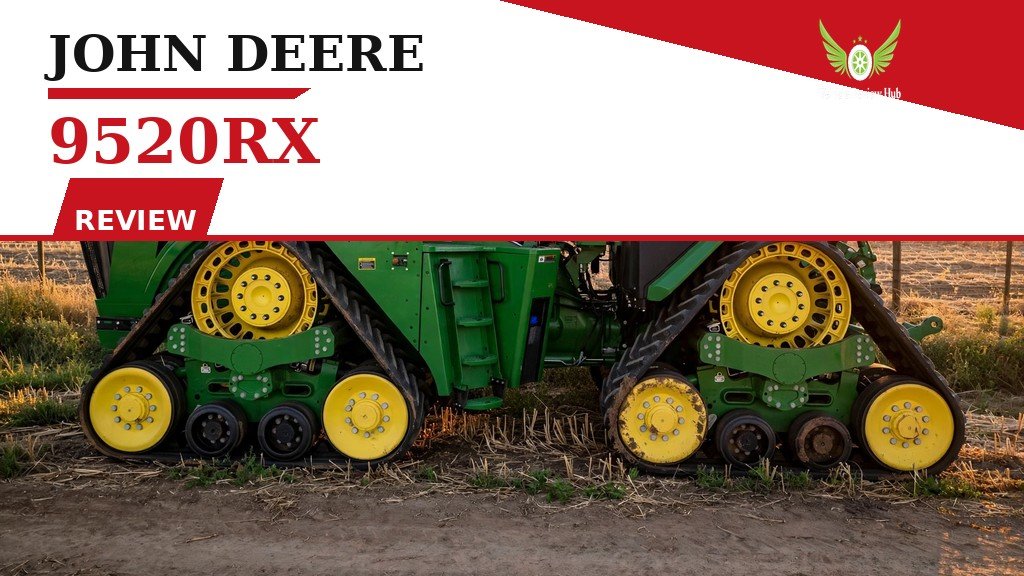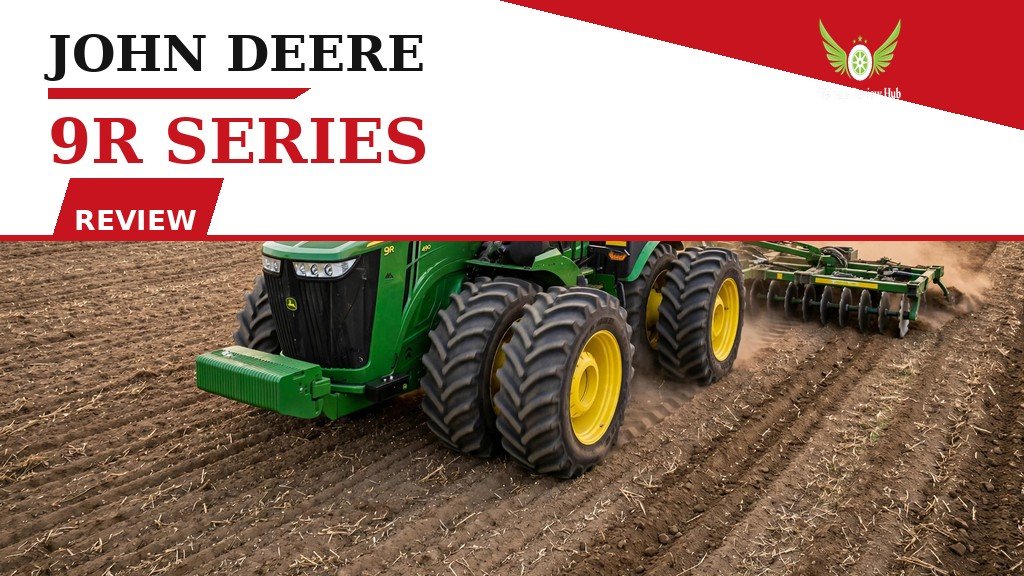
The John Deere 9R Series review starts with the essentials: this is Deere’s largest wheeled articulated tractor line, with six models from 390 to 640 horsepower, built in Waterloo, Iowa for the biggest tillage and seeding work. New base list prices run $581,900 (9R 390) to $803,613 (9R 640), with most field-ready configurations landing between $700,000 and $950,000. This John Deere 9R Series review covers the models, the JD14 13.6L engine, the e18 PowerShift transmission, and the wheeled 9R versus the tracked 9RT and 9RX.
Every 9R shares the same core hardware: the JD14 13.6-liter six-cylinder, the e18 18-speed PowerShift with Efficiency Manager, and an articulated chassis. The six models differ mainly in power output, with a 10 percent Intelligent Power Management boost holding rated speed under load. The biggest wheeled model, the 9R 640, delivers 640 rated and 691 maximum horsepower. In wet soils, the same engines are available on the tracked 9RT and 9RX lines, compared later in this John Deere 9R Series review.
John Deere 9R Series Review, Models and Price
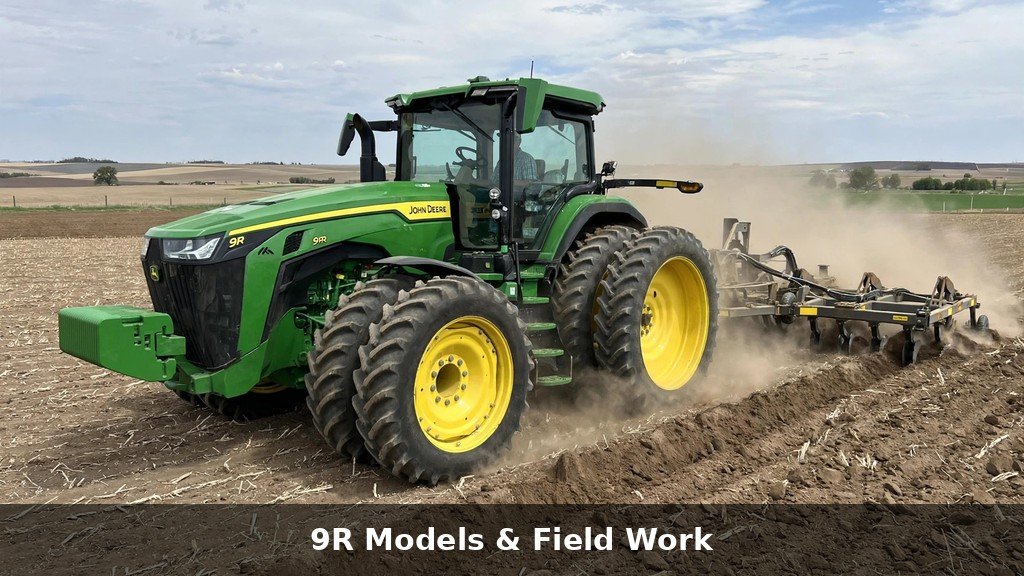
The 9R is the flagship of Deere’s articulated 4WD family, and the current generation has run since model year 2021 with the John Deere-built JD14 engine. Earlier generations used the Cummins QSX 14.9L; today’s 9R uses the 13.6L JD14 with DOC and SCR aftertreatment and no DPF, which this John Deere 9R Series review treats as one of the key changes worth understanding. The six-model lineup covers 390 to 640 horsepower so farms can match tractor size to implement width.
9R Tractor Models, Features and Intended Uses
The lineup is straightforward: the 9R 390 (385 hp SAE / 390 PS), 9R 440 (440 hp), 9R 490 (483 hp SAE / 490 PS), 9R 540 (540 hp), 9R 590 (590 hp), and 9R 640 (640 hp). Maximum boosted horsepower runs 423 to 691 hp, and peak torque runs 1,328 to 2,179 lb-ft with 38 percent torque rise.
Standard equipment on every 9R includes the e18 18-speed PowerShift with Efficiency Manager, full-locking front and rear differential locks, hydraulic power steering, a Generation 4 4600 CommandCenter display with AutoTrac readiness, JDLink capability, and cab suspension with an air-suspension seat. Most buyers order the 110-gpm dual-pump option and up to eight rear SCVs for large air seeders and planters, this John Deere 9R Series review notes from current dealer spec sheets.
Intended uses are consistent across the lineup: primary tillage, large air seeders and carts, nutrient application, scraper work, and high-speed transport at up to 25 mph. The 9R 390 and 9R 440 suit large row-crop operations running 30-to-50-foot implements, while the 9R 590 and 9R 640 are spec’d for the widest tools and heaviest draft loads. Our 8R Series review covers the 230-to-410 hp range for farms that don’t need an articulated chassis; the 9R picks up where the 8R leaves off.
New and Used Prices by Model, Year and Configuration
New prices follow Deere’s May 2026 base list prices (see table), verified from Deere’s published price pages. Few 9Rs sell at base price — a field-ready 9R 540 with duals, the 110-gpm option, six rear SCVs, PTO, AutoTrac and a StarFire receiver typically invoices well above $800,000 before dealer discount, and a loaded 9R 640 can approach $1,000,000. One dealer listing showed a new 2026-spec 9R 440 around $575,700 before options, consistent with the published list.
| Model | Rated HP | Deere Base List (May 2026) | Typical Used Range* |
|---|---|---|---|
| 9R 390 | 385 | $581,900 | $400,000–$470,000 |
| 9R 440 | 440 | $623,489 | $430,000–$520,000 |
| 9R 490 | 483 | $671,406 | $470,000–$560,000 |
| 9R 540 | 540 | $707,256 | $485,000–$590,000 |
| 9R 590 | 590 | $748,514 | $520,000–$630,000 |
| 9R 640 | 640 | $803,613 | $580,000–$700,000 |
* Used ranges are estimates from current dealer listings (2021-2024, 400-1,200 hours).
The used market is where most buyers of this class shop. Listings this John Deere 9R Series review found include a 2024 9R 440 with 489 hours at $430,999 in Washington, a 2023 9R 540 with 650 hours at $487,500 in Montana, and a 2024 9R 540 with 528 hours at $529,000 in Idaho. Low-hour 2023–2024 machines hold value well but trade roughly $150,000–$250,000 below a comparable new machine. Factory warranty is 24 months or 2,000 hours, so a used 9R with 1,200-plus hours has no factory coverage — paid PowerGard plans can fill that gap. For running costs, see our 9R Series ownership cost guide, which breaks down fuel, maintenance, and depreciation.
John Deere 9R Series Engine, Horsepower and Specifications
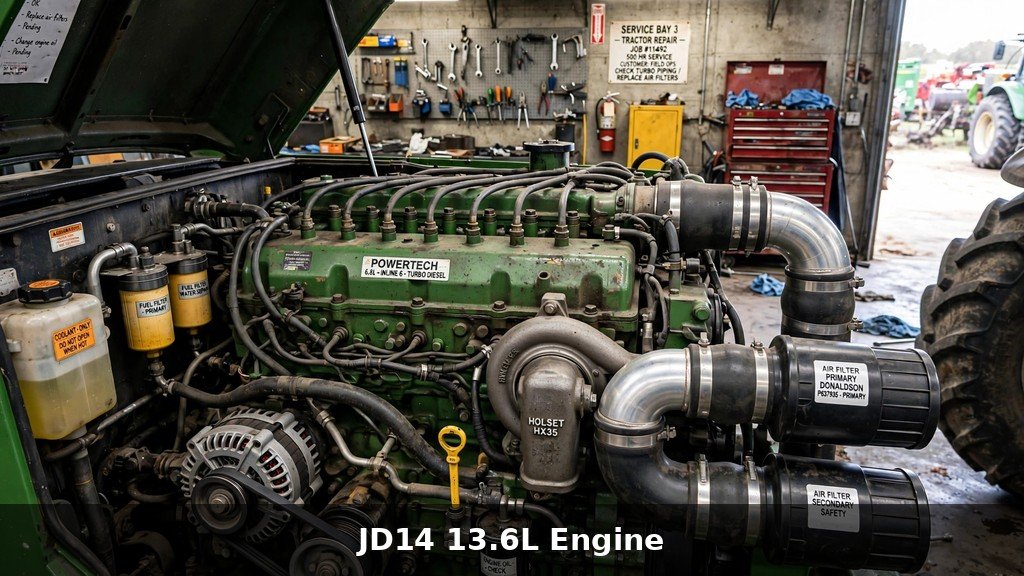
Every current 9R runs the John Deere JD14: a 13.6-liter (827 cu in) inline six-cylinder with wet-sleeve liners, common-rail injection, a wastegated turbo with air-to-air aftercooling, and cooled EGR. Rated speed is 2,100 rpm, with a 500-hour oil change interval. This John Deere 9R Series review treats the engine as the centerpiece: the JD14 replaced the Cummins QSX 14.9L, cutting fuel consumption and aftertreatment complexity.
Rated HP, Maximum HP, Engine Displacement and PTO Power
All six models share the 13.6-liter block in different tunes — rated/maximum: 385/423 hp (9R 390), 440/484 hp (9R 440), 483/532 hp SAE (9R 490), 540/594 hp (9R 540), 590/649 hp (9R 590), and 640/691 hp (9R 640). Maximum figures come from the 10 percent Intelligent Power Management boost, with peak torque from 1,328 to 2,179 lb-ft and 38 percent torque rise.
One detail this John Deere 9R Series review flags for buyers: rated PTO power is 335 hp SAE (249 kW) on every model. That is a driveline limit — the PTO driveline is rated for 335 hp, so the bigger models don’t deliver more PTO power than the smaller ones. The PTO is an independent 1,000-rpm, 1.75-inch 20-spline shaft, and many 9Rs are ordered with PTO but no 3-point hitch (drawbar-only for grain carts and air seeders). Real-world tillage fuel use runs roughly 12–18 gallons per hour, with the 400-gallon fuel and 31.7-gallon DEF tanks supporting long days between fill-ups. Our 9R Series performance and fuel usage guide, the companion to this John Deere 9R Series review, covers consumption numbers and how the e18 affects fuel per acre.
Dimensions, Hydraulics, Hitch Capacity and Fuel Capacity
The 9R is big by any measure, as this John Deere 9R Series review confirms: base weight starts around 45,980 lb (46,680 lb on the 9R 640), with maximum ballasted weight rated up to 60,000–62,000 lb depending on model, for ballasting to each operation’s soils. Wheelbase is 154 inches and overall length is 312.8 inches. The articulated chassis bends at the center pivot for steering, giving the 9R a tight turning radius for its size and keeping all tires pulling in the same line.
Hydraulics are a closed-center, pressure-and-flow-compensated system with 55 gpm standard and an optional 110-gpm dual-pump setup that most big air-seeder and planter operators choose. Four rear SCVs come standard, with up to eight available, and a single three-quarter-inch coupler delivers up to 42 gpm. The optional Category 4N three-point hitch lifts 15,000 lb (20,000 lb heavy-duty), with a Category 5 drawbar for towed implements. Capacities: 400-gallon fuel tank, 31.7-gallon DEF tank, 16.9 gallons of engine oil, 14.9 gallons of coolant, and a 60-gallon transmission-hydraulic sump. For the four-track alternative using the same engine and transmission, this John Deere 9R Series review points you to our 8RX Series review.
John Deere 9R Series Transmission and Implement Compatibility
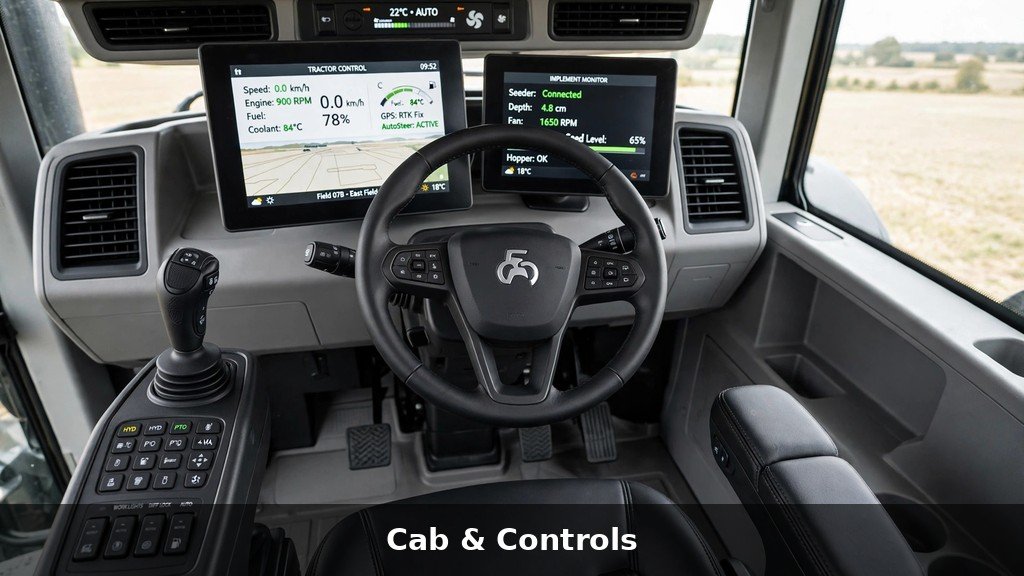
The e18 PowerShift is standard on every 9R — 18 forward and 6 reverse full-powershift speeds, an electronically controlled clutch reverser, and Efficiency Manager software that picks the right gear for the target speed and load. Owner reports are broadly positive on the e18’s smoothness under load, per this John Deere 9R Series review. It is a conventional powershift rather than a CVT, so expect discrete gear steps, not infinite speed control.
e18 PowerShift Transmission and Available Configurations
The e18 runs up to 40 km/h (25 mph) in top gear, among the fastest road speeds for an articulated tractor. Efficiency Manager shifts automatically based on load and target speed, reducing operator input during long passes and generally improving fuel economy over manual shifting. A creeper option exists for specialty applications, and the driveline adds front and rear full-locking electrohydraulic differential locks plus inboard planetary double-reduction final drives. This John Deere 9R Series review notes Deere offers no IVT or CVT on the 9R — the e18 is the only gearbox.
Our 9R Series maintenance and reliability guide, the companion to this John Deere 9R Series review, covers service intervals (engine oil at 500 hours, transmission/hydraulic oil at 1,500 hours, coolant at 6,000 hours) and the common owner-reported issues in more depth.
PTO, Drawbar, Hydraulic Flow and Heavy Implement Compatibility
Implement compatibility is where the 9R earns its price, and this John Deere 9R Series review puts it at the top of the buying checklist. The 335-hp PTO handles large grain carts, big manure spreaders, and heavy rotary tools, though the main connection on most 9Rs is the Category 5 drawbar pulling towed implements — disc rippers, vertical tillage, field cultivators, and air-seeder carts. With up to 110 gpm and eight rear SCVs, the 9R runs the largest air seeders and planters on the market, including central-fill planters with hydraulic downforce, all managed through the Generation 4 CommandCenter with ISOBUS implement control.
The three-point hitch confuses some used buyers, so this John Deere 9R Series review will be explicit: Deere lists a Category 4N hitch (15,000 or 20,000 lb lift) on the spec sheet, but many 9Rs are ordered drawbar-only. Verify the hitch is installed before you buy; adding it later is expensive. Articulated steering also means the rear implement doesn’t track exactly behind the tractor on headland turns, so GPS guidance with implement steering (Deere’s Active Implement Guidance) is popular on 9Rs pulling wide planters. For the smaller row-crop step below the 9R, see our 7R Series review and our 6R Series review for the mid-size range.
John Deere 9R Series vs. 9RT and 9RX Tractors
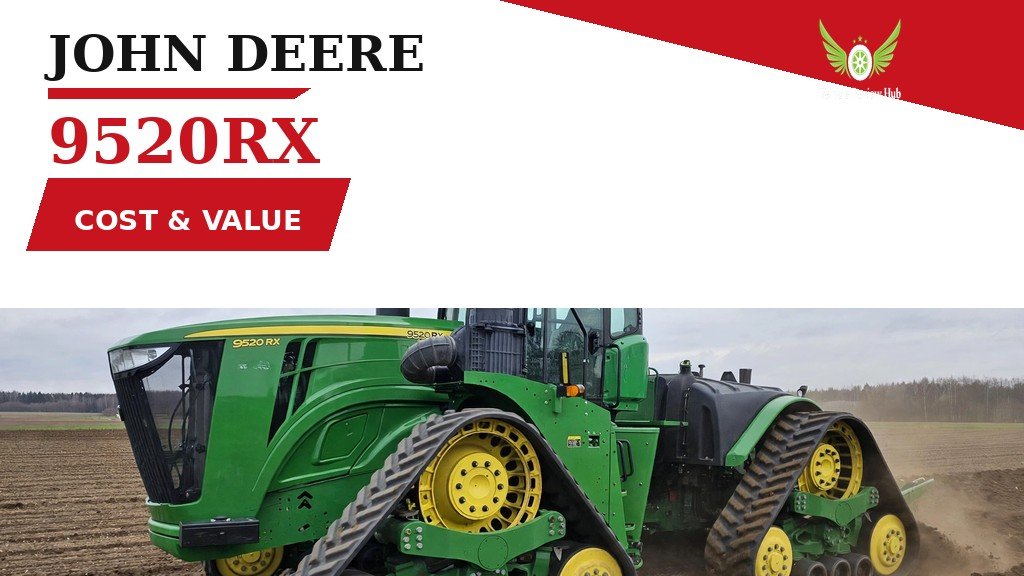
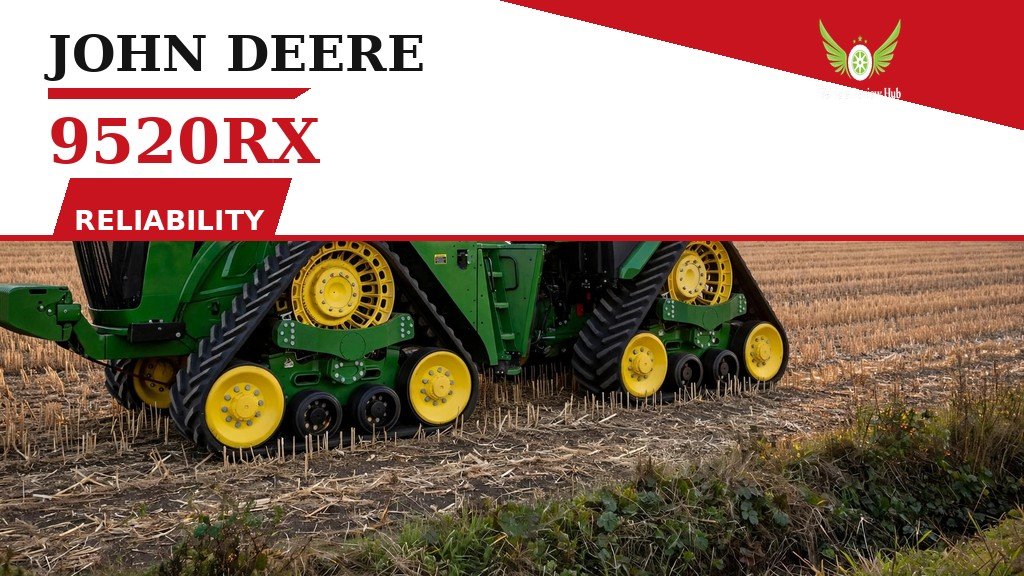
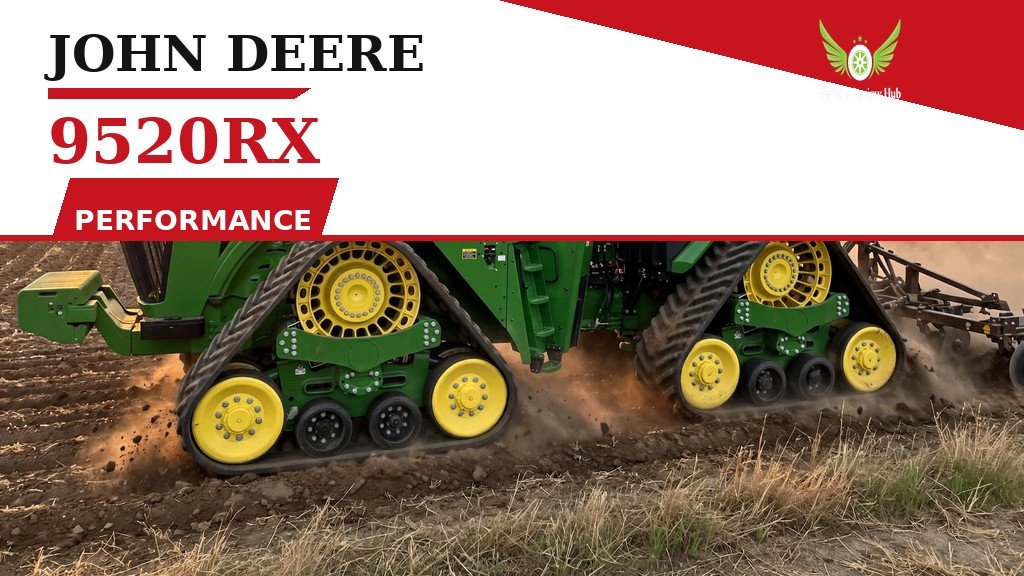
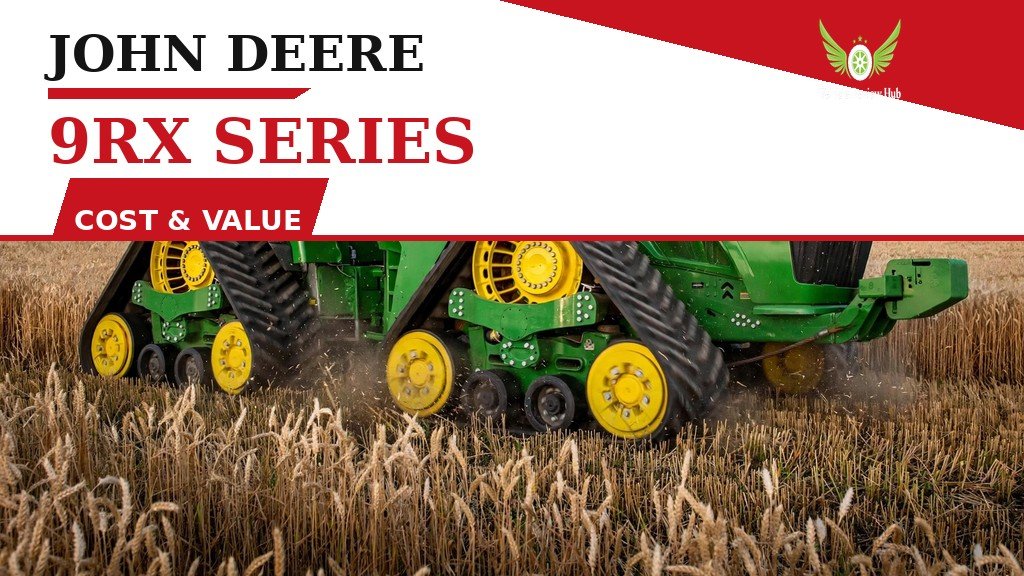
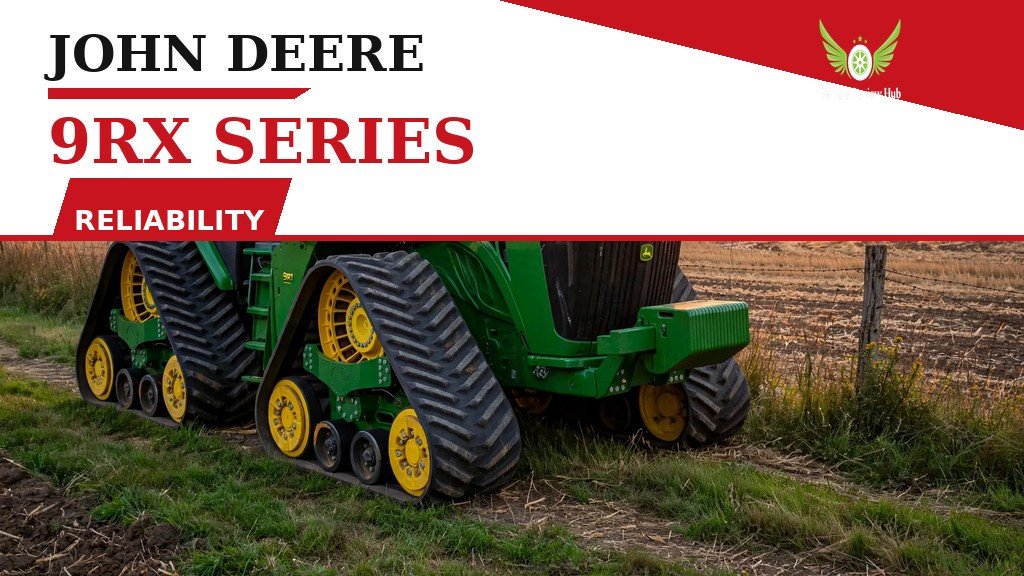
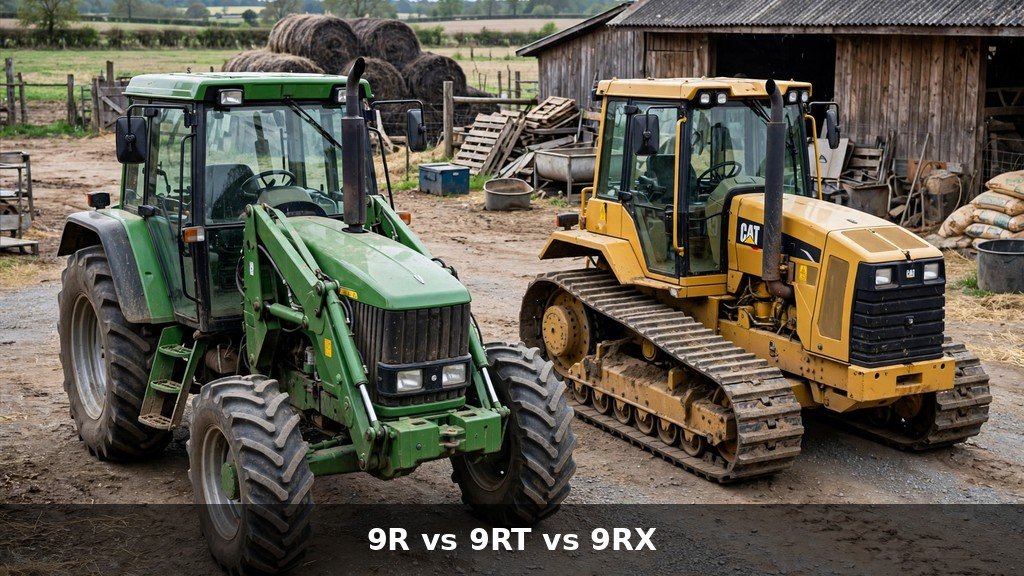
Deere sells the same JD14 engine and e18 transmission in three chassis: the wheeled 9R, the two-track 9RT (470, 520, 570), and the four-track 9RX (390 through 640). This John Deere 9R Series review compares them on traction, compaction, road transport, purchase price, and operating cost.
Differences in Wheeled, Two-Track and Four-Track Designs
The 9R rides on tires (singles, duals, or triples) and steers by center-pivot articulation. The 9RT uses two wide tracks; the 9RX uses four independent tracks, both steering with articulation plus track-speed control. All three share the JD14, the e18, the CommandCenter cab, and the precision ag stack — the chassis is the differentiator, and the key takeaway of this John Deere 9R Series review.
Tracks give far more ground contact area: less compaction, better flotation in wet conditions, and more usable drawbar pull in marginal soils. A 9RX weighs over 56,000 lb at base and runs 60,000-plus pounds ballasted while spreading that weight over four tracks. The tradeoff is purchase price (tracked models typically run $60,000–$120,000 more than the equivalent 9R), higher maintenance, slower road transport, and road-permit restrictions in some areas. The 9R is the cheapest to buy, the cheapest to maintain, and the fastest on the road — and with duals or triples it still delivers enormous traction on firm, dry soils, which is why this John Deere 9R Series review calls it the value pick for dry-land operations.
Which Tractor Configuration Fits Your Farm and Soil Conditions?
Firm soils and mostly dry conditions favor the wheeled 9R, which gives the most horsepower per dollar and the lowest operating cost — the core finding of this John Deere 9R Series review. Wet springs, heavy clay, or soft ground where getting stuck costs planting days favor the flotation of the 9RX — many no-till and strip-till operations in the upper Midwest and Canada run 9RXs for exactly this reason. The 9RT sits between them: two-track simplicity with most of the flotation benefit.
A 9R on duals can run roads at 25 mph and is far easier to move between farms; tracked machines are slower on roads and wear their tracks during transport. Resale is strong for all three, but tracked machines depreciate on their undercarriages — track condition is the first thing used buyers check, just like tires on a 9R. Our 9R Series ownership cost guide, the companion to this John Deere 9R Series review, compares total cost of ownership across wheeled and tracked configurations with real fuel, tire/track, and maintenance numbers.
Frequently Asked Questions About the John Deere 9R Series
Buyers researching a 9R ask the same core questions: how much power, how much money, how it compares with tracks, and what it costs to run. This John Deere 9R Series review answers them from Deere’s published specs, current dealer listings, and owner discussions.
How much horsepower does a John Deere 9R have?
Six models span 390 to 640 rated horsepower — 423 to 691 hp maximum with the 10 percent boost: 9R 390, 9R 440, 9R 490, 9R 540, 9R 590, and 9R 640. Rated PTO power is 335 hp on every model, limited by the PTO driveline.
How much does a new John Deere 9R cost?
New prices in this John Deere 9R Series review follow Deere’s May 2026 base list prices, verified from Deere’s published price pages: $581,900 (9R 390) to $803,613 (9R 640), with the 9R 440 at $623,489, the 9R 490 at $671,406, the 9R 540 at $707,256, and the 9R 590 at $748,514. Field-ready configurations typically land between $700,000 and $950,000. Used 2021–2024 machines with 400–1,200 hours typically list for $400,000–$700,000 depending on model and hours.
What engine is in the John Deere 9R Series?
The current generation uses the John Deere JD14, a 13.6-liter (827 cu in) inline six-cylinder diesel with cooled EGR and high-pressure common-rail injection. It meets Final Tier 4 with a diesel oxidation catalyst and selective catalytic reduction using DEF — US spec sheets do not list a diesel particulate filter. Engine family code is MJDXL13.5334, per the dealer spec sheets this John Deere 9R Series review checked. The JD14 replaced the Cummins QSX 14.9L in the 2018–2020 generation.
Is the John Deere 9R a good tractor for large farms?
For large-scale tillage, air seeding, and heavy drawbar work on firm soils, this John Deere 9R Series review rates the 9R as Deere’s flagship wheeled option, and owner reports are generally strong on engine performance, cab comfort, and e18 transmission reliability. The main caveats are purchase price, the machine’s size for farms under about 5,000 acres, and the reality that wet-soil operations often get better uptime from the tracked 9RT or 9RX. Verify hitch configuration (drawbar-only vs. Cat 4N hitch) and remaining warranty when buying used.
What is the difference between the 9R, 9RT, and 9RX?
All three share the JD14 and e18; only the chassis differs. The 9R is wheeled, the 9RT uses two tracks, the 9RX four tracks. Wheels cost less to buy, maintain, and transport; tracks give better flotation and less compaction but cost more up front and need undercarriage maintenance — the tradeoff this John Deere 9R Series review keeps coming back to.
What warranty does the John Deere 9R Series come with?
Deere covers the 9R for 24 months or 2,000 hours, whichever comes first, with paid PowerGard plans extending coverage up to eight years or 8,000 hours. The 60-month powertrain extension in Deere’s statement applies to the 5E Series, not the 9R. This John Deere 9R Series review could not verify any active CPSC safety recall specific to the current 9R generation; run the serial number through your Deere dealer’s records or call Deere at 800-537-8233 before buying used.