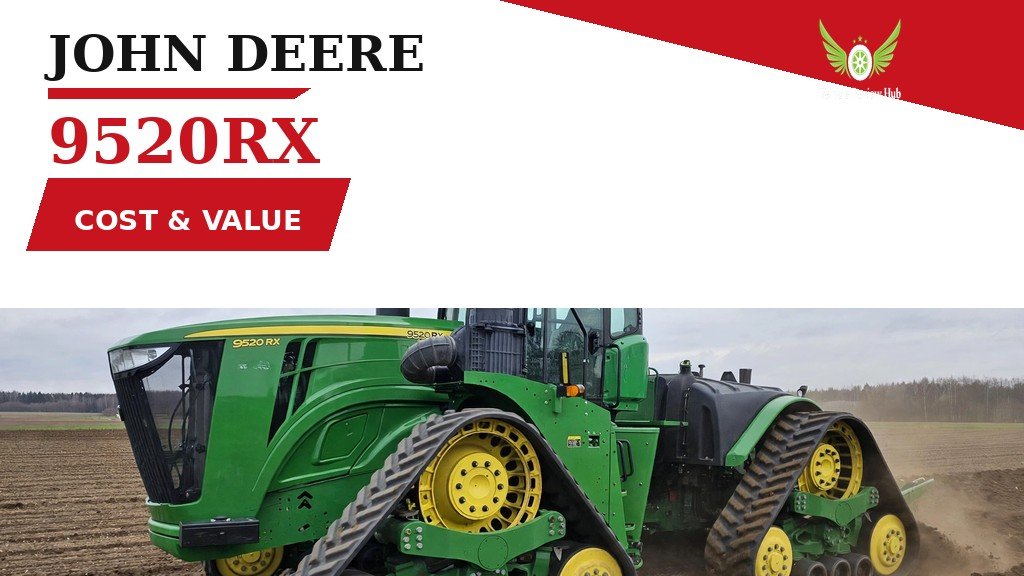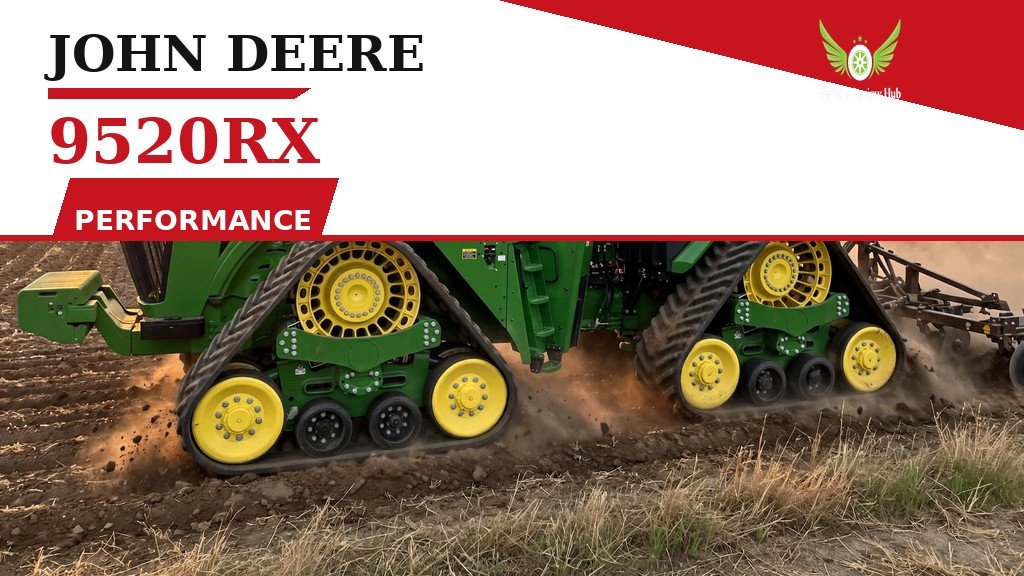
The John Deere 9520RX was Deere’s answer to one question: how do you put 520 rated horsepower to the ground without tearing the ground apart? Launched in 2015 as part of the first-ever four-track 9RX lineup, the 9520RX traded wheels for four Camso rubber belt tracks, spreading its roughly 50,000-pound bulk over a huge footprint. Production ended years ago — this is a used-market tractor now — but for farms doing heavy tillage on big acreage, John Deere 9520RX performance is still the reason these machines hold their value.
This guide covers John Deere 9520RX performance in the detail a used buyer needs: real fuel consumption bands from owner reports, what the 13.5L PowerTech PSS engine actually delivers, how the e18 PowerShift and four-track chassis behave in heavy draft work, and what owners report after thousands of hours. Every figure below comes from Deere spec sheets, dealer listings, or labeled owner reports — nothing is guessed.
John Deere 9520RX Fuel Consumption and Runtime
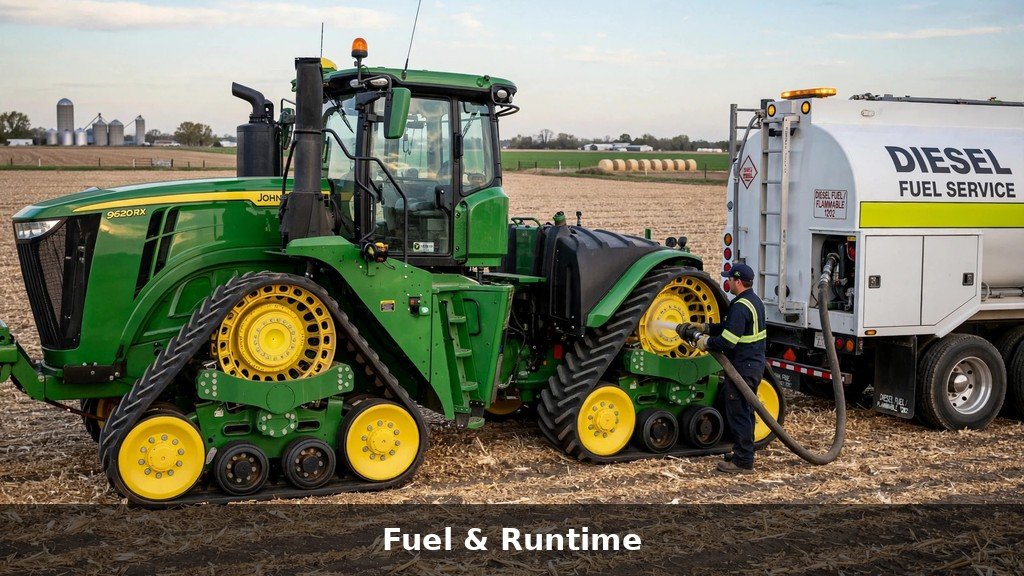
Fuel is the biggest operating expense on a 520-horsepower tractor, so John Deere 9520RX performance starts at the fuel pump. The 9520RX carries 400 gallons of diesel, and how fast that disappears depends entirely on what the tracks are doing. We could not find a published Nebraska Tractor Test figure for the 9520RX, so the bands below are owner-reported ranges, labeled as such.
Fuel Use During Heavy Tillage, Drawbar Work and Transport
Owners describe roughly 8–12 gph for light transport and road work on the 9520RX, climbing to 15–22 gph in normal field tillage. Sustained heavy-draft work — a 9520RX pulling a deep ripper or a 60-foot air seeder at full song, peak John Deere 9520RX performance — pushes consumption into the 20–28 gph range (owner-reported). These are big numbers, but they describe a big machine: at 520 rated hp with a 572-hp maximum, the 9520RX is burning fuel because it is doing the work of nearly two 300-hp tractors in one pass.
The 400-gallon fuel tank matters more than the hourly burn rate for daily logistics. At an all-day blended average of around 20 gph, John Deere 9520RX performance means roughly 18–20 hours between fills — enough for two full shifts of heavy tillage without stopping, which is exactly how these machines were designed to be used. Owners who track fuel carefully report that steady-load work at a constant ground speed is where John Deere 9520RX performance is most efficient; constant throttle changes and headland turns eat fuel faster than the draft load itself. For a closer look at what used machines cost to keep running, our 9520RX ownership cost and buying guide works through the full budget.
How Workload, Transmission and Field Conditions Affect Fuel Economy
Three things move John Deere 9520RX performance at the fuel pump more than anything else: implement draft, ground speed, and how the e18 PowerShift’s Efficiency Manager is being used. The Efficiency Manager automatically matches engine speed to the load, and owners who let it do its job — rather than holding the throttle wide open out of habit — report noticeably better fuel figures for the same acres per hour. A 9520RX pulling a moderately loaded disc at 1,600 rpm through Efficiency Manager can do the same acres as a manually shifted run at 2,100 rpm while burning several gallons less per hour.
Field conditions matter just as much. Soft, wet ground that lets the tracks slip even a few percent wastes fuel two ways: the engine burns more to maintain speed, and the implement covers fewer acres per hour. This is where four-track traction pays for itself — the 9520RX’s four belts maintain grip in conditions that would have a wheeled tractor spinning, so more of every gallon goes into forward motion. Sandy, loose, or wet conditions that defeat wheels are exactly where John Deere 9520RX performance justifies its fuel bill. The newer 9RX Series performance guide compares how the current-generation four-tracks handle the same fuel-economy question.
John Deere 9520RX Performance for Large-Scale Farming
John Deere 9520RX performance exists for one job: pulling the biggest implements at the speeds big-acreage farms demand. Its 13.5-liter PowerTech PSS six-cylinder is rated 520 hp at 2,100 rpm with a 572-hp maximum under power boost, and the four-track chassis turns that into drawbar pull that a wheeled tractor of the same horsepower cannot match in real soil conditions.
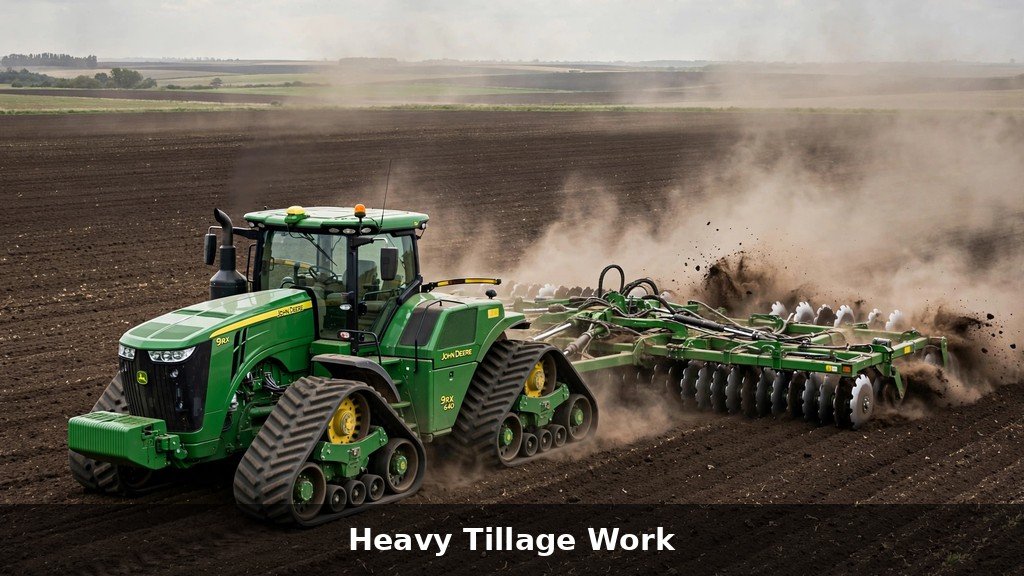
Tillage, Planting, Seeding and Heavy Implement Operation
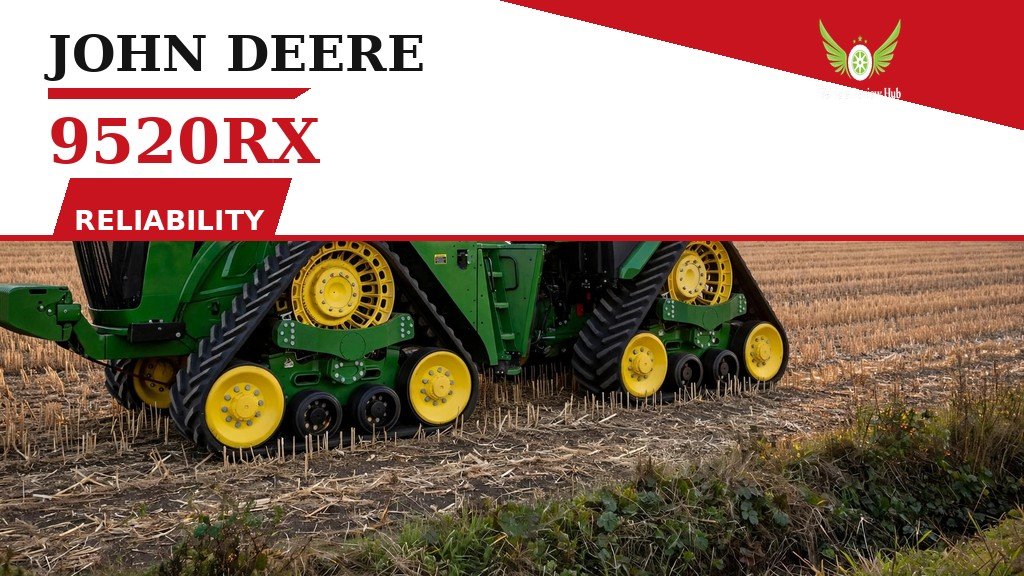
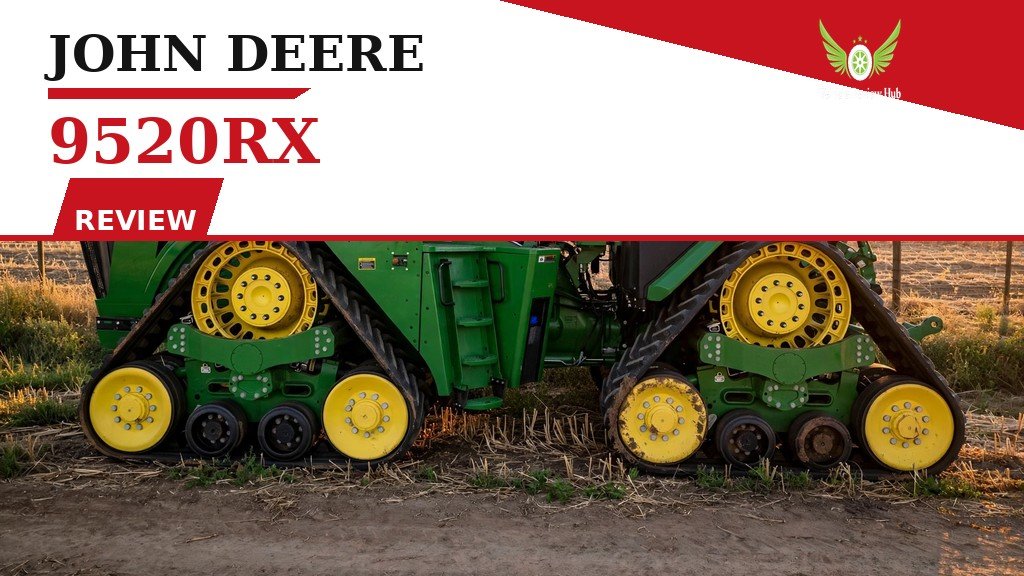
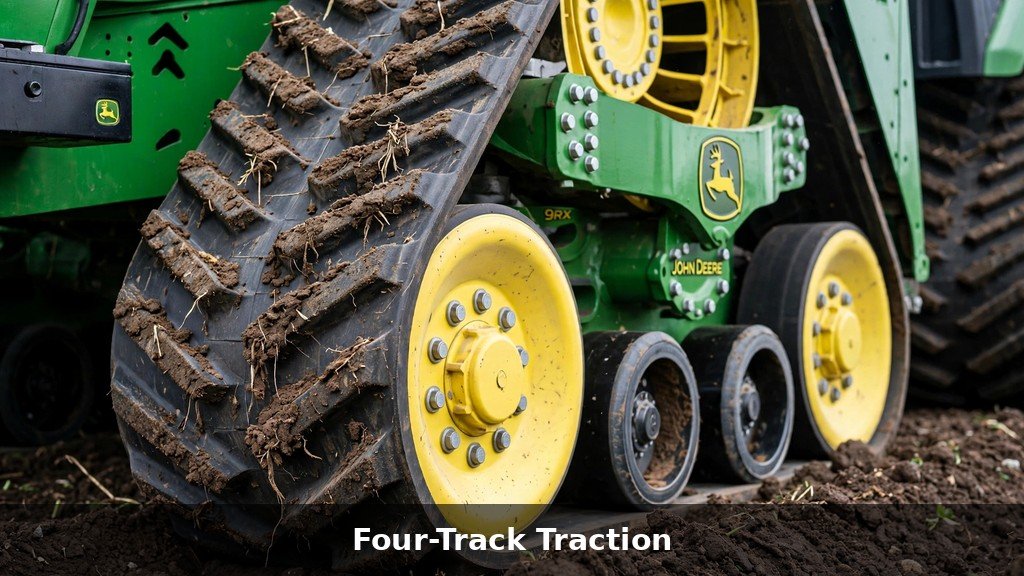
In heavy tillage, John Deere 9520RX performance is in its element: deep rippers, 50- to 60-foot discs, and large chisel plows are the implements owners buy it for. The four-track layout — Camso 3500 and 6500 Ag Series belts in 18-, 24-, 30-, or 36-inch widths — puts far more rubber on the ground than any dual setup, so the tractor holds its line and speed where wheels would spin out. Owners pulling 60-foot air seeding trains report that John Deere 9520RX performance holds consistent depth and speed across rolling ground, thanks in part to the parallel-plane four-bar linkage undercarriage with four inches of vertical travel that keeps all four belts in contact.
Hydraulic capacity backs up the draft capability. The 9520RX ships with a 58-gpm standard pump or an optional 115-gpm dual-pump system, feeding four to six rear SCVs (up to eight with field-installed valves) — enough flow and connections for the biggest air seeders, planters, and anhydrous applicators. Owners running modern seeding trains call out the 115-gpm option as the one to have: with fan motors, markers, and meter drives all drawing flow at once, the base pump can feel marginal on the most demanding implements. The video below — a 9520RX working a fertilizer spreader — shows John Deere 9520RX performance at field pace:
Drawbar Pull, Four-Track Traction and High-Load Performance
John Deere 9520RX performance is drawbar-only — there is no rear three-point hitch — so everything it pulls goes through a Category 5 drawbar rated for 12,000 lb of maximum vertical load. The 1,000-rpm PTO (44mm, 20-spline, electrohydraulic engagement) is rated around 330–335 hp SAE, and Deere’s 10 percent power boost adds horsepower for transport and mobile-PTO applications. Rated PTO torque rise of 38 percent gives John Deere 9520RX performance its lugging character: when the draft load spikes, the 13.5L drops into its torque peak rather than stalling.
Four-track traction is the defining trait of John Deere 9520RX performance. Owners consistently report that the tractor out-pulls wheeled articulated machines of equal horsepower in soft or loose conditions, with less wheel — or rather track — slip and far less soil disturbance. The trade-off is turning: articulated four-tracks don’t pivot as tightly as a wheeled tractor, and owners caution against power-turning on headlands with the belts under load, which accelerates belt wear. In straight-line draft work, though, owners describe John Deere 9520RX performance as the most sure-footed they have ever run. Compared with its two-track cousin, the 9R Series performance guide shows how the wheeled 9R line handles the same heavy-draft question.
John Deere 9520RX Handling, Comfort and Operating Limits
A 9520RX weighs roughly 50,000 pounds before ballast, so handling is about managing mass, not agility. The articulated steering bends the tractor in the middle rather than turning wheels, which gives it a tight relative turning radius for its size but demands respect for the track system on headland turns.
Cab Comfort, Controls and Operator Visibility
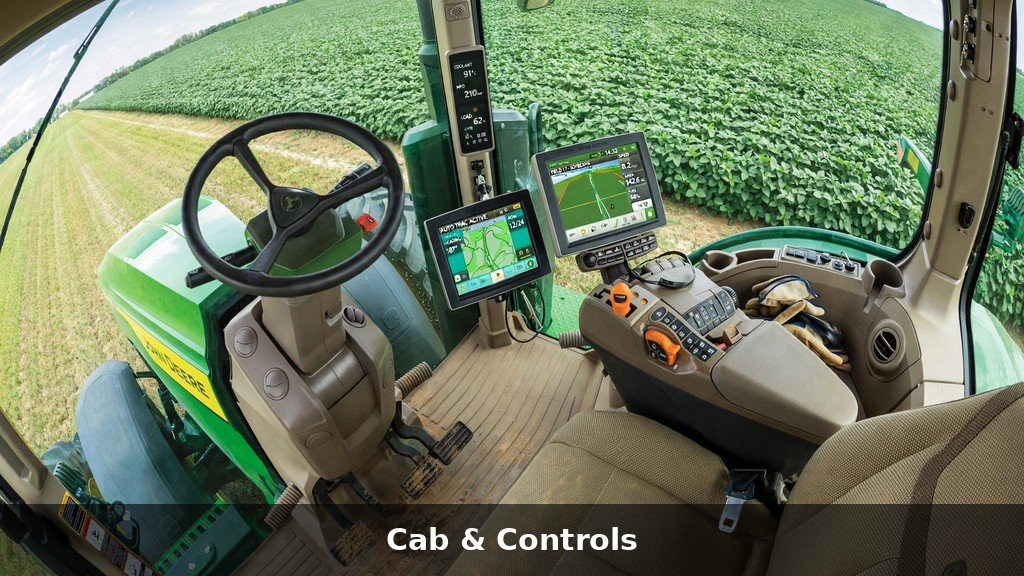
The CommandView III cab with cab suspension is where a 9520RX operator spends 14-hour days, and owners rate it highly for long shifts: the suspended cab and the four-bar undercarriage isolate the operator from the impacts and vibration that a rigid chassis would transmit. The Generation 4 CommandCenter — a 7-inch 4100 display standard, with the 10-inch 4600 optional — runs guidance, ISOBUS implements, and the tractor’s own systems through one interface, and most used machines on the market today carry StarFire 6000-ready hardware with premium activation, as current used 9520RX listings show.
Visibility is a strong point owners mention repeatedly: the cab sits high with big glass all around, and the four-track layout leaves a clear view of the drawbar and implement. The leather comfort package, premium lighting, and tow cable show up on most well-optioned used machines. After thousands of hours, owners say the cab wears well — seat, seals, and trim hold up — though they advise checking cab suspension bushings and door seals on high-hour machines, covered in our 9520RX maintenance and common problems guide.
Track Width, Soil Conditions, Turning and Field Limitations
The 9520RX was sold with track widths of 18, 24, 30, or 36 inches and tread spacings of 80, 88, or 120 inches on the narrow undercarriage (87 or 120 on the wide), so a used machine’s footprint is whatever its original buyer ordered. Owners choose widths to match their row spacing and compaction goals: 30- and 36-inch belts are the most common on used machines because they maximize flotation for tillage work, while 18- and 24-inch setups suit controlled-traffic and row-crop operations.
The limits are real and owners are honest about them. Tracked machines do not like road travel — extended roading wears belts far faster than field work, and most owners trailer or transport short distances rather than road the machine. Soft-field flotation is excellent, but wet clay that packs into the undercarriage needs clearing to avoid mid-roller wear. And while four tracks turn tighter than the tractor’s size suggests, spot turns and counter-rotation-style maneuvers destroy belts; owners treat headland turns as deliberate, wide arcs. These are the operating habits that separate a 4,000-hour belt life from a premature replacement, which our 9520RX review and specs guide covers in the buying checklist.
John Deere 9520RX Real-World Owner Experience
With the 9520RX now a decade into the used market, owner experience is the richest source of John Deere 9520RX performance truth. The consensus from forums and used-buyer reports is consistent: the tractor does exactly what it was built to do, and its weak points are known, manageable, and mostly about the tracks.
Owner-Reported Benefits, Complaints and Operating Trade-Offs
The benefits owners name most: unstoppable traction in conditions that defeat wheeled tractors, excellent ride quality from the suspended cab and four-bar undercarriage, and the 13.5L engine’s willingness to lug through load spikes without fuss. Several owners report that John Deere 9520RX performance replaced two smaller tractors on their operation — one pass with a 60-foot tool instead of two passes with smaller implements — which is where the fuel math starts working in its favor.
The complaints are equally consistent. Belt replacement cost is the big one: a full set of four Camso belts runs into five figures installed, and owners budget for it from day one. The aftertreatment system (cooled EGR with DOC, DPF, and SCR using DEF) draws the usual modern-diesel complaints — regens, DEF handling, and sensor issues on neglected machines — though owners who run the tractor hard and keep DEF fresh report few problems. DEF consumption runs roughly 2–3 percent of diesel use from the 31.7-gallon DEF tank. Cab electrical gremlins and hydraulic coupler wear show up on high-hour machines, but the engine, e18 transmission, and final drives earn strong reliability marks from owners. The 8RX Series performance guide offers a useful comparison with the smaller four-track family.
Choosing the Right Track Setup for Your Farm Work
For a used 9520RX, the track setup matters as much as the hours. Owners advise buying the width that matches your operation rather than planning to swap belts: 30-inch belts are the sweet spot for most tillage operations, 36-inch for maximum flotation on soft ground, and 18- or 24-inch for row-crop and controlled-traffic work. Check belt lug height and look for cuts, chunking, and uneven wear that signals alignment or undercarriage issues — a full belt replacement can cost more than the discount on a cheap high-hour machine.
The 115-gpm hydraulic option, six or more rear SCVs, the 4600 display with premium activation, and cab suspension are the options owners say to prioritize on the used market. The 58-gpm base pump is adequate for tillage but can feel stretched on big air seeders. And since the 9520RX is drawbar-only with no three-point hitch, confirm that your implements are all drawbar or PTO-drawn before buying — there is no hitch to add later. Our 9520RX ownership cost guide works through what a used machine really costs to own.
Frequently Asked Questions About John Deere 9520RX Performance
Quick answers to the most common questions about John Deere 9520RX performance in real farm work.

How much horsepower does the John Deere 9520RX have?
The 9520RX is rated 520 hp at 2,100 rpm from its John Deere PowerTech PSS 13.5L six-cylinder, with a maximum of about 572 hp under power boost. Rated PTO power is around 330–335 hp SAE, and the engine produces its peak torque with a 38 percent torque rise that gives it strong lugging ability in heavy draft.
What is the fuel consumption of a 9520RX?
John Deere 9520RX performance, in owner-reported bands, runs roughly 8–12 gph for light transport and road work, 15–22 gph in normal field tillage, and 20–28 gph in sustained heavy-draft work. The 400-gallon tank gives roughly 15–25 hours of runtime depending on the load. No published Nebraska Tractor Test figure was available for the 9520RX at the time of writing, so treat these as owner-reported ranges.
Does the 9520RX need DEF fluid?
Yes. Unlike the newest 9RX models with the JD18 engine (which run EGR-only with no DEF), the 9520RX’s 13.5L PowerTech PSS uses cooled EGR with DOC, DPF, and SCR aftertreatment and consumes DEF from a 31.7-gallon tank — roughly 2–3 percent of diesel use. Keep DEF fresh and the tank above empty to avoid derates.
Can the 9520RX pull a 60-foot air seeder?
Yes — that is exactly the work it was built for. Owners report John Deere 9520RX performance handles 50- to 60-foot air seeding trains, deep rippers, and large discs on big acreage. For the biggest seeding trains with multiple fan and meter motors, the optional 115-gpm hydraulic pump is the setup owners recommend over the 58-gpm base pump.
How does the 9520RX compare to the newer 9RX 710?
The 9RX 710 is the modern four-track successor with 710 rated hp from the new JD18 engine (EGR-only, no DEF), more hydraulic flow, and a redesigned cab — a significantly more capable and more expensive machine. The 9520RX counters with a far lower used price: it offers roughly 70 percent of the 710’s horsepower for a fraction of the money, making John Deere 9520RX performance the value play for operations that need four-track traction without new-machine pricing.
Is the 9520RX good in wet conditions?
Owners rate four-track flotation as one of John Deere 9520RX performance’s biggest strengths — it keeps working in soft, wet conditions where wheeled tractors spin out. The caveat is undercarriage care: wet clay that packs around the mid-rollers and idlers needs clearing, and extended road travel should be avoided since roading wears belts far faster than field work.