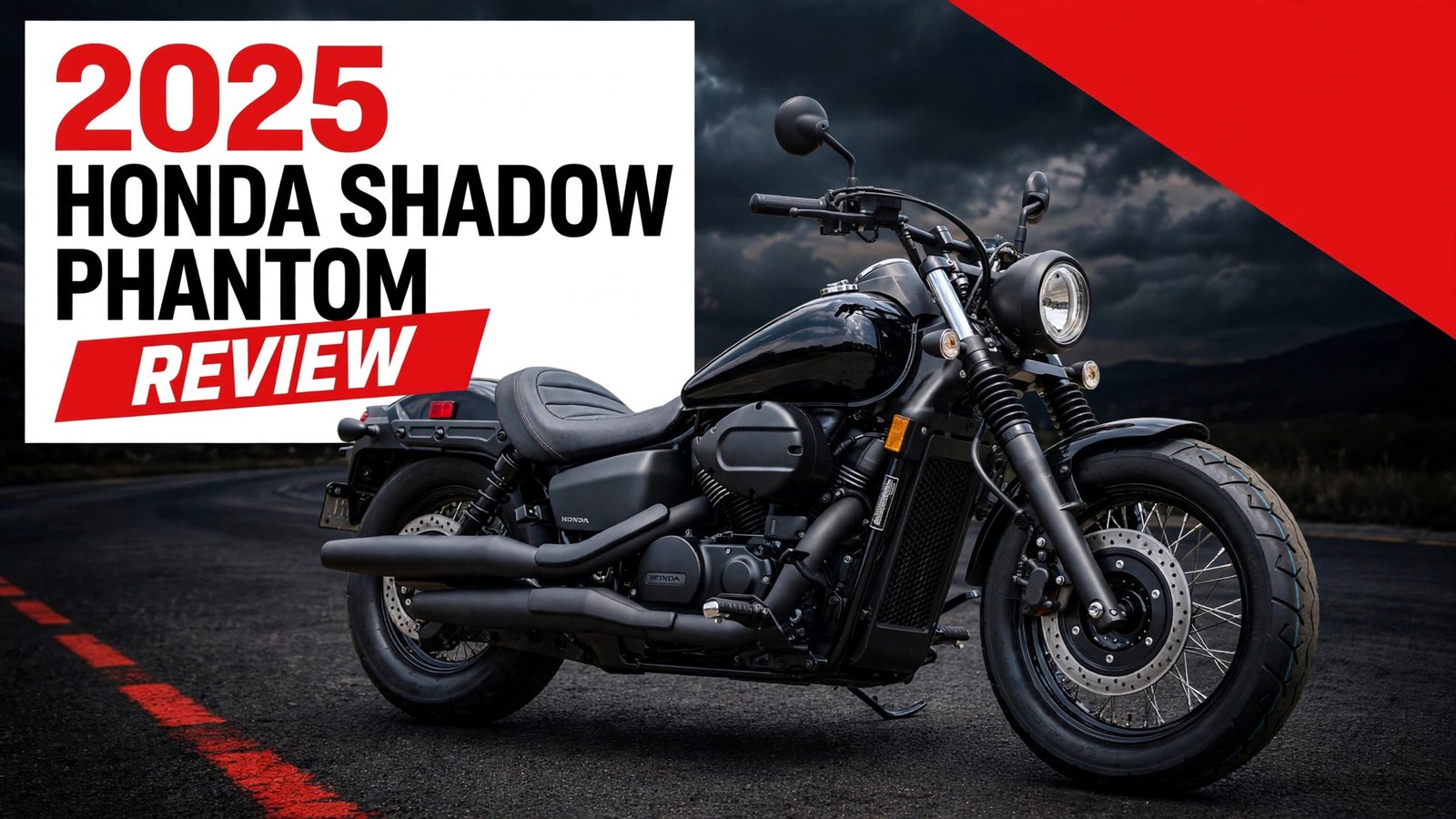
The Honda Shadow Phantom is a factory bobber built around a proven 745cc liquid-cooled V-twin, a shaft drive, and a 25.6-inch seat, one of the lowest in motorcycling. For 2025, the only model year currently listed by Honda in the United States, it costs $8,699 plus a $600 destination charge, or $9,299 before tax and fees, with ABS standard. This Honda Shadow Phantom review covers the price, specifications, and riding experience, so you can judge whether this simple, blacked-out cruiser is right for you.
The Phantom is not a new idea, and that is the point. It is the latest chapter in a Shadow line that began in 1983, little changed in fundamentals since its 2010 arrival. This Honda Shadow Phantom review treats that simplicity as a feature to be tested, not a flaw to be excused, and this Honda Shadow Phantom review separates verified facts from dealer claims.
Overview and Model-Year Updates
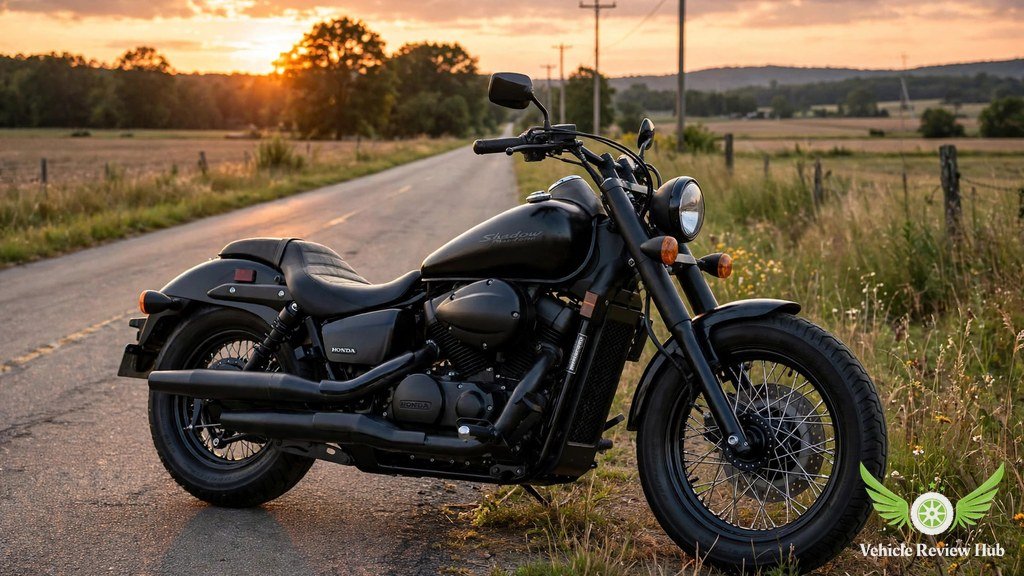
The Shadow Phantom is Honda’s blacked-out bobber version of the VT750 Shadow platform: shortened fenders, a solo saddle, black wire-spoke wheels, and blacked-out running gear. In this Honda Shadow Phantom review, its appeal is clearest for newer riders stepping up, returning riders wanting something light and simple, and experienced riders wanting a second, low-maintenance cruiser.

What Is the Honda Shadow Phantom and Who Is It Designed For?
In this Honda Shadow Phantom review, the Phantom is the bobber-styled member of Honda’s Shadow family, a V-twin cruiser line that has run for more than four decades. It uses the same 745cc liquid-cooled 52-degree V-twin and shaft drive as the Shadow Aero, but swaps the Aero’s retro touring trim for blacked-out parts, a solo seat, and bobbed fenders, so it looks like a custom bike straight from the showroom. Honda designed it for riders who value a low seat and a relaxed riding position, and this Honda Shadow Phantom review finds the 25.6-inch seat and narrow waist make flat-footing easy.
US History 2010 to 2025: The 2024 Update and No 2026 Model
In this Honda Shadow Phantom review, the Shadow story starts in 1983, the 750 line took modern form with the 1998 ACE 750, the 745cc engine arrived with the 2004 Aero relaunch, and the Phantom debuted in 2010 at $7,999. Honda skipped model year 2021, then resumed with a 2022 model. The big change came for 2024: a rear disc brake, LED signals, fork gaiters, bobbed fenders, new paint and graphics, machined fins, a blacked-out exhaust, a redesigned solo seat, and a forward handlebar. As of November 2026, Honda has announced no distinct 2026 Phantom, and this Honda Shadow Phantom review treats third-party 2026 carryover listings as predictions, not Honda announcements.
Engine and Specifications
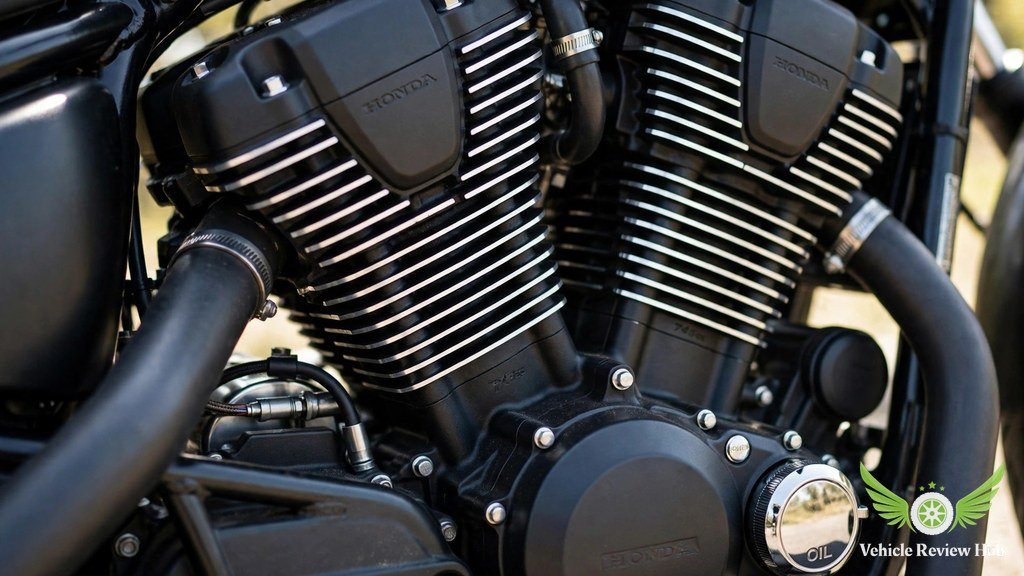
The Phantom’s engine is the least surprising part of the motorcycle, and that is a compliment. It is a 745cc liquid-cooled 52-degree V-twin with a single overhead camshaft, three valves per cylinder, dual-spark chambers, and fuel injection through a 34mm throttle body, bolted to a wide-ratio five-speed gearbox and shaft final drive. This Honda Shadow Phantom review covers the full specification set below, and this Honda Shadow Phantom review finds the drivetrain’s simplicity is the heart of its appeal.
745cc Liquid-Cooled 52-Degree V-Twin, 5-Speed Gearbox and Shaft Drive
The 745cc V-twin uses a 79mm bore and 76mm stroke with a 9.6:1 compression ratio that runs on regular fuel, and liquid cooling keeps temperatures consistent in traffic and hot weather. Honda does not publish official horsepower or torque figures for the Phantom, so any quoted factory power number is a guess. The only instrumented figure with a clear source is Rider magazine’s 2010 road test: 38 horsepower and 43 pound-feet at the rear wheel, and this Honda Shadow Phantom review uses that figure rather than any aggregator estimate. The shaft final drive needs almost no attention, and this Honda Shadow Phantom review counts that among the bike’s best ownership features.
Dimensions, 25.6-Inch Seat Height and Weight From 543 to 553 lb
In this Honda Shadow Phantom review, the Phantom’s dimensions explain its accessibility and road manners: a 25.6-inch seat, a 64.5-inch wheelbase, 34 degrees of rake with 6.3 inches of trail, and a 3.9-gallon tank. Tires are 120/90-17 front and 160/80-15 rear, both Dunlop D404s on black wire-spoke wheels, and the 41mm fork and dual preload-adjustable shocks give a controlled ride, though short rear travel transmits sharper bumps. The weight spread here is simply the ABS hardware: RevZilla’s table lists the 2024 Phantom at 543 pounds wet without ABS and 553 pounds with ABS, and this Honda Shadow Phantom review notes the ABS-only 2025 model is listed at 553 pounds.
| Specification | 2025 Honda Shadow Phantom ABS |
|---|---|
| Engine | 745cc liquid-cooled 52-degree V-twin, SOHC, 3 valves per cylinder |
| Fuel system | Programmed Fuel Injection, 34mm throttle body, 9.6:1 compression |
| Transmission / final drive | Wide-ratio 5-speed manual, shaft drive |
| Seat height | 25.6 inches |
| Wheelbase / rake / trail | 64.5 inches / 34 degrees / 6.3 inches |
| Fuel capacity | 3.9 gallons |
| Tires | 120/90-17 front, 160/80-15 rear (Dunlop D404) |
| Curb weight | 553 lb (ABS model); 543 lb for the 2024 non-ABS model |
Price and Market Availability
The Phantom’s price is one of its strongest arguments. At $8,699 plus $600 destination, it undercuts almost every comparable V-twin cruiser, with ABS, fuel injection, and a shaft drive as standard. The 2024 model started at $8,399 without ABS and $8,699 with ABS, so ABS-only for 2025 did not raise the headline price. This Honda Shadow Phantom review also notes that the 2024 price was only about five percent above the 2010 launch price of $7,999, and this Honda Shadow Phantom review considers that remarkable value retention.

Honda Shadow Phantom Price in the USA: $8,699 for 2025 Plus $600 Destination
The 2025 Shadow Phantom ABS carries an MSRP of $8,699, and Honda adds a $600 destination charge, bringing the pre-tax total to $9,299. For this Honda Shadow Phantom review, there is a single trim for 2025, so there is no cheaper non-ABS version and no premium version to be upsold into, and the warranty is 12 months. Ownership costs are covered in the companion Phantom reliability guide. Against its rivals, the Phantom’s pricing is difficult to beat: the Harley-Davidson Nightster starts well above $13,000, and Honda’s own Fury review covers a bigger chopper at $11,499, so this Honda Shadow Phantom review rates $9,299 as the value benchmark.
Deep Pearl Gray and Flare Orange Metallic Colours and Dealer Availability
For 2025, the Phantom comes in Deep Pearl Gray and Flare Orange Metallic, both with the same blacked-out engine, frame, fork, wheels, headlight, and bobber details, so the choice is purely about paint. Flare Orange Metallic is new for 2025; the 2024 orange was listed simply as Orange Metallic. Dealer listings from November 2026 show new 2025 Phantoms still advertised across the United States, with at least one at $7,999 on sale against the $8,699 MSRP. Buyers looking for a 2024 leftover may also find stock, and this Honda Shadow Phantom review recommends checking both years, with the full purchase checklist in the companion Phantom buying guide.
Design, Features and Technology
The Phantom’s design is its sales pitch. Everything that can be blacked out has been blacked out: engine, frame, fork, wheels, headlight bucket, exhaust, and handlebar. Bobbed fenders, a low solo saddle, a round headlight, and wire-spoke wheels keep it looking like a 1950s bobber rather than a modern motorcycle. This Honda Shadow Phantom review considers the styling a genuine success, because the bike looks custom-built without requiring any custom work.

Blacked-Out Bobber Styling, Solo Seat and Two-Tone Tank From 2024
For this Honda Shadow Phantom review, the 2024 update sharpened the bobber look: LED turn signals, fork gaiters, more aggressively bobbed fenders, machined fins, a blacked-out exhaust replacing the 2023 bike’s chrome, a forward handlebar, and a redesigned solo seat, with passenger accommodations now a $100 peg-and-seat kit. One honest clarification on the tank: Honda’s own description of the 2024 change is “new paint and graphic patterns,” not a two-tone paint scheme, and the most visible treatment is the orange-and-black tank logo, so this Honda Shadow Phantom review describes the 2024 tank as a new paint-and-graphics package rather than asserting a two-tone finish Honda’s own copy does not support.
ABS Only From 2024 On and Why There Are No Ride Modes or TFT
In this Honda Shadow Phantom review, the heading above needs a plain correction: ABS was not standard from 2024. For 2024, Honda fitted the rear disc brake and offered ABS as a $300 option, ($8,399 without, $8,699 with; California ABS-only), while ABS became standard, and the only trim, for 2025. Before 2024, no Phantom had ABS and the rear brake was a drum, so used buyers should check carefully: a 2024 bike may or may not have it, while every 2025 bike does. Beyond ABS there are no rider aids at all: no ride modes, traction control, TFT display, cruise control, or ride-by-wire throttle, and this Honda Shadow Phantom review finds that simplicity refreshing.
Riding Experience and Comfort
On the road, the Phantom is exactly what its specification sheet suggests: relaxed, predictable, and easy. The engine delivers linear power with a pleasant V-twin sound, and the transmission and brakes work well. RevZilla’s 2024 first ride found the bike steady at 70 to 75 mph, on what the reviewer called the good side of engaging versus annoying, with front suspension better than it needs to be. This Honda Shadow Phantom review agrees with that picture, and this Honda Shadow Phantom review finds the Phantom asks little of its rider and gives a great deal back.
Riding Position, Handling and Low-Speed Maneuverability
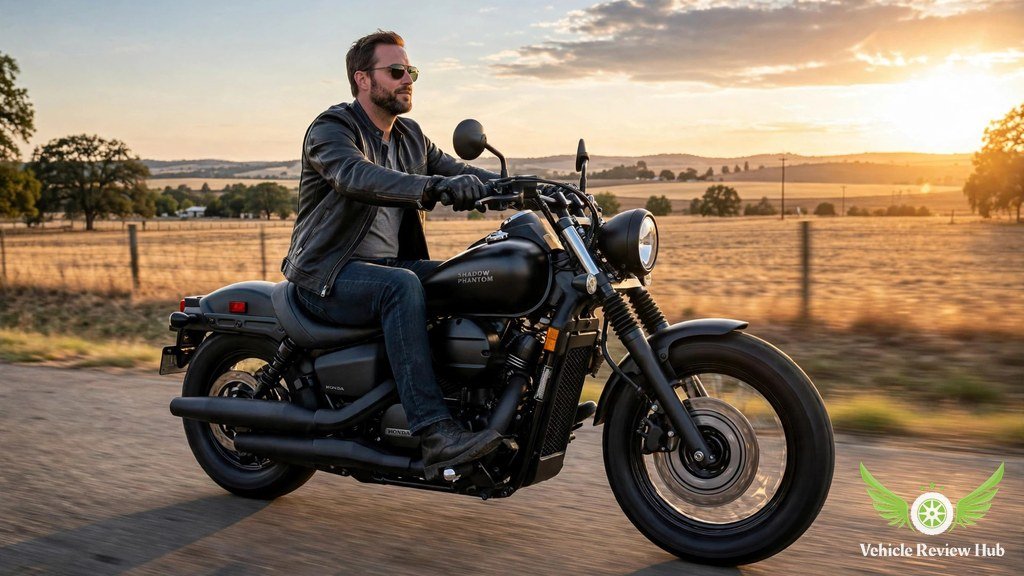
The riding position, in this Honda Shadow Phantom review’s assessment, is a relaxed cruiser triangle with a twist: a low, scooped seat, a wide handlebar, and, for 2024, a bar moved significantly forward, putting the rider in a slightly stretched posture with the footpegs nearly under the grips. Around town, the 25.6-inch seat, low center of gravity, narrow waist, communicative clutch, and solid gearbox make low-speed maneuvering and traffic painless. Handling is steady rather than sharp: the long wheelbase and 34-degree rake keep the bike stable, but peg feelers touch down in tighter curves, and with roughly 53 percent of the weight over the rear tire, the rear brake locks easily without ABS. The video below, a walkaround of a 2020 Phantom, shows the bike’s size and bobber proportions, and this Honda Shadow Phantom review recommends watching it before you visit a dealer.
Highway Comfort, Passenger Kit Option and Everyday Practicality
On the highway, the Phantom settles into a comfortable 70 to 75 mph cruise, and period testing found it wastes little time getting to freeway speeds, a verdict this Honda Shadow Phantom review shares. With no windscreen or fairing as standard, wind protection is limited to the rider’s helmet and jacket, but the relaxed engine note and upright posture keep rides pleasant. With a 3.9-gallon tank and Honda’s published 56 mpg figure, the theoretical range is around 218 miles, though real-world range depends on speed and riding style and is examined in the companion Phantom performance figures. Everyday practicality is strong for a bobber and limited only by the solo seat: the bike is narrow, easy to park, and simple to maintain, with a shaft drive that removes chain care, while the passenger kit costs about $100, a trade-off this Honda Shadow Phantom review considers acceptable for solo commuters and weekend riders.
Review: Pros, Cons and Verdict
After weighing the price, specifications, and riding experience, the Phantom’s case is straightforward. It is one of the best-value V-twin cruisers on sale in America, and one of the simplest motorcycles to own. It does not try to be a technology showcase or a performance machine. This Honda Shadow Phantom review concludes that the Phantom succeeds on its own terms, with a short list of genuine limitations buyers should understand before they sign.
Main Advantages and Limitations of the Honda Shadow Phantom
The advantages start with value: at $8,699 plus destination, with standard ABS, a shaft drive, and a 40-year-old platform, the Phantom is hard to beat on price. The 25.6-inch seat suits almost any rider, the engine is smooth and proven, the shaft drive removes the most tedious maintenance, and the blacked-out styling looks expensive. The 2024 updates, especially the rear disc and standard-for-2025 ABS, removed the bike’s two most obvious weaknesses, and this Honda Shadow Phantom review counts those updates as the reason the current bike is the best Phantom yet. The limitations are real but narrow: power is modest, there is no sixth gear, wind protection, fuel gauge, or tachometer, the tank-mounted gauge sits away from the road, footpeg clearance and rear suspension travel are limited, and two-up riding needs the $100 kit, all of which this Honda Shadow Phantom review lists here so there are no surprises.
Who Should Consider the Shadow Phantom Over the Rebel 500?
The Rebel 500 is the Phantom’s closest in-family rival, and this Honda Shadow Phantom review finds the choice between them comes down to character. The Rebel 500 is cheaper at $6,799 plus destination, lighter, and more modern, with a parallel-twin engine, a chain drive, and a contemporary roadster look; the full comparison is in the companion Rebel 500 review. Riders wanting the most modern, lightest, and cheapest Honda cruiser should buy the Rebel 500. Riders who should choose the Phantom instead want a V-twin engine note, a shaft drive, a lower seat, and classic bobber styling, since the Phantom feels like a traditional American cruiser in a way the Rebel never tries to. It is also the better choice for riders who plan to keep a bike for many years with minimal maintenance, and this Honda Shadow Phantom review finds character is the deciding factor for many buyers.
Honda Shadow Phantom Review: Frequently Asked Questions
These are the questions buyers ask most often about the Phantom, answered from the verified facts in this Honda Shadow Phantom review.
How much does a new Honda Shadow Phantom cost?
The 2025 Shadow Phantom ABS costs $8,699 plus a $600 destination charge, for $9,299 before tax and dealer fees. It is the only trim for 2025, and ABS is standard, as this Honda Shadow Phantom review confirms.
Is there a 2026 Honda Shadow Phantom?
As of November 2026, Honda has announced no distinct 2026 Phantom, and the 2025 ABS model remains the current bike on Honda’s United States site. Third-party compilations list the Phantom as an expected 2026 carryover at $8,699, but those are predictions, not Honda announcements, and this Honda Shadow Phantom review treats them as such.
What engine does the Honda Shadow Phantom have?
A 745cc liquid-cooled 52-degree V-twin with a single overhead camshaft, three valves per cylinder, dual-spark chambers, and fuel injection through a 34mm throttle body. It drives a wide-ratio five-speed gearbox and a shaft final drive, as detailed in this Honda Shadow Phantom review.
How much horsepower does the Shadow Phantom make?
Honda publishes no official horsepower or torque figures for the Phantom. The only instrumented figure this Honda Shadow Phantom review could source is Rider magazine’s 2010 road test: 38 horsepower and 43 pound-feet at the rear wheel.
What is the seat height of the Honda Shadow Phantom?
The seat height is 25.6 inches, among the lowest of any motorcycle currently on sale. Combined with the narrow seat-to-tank junction, it makes the Phantom one of the easiest full-size cruisers to flat-foot.
How much does the Honda Shadow Phantom weigh?
The 2025 ABS model weighs 553 pounds wet. The 2024 non-ABS model weighed 543 pounds, so the 543 to 553 pound spread in the specifications is simply the weight of the ABS hardware, as this Honda Shadow Phantom review explains.
Does the Honda Shadow Phantom have ABS?
Every 2025 Phantom has ABS as standard, and it is the only trim. For 2024, ABS was a $300 option, so a 2024 bike may or may not have it, and California bikes were ABS-only. Before 2024, no Phantom had ABS, and the rear brake was a drum, a timeline this Honda Shadow Phantom review states plainly.
Can you carry a passenger on the Shadow Phantom?
Not as stock. The 2024 and 2025 bikes have a solo saddle with no passenger seat or pegs. Honda sells a kit to add the pillion pegs and seat back for about $100.
What is the fuel tank size and range of the Shadow Phantom?
The tank holds 3.9 gallons. Against Honda’s published 56 mpg figure, this Honda Shadow Phantom review calculates a theoretical range of around 218 miles, though real-world range depends on speed and riding style.
Is the Honda Shadow Phantom a good beginner motorcycle?
Yes, with one caveat. The low seat, predictable power, communicative clutch, and standard ABS make it very approachable, and it is widely recommended as a beginner-friendly cruiser. At 553 pounds, however, it is heavier than a small starter bike, so new riders should sit on one and practice low-speed maneuvers first, advice this Honda Shadow Phantom review stands behind.
What changed on the Shadow Phantom for 2024?
The rear drum brake became a disc, ABS became available as an option, and the bike gained LED turn signals, fork gaiters, more aggressively bobbed fenders, new paint and graphic patterns, a headlight cover, machined-edge cylinder-head fins, a new air cleaner cover, new instruments, a blacked-out exhaust, a redesigned solo seat, and a forward handlebar, the full set of changes this Honda Shadow Phantom review documents.
Why does the Shadow Phantom have no ride modes or TFT display?
Because Honda built it as a simple, affordable cruiser. There are no ride modes, no traction control, no TFT display, and no cruise control, which keeps the price at $8,699, keeps the controls completely conventional, and keeps maintenance within reach of basic tools, a philosophy this Honda Shadow Phantom review endorses.