Short answer: the Honda CMX500 Rebel is the Honda Rebel 500. CMX500 is not a different motorcycle, a bigger Rebel, or a new model line — it is the Rebel 500’s model code, and this Honda CMX500 Rebel review treats it as exactly that. The 2026 bike costs $6,799, or $6,999 for the SE, plus a $600 destination charge, with ABS standard on both trims. It pairs a 471cc parallel-twin with a six-speed gearbox, a 27.2-inch seat, and a 414-pound curb weight. One honest note up front: because the CMX500 Rebel and the Rebel 500 are the same motorcycle, this Honda CMX500 Rebel review overlaps with our companion Rebel 500 review — the same bike under two names.
Honda CMX500 Rebel Overview and Model-Year Updates
This Honda CMX500 Rebel review starts with the naming, because getting the name wrong leads to every other mistake about this bike.

CMX500 Is the Model Code for the Rebel 500: Same Motorcycle Explained
Honda’s own 2026 specification pages list the Rebel 500 under Model ID CMX500A, and the SE under CMX500A2. That is the whole mystery of this Honda CMX500 Rebel review: when a dealer listing, a parts catalogue, or an insurance form says CMX500, it means the Rebel 500. The “CMX” prefix is Honda’s cruiser family code — the same family that gave the Rebel 250 its CMX250 code — and “500” is the engine class. Some dealer stock listings add a T suffix, such as CMX500A2T for an SE, but that is a dealer-stock code variant, not a different trim or a different motorcycle. Buyers should therefore never pay a premium for a “CMX500” presented as a separate, rarer model. This Honda CMX500 Rebel review prices, specs, and judges it as one motorcycle with two names.
Model IDs CMX500, CMX500A and CMX500A2 and US History 2017 to 2026
The Rebel 500 was presented in November 2016 in Long Beach, California, and US sales began in spring 2017, as this Honda CMX500 Rebel review notes from the model’s launch history. For 2020, Honda added an assist-and-slipper clutch, full LED lighting, a revised LCD panel with a gear-position indicator, retuned suspension, and a firmer, wider seat. The SE, or Special Edition, followed in 2021 with factory-fitted accessories. For 2025, Honda moved the handlebar grips slightly inward and rearward and refreshed comfort, convenience, and styling details, including the LCD display. For 2026, reporting on Honda’s October 2025 lineup announcement describes the Rebel 500 as carried over with no changes, which fits this Honda CMX500 Rebel review’s reading of the specification pages: the 2026 numbers match the 2025 bike, with the headline change being ABS standard on every trim. Honda advertises the Rebel 500 as the industry’s best-selling cruiser; that is Honda’s claim, not an independently audited figure.
Honda CMX500 Rebel Engine and Specifications
The specification sheet is short and almost unchanged for years, which is part of this Honda CMX500 Rebel review’s case for the bike.
471cc DOHC Parallel-Twin Engine, 6-Speed Gearbox and Slipper Clutch
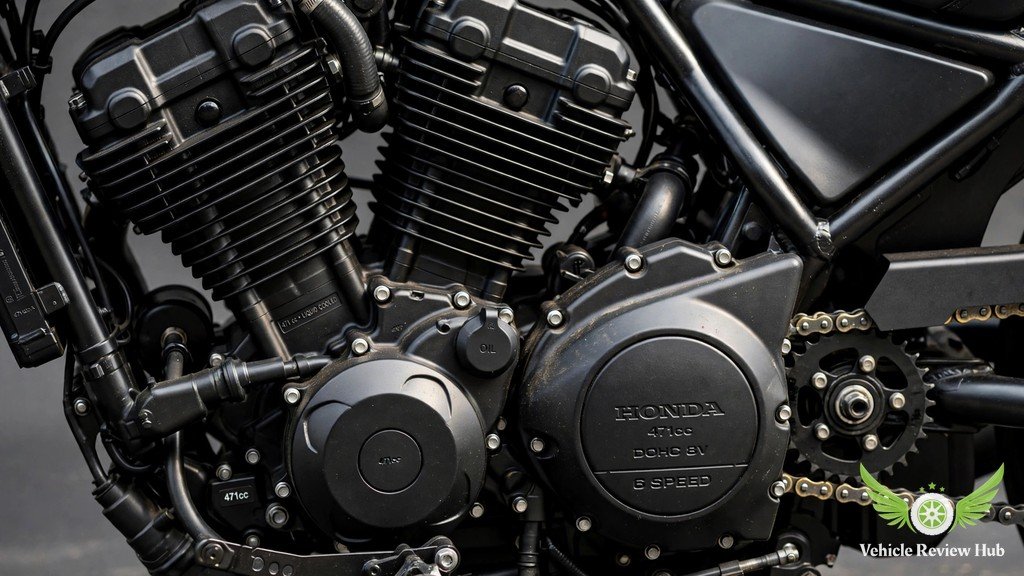
At the heart of this Honda CMX500 Rebel review is a 471cc liquid-cooled parallel-twin four-stroke engine with double overhead cams and four valves per cylinder, measuring 67.0mm by 66.8mm with a 10.7:1 compression ratio. Fuel delivery is Honda’s programmed fuel injection through a single 34mm throttle body, and the gearbox is a six-speed manual with an assist-and-slipper clutch. Final drive is an O-ring-sealed chain, 15T front and 40T rear — not a shaft or a belt, so chain care is part of owning this bike. Honda publishes no horsepower figure for the Rebel 500 in the United States, so this Honda CMX500 Rebel review presents none as a factory claim; widely quoted figures around 45 to 46 horsepower are crank or market estimates, not Honda USA numbers. Honda describes a narrow twin tuned for strong low-rpm torque, drawn from the same 500-twin family as the CBR500R but retuned for cruiser duty. The slipper clutch matters more than any horsepower number for a new rider: Honda says it cuts clutch pull by about 30 percent, and testers confirm the wide friction zone makes setting off from a stop easy, while the slipper function reduces rear-wheel hop on aggressive downshifts.
Weight 414 lb Base and 419 lb SE, Seat Height and Specification Details
Honda’s 2026 pages put the base at 414 pounds curb weight and the SE at 419, each including fluids and a full tank. Seat height is 27.2 inches on both trims, wheelbase is 58.7 inches, rake is 28.0 degrees with 4.3 inches of trail, and ground clearance is 5.4 inches. The tank holds 3.0 gallons, or 11.2 litres, and the tires are 130/90-16 front and 150/80-16 rear. Braking is a single 296mm front disc and a single 240mm rear disc, both with ABS; suspension is a 41mm fork with 5.5 inches of travel plus dual rear shocks with 3.7 inches on Honda’s current pages. Two honest conflicts belong in this Honda CMX500 Rebel review. First, Rider’s 2020 road test measured the bike at 418 pounds full of fluids, four pounds over Honda’s claimed 414, and recorded fork travel of 4.8 inches front and 3.8 inches rear — the older figures, against Honda’s current 5.5 and 3.7. The difference is most likely a specification revision between model years, not an error by either source, but shoppers comparing old and new listings should expect both sets of numbers. Some guide tables list the base bike at 419 pounds; that is the SE figure, copied onto the base trim. Warranty is a transferable one-year unlimited-mileage limited warranty, with HondaCare extended coverage available.
| Specification | 2026 Rebel 500 (CMX500A) | 2026 Rebel 500 SE (CMX500A2) |
|---|---|---|
| Engine | 471cc liquid-cooled DOHC parallel twin | 471cc liquid-cooled DOHC parallel twin |
| Gearbox / final drive | 6-speed manual, slipper clutch / O-ring chain | 6-speed manual, slipper clutch / O-ring chain |
| Seat height | 27.2 inches | 27.2 inches |
| Curb weight | 414 lb | 419 lb |
| Fuel capacity | 3.0 gallons | 3.0 gallons |
| Brakes | 296mm front / 240mm rear discs, ABS standard | 296mm front / 240mm rear discs, ABS standard |
| MSRP + destination | $6,799 + $600 | $6,999 + $600 |
Those figures frame this Honda CMX500 Rebel review’s value case: the same motorcycle, the same hardware, two trims separated only by accessories.
Honda CMX500 Rebel Price and Market Availability
Price is the Rebel 500’s second-biggest selling point after its seat height, and this Honda CMX500 Rebel review starts with the current sticker price.
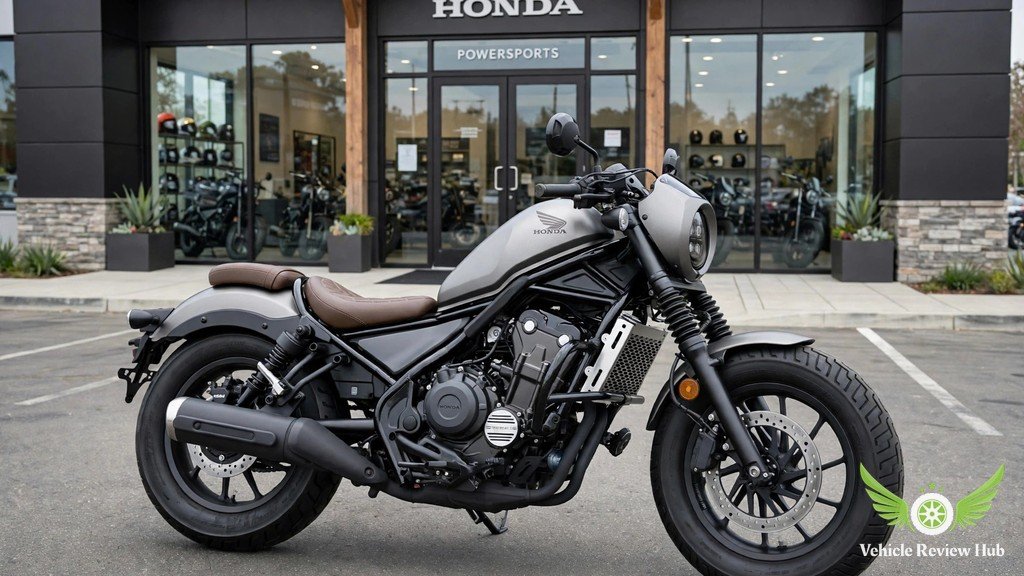
Honda CMX500 Rebel Price by Trim in the USA for 2026
Honda’s 2026 US pricing, confirmed on the manufacturer’s own specification pages for this Honda CMX500 Rebel review, is $6,799 for the base Rebel 500 and $6,999 for the SE, each plus a $600 destination charge — $7,399 and $7,599 before tax, title, and dealer fees. The $200 gap buys only the SE’s factory accessories, not more power or different brakes, as this Honda CMX500 Rebel review notes. For context, Rider’s 2020 road test listed the 2020 ABS model at $6,499 — roughly $300 less than today’s base price, before destination. Shoppers should still read the destination line carefully, since some dealer advertisements fold freight and setup into an “all-in” price.
Pearl Black, Pearl Smoky Gray and SE Pearl Blue Colours and Availability
For 2026, Honda lists the base Rebel 500 in Pearl Black and Pearl Smoky Gray, and the SE in Pearl Blue, a split this Honda CMX500 Rebel review verified against both Honda’s base page and SE page. The doc heading’s phrase “SE Pearl Blue” means the same thing: Pearl Blue is the SE-only colour, not a third base colour. Availability is straightforward: it is a current, regular-production Honda sold through official US dealers. The SE’s colour-matched headlight cowl is part of the trim, so a Pearl Blue bike without the cowl, fork boots, and diamond-stitch seat is not an SE, however a seller describes it — a check this Honda CMX500 Rebel review recommends for every used SE claim. Colour does not change the motorcycle underneath, but the SE’s Pearl Blue is the most distinctive current finish.
Honda CMX500 Rebel Design, Features and Technology
Design is where the Rebel 500 earns its “bobber” label, judged in this Honda CMX500 Rebel review on how it works, not just how it photographs.

Bobber Styling, SE Diamond-Stitch Seat, Fork Boots and Headlight Cowl
The Rebel 500’s bobber styling starts with a low-slung steel-tube frame, a teardrop tank, fat 16-inch tires, blacked-out engine parts, and minimal bodywork, a look this Honda CMX500 Rebel review finds genuinely distinctive rather than retro costume. The round LED headlight and tidy tail keep it modern, while the narrow chassis and mid-mount pegs keep it practical. The SE adds three factory-fitted items that define the trim: a brown diamond-stitch seat, black fork boots, and a color-matched headlight cowl. Those three parts are the entire SE difference in this Honda CMX500 Rebel review, and they are worth the $200 premium only if the buyer wants that factory-custom look — the seat itself is the same shape with different stitching and colour, not a comfort upgrade. Honda also offers a removable passenger seat and a detachable saddlebag as accessories, which this Honda CMX500 Rebel review mentions because the stock bike is a solo machine: the passenger perch and luggage are add-ons, not standard equipment.
LCD Dash Not TFT, ABS Only and Why There Is No E-Clutch in the USA
The instrument panel in this Honda CMX500 Rebel review is a round LCD unit with a gear-position indicator and a fuel gauge, updated for 2020 and refreshed again for 2025. It is not a TFT display, and it has no smartphone connectivity, navigation, or ride modes. The LCD’s known weakness, noted by Rider’s testers, is brightness: it can be hard to read in direct sunlight. On rider aids: ABS is the only electronic aid, now standard on both trims. There is no traction control, no ride-by-wire throttle, no cruise control, and no quickshifter on the US Rebel 500 through 2026. The E-Clutch question deserves a plain answer in this Honda CMX500 Rebel review, because Honda’s smaller Rebel 300 gained an E-Clutch version for 2026 while the 500 did not: the US Rebel 500 keeps a conventional cable-actuated clutch, lightened by the assist-and-slipper design. That simplicity means fewer systems to fail, but riders who specifically want clutchless shifting must look at the 300, not the 500. For full performance figures, see our companion CMX500 Rebel performance coverage.
Honda CMX500 Rebel Riding Experience and Comfort
On the road, this Honda CMX500 Rebel review finds the bike does what its geometry promises: it makes a new rider feel competent quickly.

Riding Position, Handling and Low-Speed Maneuverability
The riding position is north-of-neutral: mid-mount pegs, narrow backswept bars, and a low seat that lets most riders plant both feet flat. Rider’s 2020 test found that even a 5-foot-10 rider fit comfortably, while warning that riders creeping into the 6-foot range may feel cramped — a limit this Honda CMX500 Rebel review repeats, because the Rebel’s compact chassis is a virtue for shorter riders and a constraint for taller ones. At 414 pounds with a low center of gravity, it feels lighter than its weight at parking speeds and tips into corners with little input. Suspension is the honest weak point: the 2020 updates cured fork dive under braking, but short rear travel still jolts over sharp potholes. The 16-inch wheels, chosen to keep the seat low, also limit tire choices compared with more common sizes, a trade-off worth knowing before buying.
Highway Comfort, Passenger Use and Everyday Practicality
Highway comfort in this Honda CMX500 Rebel review starts with what the engine can actually do: Rider’s testers found roll-on power still available above 65 mph, and the twin stays smooth if the rider short-shifts rather than wringing its neck, where some vibration appears. But comfort ends well before performance does. There is no wind protection as standard, no cruise control, and the small 3.0-gallon tank means fuel stops come often — Rider’s tested range figures work out to roughly 129 to 193 miles depending on riding style. The video below shows an owner explaining why he chose the Rebel 500.
Passenger use is possible but limited, and this Honda CMX500 Rebel review states the limit plainly: the stock bike is a solo machine, the passenger seat is an accessory, and the small pillion pad suits short rides rather than touring. Everyday practicality is strong where it counts: the bike is narrow enough for traffic, light enough to push around a garage, cheap to fuel, and simple to service, with a chain that needs regular care but no complex electronics to diagnose. For commuting and weekend rides it is one of the easiest motorcycles to own; for daily long-distance highway work, a bigger bike with wind protection and a larger tank is the honest recommendation.
Honda CMX500 Rebel Review: Pros, Cons and Verdict
The verdict of this Honda CMX500 Rebel review: buy the CMX500 Rebel for confidence, not for speed or touring.
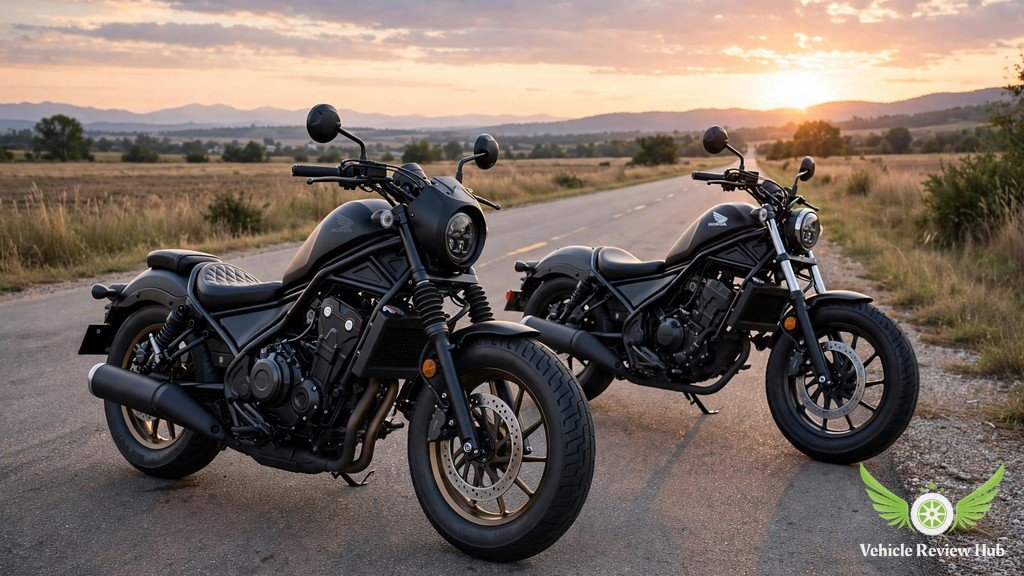
Main Advantages and Limitations of the Honda CMX500 Rebel
The advantages stack up quickly in this Honda CMX500 Rebel review. A 2026 bike costs $6,799 plus $600 destination, the 27.2-inch seat is among the lowest on any production motorcycle, the 414-pound weight makes low-speed handling easy, the slipper clutch lightens the lever by about 30 percent, and ABS is now standard. The engine is smooth and proven across Honda’s 500-twin family, and the bobber styling looks far more expensive than its price. Total Motorcycle’s 2026 guide confirms the same specification story told here. The limitations are equally plain: the seat cramps taller riders, the rear suspension jolts over sharp bumps, the 3.0-gallon tank limits range, there is no wind protection or cruise control, the LCD is hard to read in sunlight, and there is no TFT, traction control, or E-Clutch. None of those disqualifies it for its intended buyer, but all argue against buying it as a long-distance tourer.
Who Should Consider the CMX500 Rebel Over the CMX300 Rebel?
Choose the CMX500 Rebel over the CMX300 Rebel — the Rebel 300 under its own model code, CMX300 — if you want twin-cylinder smoothness, a six-speed gearbox, and genuine highway legs rather than a lighter, cheaper, single-cylinder entry point. The 300 is the easier first motorcycle in absolute terms: smaller, lighter, and less expensive, and for 2026 it even offers the E-Clutch version that the 500 lacks. But the 500 is the bike that still feels right after two years of riding, when the 300’s single cylinder and smaller chassis start to feel like a stepping stone. The choice is therefore about time horizon: buy the CMX300 Rebel if the budget is tight, and the CMX500 Rebel if the rider plans to keep the bike and ride highways. Our companion CMX500 Rebel reliability coverage examines the shared service story, and the CMX500 Rebel buying guide covers used prices and inspection. The verdict of this Honda CMX500 Rebel review is simple: if a low, light, good-looking cruiser with a proven twin and standard ABS appeals to you, and you understand that it is a city and weekend bike rather than a tourer, the CMX500 Rebel — the Rebel 500 by its proper code — is the right buy.
Honda CMX500 Rebel Review FAQs
Direct answers in this Honda CMX500 Rebel review, covering price, specs, and identity.
Is the Honda CMX500 Rebel the same as the Honda Rebel 500?
Yes. CMX500 is the Rebel 500’s model code — CMX500A for the base bike and CMX500A2 for the SE — and this Honda CMX500 Rebel review covers the same motorcycle as our Rebel 500 coverage.
What is the price of a 2026 Honda CMX500 Rebel?
$6,799 for the base bike and $6,999 for the SE, each plus a $600 destination charge, per this Honda CMX500 Rebel review.
What engine does the Honda CMX500 Rebel have?
A 471cc liquid-cooled DOHC parallel-twin with a six-speed gearbox, slipper clutch, and chain final drive, per this Honda CMX500 Rebel review.
What is the Honda CMX500 Rebel seat height?
27.2 inches on both trims, per this Honda CMX500 Rebel review.
How much does a Honda CMX500 Rebel weigh?
414 pounds for the base bike and 419 pounds for the SE, curb weight with a full tank, per this Honda CMX500 Rebel review.
Does the Honda CMX500 Rebel have ABS?
Yes, ABS is standard on both 2026 trims, front and rear discs, per this Honda CMX500 Rebel review.
Does the Honda CMX500 Rebel have a TFT display?
No. It uses a round LCD panel with a gear-position indicator, per this Honda CMX500 Rebel review.
Does the Honda CMX500 Rebel have E-Clutch?
No. The US Rebel 500 keeps a conventional cable clutch with an assist-and-slipper design, per this Honda CMX500 Rebel review.
What colours does the 2026 Honda CMX500 Rebel come in?
Pearl Black and Pearl Smoky Gray for the base bike, and Pearl Blue for the SE, per this Honda CMX500 Rebel review.
What is the Honda CMX500 Rebel fuel tank size?
3.0 gallons, or 11.2 litres, per this Honda CMX500 Rebel review.
Is the Honda CMX500 Rebel good for beginners?
Yes. Its low seat, light weight, light clutch, and predictable twin make it one of the most recommended beginner cruisers, per this Honda CMX500 Rebel review.
Is the Honda CMX500 Rebel good for highway riding?
Competent at highway speeds with roll-on power above 65 mph, but with no wind protection, no cruise control, and a small tank, it suits shorter highway runs better than touring, per this Honda CMX500 Rebel review.
Should I buy the CMX500 Rebel or the CMX300 Rebel?
Buy the CMX500 Rebel for twin-cylinder smoothness and highway legs you will still enjoy after two years; buy the CMX300 Rebel if budget is tight or motorcycling is still a trial, per this Honda CMX500 Rebel review.