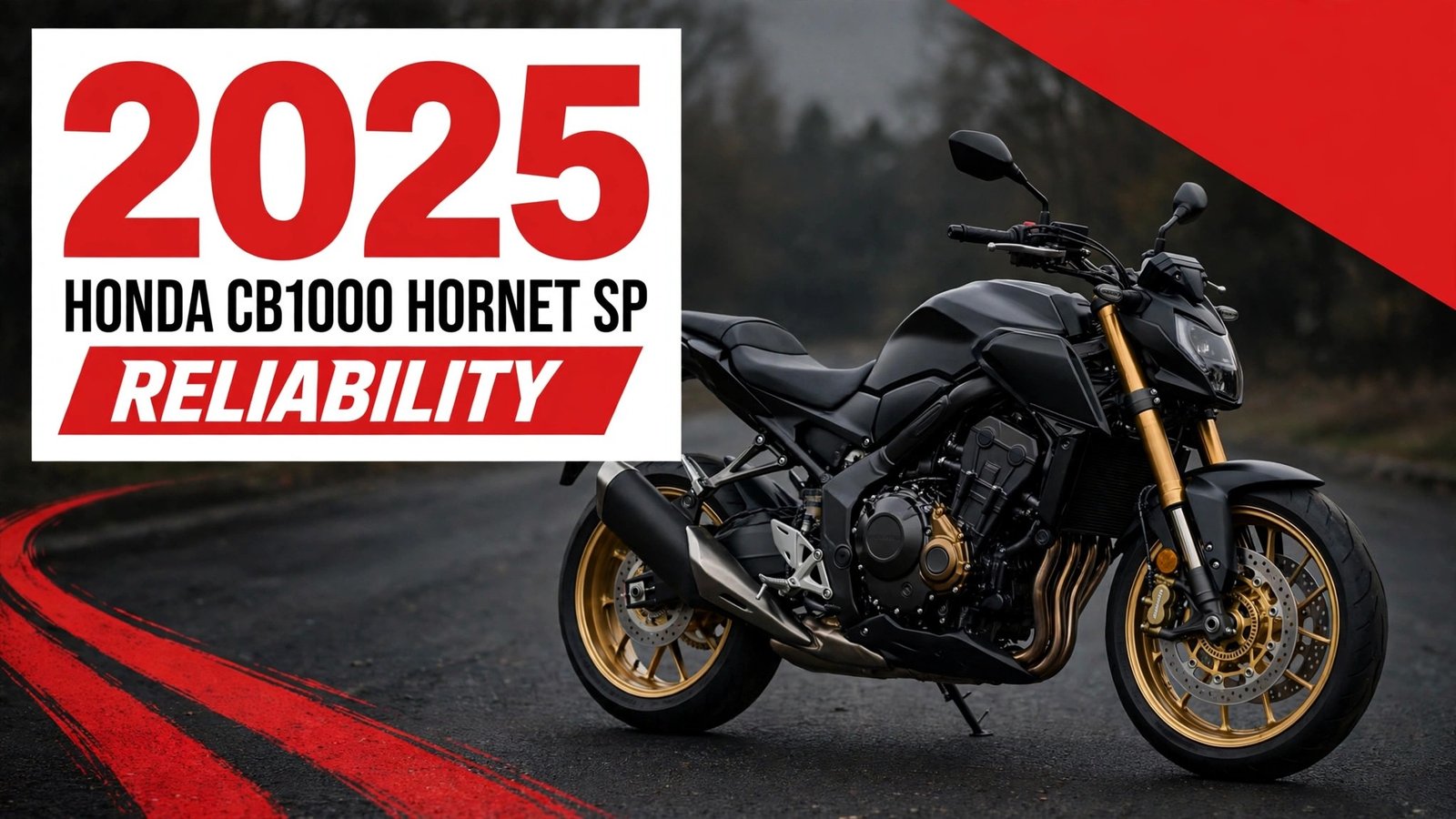
Short answer: Honda CB1000 Hornet SP reliability is a story of a strong motorcycle carrying one serious flaw. The 999cc four, twin-spar chassis, Showa fork and Öhlins shock are proven hardware, and the schedule is simple. But every 2025 bike must be checked against three NHTSA recalls before paying, because the piston-and-ring recall alone can turn low oil into a seized engine. This Honda CB1000 Hornet SP reliability guide reports that record plainly.
One identity rule governs this Honda CB1000 Hornet SP reliability guide: the Hornet SP is not the CB1000R. It replaced the CB1000R for 2025 with a different engine, frame, swingarm, and record. The CB1000R has no NHTSA recall naming it in any US year. The Hornet SP has three recalls naming 2025 bikes, and none naming 2026 bikes. Every figure below belongs to the Hornet SP by year; every recall is labelled by market. For the full model story, see our Honda CB1000 Hornet SP review.
Honda CB1000 Hornet SP Reliability Overview
For Honda CB1000 Hornet SP reliability, the headline is honest: a well-built motorcycle with one defect that matters, confined to known 2025 bikes. Outside that population, nothing in the record suggests a fragile motorcycle. The retuned 2017 CBR1000RR engine, twin-spar frame, and Brembo, Showa and Öhlins running gear are premium hardware with deep service networks. What Honda CB1000 Hornet SP reliability really depends on is paperwork: the VIN check, the oil-level habit, and the service book.
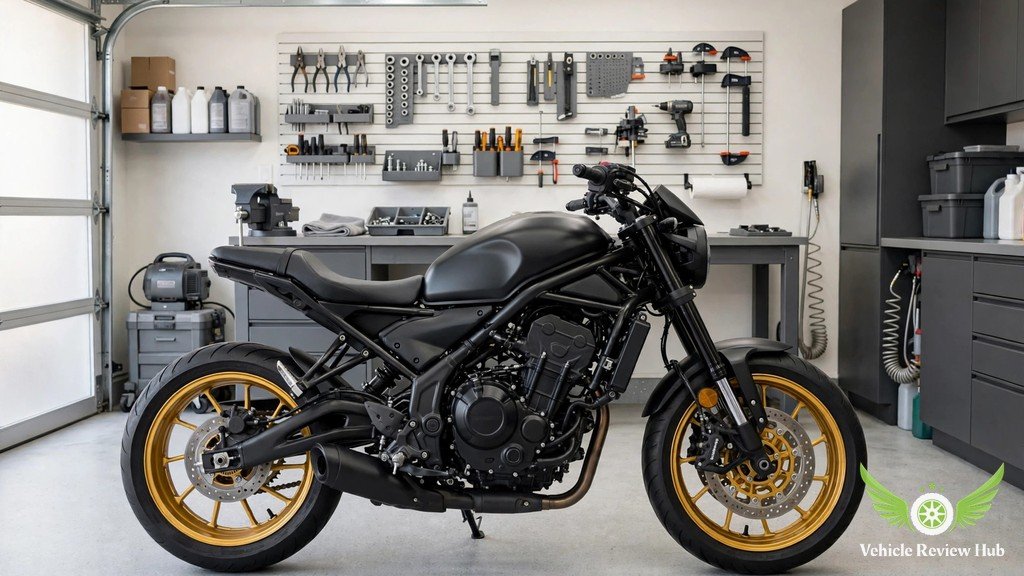
Owner Data Barely Exists: One MCN Review From EU-UK Owners
Owner data barely exists for this motorcycle, and this Honda CB1000 Hornet SP reliability guide says so instead of inventing a consensus. The bike reached the United States only in April 2025 and sells in low volume. The doc records a single MCN owner review from EU-UK owners — too small to prove much. The richer source is MCN’s UK long-term test bike: 13,000+ miles, sharp handling, a praised Öhlins shock once dialled in, standout brakes.
The video below is Honda’s official closer look at the 2025 Hornet SP — a features film, not a service tutorial.
How Mileage, Oil Use and Previous Care Affect Reliability
How mileage, oil use, and previous care affect reliability matters more here than model year, because the one serious defect announces itself through the oil level. A 2025 bike with 8,000 careful miles and a full book beats a lower-mileage bike whose oil was never checked. A missed oil check on an affected bike can starve the connecting-rod bearings — exactly the failure path Honda’s recall describes. The most valuable documents on any used Hornet SP are the recall-status printout and the service receipts — the first rule of Honda CB1000 Hornet SP reliability. For the measured output behind those miles, see our Honda CB1000 Hornet SP performance guide.
Honda CB1000 Hornet SP Common Problems and Wear Items
For Honda CB1000 Hornet SP reliability, problems divide into two groups. The first is one genuine defect: excessive oil consumption on certain 2025 bikes from out-of-spec pistons and rings. The second is ordinary wear: chains, sprockets, tyres, seals, pads, and electrical checks. Everything below is labelled by authority.
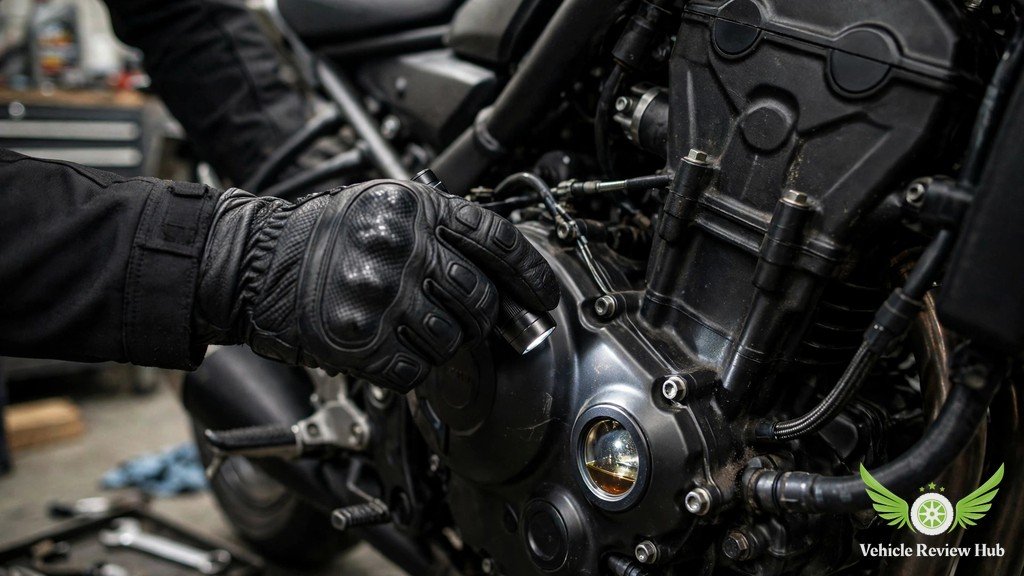
Oil Use of 300 to 400 ml per 1,000 Miles in EU Long-Term Use
Oil use of 300 to 400 ml per 1,000 miles in EU long-term use is the figure every buyer must understand, and this Honda CB1000 Hornet SP reliability guide reports the unit conflict openly. European reports describe 300 to 400 ml per 1,000 miles, while another report phrases it per 1,000 kilometers. Those are different units, and this Honda CB1000 Hornet SP reliability guide does not silently convert one into the other. Both agree affected bikes drink oil far faster than a healthy modern four should. Honda’s mechanism: the piston design changed from forging to casting, the geometry change altered oil-jet flow, oil reaches the top ring in greater quantity, and under sustained high vacuum it is drawn into the combustion chamber and burns. Honda’s February 2026 letter tells affected owners to check oil every 300 miles until repaired. A bike needing regular top-ups is telling you to check its VIN first.
Chain, Sprockets, Tires, Fork Seals, Brakes and Electrical Checks
Chain, sprockets, tyres, fork seals, brakes, and electrics make up the ordinary half of the Honda CB1000 Hornet SP reliability watch list, and none of it is unusual for a litre naked. Chain and sprockets wear first: look for tight spots, hooked teeth, and missing O-rings, and replace them as a set when adjustment runs out. The chain is a #525 O-ring running 15T/45T sprockets — not the CB1000R’s 15T/44T — and this Honda CB1000 Hornet SP reliability guide prints no millimetre slack figure, the Hornet SP manual figure not pinned at writing time; use your year manual’s figure. Fork seals weep with age; check for oil mist on the fork legs. On brakes, check pads, discs, and caliper movement on the dual 310 mm front discs with Brembo Stylema calipers plus the 240 mm rear disc; the ABS is not lean-sensitive, because this bike has no IMU. Tyres are 120/70-17 front and 180/55-17 rear — never the CB1000R’s 190/55. On electrics, check the TFT, RoadSync, the USB-C port, and the quickshifter. These checks keep Honda CB1000 Hornet SP reliability honest.
Honda CB1000 Hornet SP Maintenance Schedule and Servicing
The maintenance schedule is the backbone of Honda CB1000 Hornet SP reliability, and it is reassuringly simple. First service at 600 miles, oil and filter every 8,000 miles or 12 months, an interim inspection every 4,000 miles, and one major service much later than newcomers expect. The table below draws on MaintenanceSchedule’s Hornet SP schedule, from the owner’s manual.

First Service at 600 Miles, Oil Every 8,000 Miles or 12 Months
First service at 600 miles, oil every 8,000 miles or 12 months — that pairing is the heartbeat of Honda CB1000 Hornet SP reliability. The 600-mile first service clears break-in debris and establishes the book; a used bike without it deserves a discount. After that, oil and filter go every 8,000 miles or 12 months, with interim inspections every 4,000 miles. On an affected 2025 bike, that interval is not permission to ignore the dipstick: Honda requires an oil check every 300 miles until the piston-and-ring repair is done.
Valve-Clearance Inspection at 24,000 Miles, Not 16,000
Valve-clearance inspection at 24,000 miles, not 16,000, is the single easiest error in this topic, and this Honda CB1000 Hornet SP reliability guide puts it in the heading. Sixteen thousand miles is the CB1000R’s interval; carrying it onto the Hornet SP would trigger a major service 8,000 miles early. The Hornet SP interval is 24,000 miles, with spark plugs inspected at 16,000 miles and replaced at 32,000 miles. A bike near 24,000 miles without a valve receipt carries a bill coming — demand it and discount without one, the standing rule for Honda CB1000 Hornet SP reliability.
| Service item | Honda CB1000 Hornet SP interval (US) | Notes |
|---|---|---|
| First service | 600 miles | Establishes the service book |
| Engine oil + filter | Every 8,000 miles / 12 months | Interim checks 4,000 miles |
| Oil-level checks (affected 2025 bikes) | Every 300 miles until repaired | Feb 2026 letter |
| Valve clearance | Inspect at 24,000 miles | NOT 16,000 (CB1000R interval) |
| Spark plugs | Inspect 16,000 miles; replace 32,000 miles | Confirm part from year manual |
| Chain care | Lube + slack check every 600 miles | #525, 15T/45T; year-manual slack spec |
| Brake fluid | Replace every 2 years | Time-based |
| Coolant | Replace every 3 years | Time-based |
| Summary | Oil 8,000 mi, valves 24,000 mi | Receipts are key |
Honda CB1000 Hornet SP Tires, Brakes and Suspension Maintenance
Tyres, brakes, and suspension are where Honda CB1000 Hornet SP reliability meets the road most directly, and where the bike’s premium hardware earns its price. The adjustable Showa fork and Öhlins TTX36 shock are not fit-and-forget parts: they reward correct setup, and the Öhlins unit carries its own service rhythm.

Öhlins TTX Service Around 18,600 Miles From the Öhlins Manual
Öhlins TTX service around 18,600 miles from the Öhlins manual is the figure this Honda CB1000 Hornet SP reliability guide reports with its context attached — the bare number misleads without it. The Öhlins Road and Track manual states street service every 20,000 to 30,000 kilometres; the doc’s 18,600 miles is the top of that range. Öhlins USA guidance quoted elsewhere suggests roughly 15,000 to 18,000 miles or once a year for shocks generally — general guidance, not a Hornet mandate. The TTX36’s hydraulic preload knob and full adjustability make it easy to live with, and the UK long-term bike praised it once dialled in. A used bike with a weeping shock or no suspension history deserves a price reduction, a basic Honda CB1000 Hornet SP reliability check. The conventional swingarm with Pro-Link also makes shock work simpler than the CB1000R’s single-sided swingarm, a small Honda CB1000 Hornet SP reliability advantage.
Brake Fluid Every Two Years and Coolant Every Three Years
Brake fluid every two years and coolant every three years complete the Honda CB1000 Hornet SP reliability running-gear picture, and both are time-based items that low-mileage bikes still need. The front brakes are dual 310 mm discs with Brembo Stylema calipers and a Brembo master cylinder, plus a 240 mm rear disc with a Nissin caliper, and rubber lines. The Showa SFF-BP fork is fully adjustable and rarely troublesome beyond seal weeping, though one test found the front end slightly nervous under hard braking versus the Suzuki rival’s KYB fork. Tyres are 120/70-17 front and 180/55-17 rear — never the CB1000R family’s 190/55.
Honda CB1000 Hornet SP Maintenance and Ownership Costs
Ownership costs are where Honda CB1000 Hornet SP reliability pays off in cash with one honest catch: the bike is cheap to keep when healthy, but a 2025 bike bought without a recall check can become expensive exactly as the recall describes. Fuel is a middling bill, servicing follows a simple rhythm, and the only large bills are the valve service and, on an affected bike, the engine work the recall covers free. No published US servicing-cost figure was found, so no American quote is given here.
Fuel, Routine Servicing, Tires and Replacement Parts
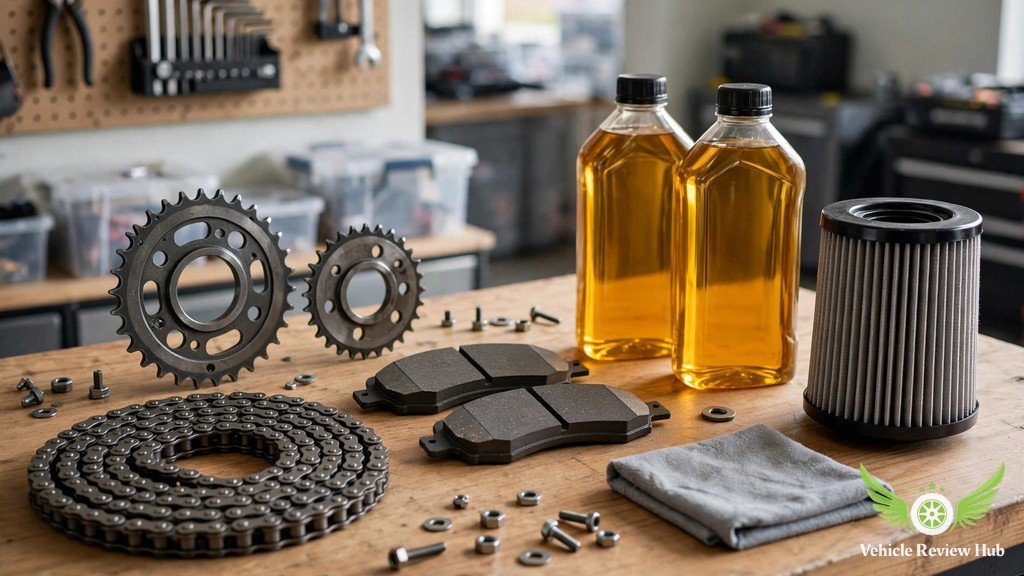
Fuel, routine servicing, tyres, and replacement parts form the everyday running costs in Honda CB1000 Hornet SP reliability, and three of the four are modest. Fuel first: Cycle News measured 38.9 mpg, giving roughly 175 miles from the 4.5-gallon tank — plan stops early, because hard riding drops economy further. MCN’s 48 mpg is a UK imperial-gallon figure, not a US one. Tyres are widely available in these sizes, and a chain-and-sprocket set is routine when the 600-mile habit is kept. Parts availability is a qualified strength of Honda CB1000 Hornet SP reliability: consumables are common Honda parts, while model-specific trim can take longer to source — and recall parts go through the dealer channel, free of charge, once the remedy is available.
Repair Expenses, Parts Availability and Long-Term Ownership Costs
Repair expenses, parts availability, and long-term ownership costs complete the Honda CB1000 Hornet SP reliability money picture, and the recall position dominates it. The piston-and-ring, fuel-hose, and gearshift-bolt repairs are all free recall work on affected bikes — the owner’s cost is time and diligence, not the parts bill. The major valve service at 24,000 miles is the big scheduled bill and the one most likely skipped — which is why its receipt matters on a higher-mileage bike. The US warranty is one year, transferable, with unlimited mileage — a useful Honda CB1000 Hornet SP reliability baseline. Australian owners were offered seven-year backing for the engine repair — an Australian arrangement, not US cover. For the buying decision in full, see our Honda CB1000 Hornet SP buying guide.
| Cost item | Figure | Label |
|---|---|---|
| Fuel economy | 38.9 mpg US tested (Cycle News) | ~175-mile range, 4.5 gal |
| Routine service rhythm | Oil every 8,000 miles / 12 months | Interim safety checks 4,000 miles |
| Major valve service | The big bill — inspect at 24,000 miles | Receipt is key |
| Recall repairs (affected 2025 bikes) | Free of charge at the dealer | VIN check proves status |
| US servicing cost | No published figure found | Stated plainly, never a quote |
| US warranty | 1 year, transferable, unlimited miles | Australian 7-year backing is NOT US cover |
| Summary | Cheap years, one big valve bill | Recalls free — if you check the VIN |
How to Keep a Honda CB1000 Hornet SP Reliable
Keeping a Hornet SP reliable means doing the simple things on time and doing one piece of paperwork before paying. Nothing in Honda CB1000 Hornet SP reliability requires exotic tools — just a calendar, a chain habit, an oil-level habit, a shock-service plan, and a service book, plus the recall check no book can replace.
Preventive Maintenance, Oil Checks and Regular Inspections
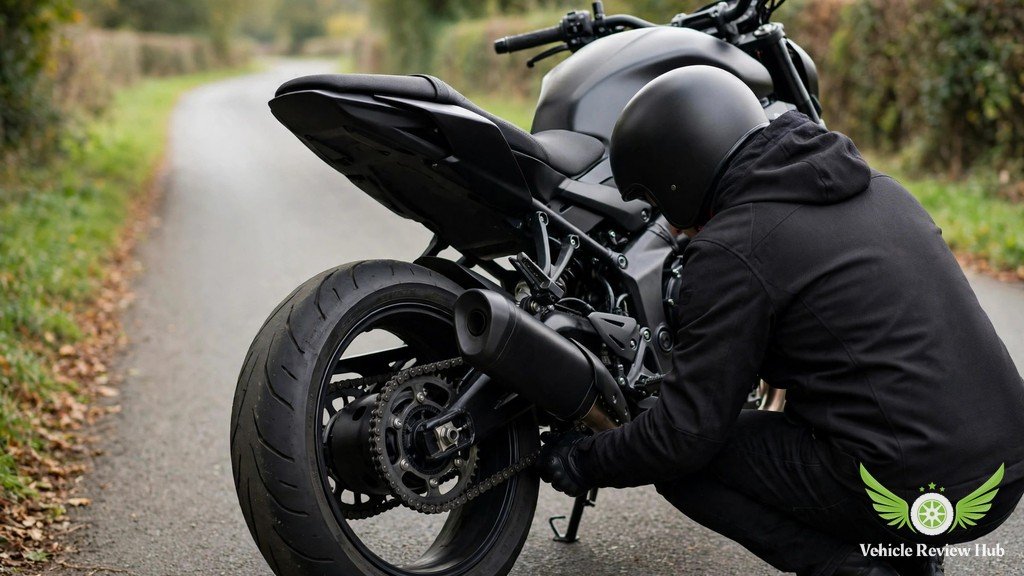
Preventive maintenance, oil checks, and regular inspections are the three habits that define Honda CB1000 Hornet SP reliability in practice. Preventive maintenance means the 600-mile chain habit, oil every 8,000 miles, fluids on time, the valve check booked before it is overdue, and the Öhlins service inside its kilometre window. Oil checks mean the dipstick every ride on an affected 2025 bike — every 300 miles at minimum — plus a top-up log showing whether consumption is stable or climbing. Regular inspections, the daily habit of Honda CB1000 Hornet SP reliability, mean a two-minute pre-ride check plus a seasonal look at fork seals, pads, battery, and fastener corrosion.
Recall 25V892 Engine Remedy Not Yet Issued: Check Status by VIN
Recall 25V892 engine remedy not yet issued: check status by VIN — that heading is kept verbatim, and this Honda CB1000 Hornet SP reliability guide reports the dated timeline behind it both ways, because the remedy story has moved since the heading was written. Honda’s February 2026 letter said the repair was being finalised, expected in August 2026, with oil checks every 300 miles meanwhile. Later filings describe redesigned parts — an improved piston, revised top-ring specs, and added drain holes — and one source anticipates further letters around December 30, 2026. This Honda CB1000 Hornet SP reliability guide therefore declares the remedy neither definitively available nor unavailable as of writing: the only answer for a single bike is its own VIN lookup, in writing, before paying. The same VIN-first rule covers the other two recalls, and the full picture is in the table below. RideApart’s recall coverage reports the press version of the 25V-892 population; NHTSA’s Part 573 report carries the filing version — both quoted, never merged. A January 2025 European rear-brake-hose report could not be verified from primary sources, so it is not counted as a fourth US recall.
| Recall check | Hornet SP position | Note |
|---|---|---|
| 25V-723 / KT2 — gearshift pedal pivot bolt | 2025 only, 340 units; stop sale Oct 16, 2025 | Remedy: replace pivot bolt, free |
| 25V-892 / KT6+KU4 — piston and ring oil use | 2025 only; 474 units (Part 573) vs ~452 (press) | Check oil every 300 miles until repaired |
| 26V-194 / KU5 — fuel feed hose disconnect | 2025 only, 429 units; stop sale Mar 20, 2026 | Remedy: secure harness + replace hose, free |
| 2026 models | Named in NONE of the three recalls | Line fix Aug 26, 2025 supports this |
| Buyer rule | Run the VIN, get it in writing | A recall search is not a VIN check |
Honda CB1000 Hornet SP Reliability FAQs
Direct answers to the Honda CB1000 Hornet SP reliability questions buyers ask most.
Is the Honda CB1000 Hornet SP reliable?
Yes, with one condition, says this Honda CB1000 Hornet SP reliability guide: the hardware is strong and the schedule simple, but every 2025 bike must pass a VIN check against three recalls first.
What are the common problems on a Hornet SP?
For Honda CB1000 Hornet SP reliability shoppers, the watch items are excessive oil consumption on certain 2025 bikes, plus ordinary wear: chain and sprockets, fork-seal weeping, tyre age, and brake wear.
Which recalls affect the Hornet SP?
For Honda CB1000 Hornet SP reliability checks, three — all 2025-only: 25V-723 (gearshift bolt), 25V-892 (piston and ring oil use), and 26V-194 (fuel feed hose). No 2026 bike is named in any of them — but run the VIN anyway.
What is the Hornet SP service schedule?
For Honda CB1000 Hornet SP reliability: first service 600 miles, oil and filter every 8,000 miles or 12 months, chain care every 600 miles, brake fluid every two years, coolant every three years.
When does the Hornet SP need a valve check?
For Honda CB1000 Hornet SP reliability, valve-clearance inspection falls at 24,000 miles — not 16,000, which is the CB1000R interval. Demand the receipt.
How much oil does an affected Hornet SP use?
For Honda CB1000 Hornet SP reliability readers, European reports describe roughly 300 to 400 ml per 1,000 miles, while another report phrases it per 1,000 kilometres — both units are reported, never silently converted.
Is the 25V-892 engine remedy available yet?
For Honda CB1000 Hornet SP reliability buyers, the honest answer is dated, not final: Honda’s February 2026 letter expected the repair in August 2026, later filings describe redesigned parts, and further letters were anticipated around December 30, 2026. Check the VIN for the current status.
How much does servicing cost?
For Honda CB1000 Hornet SP reliability budgeting, no published US servicing figure was found, so no American quote is given here — expect modest routine costs and one large valve bill.
Does the Hornet SP need Öhlins servicing?
For Honda CB1000 Hornet SP reliability, yes on a schedule: the Öhlins manual states street service every 20,000 to 30,000 kilometres, the doc’s 18,600 miles at the top of that range.
Is the Hornet SP the same as the CB1000R?
No, says this Honda CB1000 Hornet SP reliability guide. The Hornet SP is the replacement — 999cc, twin-spar frame, conventional swingarm, 24,000-mile valves, three 2025 recalls.
Is buying a used Hornet SP safe?
Yes, says this Honda CB1000 Hornet SP reliability guide, when the VIN check is clean or recalls repaired, oil history documented, and the book complete.