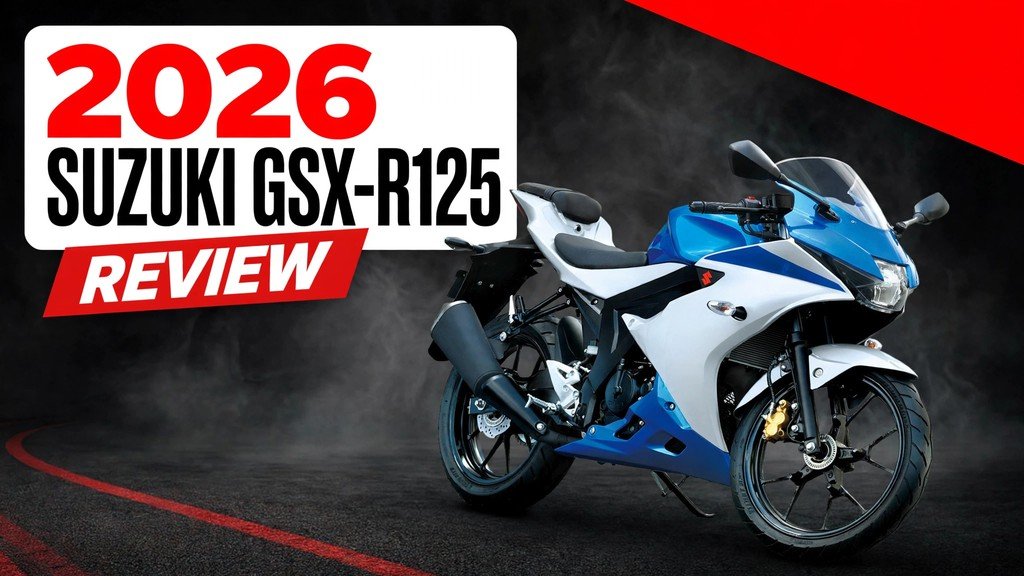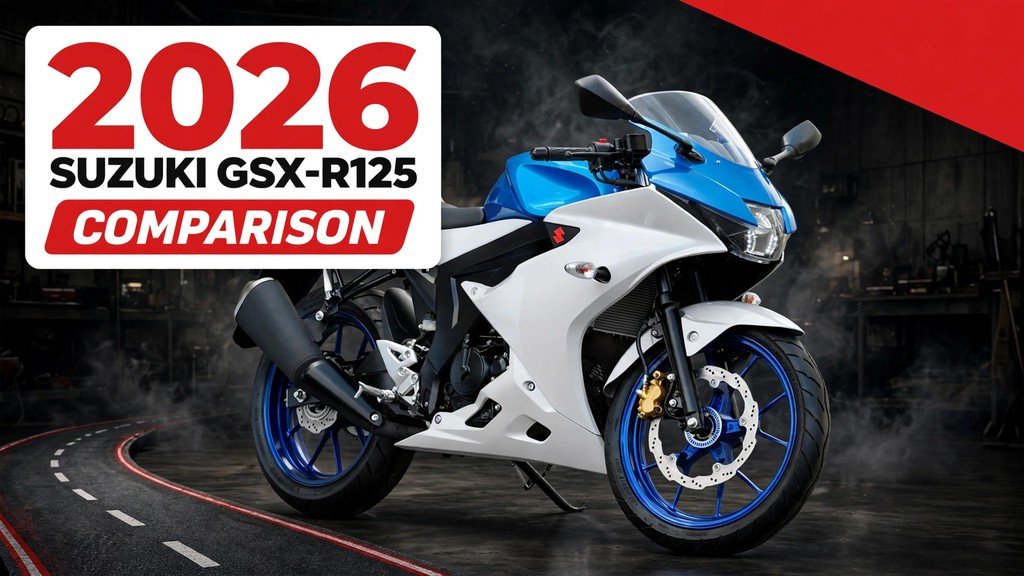
Four faired 125s, one licence cap, £1,502 between the cheapest and the dearest — that is the whole Suzuki GSX-R125 comparison in one line. Every bike here makes the same 15 PS, because European A1 law caps learner bikes at 11 kW, so none of them wins on power. What separates them is weight, equipment, chassis and price. The GSX-R125 costs £3,999 on the road in the UK right now, £700 less than the next bike and £1,502 less than the best-equipped one. One more honest fact for American readers: the GSX-R125 was never sold in the United States, so every figure in this Suzuki GSX-R125 comparison is a UK or European one, with the American options separately at the end.
Suzuki GSX-R125 Overview and Its Closest Rivals
Suzuki GSX-R125 comparison starts with a simple truth: the class is a weight contest, not a power contest. All four bikes are limited to the same 15 PS, so what matters is weight, electronics, chassis and price.

Why These Three Rivals: the European 125 Class
The three rivals in this Suzuki GSX-R125 comparison are the only other faired A1 sportbikes on sale in the UK in 2026: the Yamaha YZF-R125 (now sold simply as the R125), the Kawasaki Ninja 125 and the Aprilia RS 125. Each one is a 125cc single with a six-speed gearbox, full fairing and ABS, aimed at the same buyer — a 17-year-old on an A1 licence, or an adult wanting a small, cheap faired bike. The KTM RC 125 and Honda CBR125R are not current rivals in this Suzuki GSX-R125 comparison — the price section explains why. MCN’s review of the Suzuki sets the tone: the bike has the best power-to-weight ratio in the class, because it is the lightest here at 137 kg. Visordown’s first ride called the Suzuki’s power delivery “linear, and abundant up until the 11,500 redline”.
How the Four Bikes Differ at a Glance
At a glance: the Suzuki is the lightest and cheapest, the Yamaha the best equipped, the Kawasaki the heaviest, and the Aprilia the biggest on tank.
| Bike | Power | Weight | Seat height | UK price |
|---|---|---|---|---|
| Suzuki GSX-R125 | 15 PS @ 10,000 rpm | 137 kg | 785 mm | £3,999 |
| Yamaha YZF-R125 (R125) | 15 PS @ 10,000 rpm | 141 kg | 820 mm | £5,501 |
| Kawasaki Ninja 125 | 15 PS @ 10,000 rpm | 149 kg | 785 mm | £4,699 |
| Aprilia RS 125 | 15 hp @ 10,500 rpm | 144 kg | 820 mm | £5,230 |
This Suzuki GSX-R125 comparison table is measured against bikes with the same 15 PS cap — the Suzuki is the lightest and the cheapest, the Yamaha the best equipped, the Kawasaki the heaviest, and the Aprilia the biggest on tank. One honest note on video: the video embedded on MCN’s GSX-R125 review page is a 2023 beginner-125 group test that does not include the GSX-R125 as a test bike, so this Suzuki GSX-R125 comparison carries no video rather than one that does not show the bike.
Suzuki GSX-R125 vs Yamaha YZF-R125
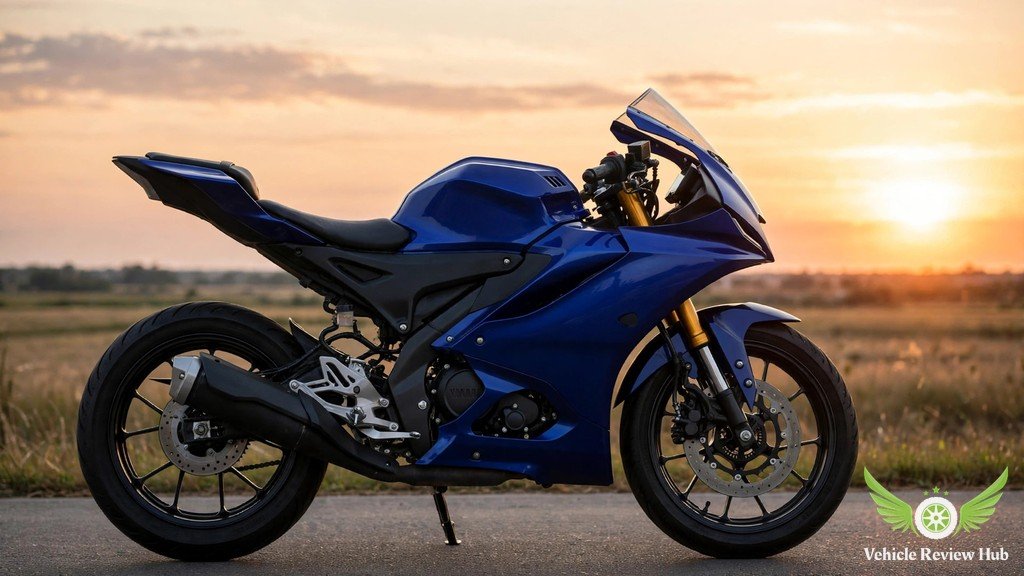
The Yamaha YZF-R125 — now simply the R125 — is the best-equipped rival in this Suzuki GSX-R125 comparison, and the most expensive: £5,501 on the road against the Suzuki’s £3,999, a gap of £1,502, for equipment the Suzuki does not have at any price.
Engine, Specs and Performance Side by Side
Both engines make the same 15 PS at 10,000 rpm, but they get there differently. The Suzuki runs a 124.4cc DOHC single making 11 Nm at 8,000 rpm on Euro 5 spec. The Yamaha runs a 124.7cc SOHC single with Variable Valve Actuation — a low-lift cam below 7,400 rpm and a high-lift profile above it — making 11.5 Nm at 8,000 rpm. One correction that matters: the R125 is a 124.7cc bike. The bigger-capacity VVA engine belongs to the YZF-R15, a different bike sold in India and Asia. The Suzuki is the lighter, lower bike: 137 kg against 141 kg, and a 785 mm seat against 820 mm. On top speed the Yamaha has the only GPS-verified figure in the class — Bennetts’ reviewer recorded about 79 mph on a phone GPS app — against the Suzuki’s 69 mph in MCN’s spec box and 72.75 mph on the speedometer. Those figures come from different tests, so this Suzuki GSX-R125 comparison does not present the Yamaha’s number as a head-to-head win. On fuel, the Yamaha claims 2.1 litres per 100 km, about 134.5 mpg UK, against the Suzuki’s 117.7 mpg UK; Bennetts achieved 97 mpg riding aggressively on the 2019 launch.
Price, Equipment and Which Suits Which Rider
The £1,502 gap buys a different class of equipment: a 5-inch colour TFT dash with Bluetooth and the MyRide app, traction control, an assist and slipper clutch, a 41 mm upside-down KYB fork, and pre-wiring for an optional quickshifter. The Suzuki has a full-LCD dash, no traction control, no riding modes, no quickshifter and a conventional fork — its only electronic rider aid is the two-channel Bosch ABS unit, which the Yamaha also has. MCN’s used-bike guide names the R125 its “MCN Recommended” 125, calling it the best-selling R-series model by a mile and one of the better-handling 125s. The same guide is cooler on the Suzuki, saying it has “more than the hint of a cheap motorcycle about it” while praising its power-to-weight and standard ABS. So the Yamaha suits the rider who wants the best dashboard and the most rider aids — and will pay £1,502 for them. The Suzuki suits the rider who wants the lightest, lowest, cheapest faired 125 and does not miss a TFT. The full GSX-R125 performance guide covers the Suzuki’s own numbers, including why no dyno figure exists.
Suzuki GSX-R125 vs Kawasaki Ninja 125
The Kawasaki Ninja 125 is the closest rival on price in this Suzuki GSX-R125 comparison — £4,699 on the road, just £700 more than the Suzuki — the heaviest bike in the group at 149 kg and the least equipped after the Suzuki.

Engine, Specs and Performance Side by Side
The Ninja 125 runs a 125cc liquid-cooled DOHC single making 15 PS at 10,000 rpm and 11.7 Nm at 7,700 rpm — the most torque in the group, delivered lowest. But the Kawasaki carries 12 kg more — 149 kg curb against the Suzuki’s 137 kg — so the Suzuki’s power-to-weight advantage survives the torque gap. Seat height is a tie at 785 mm, the lowest in the class. The Kawasaki’s dash is an all-digital LCD panel, not a TFT, and its fork is a 37 mm conventional telescopic unit with a Uni-Trak rear shock and a trellis frame — neither bike has an upside-down fork. SportsBikeShop found the Suzuki’s engine “needs to stay above 8000 rpm to remain in the sweet spot”. On top speed there is no instrumented test for the Ninja 125 from any major outlet; listed figures range from 75 to 81 mph, and this Suzuki GSX-R125 comparison prints none of them as a result. On fuel, the Kawasaki claims a combined 2.7 litres per 100 km, about 104.6 mpg UK, against the Suzuki’s 117.7 mpg UK.
Price, Equipment and Which Suits Which Rider
For the £700 gap, the Kawasaki adds very little equipment. Its tech list is ERGO-FIT — an adjustable riding position with a +20 mm high seat available as an accessory — plus ABS, and that is all: no traction control, no quickshifter, no riding modes, no TFT. A Performance version costs £5,399 and adds styling rather than hardware. The Suzuki, £700 cheaper, matches the Kawasaki on ABS and the LCD dash and beats it on weight by 12 kg. So the Ninja 125 suits the rider who wants the Ninja name, the lowest seat in the class and the most torque low down. In this Suzuki GSX-R125 comparison, the Suzuki suits the rider who wants the same money to go further: £700 cheaper, 12 kg lighter, and more economical. The full GSX-R125 review covers the Suzuki’s price history, including the £5,199 list of 2024 and 2025.
Suzuki GSX-R125 vs Aprilia RS 125
The Aprilia RS 125 is the most premium bike in this Suzuki GSX-R125 comparison — the most expensive chassis, the most electronics after the Yamaha, and the biggest tank — at £5,230 on the road, £1,231 more than the Suzuki, with a GP Replica at £5,380.

Engine, Specs and Performance Side by Side
The RS 125 runs a 124.2cc liquid-cooled DOHC single, Euro 5+, making 15 hp at 10,500 rpm and 11.4 Nm at 8,500 rpm — the highest-revving engine here. One figure must never be printed as the stock bike’s power: Aprilia sells an official race kit that lifts the bike from 15 bhp to 25 bhp, but that is kit-only and not road-legal A1 spec — the road bike is 15 hp. On weight the Suzuki wins again: 137 kg against the Aprilia’s 144 kg wet, though the Aprilia’s seat is 820 mm against the Suzuki’s 785 mm. The Aprilia’s trump card is range: a 14.5-litre tank, the largest in the class, against 11 litres on the other three, at a claimed 2.6 litres per 100 km, about 108.6 mpg UK, against the Suzuki’s 117.7. On top speed the honest line is about 75 to 80 mph — Devitt lists 80 mph. The 93 mph figure sometimes quoted belongs to the old two-stroke RS125, not this four-stroke — this Suzuki GSX-R125 comparison does not use it.
Price, Equipment and Which Suits Which Rider
For the £1,231 gap, the Aprilia brings the best chassis in the group: an aluminium twin-spar frame, a 40 mm upside-down fork, a radial-mount four-piston caliper on a 300 mm front disc, switchable traction control as standard, and a Bosch dual-channel ABS with an anti-rollover system. A quickshifter and the Aprilia MIA multimedia platform are optional extras — but the dash is an LCD panel, not a TFT. MCN’s used-bike guide says Aprilia knows “how to set a teenager’s pulse racing”, praising the connectivity and the lap timer in the dash. So the RS 125 suits the rider who wants the sharpest chassis, the longest range and the most superbike theatre — and will pay £1,231 for it. The Suzuki suits the rider who wants the same 15 PS for £1,231 less, in a lighter, lower bike. The GSX-R125 reliability guide covers what the Suzuki costs to keep, including the £170-a-year servicing figure.
Suzuki GSX-R125 Price and Value Compared
Price is where this Suzuki GSX-R125 comparison is decided: the Suzuki is £700 to £1,652 cheaper than every rival.

Cheapest in Its Class at £3,999
The Suzuki GSX-R125 comparison on price is not close. The Suzuki costs £3,999 on the road in the UK now, on Suzuki GB’s model page, with the current dealer offer running to 31 December 2026. Every price below is a 2026 UK on-the-road figure including 20% VAT, and every gap is measured against the Suzuki.
| Bike | 2026 UK OTR price | Gap vs GSX-R125 |
|---|---|---|
| Suzuki GSX-R125 | £3,999 | — |
| Kawasaki Ninja 125 | £4,699 | +£700 |
| Kawasaki Ninja 125 Performance | £5,399 | +£1,400 |
| Aprilia RS 125 | £5,230 | +£1,231 |
| Aprilia RS 125 GP Replica | £5,380 | +£1,381 |
| Yamaha YZF-R125 (R125) | £5,501 | +£1,502 |
| Yamaha R125 70th Anniversary | £5,651 | +£1,652 |
The value argument in this Suzuki GSX-R125 comparison is simple: the £700 saved against the Ninja 125 buys a helmet, gloves and a first service; the £1,231 saved against the RS 125 adds a year of insurance; the £1,502 saved against the R125 adds tyres. The Suzuki also costs the least to run — £170 a year for servicing, road tax £27 a year. Two cautions: the £3,999 price is the current dealer offer — the same bike listed at £5,199 in 2024 and 2025 — and a few dealers advertise lower figures, such as £4,989 for a 2026 R125 or “from £4,599” for a Ninja 125: dealer discounts, not list prices. This Suzuki GSX-R125 comparison uses list prices throughout so the gaps are honest.
CBR125R Gone Since 2016; RC 125 Down to Leftover Stock
Two bikes that used to sit in this class no longer count. The Honda CBR125R has been gone from sale since 2016 — it appears in older group tests, including the BikeSocial Rockingham shootout where it recorded 15.79 seconds to 60 mph, but you cannot buy one new. The KTM RC 125 is still buyable new in the UK, but only as leftover 2024 stock — Fowlers lists it at £4,099 — not as a current-model rival with a 2026 list price. That is why this Suzuki GSX-R125 comparison tests the Suzuki against the three bikes on sale as 2026 models. For a bargain hunter, the RC 125 at £4,099 undercuts the Ninja 125 by £600 — but it is old stock with no 2026 model behind it.
Suzuki GSX-R125 Comparison Verdict and US Alternatives
The verdict of this Suzuki GSX-R125 comparison is that there is no single best bike — there is a best value bike, and it is the Suzuki. The Yamaha is the best equipped, the Aprilia has the best chassis, and the Kawasaki is the closest on price. But the Suzuki is the lightest, the lowest, the cheapest to buy and the cheapest to run — four facts that matter more than a TFT dash for a learner bike.

Americans Cannot Buy Any of These New
None of the four bikes in this Suzuki GSX-R125 comparison was ever sold new in the United States. All four are European A1-licence bikes with no US MSRP, no US dealer network and no EPA/DOT certification. Yamaha USA’s smallest R-series bike is the 321cc YZF-R3; Kawasaki USA’s smallest Ninja is the 451cc Ninja 500; Aprilia USA sells the RS 660 and RSV4, not the RS 125. The only way one of these four reaches the US is as a private import under the 25-year rule, and no import price was verified, so this Suzuki GSX-R125 comparison prints none. The MCN six-bike group test is the closest thing to a shootout verdict: dealer-quoted lines say the GSX-R125 topped MCN’s speed chart at 72.75 mph on the speedometer and topped their track-day table as the most fun 125 to ride — but the test’s date, the other five bikes and any overall winner are unverified, so this guide claims no shootout win. No current four-way test of these four bikes together was found at all.
Real US Alternatives: GSX250R, R3, Ninja 500
For an American buyer, the real alternatives are bigger twins and small minis — not 125s. This Suzuki GSX-R125 comparison puts the three faired stand-ins and the two minis side by side, all buyable new in the US.
| US alternative | US price (delivered) | Engine | Power | Seat height |
|---|---|---|---|---|
| Yamaha YZF-R3 (2026) | $6,149 ($5,499 + $650) | 321cc twin | ~42 hp (press test) | 30.7 in (780 mm) |
| Kawasaki Ninja 500 ABS (2026) | $6,449 ($5,799 + $650) | 451cc twin | 51.0 hp @ 10,000 rpm | 30.9 in (785 mm) |
| Suzuki GSX250R (2025 leftover) | $5,149 + dest. (unverified) | 248cc twin | ~24–25 hp | 31.1 in (790 mm) |
| Honda Grom (2026) | $3,899 ($3,599 + $300) | 124cc single | ~9.7 hp (third-party) | 30.0 in |
| Kawasaki Z125 Pro (2026) | $4,114 ($3,799 + $315) | 125cc single | 10.0 hp @ 8,000 rpm | Not verified |
The Yamaha YZF-R3 is the closest American stand-in for the R125 — the smallest faired R-series bike sold in the US, at $5,499 plus $650 destination, with ~42 hp from a press test, since Yamaha publishes no horsepower figure. The Kawasaki Ninja 500 is the stand-in for the Ninja 125 — the smallest faired Ninja in America, from $5,399, or $5,799 for ABS, with 51.0 hp from Kawasaki itself. The Suzuki GSX250R is Suzuki’s own US stand-in for the GSX-R125 — but buy a leftover 2025 at the last US MSRP of $5,149, or used: Suzuki has announced no 2026 US model, and an updated VVT version is confirmed only for China so far. The Honda Grom and Kawasaki Z125 Pro are the only 125cc bikes an American can buy new — naked minis, not faired sportbikes, making about 10 hp. The Honda CB300R does not count: delisted in the US in 2025. The GSX-8R review covers the natural step up for a rider who outgrows the 125 class.
Suzuki GSX-R125 Comparison: Frequently Asked Questions
Direct answers to the questions riders ask about this Suzuki GSX-R125 comparison.
Which 125 sportbike is the best overall?
There is no single winner in this Suzuki GSX-R125 comparison. The Yamaha R125 is the best equipped, with a TFT dash, traction control and a slipper clutch. The Aprilia RS 125 has the best chassis. The Suzuki GSX-R125 is the best value — lightest, lowest and cheapest.
Which is the cheapest 125 sportbike in the UK?
The Suzuki GSX-R125 at £3,999 on the road. Next cheapest is the Kawasaki Ninja 125 at £4,699, then the Aprilia RS 125 at £5,230, then the Yamaha R125 at £5,501. This Suzuki GSX-R125 comparison finds a £1,502 gap to the dearest rival.
Which 125 is the fastest?
The Yamaha R125 has the only GPS-verified figure: Bennetts recorded about 79 mph on a phone GPS app. The Suzuki’s best numbers are 69 mph in MCN’s spec box and 72.75 mph on the speedometer. The Ninja 125 and RS 125 have only listed figures — 75 to 81 mph for the Ninja, about 75 to 80 mph for the Aprilia — and this Suzuki GSX-R125 comparison prints none of them as a test result.
Which 125 has a TFT dash?
Only the Yamaha R125, with a 5-inch colour TFT, Bluetooth and the MyRide app. The Suzuki, the Ninja 125 and the RS 125 all have LCD dashes — the Yamaha’s TFT is the biggest reason to pay its £1,502 premium in this Suzuki GSX-R125 comparison.
Which 125s have traction control?
The Yamaha R125 and the Aprilia RS 125 have traction control as standard — the Aprilia’s is switchable. The Suzuki GSX-R125 and the Kawasaki Ninja 125 have none; their only electronic rider aid is ABS. No bike in this Suzuki GSX-R125 comparison has riding modes.
Which 125 is the lightest?
The Suzuki GSX-R125 at 137 kg — the lightest faired 125 in its class. The Yamaha R125 is 141 kg, the Aprilia RS 125 is 144 kg, and the Kawasaki Ninja 125 is the heaviest at 149 kg. That 12 kg advantage over the Kawasaki is why the Suzuki wins on power-to-weight in this Suzuki GSX-R125 comparison.
Which 125 is best for beginners?
The Suzuki GSX-R125: lightest, lowest at 785 mm, cheapest, with a light clutch and a gear indicator. The Yamaha suits a beginner who wants the most rider aids; the Aprilia suits one who wants the sharpest chassis. The caveats are the same as in every Suzuki GSX-R125 comparison — small size, an engine needing revs above 8,000 rpm, and a gearbox stubborn into first from neutral.
Which 125 is best for taller riders?
The Yamaha R125 and the Aprilia RS 125, both at 820 mm seat height, against 785 mm on the Suzuki and the Ninja 125. Riders much above 5 ft 8 in should try the Suzuki for size first. This Suzuki GSX-R125 comparison still rates the Suzuki first on value, but a tall rider may prefer the Yamaha’s extra 35 mm.
Can Americans buy any of these 125s new?
No. None of the four bikes in this Suzuki GSX-R125 comparison was ever sold new in the United States — no US MSRP, no dealer network, no EPA/DOT certification. The only way one reaches the US is as a private import under the 25-year rule.
Which US bike should I buy instead of the GSX-R125?
The Yamaha YZF-R3 at $5,499 plus $650 destination, the Kawasaki Ninja 500 from $5,399 plus $650, or a leftover 2025 Suzuki GSX250R at $5,149 — the three faired sportbikes this Suzuki GSX-R125 comparison recommends. The Honda Grom ($3,599 plus $300) and Kawasaki Z125 Pro ($3,799 plus $315) are naked minis, not faired sportbikes.
Is the Aprilia RS 125 really 25 hp?
No. The standard road bike makes 15 hp — the A1 licence cap. Aprilia sells an official race kit that lifts it to 25 bhp, but that is kit-only, not road-legal A1 spec — never treat it as the stock bike’s power in this Suzuki GSX-R125 comparison.
Does the GSX-R125 have a quickshifter?
No. The Suzuki GSX-R125 has no quickshifter and no riding modes — its only electronic rider aid is the two-channel Bosch ABS unit. The Yamaha R125 is pre-wired for an optional quickshifter, and the Aprilia RS 125 offers one as an optional extra — part of the £1,502 and £1,231 price differences in this Suzuki GSX-R125 comparison.