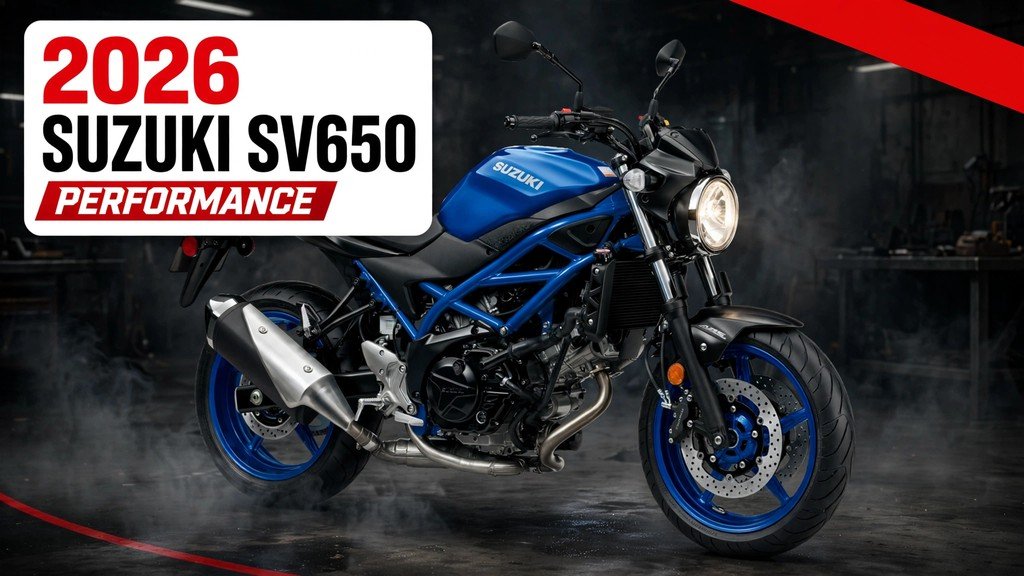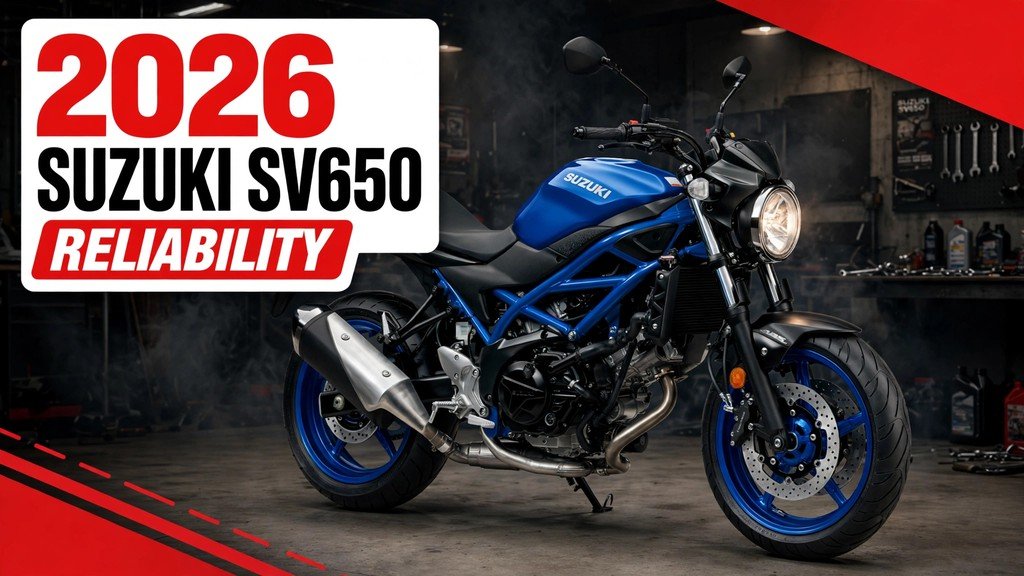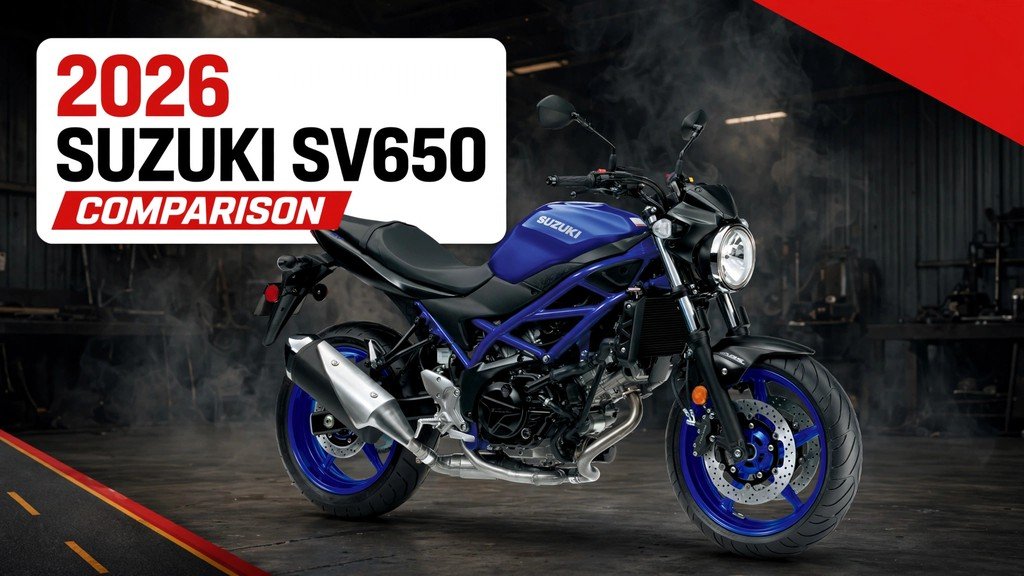
The Suzuki SV650 is the middleweight naked that refuses to die — on sale in the USA since 1999, still $8,149 for 2026, and still the bike every rival gets measured against. The question is whether it is still the right buy now that Yamaha has cut the MT-07 to $7,999, Kawasaki sells the Z650 S for $7,699, and Suzuki’s own GSX-8S sits $600 above it in the same showroom. This Suzuki SV650 comparison answers that with verified US prices and named-outlet verdicts.
Suzuki SV650 Overview and Its Closest Rivals
The SV650’s case is simple: a 645cc 90° V-twin, 437 lb wet, a 30.9-inch seat and a price that has barely moved in a decade. This Suzuki SV650 comparison puts it against the Yamaha MT-07, the Kawasaki Z650 S and the Suzuki GSX-8S — then checks the Triumph Trident 660 and the Honda CB650R.

Why These Three Rivals: Benchmark, Undercutter, Heir
Each rival plays a different role, and this Suzuki SV650 comparison labels them honestly. The Yamaha MT-07 is the benchmark: the best-selling middleweight naked in the class. The Kawasaki Z650 S is the undercutter: at $7,699 it is the cheapest of the four by $450 on MSRP, and it brings a TFT dash and traction control the SV650 does not have. The Suzuki GSX-8S is the heir: Suzuki’s own parallel-twin successor in spirit, launched for 2023, with more power and a $600 MSRP premium over the SV650. The Trident 660 and CB650R sit above them all on price and power.
How the Four Bikes Differ at a Glance
The table below is the short version of this Suzuki SV650 comparison. Two things jump out: the SV650 has the lowest seat in the group, and it is the only bike here with no ride modes, no traction control and no TFT dash.
| Figure | 2026 Suzuki SV650 ABS | 2027 Yamaha MT-07 | 2026 Kawasaki Z650 S | 2027 Suzuki GSX-8S |
|---|---|---|---|---|
| Engine | 645cc 90° V-twin | 689cc parallel twin | 649cc parallel twin | 776cc parallel twin |
| Claimed power | ~73–75 hp (Suzuki USA publishes no hp figure) | 73.4 hp @ 8,750 rpm | 67 hp @ 8,000 rpm | 82 hp @ 8,500 rpm |
| Claimed torque | 64 Nm / 47.2 lb-ft (no peak rpm stated) | 67 Nm / 50 lb-ft @ 6,500 rpm | 64 Nm / 47.2 lb-ft @ 6,700 rpm | 78 Nm / 57.5 lb-ft @ 6,800 rpm |
| Curb / wet weight | 437 lb | 403–406 lb | 416.7 lb wet | 445 lb |
| Seat height | 30.9 in (785 mm) | 31.7 in (805 mm) | 31.7 in (805 mm) | 31.9 in (810 mm) |
| Fuel capacity | 3.8 gal | 3.7 gal | 4.0 gal | 3.7 gal |
| Dash | LCD (not TFT) | 5-in TFT, Y-Connect | 4.3-in TFT, Rideology app | 5-in TFT (no Bluetooth) |
| Ride modes / traction control | None (ABS only) | YRC modes, switchable TCS | None, KTRC 2 modes + off | S-DMS 3 modes, STCS 3 levels + off |
| Quickshifter | No | No (accessory upshift only) | No (optional accessory) | Yes, bi-directional, standard |
| MSRP | $8,149 | $7,999 | $7,699 | $8,749 |
| Delivered | $8,999 (with provisional $250 surcharge) | $8,674 | $8,384 | $9,499 |
Suzuki SV650 vs Yamaha MT-07
This is the Suzuki SV650 comparison most buyers actually make: the V-twin original against the parallel-twin benchmark. The two bikes have been paired in group tests since 2014, and the verdict has barely changed — the MT-07 wins on engine character and electronics, the SV650 wins on V-twin feel. What changed in November 2026 is the price: the MT-07 now undercuts the SV650 in the USA.

Engine, Specs and Performance Side by Side
The SV650’s 645cc 90° V-twin makes a claimed 64 Nm / 47.2 lb-ft — Suzuki USA publishes no horsepower figure and no torque-peak rpm, so this Suzuki SV650 comparison quotes the torque with no peak rpm attached, because the peak is disputed between sources. The MT-07’s 689cc parallel twin makes 73.4 hp @ 8,750 rpm and 67 Nm / 50 lb-ft @ 6,500 rpm. On the dyno the gap is small: Cycle World’s 2017 same-test runs gave the SV650 69.3 hp @ 8,530 rpm and 44.2 lb-ft @ 8,000 rpm against the FZ-07’s 66.7 hp @ 8,820 rpm and 46.3 lb-ft @ 6,290 rpm — the SV650 ahead on peak power, the Yamaha ahead on torque lower down. The quarter-mile is effectively tied: 12.06 seconds @ 108.91 mph for the SV650 against 12.02 @ 107.93 mph for the FZ-07, with both bikes recording 3.3 seconds to 60 mph. Braking favours the Yamaha slightly, 136 ft against the SV650’s 139 ft from 60 mph, and fuel economy favours it too — 51 mpg against the SV650’s 48 mpg in the same Cycle World test. That is the tightest performance gap in this Suzuki SV650 comparison. Where the SV650 fights back is feel: the V-twin’s low-down pulse and the simpler steering.
Price, Equipment and Which Suits Which Rider
Price is where this Suzuki SV650 comparison has to pick a model year and say so, because Yamaha’s November 2026 price announcement changed the answer. The 2026 MT-07 was $8,599 plus $675 — $9,274 delivered, $275 more than a new SV650. The 2027 MT-07 is $7,999 plus $675 — $8,674 delivered, $325 cheaper than the SV650 and $150 cheaper on MSRP. Against 2027 pricing the MT-07 is the cheaper bike, and it brings a 5-inch TFT dash, ride-by-wire with three ride modes, switchable traction control, a 41 mm inverted KYB fork and radial brakes — equipment the SV650 does not offer. The SV650’s answer is its seat and its simplicity: 30.9 inches against 31.7. The video below, from Yammie Noob, covers both bikes in one beginner-bike roundup — the SV650 at chapter 6:30 and the MT-07 at chapter 7:45 — a roundup, not a head-to-head test.
Which suits which rider: the MT-07 suits the rider who wants the modern package and is comfortable with the taller seat. The SV650 suits the shorter rider who wants the lowest seat and the simplest bike. On 2027 prices the MT-07 is the value pick on equipment; the SV650 is the value pick on fit and feel. The performance guide has the full dyno and quarter-mile record behind these figures.
Suzuki SV650 vs Kawasaki Z650 S
The Z650 S is the quiet threat in this Suzuki SV650 comparison: the cheapest bike in the group, and the one that makes the SV650’s missing electronics hardest to defend. Kawasaki replaced the base Z650 in the USA with the S for 2026, adding a 4.3-inch TFT dash and KTRC traction control — all for $7,699.

Engine, Specs and Performance Side by Side
The two engines are almost the same size: the SV650’s 645cc V-twin against the Z650 S’s 649cc parallel twin. The Kawasaki claims 67 hp @ 8,000 rpm and 64 Nm / 47.2 lb-ft @ 6,700 rpm — the same torque figure as the SV650. No named outlet has run the two bikes on the same dyno, so this Suzuki SV650 comparison does not invent a dyno gap: on claimed figures the SV650’s dyno-tested 68–71 hp rear-wheel band puts it ahead of the Z650 S’s 67 hp claim, while the Kawasaki is lighter at 416.7 lb wet against 437 lb. The Z650 S carries the bigger tank at 4.0 gallons against 3.8, and the same 31.7-inch seat as the MT-07 — nearly an inch taller than the SV650’s 30.9. Bennetts’ 2017 group test called the Z650 “probably the best all-rounder” of the three. The Kawasaki also brings the equipment the SV650 lacks: a 4.3-inch TFT, KTRC with two modes plus off, an assist-and-slipper clutch and dual 300 mm Nissin discs.
Price, Equipment and Which Suits Which Rider
On price the Z650 S is the clear undercutter in this Suzuki SV650 comparison: $7,699 plus $685 destination is $8,384 delivered, $450 cheaper than the SV650 on MSRP and $615 cheaper delivered. That is the biggest price gap in the group, and it buys a TFT dash, traction control and a slipper clutch the SV650 does not have. The SV650’s defence is fit and feel: the lowest seat and the V-twin pulse. Which suits which rider: the Z650 S suits the budget buyer who wants modern equipment for the least money. The SV650 suits the rider who wants the lowest seat and the V-twin — and who is willing to pay $615 more delivered for it. If the budget is the whole decision, the Kawasaki wins this Suzuki SV650 comparison; if the seat and the engine character are the decision, the Suzuki still has a case. The review covers the SV650’s generations and what changed between them.
Suzuki SV650 vs Suzuki GSX-8S
The most awkward comparison in this Suzuki SV650 comparison is inside Suzuki’s own showroom. The GSX-8S is the parallel-twin heir Suzuki launched for 2023 — more power, more electronics, a better chassis — and it sits $600 above the SV650 on MSRP. The question is whether it replaces the SV650, and the answer is no: Suzuki has sold both side by side since 2023, and the true SV650 successor is the 2027 SV-7S, whose US sale is still unconfirmed.

Engine, Specs and Performance Side by Side
The GSX-8S is the bigger, stronger bike on every performance number. Its 776cc parallel twin makes a claimed 82 hp @ 8,500 rpm and 78 Nm / 57.5 lb-ft @ 6,800 rpm — against the SV650’s roughly 73–75 hp claim. On the dyno the gap narrows but stays real: Motorcycle.com’s 2025 shootout measured the 8S at 73.5 hp @ 7,900 rpm, against the SV650’s Cycle World band of 68–71 hp. The 8S is also heavier at 445 lb against 437 lb, and the tallest in the group at 31.9 inches. The electronics gap is the widest in this Suzuki SV650 comparison: the 8S has ride-by-wire with three S-DMS modes, four-mode STCS traction control, a bi-directional quickshifter, a 5-inch TFT and a KYB inverted fork, while the SV650 has a cable throttle and an LCD dash. Visordown’s 2023 verdict was that both have a place and are “straight-up competitors”: the 8S is the better chassis, while the SV650 keeps the charm and the lower price. Motorcycle.com’s 2025 shootout ranked the GSX-8S first overall at 88.8% against the Honda CB750 Hornet’s 86.8% and the MT-07’s 85.9%.
Price, Equipment and Which Suits Which Rider
The headline number of this Suzuki SV650 comparison is the $600 premium: $8,749 against $8,149. On a delivered basis the gap is smaller — $9,499 against $8,999, a $500 premium — because the SV650 carries a $250 freight surcharge the 8S does not. The 8S has also got cheaper: it launched at $8,849 for 2023, rose to $9,249 for 2026, and was cut to $8,749 for 2027. What the $500 delivered premium buys is real: 10 hp more on the dyno, traction control, a quickshifter, a TFT dash and a better chassis. What it costs is the V-twin, the lowest seat and the simplest bike in the group. Which suits which rider: the GSX-8S suits the rider who wants the most complete modern middleweight. The SV650 suits the rider who wants the V-twin, the 30.9-inch seat and $500 left in the pocket. That is the trade-off at the heart of this Suzuki SV650 comparison. The GSX-8S review has the full story on the in-house heir.
Suzuki SV650 Price and Value Compared
Price is where this Suzuki SV650 comparison becomes a verdict: the four bikes span $8,384 to $9,499 delivered, and the SV650 sits second-cheapest, not cheapest. The table below uses current model-year prices, with the SV650’s $250 freight surcharge shown separately and labelled provisional, and every figure in this Suzuki SV650 comparison is a US price before tax.

| Bike | MSRP | Destination | Surcharge | Delivered | vs SV650 delivered |
|---|---|---|---|---|---|
| 2026 Suzuki SV650 ABS | $8,149 | $600 | $250 (provisional) | $8,999 | — |
| 2027 Yamaha MT-07 | $7,999 | $675 | — | $8,674 | −$325 |
| 2026 Kawasaki Z650 S | $7,699 | $685 | — | $8,384 | −$615 |
| 2027 Suzuki GSX-8S | $8,749 | $750 | — | $9,499 | +$500 |
| 2026 Triumph Trident 660 | $8,745 | $725 (dealer) | — | $9,470 | +$471 |
| 2026 Honda CB650R E-Clutch | $8,699 | $600 | — | $9,299 | +$300 |
The 8S Premium Is $600 for 2027
The heading is exact on MSRP, and this Suzuki SV650 comparison keeps it that way: $8,749 minus $8,149 is exactly $600. On a delivered basis the premium is $500 — $9,499 against $8,999 — because the SV650’s $250 freight surcharge is not charged on the 8S. The SV650’s MSRP rose only $100 from 2025 to 2026, while the 8S fell $500 for 2027. The two bikes are converging in price while the equipment gap stays wide, which is why the $600 figure is the one to remember — and the $500 delivered figure is the one to pay. The GSX-8S comparison puts the same $600 premium in the heir’s own terms.
Running Costs and Resale Value Compared
Running costs are where the SV650 quietly wins back ground. Its tested fuel economy is 48 mpg in both US comparison tests, on a 3.8-gallon tank. The MT-07 is the only rival with a same-test US figure, and the gap is small; the GSX-8S is the thirsty one of the group on the same Motorcycle.com test loop. Servicing favours the 8S on intervals — oil every 7,500 miles against the SV650’s every-service oil change and the MT-07’s short 4,000-mile interval — but the SV650’s valve inspection only falls near 15,000 miles, while the MT-07’s valves stretch to 26,600 miles. Resale is the SV650’s strongest card in this Suzuki SV650 comparison: clean 2023 Gen 3 bikes ask $5,849–$5,999 on Cycle Trader, about 72–74% of the $8,149 new MSRP after three years. No KBB or NADA dollar value could be retrieved for any used SV650 year, and no verified used prices were found for the MT-07, Z650 S or GSX-8S, so this Suzuki SV650 comparison claims no resale ranking across the four.
| Bike | Tested fuel economy | Source |
|---|---|---|
| 2026 Suzuki SV650 | 48 mpg (US tests) | Cycle World + Motorcycle.com |
| 2027 Yamaha MT-07 | 47.7 mpg (US test loop) | Motorcycle.com 2025 shootout |
| 2026 Kawasaki Z650 S | 53.3 mpg UK ≈ 44 US mpg (labelled) | Bennetts 2017 (Z650) |
| 2027 Suzuki GSX-8S | 40.8 mpg (US test loop) | Motorcycle.com 2025 shootout |
Suzuki SV650 Comparison Verdict and US Alternatives
The verdict of this Suzuki SV650 comparison is that the SV650 is no longer the cheapest bike in its class, no longer the best-equipped, and still the easiest bike to buy with confidence. The MT-07 undercuts it by $325 delivered; the Z650 S by $615; the GSX-8S costs $500 more delivered and brings more of everything. None of them brings the SV650’s combination: the lowest seat, the V-twin’s character, a 48-mpg tested economy and a used market where a three-year-old bike still holds 72–74% of its new price.

Its Biggest Rival Is a Used SV650
The hardest competitor in this Suzuki SV650 comparison is not a Yamaha or a Kawasaki — it is a three-year-old SV650. A clean 2023 Gen 3 asks $5,849–$5,999 on Cycle Trader, $2,400–$3,000 less than a new 2026 delivered, with the same V-twin, frame and economy. A Gen 2 bike is a $3,300–$4,600 proposition. The used bike’s case is the new bike’s weakness: the SV650 changes so little year to year that a used one gives up almost nothing. The new bike’s case is warranty, a fresh service history and the ABS-only 2026 line-up — plus the knowledge that no recall names a Gen 3 bike. For a buyer with $6,000, the used SV650 is the best middleweight naked in America; for a buyer with $9,000, the new one is still defensible. The reliability guide covers what to check before buying used, starting with the front plug well.
Trident 660 and CB650R Alternatives
Above the four main bikes sit two alternatives. The Triumph Trident 660 is $8,745 after its June 2026 price cut — $400 less than its January announcement — with a 660cc inline triple making 94 hp @ 11,250 rpm, a TFT dash, switchable traction control and a 24-month warranty, the only two-year warranty in this Suzuki SV650 comparison. Its $725 destination comes from dealer listings, not Triumph USA, so the $9,470 delivered figure is dealer-confirmed, and Motorcycle.com’s spec page still shows the stale $9,145 — do not use that figure. The Honda CB650R E-Clutch is $8,699 plus $600 destination — $9,299 delivered — with a 649cc inline-four making 94 hp @ 12,000 rpm, a 5-inch TFT with Honda RoadSync, selectable riding modes and the E-Clutch system that acts as a quickshifter while keeping the manual clutch. Both bikes out-power the SV650 by roughly 20 hp and out-tech it on every line, and both cost $300–$471 more delivered. The SV650’s answer is the same as ever: $300–$471 less money, the lowest seat and the V-twin. If power and electronics are the decision, buy the Trident or the Honda; if fit, character and value are the decision, the SV650 still stands.
Suzuki SV650 Comparison: Frequently Asked Questions
Direct answers to the questions riders ask about this Suzuki SV650 comparison.
Which is better, the SV650 or the MT-07?
Neither wins outright. The MT-07 wins on equipment — TFT, ride modes, traction control — and on price since its November 2026 cut to $7,999, $325 cheaper delivered. The SV650 wins on seat height (30.9 against 31.7), on V-twin character and on dyno peak power (69.3 hp against 66.7 hp in Cycle World’s same-test runs). Pick the MT-07 for the modern package; pick the SV650 for the fit.
Is the GSX-8S worth $600 more than the SV650?
On MSRP the premium is exactly $600 — $8,749 against $8,149 — and on a delivered basis it is $500, $9,499 against $8,999, as this Suzuki SV650 comparison records. For that $500 you get about 10 hp more on the dyno, traction control, a bi-directional quickshifter and a TFT dash. It is worth it if you want the most complete modern middleweight; it is not worth it if you want the V-twin and the lowest seat.
Is the Z650 S the cheapest of the four?
Yes. At $7,699 plus $685 destination, the Z650 S is $8,384 delivered — $615 cheaper than the SV650 delivered and $450 cheaper on MSRP, the biggest price gap in this Suzuki SV650 comparison. It also brings a 4.3-inch TFT dash and KTRC traction control.
Is the SV650 still sold in the USA?
Yes. The SV650 was dropped from Europe for 2026, but it remains on sale in the USA as a 2026 model at $8,149 plus $600 destination, as this Suzuki SV650 comparison confirms. The 2027 successor is the SV-7S, but its US sale is unconfirmed.
Does the GSX-8S replace the SV650?
No — not in the USA. Suzuki has sold both side by side since 2023, and this Suzuki SV650 comparison treats the 8S as the in-house heir, not the replacement.
Which bike is fastest in a quarter-mile?
The SV650 and the MT-07 are effectively tied: Cycle World’s 2017 same-test runs gave the SV650 12.06 seconds @ 108.91 mph and the FZ-07 12.02 seconds @ 107.93 mph, with both recording 3.3 seconds to 60 mph, as this Suzuki SV650 comparison records.
Which middleweight naked is best for beginners?
All four are good first big bikes, but this Suzuki SV650 comparison rates the SV650 and the GSX-8S highest for new riders: the SV650 for its 30.9-inch seat and Low RPM Assist, and the 8S for its riding modes and traction control. The MT-07 is the livelier choice, not the easiest one.
Which bike has the lowest seat height?
The SV650, at 30.9 inches (785 mm) — the lowest in this Suzuki SV650 comparison.
Which bike gets the best fuel economy?
On US tests the SV650’s 48 mpg and the MT-07’s 47.7 mpg are effectively tied, while the GSX-8S managed 40.8 mpg on the same Motorcycle.com test loop, as this Suzuki SV650 comparison records. The Z650 S has no US-tested figure; Bennetts’ UK figure is about 44 US mpg.
Is a used SV650 a better buy than a new one?
Usually, yes. A clean 2023 Gen 3 SV650 asks $5,849–$5,999 — $2,400–$3,000 less than a new 2026 delivered — as this Suzuki SV650 comparison shows. Buy new only if you want the warranty and a fresh service history.
What about the Trident 660 and CB650R?
Both are real alternatives above the SV650’s price: the Trident 660 at $8,745 ($9,470 delivered) and the CB650R E-Clutch at $8,699 ($9,299 delivered), each making 94 hp with TFT dashes and traction control, as this Suzuki SV650 comparison records. Buy either for power and tech; buy the SV650 for fit and character.
Will the SV-7S replace the SV650 in the USA?
Not yet confirmed. The SV-7S was shown at EICMA on 3 November 2026 as a 2027 model with the same 645cc V-twin, ride-by-wire, three ride modes, traction control and a quickshifter, but Suzuki has not confirmed a US sale, so this Suzuki SV650 comparison treats it as unconfirmed and the 2026 SV650 as the bike to buy now.