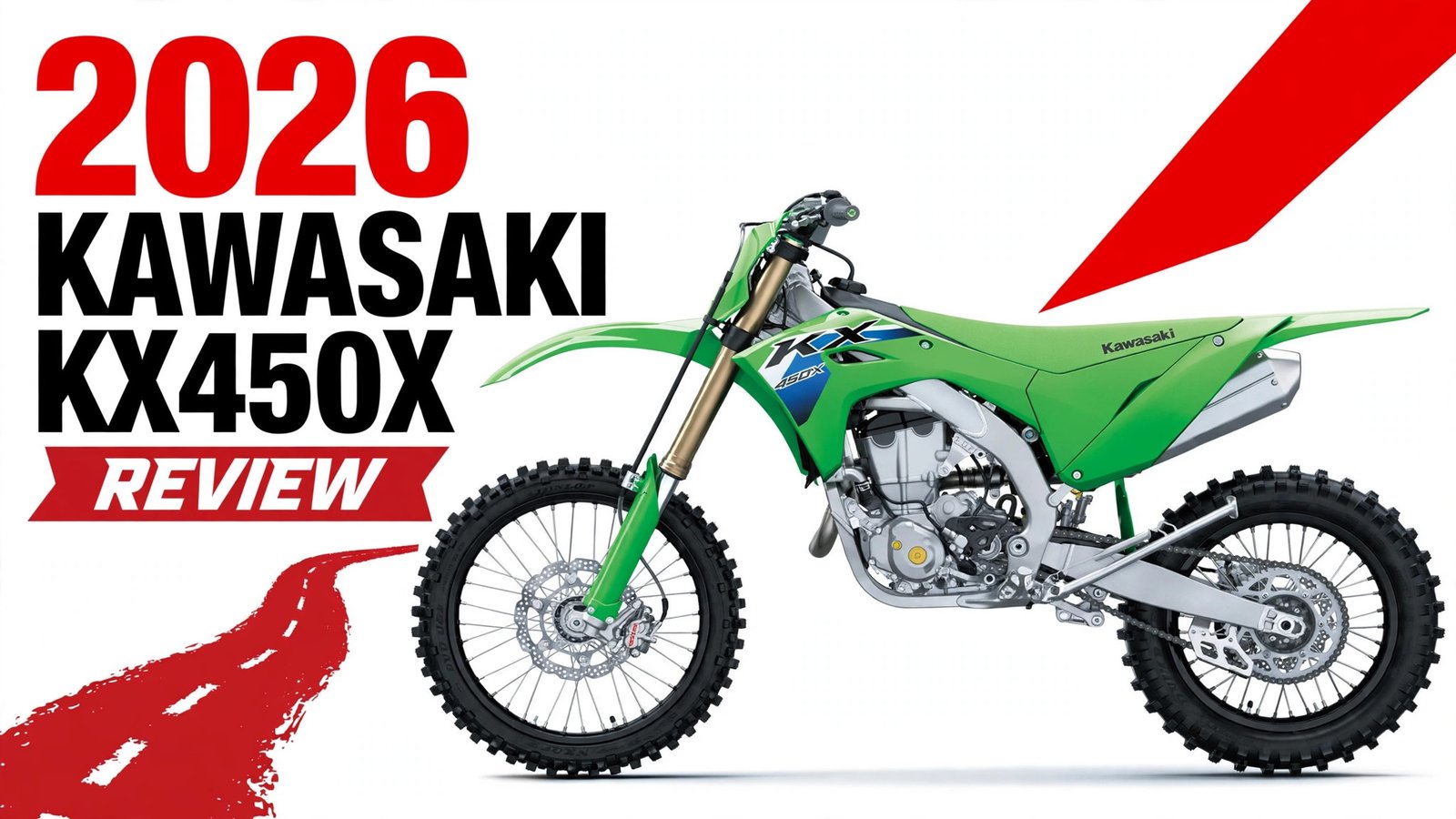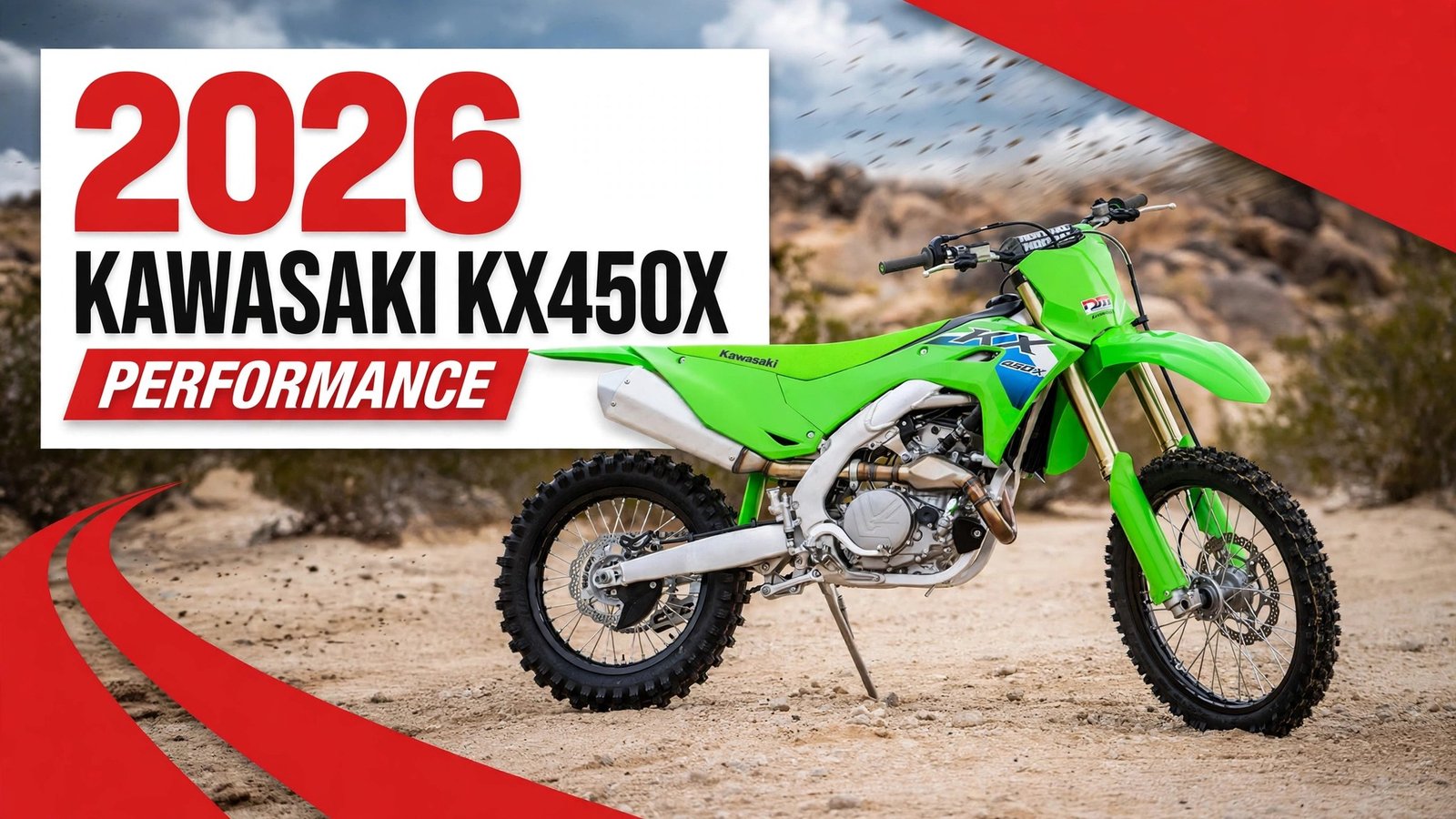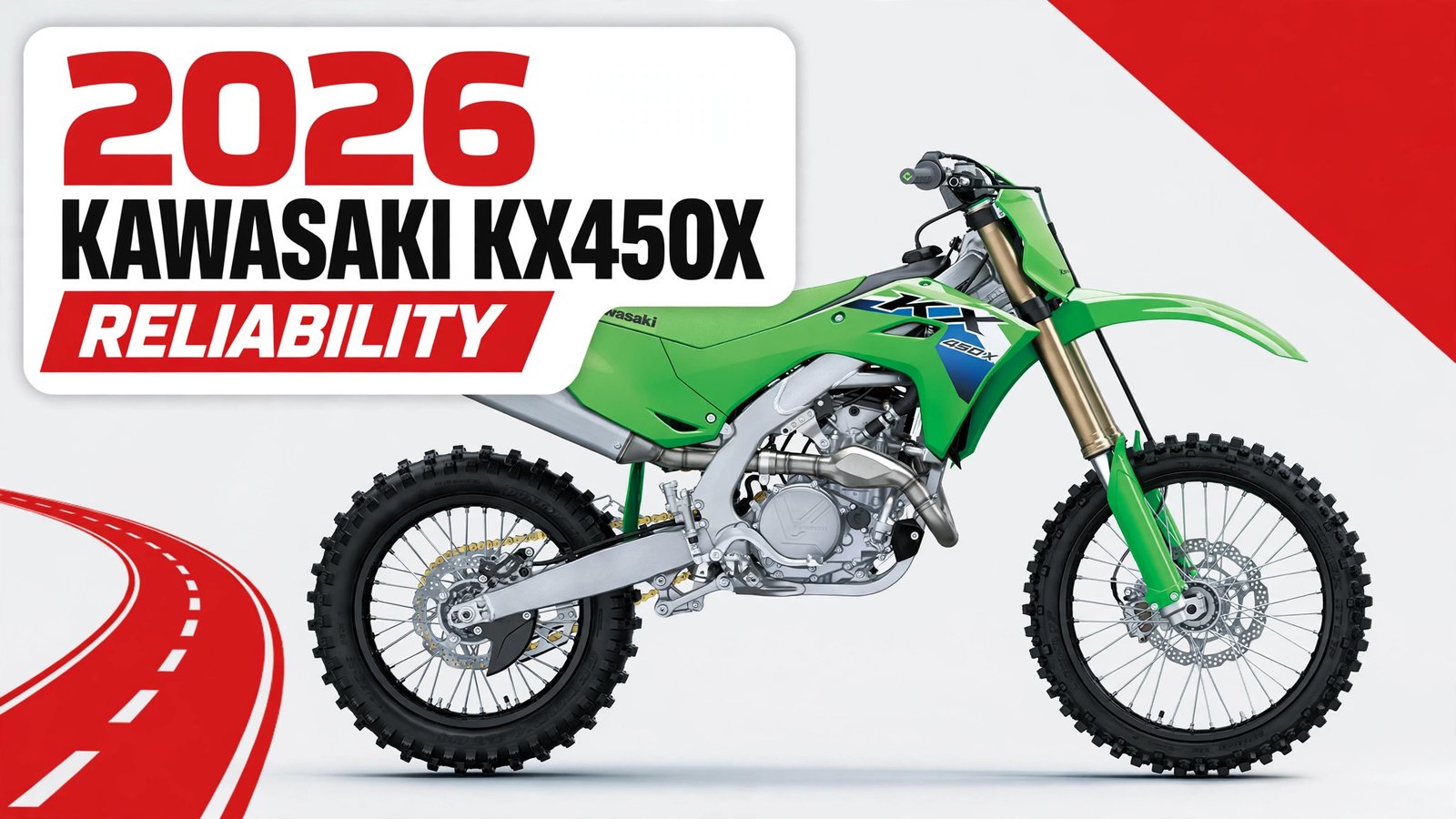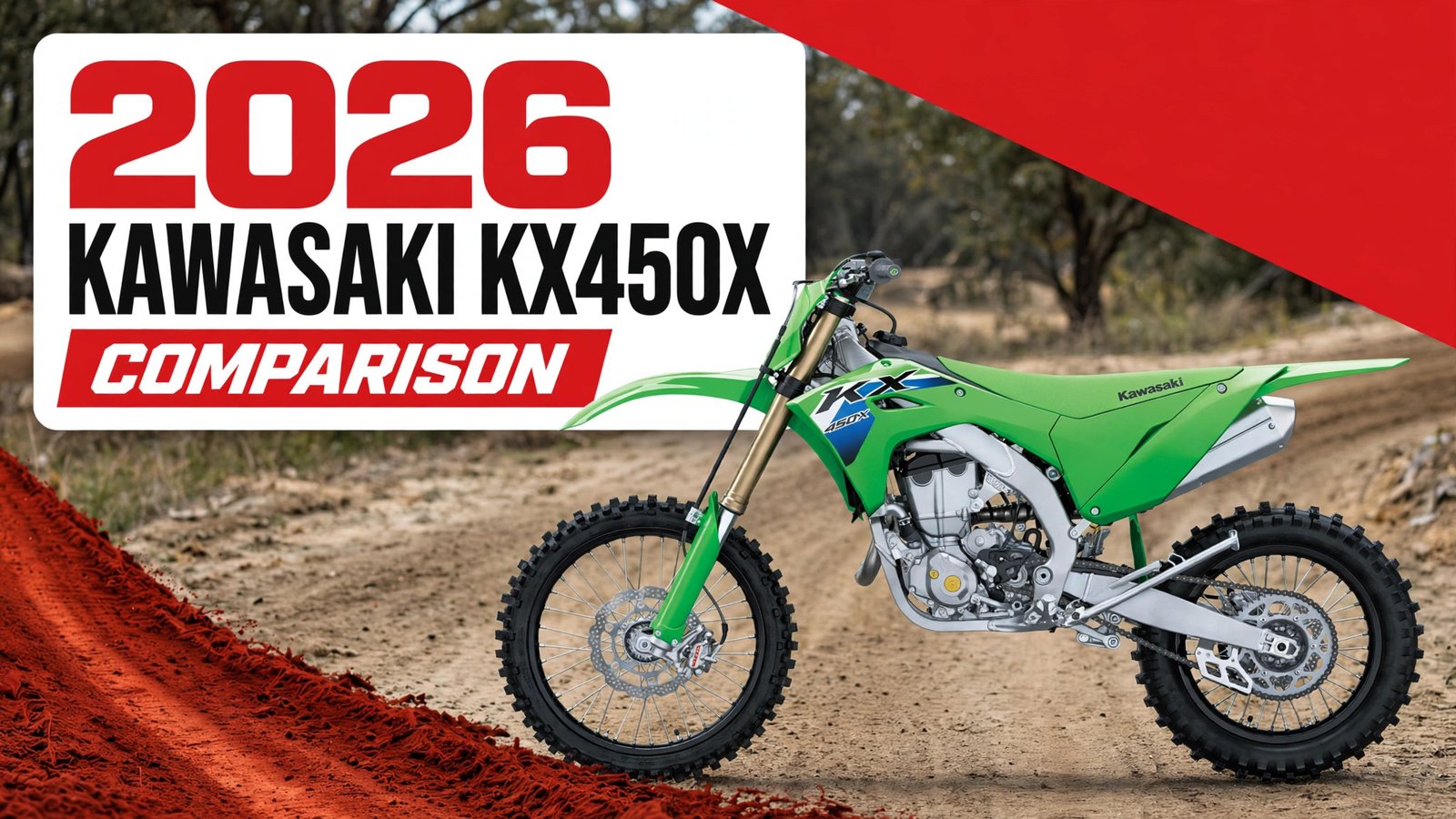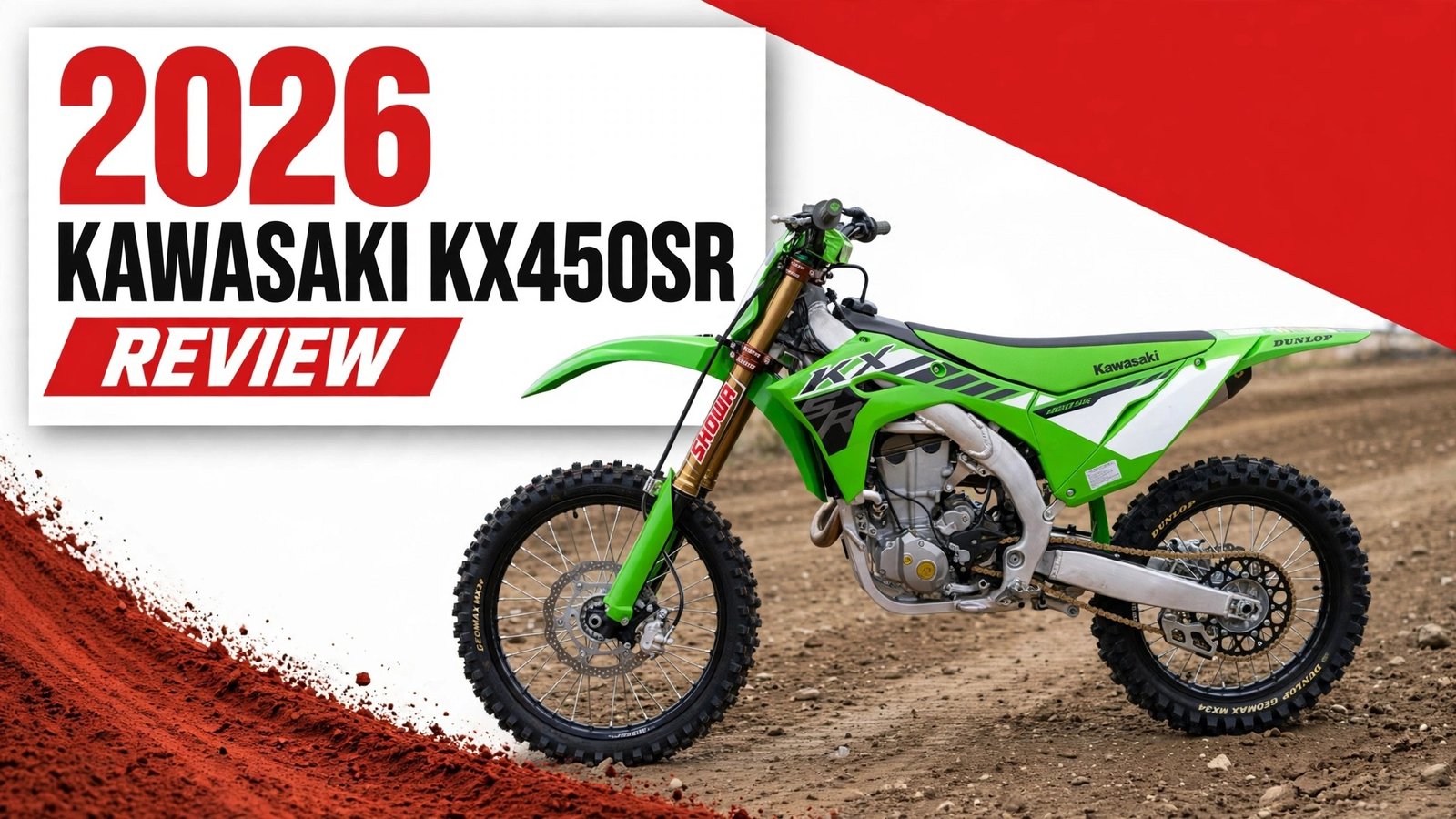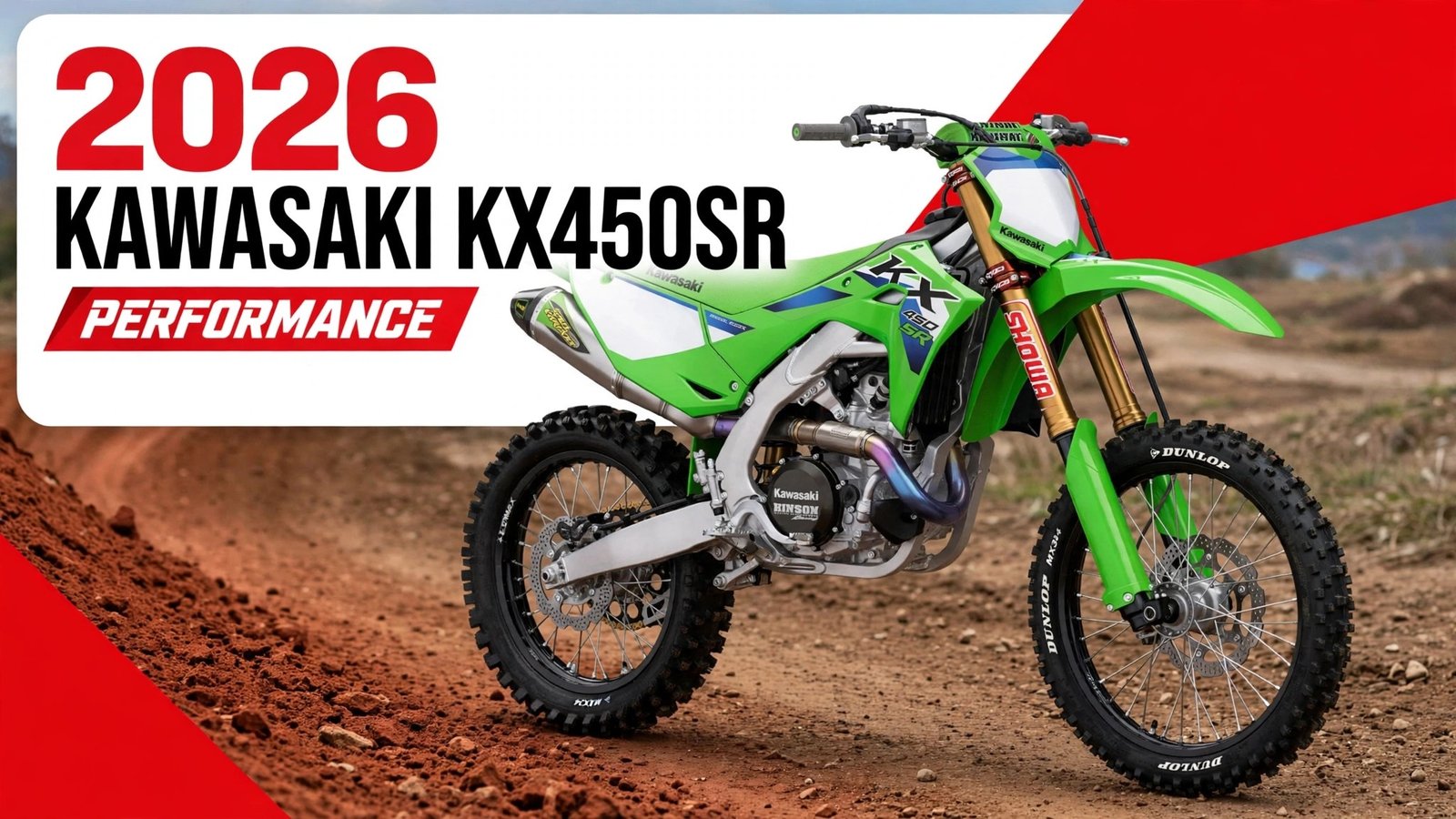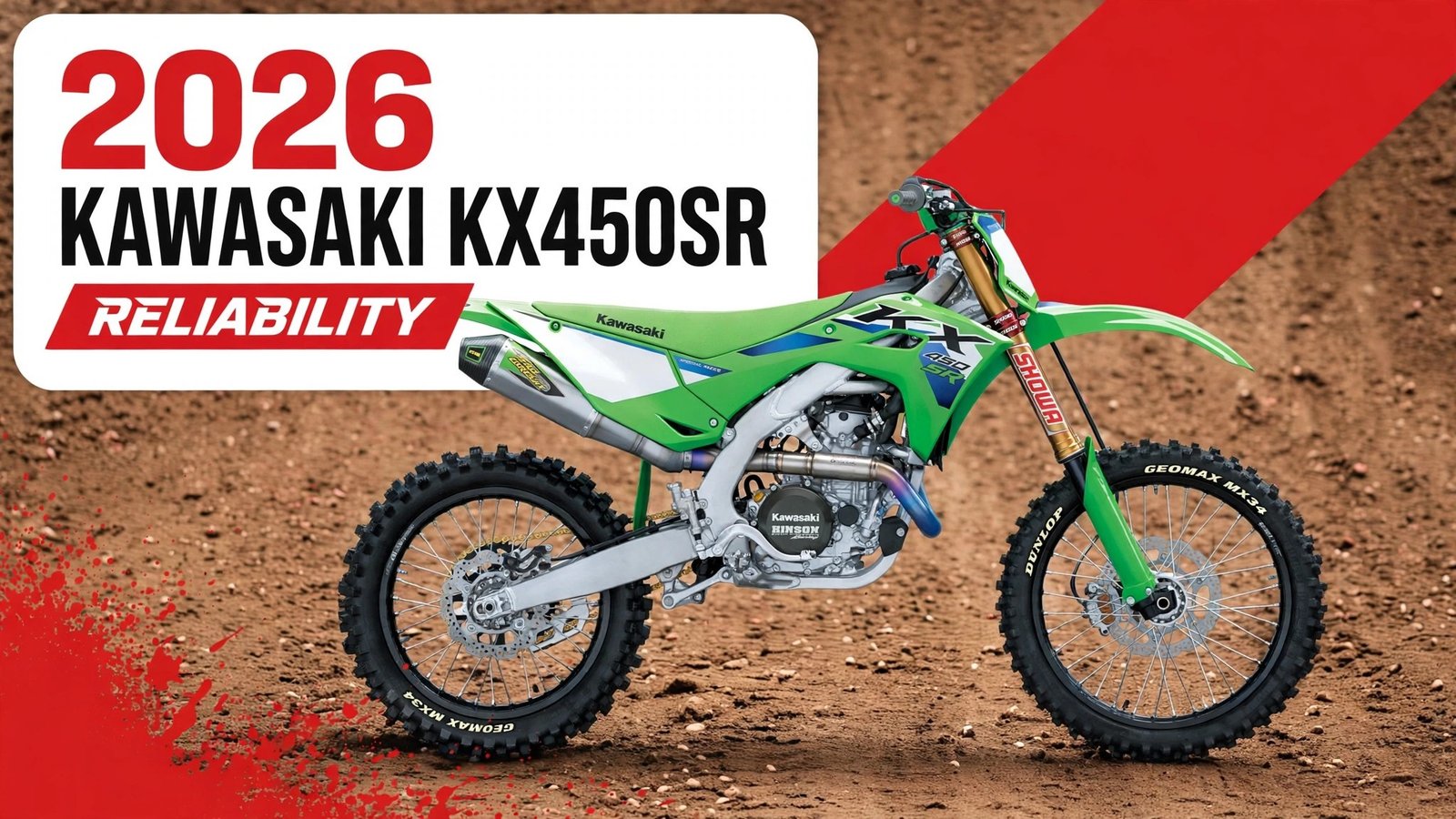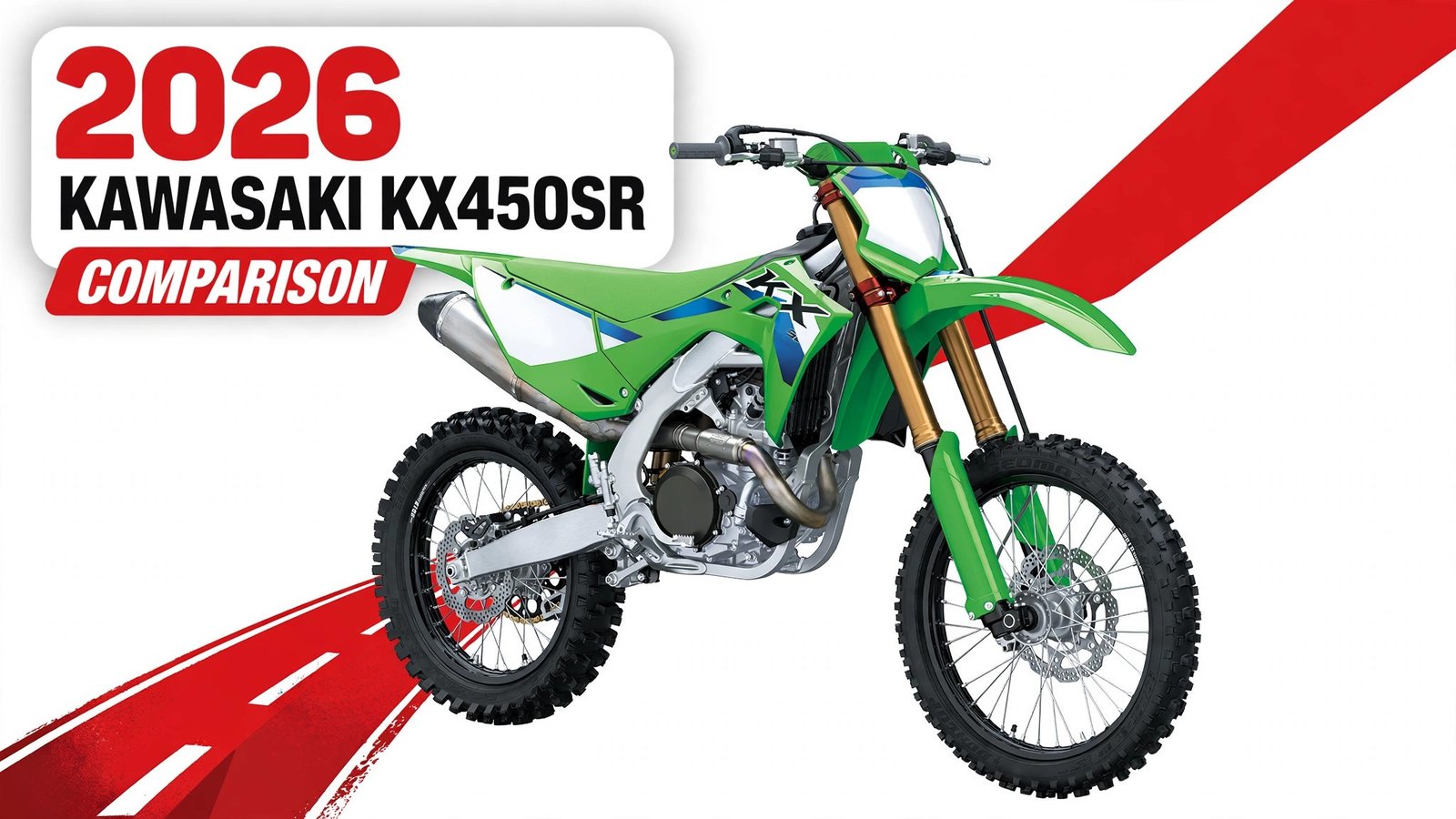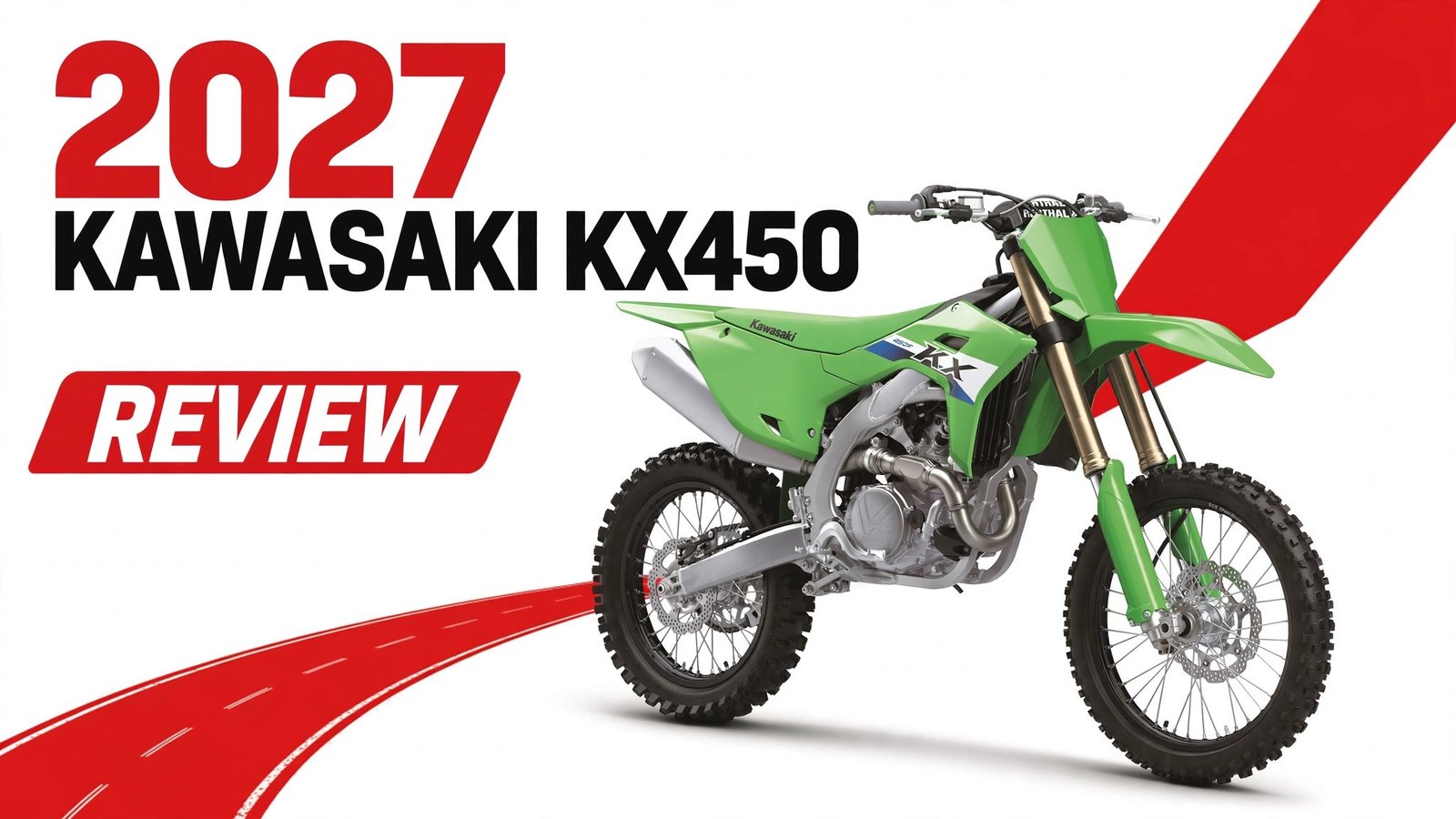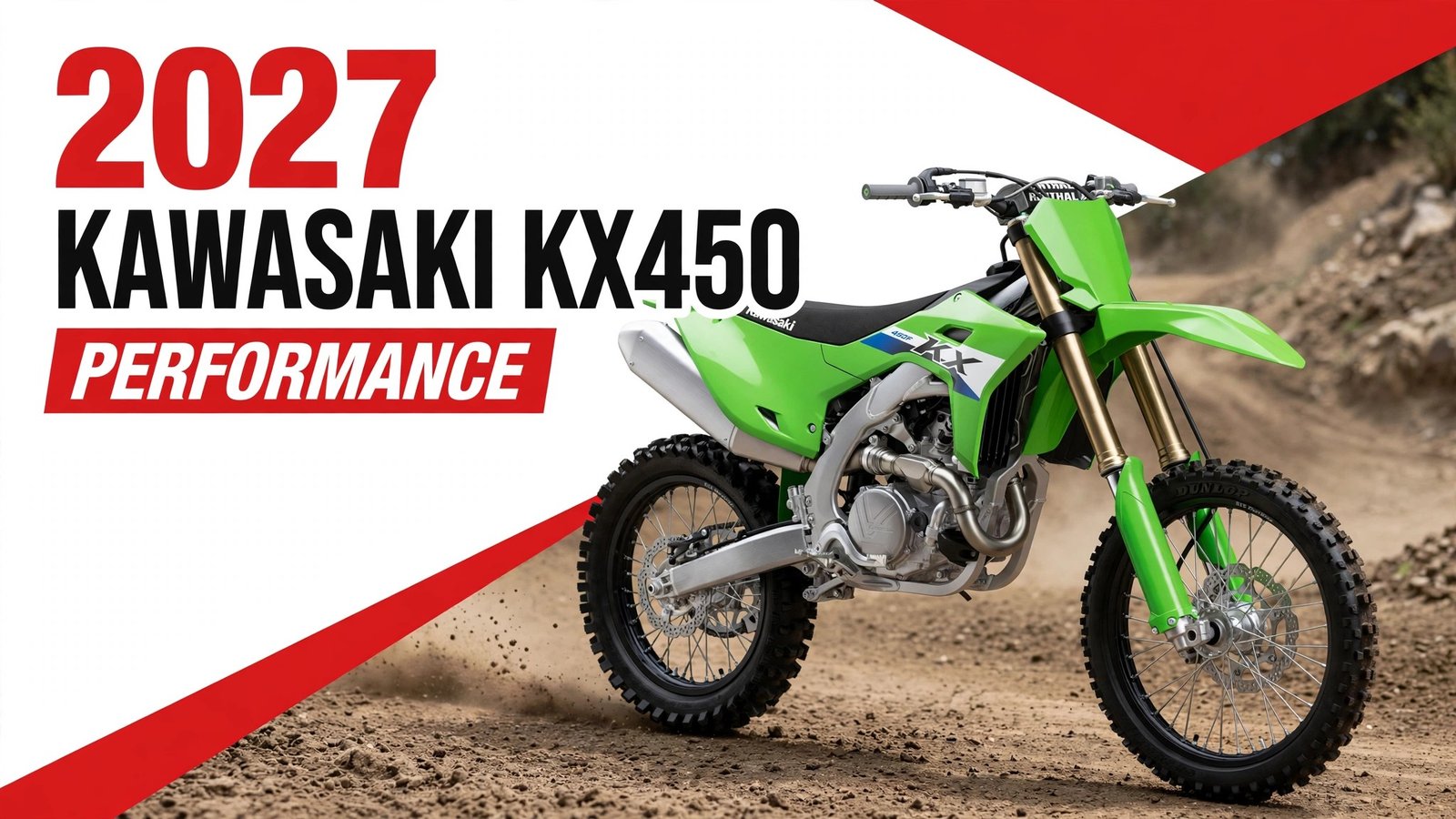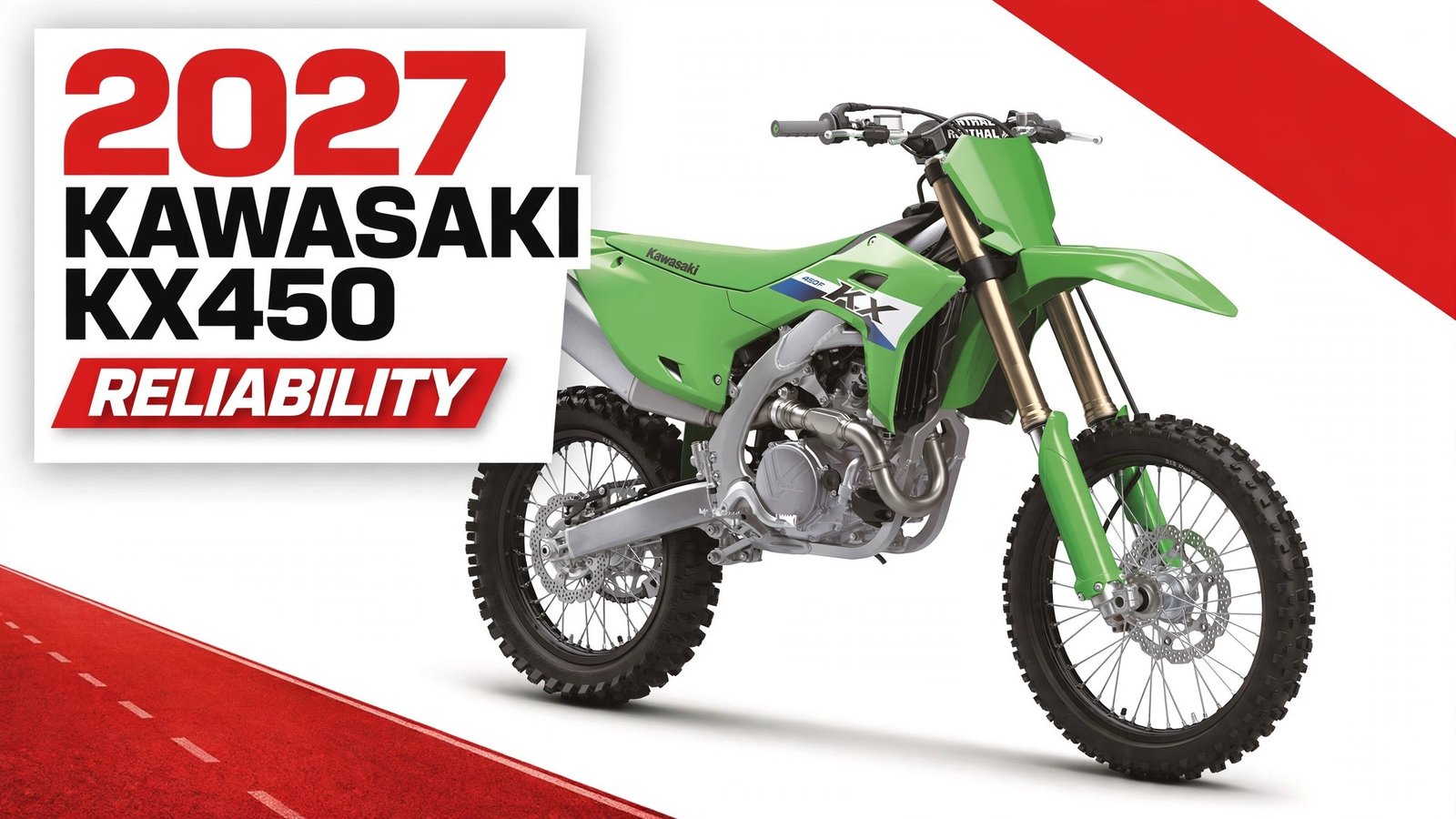
This Kawasaki KX450 reliability guide measures the 2027 KX450F the way a race bike deserves to be measured: in hours, not miles. It is a 449cc closed-course motocrosser, sold as-is with no warranty, and its service intervals are short by design. The 2027 bike costs $10,299 plus a $650 destination charge, or $10,949 delivered, per the Kawasaki model page and the motorcycle.com 2027 specs page. One recall names this bike’s family, and it names the 2025 bike only. The rest is about the maintenance that keeps a race bike alive between rebuilds.
The short version of this Kawasaki KX450 reliability guide: the engine is proven, the weak points are known and documented, and the costs are predictable once you accept the hours. The 2025 primary-gear recall is a VIN check, not a reason to avoid the model. The 2019 clutch problem was fixed for 2021 and has stayed fixed. The piston comes out every 15 hours by the manual’s chart.
Kawasaki KX450 Reliability Overview
Reliability on a motocross bike means something different from reliability on a road bike. There is no odometer, no warranty and no roadside assistance — there is an hour meter, a service chart and a rider who follows it or pays later. This guide starts with the one recall that exists, then works through the wear items, the service chart and the costs, so a buyer knows exactly what “reliable” costs on a 450 — the question this Kawasaki KX450 reliability guide answers.
25-238 Covers the 2025 Bike
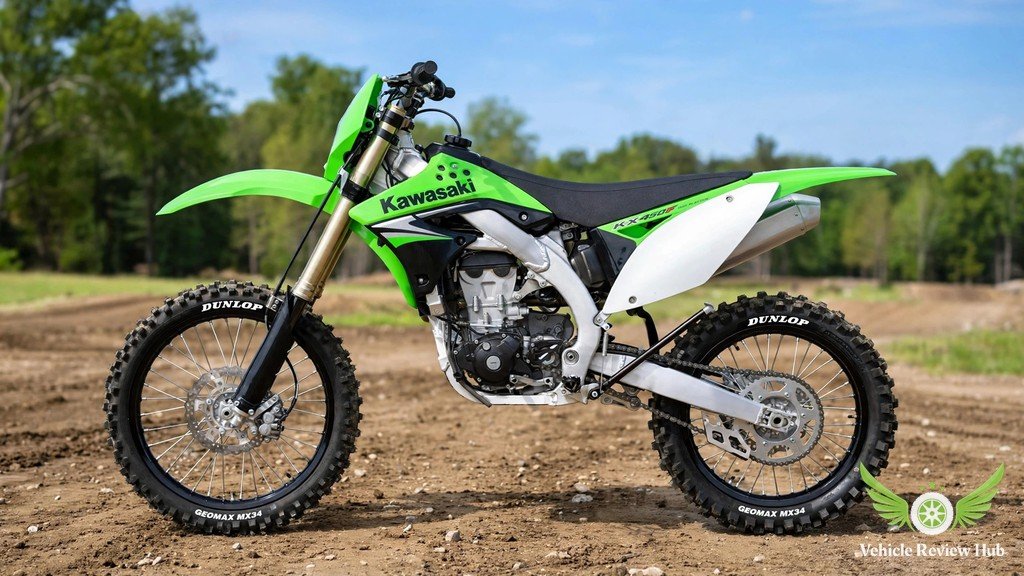
CPSC recall 25-238 is the only recall that names the KX450 in the current generation, and it names the 2025 bike only. Announced April 24, 2025, it covers about 3,400 units: the 2025 KX450, the 2025 KX450SR and the 2025 KX450X. The defect is in the crankshaft primary gear — the CPSC text says the surface durability of the primary gear for the crankshaft may be insufficient, and continuous use in that condition may result in failure of the primary gear. It is a crash hazard, and Kawasaki issued an immediate stop-sale notice to dealers. The remedy is a free repair: replace the primary gear at an authorized Kawasaki dealer. No injuries were reported, and the bikes were sold between June 2024 and March 2025. No recall names any 2026 or 2027 KX450, and this Kawasaki KX450 reliability guide never implies otherwise. Cycle News reported that the precautionary recall has since been resolved and that all 2026 models feature the updated coatings.
How Mileage, Storage and Previous Care Affect Reliability
A motocrosser has no odometer, so “mileage” is really hours, and hours are only honest when someone kept a record. A bike with 40 hours and a logbook is a better buy than a bike with 15 claimed hours and no records at all. Ask for the hour meter reading, the last piston change and the last valve check before you believe any number a seller gives you — this Kawasaki KX450 reliability guide’s first buying rule. Storage matters just as much: a bike left with old fuel, a dirty air filter and a dry chain corrodes quietly between rides. Previous care is the real reliability test on a used KX450. This Kawasaki KX450 reliability guide treats service records as evidence, not paperwork: no records means you budget for a piston, a valve check and fresh fluids on day one.
Kawasaki KX450 Common Problems and Wear Items
The KX450’s known problems are few, and all of them are documented in public. This Kawasaki KX450 reliability guide covers the two that matter: the primary gear on the 2025 bikes and the clutch on the 2019 bike. Everything else is wear, and wear is a schedule, not a surprise.
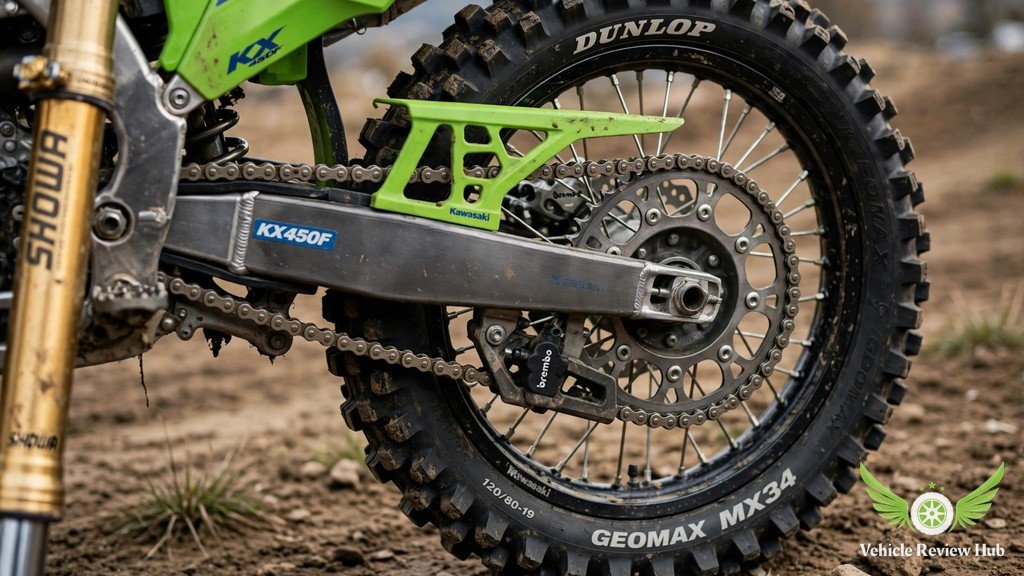
Primary Gear Can Fail
The primary gear is the one genuine failure point in this bike’s recent history, and it belongs to the 2025 model year. The crankshaft primary gear’s surface durability may be insufficient, and if it fails, the engine stops driving the bike — the CPSC classified it as a crash hazard, which is why Kawasaki stopped sales immediately and repaired the affected bikes free of charge. The 2025 KX450 VIN range is JKAKXGMCSA008598 to JKAKXGMCSA011475, and any 2025 bike inside that range needs the repair confirmed before it changes hands. A class action was also filed over the primary-gear issue — Melendez v. Kawasaki Motors Corp., USA, case 8:25-cv-00910, filed May 1, 2025. This Kawasaki KX450 reliability guide mentions the lawsuit because it exists, not because its claims are adopted: the law firm’s “over-torqued crankshaft bolts” theory is not the CPSC’s finding, and the CPSC text on surface durability is the authoritative version. For the 2026 and 2027 bikes, the updated coatings are in and no recall names them.
2019 Clutch Squeal and Fade
The 2019 KX450 was the first Japanese motocrosser with a hydraulic clutch, and its clutch still squealed and faded as it heated up. Motocross Action’s 2019 shootout put it plainly: the clutch squealed and faded not because of the hydraulics but in spite of them. The factory fix came for 2021: larger-diameter plates, revised friction material and a coned disc-spring — a Belleville washer — replacing the coil clutch springs. That 2021 revision resolved the fade, and the design has carried over since: the 2027 bike’s press release lists a coned disc-spring hydraulic clutch, and the 2025 and 2026 bikes run a Nissin wet multi-disc clutch with hydraulic actuation. A 2019 bike with its original clutch is a bike you budget a clutch job for; a 2021 or newer bike has the fix already in it. This Kawasaki KX450 reliability guide calls the 2019 clutch a solved problem, not a running one.
Kawasaki KX450 Maintenance Schedule and Servicing
The KX450’s service chart runs on races and hours, not months and miles. Four columns carry the whole schedule: after each race (2.5 hours), every 3 races (7.5 hours), every 6 races (15 hours) and every 12 races (30 hours). This Kawasaki KX450 reliability guide prints the verified intervals from that chart, and it labels every figure with its source.
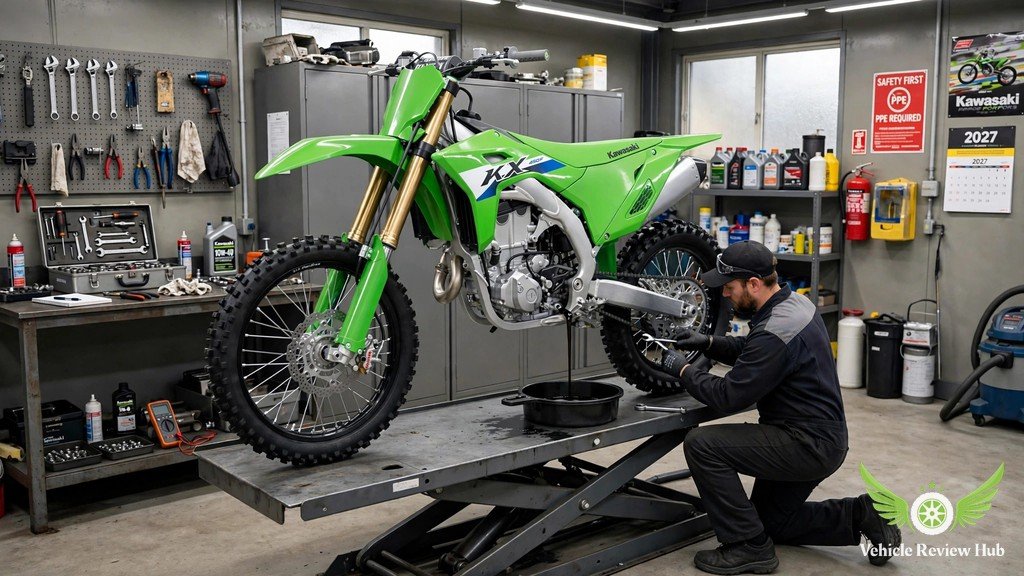
Piston and Oil at 15 Hours
The heading says “Piston and Oil at 15 Hours”, and only half of it is a manual figure — this Kawasaki KX450 reliability guide corrects that here, in the first paragraph, before anything else. The piston half is verified: the piston, the piston ring and the piston pin are all replaced every 6 races, or 15 hours, per the KX450 owner’s manual periodic-maintenance chart. That is the KX450 family figure, carried across generations, and it is labelled as the manual’s chart figure every time it appears in this guide. The oil half is not verified as a manual figure. The manual’s replacement chart does not place the engine-oil change in the 15-hour column, and no text source ties the oil change to 15 hours — so this guide does not print “oil at 15 hours” as the manual’s interval. Oil changes are frequent, race-interval servicing — but the 15-hour number belongs to the piston, not the oil.
Chart Is From the 2018 Manual
The chart behind this section comes from the 2018 KX450F owner’s manual, pages 34 to 38, and it was cross-checked against the 2013 owner’s manual and the 2006 service manual chart — all three agree on the piston rows, which is why this Kawasaki KX450 reliability guide trusts them. The current-generation bike’s own owner’s manual was not located at research time, which is why this Kawasaki KX450 reliability guide calls the 15-hour piston figure the KX450 family figure rather than the 2027 bike’s published interval. The same family chart puts valve clearance inspection every 3 races, or 7.5 hours (Ex 0.17–0.22 mm, In 0.10–0.15 mm). The long columns are calendar items, not hour items: brake fluid every two years, brake hoses every four years, fuel hose every five years. The same 15-hour piston interval appears in our Kawasaki KX250 reliability guide for the 250cc sibling, which shares the family chart.
| Item | Interval | What it means |
|---|---|---|
| Piston + piston ring — replace | Every 6 races / 15 hours | Per the KX450 owner’s manual periodic-maintenance chart |
| Piston pin — replace | Every 6 races / 15 hours | Same chart, same column as the piston |
| Valve clearance — inspect | Every 3 races / 7.5 hours | Ex 0.17–0.22 mm / In 0.10–0.15 mm |
| Throttle cable, clutch plates, spark plug, air cleaner — inspect / clean | After each race / 2.5 hours | The small jobs that keep a race bike alive |
| Brake fluid — change | Every 2 years | Calendar item, not an hour item |
| Brake hoses — replace | Every 4 years | Calendar item, not an hour item |
| Fuel hose — replace | Every 5 years | Calendar item, not an hour item |
Note: Every interval above comes from the KX450 owner’s manual periodic-maintenance chart (2018 manual, pages 34–38, cross-checked against the 2013 manual and the 2006 service manual). The 15-hour piston figure is the KX450 family figure, labelled as the manual’s chart figure every time — it is not presented here as the 2027 bike’s own published interval. The oil change has no hour figure in this table, because no verified manual figure ties the oil change to a specific hour count, and this Kawasaki KX450 reliability guide never prints one.
Kawasaki KX450 Tires, Brakes and Suspension Maintenance
Tyres, brakes and suspension are the parts a rider touches every ride, so they are also the parts that show neglect first. This Kawasaki KX450 reliability guide treats them as a pre-ride checklist: look at them before every ride, and the expensive failures mostly never happen.
OEM Piston Is About $171
About $171 is the observed price range for the previous-generation piston only — and this Kawasaki KX450 reliability guide says so plainly, because the heading on its own invites the wrong reading. The 2021–2023 OEM piston is part number 13001-0816, and genuine examples on eBay run from $117.81 to $187.57, which brackets $171. The 2024 and newer bike runs a different piston: aftermarket makers split their kits at 2019–2023 versus 2024–2026, and the 2024-plus bike’s OEM part number and price were not verified at research time — no price surfaced, and the parts supplier’s page would not load. The verified alternative is the Pro X piston kit for the 2024–2026 KX450 and KX450X, at $199.76 from RevZilla, in stock, including the piston, piston pin, clips and rings (gaskets not included). Budget the Pro X kit price for a 2024 or newer piston job, as this Kawasaki KX450 reliability guide does — and never quote $171 as the current bike’s OEM piston price without the part number and the previous-generation label.
Tire, Brake and Suspension Checks That Matter
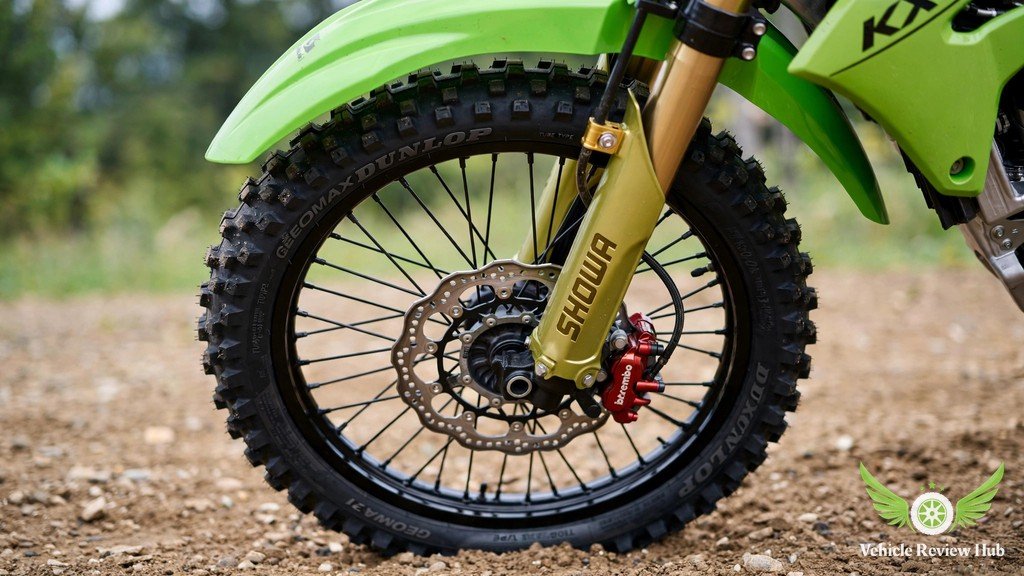
The tyres are Dunlop Geomax MX34 knobbies, 80/100-21 at the front and 120/80-19 at the rear, and they wear fast on hardpack — check the knobs for tearing and the sidewalls for cracking before every ride — this Kawasaki KX450 reliability guide’s first pre-ride check — and remember these tyres are not road-legal. No Kawasaki tyre-pressure figure was verified for this bike, so none is printed here. The brakes changed for 2027: the 2025 and 2026 bikes run a Brembo front (270 mm petal disc) with a Nissin rear (240 mm petal disc), while the 2027 bike is the first KX450 with Brembo at both ends. Cycle News called the Brembo front brake arguably the best in class and noted that Kawasaki is the only Japanese brand where it comes standard. The manual’s calendar items are brake fluid every two years, brake hoses every four years, and the master-cylinder cup, dust cover and caliper seals every two years. The suspension is a 49 mm Showa coil-spring fork with 12.0 inches of travel and a Uni-Trak rear shock — 12.1 inches of travel on the 2025 and 2026 bikes, 11.8 inches on the 2027 bike with its new Showa shock. Fork-oil and rear-shock-oil change intervals were not verified as specific hour figures, so no hour figure is printed for them here. The stock settings run soft; the MXA 2026 race test suggests a couple of clicks in on compression as test-rider advice, not a factory setting. Check seals for leaks, linkage for play and sag before every ride — a fork seal caught early is a cheap job.
| Component | What to check | When |
|---|---|---|
| Front tyre — Dunlop Geomax MX34, 80/100-21 | Knob tearing, sidewall cracking | Before every ride |
| Rear tyre — Dunlop Geomax MX34, 120/80-19 | Knob tearing, sidewall cracking | Before every ride |
| Front brake — Brembo, 270 mm petal disc | Pad wear, disc condition, fluid level | Before every ride; fluid every 2 years |
| Rear brake — Brembo 2027 / Nissin 2025–2026, 240 mm petal disc | Pad wear, disc condition | Before every ride |
| Fork — 49 mm Showa, 12.0 in travel | Seal leaks, clicker settings | Before every ride |
| Rear shock — Uni-Trak, 11.8 in (2027) / 12.1 in (2025–2026) | Linkage play, sag | Regular inspection |
Note: Tyre sizes (80/100-21 front, 120/80-19 rear) and brake disc sizes (270 mm front, 240 mm rear) come from the Kawasaki spec sheets — the sheet wins where other sources disagree. The 2027 bike is the first KX450 with Brembo brakes at both ends; 2025 and 2026 bikes have a Brembo front and a Nissin rear. No tyre-pressure figure and no fork-oil or shock-oil hour figure was verified, so this Kawasaki KX450 reliability guide prints neither.
Kawasaki KX450 Maintenance and Ownership Costs
Owning a 450 motocrosser costs more than owning a trail bike, and most of the money goes to parts that wear out on purpose. This Kawasaki KX450 reliability guide puts the real numbers in one place, so the purchase price is never the surprise.
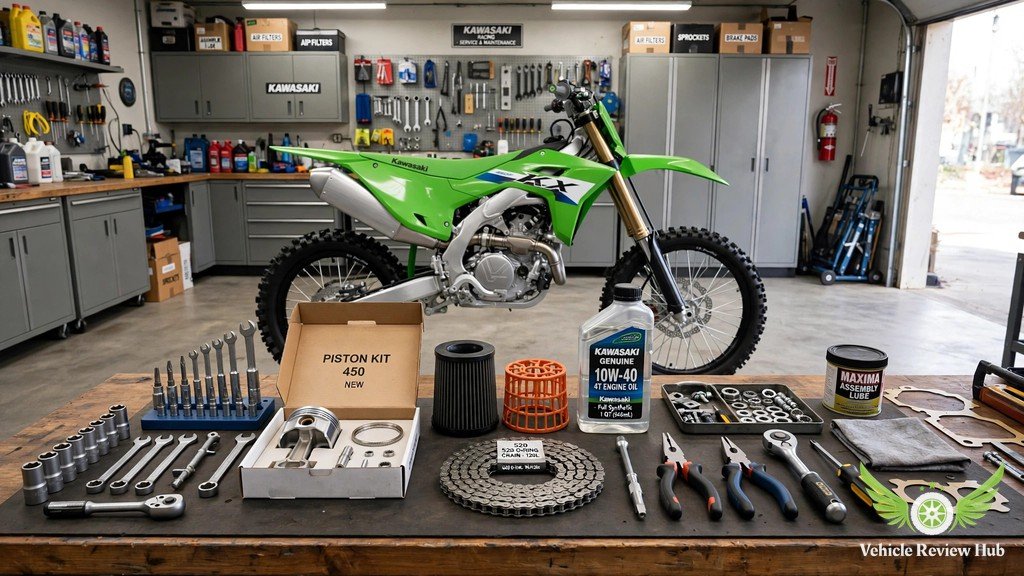
Fuel, Routine Servicing, Tires and Replacement Parts
The fuel tank holds 1.64 gallons, the same every year, and there is no official MPG figure and no tested fuel economy for this bike — so this Kawasaki KX450 reliability guide prints no fuel-cost-per-mile number, because none exists to print. A race weekend burns fuel, oil, filters and tyres in that order: oil and filters after every race, tyres as the knobs tear on hardpack, and a piston kit every 15 hours by the manual’s chart — the rhythm this Kawasaki KX450 reliability guide is built around. The piston kit is the big recurring part — $199.76 for the verified Pro X kit on a 2024 or newer bike — and the valve check every 7.5 hours is labour, not parts. There is no warranty to fall back on — the bike is sold as-is — which means every repair is the owner’s bill. The $10,949 delivered price is the cheapest part of owning it; the service chart is the expensive part. For the power that all this maintenance protects, see our Kawasaki KX450 performance guide — 57.7 hp on the 2026 dyno, fifth of twelve, with the softest delivery in the class.
2025 Bikes Need a VIN Check
Any 2025 KX450, KX450SR or KX450X must be checked by VIN before purchase, full stop — the single most important check in this Kawasaki KX450 reliability guide. The 2025 KX450 VIN range for recall 25-238 is JKAKXGMCSA008598 to JKAKXGMCSA011475, and the buyer should confirm the primary-gear repair was done at an authorized Kawasaki dealer before money changes hands. The repair is free, and a 2025 bike with the repair done is a fixed bike — the recall is a reason to verify the VIN, not a reason to avoid the model, a point this Kawasaki KX450 reliability guide stresses. For the full price story on every model year, see our Kawasaki KX450 review — and for how the KX450 stacks up against its rivals on price and running costs, see our Kawasaki KX450 comparison.
| Item | Cost / figure | Source / note |
|---|---|---|
| 2027 MSRP | $10,299 | Kawasaki USA spec sheet |
| 2027 delivered price | $10,949 ($10,299 + $650 destination) | Destination verified on motorcycle.com |
| Fuel tank | 1.64 gal, same every year | Spec sheet; no MPG figure exists |
| Pro X piston kit, 2024–2026 | $199.76 | RevZilla, in stock |
| OEM piston, previous generation (2021–2023, part 13001-0816) | $117.81–$187.57 observed | eBay examples; 2024+ OEM price not verified |
| Wiseco piston kit, 2024–2025 | $341.99 | Aftermarket alternative |
Note: Prices are as verified at research time in November 2026 and will move — re-check before buying. No 2025 delivered price is printed anywhere in this Kawasaki KX450 reliability guide, because the 2025 destination charge was not verified. The $199.76 Pro X kit is the verified 2024–2026 piston-kit price; the 2024-plus bike’s OEM piston price was not verified and is not printed as a figure.
How to Keep a Kawasaki KX450 Reliable
Keeping a KX450 reliable is not a mystery — it is a routine, and the routine is short. This Kawasaki KX450 reliability guide ends with the habits that matter.
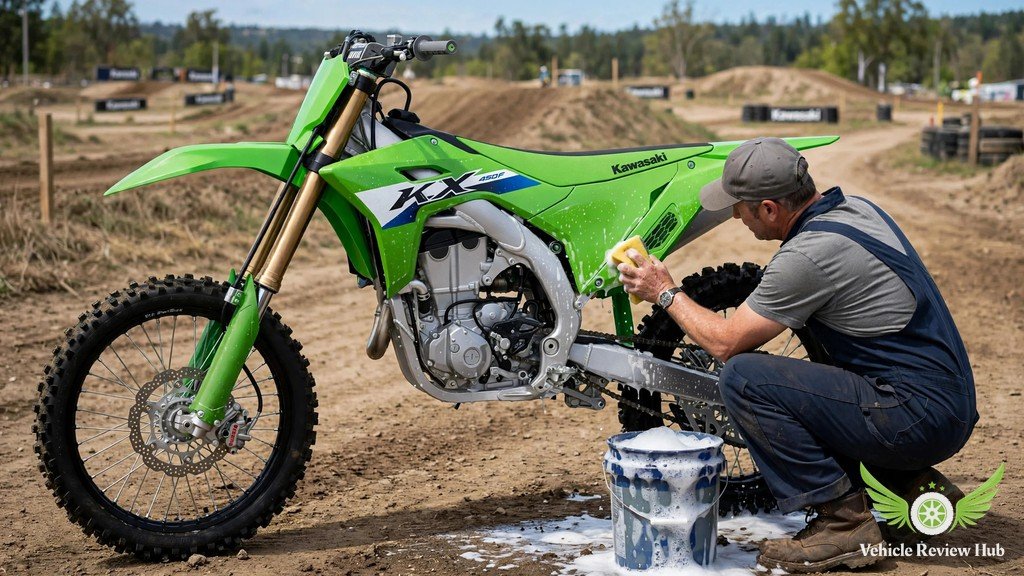
Preventive Maintenance, Records and Regular Inspections
Fit an hour meter if the bike does not have one — the first step in this Kawasaki KX450 reliability guide’s routine — and write down every service: the date, the hours, the piston, the valve check, the oil and the filter. Clean the air filter after every ride — a dirty filter is the fastest way to wear an engine out from the inside. Check the chain, the spokes and the fasteners before every ride, because vibration loosens things and a loose spoke becomes a broken wheel. This Kawasaki KX450 reliability guide has one rule for all of it: the 15-hour piston, the 7.5-hour valve check and the after-every-race inspections are not suggestions, they are the reason the bike survives its own power.
No Kick Starter to Fall Back On
The KX450 has been electric-start only since 2019, and there is no kick starter to fall back on. The 2018 bike was the last one with a kick starter; the 2019 redesign dropped it, and every bike since — including the 2027 KX450F — starts with a button or not at all. A dead battery or a failed starter means no bump-start fallback on the trail, so the battery is a reliability item, not an accessory: keep it charged, keep the terminals clean, and carry a small jump pack in the truck. This Kawasaki KX450 reliability guide says it plainly because it is the one failure that leaves a rider walking: on a bike with no kick starter, the battery is part of the service schedule.
Kawasaki KX450 Reliability FAQs
The questions below cover what buyers ask about most in this Kawasaki KX450 reliability guide: the recall, the VIN check, the piston interval, the oil question, the 2019 clutch and the missing kick starter. Each answer is short and direct, with the source attached to every figure.
Is there a recall on the KX450?
Yes — CPSC recall 25-238 covers the 2025 KX450, KX450SR and KX450X, about 3,400 units: the crankshaft primary gear can fail. The repair is free — replace the primary gear at an authorized Kawasaki dealer. No recall names any 2026 or 2027 KX450, and this Kawasaki KX450 reliability guide never implies otherwise.
How do I check if a 2025 KX450 is recalled?
By VIN. The 2025 KX450 range is JKAKXGMCSA008598 to JKAKXGMCSA011475. Confirm the primary-gear repair was done at an authorized Kawasaki dealer before buying — a repaired 2025 bike is a fixed bike, and this Kawasaki KX450 reliability guide treats the VIN check as a buying step, not a reason to avoid the model.
When do I replace the piston?
Every 6 races, or 15 hours — piston, piston ring and piston pin, all replaced together. That is the KX450 family figure from the KX450 owner’s manual periodic-maintenance chart, labelled as the manual’s chart figure every time, and this Kawasaki KX450 reliability guide never presents it as the 2027 bike’s own published interval.
What about the oil change interval?
The manual’s chart schedules frequent, race-interval oil changes, but no verified manual figure ties the oil change to 15 hours — so this Kawasaki KX450 reliability guide does not print “oil at 15 hours” as the manual’s interval. Change the oil after every race weekend and you are doing the right thing; just do not quote 15 hours as the manual’s oil figure, because it is not.
What was wrong with the 2019 clutch?
It squealed and faded as it heated up, even though it was the first hydraulic clutch on a Japanese motocrosser. Kawasaki fixed it for 2021 with larger-diameter plates, revised friction material and a coned disc-spring washer replacing the coil springs, and this Kawasaki KX450 reliability guide calls the 2019 clutch a solved problem — the 2027 bike carries the coned disc-spring hydraulic clutch.
Does the KX450 have a kick starter?
No — electric-start only since 2019. The 2018 bike was the last KX450 with a kick starter. A dead battery means no bump-start fallback, so this Kawasaki KX450 reliability guide counts the battery as part of the service schedule, not an accessory.