The 2026 Ford Ranger remains one of the most practical mid-size trucks for buyers looking for balanced ownership costs, strong truck capability, and reliable daily usability. Compared to many full-size pickups, the Ford Ranger is easier to maintain, cheaper to fuel, and more manageable for daily driving while still delivering strong towing and hauling performance.
Recent ownership reports and long-term reliability data show that the latest Ford Ranger performs competitively within the mid-size truck segment for maintenance cost, durability, and long-term ownership value. The standard 2.3L EcoBoost remains the most balanced setup for buyers focused on lower operating costs and dependable daily driving.
The latest Ford Ranger also benefits from improved drivetrain refinement, updated suspension tuning, and better interior quality compared to older Ranger generations. Most ownership costs now focus mainly on regular maintenance, tire replacement, fluid servicing, and normal wear items rather than major powertrain failures.
This Ford Ranger Ownership Guide covers real Ford Ranger maintenance costs, long-term reliability, common ownership problems, expected lifespan, warranty coverage, resale value, and real USA ownership experience using verified latest-market data.
2026 Ford Ranger Reliability Overview
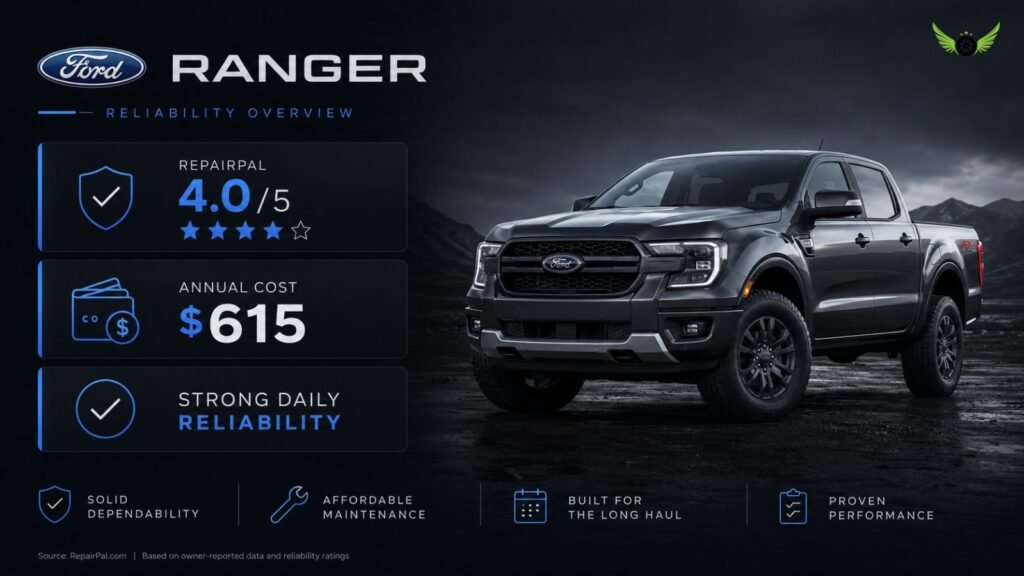
The 2026 Ford Ranger delivers strong overall reliability in the mid-size truck segment while maintaining solid towing capability, turbocharged performance, and everyday usability. Recent owner reports, reliability studies, and maintenance-cost data show that the latest Ranger performs better than many older Ford truck generations, especially in drivetrain refinement and long-term durability.
Most ownership costs now come from scheduled maintenance, tires, brakes, fluid servicing, and normal wear items rather than major engine or transmission failures.
Long-Term Reliability Ratings
Recent reliability studies show the Ford Ranger performing competitively within the mid-size truck segment for long-term ownership and repair frequency.
Source | Ford Ranger Reliability Result |
RepairPal | 4.0/5.0 reliability rating |
Average Annual Repair Cost | Around $615 per year |
Consumer Reports | Average predicted reliability |
Many long-term owners report that the standard 2.3L EcoBoost engine performs reliably when oil changes, cooling-system servicing, and transmission maintenance are completed on schedule.
The 10-speed automatic transmission also performs more smoothly than earlier Ford truck applications, although some owners still report occasional rough low-speed shifting during stop-and-go traffic.
Most Common Ford Ranger Problems
The latest Ford Ranger has fewer major reliability concerns than many older Ranger generations, but several common issues still appear in owner reports, recalls, and service bulletins.
The most commonly reported concerns include:
- Rough low-speed transmission shifting
- Infotainment software glitches
- Minor electrical sensor issues
- Premature tire wear on off-road tire setups
- Wind noise around mirrors at highway speed
- Occasional cold-weather electronic issues
Some 2024–2026 Ranger models also received recalls related to wiring-harness positioning and seat-frame hardware. Most reported issues are not severe powertrain failures and are usually resolved through software updates, warranty repairs, or standard dealership servicing.
Common Repairs Reported by Owners
Most Ford Ranger owners mainly report routine maintenance and wear-item repairs instead of major engine failures.
The most common repair and maintenance items include:
- Brake pad replacement
- Tire replacement
- Battery replacement
- Transmission fluid servicing
- Turbo-related sensor servicing
- Suspension wear components on off-road-driven trucks
Owners using oversized tires, heavy towing setups, or frequent off-road driving usually experience faster tire and suspension wear compared to normal commuting-focused drivers.
Many USA owners also report that regular maintenance plays a major role in long-term Ford Ranger Reliability, especially for turbocharged EcoBoost engines and 10-speed automatic transmissions.
2026 Ford Ranger Maintenance Schedule
The 2026 Ford Ranger follows a maintenance schedule designed to protect the turbocharged EcoBoost engine, 10-speed automatic transmission, towing capability, and long-term durability. Regular servicing plays a major role in long-term Ford Ranger Reliability, especially for drivers who tow regularly, drive off-road, or operate in high-temperature and heavy-traffic conditions.
Ford also uses an Intelligent Oil Life Monitor system that adjusts service intervals based on towing load, idle time, temperature, and driving conditions rather than relying only on fixed mileage intervals.
Oil Change and Fluid Service Intervals
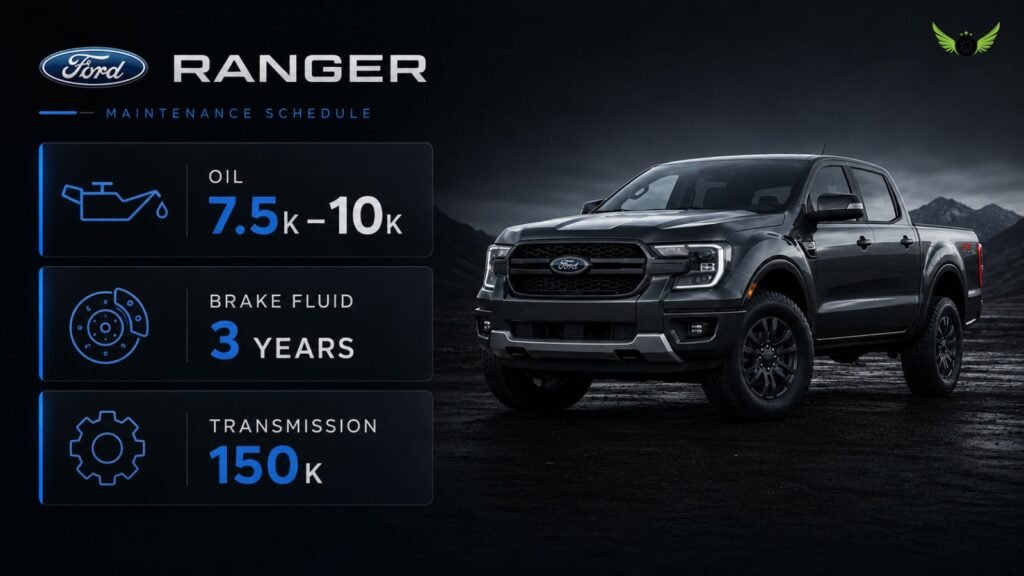
The turbocharged EcoBoost engines used in the Ford Ranger generate higher operating temperatures than naturally aspirated engines, making regular oil and fluid servicing important for long-term durability.
Service Item | Recommended Interval |
Engine oil and filter | 7,500–10,000 miles |
Severe-duty oil service | 5,000–7,500 miles |
Heavy towing/off-road use | 3,000–5,000 miles |
Cabin air filter | Around 20,000 miles |
Engine air filter | Around 30,000 miles |
Spark plugs | Around 100,000 miles |
Brake fluid | Every 3 years |
Automatic transmission fluid | Up to 150,000 miles |
Engine coolant | 200,000 miles or 10 years |
Many experienced Ford Ranger owners still prefer earlier transmission-fluid servicing around 30,000–60,000 miles for trucks used regularly for towing, mountain driving, or heavy hauling because the 10-speed automatic operates under higher thermal load during these conditions.
Brake, Tire and Battery Replacement Timeline
Brake, tire, and battery lifespan changes depending on towing use, climate, road conditions, tire type, and driving habits.
Most USA owners report:
- Brake pads lasting around 35,000–60,000 miles
- Factory tires lasting around 40,000–55,000 miles
- Batteries lasting around 3–5 years
FX4 and Ranger Raptor models often experience faster tire wear because of their aggressive all-terrain tire setups and heavier off-road-focused suspension systems.
Frequent towing, steep terrain, stop-and-go traffic, and oversized tires can also reduce brake lifespan faster than normal commuting-focused driving.
Transmission and Turbo Maintenance Tips
The Ford Ranger 10-speed automatic transmission performs best with regular fluid inspections and smooth warm-up driving habits during cold starts and towing situations.
Many long-term owners report smoother shifting and improved transmission behavior after earlier fluid servicing instead of waiting for the maximum factory interval.
Turbocharged EcoBoost engines also benefit from:
- High-quality full synthetic oil
- Proper engine warm-up during cold weather
- Short cooldown periods after heavy towing
- Regular cooling-system inspections
- Clean air filters for stable turbo airflow
Consistent maintenance helps improve long-term Ford Ranger Reliability and reduces the risk of turbo-related wear, overheating issues, and transmission stress during high-load driving conditions.
2026 Ford Ranger Ownership Cost
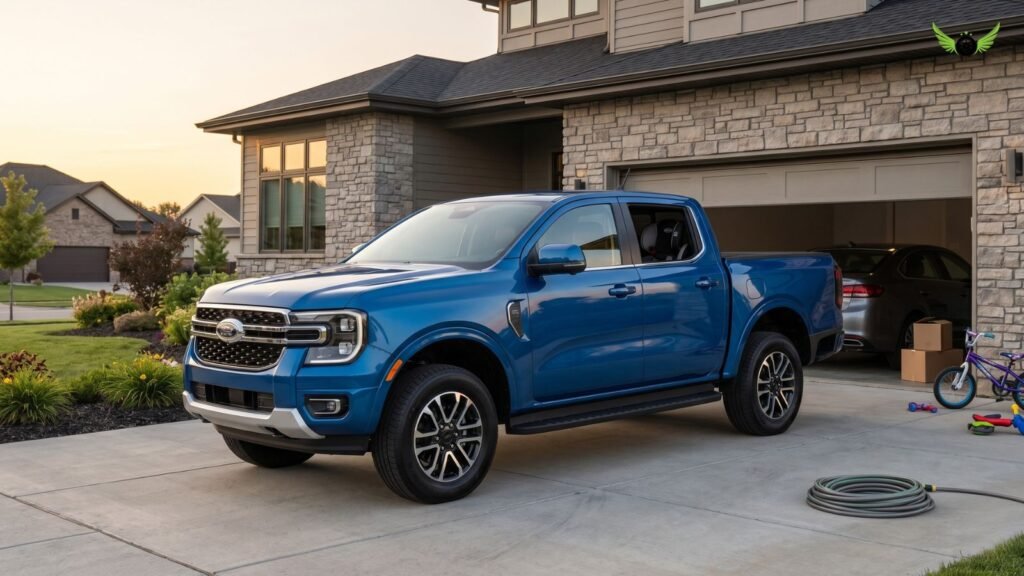
The 2026 Ford Ranger delivers manageable long-term ownership costs for a mid-size truck while still maintaining strong towing capability, turbocharged performance, and daily usability. Compared to many full-size pickups, the Ford Ranger is generally cheaper to maintain, easier to insure, and less expensive to fuel during daily driving.
The standard 2.3L EcoBoost remains the most cost-effective setup for long-term ownership because it balances fuel economy, maintenance cost, and daily driving practicality better than the larger V6 models.
Annual Maintenance Cost in the USA
Recent ownership studies and repair-cost reports show that the Ford Ranger remains competitive within the mid-size truck segment for annual maintenance expenses.
Ownership Expense | Estimated Annual Cost |
Routine maintenance and repairs | Around $615 |
Oil services and inspections | Around $120–$250 |
Brake service | Around $300–$700 |
Tire replacement | Around $900–$1,400 per set |
RepairPal estimates average annual repair and maintenance costs at approximately $615 per year for the Ford Ranger.
Most owners mainly spend money on normal wear items such as tires, brakes, battery replacement, fluid servicing, and scheduled maintenance rather than major engine repairs.
FX4 and Ranger Raptor models usually cost more to maintain because of larger tires, off-road suspension components, and higher-performance brake systems.
Insurance and Registration Expenses
Insurance costs for the 2026 Ford Ranger depend heavily on driver age, state location, trim level, annual mileage, and driving history.
Most USA owners report:
- Insurance costs around $1,500–$2,400 per year
- Registration and taxes commonly ranging between $150–$500 annually depending on state regulations
Ranger Raptor insurance costs are usually higher because of the truck’s higher purchase price, performance classification, and more expensive repair costs.
The standard XLT 2.3L EcoBoost remains one of the least expensive Ford Ranger configurations to insure for daily commuting and family-focused driving.
5-Year Ownership Cost Estimate
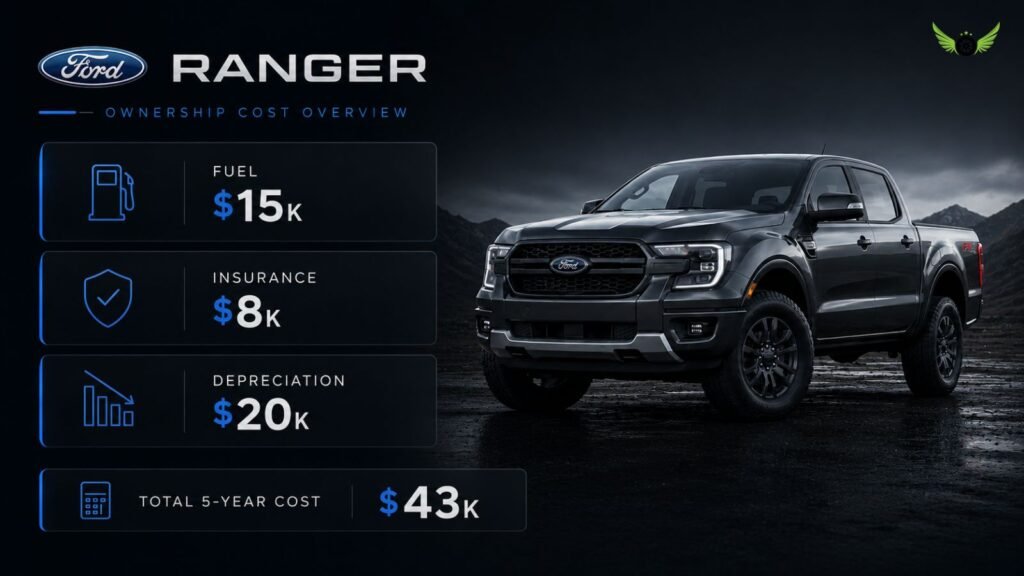
Edmunds estimates 5-year Ford Ranger ownership costs between approximately $44,000–$58,000 depending on trim level, drivetrain configuration, financing terms, insurance costs, annual mileage, and fuel prices.
5-Year Ownership Category | Estimated Cost |
Depreciation | Around $13,000–$20,000 |
Fuel costs | Around $11,000–$15,000 |
Insurance | Around $4,000–$8,000 |
Maintenance and repairs | Around $4,000–$6,000 |
Depreciation remains the largest ownership expense during the first five years. However, the Ford Ranger still retains value better than many traditional full-size trucks because of strong demand in the USA mid-size truck market.
Many USA owners consider the Ford Ranger a strong long-term ownership value because it combines manageable maintenance costs, practical daily usability, solid towing capability, and competitive resale demand within the mid-size truck segment.
2026 Ford Ranger Lifespan and Durability
The 2026 Ford Ranger is designed for long-term truck ownership when maintained properly. Recent owner reports, reliability studies, and high-mileage driving experiences show that the latest Ranger performs competitively within the mid-size truck segment for durability, drivetrain longevity, and daily usability.
Most long-term Ford Ranger owners report that regular oil changes, transmission servicing, cooling-system maintenance, and proper towing habits play the biggest role in overall lifespan.
Expected Engine Lifespan
The standard 2.3L EcoBoost engine used in the 2026 Ford Ranger is expected to last between 200,000 and 300,000 miles when properly maintained.
Component | Expected Lifespan |
2.3L EcoBoost engine | Around 200,000–300,000 miles |
10-speed automatic transmission | Around 150,000–250,000 miles |
Turbocharger system | Around 150,000–200,000 miles |
Many long-term owners report strong durability from the 2.3L EcoBoost because the engine operates with relatively conservative tuning compared to higher-performance Ford applications using the same engine family.
Long-term durability depends heavily on:
- Regular oil changes
- Cooling-system maintenance
- Transmission-fluid servicing
- Proper engine warm-up
- Reduced heavy towing abuse
High-Mileage Ownership Experience
Many high-mileage Ford Ranger owners report that the truck remains dependable well beyond 150,000 miles when maintenance is completed consistently.
The most common high-mileage wear items include:
- Suspension components
- Brake systems
- Wheel bearings
- Turbo-related sensors
- Tires and alignment components
Most owners report routine wear-item replacement rather than major engine failure during higher-mileage ownership.
The 10-speed automatic transmission also performs more smoothly in higher-mileage trucks when fluid servicing is completed earlier than the maximum factory interval.
Some owners still report occasional infotainment glitches and low-speed transmission hesitation, although severe powertrain failures remain less common than normal maintenance-related repairs.
How Long a Ford Ranger Can Last
A properly maintained Ford Ranger can commonly last 15–20 years or more depending on maintenance history, climate conditions, towing use, and driving habits.
Many USA owners consider the Ford Ranger one of the more durable mid-size trucks for balancing:
- Daily commuting
- Towing capability
- Off-road use
- Long-term ownership cost
- Practical durability
Trucks used mainly for highway driving and normal commuting usually last significantly longer than trucks exposed to frequent heavy towing, oversized tires, aggressive off-road driving, or neglected maintenance.
Regular fluid servicing, cooling-system maintenance, and proper turbocharged-engine care remain the biggest factors affecting long-term Ford Ranger Reliability and durability
2026 Ford Ranger Resale Value and Depreciation
The 2026 Ford Ranger maintains strong resale value within the mid-size truck segment because of steady USA market demand, practical truck capability, and manageable ownership costs. Mid-size trucks usually depreciate slower than many SUVs and full-size pickups, and the Ford Ranger benefits from consistent demand in both the new and used truck market.
Depreciation still remains one of the largest long-term ownership expenses during the first five years.
Best Model Years for Resale Value
The redesigned 2024+ Ford Ranger models generally retain value better than older Ranger generations because of improved towing capability, updated technology, better interior refinement, and stronger overall market demand.
Many used-truck buyers prefer:
- 2024+ redesigned Ranger models
- XLT trims
- FX4-equipped configurations
- Lower-mileage 4WD models
These versions usually maintain stronger resale demand because they balance:
- Daily driving comfort
- Towing capability
- Off-road usability
- Modern technology features
- Practical ownership costs
Ford Ranger Resale Data | Estimated Value Retention |
3-Year Residual Value | Around 74%–76% |
5-Year Residual Value | Around 70%–72% |
Estimated 5-Year Depreciation | Around 28%–30% |
Ford Ranger resale value remains stronger than many traditional full-size trucks because mid-size truck demand continues growing in the USA market.
Used Market Demand in the USA
The Ford Ranger continues to maintain strong demand in the USA used-truck market because many buyers want:
- Mid-size truck practicality
- Lower ownership cost than full-size trucks
- Strong towing capability
- Easier urban driving
- Better fuel economy than larger pickups
4WD XLT and Lariat trims commonly sell faster in the used market because they appeal to both commuting-focused buyers and light towing users.
Higher-mileage Ranger models with complete maintenance history usually retain value better than trucks with inconsistent service records.
Many USA buyers also consider the Ford Ranger a practical balance between daily usability, manageable ownership cost, towing capability, and long-term durability, which helps maintain stable resale demand across the mid-size truck segment.
2026 Ford Ranger Warranty Coverage
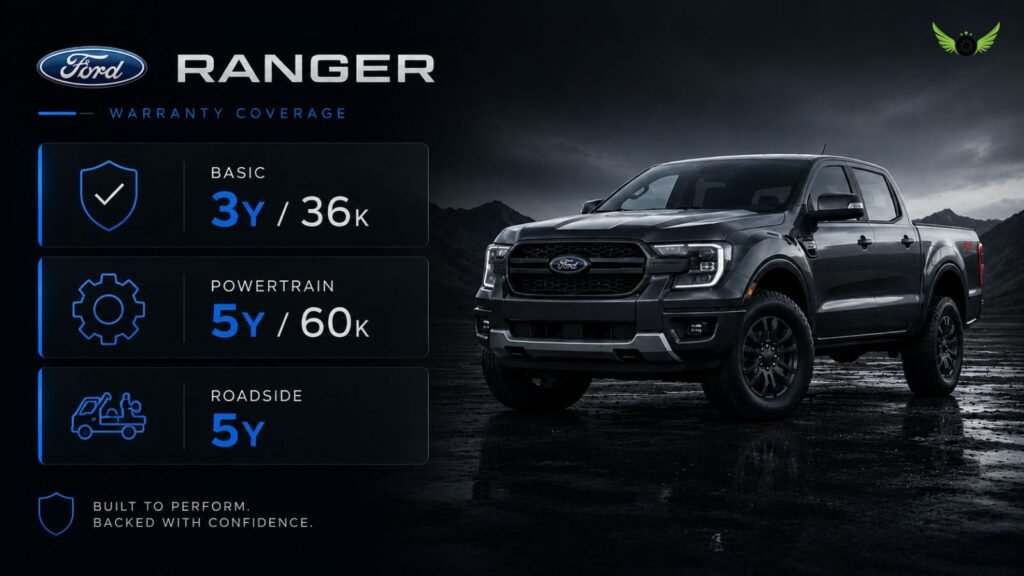
The 2026 Ford Ranger includes factory warranty coverage designed to protect major vehicle systems during the early ownership period. Ford also includes roadside assistance and powertrain protection, helping reduce unexpected repair costs during daily driving, towing, and long-distance travel.
The warranty structure remains competitive within the USA mid-size truck segment and follows Ford’s standard light-truck coverage plan.
Factory Warranty Details
The standard 2026 Ford Ranger factory warranty covers defects related to factory materials and workmanship during normal vehicle use.
Warranty Coverage | Duration |
Basic bumper-to-bumper warranty | 3 years / 36,000 miles |
Powertrain warranty | 5 years / 60,000 miles |
Corrosion perforation warranty | 5 years / Unlimited miles |
Safety restraint system coverage | 5 years / 60,000 miles |
Roadside assistance | 5 years / 60,000 miles |
The bumper-to-bumper warranty mainly covers factory-installed components excluding normal wear items such as brake pads, tires, filters, fluids, and routine maintenance services.
Powertrain Coverage Explained
The Ford Ranger powertrain warranty covers the major drivetrain systems responsible for vehicle operation and long-term durability.
Covered components generally include:
- Engine block and internal engine components
- Turbocharger system
- Transmission and torque converter
- Transfer case
- Driveshaft
- Differential systems
The 5-year/60,000-mile powertrain warranty provides important protection for EcoBoost turbocharged engines and the 10-speed automatic transmission because these systems are expensive to repair outside warranty coverage.
Many buyers also consider the powertrain warranty valuable for towing-focused ownership because transmission and turbocharger systems operate under higher load during trailer hauling and mountain driving.
Roadside Assistance Benefits
Ford includes 24/7 roadside assistance coverage for 5 years or 60,000 miles with the Ford Ranger.
Roadside assistance services include:
- Emergency towing
- Flat tire assistance
- Battery jump-start service
- Lockout assistance
- Fuel delivery support
The roadside assistance program is especially useful for long-distance travel, towing trips, and highway driving because emergency support remains available nationwide during the factory coverage period.
Ford also offers optional Ford Protect extended coverage plans for buyers wanting longer-term warranty protection beyond the standard factory coverage.
2026 Ford Ranger Ownership FAQs
Many buyers research the 2026 Ford Ranger before purchasing because long-term ownership cost, reliability, maintenance, and durability matter more than just towing numbers. These direct-answer FAQs cover the most important ownership questions using real USA-market ownership data.
Is the Ford Ranger reliable?
Yes. The Ford Ranger delivers above-average reliability for the mid-size truck segment when maintained properly.
How much does Ford Ranger maintenance cost yearly?
Average annual maintenance and repair costs are around $615 per year in the USA.
How long can a Ford Ranger last?
A properly maintained Ford Ranger can commonly last 200,000–300,000 miles.
Is the Ford Ranger expensive to maintain?
No. Ownership costs are usually lower than many full-size trucks because of lower fuel, maintenance, and repair expenses.
What is the most common Ford Ranger problem?
The most commonly reported issue is rough low-speed shifting from the 10-speed automatic transmission.
Does the 2.3L EcoBoost engine last long?
Yes. Many owners report strong long-term durability when oil changes and cooling-system maintenance are completed regularly.
Does the Ford Ranger hold its value well?
Yes. The Ford Ranger maintains strong resale demand in the USA mid-size truck market.
Which Ford Ranger trim has the best resale value?
XLT 4WD and FX4-equipped models usually maintain the strongest resale demand.
What warranty does the Ford Ranger include?
The Ford Ranger includes:
- 3-year/36,000-mile basic warranty
- 5-year/60,000-mile powertrain warranty
- 5-year/60,000-mile roadside assistance coverage
Is the Ford Ranger good for daily driving?
Yes. The Ford Ranger balances truck capability, daily comfort, manageable size, and practical ownership costs well.