The 2026 BMW X5 is a premium luxury SUV, but its purchase price is only part of the financial picture. Buyers should also consider fuel, maintenance, insurance, financing, repairs, and depreciation before deciding whether it fits their long-term budget.
Current ownership estimates show that costs can vary significantly by trim and assumptions. For example, Edmunds estimates a five-year True Cost to Own of about $97,800 for the X5 xDrive40i, based on 15,000 miles per year and specific financing assumptions, while other estimates use different methods and produce different totals. This means BMW X5 Ownership Cost should be treated as an estimate rather than a guaranteed amount.
BMW X5 Insurance can also vary widely based on the driver’s location, age, driving record, coverage, and chosen trim. Depreciation is another major ownership expense, and available market estimates suggest that the X5 can lose a substantial portion of its value over five years.
This guide examines the key costs and long-term considerations that matter most to a U.S. buyer, helping you understand whether the BMW X5 offers the right balance of luxury, performance, and long-term value for your needs.
BMW X5 Ownership Cost Breakdown
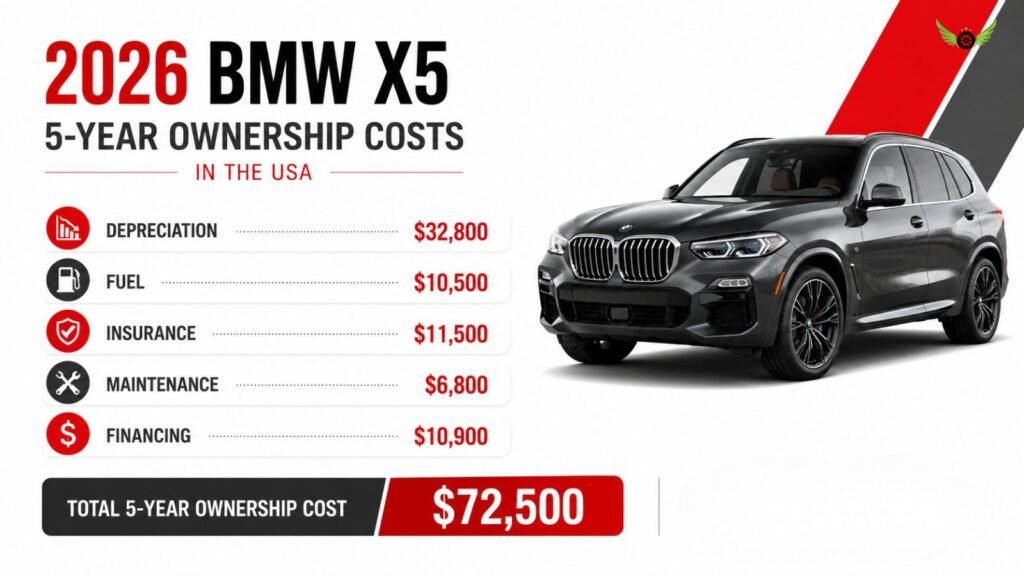
The BMW X5 Ownership Cost is significantly higher than the purchase price alone. For a typical U.S. owner, the main five-year expenses are depreciation, fuel, insurance, financing, maintenance, and repairs. The final cost varies by trim, mileage, ZIP code, loan terms, and driving habits.
To provide a realistic benchmark, Edmunds estimates the 2026 BMW X5 xDrive40i at $97,800 in total five-year ownership costs, based on 15,000 miles of driving per year. The xDrive50e plug-in hybrid is estimated higher at $105,752, while the V8-powered M60i reaches $125,546. These are modeled estimates rather than guaranteed costs, but they clearly show how trim choice affects long-term spending.
Fuel, Maintenance & Financing Costs
The xDrive40i is rated at 25 mpg combined (23 city/27 highway), making fuel a predictable but significant ongoing expense. Edmunds estimates $13,443 in fuel costs over five years for the xDrive40i under its ownership assumptions. The M60i’s lower 19 mpg combined rating contributes to a substantially higher estimated five-year fuel cost of $17,676.
Maintenance costs deserve attention because the BMW X5 is a complex luxury SUV. Edmunds estimates $9,836 in maintenance and $2,177 in repairs over five years for the xDrive40i. Its year-by-year estimate shows that maintenance costs rise later in the ownership period, which is important for buyers planning to keep the vehicle after the initial coverage period.
Financing is another major variable. For the xDrive40i, Edmunds estimates $15,433 in financing costs over five years under its assumptions. Buyers with a larger down payment or lower interest rate may pay considerably less, while expensive loan terms can push the overall BMW X5 Ownership Cost higher.
Estimated 5-Year Cost | 2026 X5 xDrive40i | 2026 X5 M60i |
Fuel | $13,443 | $17,676 |
Maintenance | $9,836 | $10,578 |
Repairs | $2,177 | $2,177 |
Financing | $15,433 | $20,251 |
Edmunds estimates; actual costs depend on location, mileage, financing, and individual ownership conditions.
Total 5-Year Ownership Cost
For most buyers, depreciation is the largest single cost of owning a BMW X5, followed by financing and other operating expenses. Edmunds estimates $41,489 in depreciation for the 2026 xDrive40i over five years, accounting for a substantial portion of its total estimated ownership cost.
2026 BMW X5 Trim | Estimated 5-Year Cost to Own |
sDrive40i | $96,480 |
xDrive40i | $97,800 |
xDrive50e | $105,752 |
M60i | $125,546 |
Estimates are based on Edmunds’ five-year ownership methodology and 15,000 miles driven annually.
BMW X5 Insurance Cost
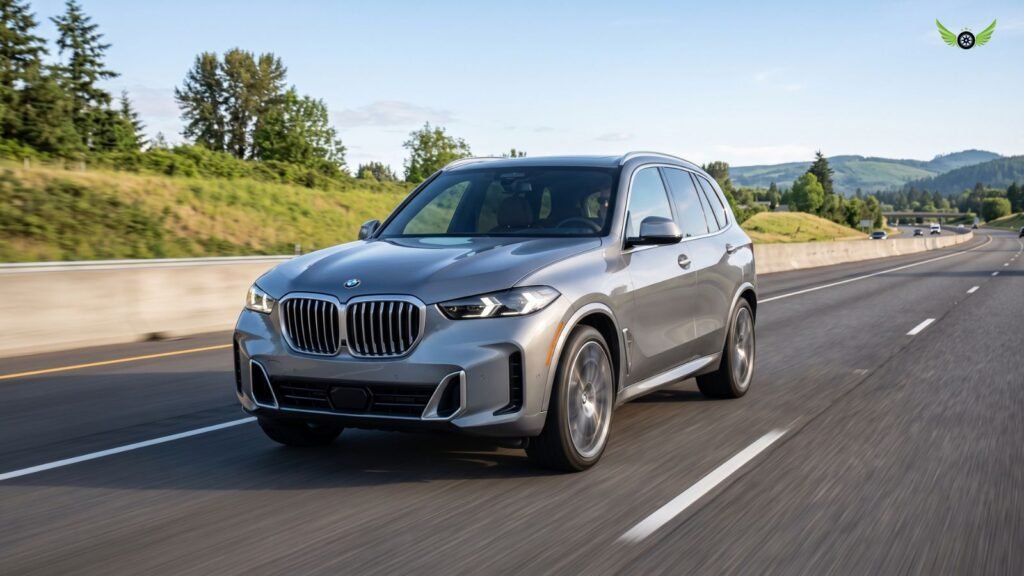
Insurance is an important part of the overall cost of owning a luxury SUV. The amount you pay depends heavily on your driver profile, location, coverage level, and the specific vehicle, so there is no single premium that applies to every owner.
For the 2026 BMW X5 xDrive40i, Edmunds estimates $9,991 in insurance costs over five years, averaging about $2,000 per year under its ownership-cost assumptions. Independent insurance data can produce different results because it uses different coverage levels and driver profiles.
Average Insurance Premium
Recent national estimates provide a useful starting point, but they should not be treated as a personalized quote. MoneyGeek estimates full coverage for a 2026 X5 at about $251 per month, while Compare.com lists an average of $196 per month for the 2026 model across its analyzed policies. The difference reflects variations in methodology and coverage assumptions.
Source | Estimate for 2026 X5 |
Edmunds | $9,991 over 5 years |
MoneyGeek | $251/month for full coverage |
Compare.com | $196/month average premium |
For comparison purposes, these figures are useful, but getting quotes based on your own ZIP code and driving history is the most accurate way to estimate your actual premium.
Factors That Affect Insurance Rates
Several factors can significantly change what an owner pays for coverage:
- Location: State and ZIP code can create large differences in premiums because of local accident rates, theft risk, repair costs, and insurance regulations.
- Driving record: Tickets, accidents, and other violations can increase rates substantially. Compare.com data, for example, shows higher average premiums for X5 drivers with violations than for those with clean records.
- Driver profile and coverage: Age, insurance history, selected coverage limits, and deductibles all affect the final quote.
- Trim and vehicle value: Higher-value or higher-performance versions can cost more to repair or replace, potentially increasing premiums.
For most buyers, insurance should be included in the ownership budget before purchasing. Comparing quotes from multiple insurers using the same coverage limits gives a more realistic estimate than relying on a national average alone.
BMW X5 Resale Value & Depreciation
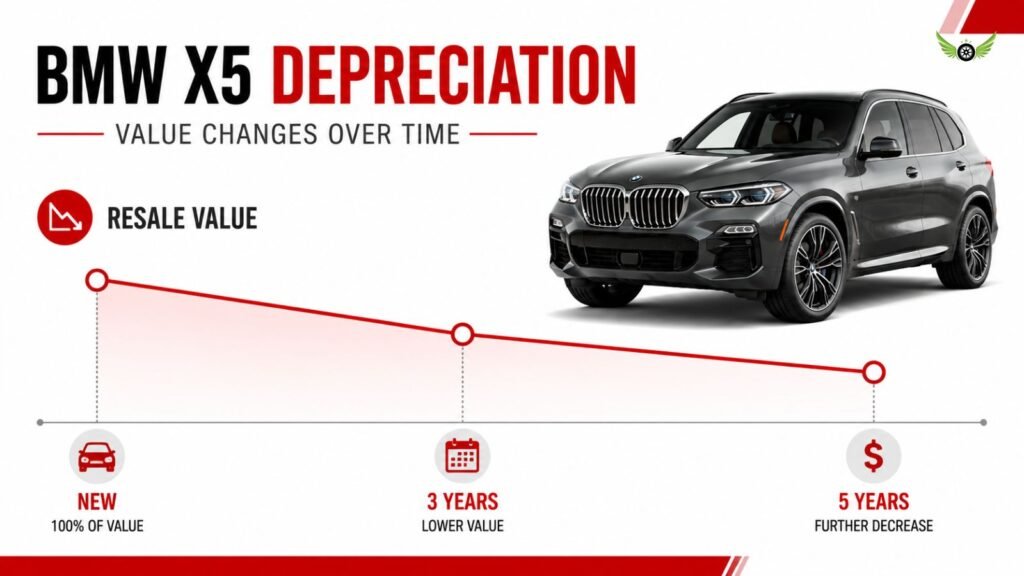
Depreciation is one of the largest long-term ownership costs for a luxury SUV. The BMW X5 resale value depends on mileage, condition, trim, options, and used-car market demand so no estimate can predict an individual vehicle’s exact value. However, current depreciation data provides a useful benchmark for buyers planning to sell or trade in their SUV within a few years.
Published estimates for the 2026 model also vary by methodology. Edmunds estimates approximately $40,939 in five-year depreciation for a 2026 X5 sDrive40i, while KBB estimates $39,795 for the 2026 X5 overall. Model-wide historical depreciation data provides additional context for how the vehicle performs in the used market.
3-Year & 5-Year Depreciation
According to iSeeCars’ model-level analysis, a new X5 depreciates approximately 28.4% after three years and 53.1% after five years. That is slightly worse than the average for the luxury midsize SUV segment, which loses about 26.5% after three years and 50.2% after five years in the same analysis.
Ownership Period | Estimated Depreciation | Estimated Value Retained |
3 Years | 28.4% | 71.6% |
5 Years | 53.1% | 46.9% |
These are model-level estimates based on iSeeCars’ analysis and are not guaranteed resale values for a specific 2026 vehicle.
For buyers considering the xDrive50e plug-in hybrid, depreciation may follow a different pattern. iSeeCars estimates 35.3% depreciation after three years and 56.4% after five years for the plug-in hybrid model, although future demand and market conditions can change these results.
BMW X5 vs Luxury SUV Competitors
Compared with major luxury SUV alternatives, resale performance is competitive but not class-leading. iSeeCars estimates the Mercedes-Benz GLE retains more value over five years, while the Audi Q7 depreciates slightly faster. The Lexus RX 350 shows substantially stronger value retention, although it serves a somewhat different buyer profile and is not a direct performance equivalent.
Model | Estimated 5-Year Depreciation |
Lexus RX 350 | 33.0% |
Mercedes-Benz GLE | 47.5% |
BMW X5 | 53.1% |
Audi Q7 | 57.2% |
Figures are model-level estimates from iSeeCars and should be used for comparison rather than as guaranteed future resale values.
The X5’s depreciation is therefore an important factor for buyers who plan to trade or sell within five years. Choosing a desirable trim, maintaining the vehicle properly, and controlling mileage can help support its resale appeal, but market conditions ultimately play a major role in the final selling price.
BMW X5 Long-Term Ownership Experience
The BMW X5 can be a strong long-term choice for buyers who value comfort, performance, and technology, but ownership becomes more expensive as the vehicle ages. Consumer Reports predicts the 2026 X5 will be more reliable than the average new vehicle, based on data from recent model years. BMW’s maintenance schedule is also condition-based, meaning service needs can vary depending on how and where the vehicle is driven.
High-Mileage Ownership Expectations
A well-maintained X5 can remain practical beyond 100,000 miles, but buyers should expect repair risk to increase after the original warranty period. The most important factor is a consistent maintenance history, as BMW recommends following the service intervals shown by the vehicle’s Maintenance Service Display rather than relying only on mileage.
For buyers planning to keep the SUV for many years, setting aside a repair budget after warranty coverage ends is sensible. Complex electronics, suspension components, and other luxury features can be more expensive to repair than those in a mainstream SUV. Consumer Reports’ positive reliability prediction is encouraging, but a new model’s long-term reliability cannot be known with certainty yet.
Plug-in Hybrid vs Mild Hybrid Ownership
The X5 xDrive50e plug-in hybrid is best suited to owners who can charge regularly and want to reduce gasoline use. BMW states that its plug-in hybrids do not require special scheduled maintenance beyond the normal factory maintenance schedule, and BMW provides high-voltage battery defect coverage for a specified warranty period depending on the model and model year.
The mild-hybrid models do not require external charging and offer a simpler daily ownership routine. The main trade-off is that they cannot provide the same electric-driving capability as the plug-in hybrid.
Ownership Consideration | Plug-in Hybrid (xDrive50e) | Mild-Hybrid Models |
External charging | Recommended to maximize benefits | Not required |
Electric-only driving | Yes | No |
Daily ownership | Best with convenient charging access | Similar to a conventional gasoline vehicle |
Powertrain system | Engine, electric motor, and high-voltage battery | Engine with 48-volt hybrid assistance |
For long-term ownership, the choice depends mainly on driving habits and charging access. The plug-in hybrid offers the greatest benefit when its electric capability is used regularly, while the mild-hybrid option may be more convenient for owners who do not have reliable charging at home or work. Consumer Reports currently predicts the 2026 X5 Plug-in Hybrid to have about average reliability, compared with an above-average prediction for the standard 2026 X5, though these predictions are based on recent model-year data and may change as more ownership data becomes available.
Is the BMW X5 Worth Buying in 2026?
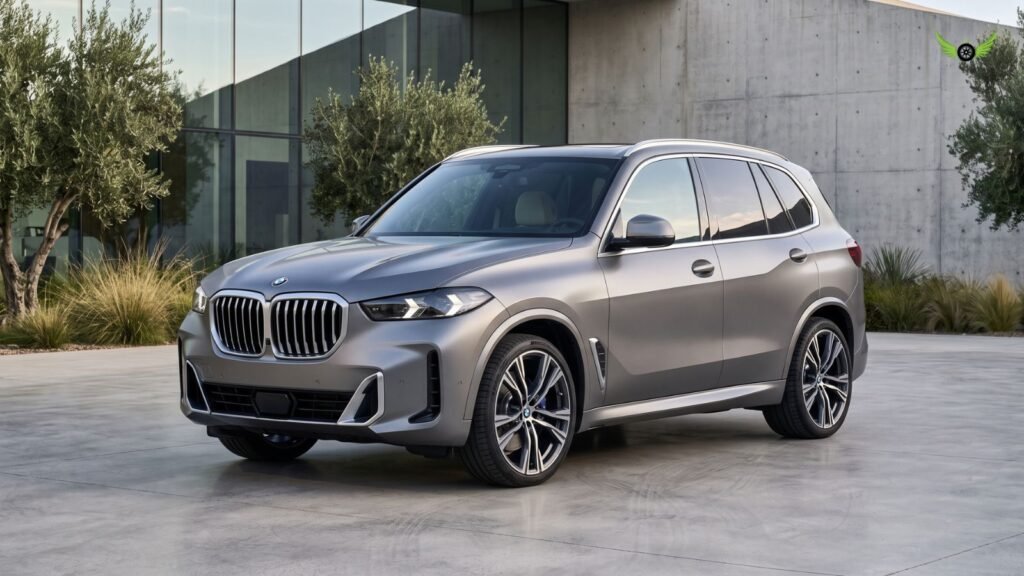
Yes, the 2026 BMW X5 is worth buying if you want a well-rounded luxury SUV and are comfortable with its higher ownership costs. It combines a refined cabin, strong performance, practical cargo space, and a choice of mild-hybrid, plug-in hybrid, and V8 powertrains. However, buyers should consider the full five-year cost—not just the purchase price—before making a decision.
The 2026 model has no major changes from the previous year, so buyers who are open to a lightly used X5 may also find better value in a recent model-year vehicle. Edmunds estimates five-year ownership costs ranging from $96,480 for the sDrive40i to $125,546 for the M60i, depending on the trim and its assumptions.
Who Should Buy the BMW X5?
The X5 is a strong choice for buyers who want a luxury SUV that performs well as both a daily driver and a long-distance vehicle. The sDrive40i and xDrive40i are likely to suit most buyers because the turbocharged inline-six provides strong performance without the higher operating costs associated with the V8. Car and Driver highlights the model’s refined ride, modern technology, and spacious cabin, while Edmunds notes its strong performance and comfortable interior.
The xDrive50e is better suited to drivers who have convenient access to charging and can regularly use its plug-in hybrid capability. The M60i is primarily for buyers who prioritize V8 performance and accept its substantially higher purchase and five-year ownership costs. BMW’s 2026 lineup offers clear choices based on driving needs and budget.
Final Ownership Verdict
The BMW X5 remains one of the more complete choices in the midsize luxury SUV segment. Its main strengths are the balance of comfort, performance, technology, and everyday usability. The biggest trade-offs are depreciation and the higher maintenance, insurance, and repair costs that can come with long-term luxury vehicle ownership.
For buyers who can comfortably afford the total cost of ownership, the 2026 model is a strong purchase. Those focused mainly on minimizing long-term expenses or getting the lowest purchase price may find better value elsewhere. Since the 2026 X5 is largely unchanged, comparing new pricing with recent low-mileage models is also worth considering before buying.
BMW X5 Ownership Cost, Insurance, Resale Value & Long-Term Ownership FAQs
Buying a luxury SUV involves more than comparing the purchase price. These FAQs cover the main ownership questions U.S. buyers have about costs, insurance, depreciation, resale value, maintenance, and long-term ownership. Actual expenses vary by trim, location, mileage, financing, and driving history.
How much does it cost to own a 2026 BMW X5 for five years?
Five-year ownership estimates vary depending on the source and assumptions used. Kelley Blue Book currently estimates the total five-year cost to own a 2026 X5 at $85,049 under its displayed assumptions, including depreciation and operating expenses. Cost estimates should be treated as planning tools rather than a guaranteed amount.
Is the BMW X5 expensive to insure?
Yes, insurance can be a significant ownership expense for a luxury SUV. Rates depend on the driver’s age, driving record, location, coverage level, vehicle trim, and insurer. Comparing personalized quotes is more useful than relying on a national average.
How much value does a BMW X5 lose over five years?
Depreciation is one of the biggest ownership costs. iSeeCars estimates that the X5 depreciates about 53.1% over five years, although the actual resale value of a specific vehicle will depend on its mileage, condition, history, and future market demand.
Is the BMW X5 expensive to maintain long term?
Maintenance costs generally increase as a luxury vehicle ages and moves beyond its included service and warranty coverage. Buyers planning long-term ownership should budget for maintenance and potential repairs, particularly after the original coverage period ends. Published estimates can vary based on the methodology used.
Should I choose the X5 plug-in hybrid or a mild-hybrid model for long-term ownership?
The plug-in hybrid is most beneficial for drivers who can charge regularly and use its electric driving capability. Mild-hybrid models do not require external charging and may be more convenient for owners who want a traditional ownership routine. The better choice depends primarily on charging access and daily driving patterns.
Is the BMW X5 a good choice for long-term ownership?
It can be a good long-term choice for buyers who value its comfort, performance, and practicality and are prepared for higher luxury-vehicle ownership costs. A consistent maintenance history becomes increasingly important as mileage increases.
Is a new 2026 BMW X5 worth buying compared with a used one?
That depends on your budget and priorities. A new vehicle provides full factory coverage and the latest ownership starting point, while a recent used model may reduce the initial depreciation hit. Buyers should compare the new price, used-market pricing, condition, mileage, and remaining warranty before deciding.