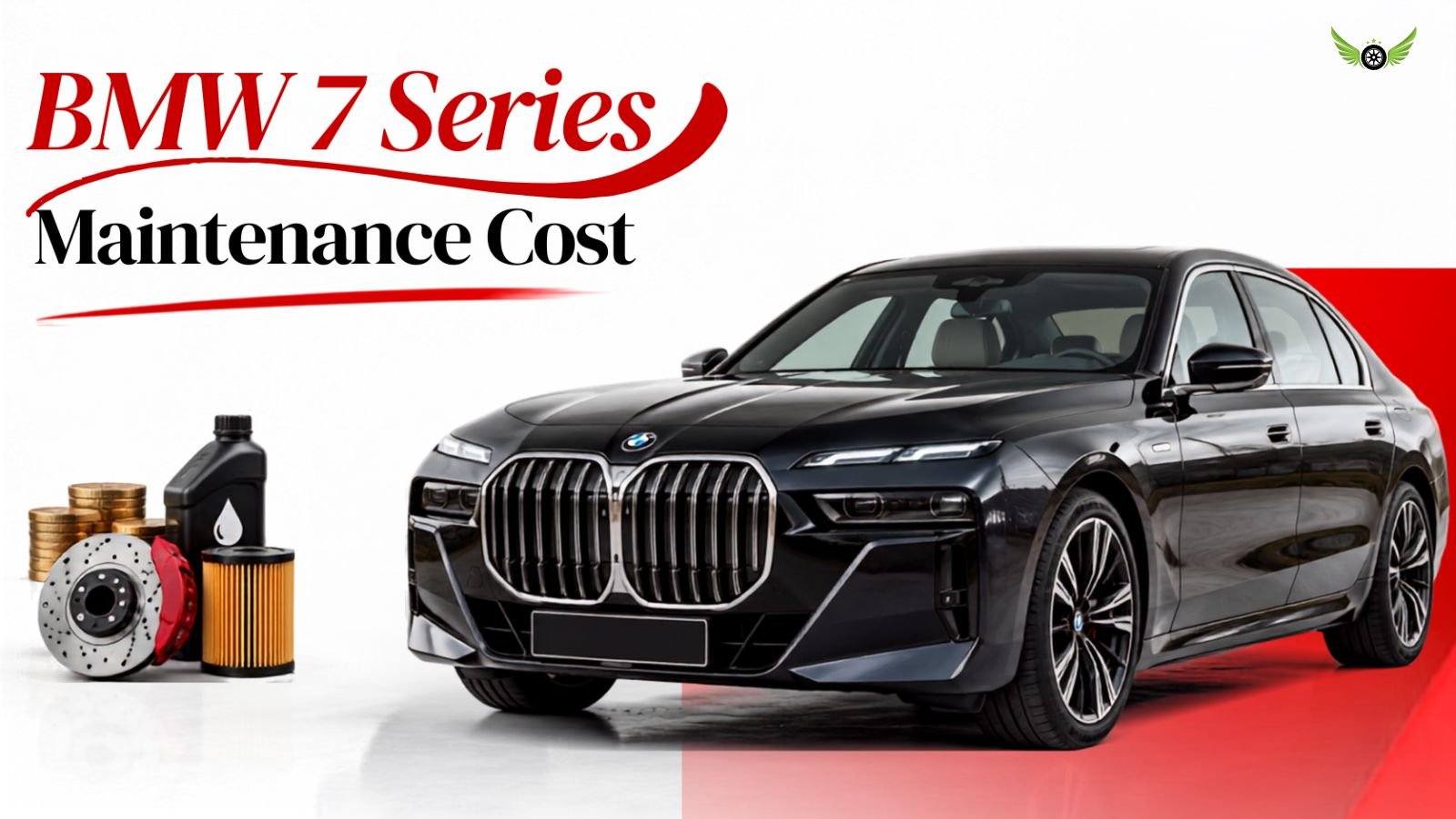
The 2026 BMW 7 Series is designed as a flagship luxury sedan, combining advanced technology, sophisticated suspension systems, and powerful electrified powertrains. That also means maintenance and repair costs can be higher than those of a typical luxury sedan. BMW covers scheduled maintenance for the first 3 years or 36,000 miles, whichever comes first, under BMW Ultimate Care.
This guide explains the BMW 7 Series Maintenance Cost, required service, expected repair expenses, BMW 7 Series Reliability, and the BMW 7 Series Common Problems owners should understand. It also covers warranty protection, recalls, software updates, long-term ownership, and practical ways to reduce repair costs as the car ages. Current ownership estimates from Edmunds put five-year maintenance for the 2026 740i at about $9,960, with approximately $2,887 in repairs, although actual costs vary by mileage, driving conditions, and service provider.
BMW 7 Series Maintenance Schedule & Service Requirements
The BMW 7 Series uses BMW’s Condition Based Service (CBS) system, which determines when individual maintenance items are due based on vehicle use and operating conditions. For the 2026 model year, BMW’s maintenance program covers eligible scheduled services for 3 years or 36,000 miles, whichever comes first. Covered services include engine oil and filter, brake fluid, cabin microfilters, engine air filters, spark plugs, the remote-control battery, and the vehicle check.
For owners, the main advantage is that routine service is not based on an arbitrary one-size-fits-all interval. The vehicle’s CBS display indicates when specific work is required. According to our experience reviewing BMW maintenance requirements, following those vehicle-specific service reminders is a better approach than relying on generic mileage schedules.
Routine Maintenance and Major Service Intervals
The routine maintenance plan centers on engine oil and filter service, brake-fluid service, filters, spark plugs, and periodic vehicle inspections. BMW’s 2026 maintenance documentation also identifies additional work at later service points; for example, the second engine-oil service is approximately 20,000 miles and includes replacement of the ventilation microfilter.
Service item | BMW’s 2026 maintenance approach |
Engine oil & filter | CBS-based service |
Brake fluid | Scheduled maintenance |
Cabin microfilter | Factory maintenance item |
Engine air filter | Scheduled maintenance |
Spark plugs | Scheduled maintenance |
Vehicle check | CBS-based requirement |
Brake pads | Wear-based replacement |
The exact timing can vary, so owners should use the service information displayed by the vehicle rather than treating the figures above as a complete fixed-mileage schedule.
Tires, Brakes, Fluids & Other Premium Wear Items
Tires and brakes are important out-of-pocket costs because their replacement depends on actual wear. BMW’s standard Ultimate Care program does not cover tires, wheels, alignment, balancing, or rotation. Brake pads are monitored as a wear item, while brake components are inspected during applicable service.
Fluid servicing also follows BMW’s specified maintenance requirements rather than a universal replacement interval for every fluid. The 2026 maintenance booklet identifies engine oil, brake fluid, coolant checks, and other component-specific requirements. For the 750e xDrive, the plug-in-hybrid system adds high-voltage components, but the regular maintenance program remains centered on the factory service schedule.
For a luxury sedan of this size and complexity, keeping tires correctly inflated, addressing brake wear promptly, and following CBS reminders are practical ways to avoid unnecessary wear-related expenses.
BMW 7 Series Maintenance & Repair Costs
The BMW 7 Series Maintenance Cost is high compared with mainstream luxury sedans, but new U.S. buyers get some protection from BMW’s included scheduled maintenance. The 2026 model is covered by BMW Ultimate Care for 3 years or 36,000 miles, whichever comes first. After that, routine servicing, wear items, and repairs become more important to the ownership budget.
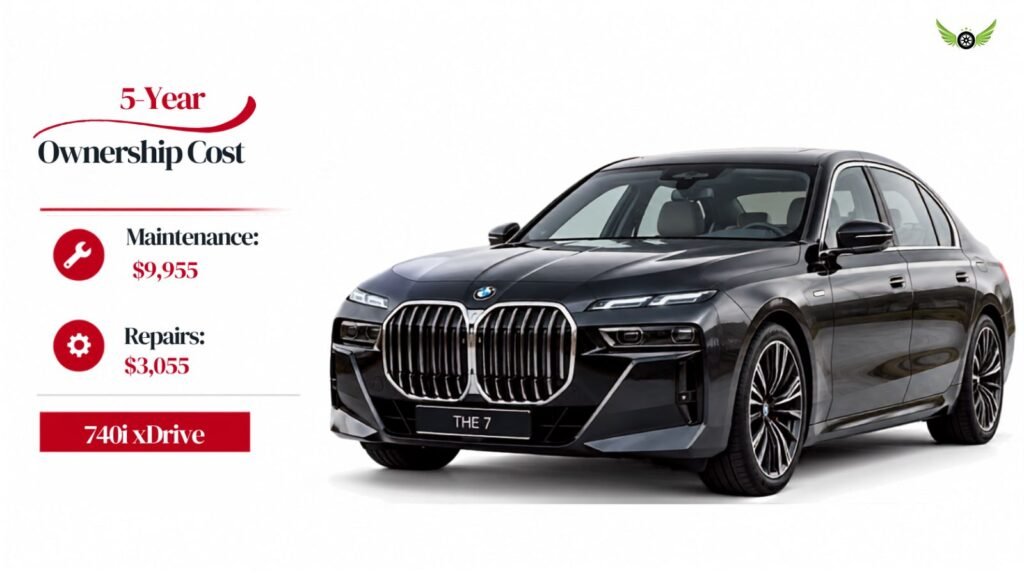
Current Edmunds estimates provide a useful five-year benchmark based on 15,000 miles per year. For the 740i, estimated maintenance is $9,960 and repairs are $2,887 over five years. The 740i xDrive is estimated at $9,955 maintenance and $3,055 repairs, while the 760i xDrive reaches $10,062 maintenance and $3,055 repairs.
Routine Service Costs vs Unexpected Repairs
The main difference is predictability. Scheduled work such as oil service, filters, brake-fluid service, spark plugs, and inspections can be planned around BMW’s Condition Based Service system. Unexpected repairs are harder to budget because they depend on component wear, mileage, driving conditions, and individual vehicle history.
2026 BMW 7 Series | 5-Year Maintenance | 5-Year Repairs |
740i | $9,960 | $2,887 |
740i xDrive | $9,955 | $3,055 |
750e xDrive | $9,955 | $3,055 |
760i xDrive | $10,062 | $3,055 |
Edmunds estimates; 15,000 miles per year. Actual costs can differ.
The important ownership point is that maintenance costs increase substantially after the initial factory coverage period. Edmunds estimates $0 in maintenance during the first two years for the 740i, followed by approximately $743 in year three, $4,969 in year four, and $4,248 in year five.
How Powertrain Choice Affects Long-Term Maintenance
The 2026 lineup uses three different powertrain configurations: the 740i and 740i xDrive use a 3.0-liter turbocharged inline-six with mild-hybrid technology, the 750e xDrive adds plug-in-hybrid hardware to the six-cylinder, and the 760i xDrive uses a 4.4-liter turbocharged V8 with mild-hybrid technology.
Interestingly, current Edmunds estimates show very similar five-year maintenance figures across these versions. The 740i is estimated at $9,960, the 740i xDrive and 750e xDrive at $9,955, and the 760i xDrive at $10,062. Therefore, the available estimates do not show a major maintenance-cost difference between powertrains.
For a buyer focused on long-term simplicity, the 740i has the least complex powertrain of the four choices, while the 750e adds a high-voltage plug-in system and the 760i brings the larger V8. However, it is too early to claim that either added system will necessarily produce higher real-world repair costs over the full life of a 2026 model.
BMW 7 Series Reliability & Common Problems
The BMW 7 Series combines complex powertrains, air suspension, extensive electronics, and advanced driver-assistance technology. For 2026, the available reliability picture is favorable in J.D. Power’s current assessment, which gives the model 86/100 for Quality & Reliability. Consumer Reports, however, has not assigned a predicted reliability rating for the 2026 model.
The most relevant concerns for buyers are documented recalls and early owner reports involving electronic functions. Edmunds’ 2026 owner reviews include complaints about infotainment, smartphone connectivity, digital-key functions, and other software-related features, although these are individual reports rather than evidence of a defect affecting every car.
Engine, Plug-In Hybrid & Transmission Reliability
The 2026 lineup includes the 740i and 740i xDrive with a 3.0-liter turbocharged inline-six and 48-volt mild-hybrid system, the 750e xDrive plug-in hybrid, and the 760i xDrive with a 4.4-liter twin-turbo V8. The gasoline models use an 8-speed automatic transmission.
A significant documented issue concerns the 750e xDrive. NHTSA recall 26V525 affects certain 2024–2026 750e xDrive vehicles because the connection between the driveshaft and rear differential may become damaged. The condition can result in loss of power to the rear wheels and, under certain circumstances, vehicle rollaway if the parking brake is not applied. BMW’s remedy is inspection and, where required, repair or replacement at no charge.
For the gasoline engines and 8-speed automatic transmission, current 2026 data does not identify a recurring model-year failure pattern. The 750e’s additional hybrid components add complexity, but that alone does not establish a higher failure rate.
Electronics, Air Suspension & Infotainment Issues
Electronics are one of the areas buyers should examine closely. Current 2026 owner feedback includes reports involving smartphone connection reliability, digital-key and wallet-app communication, infotainment operation, and software usability. One 2026 740i review specifically describes recurring problems with phone connectivity and digital functions.
The current-generation 7 Series has also received electrical-system and brake-related recalls. NHTSA recall 26V096 covered certain 2023–2025 7 Series vehicles because the A/C electrical wiring harness could be damaged during cabin-air-filter service. NHTSA recall 26V422 concerns the integrated brake system on certain 2023–2025 vehicles.
The air suspension should be checked for warning messages, uneven ride height, or unusual operation. According to our experience reviewing modern luxury vehicles, these symptoms should be investigated during servicing or a pre-purchase inspection because electronically controlled suspension faults can involve both mechanical and electronic components.
For a 2026 BMW 7 Series, the practical reliability check is therefore straightforward: verify open recalls by VIN, test the infotainment and connectivity functions, confirm that the suspension operates normally, and make sure all warning messages have been resolved.
BMW 7 Series Warranty, Recalls & Software Updates
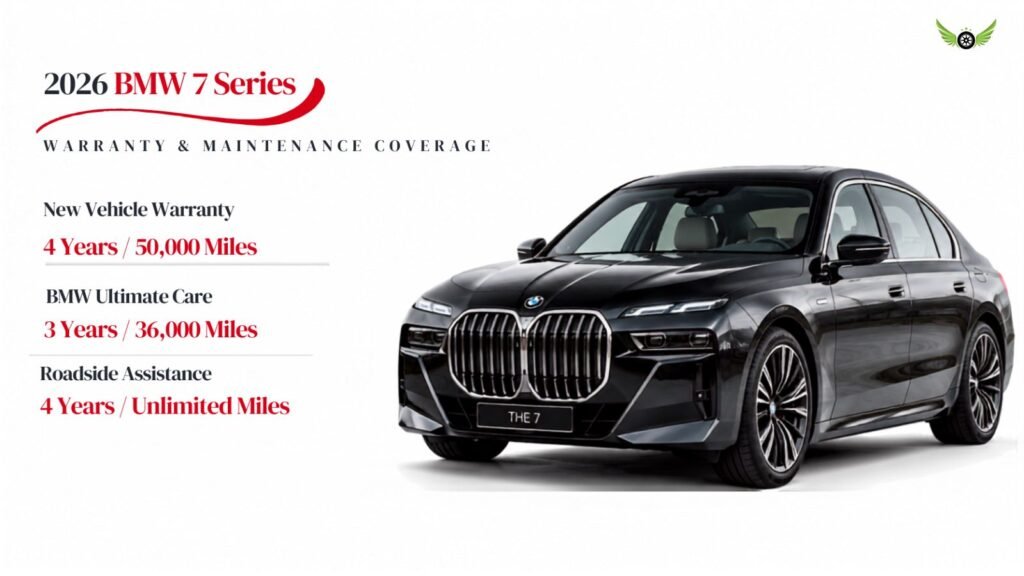
For U.S. buyers, the BMW 7 Series comes with a 4-year/50,000-mile New Vehicle Limited Warranty. BMW also includes BMW Ultimate Care for 3 years or 36,000 miles, covering eligible scheduled maintenance at authorized BMW Centers. The maintenance coverage is transferable to subsequent owners.
BMW also provides roadside assistance during the first four years with unlimited mileage. For owners who plan to keep the car beyond its factory warranty, BMW offers optional protection products and extended maintenance plans.
Factory Warranty and Available Protection Options
Coverage | 2026 BMW 7 Series |
New Vehicle Limited Warranty | 4 years / 50,000 miles |
BMW Ultimate Care | 3 years / 36,000 miles |
Roadside Assistance | 4 years / unlimited miles |
Rust Perforation Warranty | 12 years / unlimited miles |
The standard warranty covers eligible defects in materials and workmanship. BMW Ultimate Care is different: it pays for specified scheduled maintenance during its coverage period rather than unexpected mechanical repairs. BMW’s 2026 warranty documentation confirms these coverage periods for U.S.-specification vehicles.
For the 750e xDrive, the high-voltage battery has separate federal warranty requirements, so buyers should review the warranty booklet for coverage applicable to their vehicle and registration location. BMW’s protection products can also extend certain coverage beyond the original factory warranty.
How to Check Recalls and Vehicle-Specific Updates
Recall status should always be checked using the vehicle’s 17-character VIN. BMW provides a VIN recall lookup, while the My BMW App also lists applicable recalls and campaigns under Service and Maintenance → More → Recalls & Campaigns. BMW states that recall repairs are performed free of charge at authorized BMW Centers.
NHTSA’s VIN lookup is another useful check because it shows unrepaired safety recalls associated with a specific vehicle. NHTSA notes that very recently announced recalls may take some time to appear in its database.
Software updates are particularly important on the 7 Series because several vehicle functions depend on electronic control systems. BMW can address certain issues through Remote Software Upgrades (OTA) or dealer-installed software. For example, NHTSA recall 25V857 used a steering-system software update as the remedy, available over the air or through a BMW dealer.
BMW technical documentation also shows software-related service procedures for the 750e xDrive, including a 2026 service bulletin for a malfunction-indicator issue that could be corrected through updated software.
According to our experience reviewing BMW ownership requirements, checking the VIN before purchase and keeping recall repairs and available software updates current are two of the most important steps for reducing avoidable ownership problems.
BMW 7 Series Long-Term Reliability
The best available long-term data puts the BMW 7 Series at an average lifespan of 94,492 miles, or approximately 8.4 years, with a 6.7/10 reliability score in iSeeCars’ analysis of more than 312 million vehicles. The model ranks 9th among 13 luxury large cars in that dataset.
For the current 2023–2026 generation, iSeeCars does not provide a generation-specific lifespan figure because its dataset does not yet contain sufficient mileage history. For a 2026 buyer, the 94,492-mile figure is therefore best used as the broader 7 Series ownership benchmark, not as a guaranteed mileage target.
Expected Lifespan with Proper Maintenance
The available 7 Series data shows an average lifespan of 94,492 miles, with vehicles in the dataset typically driven about 8,608 miles per year during their first 10 years. iSeeCars also calculates a 0% probability of reaching 200,000 miles within its usable-lifespan model.
For the 2026 model, proper maintenance remains important because BMW uses sophisticated engine, hybrid, transmission, suspension, and electronic systems. BMW’s factory maintenance program covers scheduled maintenance for 3 years or 36,000 miles, and its maintenance documentation specifies service operations for the 7 Series as mileage and service conditions progress.
According to our experience reviewing premium-car ownership, keeping the service history complete is especially important with a 7 Series. Regular maintenance, timely software updates, recall completion, and early attention to warning messages give owners the best chance of keeping repair needs under control.
How to Reduce Long-Term Repair Costs
The biggest opportunity to control ownership expenses is preventing avoidable repairs and planning for the costs that appear after factory maintenance coverage ends. Edmunds estimates $9,955 in maintenance and $3,055 in repairs over five years for a 2026 740i xDrive, based on 15,000 miles of annual driving.
That estimate also shows how expenses change with age: maintenance is projected at $743 in year three, $5,095 in year four, and $4,117 in year five, while repair costs are estimated at $1,203 in year four and $1,852 in year five.
To keep long-term costs under control:
- Follow BMW’s Condition Based Service reminders.
- Maintain tires and brakes before excessive wear develops.
- Complete recall and software campaigns promptly.
- Keep detailed service records.
- Have unusual suspension, electrical, or drivetrain symptoms inspected early.
- Use BMW-qualified technicians for complex repairs.
These steps are particularly valuable once the 3-year/36,000-mile BMW Ultimate Care period has ended.
2026 BMW 7 Series FAQs: Maintenance, Reliability & Ownership
The questions below cover the main ownership points buyers usually want to know before choosing a 2026 BMW 7 Series in the USA, including maintenance costs, reliability, common issues, warranty coverage, recalls, powertrain choices, and long-term ownership. Current cost estimates and BMW’s factory documentation are used where applicable.
Is the 2026 BMW 7 Series expensive to maintain?
Yes. Edmunds estimates five-year maintenance at $9,955 for the 740i xDrive, $9,960 for the 740i, $9,955 for the 750e xDrive, and $10,062 for the 760i xDrive.
Does BMW cover maintenance on the 2026 7 Series?
Yes. BMW Ultimate Care covers eligible scheduled maintenance for 3 years or 36,000 miles, whichever comes first.
Is the BMW 7 Series reliable?
Yes, based on the current available rating. J.D. Power currently gives the 2026 7 Series an 86/100 Quality & Reliability score. The broader 7 Series model line has a 6.7/10 reliability rating in iSeeCars’ analysis.
What are the most important BMW 7 Series common problems to check?
Electronics, infotainment, suspension systems, and recall-related issues deserve attention. The current-generation 7 Series has had documented recalls involving the integrated brake system and A/C wiring harness, making VIN-based recall checking important.
Is the 750e xDrive reliable?
It has additional systems to consider. The 750e combines a turbocharged six-cylinder engine with a plug-in hybrid system and 8-speed automatic transmission. Certain 750e xDrive vehicles have also been included in recall campaigns, so checking the specific VIN is important.
How long can a BMW 7 Series last?
The broader 7 Series data shows an average lifespan of 94,492 miles or about 8.4 years. iSeeCars also reports a 6.7/10 reliability rating for the model line. This figure covers the broader 7 Series population rather than only 2026 vehicles.
Is the BMW 7 Series warranty good?
Yes. The 2026 model has a 4-year/50,000-mile New Vehicle Limited Warranty, while BMW Ultimate Care provides eligible scheduled maintenance for 3 years/36,000 miles. The 750e xDrive also has separate high-voltage battery coverage of 8 years/100,000 miles.
Should I check recalls before buying a 2026 BMW 7 Series?
Yes. BMW recommends checking the vehicle’s 17-digit VIN through BMW’s recall system or NHTSA. BMW also provides recall information through the My BMW App, and eligible recall repairs are performed free of charge at authorized BMW Centers.
Is the 740i better for long-term ownership than the 760i?
It can be a simpler choice. The 740i uses a 3.0-liter turbocharged six-cylinder with mild-hybrid technology, while the 760i uses a 4.4-liter turbocharged V8. However, current Edmunds estimates show very similar five-year maintenance costs—$9,960 for the 740i versus $10,062 for the 760i—so the available cost data does not show a large difference.
Should I buy a BMW 7 Series for long-term ownership?
Yes, if you are comfortable with premium maintenance and repair costs. The model offers extensive luxury and technology, but owners should budget beyond the included maintenance period and keep the vehicle properly serviced. Edmunds estimates $9,955 in maintenance plus $3,055 in repairs over five years for a 740i xDrive.
Does the BMW 7 Series need regular software updates?
Yes. BMW uses software updates to maintain and improve functions across its electronically controlled vehicle systems. Keeping applicable software current is especially relevant for a vehicle with extensive infotainment, connectivity, driver-assistance, and chassis technology.