The 2026 BMW 5 Series is a luxury sedan aimed at buyers who want a combination of performance, comfort, technology, and everyday practicality. But before buying one, maintenance cost and long-term reliability are important considerations, especially once the factory maintenance coverage ends.
BMW provides scheduled maintenance coverage for 3 years or 36,000 miles, while the new-vehicle limited warranty lasts 4 years or 50,000 miles. Current reliability data for the 2026 model are still limited, although Consumer Reports predicts about-average reliability based on earlier model-year data and BMW’s reliability history.
In this guide, we examine the BMW 5 Series Maintenance Cost, expected service requirements, reliability, reported problems, warranty coverage, recalls, and long-term ownership considerations in the USA. Because the 2026 model is still relatively new, we also separate confirmed information from older 5 Series issues that should not automatically be treated as 2026 problems.
According to our experience, a proper ownership assessment should focus on more than the initial purchase price. Regular servicing, wear items, warranty protection, and the complexity of the car’s electrical and powertrain systems all have a direct impact on the cost of keeping a BMW 5 Series for the long term.
BMW 5 Series Maintenance Schedule & Service Coverage
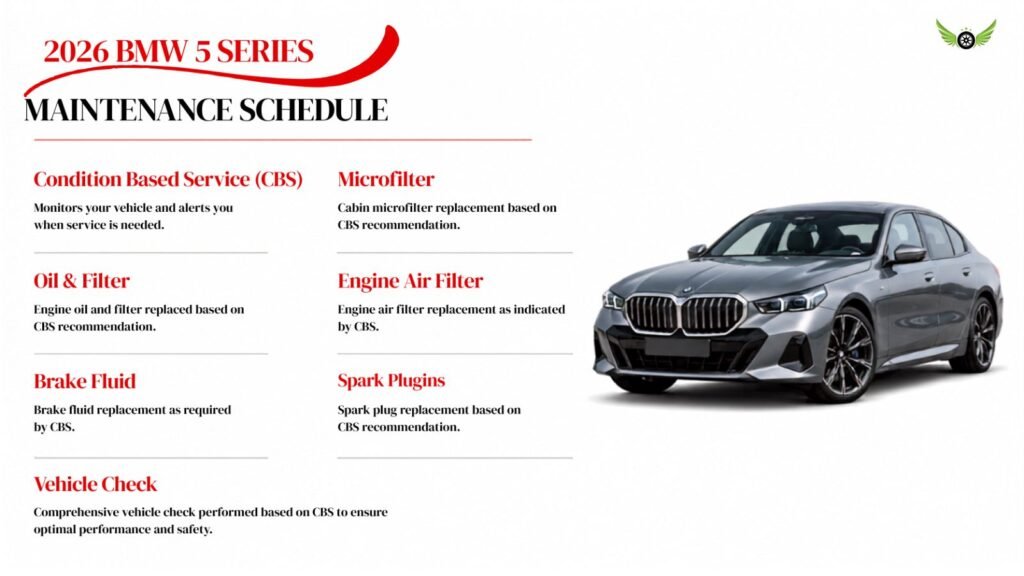
The BMW 5 Series uses BMW’s Condition Based Service (CBS) system to determine when scheduled maintenance is required. The system considers factors such as mileage and operating conditions and displays the applicable service requirement in the vehicle. BMW recommends using the maintenance display together with the vehicle-specific maintenance booklet rather than relying on one fixed interval for every service.
Routine Service Intervals and Major Maintenance Requirements
The 2026 maintenance schedule is built around recurring engine-oil services and other maintenance items that become due at specified service points. BMW lists the following approximate milestones for applicable vehicles:
Service item | Approximate interval |
Engine oil and filter | CBS/service display |
Brake fluid | CBS/service display |
Ventilation microfilter | 20,000 miles |
Engine air filter | 30,000 miles |
Spark plugs | 30,000 miles |
Vehicle check | CBS/service display |
BMW’s maintenance booklet notes that the actual timing is controlled by the vehicle’s maintenance system and can vary according to operating conditions. Brake pads and discs are treated according to their actual condition rather than as a simple fixed-mileage replacement.
For an owner, the most important point is to follow the CBS notification instead of waiting until a warning or noticeable problem appears. BMW itself states that regular recommended maintenance helps protect vehicle operation, safety, and reliability.
BMW Complimentary Maintenance and Factory Service Coverage
BMW Ultimate Care provides complimentary scheduled maintenance on new BMW vehicles sold or leased through an authorized BMW center for 3 years or 36,000 miles, whichever comes first. The program covers only maintenance services identified by BMW as eligible and due under the factory schedule.
For a 2026 BMW 5 Series, eligible services include engine oil and filter, brake fluid, cabin microfilters, engine air filters, spark plugs, remote-control/key batteries, and the vehicle check when they are required by the maintenance schedule.
BMW’s program specifically excludes items such as tires and wheels, wheel alignment, tire balancing and rotation, gasoline, fuel additives, and maintenance performed outside an authorized BMW center. Services performed earlier or more frequently than BMW specifies also fall outside the scheduled maintenance benefit.
For buyers planning ownership beyond the complimentary period, this distinction matters: scheduled factory maintenance is largely covered during the first 36 months/36,000 miles, while excluded wear items and maintenance after that period need to be budgeted separately.
BMW 5 Series Maintenance & Repair Costs
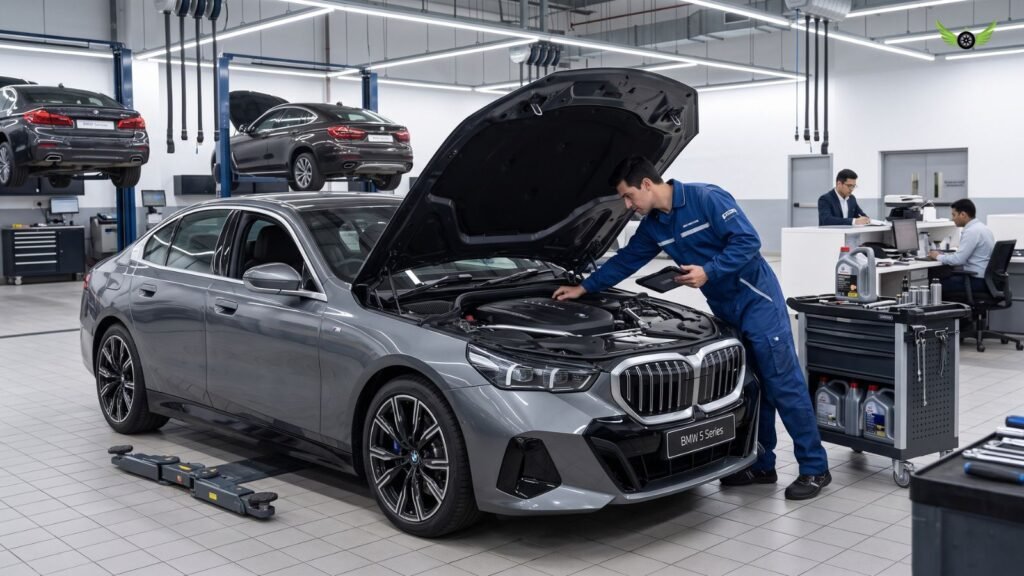
The BMW 5 Series Maintenance Cost varies mainly with the powertrain, mileage, service needs, tires, and brakes. For the 2026 model, Edmunds estimates five-year maintenance at $6,859 for the 530i, $6,857 for the 530i xDrive, $7,944 for the 540i xDrive, and $7,994 for the 550e xDrive, based on 15,000 miles per year.
BMW provides complimentary scheduled maintenance for 3 years or 36,000 miles, so much of the factory-scheduled service is covered during the early ownership period.
Routine Service, Tires, Brakes & Common Wear Item Costs
The 2026 maintenance program covers scheduled items such as engine oil, engine filter, brake fluid, cabin microfilters, engine air filters, spark plugs, and the vehicle check when they become due. BMW uses the Condition Based Service system to determine service timing.
Actual wear costs are separate. BMW lists tires, wheels, alignment, balancing, and rotation outside the standard Ultimate Care coverage. Brake pads and discs also depend on actual wear and driving conditions.
For current U.S. repair pricing, RepairPal estimates a 530i oil change at $139–$174, including estimated labor and parts but excluding taxes and fees. A 540i brake-pad replacement is estimated at $582–$675.
Item | Current U.S. cost/reference |
530i oil change | $139–$174 |
540i brake-pad replacement | $582–$675 |
Tires | Owner-paid |
Wheel alignment | Owner-paid |
Tire balancing/rotation | Owner-paid |
Scheduled maintenance | Covered for 3 years/36,000 miles* |
Eligible scheduled maintenance under BMW Ultimate Care.
Long-Term Maintenance Cost Expectations by Powertrain
Edmunds’ five-year estimates provide a useful comparison between the main 2026 powertrains. The figures assume 15,000 miles per year.
Powertrain | 5-year maintenance | 5-year repairs | Combined |
530i | $6,859 | $2,369 | $9,228 |
530i xDrive | $6,857 | $2,507 | $9,364 |
540i xDrive | $7,944 | $2,507 | $10,451 |
550e xDrive | $7,994 | $2,507 | $10,501 |
The 530i xDrive has the lowest projected five-year maintenance cost at $6,857, while the 550e xDrive is highest at $7,994. The gap is about $1,137 over five years.
Kelley Blue Book’s estimates are lower, showing $3,269 in maintenance and $2,071 in repairs for the 2026 530i xDrive and $3,583 in maintenance and $2,119 in repairs for the 540i xDrive. The difference illustrates that ownership-cost estimates vary by methodology, so these figures should be used for budgeting rather than treated as guaranteed expenses.
According to our experience, the best way to plan long-term ownership is to separate scheduled maintenance from wear items and unexpected repairs. That gives a more realistic picture of what keeping the car will cost after the complimentary maintenance period ends.
BMW 5 Series Reliability & Common Problems
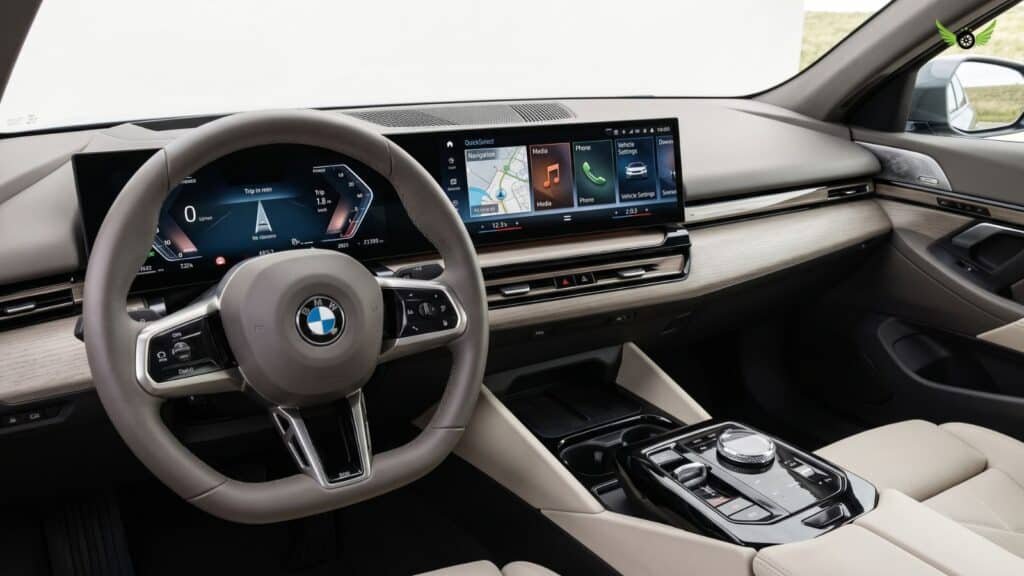
The BMW 5 Series Reliability rating is currently 77/100 from J.D. Power, which places it in the average category for quality and reliability. Consumer Reports also predicts about-average reliability for the 2026 model.
The most relevant documented concern for the current-generation car is electrical rather than an established engine failure. NHTSA recall 26V096000 covers certain 2024–2026 5 Series vehicles because the air-conditioning wiring harness can be damaged during cabin-air-filter replacement. For the affected 5 Series configuration, NHTSA lists 20,438 potentially involved vehicles.
Engine, Mild-Hybrid & Plug-In Hybrid System Reliability
The 2026 range includes the 530i, 540i xDrive, and 550e xDrive. The 530i uses a 2.0-liter turbocharged four-cylinder with 48-volt mild-hybrid assistance, while the 540i xDrive uses a 3.0-liter turbocharged inline-six with the same 48-volt technology. The 550e xDrive adds plug-in-hybrid technology to the inline-six powertrain.
Current reliability evidence does not identify a widespread engine or hybrid-system defect across the 2026 5 Series. Consumer Reports’ prediction is based on the 2024 and 2025 models plus BMW’s brand reliability data, so it is best used as an early reliability indicator rather than a model-specific failure statistic.
Consumer Reports’ road test of the 530i xDrive found the 255-hp four-cylinder engine and eight-speed automatic transmission smooth and refined. Its test car also showed the 48-volt mild-hybrid system operating smoothly during stop-start driving.
Electrical, Software & Other Reported Issues
Electrical and electronic systems are an important area to monitor. The current 5 Series uses extensive digital controls, infotainment, driver-assistance technology, cameras, and electronic modules. J.D. Power’s 2026 industry study identifies infotainment as the most problematic category across the broader vehicle market, although this is not a 5 Series-specific failure rate.
The clearest documented issue affecting the current 5 Series is the air-conditioning wiring-harness recall. BMW reported that the harness can be damaged when the cabin air filter is replaced; the resulting electrical short can increase fire risk. Dealers inspect the harness and install a replacement harness and retaining hardware where required at no charge.
BMW also issued a 2026 emissions-related software campaign covering certain G60 5 Series vehicles produced between January 14, 2022 and September 16, 2025. The issue concerns OBD diagnostic software that may fail to automatically clear certain stored fault codes and the malfunction indicator light after an underlying fault has been corrected.
According to our experience, a sensible reliability assessment should focus on documented recalls, service history, software updates, and actual vehicle condition rather than labeling every older BMW issue as a 2026 BMW 5 Series Common Problem. The current evidence points to average predicted reliability, with electrical and software-related systems deserving particular attention.
BMW 5 Series Warranty, Recalls & Technical Updates
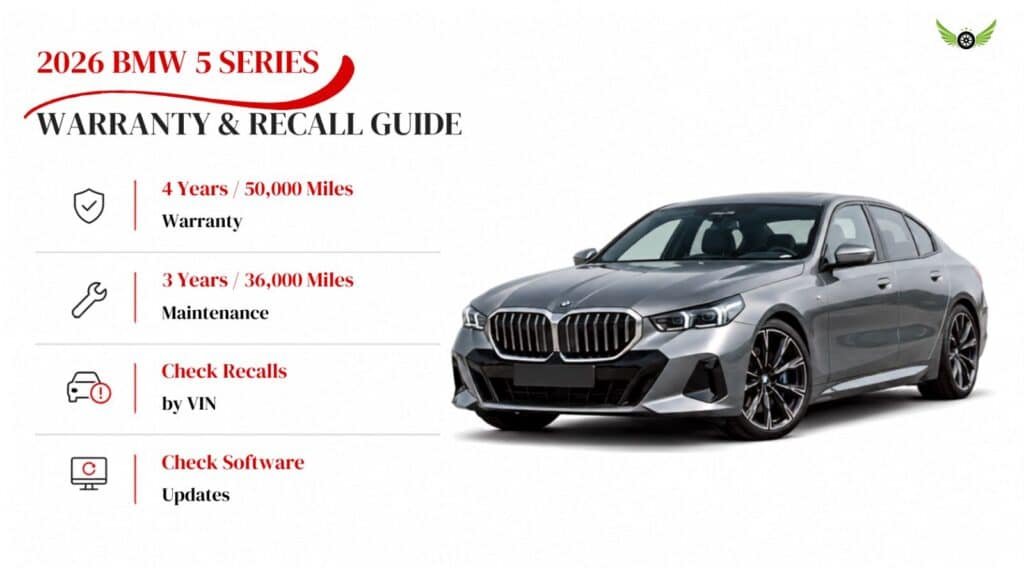
For U.S. buyers, the BMW 5 Series comes with BMW’s standard new-vehicle warranty plus complimentary scheduled maintenance. BMW provides a 4-year/50,000-mile New Vehicle Limited Warranty and 3-year/36,000-mile BMW Ultimate Care scheduled-maintenance coverage, whichever period comes first.
Recall and software status should also be checked by VIN because coverage and campaigns can vary between individual vehicles.
Factory Warranty and Extended Protection Options
The 2026 BMW New Vehicle Limited Warranty covers defects in materials or workmanship for 4 years or 50,000 miles, whichever comes first. BMW also provides 24-hour roadside assistance for the first 4 years, according to its U.S. warranty information.
BMW Ultimate Care separately covers eligible scheduled maintenance for 3 years or 36,000 miles. This includes factory-scheduled services such as oil and filter service, brake fluid, applicable filters, spark plugs, and vehicle checks when due.
After the original warranty period, BMW offers Vehicle Service Contracts (VSCs) rather than a direct warranty extension. BMW states that these contracts can provide coverage for up to 7 years or 100,000 miles, with Platinum and Powertrain coverage levels available. Platinum coverage includes major vehicle systems and electronics, while Powertrain focuses on engine, transmission, and drivetrain components.
How to Check Recalls and Software or Service Updates
The easiest way to check a BMW 5 Series for open safety recalls is by entering its 17-digit VIN on BMW USA’s recall website. BMW also provides recall information through the My BMW App, under Service and Maintenance → Recalls & Campaigns. Recall repairs are performed free of charge at authorized BMW Centers.
NHTSA’s VIN lookup is another reliable check. Its database shows unrepaired safety recalls associated with a specific vehicle and also provides information on investigations and manufacturer communications.
For software, BMW USA provides a VIN-based Software Update page where owners can check whether a new software update is available for their vehicle and paired mobile devices.
One documented recall is NHTSA 26V096, which affects certain 2025–2026 BMW vehicles, including the 550e xDrive. The issue involves an air-conditioning wiring harness that can be damaged during cabin air-filter replacement and potentially short-circuit. BMW’s remedy includes inspection and, where necessary, replacement and additional retaining hardware at no charge.
According to our experience, checking the VIN before purchasing a used BMW 5 Series and again during ownership is a simple way to confirm that applicable recall repairs and manufacturer updates have been completed.
BMW 5 Series Long-Term Reliability
The BMW 5 Series has a historical average lifespan of approximately 109,383 miles, or 10.2 years, according to iSeeCars’ analysis of more than 300 million vehicles. Its overall reliability score is 6.8 out of 10, and the model has an estimated 2.2% probability of reaching 200,000 miles.
For the current 2024–2026 generation, iSeeCars has not assigned a separate generation reliability score. J.D. Power currently rates the 2026 5 Series 77/100 for Quality & Reliability, placing it in the Average category.
These figures make regular maintenance especially important. BMW’s Condition Based Service system tracks service requirements, while BMW Ultimate Care provides scheduled maintenance coverage for 3 years or 36,000 miles on new vehicles.
Expected Lifespan with Proper Maintenance
Historical data show that a BMW 5 Series typically reaches around 109,383 miles and 10.2 years of use. Reaching 150,000 miles or more is possible, but the condition of the individual vehicle and its maintenance history become increasingly important as mileage rises.
The current generation uses turbocharged engines, 48-volt mild-hybrid technology on the 530i and 540i, and plug-in-hybrid technology in the 550e. Keeping the scheduled services current is therefore important for the engine, drivetrain, cooling system, brakes, and electronic systems.
The 2026 model’s 77/100 J.D. Power Quality & Reliability score provides a useful current benchmark, while the iSeeCars lifespan figure provides longer-term historical context for the nameplate.
How to Reduce Long-Term Repair Costs
The most practical way to control repair costs is to follow the BMW maintenance schedule and address service requirements when they appear in the CBS system. BMW’s Ultimate Care program covers eligible scheduled maintenance for the first 36 months or 36,000 miles, reducing routine service expenses during that period.
After that coverage ends, keeping service records and using a qualified BMW technician can make maintenance easier to manage. Regular attention to tires, brakes, fluids, filters, and warning messages can also help prevent avoidable repair costs.
For owners planning a longer ownership period, BMW offers Ultimate Care+ maintenance plans that can extend scheduled-maintenance coverage beyond the standard period. BMW also offers Vehicle Service Contracts with protection options extending up to 7 years or 100,000 miles, depending on the selected plan.
According to our experience, the strongest approach to long-term BMW ownership is consistent maintenance rather than stretching service intervals. A complete service history also gives a clearer picture of how the car has been maintained when major repairs or resale eventually become relevant.
BMW 5 Series Maintenance, Reliability & Common Problems FAQs
The 2026 BMW 5 Series combines turbocharged gasoline engines, 48-volt mild-hybrid technology, and a plug-in-hybrid option, making maintenance, reliability, warranty coverage, and long-term ownership costs important considerations for U.S. buyers. BMW provides scheduled maintenance coverage for 3 years or 36,000 miles, while the new-vehicle limited warranty covers 4 years or 50,000 miles.
The questions below cover the main ownership concerns, including maintenance intervals, service costs, reliability, common problems, recalls, warranty protection, expected lifespan, and ways to manage repair expenses.
How much does it cost to maintain a 2026 BMW 5 Series?
Edmunds estimates five-year maintenance costs of $6,859 for the 530i, $6,857 for the 530i xDrive, $7,944 for the 540i xDrive, and $7,994 for the 550e xDrive, assuming 15,000 miles per year.
How often does a BMW 5 Series need maintenance?
The car uses BMW’s Condition Based Service (CBS) system to determine when individual maintenance services are due. Scheduled work can include engine oil and filter service, brake fluid, cabin microfilters, engine air filters, spark plugs, and vehicle checks.
What maintenance does BMW cover for free?
BMW Ultimate Care covers eligible scheduled maintenance for 36 months or 36,000 miles, whichever comes first. Covered services include engine oil and filter, brake fluid, cabin microfilters, engine air filters, spark plugs, remote-control/key batteries, and vehicle checks when required by the factory schedule.
Are tires and brakes covered by BMW maintenance?
BMW Ultimate Care does not include tires, wheels, wheel alignment, tire balancing, or rotation. Brake pads and discs are handled according to wear and the applicable coverage terms rather than a simple fixed replacement mileage.
Is the 2026 BMW 5 Series reliable?
J.D. Power rates the 2026 5 Series 77/100 for Quality & Reliability, classified as Average. Consumer Reports also predicts about-average reliability for the model.
What are the common problems with the 2026 BMW 5 Series?
A documented recall affects certain 2025–2026 BMW vehicles, including some 5 Series models. The issue involves an air-conditioning electrical wiring harness that can be damaged during cabin air-filter replacement and potentially short-circuit.
Does the 2026 BMW 5 Series have engine problems?
Current reliability information does not identify a widespread engine defect across the 2026 5 Series lineup. The 530i uses a 2.0-liter turbocharged four-cylinder, while the 540i xDrive and 550e xDrive use a 3.0-liter turbocharged inline-six, with the 550e adding plug-in-hybrid technology.
Is the BMW 550e expensive to maintain?
The 550e xDrive has the highest projected five-year maintenance cost among the main 2026 configurations in Edmunds’ data, at $7,994. The 530i is estimated at $6,859, making the projected difference $1,135 over five years.
Does the 550e plug-in hybrid require special maintenance?
BMW states that its plug-in-hybrid vehicles, including their high-voltage components, do not require a separate scheduled-maintenance program beyond the factory maintenance schedule. BMW also provides an 8-year/100,000-mile warranty for the high-voltage lithium-ion battery assembly against defects in materials or workmanship.
How long can a BMW 5 Series last?
iSeeCars estimates an average 5 Series lifespan of approximately 109,383 miles or 10.2 years based on its historical vehicle data. That figure is a model-level historical estimate rather than a specific mileage guarantee for the 2026 model.
What is the warranty on a 2026 BMW 5 Series?
BMW’s U.S. new-vehicle limited warranty covers the vehicle for 4 years or 50,000 miles, whichever comes first. BMW also provides 24-hour roadside assistance for the first four years with no mileage restriction.
Can BMW 5 Series owners buy extended coverage?
BMW offers Vehicle Service Contracts rather than simply extending the original warranty. Available coverage can extend to 7 years or 100,000 miles, with Platinum and Powertrain options.
How do I check for BMW 5 Series recalls?
Use the vehicle’s 17-character VIN through the NHTSA recall lookup or BMW’s recall resources. NHTSA’s VIN search shows whether a specific vehicle has an unrepaired safety recall.
How can I reduce long-term BMW 5 Series repair costs?
Follow the CBS maintenance schedule, keep service records, monitor tire and brake wear, and address warning messages promptly. After the complimentary-maintenance period, comparing prices between an authorized BMW Center and a qualified BMW specialist can also help manage routine repair costs.
Is the BMW 5 Series a good choice for long-term ownership?
It can be a good long-term choice for buyers who are comfortable with luxury-car maintenance costs and who keep up with scheduled servicing. The 2026 model combines an average J.D. Power reliability rating with BMW’s factory maintenance and warranty programs, while current Edmunds estimates show that ownership costs vary noticeably between powertrains.