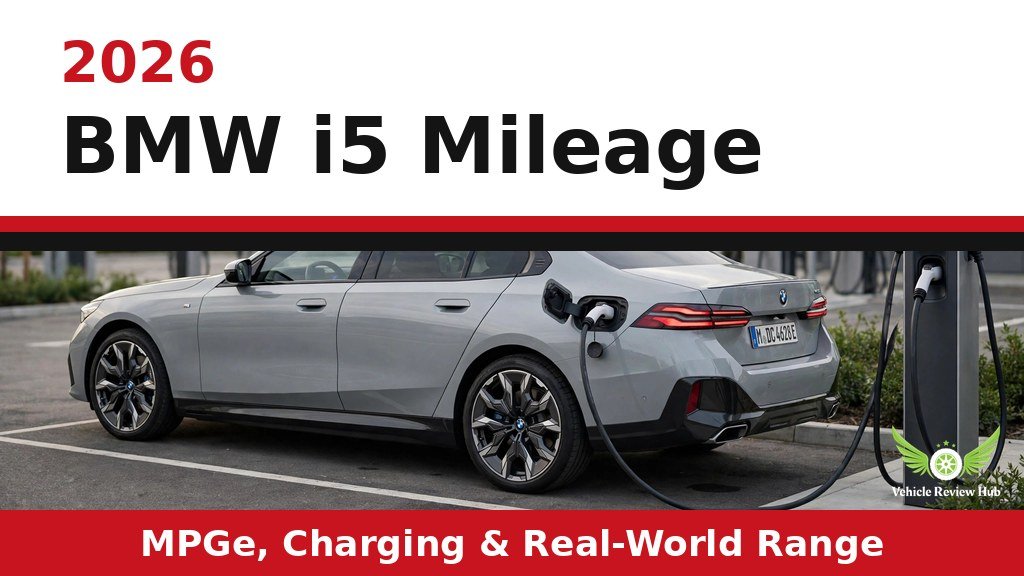
The 2026 BMW i5 delivers up to 310 miles of EPA-estimated range and a peak DC fast-charging speed of 205 kW, making it a well-rounded luxury electric sedan for American drivers. In real-world testing, BMW i5 mileage varies from about 259 to 310 miles per charge depending on the trim and wheel size, with the single-motor eDrive40 on 19-inch wheels offering the best BMW i5 mileage in the lineup. Charging from 10 to 80 percent takes roughly 30 minutes at a fast charger, and the 2026 model year adds native Tesla-style NACS charging ports plus efficiency upgrades for a few extra miles. This guide covers BMW i5 mileage, MPGe ratings, charging times, and the real-world driving experience so you know exactly what to expect.
BMW i5 Range, MPGe & Electricity Efficiency
The 2026 BMW i5 comes in three trims — eDrive40, xDrive40, and M60 xDrive — and each has different BMW i5 mileage, MPGe, and efficiency numbers. Wheel size also matters more than most buyers expect: stepping up to 21-inch wheels can cost you 30 miles of range or more. That is why comparing BMW i5 mileage across the lineup starts with understanding how trims and wheels change the numbers.

Official EPA Range and MPGe by BMW i5 Model
The table below summarizes the official EPA figures for the 2026 BMW i5, compiled from Autoblog’s specification data for the 2026 model year. The eDrive40 with the standard 19-inch wheels is the range champion at 310 miles, while the dual-motor trims trade some efficiency for extra power and all-wheel drive. For 2026, BMW improved efficiency with silicon carbide inverter components and lower-friction wheel bearings, which pushed the eDrive40 from 295 miles up to 310 miles.
| Model | Wheels | EPA Range | MPGe (City / Hwy / Combined) |
|---|---|---|---|
| i5 eDrive40 | 19-inch | 310 mi | 114 / 106 / 110 |
| i5 eDrive40 | 20-inch | 300 mi | 110 / 102 / 106 |
| i5 eDrive40 | 21-inch | 278 mi | 102 / 93 / 98 |
| i5 xDrive40 | 19-inch | 278 mi | 99 / 97 / 98 |
| i5 xDrive40 | 20-inch | 272 mi | 97 / 94 / 96 |
| i5 xDrive40 | 21-inch | 259 mi | 92 / 88 / 91 |
| i5 M60 xDrive | 19-inch | 277 mi | 100 / 98 / 99 |
| i5 M60 xDrive | 20-inch | 266 mi | 96 / 92 / 94 |
| i5 M60 xDrive | 21-inch | 259 mi | 92 / 89 / 91 |
MPGe works like a familiar mpg number, but for electricity. A higher MPGe means the car travels farther on the same amount of electricity, so the eDrive40’s 110 combined MPGe makes it the clearest choice for drivers who prioritize running costs. The M60’s figures are respectable for a 593-horsepower performance sedan, but its extra motor and sportier tuning push BMW i5 mileage down to the mid-200s on the largest wheels. The takeaway: small choices in trim and wheels make big differences in BMW i5 mileage.
Real-World BMW i5 Range and Energy Consumption
Independent testing suggests the i5 can do better than its EPA label in the right conditions. MotorTrend’s 2026 i5 coverage confirms the powertrain specs, while Consumer Reports ran its 70-mph highway range test on the i5 M60 and recorded 295 miles on a single charge, far exceeding the EPA’s estimate — an impressive result for the most powerful trim. On the other hand, reviewers have found that freeway speeds and larger wheels eat into range: one road test of the xDrive40 with 21-inch wheels, as reviewed by SlashGear, noted that its EPA estimate of 259 miles was optimistic at sustained highway pace, with real-world consumption around 37 kWh per 100 miles versus 31 kWh per 100 miles for the eDrive40 on 19-inch wheels.
For American owners, expect real-world BMW i5 mileage of roughly 270 to 290 miles from an eDrive40 in mixed driving, and 230 to 260 miles from an xDrive40 or M60 in normal highway use. Gentle driving, moderate speeds, and the adaptive regenerative braking system all help, while cold weather, aggressive acceleration, and 21-inch wheels all pull the number down. Pre-conditioning the battery while still plugged in is one of the easiest ways to protect range on cold mornings. Most owners find their observed BMW i5 mileage settles within 10 percent of these published figures after the first month of driving.
BMW i5 Charging Time & Charging Experience
All three i5 trims share the same 84.3 kWh usable battery pack, 205 kW peak DC fast-charging speed, and 11 kW AC charging capacity. That means charging time and overall BMW i5 mileage depend more on your trim’s efficiency than on any hardware difference between models. Understanding BMW i5 mileage alongside charging behavior is the key to stress-free ownership.
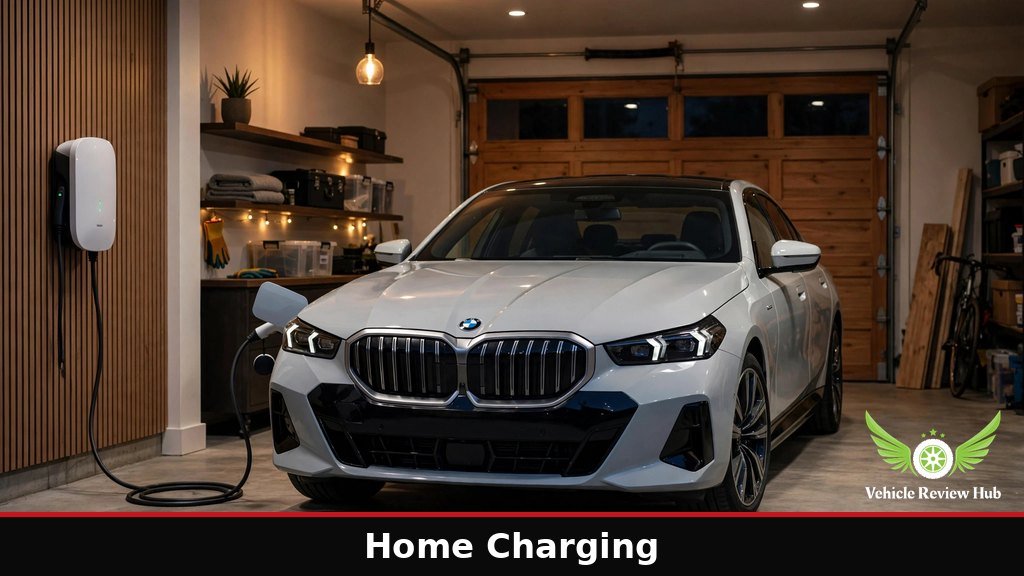
Home Charging with Level 1 and Level 2 Chargers
Most i5 owners will do most of their charging at home. A standard 240V Level 2 charger (up to 11 kW) fills the battery from empty in roughly eight hours, so an overnight charge easily restores a full battery every morning. On a Level 2 setup, adding 30 to 35 miles of range per hour is typical, which covers the average American daily commute in about two hours of plugged-in time.
A regular 120V Level 1 outlet is much slower — expect only three to five miles of range per hour — so it only makes sense as an emergency backup or for very low-mileage drivers. BMW recommends installing a dedicated Level 2 charger at home, and the My BMW app lets you schedule charging for off-peak electricity hours, which can cut your energy cost per mile significantly. Keeping the car plugged in at home also means you always leave with a warm, pre-conditioned battery in winter. Drivers who commute 40 miles daily will use only a small fraction of their BMW i5 mileage capacity each day, so a simple overnight Level 2 charge is more than enough.
DC Fast Charging, Charging Speed & Road Trip Planning
On the road, the i5’s 205 kW peak DC fast-charging rate takes the battery from 10 to 80 percent in about 30 minutes, adding roughly 90 to 100 miles of range in the first 10 minutes under ideal conditions. BMW includes two years or 1,000 kWh of free charging with Electrify America, which covers the first several thousand miles of road trips. The 2026 i5 also gains a native Tesla-style NACS charging port starting with March 2026 production, giving owners direct access to Tesla Superchargers alongside CCS stations with an adapter — a major practical win for long-distance travel in the United States.
For road trip planning, the i5’s navigation automatically routes you through charging stops and pre-conditions the battery en route so you hit peak speed on arrival. A good rule of thumb is to charge to 80 percent and move on, since speeds taper above that level. At a typical stop, 25 to 30 minutes of charging returns you to the road with another 150 to 200 miles of real-world range — enough for a rest break and a coffee. When you factor in how far BMW i5 mileage stretches on a charge, most interstate legs need only one stop every three hours or so. That rhythm matches how most families road-trip anyway, making BMW i5 mileage far less of a constraint than range anxiety suggests.
BMW i5 Performance & Real-World Driving Experience
The i5 is first and foremost a BMW, and its electric powertrains keep that reputation alive. How the car delivers its power — and how that power affects BMW i5 mileage — differs across the three trims, but all of them feel quick and composed in everyday driving. Power and BMW i5 mileage pull in opposite directions, so the right trim depends on your priorities.
eDrive40 vs xDrive40 vs M60 Acceleration and Power Delivery
The rear-wheel-drive eDrive40 makes 335 horsepower and 295 lb-ft of torque, enough for a 0–60 mph sprint in about 5.1 to 5.7 seconds depending on conditions — quick enough for confident merging and passing. The xDrive40 adds a second motor for 389 horsepower, 435 lb-ft, and all-wheel-drive traction, dropping the sprint to roughly 5.2 seconds. The M60 xDrive is the flagship: 593 horsepower with Sport Boost, 586 lb-ft (605 in boost mode), and a tested 3.4-second 0–60 time that rivals dedicated sports cars.
Power delivery is smooth and linear across all three, with no gear changes and instant response. The M60’s acceleration comes with standard active anti-roll bars, sport suspension tuning, and rear-wheel steering that make it feel smaller than it is. That performance does cost efficiency — the M60’s BMW i5 mileage trails the eDrive40 by 30 to 40 miles per charge — but drivers who use Sport mode sparingly will still see respectable numbers. In normal commuting, most owners report BMW i5 mileage that stays close to the EPA estimate regardless of trim. For more on the trims and pricing, see our full 2026 BMW i5 review with specs and buying advice.
Ride Comfort, Handling & Regenerative Braking Feel
Reviewers consistently praise the i5 for feeling more driver-focused than rivals like the Mercedes-Benz EQE, with sharp steering, balanced chassis tuning, and a composed ride. The eDrive40 on 19-inch wheels offers the most comfortable and most efficient setup, while larger wheels sharpen responses at the cost of range. Wind and road noise are well suppressed at highway speeds, and the cabin feels expensive and solid.
Regenerative braking can be set to a strong one-pedal mode, which makes city driving smoother and recaptures energy that would otherwise be lost — a direct contributor to good city BMW i5 mileage. The system also offers an adaptive mode that adjusts regen strength based on traffic ahead, and many drivers leave it there for the most natural feel. The transition to the friction brakes is seamless, with none of the grabbiness that affects some electric sedans. This everyday efficiency boost is a quiet reason city BMW i5 mileage often impresses new owners.
BMW i5 Daily Driving & Long-Distance Comfort
A luxury electric sedan lives or dies on how it handles the daily grind. The i5 scores well here: it’s easy to drive, quiet at speed, and its BMW i5 mileage is predictable enough that owners rarely need to think about range in normal use. Still, knowing what moves BMW i5 mileage up or down helps you get the most from every charge.

City Driving, Highway Refinement & Cabin Quietness
In the city, the i5’s compact turning behavior, smooth throttle response, and one-pedal driving make stop-and-go traffic relaxing. Efficiency is actually best in urban driving, where regenerative braking recovers the most energy — many owners see city BMW i5 mileage that meets or beats the EPA city figures. On the highway, the cabin stays impressively quiet, with minimal wind noise around the mirrors and glass, and the optional Highway Assistant adds hands-free driving with automatic lane changes on divided highways.
The available Sky Lounge panoramic roof and Harman Kardon sound system (now standard for 2026) make long drives pleasant, and the iDrive 8.5 system with a 12.3-inch instrument display and 14.9-inch center touchscreen handles navigation, charging, and entertainment cleanly. This is where urban BMW i5 mileage shines — low speeds and frequent braking play to the car’s strengths. For owners weighing long-term running costs, our BMW i5 maintenance cost guide covers service intervals and what to expect after the included maintenance period.
Winter Range and Factors That Affect Real-World Range
Cold weather is the biggest variable in real-world BMW i5 mileage. At temperatures around freezing, expect a 15 to 25 percent drop in range as the battery heats itself and the cabin, with the effect worse on short trips where warm-up energy is a larger share of total use. The i5’s heat pump, battery pre-conditioning, and heated seats all help, and pre-conditioning while plugged in is the single best way to protect winter range.
Other factors that move the number: wheel size is the largest, worth up to 32 miles between 19- and 21-inch wheels; sustained 75-mph highway speeds cost 10 to 15 percent versus mixed driving; and aggressive Sport-mode driving drains the battery noticeably faster. Conversely, moderate speeds, gentle acceleration, and heavy use of regenerative braking all stretch BMW i5 mileage toward the upper end of its range. If winter driving is a big part of your year, the xDrive40’s all-wheel-drive traction is worth considering even though its efficiency trails the eDrive40 slightly. Drivers in snowy states routinely say winter BMW i5 mileage still covers their daily driving with room to spare.
Is the BMW i5 Practical for Daily Driving and Road Trips?
The i5’s 17.3 cubic-foot trunk swallows luggage for four, the rear seat is comfortable for adults, and its fast-charging speed keeps road trips realistic. The question is how its BMW i5 mileage holds up across different ownership patterns. Here is how BMW i5 mileage fits daily life and longer adventures.
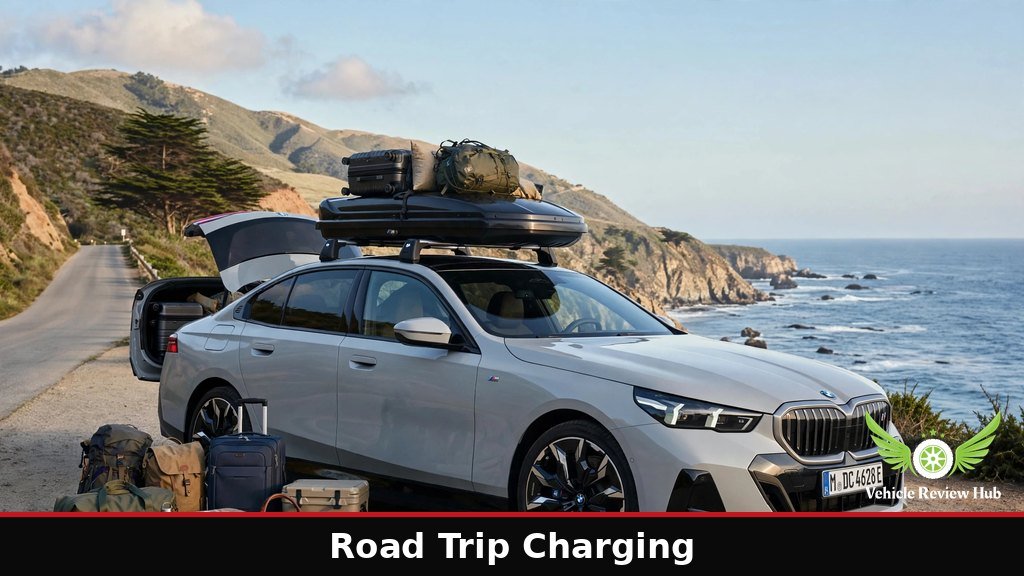
Long-Distance Range and Charging Convenience
For daily commuting, any i5 works: the average American drives under 40 miles a day, so even the M60’s 259-mile EPA rating covers a full week of commuting on one charge. For road trips, plan on charging every 180 to 220 miles of real highway driving to stay in the battery’s fastest-charging zone between 10 and 80 percent. With Electrify America’s network, Tesla Supercharger access via the new NACS port, and automatic route planning with battery pre-conditioning, the i5 is one of the easiest electric sedans to road-trip in 2026.
One practical tip: charging stations cluster in urban corridors, so check coverage along rural routes before leaving, especially in the Mountain West. BMW’s two years of free Electrify America charging softens the cost of your first long trips, and home charging at off-peak rates makes daily driving remarkably cheap. Charging stops also give you natural breaks, and planning them around your BMW i5 mileage rhythm keeps trips relaxed. Our BMW i5 ownership cost analysis breaks down insurance, charging, and depreciation so you can see the full financial picture.
Which BMW i5 Offers the Best Balance of Range and Performance?
The eDrive40 offers the best BMW i5 mileage at 310 miles and the lowest price, making it the smart pick for efficiency-first buyers and high-mileage commuters. The xDrive40 splits the difference: 278 miles of range, 389 horsepower, and all-wheel drive for only $3,000 more, which many buyers find the sweet spot. The M60 sacrifices range for 593-horsepower excitement — choose it if performance is the priority and you can live with charging more often.
If your annual mileage is high or you regularly drive long distances, the eDrive40 on 19-inch wheels returns the lowest cost per mile and the fewest charging stops. If you want all-weather confidence with minimal range penalty, the xDrive40 is the best-balanced i5. Either way, the i5’s combination of strong real-world efficiency, 205 kW charging, and a refined driving experience makes it a practical daily driver and a credible road-trip car. Match the trim to your real driving, and BMW i5 mileage becomes a strength rather than a question mark.
BMW i5 Mileage FAQs
These are the questions American shoppers ask most about BMW i5 mileage, charging, and real-world ownership.
What is the EPA range of the 2026 BMW i5?
The 2026 BMW i5 ranges from 259 to 310 miles depending on trim and wheels. The eDrive40 on 19-inch wheels is rated at 310 miles, the xDrive40 at 278 miles, and the M60 xDrive at up to 277 miles. Larger wheels reduce every trim’s rating by 10 to 30 miles.
What is the real-world BMW i5 mileage?
Independent tests suggest real-world BMW i5 mileage of roughly 270 to 290 miles for the eDrive40 in mixed driving, and 230 to 260 miles for the xDrive40 and M60. Consumer Reports measured 295 miles from an i5 M60 in its 70-mph highway test, while sustained high-speed driving with 21-inch wheels can fall below the EPA estimate.
How long does it take to charge a BMW i5?
At a DC fast charger, the i5 goes from 10 to 80 percent in about 30 minutes thanks to its 205 kW peak rate. At home on a 240V Level 2 charger (11 kW), a full charge takes roughly eight hours — an easy overnight fill. A regular 120V outlet is too slow for daily use at only a few miles of range per hour.
Does the BMW i5 get Tesla Supercharger access?
Yes. BMW i5 models built from March 2026 onward come with a native Tesla-style NACS charging port, giving direct access to Tesla Superchargers in the US. Earlier 2026 models can charge at Superchargers using an adapter and software updates. Plug & Charge support simplifies payment at supported stations.
How much does winter weather affect BMW i5 mileage?
Expect a 15 to 25 percent range reduction in freezing temperatures, with short trips affected most. The i5’s heat pump, heated seats, and battery pre-conditioning help limit the loss, and pre-conditioning while plugged in before departure is the best countermeasure. All-wheel-drive xDrive trims handle snow better but don’t escape the physics of cold batteries.
Which BMW i5 trim is the best buy for range and value?
The eDrive40 gives the best BMW i5 mileage (310 miles) at the lowest price, making it the efficiency and value pick. The xDrive40 adds 54 horsepower and all-wheel drive for $3,000 more with only a modest range penalty, making it the best balance for most buyers. The M60 is the performance choice, not the efficiency one.