Yes, the touring version of Honda’s big adventure bike is fast enough for any legal road use, and its strength is long-distance ease. This guide to Honda Africa Twin Adventure Sports ES performance gives the direct answers first: the 1084cc twin makes a claimed 100.6 horsepower at the crankshaft and a measured 92.0 at the rear wheel, Honda USA publishes no MPG figure, and no instrumented 0–60, quarter-mile or top-speed test exists. Honda Africa Twin Adventure Sports ES performance really means strong midrange, a relaxed sixth gear, adaptive electronic suspension, and a 6.6-gallon tank.
The engine is the same 1084cc Unicam twin as the standard bike, but the ES wraps it in touring bodywork, a 19-inch front wheel from 2024, Showa EERA suspension and heated grips, and weighs 24 pounds more in manual form. This Honda Africa Twin Adventure Sports ES performance guide separates measured facts from unverified internet claims.
Honda Africa Twin Adventure Sports ES Engine Performance and Power Delivery
Honda Africa Twin Adventure Sports ES performance starts with an engine built for torque, not peak horsepower. The 1084cc liquid-cooled Unicam twin uses a 270-degree crankshaft, and the 2024 retune lifted peak torque about 7 percent at 750 rpm lower, so the bike pulls harder where touring riders spend their time.

Rider Dyno 92.0 HP at 7,600 RPM and EU Claim 101 HP Explained
The two power figures quoted for Honda Africa Twin Adventure Sports ES performance measure different things. Honda’s European claim of 100.6 horsepower at 7,500 rpm — often rounded to 101 hp — is a crankshaft figure, measured before gearbox, chain and rear wheel take their share. Rider’s 2024 first look covers the retuned engine behind that claim, including 10.5:1 compression and revised tuning.
The independent figure is a rear-wheel dyno run: 92.0 horsepower at 7,600 rpm, with 69.5 lb-ft of torque at 6,300 rpm. That test bike was an Adventure Sports ES, so the number applies directly to Honda Africa Twin Adventure Sports ES performance; the gap is normal drivetrain loss. Torque splits by generation: 2020–2023 bikes made 77 lb-ft at 6,250 rpm, while 2024-on bikes make 82.6 lb-ft at 5,500 rpm. The official Honda USA Adventure Sports ES page lists current specifications, including the 6.6-gallon tank and 535-pound manual weight.
| Figure | Value | Measured where |
|---|---|---|
| Engine | 1084cc Unicam twin | — |
| Claimed power | 100.6 hp at 7,500 rpm | Crank (EU) |
| Dyno power | 92.0 hp at 7,600 rpm | Rear wheel |
| Torque, 2024-on | 82.6 lb-ft at 5,500 rpm | Crank (EU) |
Six-Speed Manual and DCT Shifting, Ride Modes and Power Delivery
Both gearboxes serve Honda Africa Twin Adventure Sports ES performance well but change the bike’s character. The six-speed manual uses a conventional clutch with an assist-and-slipper function. The six-speed DCT removes the clutch lever: it shifts automatically, or by handlebar paddles in manual mode, with Drive and three Sport settings.
DCT costs about $800 more and adds 24 pounds, taking weight from 535 to 559 pounds. For Honda Africa Twin Adventure Sports ES performance in traffic and on tours, DCT is the easier choice, and the 2024 software improved low-speed engagement for smoother stop-and-go riding. Throttle-by-wire feeds six ride modes — Tour, Urban, Gravel, Off-Road, User 1 and User 2 — adjusting power, engine braking, torque control and wheelie control together. The standard Africa Twin performance figures come from the same engine, so the ES feels familiar, just calmer and heavier.
Honda Africa Twin Adventure Sports ES Top Speed and Acceleration
Honda Africa Twin Adventure Sports ES performance has one honest gap: nobody has published an instrumented acceleration or top-speed test for this bike. Buyers often shop by 0–60 and top-speed numbers, which do not exist in verifiable form for the ES.

Why No Instrumented 0-60, Quarter Mile or Top Speed Test Exists
Major American outlets have dyno-tested the Africa Twin platform and first-ride reviewed the ES, but none has published an instrumented 0–60, quarter-mile or top-speed run for the ES. Honda Africa Twin Adventure Sports ES performance coverage concentrates on touring comfort, suspension and electronics instead, and testers rarely strap timing gear to a tourer.
Any seller, video or page stating a 0–60 time or top speed as measured is dressing up an estimate; until a publication measures it, this guide will not put a number on it.
Online Figures From 112 to 137 MPH Are Conflicting Unverified Estimates
Online Honda Africa Twin Adventure Sports ES performance top-speed figures run from about 112 mph to about 137 mph. The top comes from aggregator listings quoting 220 km/h (137 mph) for the 2025 ES DCT; others put the same bike near 200 km/h (about 124 mph). A genuine measured top speed would not vary by 25 mph between listings for the same model.
Treat all of them as unverified estimates: fairing and windscreen help highway cruising, but upright ergonomics and DCT weight work against outright top speed. Still, Honda Africa Twin Adventure Sports ES performance cruises effortlessly at any legal highway speed with passing reserve.
Honda Africa Twin Adventure Sports ES Mileage and Fuel Economy
Honda Africa Twin Adventure Sports ES performance on fuel is a story of a big tank, not a frugal engine. The ES carries 6.6 gallons against the standard bike’s 5.0, so it goes about a third further per fill-up. For Honda Africa Twin Adventure Sports ES performance budgeting, the tank is the reliable fact; the MPG figure needs more care, because Honda USA publishes no official MPG number.

Honda USA Publishes No MPG Figure and the 6.6-Gallon Tank
Honda USA’s specification pages give the ES a 6.6-gallon capacity including reserve, but no MPG rating. That leaves Honda Africa Twin Adventure Sports ES performance buyers dependent on owner data and tester reports. The tank is larger because the Adventure Sports line was built for long-distance travel, and on 2024-on bikes it pairs with the lower 19-inch chassis, not the tall 2018–2019 setup.
Work from a range of owner-reported economy, not a single figure: roughly 40 to 50 mpg mixed use for the CRF1100L platform. At 40 mpg the ES covers about 264 miles per tank; at 50 mpg, about 330 miles.
Rider Tested 47.8 MPG Average and Around 310 Mile Range
This heading repeats the outline’s wording, and it needs a plain correction for Honda Africa Twin Adventure Sports ES performance readers: the 47.8 mpg figure was not a Rider test. The published 47.8 figure is Fuelly’s owner-logged average for the 2017 CRF1000L ABS — 33 bikes, 1,194 fuel-ups, 201,617 miles — for the older 998cc generation, not a test of the current 1084cc ES, and no Rider 47.8 mpg average is traceable.
Used carefully, the Fuelly figure is still useful for Honda Africa Twin Adventure Sports ES performance range math: 47.8 mpg times the ES tank gives about 315 miles, rounding to the outline’s “around 310 mile range.” The table below shows that arithmetic, not measured ES test results.
| Fuel economy | ES range (6.6 gal) | Standard range (5.0 gal) |
|---|---|---|
| 40 mpg | About 264 miles | About 200 miles |
| 47.8 mpg (Fuelly 2017 CRF1000L ABS) | About 315 miles | About 239 miles |
| 50 mpg | About 330 miles | About 250 miles |
| Ranges are arithmetic, not measured ES tests. | ||
The ES advantage is entirely the tank: at any economy, Honda Africa Twin Adventure Sports ES performance buys roughly 65 to 80 extra miles per fill-up.
Honda Africa Twin Adventure Sports ES Real-World Riding Performance
On the road, Honda Africa Twin Adventure Sports ES performance feels less like a dirt bike that can tour and more like a tourer that can handle dirt roads. The 2024 chassis changes did it: the 19-inch front wheel, shorter travel and lower seat moved the ES toward pavement, while the retune strengthened low and midrange pull.

City Riding, Traffic Performance and Everyday Acceleration
Around town, Honda Africa Twin Adventure Sports ES performance is defined by weight and throttle manners more than speed. At 535/559 pounds, the ES is heavy at parking-lot speeds, and its 33.7/32.9-inch seat still challenges shorter riders, though 2024 geometry quickens steering versus the 21-inch 2020–2022 ES. Throttle-by-wire keeps low-speed response smooth.
Everyday acceleration is where Honda Africa Twin Adventure Sports ES performance earns its keep. The 5,500 rpm torque peak means clean pulls from low revs without double downshifts, so traffic gaps and short on-ramps feel relaxed.
Highway Riding, Overtaking Ability and Long-Distance Performance
On the highway, Honda Africa Twin Adventure Sports ES performance settles into its natural habitat. Sixth gear is tall and relaxed, cruise control is standard, and windscreen, fairing and heated grips matter more at mile 300 than a horsepower figure. Overtaking is a roll-on exercise: the 82.6 lb-ft peak sits where highway passing happens.
Watch a back-to-back test of the 2025 standard Africa Twin against the Adventure Sports.
Long-distance Honda Africa Twin Adventure Sports ES performance is also about rider stamina. The 6.6-gallon tank means fuel stops roughly every 300 miles, EERA suspension keeps the ride composed, and the lower seat makes long days less tiring. TopSpeed’s long-term view of the Adventure Sports ES agrees: a bike bought for commuting, touring, passengers and poor pavement for years.
Honda Africa Twin Adventure Sports ES Handling, Braking and Stability
Honda Africa Twin Adventure Sports ES performance in corners is shaped by one 2024 decision: the 19-inch front wheel. The 2020–2022 ES and the 2018–2019 Adventure Sports ran a 21-inch front wheel, favoring rough ground but steering more slowly on pavement. The 2024-on ES runs a 19-inch front wheel with a wider rim and an 18-inch rear, shorter travel and a lower seat, trading some off-road ability for sharper handling. For Honda Africa Twin Adventure Sports ES performance buyers, model year matters: a pre-2024 ES does not handle like a 2024-on one.

EERA Suspension Settings, 19-Inch Front Wheel, Tires and Cornering
Showa EERA — Electronically Equipped Ride Adjustment — is the ES’s defining chassis feature and the heart of Honda Africa Twin Adventure Sports ES performance on changing roads. The system adjusts damping and preload electronically, tied to the ride modes. On 2024-on bikes, travel is 7.3–8.3/7.9 inches (2024–2026 spec), shorter than the standard bike’s 9.1/8.7.
Tires complete the Honda Africa Twin Adventure Sports ES performance picture: the 2024-on ES runs a 110/80-19 front and a 150/70-18 rear, against the 90/90-21 front of the 2020–2022 ES. The smaller, wider front tire gives a bigger contact patch and quicker turn-in. In corners the ES feels planted and holds a line steadily. The EERA suspension checks in the reliability guide explain used-ES inspection.
Dual 310mm Front Discs, Cornering ABS and HSTC Features
Braking matches the touring brief. Dual 310 mm front discs, four-piston calipers and a single 256 mm rear disc give strong, progressive stopping power, and Honda Africa Twin Adventure Sports ES performance braking is backed by cornering ABS through a six-axis inertial measurement unit, adjusting intervention for lean angle. That matters loaded, two-up, in the rain.
Honda Selectable Torque Control adds another layer to Honda Africa Twin Adventure Sports ES performance: it manages rear-wheel slip across levels tied to the ride modes, relaxable for gravel or off for off-road riding. Wheelie control, also ride-mode-linked, keeps the front wheel down without cutting power abruptly.
Honda Africa Twin Adventure Sports ES Performance Compared With Rivals
Honda Africa Twin Adventure Sports ES performance looks different depending on the rival parked next to it. Against middleweights it is bigger, heavier and stronger; against flagship European tourers it is smaller, lighter and much cheaper. The honest comparison is with the BMW R 1300 GS Adventure and the KTM 1390 Super Adventure, the machines a touring buyer cross-shops — and the ES wins on value while losing on outright power.
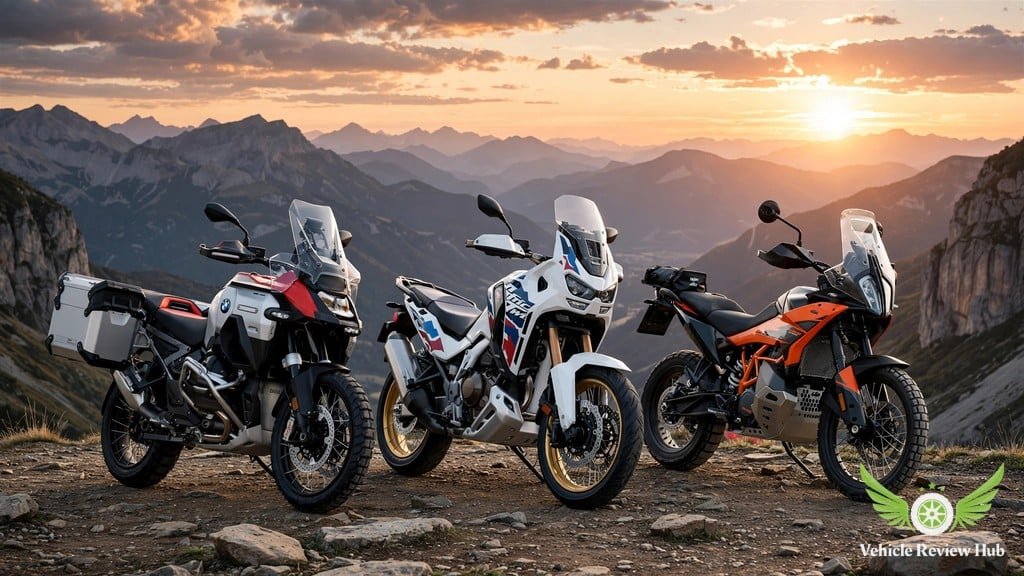
Africa Twin Adventure Sports ES vs BMW R 1300 GS Adventure and KTM 1390
The BMW R 1300 GS Adventure is the benchmark big tourer: a 1,300cc ShiftCam boxer twin making 145 horsepower at 7,750 rpm and 110 lb-ft at 6,500 rpm, a 7.9-gallon tank, 593 pounds fully fueled, and a 2026 US base price of $23,645 plus destination — about $5,850 more than the 2026 ES manual at $17,799 plus $775 destination, and 58 pounds heavier. Torquepedia’s 2026 R 1300 GS Adventure specification summary, from BMW PressClub USA data, confirms these figures; optioned examples run higher.
The KTM 1390 Super Adventure S EVO is the performance pick on paper: a claimed 170 horsepower and 107 lb-ft, a 6.1-gallon tank, and a $22,699 Cycle News price — roughly $4,900 more than the ES manual. Its smaller tank means shorter range than the ES. Cycle News’ 2024 Africa Twin announcement coverage confirms the ES pricing ladder: $17,599 manual and $18,399 DCT for 2024, rising to $17,799 and $18,599 for 2026. For Honda Africa Twin Adventure Sports ES performance shoppers, that gap is the story: roughly $5,000–$6,000 less than either rival.
| Bike (2026) | Price | Power (claimed) | Tank | Weight |
|---|---|---|---|---|
| Honda Africa Twin Adventure Sports ES | $17,799 manual / $18,599 DCT | 100.6 hp (crank) | 6.6 gal | 535 / 559 lb |
| BMW R 1300 GS Adventure | $23,645 base + destination | 145 hp | 593 lb | |
| KTM 1390 Super Adventure S EVO | $22,699 | 170 hp (claimed) | 6.1 gal | — |
| Sources: Honda USA/Cycle News; BMW PressClub; Cycle News. | ||||
The ES gives up 45 horsepower to the BMW and about 70 to the KTM, but costs roughly $5,000–$6,000 less, weighs less than the BMW, and out-ranges the KTM on a tank. If outright speed matters most, the Europeans win; on value, range and running costs, Honda Africa Twin Adventure Sports ES performance is the rational pick — and 92 rear-wheel horsepower suffices for loaded two-up touring.
Is the Africa Twin Adventure Sports ES Suitable for Touring Riders?
Yes — touring is exactly what Honda Africa Twin Adventure Sports ES performance is built for; the full Adventure Sports ES review covers comfort in detail. The case rests on four things: a 6.6-gallon tank delivering roughly 300-plus miles per fill-up, electronic suspension adapting to roads and loads, a complete touring set (windscreen, heated grips, cruise control, larger fairing) as standard, and a price thousands below the European flagships.
The Honda Africa Twin Adventure Sports ES performance limitations are equally clear: heavy at low speed, less off-road ability than the standard bike, and power that will not thrill riders from 150-plus-horsepower tourers. But for mainly-pavement touring with passenger and luggage, the ES is arguably the best-balanced big adventure tourer on sale. The Adventure Sports ES buying guide covers used prices and inspection for pre-owned buyers.
Honda Africa Twin Adventure Sports ES Performance: Frequently Asked Questions
Direct answers on Honda Africa Twin Adventure Sports ES performance: dyno numbers, fuel range and rivals.
How much horsepower does the Honda Africa Twin Adventure Sports ES make?
Honda claims 100.6 horsepower at 7,500 rpm at the crankshaft; an independent dyno measured 92.0 at the rear wheel. For Honda Africa Twin Adventure Sports ES performance, compare the rear-wheel figure against rivals measured the same way.
What is the top speed of the Honda Africa Twin Adventure Sports ES?
There is no verified top speed. Online figures for Honda Africa Twin Adventure Sports ES performance run from about 112 mph to about 137 mph, all conflicting unverified estimates; no major outlet has published an instrumented or GPS-verified test.
What is the 0–60 time of the Honda Africa Twin Adventure Sports ES?
No instrumented 0–60 time exists for the ES. Any Honda Africa Twin Adventure Sports ES performance 0–60 figure online is an estimate, not a measured result, and this guide does not quote one.
What MPG does the Honda Africa Twin Adventure Sports ES get?
Honda USA publishes no MPG figure. Owner-reported mixed-use economy for the CRF1100L platform runs roughly 40 to 50 mpg; Honda Africa Twin Adventure Sports ES performance range math on the 6.6-gallon tank gives roughly 264 to 330 miles.
Is the 47.8 MPG figure a Rider test result?
No. The 47.8 mpg figure is Fuelly’s owner-logged average for the 2017 CRF1000L ABS (33 bikes, 1,194 fuel-ups), not a Rider test, describing the older 998cc generation. Honda Africa Twin Adventure Sports ES performance range at 47.8 mpg is about 315 miles on the 6.6-gallon tank, labelled as arithmetic.
Should I buy the manual or DCT Adventure Sports ES?
The manual is lighter (535 vs 559 lb) and $800 cheaper; the DCT removes clutch work in traffic and on tours, shifting automatically or by paddles. For Honda Africa Twin Adventure Sports ES performance in daily riding, DCT is the easier choice; for off-road control and simplicity, choose the manual.
How does the ES differ from the standard Africa Twin in performance?
The engine is the same 1084cc twin, but Honda Africa Twin Adventure Sports ES performance adds touring weight (535/559 vs 510/535 lb), a 6.6-gallon tank (vs 5.0), EERA suspension, and — from 2024 — a 19-inch front wheel that sharpens pavement handling.
What is Showa EERA and how does it affect performance?
EERA is Honda’s electronically controlled suspension: it adjusts damping and preload electronically, tied to the ride modes. For Honda Africa Twin Adventure Sports ES performance, it keeps the bike composed across changing surfaces and loads.
Is the Adventure Sports ES faster than the BMW R 1300 GS Adventure?
No. The BMW makes 145 horsepower against the Honda’s 100.6 claimed (92.0 at the wheel) and costs about $5,850 more at base. Honda Africa Twin Adventure Sports ES performance wins on value, weight and running costs.
What is the fuel range of the Adventure Sports ES?
At owner-reported 40–50 mpg, Honda Africa Twin Adventure Sports ES performance range is roughly 264 to 330 miles per 6.6-gallon tank; at the Fuelly 47.8 mpg average, about 315 miles. Plan touring days around 300 miles.
Does the 2024 ES handle differently from older ES models?
Yes. The 2024-on ES uses a 19-inch front wheel, shorter travel — 7.3 inches front on Honda’s 2024 spec and 8.3 inches on Honda’s current 2026 spec, 7.9 inches rear — and a lower seat, while 2020–2022 ES models used a 21-inch front wheel. Honda Africa Twin Adventure Sports ES performance on pavement improved.