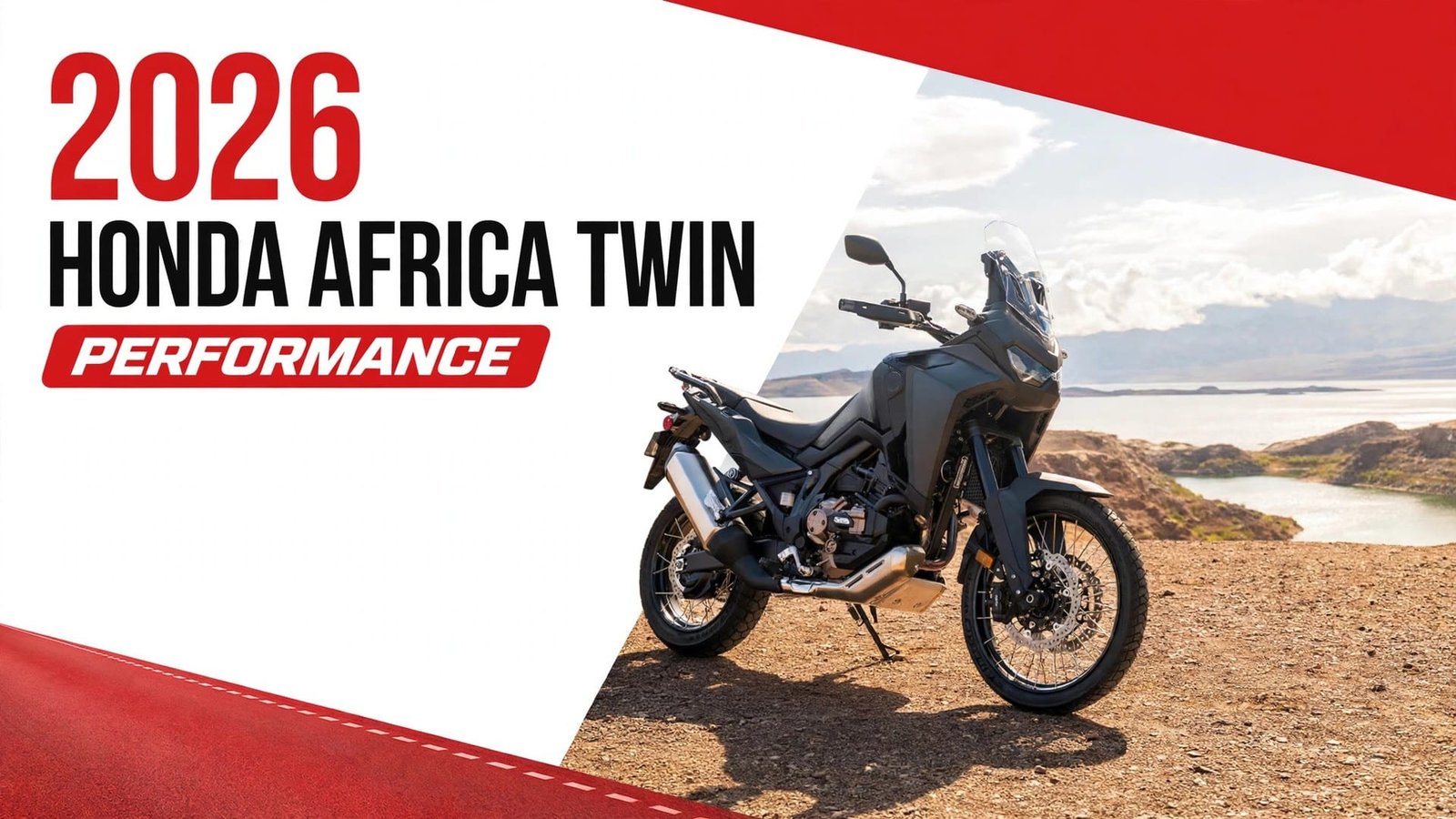
Honda Africa Twin performance comes down to one honest summary: a 1,084cc parallel twin putting 92.0 horsepower to the rear wheel on a dyno against a European factory claim of 100.6 horsepower at the crank, no instrumented American 0-60 or top-speed test, no fuel-economy figure from Honda USA, and roughly 200 to 240 miles from a 5.0-gallon tank. The standard bike weighs 510 pounds manual and 535 pounds DCT, and for 2026 costs $15,199 manual and $15,999 DCT plus $775 destination. This article keeps measured figures, factory claims and estimates separate, so you can judge Honda Africa Twin performance without confusing crank and wheel numbers, or the standard bike and the Adventure Sports ES. That discipline is what honest Honda Africa Twin performance coverage requires.
The full Africa Twin review covers prices, colours and model-year changes. Here the focus stays on performance: engine, acceleration, fuel economy, riding, handling, braking, and the BMW and KTM rivals.
Honda Africa Twin Engine Performance and Power Delivery
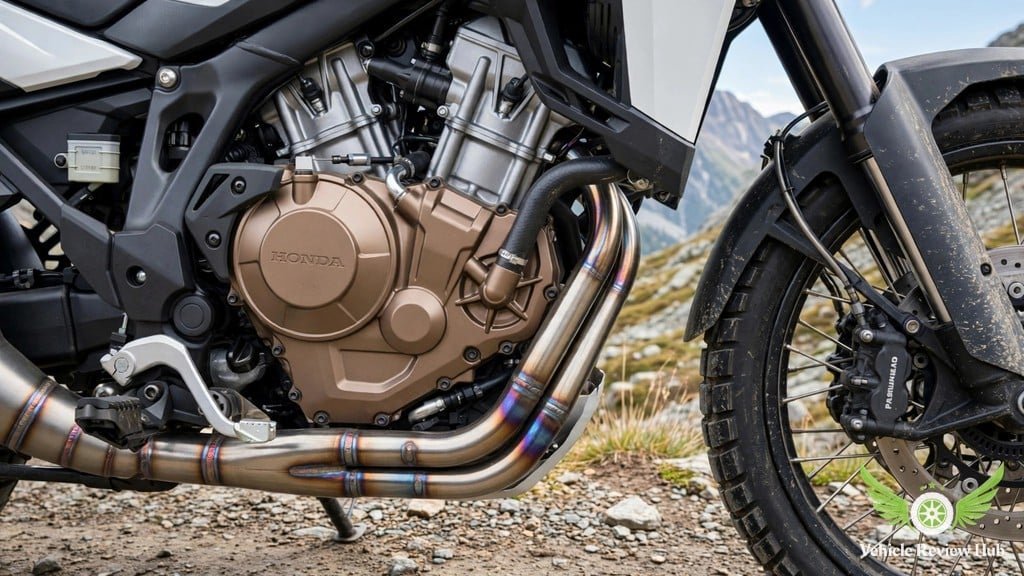
At the centre of Honda Africa Twin performance sits a 1,084cc liquid-cooled Unicam parallel twin with a 270-degree crankshaft, 92.0mm by 81.5mm bore and stroke, and 10.5:1 compression. The 270-degree firing order gives a pulsing, tractable character, and Honda’s 2024 revisions added about 7 percent more midrange torque. Peak power arrives at 7,500 rpm on the factory claim, but the broad torque spread below that defines Honda Africa Twin performance more than any peak number.
Rider Dyno 92.0 HP at 7,600 RPM and EU Claim 100.6 HP Explained
The two headline figures for Honda Africa Twin performance measure different things, and mixing them up is the most common mistake in Africa Twin coverage. The European factory claim of 100.6 horsepower at 7,500 rpm is a crankshaft figure, measured before the gearbox, chain and rear wheel take their share. The Rider Magazine dyno run recorded 92.0 horsepower at 7,600 rpm at the rear wheel, with 69.5 lb-ft of torque at 6,300 rpm. A chain-drive bike typically loses roughly 8 to 10 percent between crank and wheel, so 92.0 at the wheel against a 100.6 crank claim is exactly the expected result for Honda Africa Twin performance, not a shortfall. The Rider Magazine road test of the 2020 Adventure Sports ES is the dyno source; the standard bike shares the same engine.
Torque needs the same care: the current European claim is 112 Nm, or 82.6 lb-ft, at 5,500 rpm, reflecting the 2024 midrange update. The earlier 2020 to 2023 claim was 105 Nm, about 77 lb-ft, at 6,250 rpm, so a lower torque figure for a current bike is an outdated spec. Independent commentary has put rear-wheel output in the low 90s with torque near 70 lb-ft, which lines up with the Rider dyno numbers for Honda Africa Twin performance. For context, the older 998cc CRF1000L made about 86 horsepower at the wheel against a 93.9-horsepower crank claim on the Motorcycle.com dyno chart.
Six-Speed Manual and DCT Shifting, Modes and Power Delivery
Honda Africa Twin performance changes noticeably with the gearbox you choose. The six-speed manual uses a conventional clutch lever with an assist and slipper clutch, and is lighter at 510 pounds. The six-speed Dual Clutch Transmission adds about 25 pounds for a 535-pound curb weight, shifting itself automatically or on demand through handlebar paddles. Ride-by-wire throttles, two 46mm throttle bodies and a six-axis IMU feed six ride modes that shape Honda Africa Twin performance: Tour, Urban, Gravel, Off-Road, User 1 and User 2. Tour gives full, smooth highway power, Urban softens throttle response, Gravel and Off-Road relax traction control and ABS for loose surfaces, and two User modes mix settings. The same engine therefore feels gentle in town and assertive on an open road, and that flexibility is a large part of Honda Africa Twin performance.
Honda Africa Twin Top Speed and Acceleration
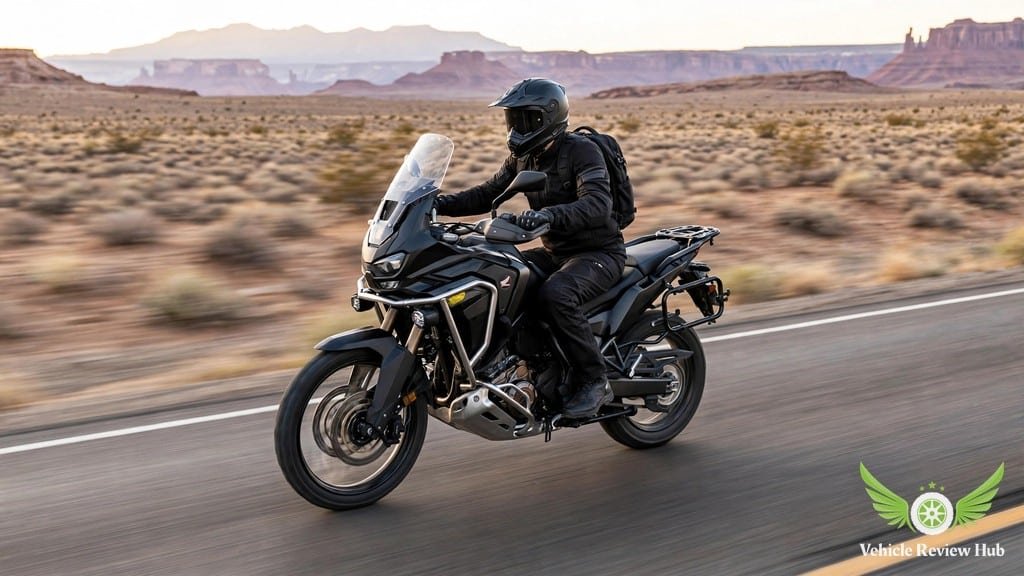
Straight-line speed is the least documented part of Honda Africa Twin performance: no American magazine has published an instrumented 0-60 mph time or verified top speed for the CRF1100L, and Honda publishes neither figure.
Why No US Instrumented 0-60 or Top Speed Test Exists Yet
An instrumented test means acceleration and speed measured with GPS or timing gear on a closed course, not a speedometer reading or a seat-of-the-pants guess. American outlets rarely instrument-test big adventure bikes, whose buyers rank versatility above outright acceleration. The bike also changed generations, from the 998cc CRF1000L to the 1,084cc CRF1100L, and skipped the 2023 US model year before returning for 2024, which fragments the test record further. If a source quotes an exact 0-60 time or top speed without naming its test method and equipment, treat it as an estimate, not a result. Judge Honda Africa Twin performance on the dyno figures and riding reports that do exist, not on numbers nobody has measured.
Around 125 MPH and 3.5 Second Claims Labelled as Estimates Only
The figures repeated online for Honda Africa Twin performance are around 125 mph for top speed and around 3.5 seconds for 0-60 mph, and both are estimates only, not test results. They are plausible: 92 horsepower at the wheel pushing 510 pounds is strong for the adventure class, and low-end torque means hard launches without high revs. But plausible is not proven for Honda Africa Twin performance. Aerodynamics, gearing, altitude and rider weight all move the real numbers, and the #525 chain with 16-tooth front and 42-tooth rear sprockets is geared for highway cruising and off-road control, not top-speed runs. Older 998cc claims, such as 190 km/h and 4.58 seconds to 100 km/h, say nothing verified about the CRF1100L. Until a US outlet publishes an instrumented test, around 125 mph and around 3.5 seconds stay labelled as estimates in every mention.
Honda Africa Twin Mileage and Fuel Economy
Fuel economy needs the most careful reading in Honda Africa Twin performance, because the most-quoted mileage figure is misattributed. Honda USA publishes no MPG figure; its spec page lists only the 5.0-gallon tank.
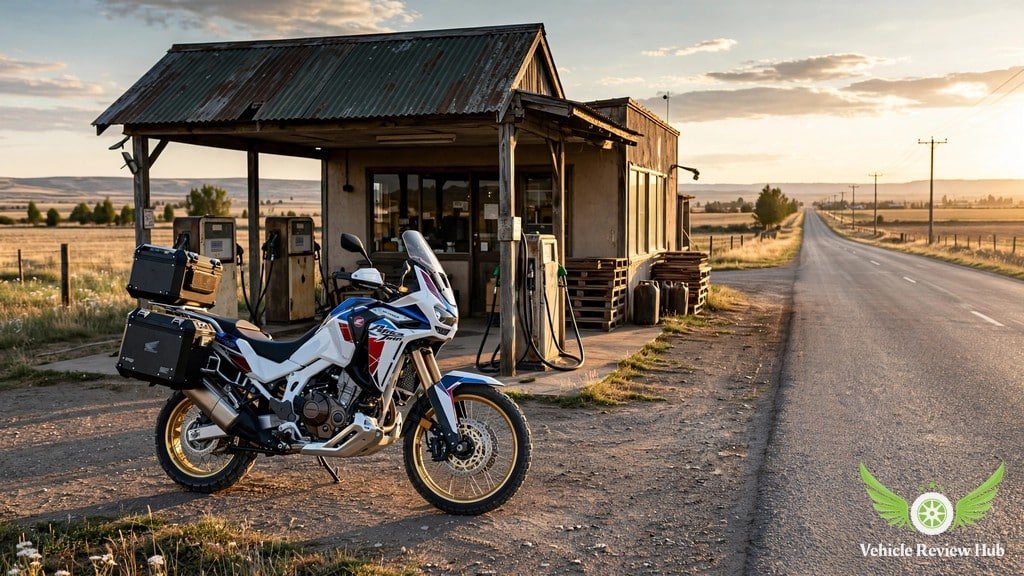
Honda USA Publishes No MPG Figure and 5.0-Gallon Tank
The Honda USA 2026 Africa Twin specifications list fuel capacity at 5.0 gallons for the standard model and no fuel-economy figure at all, which is normal for motorcycles, since bikes are not sold with an EPA combined rating in the US. The Adventure Sports ES has a 6.6-gallon tank; its range must never be quoted for the standard model. Every MPG figure for this bike therefore comes from a magazine test, a European consumption listing, or owner logs, each with a different meaning for Honda Africa Twin performance. Honda Africa Twin performance in fuel terms is a range of credible reports, not a single official rating, and any article giving one exact MPG as the Honda figure is inventing an official number.
Rider Tested 47.8 MPG Average and Around 200 to 240 Mile Range
This heading needs an honest correction: the 47.8 mpg figure could not be traced to a Rider test average in published Rider material reviewed here. The published 47.8 mpg figure that does exist is the Fuelly owner-logged average for 2017 CRF1000L ABS models: 33 bikes, 1,194 fuel-ups, 201,617 miles tracked, the older 998cc generation, not the CRF1100L and not a magazine test. Rider’s own documented long-term average for the 998cc bike was 42.7 mpg, and the European consumption listing for the 1,084cc bike converts to about 48.2 mpg, giving two more reference points for Honda Africa Twin performance. All three figures support the same conclusion: the 200 to 240 mile band is a planning figure for Honda Africa Twin performance, not a tested result.
| Fuel-economy source | MPG figure | Range on 5.0 gallons |
|---|---|---|
| Rider long-term average, 998cc bike | 42.7 mpg | About 214 miles |
| Fuelly owner average, 2017 CRF1000L ABS | 47.8 mpg | About 239 miles |
| European consumption listing, 1,084cc bike | 48.2 mpg | About 241 miles |
| Planning guidance for the standard bike | Roughly 43 to 48 mpg mixed use | Plan fuel stops by 200 miles |
Use 200 miles as your fuel-stop plan and 240 miles as the optimistic end of the band, and expect less at sustained high speeds, in headwinds, or off road, the realistic envelope for Honda Africa Twin performance. Fuel economy in Honda Africa Twin performance is genuinely good for a 1,084cc adventure bike, but the honest statement is a range with named sources.
Honda Africa Twin Real-World Riding Performance
On the road, Honda Africa Twin performance is defined by a torque-rich twin, a tall chassis, and electronics that change its behaviour between traffic and open road.
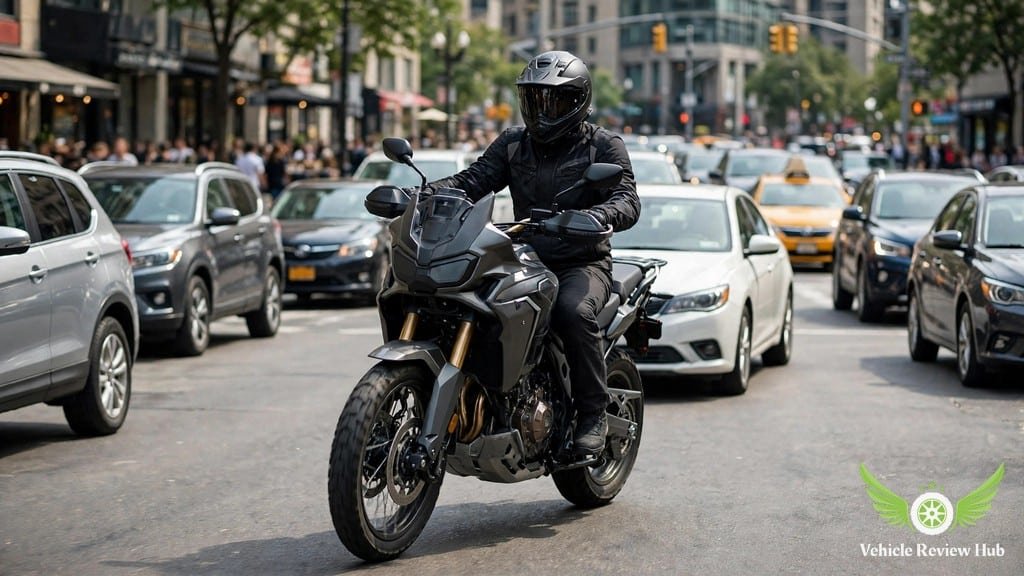
City Riding, Traffic Performance and Everyday Acceleration
Around town, Honda Africa Twin performance feels easier than its 510-pound curb weight and 34.3-inch seat height suggest. The 270-degree crank delivers strong torque just off idle, so the bike pulls cleanly away from traffic lights without high revs, and Urban mode softens response further for stop-and-go riding. The DCT is the easier city tool for Honda Africa Twin performance, removing clutch work from traffic entirely, while the manual keeps the lighter weight. Everyday acceleration is brisk rather than violent: the bike gaps traffic comfortably, but its tall seat and wide bars ask for care at low speed, and the seat drops to a lower 33.5-inch position. For commuting, low-end torque and flexible ride modes matter more than peak horsepower in Honda Africa Twin performance.
Highway Riding, Overtaking Ability and Long-Distance Comfort
On the highway, Honda Africa Twin performance settles into a relaxed, long-legged stride. The low torque plateau means overtaking often needs no downshift: roll on in top gear and the bike gathers speed cleanly, and dropping a gear makes a pass quick. The 62.0-inch wheelbase gives straight-line stability for Honda Africa Twin performance, and standard cruise control takes the strain out of long stretches. Wind protection from the compact standard screen is adequate for most riders, while the ES adds a taller adjustable screen and larger fairing. For long-distance comfort, Honda Africa Twin performance is best described as unstressed: the engine is barely working at highway speeds and the chassis is stable.
Honda Africa Twin Handling, Braking and Stability
Handling is half of Honda Africa Twin performance, and it is where the standard bike’s off-road bias shows most clearly: a 21-inch front wheel, long-travel suspension and a six-axis IMU.
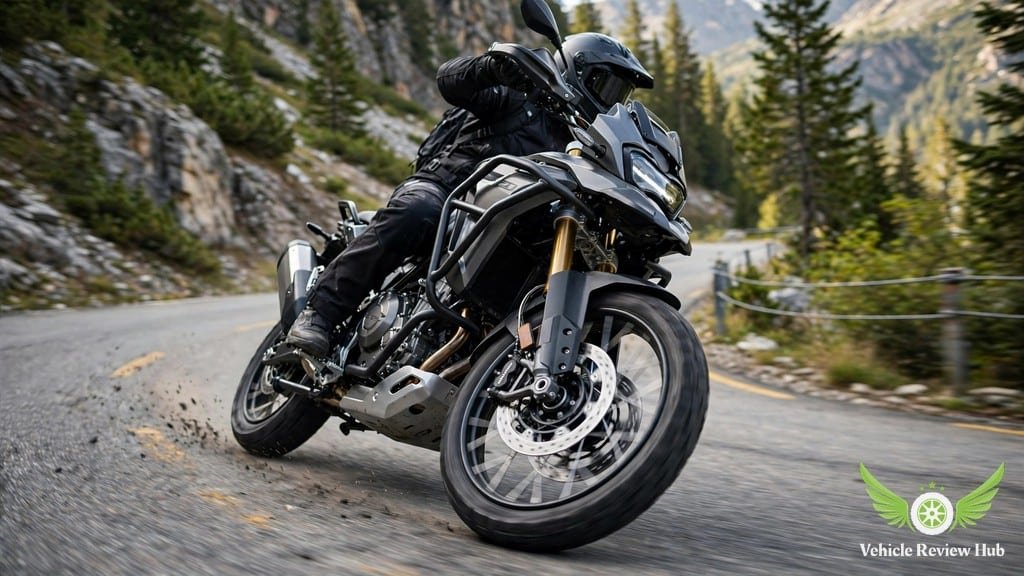
21-Inch Front Wheel, Suspension Travel Conflict and Cornering
The standard bike runs a wire-spoked 21-inch front wheel with a 90/90-21 tire and an 18-inch rear with a 150/70R-18 tire, the foundation of Honda Africa Twin performance off pavement. The big front wheel rolls over rocks and ruts that would stop a smaller wheel, but it steers more slowly on pavement and needs a firmer push in tight corners, the classic adventure-bike trade-off in Honda Africa Twin performance. The suspension travel conflict is real: Honda’s 2026 specification page lists 9.1 inches front and 8.7 inches rear, while some pages round the front figure to 9 inches. The metric figures settle it at 230mm front and 220mm rear, which convert to 9.1 and 8.7 inches, so 9.1 and 8.7 are the numbers to use for Honda Africa Twin performance. The ES differs: Showa EERA suspension, 8.3/7.9 inches travel, 19-inch front wheel, 4.2-inch trail, 61.8-inch wheelbase. In corners, the six-axis IMU and long wheelbase keep the standard bike planted.
Dual 310mm Front Discs, Cornering ABS and HSTC Features
Braking hardware in Honda Africa Twin performance is serious: dual 310mm front discs with radial-mounted four-piston calipers and ABS, plus a single 256mm rear disc with ABS. The six-axis IMU enables cornering ABS, which adjusts braking force for lean angle, and Honda Selectable Torque Control (HSTC) lets the rider choose how much the electronics intervene on wheelspin. Wheelie control, rear-lift control, switchable rear ABS and DCT cornering detection add further safety nets. No verified 60-0 mph braking distance has been published for this bike, so this article claims none, but large discs, radial calipers and lean-sensitive ABS suit a 510-pound bike ridden loaded, two-up and on loose surfaces. Brake feel and pad life are covered in the companion reliability and maintenance article.
| Chassis item | Standard Africa Twin | Adventure Sports ES |
|---|---|---|
| Front wheel | 21-inch, wire-spoked | 19-inch, wider rims |
| Front suspension travel | 9.1 inches, Showa SFF-BP | 8.3 inches, Showa EERA electronic |
| Rear suspension travel | 8.7 inches, Pro-Link | 7.9 inches, Pro-Link EERA electronic |
| Fuel capacity | 5.0 gallons | 6.6 gallons |
| Curb weight, manual | 510 pounds | 535 pounds |
Honda Africa Twin Performance Compared With Other Adventure Bikes
Against its biggest rivals, Honda Africa Twin performance trades outright power for weight, price and off-road ability. That positioning defines Honda Africa Twin performance against pricier rivals.
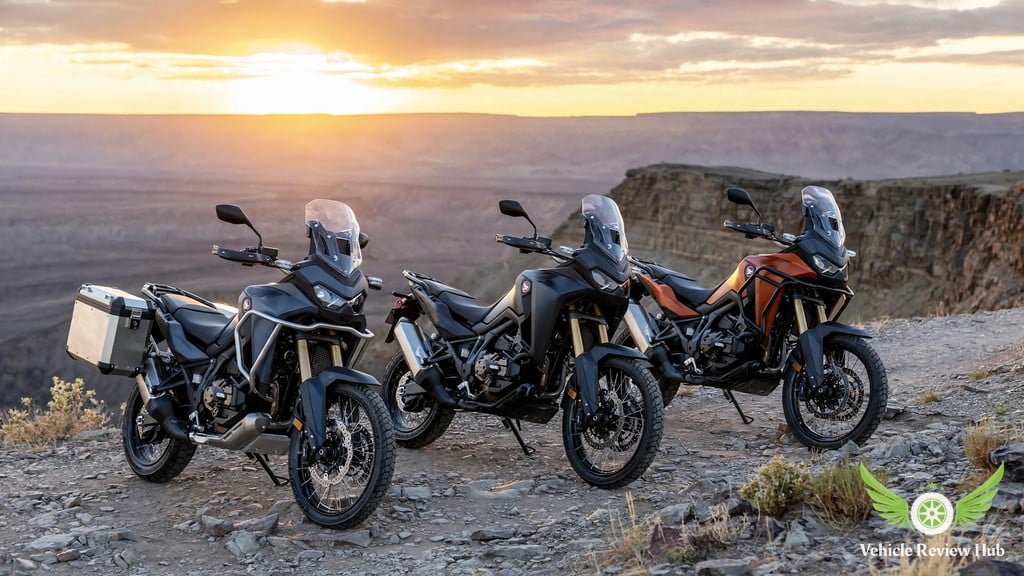
Honda Africa Twin vs BMW R 1300 GS and KTM 1390 Super Adventure
The BMW R 1300 GS starts at about $20,395 for 2026 with a 1,300cc boxer twin making 145 horsepower at 7,750 rpm and 110 lb-ft at 6,500 rpm, shaft drive and a 19-inch front wheel. It is more powerful, more road-oriented, and roughly $5,200 pricier before options. The KTM 1390 Super Adventure S EVO starts at $22,699 with a 1,350cc V-twin claimed at 170 horsepower and 107 lb-ft, a 6.1-gallon tank and a 33.3-inch seat height, per the Cycle News review of the KTM. Against those two, Honda Africa Twin performance looks modest on paper: 92 horsepower at the wheel against 145 and 170 claimed at the crank. But the Honda weighs less, costs far less, runs a genuine 21-inch off-road front wheel, and its low, flat torque makes it easier to ride fast on a rough road even if it loses a drag race. The TopSpeed BMW R 1300 GS overview confirms the BMW figures used here. Riders who want maximum power and touring tech should look at the BMW or the KTM; riders who want the most capable big adventure bike for the least money will find Honda Africa Twin performance hard to beat.
| Model | Engine and output | Starting price | Fuel tank | |
|---|---|---|---|---|
| Honda Africa Twin standard | 1,084cc twin, 92.0 hp at the wheel | $15,199 manual | $15,999 manual | 5.0 gallons |
| BMW R 1300 GS | 1,300cc boxer, 145 hp claimed | About $20,395 | 5.0 gallons | |
| KTM 1390 Super Adventure S EVO | 1,350cc V-twin, 170 hp claimed | $22,699 | 6.1 gallons | |
| Honda Africa Twin Adventure Sports ES | 1,084cc twin, same engine | $17,799 manual | $18,599 manual | 6.6 gallons |
For the ES version, see the future Adventure Sports ES performance comparison when that cluster goes live.
Is the Honda Africa Twin Suitable for Experienced Riders and Touring?
Yes, with the right expectations for Honda Africa Twin performance. Honda Africa Twin performance suits experienced riders who want one bike for commuting, highway touring and dirt roads, and the DCT option suits experienced tourers who would rather skip clutch work on a long day. It is not a beginner bike: 510 pounds, a 34.3-inch seat and 100 crank horsepower demand comfort with weight and height. For touring, the standard bike covers long distances comfortably but stops for fuel roughly every 200 miles, so remote-route riders should weigh the Adventure Sports ES and its 6.6-gallon tank. Prices, used values and ownership costs for this Honda Africa Twin performance decision are covered in the companion buying guide.
Honda Africa Twin Performance FAQs
Questions buyers actually ask about Honda Africa Twin performance, answered directly.
How Much Horsepower Does the Honda Africa Twin Make?
The European factory claim is 100.6 horsepower at 7,500 rpm at the crankshaft; an independent dyno run recorded 92.0 horsepower at 7,600 rpm at the rear wheel. Both describe the same 1,084cc engine; the difference is driveline loss. Quote the wheel figure when comparing against other dyno-tested bikes, and the crank figure when comparing factory claims. That is the essential Honda Africa Twin performance fact.
What Is the Honda Africa Twin Top Speed?
No verified top speed exists from a US instrumented test. The figure circulating online is around 125 mph, and it is an estimate only, not a measured result. Aerodynamics, gearing, altitude and rider weight all affect the real number.
What Is the Honda Africa Twin 0-60 Time?
No US instrumented 0-60 time has been published for the CRF1100L standard model. The circulating figure of around 3.5 seconds is an estimate only. The bike launches strongly on low-end torque, but no verified 0-60 time exists until a magazine tests it with timing gear.
What MPG Does the Honda Africa Twin Get?
Honda USA publishes no MPG figure for the Africa Twin. Credible reports cluster between roughly 43 and 48 mpg mixed use: Rider’s long-term 998cc average was 42.7 mpg, owner logs for 2017 CRF1000L ABS models average 47.8 mpg, and the European 1,084cc listing converts to about 48.2 mpg. Expect less from Honda Africa Twin performance at sustained highway speeds or off road.
How Far Can the Honda Africa Twin Go on a Tank?
Plan on roughly 200 to 240 miles from the standard bike’s 5.0-gallon tank, with 200 miles as the sensible fuel-stop plan. The Adventure Sports ES stretches past 300 miles on its 6.6-gallon tank. Your own Honda Africa Twin performance range depends on speed, wind, load and terrain.
Is the Honda Africa Twin Faster With Manual or DCT?
The manual is 25 pounds lighter at 510 pounds against 535 pounds for the DCT, a small theoretical edge, but no back-to-back acceleration test separates the two. The DCT shifts faster and more consistently than most riders, so the practical difference is smaller than the weight gap suggests. Choose on riding preference, not speed alone.
How Does Honda Africa Twin Performance Compare to the BMW R 1300 GS?
The BMW makes more power, with 145 horsepower claimed against the Honda’s 92 at the wheel, and costs about $5,200 more at base price. The Honda is lighter, cheaper and better set up for off-road work with its 21-inch front wheel, while the BMW is the stronger pure road-touring machine.
Is the Honda Africa Twin Good for Long-Distance Touring?
Yes: Honda Africa Twin performance suits touring especially with the DCT and cruise control, a stable 62.0-inch wheelbase, and a comfortable riding position. The main limit is the standard bike’s 5.0-gallon tank, which sets fuel stops roughly every 200 miles.