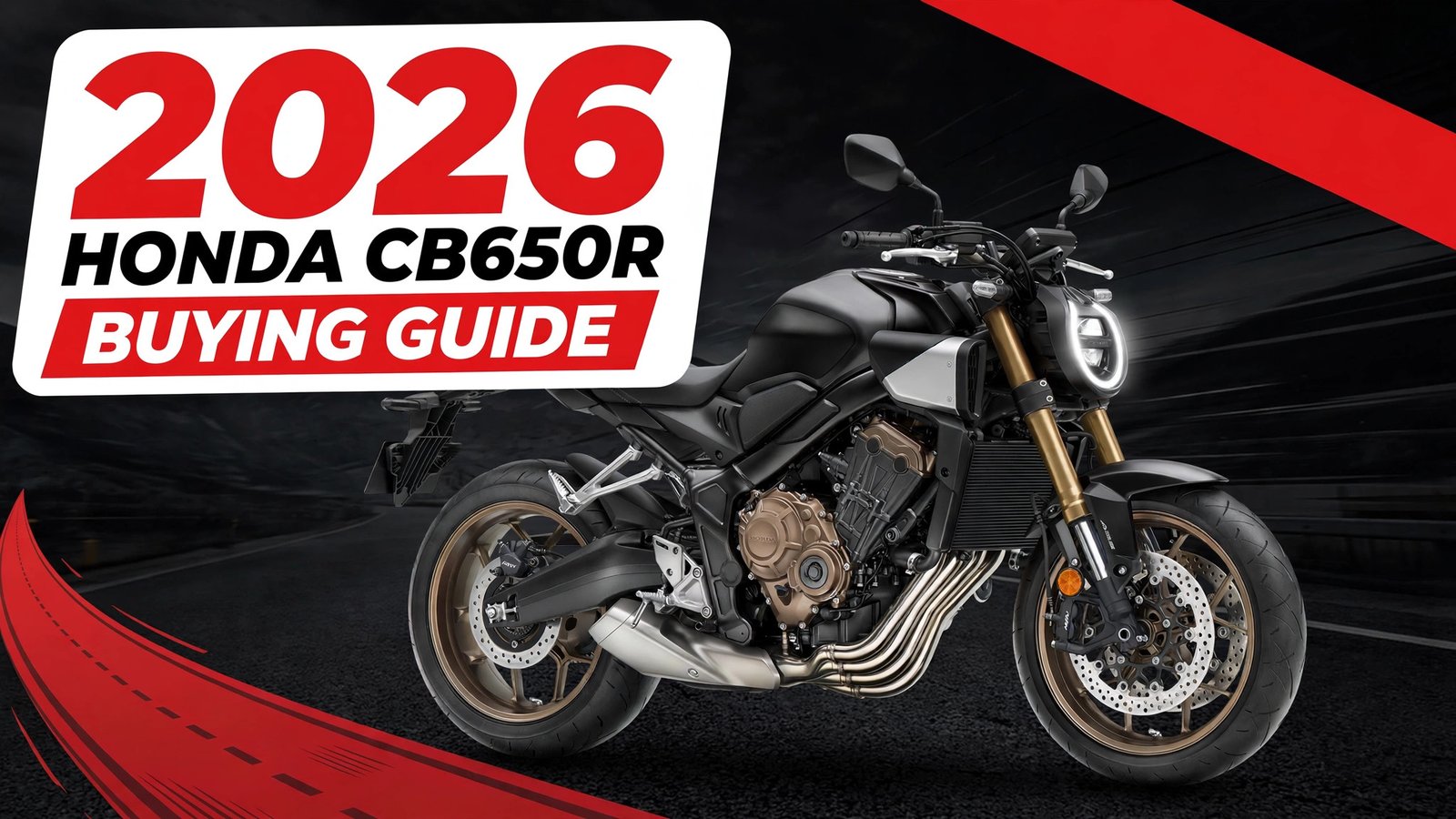
Short answer: this Honda CB650R buying guide starts with a warning most used-bike guides never have to give — the bike you want is rare in the United States. The naked 649cc inline-four launched here in 2019, replaced the CB650F, and has sold in small numbers ever since, so a used Honda CB650R buying guide is really a guide to patience: know the right years, check one recall before anything else, and never pay new-bike money for a used example when the 2026 bike costs $8,699 plus $600 destination.
One identity rule runs through this whole Honda CB650R buying guide: the CB650R is the naked bike, not the faired CBR650R. Every figure below belongs to the naked CB650R by model year, and this Honda CB650R buying guide labels anything borrowed from another bike as borrowed. For the full model story, see our Honda CB650R review.
Honda CB650R Price and Market Availability
Prices are the first thing to get right in this Honda CB650R buying guide, because the CB650R’s price arc is unusual: it climbed for five years, then Honda cut it. This Honda CB650R buying guide lays it out year by year.

What Does a Used Honda CB650R Cost in the USA by Year?
Used prices in this Honda CB650R buying guide split by generation, not by badge, because the bike never changed its name — only its equipment. Early bikes from 2019 to 2020, with the conventional Showa SFF fork and LCD dash, are the cheapest used buys: expect roughly $6,500 to $8,000 for honest examples, with the lowest prices on higher-mileage bikes and the highest on clean, low-mileage ones. The 2021 to 2023 bikes, with the Showa SFF-BP fork upgrade, typically ask more, and 2021 examples have been listed up to $9,600. The pool is thin — this Honda CB650R buying guide found only a handful of used examples in national listing snapshots, including a 2021 CB650R ABS at $7,899 at Monarch Powersports in Orem, Utah, a second 2021 listing at $8,399, and a 2021 ABS with 11,142 miles at $8,699 at Atlantic Cycle in White Plains, Maryland. For the performance story behind those prices, see our Honda CB650R performance guide.
Tiny US Volume: 2019 Bikes Ask $6,500 to $8,000, 2021 to $9,600
The heading above is literal, and this Honda CB650R buying guide treats thin volume as a buying risk in its own right. The 2019 band of $6,500 to $8,000 and the 2021 ceiling near $9,600 come from listing bands, not from a thick market of completed sales, so treat them as guides rather than gospel. The ceiling that matters most is the new bike: a brand-new 2026 CB650R E-Clutch costs $8,699 plus $600 destination, or $9,299 before tax and fees. Any used CB650R asking at or above that figure makes no sense unless it carries valuable accessories and a flawless history, because the buyer could walk out with a new bike, a full warranty, and zero miles for the same money. That new-bike cap is the single most useful number in this Honda CB650R buying guide.
| Model year | New price (MSRP) | Used ask band / note |
|---|---|---|
| 2019 | $8,899 base / $9,199 ABS | $6,500–$8,000 (listing band) |
| 2020–2021 | Not re-verified — omitted, not guessed | 2021 examples to $9,600; samples $7,899–$8,699 |
| 2022 | $9,299 | SFF-BP fork era; thin pool |
| 2023 | $9,399 | Last manual year |
| 2024–2025 | $9,399 (2024 same as 2023; 2025 + $600 dest) | E-Clutch standard; check 25V-107 first |
| 2026 | $8,699 + $600 destination | $700 cut, no mechanical changes — the cap |
Honda CB650R Insurance and Ownership Costs
Insurance and running costs decide whether a cheap used CB650R stays cheap, and this Honda CB650R buying guide is blunt about what is known and what is not. No published United States model-specific insurance figure exists for this bike, so no number below is dressed up as a quote, and this Honda CB650R buying guide explains how to get a real one instead.

No US Model-Specific Insurance Data Was Found for This Bike
No US model-specific insurance data was found for this bike, and this Honda CB650R buying guide says so rather than inventing a premium. The CB650R is a 649cc naked middleweight, so insurers price it in the middleweight naked class, and the only honest way to get a number is to quote the exact VIN with three insurers and compare like for like. Age, riding record, garaging, and state matter more than the badge, and a 2021 CB650R and a 2024 E-Clutch bike with the same rider will usually quote within a few dollars of each other, because the insurer sees the same displacement class. Be wary of any website printing a single “CB650R insurance cost” figure without a rider profile attached; that figure describes somebody else, not you. For the servicing costs behind the ownership maths, see our Honda CB650R reliability guide.
How to Estimate Fuel, Maintenance, Parts and Other Ownership Expenses
Ownership expenses in this Honda CB650R buying guide are easy to estimate from tested figures. Fuel is the smallest bill: American testers averaged 47 mpg, so on the 4.1-gallon tank a theoretical planning range of roughly 193 miles is realistic — theoretical, because nobody rides a full tank to empty. Maintenance follows a simple schedule in this Honda CB650R buying guide: first service at 600 miles, oil and filter every 8,000 miles or 12 months, valve-clearance inspection every 16,000 miles, and chain care every 600 miles. Brake-fluid and coolant intervals come from the CB650R’s own manual, never from another family’s figures, and no E-Clutch-specific service items appear in the CB650R’s own manual schedule. Parts are the honest worry: with a thin US sales pool, bodywork and model-specific trim can take longer to source than parts for a high-volume twin, so check parts availability for your year before buying. The one-year transferable United States warranty on a late bike is worth checking before it expires — the UK two-year cover is not the US warranty.
How to Inspect a Used Honda CB650R
Inspection is where this Honda CB650R buying guide earns its keep. The CB650R is a reliable motorcycle, so a bad used example is usually a neglected, crashed, or unrepaired-recall one, not a bike with a hidden design flaw. Check the motorcycle, not the listing title, says this Honda CB650R buying guide, and check the paperwork against the VIN.

Checking 25V-107 Completion First on Any 2024 Example
Checking 25V-107 completion comes first on any 2024 example, before price talk, before the test ride, before anything else in this Honda CB650R buying guide. Recall 25V-107 covers certain 2024 CB650R and CBR650R bikes: the fasteners securing the gear-change arm may loosen or separate from the stroke sensor, leaving the rider unable to shift. Honda issued a stop sale on February 13, 2025, with owner letters in late April 2025, and roughly 507 units were estimated across both models combined — no CB650R-only unit count was ever published, so do not let a seller quote one. The fix is free, but only a completed repair counts: ask for the dealer paperwork showing the fastener work done, then run the VIN through Honda’s recall lookup yourself and get the answer in writing. Exactly two recalls name the CB650R in total — 25V-107 and the 21V-382 rear-reflector campaign for certain 2020–2021 bikes — and the faired bike’s 25V-911 harness recall never names the naked CB650R, so any seller citing it for a CB650R has the wrong bike’s paperwork.
Inspecting E-Clutch Health and the Right Engine Cover
Inspecting E-Clutch health matters on every 2024-on bike in this Honda CB650R buying guide, because the E-Clutch hardware lives under an expanded right-side engine cover and it changes what a test ride should prove. On your ride, test every E-Clutch behaviour: pull away from a stop without touching the clutch lever, shift up and down without the lever at various throttle openings, then override with the lever to confirm manual control still works, and switch the system off to confirm the bike still rides as a normal manual. Any hesitation, missed shift, or warning light is a walk-away or a dealer-diagnosis condition, not a haggling point. Also inspect the right engine cover itself for scrapes, cracks, or non-factory fasteners, since a dropped bike lands there and the E-Clutch hardware sits just behind it. Check the chain and sprockets, fork seals, brake pads and discs, tyre date codes, and crash evidence on bar ends, levers, and engine cases — the same routine checks as any used naked, applied with extra care because the pool is thin and a second example may be weeks away.
Honda CB650R Model Years and Features to Compare
Model years are the real buying decision in this Honda CB650R buying guide, because the badge never changed but the equipment changed plenty. Buy the year, not the name, says this Honda CB650R buying guide, and pay for the updates that matter to how you ride.

Comparing 2019-20 Bikes With the 2021 SFF-BP Update
Comparing 2019–20 bikes with the 2021 update is the first fork in this Honda CB650R buying guide. The early bikes are honest, simple machines with a conventional 41mm Showa SFF fork, an LCD dash, and a cable throttle — no ride modes, no IMU, no lean-sensitive electronics, just ABS and Honda Selectable Torque Control on ABS models. The 2021 update brought the 41mm Showa SFF-BP inverted fork, sharpening front-end feel, and the bike kept its 649cc inline-four character throughout. One conflict buyers should know about: some sources describe the SFF-BP fork as preload-adjustable while others call it non-adjustable, so this Honda CB650R buying guide picks no winner — check the fork on the actual bike. A second fact to pin down on any 2019 bike: ABS was optional in 2019 only and standard from 2020, so verify ABS hardware on a 2019 example rather than trusting the listing.
Manual Bikes End at 2023: Every 2024-On US Bike Is E-Clutch
Manual bikes end at 2023, and every 2024-on US bike is E-Clutch — that sentence is the most important model-year fact in this Honda CB650R buying guide. The E-Clutch is an automatic clutch, never an automatic gearbox and never a DCT: the rider still foot-shifts every gear, the lever override still works, and the system can be switched off. Honda added it for 2024 at the same $9,399 price as 2023, alongside a 5-inch TFT display replacing the LCD, all-LED lighting, and standard HSTC. One more caution from this Honda CB650R buying guide: Honda USA never mentions RoadSync for the US CB650R, so do not let a European review convince you the American bike has phone connectivity it does not. Weight moved with the package too: 445 lb before E-Clutch, 456 lb from 2024 on — never the 466 lb figure that sometimes circulates, which this Honda CB650R buying guide explicitly rejects.
Honda CB650R vs Yamaha MT-07: Which One to Buy in the USA
The MT-07 is the rival every used-CB650R buyer should cross-shop, and this Honda CB650R buying guide compares them on sticker prices, not on brand loyalty. The answer depends on whether the buyer wants four-cylinder smoothness or twin-cylinder punch, and this Honda CB650R buying guide lays out the numbers plainly.

CB650R at $8,699 Against the MT-07 at $8,599 Plus $675
A new CB650R at $8,699 against the MT-07 at $8,599 plus $675 is a near-dead heat on sticker, and this Honda CB650R buying guide calls it that way: $9,299 for the Honda before tax and fees against $9,274 for the Yamaha, a $25 gap that no buyer should decide on. The Honda counters with its TFT dash, its E-Clutch convenience, and Honda’s dealer network. A used CB650R only beats a new MT-07 when it is clean, documented, recall-cleared, and at least $1,000 under the Yamaha’s out-the-door price; otherwise the new Yamaha wins on value and availability. Dealer listings confirm the 2026 MT-07 at $8,599 MSRP, and the Yamaha’s destination charge is $675 per the doc comparison.
| 2026 comparison | Honda CB650R E-Clutch | Yamaha MT-07 |
|---|---|---|
| Price + destination | $8,699 + $600 | $8,599 + $675 |
| Engine | 649cc inline-four, E-Clutch | 689cc parallel twin |
| Weight / seat | 456 lb / 31.9-in seat | ~403 lb wet (dealer sheet) |
| Summary | Smooth four, TFT, E-Clutch | Cheaper twin, deeper used pool |
When a GSX-8S at $9,249 or the CBR650R Makes More Sense
A GSX-8S at $9,249 or the faired CBR650R makes more sense in two specific cases, says this Honda CB650R buying guide. The Suzuki GSX-8S, at $9,249 plus $700 destination for 2026, wins for a buyer who wants more midrange punch and modern electronics in a naked package and is willing to pay roughly $550 more than the Honda before destination. Dealer listings confirm the 2026 GSX-8S at $9,249 retail. The faired CBR650R, at $9,199 plus $600 for 2026 in E-Clutch form, wins for a buyer who wants wind protection and a sportier riding position on the same platform — compare it, never confuse it, since its recall list and ergonomics differ. For the faired bike’s own story, see our Honda CBR650R review. Either way, this Honda CB650R buying guide prices every used CB650R against all three new alternatives before calling it a deal.
Is Buying a Used Honda CB650R Worth It?
Yes, with conditions, and this Honda CB650R buying guide ends with the verdict buyers actually need: the CB650R is one of the smartest used purchases in the middleweight class, provided the price respects the new-bike cap, the recalls are cleared, and the buyer accepts the thin market.

The video below is an owner’s buying-considerations video for the real CB650R — a frank owner take on what to weigh before buying, not a used-buyer inspection, notes this Honda CB650R buying guide — but it captures exactly why the bike is worth hunting down: the four-cylinder character and the everyday usability that make the CB650R special.
Benefits and Risks: Rare Bike, Thin Parts and Resale Pool
The benefits in this Honda CB650R buying guide are real: a proven 649cc inline-four, a simple service schedule, Honda reliability, a TFT dash and E-Clutch on late bikes, and a bike that stands out precisely because it is uncommon. The risks are equally plain: a thin used pool means fewer choices and slower resale, model-specific parts can take longer to source, and a 2024 bike with an open 25V-107 recall is a safety issue, not a bargaining chip. MCN’s CB650R review covers the naked bike’s everyday strengths, and owner scores reported by MCN run 4.5 out of 5 overall with 4.6 for reliability from 12 reviews — doc figures, labelled as such, from a small sample.
US-Market Alternatives: Trident 660, Z650 and the 790 Duke
The alternatives in this Honda CB650R buying guide cover every reason to walk away from an overpriced CB650R. The Triumph Trident 660, at $8,995 for 2026 per prior verification, is the triple-cylinder alternative with a character all its own, right for a buyer who wants something neither Japanese twin nor four. The Kawasaki Z650 S ABS, at $7,699 plus $685 for 2026, is the budget door — cheaper than the Honda on sticker, a twin rather than a four, and sold in far greater numbers. The KTM 790 Duke has no 2026 US model, with 2025 as the last US year, so treat any “new 2026 790 Duke” listing with suspicion and verify the model year on the paperwork. A used 2021 CB650R ABS at $8,699 with 11,142 miles, found in Atlantic Cycle’s listing, shows the trap plainly: that used ask equals the new 2026 bike’s MSRP, before destination, which is no deal at all. The verdict of this Honda CB650R buying guide stands: buy a clean, documented CB650R well under the new-bike cap, or buy the new bike.
Honda CB650R Buying Guide FAQs
Direct answers to the questions used buyers ask most.
How much does a used Honda CB650R cost?
By year, says this Honda CB650R buying guide: roughly $6,500 to $8,000 for 2019 bikes, with 2021 examples listed up to $9,600, all as dealer asks, never above the $9,299 new-bike cap before tax and fees.
What is the new 2026 CB650R price?
$8,699 plus $600 destination, says this Honda CB650R buying guide — a $700 cut from the 2024–2025 price of $9,399, with no mechanical changes.
How much does insurance cost for a CB650R?
No United States model-specific figure exists, says this Honda CB650R buying guide. Quote the exact VIN with three insurers; age, record, garaging, and state matter more than the badge.
What should I check first on a used CB650R?
Recall 25V-107 completion on any 2024 example, says this Honda CB650R buying guide, then the VIN, the service history, E-Clutch health on 2024-on bikes, chain, tyres, brakes, and crash damage.
Which recalls affect the CB650R?
Exactly two, says this Honda CB650R buying guide: 21V-382 for certain 2020–2021 bikes (256 plus 570 units) and 25V-107 for certain 2024 bikes. The 25V-911 harness recall never names the naked CB650R.
Is every 2024-on CB650R an E-Clutch bike?
Yes, says this Honda CB650R buying guide. Manual CB650R production for the US ended at 2023; every 2024-on US bike is E-Clutch, and the E-Clutch is an automatic clutch, not an automatic gearbox.
Does the US CB650R have RoadSync?
Not confirmed, says this Honda CB650R buying guide. Honda USA never mentions RoadSync for the US CB650R, so do not assume phone connectivity from a European review.
Should I buy a used CB650R or a new MT-07?
Buy the used CB650R only if it is clean, documented, recall-cleared, and at least $1,000 under the MT-07’s out-the-door price, says this Honda CB650R buying guide; otherwise the new MT-07 at $8,599 plus $675 wins on value and availability.
Is buying a used Honda CB650R worth it?
Yes, says this Honda CB650R buying guide, when the bike is clean, documented, recall-cleared, and priced well under the new-bike cap. Otherwise buy the new 2026 bike itself.