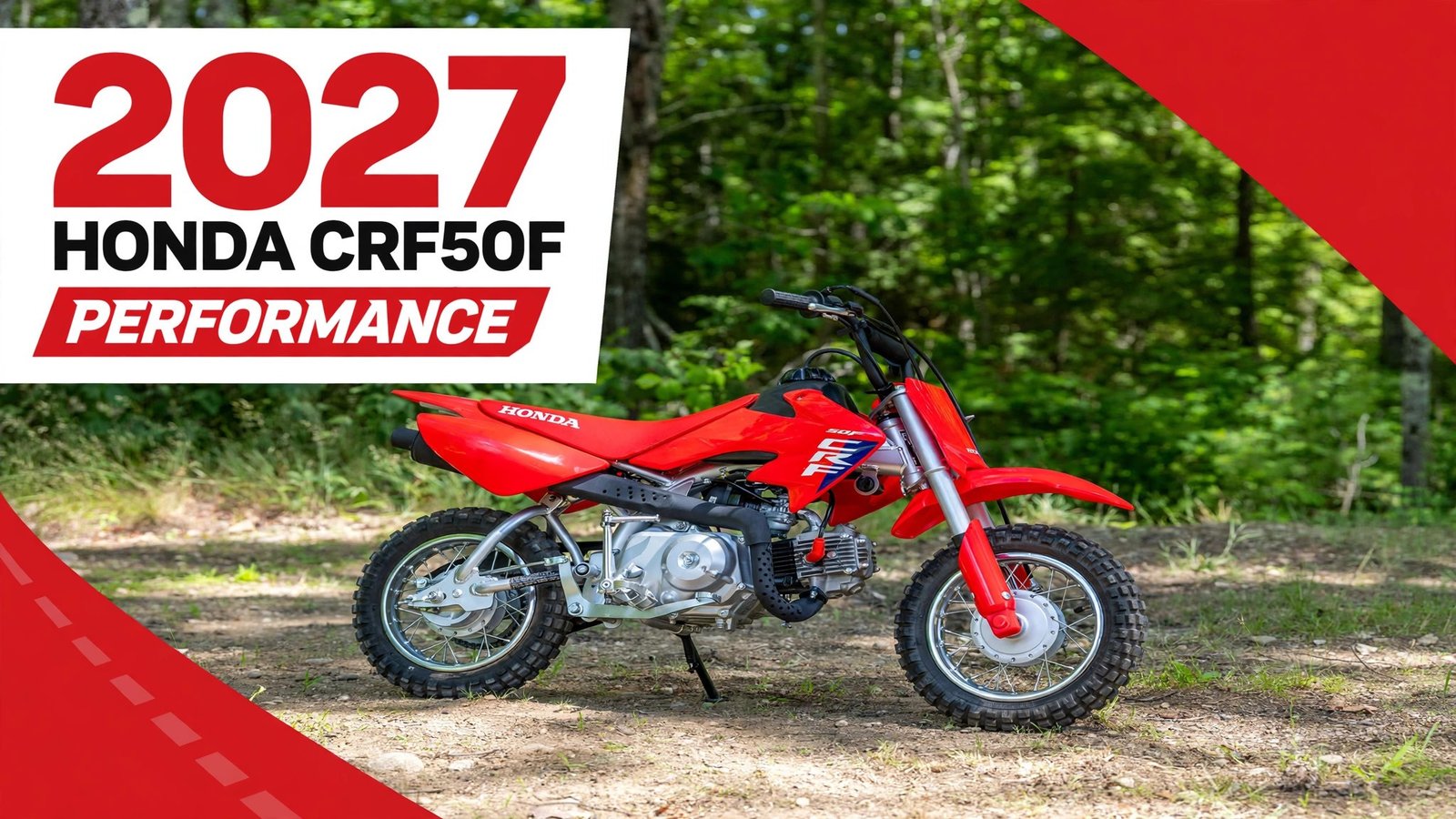
Short answer: Honda NX500 reliability looks strong so far, but the honest version of that statement matters more than the headline. The NX500 is a 2024-on motorcycle built around Honda’s long-serving 471cc parallel twin, a platform in production since 2013 that also powers the Rebel 500 and CBR500R. The bike itself is only about two years old in the United States, so no one can yet point to a decade of NX500-specific ownership data. What can be said, with sources attached, is this: MCN owner reviews rate Honda NX500 reliability at 4.8 out of 5, but from just six owners. The US recall record is clean, with zero NX500 recalls in the NHTSA database for model years 2024 through 2027. That is why Honda NX500 reliability reads so well in early reports.
Honda NX500 Reliability Overview
The NX500 replaced the CB500X for 2024, and that lineage is central to any fair judgement of Honda NX500 reliability. The NX500 added a 5-inch TFT display, HSTC, lighter cast wheels, and retuned suspension.

MCN Reliability 4.8 Out of 5 From Only 4 to 6 Owner Reviews Explained
MCN’s owner-review page rates Honda NX500 reliability at 4.8 out of 5, and that figure is worth quoting only with its sample size attached. But it should never be presented as a robust verdict. For comparison, the Honda NC750X reliability picture rests on far larger owner samples. Treat the NX500’s 4.8 as a promising early read, not a final grade. That is the honest state of Honda NX500 reliability evidence today.
How Mileage, Maintenance History and Previous Use Affect Reliability
Mileage, maintenance history, and previous use shape Honda NX500 reliability more than the badge on the tank does. A 2024 bike with a full dealer service record, chain care every 600 miles, and 8,000-mile oil changes is a fundamentally different purchase from a similar-mileage bike with no paperwork, a dry chain, and worn tires. Previous use matters too: a garaged highway commuter will generally present better than a bike that spent two winters outside, did regular gravel miles, and never had its suspension or brakes inspected. Service history is therefore the single most valuable reliability document on a used NX500. Judge Honda NX500 reliability on that paper trail, not on promises.
Honda NX500 Common Problems and Wear Items
There is no proven NX500 defect pattern yet, and that sentence needs to stay exactly that careful. This section separates wear from failure, which is the key to judging Honda NX500 reliability fairly.
Why No Proven NX500 Defect Pattern Exists Yet and Claims Need Checking
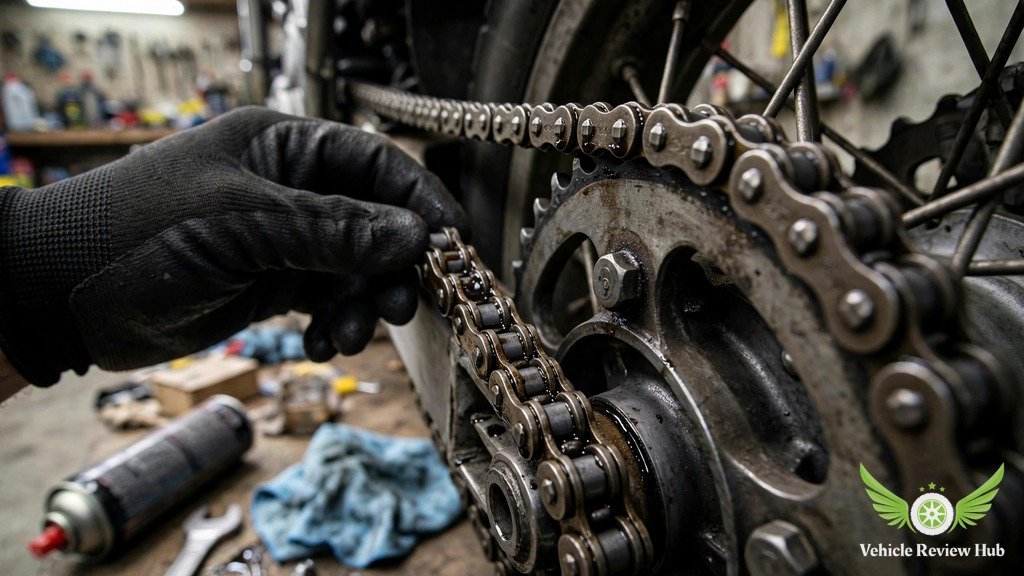
No proven NX500 defect pattern exists yet because the evidence base is too young and too thin to support one. Owner forums show thin complaint threads rather than repeated identical failures, and a mechanics-focused TopSpeed analysis notes the same. Claims that do circulate need checking before they are repeated. One owner thread describes a new bike pulling to the right, which the dealer worked on over several months until the pull was greatly reduced; that is a single case, and it says nothing reliable about other bikes. That is Honda NX500 reliability in practice.
Chain, Sprockets, Seat Comfort, Battery and Electrical Checks
The wear items that actually deserve attention on the NX500 are ordinary, and most are cheap to stay ahead of. The #520 O-ring chain is the hardest-working consumable on the bike: Honda calls for lubrication and slack checks every 600 miles, with slack held at 30 to 40 mm, and a chain allowed to run dry or loose will wear sprockets and shorten its own life. Seat comfort is the most argued-over owner topic: one long-term owner review calls the seat his number one complaint, saying soreness sets in within a couple of hours, while another rider who covered 540 miles in a day calls the original seat awfully good once rider and seat break in together. None of these items threatens Honda NX500 reliability structurally. That sums up Honda NX500 reliability today.
The video below gives useful real-world context for this section, with one honest label attached. It is a European test of the NX500 with E-Clutch, a variant not sold in the United States, where the NX500 is a conventional six-speed manual. The engine, chassis, brakes, and suspension are shared, so the ride observations still apply, but the clutch behaviour in the video does not describe the US bike. That context helps judge Honda NX500 reliability beyond the spec sheet.
Honda NX500 Maintenance Schedule and Servicing
The maintenance schedule is the strongest practical argument for Honda NX500 reliability. The schedule below follows the manual-derived maintenance schedule for the 2024-on bike, using US-mileage intervals.

First Service at 600 Miles, Oil Every 8,000 Miles and Routine Checks
The first service falls at 600 miles, and it matters more than its modest scope suggests. It is an oil and filter change plus a full check-over, and it is the point at which a dealer confirms the new bike has bedded in correctly, with nothing loose, leaking, or out of adjustment. After that, engine oil is replaced every 8,000 miles or 12 months, using Pro Honda GN4 10W-30 or an equivalent meeting JASO MA and API SJ or higher, and a general multi-point inspection is carried out at the same visit. The Honda NX500 performance story is often told through horsepower, but the ownership story is told through this schedule. Keep this schedule, and Honda NX500 reliability stays on the owner’s side. That is Honda NX500 reliability, plainly stated.
Valve-Clearance Inspection and Spark Plugs Every 16,000 Miles
The major service lands every 16,000 miles, and it is where the NX500’s ownership costs stay honest. At 16,000 miles, and again at 32,000 and 48,000, the valve clearances are checked and adjusted if needed, and the spark plugs are replaced with NGK CPR8EA-9 plugs gapped at 0.8 to 0.9 mm. First, the 471cc twin uses screw-and-locknut valve adjusters rather than shim-under-bucket valves, so an adjustment does not require pulling the camshafts and ordering shims. Second, the clearances on this platform rarely need much correction, which is why experienced mechanics describe the 16,000-mile check as usually a confirmation rather than a repair. One important distinction: plugs at 16,000 miles is the NX500 interval, and it differs from some larger Hondas, where plugs run to 32,000 miles. Done on time, this schedule is the backbone of Honda NX500 reliability. That is the Honda NX500 reliability picture today.
| Service item | Interval | Notes |
|---|---|---|
| First service | 600 miles | Oil and filter change plus full check-over |
| Engine oil (GN4 10W-30) | Every 8,000 miles / 12 months | Filter part 15410-MFJ-D02 |
| Chain lubrication and slack check | Every 600 miles | Slack 30–40 mm; do not ride above 50 mm |
| Valve clearances and spark plugs | Every 16,000 miles | NGK CPR8EA-9, gap 0.8–0.9 mm |
| Air filter | 12,000 and 24,000 miles | More often in wet or dusty use |
| Brake fluid (DOT 4) | Every 2 years | Level checked at every service |
| Coolant | Every 3 years | Pro Honda HP Coolant |
Honda NX500 Tires, Brakes and Suspension Maintenance
Tires, brakes, and suspension are where Honda NX500 reliability meets the road surface, and they are also where neglect shows up first. None of these systems is exotic: no electronic suspension, no cornering ABS, and no IMU.
Tire Condition, Pressure, Tread Wear and Replacement
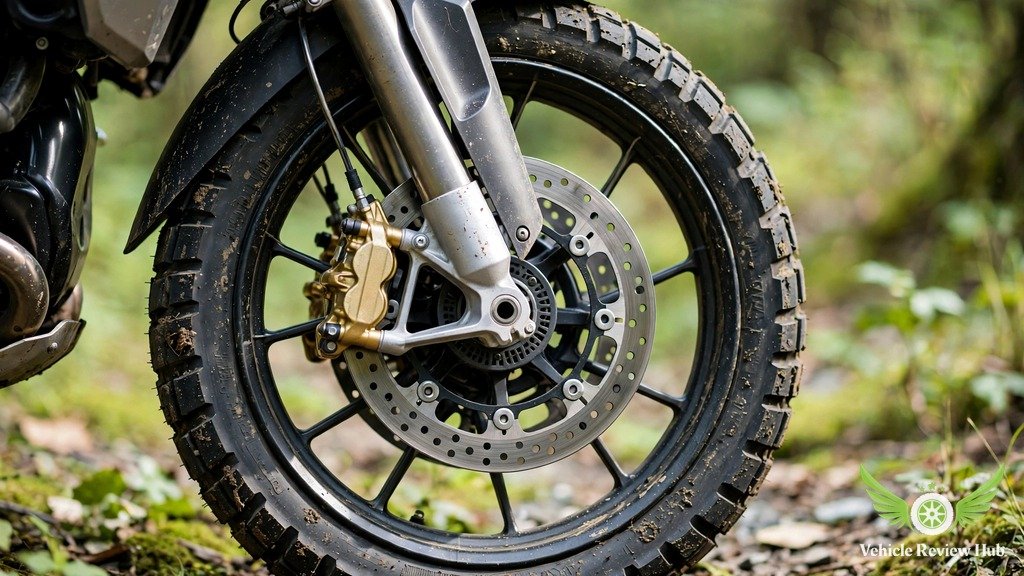
Tire sizes on the NX500 are 110/80-19 at the front and 160/60-17 at the rear, both tubeless on cast wheels, with cold pressures of 29 psi front and 36 psi rear. Minimum tread depth is 1.5 mm front and 2.0 mm rear, but a tire that has squared off from highway miles or cracked from age should be replaced before it reaches the legal limit, since grip falls off well before the tread disappears. Budget for a pair roughly every 8,000 to 12,000 miles depending on riding style, and remember that tire condition is part of Honda NX500 reliability in the real world. That supports Honda NX500 reliability overall.
Brake Pads, Brake Fluid Every Two Years, Forks and Shock Checks
Braking on the NX500 is a dual 296mm front disc setup with four-piston calipers and a single 240mm rear disc, with two-channel ABS that cannot be switched off, including at the rear. That last point matters for off-road use: rear ABS cannot be disabled for loose surfaces. Brake fluid is Honda DOT 4, with the level checked at every service and a full replacement every two years, regardless of mileage, because brake fluid absorbs moisture over time and old fluid gives a spongy lever and a lower boiling point. The front end is a 41mm inverted Showa SFF-BP fork, and Honda’s own 2026 NX500 specification page lists 5.9 inches of front travel with 5.3 inches at the single rear shock, which has five-stage preload adjustment and no other adjustment. One honest note on figures: some outlets quote around 135 mm of suspension travel for the NX500, and 135 mm is exactly 5.3 inches, the rear shock’s figure, so a quoted 135 mm figure should be checked for which end it describes before it is repeated as a front-fork number. Done this way, brakes and suspension contribute quietly to Honda NX500 reliability. That is Honda NX500 reliability in daily use.
Honda NX500 Maintenance and Ownership Costs
Ownership costs are where Honda NX500 reliability turns into money, and the picture is genuinely favourable, with one honest gap.

Fuel, Routine Servicing, Tires and Replacement Parts
Fuel is the NX500’s cheapest running cost, and the numbers behind that claim are verifiable. The tank holds 4.7 gallons, Honda USA publishes no MPG figure, and independent testing gives a realistic band: a US magazine test averaged 49 mpg with mid-50s figures for gentle riding, and a RevZilla test recorded 64 mpg over 677 miles. Taking a middle-of-the-road illustration, a rider covering 8,000 miles a year at 55 mpg would use about 145 gallons, which at an assumed $3.50 per gallon is roughly $510 a year in fuel. That is an illustration with stated assumptions, not a quote, and real costs move with fuel prices and riding style. That parts commonality is a quiet but real contributor to Honda NX500 reliability. That is Honda NX500 reliability, honestly measured.
Repair Expenses, Parts Availability and Long-Term Ownership Costs
Repair expenses on the NX500 should be low, and the reasons are structural rather than hopeful. Parts availability is strong in the United States because Honda’s dealer network stocks the shared 500-platform parts, and the NX500’s one-year transferable limited warranty in the US covers the first year, with HondaCare extended coverage available. Note the warranty difference honestly: MCN lists a two-year term, but that is the UK term, and the US term on Honda’s own 2026 page is one year. For buyers weighing the purchase itself, the Honda NX500 buying guide covers used prices and the thin-supply market in detail. As a reliability conclusion, the NX500’s long-term cost story is about prevention being cheap and cure being rarely needed, which is the practical meaning of Honda NX500 reliability. That reflects Honda NX500 reliability well.
How to Keep a Honda NX500 Reliable
Keeping an NX500 reliable is mostly a matter of doing the small jobs on time. This section turns the schedule into habits, and ends with the recall check every buyer should run.
Preventive Maintenance, Chain Care Every 600 Miles and Inspections
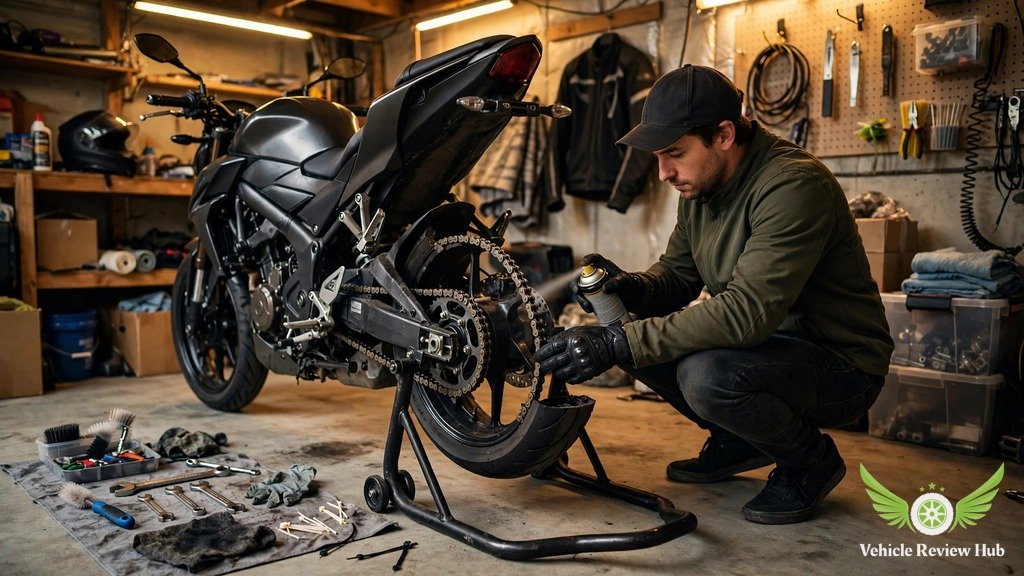
Preventive maintenance on the NX500 starts with the chain, because the chain is the one item Honda asks about every 600 miles, and it is also the item owners most often neglect. Clean and lubricate the chain every 600 miles, more often after rain, washing, or dusty and gravel riding, and always lubricate after washing the bike. Check slack at several points along the chain, and hold slack at 30 to 40 mm on the lower run midway between the sprockets. Never ride with slack above 50 mm, and have a dealer inspect the chain if slack varies sharply between positions, which can mean kinked or binding links. Beyond the chain, a monthly owner inspection covers tire pressures and condition, brake pad thickness and fluid level, coolant level, oil level, lights and horn, throttle and clutch free play, fork seals, and fastener tightness. The Honda NX500 review covers day-to-day life with the bike, but the reliability version is simpler: owners who follow this routine are the ones whose bikes stay quiet. Honda NX500 reliability is, to a large extent, a maintenance contract the owner signs with the bike. That is Honda NX500 reliability in short.
Recall Reality Check: No NX500 Recall in NHTSA and CB500X Recalls Differ
The recall reality check is straightforward and verified. The NHTSA recalls database was checked in November 2026 for the Honda NX500 for model years 2024, 2025, 2026, and 2027, and every year returned zero recalls, a count of zero with no campaigns listed. That means no NX500-specific recall, defect investigation remedy, or stop-sale has been recorded in the US database for any NX500 model year to date. The CB500X does carry recalls, and they must never be applied to the NX500: for example, campaign 21V690000 covers certain 2019–2020 CB500X and CBR500R ABS models for a service-brake hydraulic issue, and campaign 21V382000 covers certain 2020–2021 CB500X models among others for an exterior-lighting issue. Both are CB500X-era campaigns for model years before the NX500 existed, and neither names the NX500. The same discipline applies to the Transalp comparison some buyers make: the Honda Transalp XL750 reliability record includes its own model-specific recall scope, and none of it transfers to the NX500. Check the VIN, trust the database over the forum, and Honda NX500 reliability stands on a clean official record. That confirms Honda NX500 reliability so far.
Honda NX500 Reliability FAQs
These answers cover the questions buyers actually ask about Honda NX500 reliability, with the same honesty rules as the main article: sample sizes stated, estimates labelled, and no NX500-specific claim made from predecessor data. Each answer keeps Honda NX500 reliability claims tied to their evidence.
Is the Honda NX500 reliable?
Early evidence says yes, with the caveat that the bike is young. MCN owner reviews rate Honda NX500 reliability at 4.8 out of 5, but from only six owners, and the NHTSA database shows zero NX500 recalls for 2024 through 2027.
What does the MCN 4.8 out of 5 reliability rating actually mean?
It means six owners rated reliability and build quality at an average of 4.8 out of 5, alongside an overall rating of 4.8 out of 5. That is a positive early signal, not a statistically robust rating. A sample of six can shift with a single new review, so the figure should always be quoted with its sample size. That is Honda NX500 reliability in practice.
Has the Honda NX500 ever been recalled?
No. The NHTSA recalls database returns zero recalls for the Honda NX500 for model years 2024, 2025, 2026, and 2027, checked in November 2026. That sums up Honda NX500 reliability today.
What are the common problems with the Honda NX500?
No proven defect pattern exists yet. Owner discussion centres on wear and comfort topics rather than failures: chain care every 600 miles, seat comfort that divides opinion, occasional HSTC intervention on bumpy surfaces, and isolated single-owner reports such as one bike pulling to the right. None of these has been shown to be a widespread NX500 fault. That is Honda NX500 reliability, plainly stated.
How often does the Honda NX500 need servicing?
The first service is at 600 miles, engine oil is replaced every 8,000 miles or 12 months, a general inspection and diagnostic check fall every 4,000 miles, and the major valve-clearance and spark-plug service is every 16,000 miles. Those long intervals are a core reason Honda NX500 reliability scores well with owners.
How much does it cost to maintain a Honda NX500?
No verified US dealer service price could be found, so no US dollar service figure is quoted here. MCN lists £150 a year for servicing in the UK, which is UK-only and not a US price. That is the Honda NX500 reliability picture today.
Is the Honda NX500 good for high mileage?
The platform suggests yes, but NX500-specific high-mileage proof is still thin because the model has only been on sale since 2024. A used NX500 with a full service history, including the 16,000-mile valve and plug service, is the best high-mileage bet. That supports Honda NX500 reliability overall.
Does the Honda NX500 have any electrical problems?
No electrical defect pattern has emerged. The bike’s electronics are modest: a 5-inch TFT display with RoadSync connectivity, HSTC traction control, LED lighting, and conventional ABS. There is no ride-by-wire, IMU, or cornering ABS to generate fault codes, and owner reports focus on the HSTC light intervening on rough surfaces, which is normal traction-control behaviour rather than a fault. That is Honda NX500 reliability in daily use.
What should I check before buying a used Honda NX500?
Check the service history first, especially the 600-mile first service and any 16,000-mile valve and plug service. Run a NHTSA VIN check even though no NX500 recall currently exists, and take a long test ride to judge the seat, since owner opinion on seat comfort is genuinely split. That is Honda NX500 reliability, honestly measured.
How long will a Honda NX500 last?
With scheduled maintenance, the 471cc platform has the ingredients for a long life: low stress, liquid cooling, a modest 10.7:1 compression ratio, and screw-and-locknut valves that make the major service affordable. No NX500 has yet demonstrated a 100,000-mile life in the United States because the model is too new, so any claim of a specific lifespan is a projection, not a fact. That reflects Honda NX500 reliability well.