Short answer first: in this Honda Rebel 300 buying guide, the smart buy is a 2020-or-newer bike with a clean VIN for roughly $3,900 to $4,600 — never pay an ABS premium on a 2025 bike before checking its model code.
The basics never change: every US-market Rebel 300 uses the same 286cc liquid-cooled single, six-speed gearbox, and 3.0-gallon tank. Clutch, lighting, seat, suspension, and ABS fitment vary by year. The 2026 model breaks the pattern: E-Clutch only at $5,349, the ceiling this Honda Rebel 300 buying guide judges every used asking price against.
Honda Rebel 300 Price and Market Availability
Used Rebel 300s are easy to find, and this Honda Rebel 300 buying guide starts there: new riders buy them and move on within a couple of years.
What Does a Used Honda Rebel 300 Cost in the USA by Year?
Start with new prices, because used sellers anchor to them, and this Honda Rebel 300 buying guide does the same. The table below lists US MSRP by year, before destination.
| Model year | New MSRP (base) | ABS version |
|---|---|---|
| 2017 | $4,399 | Not offered at launch |
| 2018 | $4,449 | $4,749 |
| 2019 | $4,499 | $4,799 |
| 2020 | $4,499 | $4,799 |
| 2021 | $4,599 | $4,899 |
| 2022 | $4,699 | $4,999 |
| 2023 | $4,749 | $5,049 |
| 2024 | $4,849 | $5,149 |
| 2025 | $4,849 | See ABS section below |
| 2026 | $5,349 (E-Clutch only) | Standard |
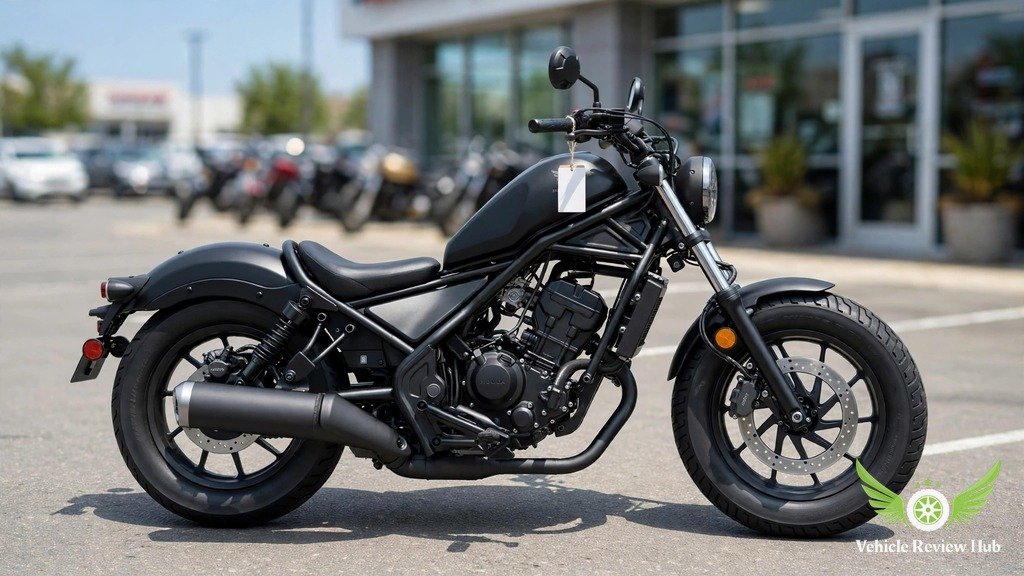
Against those new prices, the used bands in this Honda Rebel 300 buying guide are: $3,000–$3,800 for a 2017–2019 bike with a few thousand miles; $3,900–$4,300 for a clean 2021–2023 bike under 2,000 miles; and $4,200–$4,600 for a 2024–2025 bike under 1,000 miles. That top band sits close to the $4,849 a new 2025 cost — push back or walk toward a leftover. Asking prices are not selling prices: a bike listed at $4,599 for two months is a bike the market already rejected. Webbikeworld lists the 2023 bike at $4,749, matching the dealer brochures above.
Low-Mile Beginner Bikes Are Common: 49-Mile and 122-Mile Examples Listed
The outline for this Honda Rebel 300 buying guide mentions 49-mile and 122-mile examples. Honestly, those two exact listings could not be traced to live advertisements — but the verified examples below prove the pattern. Beginners buy Rebel 300s, ride them briefly, and sell them when they upgrade — as this Honda Rebel 300 buying guide verifies below.
Snapshot from live dealer listings, November 2, 2026 — asking prices, not sales, in this Honda Rebel 300 buying guide.
| Bike | Mileage | Asking price | Seller and location |
|---|---|---|---|
| 2025 Rebel 300 | 85 miles | $4,399 | Bettencourts Honda Suzuki, West Bridgewater, MA |
| 2025 Rebel 300 | 263 miles | $4,599 | Handlebar Motorsports, Durango, CO |
| 2021 Rebel 300 ABS | 948 miles | $3,899 | Pompton Sport Center, Pompton Plains, NJ |
| 2024 Rebel 300 ABS | 1,443 miles | $4,199 | Champion Honda, Hicksville, NY |
| 2024 Rebel 300 | 1,455 miles | $4,349 | Mountain Motorsports, Chattanooga, TN |
| 2025 Rebel 300 (new leftover) | 0 miles | $4,349 | Engelhart Motorsports, Madison, WI |
The new leftover 2025 at Engelhart Motorsports in Madison, Wisconsin, was advertised at $4,349 — $500 under MSRP, $250 less than the used 263-mile 2025 in Durango. The lesson of this Honda Rebel 300 buying guide is patience: another low-mile bike will be listed next week.
Honda Rebel 300 Insurance and Ownership Costs
Purchase price is only the first bill; this Honda Rebel 300 buying guide counts insurance, fuel, tires, and service as the rest — with one gap this Honda Rebel 300 buying guide refuses to paper over.
Why No Model-Specific US Insurance Average Exists for the Rebel 300
There is no published, model-specific US insurance average for the Honda Rebel 300, and any article quoting one is guessing or quoting another country’s market. Searches turn up Indian and Thai premium figures, irrelevant to US underwriting. That absence is useful information: insurers price the Rebel 300 as an inexpensive, low-displacement cruiser, so your quote depends far more on your age, record, ZIP code, and coverage than the model name. This Honda Rebel 300 buying guide therefore gives you a method, not a made-up number.
Get three quotes before you buy, not after — this Honda Rebel 300 buying guide insists on it — and ask each insurer: does an MSF Basic RiderCourse earn a discount, how much does full coverage add over liability-only under $5,000, and what is the comprehensive deductible if stolen. On a bike this cheap, a higher deductible or liability-only coverage, if you own it outright, is often rational. If you finance, the lender requires full coverage.
How to Estimate Fuel, Maintenance, Parts and Other Ownership Expenses
Fuel is the easiest cost for this Honda Rebel 300 buying guide to estimate. Honda’s older dealer material rated the Rebel 300 at 78 mpg, but that figure is optimistic; independent tests and owner reports cluster in the high-50s to low-70s. On the 3.0-gallon tank, that means roughly 170 to 210 miles between fill-ups; planning stops around 150 miles keeps a reserve. At 60 mpg and $3.50 a gallon, 5,000 miles a year costs about $290 in fuel.
Maintenance follows Honda’s schedule, detailed in the Rebel 300 maintenance schedule: first service at 600 miles, oil and filter every 8,000 miles or 12 months, valve inspection every 16,000 miles, spark plugs at 32,000 miles, chain checks every 600 miles, brake fluid every two years. Parts stay cheap. This Honda Rebel 300 buying guide treats ownership costs as quote-and-arithmetic, not one number.
How to Inspect a Used Honda Rebel 300
Inspection order matters: this Honda Rebel 300 buying guide starts with paperwork, not paint.

Checking VIN Recall Status First, Then Engine, Cold Start and Records
Run the 17-character VIN through the NHTSA recall lookup before traveling to see the bike, and ask the seller for it if omitted. A clean NHTSA result is not sufficient — also ask a Honda dealer to check Honda’s system. Four safety recalls name the Rebel 300, and the table below, compiled for this Honda Rebel 300 buying guide, gives each one’s scope.
| Recall | Bikes affected | Defect and remedy |
|---|---|---|
| 19V-412 (Honda KK3) | Certain 2019 CMX300, 868 units (3,898 multi-model) | Gear circlip could detach, locking the rear wheel; free main-shaft replacement |
| 21V-382 (Honda KM3) | 2020: 608 units; 2021: 2,144 units (28,528 multi-model) | Rear reflector too dim (FMVSS 108); free reflector replacement |
| 23V-261 (Honda KP2) | Certain 2023, 1,461 units (built Sep 15–Nov 17, 2022) | Crankcase-cover plug could come out, spraying oil; free cover replacement |
| 26V-500 (Honda KU8) | 2017–2023: 19,007 units; 2025–2026: 245 units (43,913 campaign) | Handlebar screw may loosen, jamming steering; free replacement; letters Sep 21, 2026 |
The 26V-500 handlebar-screw recall deserves a closer look as the newest and largest. RideApart’s breakdown of the 26V-500 recall confirms the ranges above, noting two warranty claims and no injury reports as of July 23, 2026. Note the gap: 2024 does not appear in the published Rebel 300 ranges — a reason to run the individual VIN, not proof 2024 bikes are clear. The 23V-261 detail is in the NHTSA filing for recall 23V261. This Honda Rebel 300 buying guide treats the VIN check as non-negotiable.
Once the VIN is clear, this Honda Rebel 300 buying guide insists on a cold start. Arrive early or ask the seller not to warm the bike: a cold engine that starts cleanly, idles steadily without smoke or rattles, and shows no oil weeping is worth more than any story. Check oil, coolant leaks, and service records.
Inspecting for Drop Damage, Frame, Tires, Brakes, Chain and ABS Code
Beginners drop bikes, and as this Honda Rebel 300 buying guide notes, the low seat does not make it immune. Check bar ends, levers, footpegs, and the muffler for scraping, and fork tubes for pitting or bent lowers. Then check the frame: sight for twists, feel steering-head bearings for notchiness, and inspect the VIN plate and welds for tampering. Parking-lot drops leave cosmetic marks; a hard drop bends levers and forks — a walk-away unless priced as a project.
Tires tell you how the bike was kept, and this Honda Rebel 300 buying guide reads them first. Read the date codes — rubber older than five years should be replaced regardless of tread — and check flat spots and cracking. Brakes are simple here: a single 296mm front disc and a 240mm rear disc; check pads and fluid. Check the chain for tight spots, rust, and hooked sprockets. Finally, verify the ABS code, not the claim: an ABS bike’s VIN plate code carries an “A” after CMX300 plus a year letter, its front wheel carries a tone ring, and its dash light cycles.
Honda Rebel 300 Model Years and Features to Compare
Year-to-year differences are small: no bad year, only better and worse values at a given price. This section of the Honda Rebel 300 buying guide separates the two real generations, and this Honda Rebel 300 buying guide then resolves the 2025 ABS confusion that catches buyers out.

Comparing 2017-2019 Originals With 2020-On Slipper Clutch Versions
The 2017–2019 bikes are the originals: the same 286cc single and low bobber stance, but a conventional clutch, earlier instruments, and non-LED lighting. At $3,000 to $3,800 they are the cheapest way into a Rebel — but with the oldest rubber, batteries, and widest recall net, the 2019 bike inside both the 19V-412 and 26V-500 ranges. The 2020 update is the one to pay extra for: full LED lighting, an assist-and-slipper clutch cutting lever effort by about 30 percent, and revised LCD instruments — the step this Honda Rebel 300 buying guide rates as the range’s best value. See our Rebel 300 review for riding character.
Later years refine rather than reinvent: this Honda Rebel 300 buying guide treats them as comfort steps, not performance ones. The 2021 bike added a gear-position indicator and fuel-consumption display. The 2025 refresh brought a new seat, handlebars, revised rear suspension, and restyled fenders. Weight moved only slightly: 364 lb for 2025, 370 lb for the 2021 ABS bike, and 379 lb for the 2026 E-Clutch bike.
2025 ABS Conflict: Check for Model Code CMX300A Before Paying Extra
This is the most expensive trap in the used Rebel 300 market, and it is why this Honda Rebel 300 buying guide insists on the model code, not the ad. Honda’s own 2025 US spec page lists Model ID CMX300 — no “A” — at $4,849, and 2025 dealer brochures reviewed for this Honda Rebel 300 buying guide show CMX300S at the same price. Honda’s ABS pattern: an “A” after CMX300 plus a year letter — 2021 ABS is CMX300AM, 2023 ABS is CMX300AP. By that pattern, a genuine 2025 ABS bike would carry a CMX300A-based code — but none could be confirmed in Honda’s 2025 materials.
The buying rule in this Honda Rebel 300 buying guide: never pay an ABS premium on a 2025 bike based on a listing title. Check the model code on the VIN plate, the ABS tone ring on the front wheel, and the dash ABS light cycle at startup. If all three confirm ABS, pay the premium with confidence; if any one fails, pay standard-bike price.
Honda Rebel 300 vs Rebel 500: Which One to Buy in the USA
The Rebel 300 versus Rebel 500 question is the one every prospective buyer asks, and the honest answer is that both bikes are good — the right one depends on how long you keep it. This part of the Honda Rebel 300 buying guide prices the 2026 pair head to head, and this Honda Rebel 300 buying guide then looks at rivals that beat both Rebels for certain riders.

Rebel 300 E-Clutch at $5,349 Against the Rebel 500 at $6,799 for 2026
Both 2026 prices check out: the Rebel 300 E-Clutch is $5,349 before its $600 destination charge, and the Rebel 500 base is $6,799, SE $6,999. The $1,450 gap buys a different motorcycle, not just a bigger engine. The 300 is a 286cc single with the E-Clutch, which lets a new rider shift without touching the clutch lever — then switch it off later to learn clutch control. The 500 is a 471cc parallel twin with roughly double the power, more highway headroom, and more two-up ability, but no E-Clutch for 2026. That contrast is the comparison this Honda Rebel 300 buying guide uses.
When an Eliminator, Meteor 350 or SCL500 Makes More Sense
Sometimes the right answer is not a Rebel at all, and this Honda Rebel 300 buying guide says so plainly. The Kawasaki Eliminator suits riders who want twin-cylinder power without the Rebel 500’s price: the 2025 Eliminator lists at $6,499 without ABS and $6,799 with ABS, with a 451cc Ninja-derived twin stronger than the Rebel 300’s single. The Royal Enfield Meteor 350 suits classic-styling fans: the 2026 Meteor 350 starts at $4,899, undercutting the Rebel 300 E-Clutch by $450, with a relaxed 349cc single. The Honda SCL500 suits riders who like the Rebel 500’s 471cc twin but want scrambler styling: the 2025 SCL500 lists at $6,799 plus $600 destination, the same MSRP as the Rebel 500 base (see the SCL500 buying guide).
Is Buying a Used Honda Rebel 300 Worth It?
After prices, recalls, inspections, and rivals, the verdict in this Honda Rebel 300 buying guide is straightforward: yes, for most buyers — buy the right year at the right discount to new, and never skip the VIN check. That verdict is the whole point of this Honda Rebel 300 buying guide.

Benefits and Risks of Buying a Used Rebel 300 in the USA
The benefits are real: Honda reliability, a 27.2-inch seat that suits shorter riders, cheap fuel and insurance, and easy resale to the next beginner. Low-mile examples are common, parts are inexpensive, and the single-cylinder layout means little to go wrong beyond the checklist. The risks are equally real but manageable: open recalls (especially 26V-500), aged tires and batteries on older examples, deferred chain maintenance, and sellers asking near-new money. Every risk is priced in the negotiation if found before paying, and expensive if found after. Check the new-leftover market before every used purchase — the final rule of this Honda Rebel 300 buying guide.
The video below, a before-buying guide for the 2024 Rebel 300, covers ten things to know before paying — a useful final check for this Honda Rebel 300 buying guide.
US-Market Alternatives: V Star 250, Hunter 350 and Used TU250X
If the Rebel 300 does not fit: The Yamaha V Star 250 is a used-only buy: a 249cc V-twin cruiser with an even lower seat, cheap used but older throughout. The Royal Enfield Hunter 350 is the cheapest new-bike alternative: the 2026 Hunter 350 starts at $4,299, undercutting the Rebel 300 E-Clutch, with a 349cc single in a roadster chassis for an upright riding position. The Suzuki TU250X is a used-only classic: a fuel-injected 249cc single with a timeless standard look and a reputation for simplicity, but no new supply, so condition matters most. The Cycle World Hunter 350 overview confirms the 2026 Hunter’s $4,299 price used here.
Honda Rebel 300 Buying Guide: Frequently Asked Questions
Questions buyers ask, answered directly in this Honda Rebel 300 buying guide.
What is a fair price for a used Honda Rebel 300?
For a clean, low-mile bike with records, expect $3,000–$3,800 for 2017–2019, $3,900–$4,300 for 2021–2023 under 2,000 miles, $4,200–$4,600 for 2024–2025 under 1,000 miles. Always compare against the nearest new leftover first — the bands this Honda Rebel 300 buying guide uses throughout.
Is the Honda Rebel 300 good for a beginner?
Yes — the beginner verdict of this Honda Rebel 300 buying guide. The 27.2-inch seat, 364–379 lb weight depending on year, friendly low-end torque, and — from 2020 on — the assist-and-slipper clutch make it one of the easiest motorcycles to learn on. Its limits are highway comfort and two-up riding.
Does the 2025 Honda Rebel 300 have ABS?
Not as confirmed by Honda’s own materials: the 2025 US spec page lists CMX300 at $4,849, and brochures show CMX300S at the same price. Do not pay an ABS premium unless the model code, tone ring, and dash light all confirm ABS, the rule this Honda Rebel 300 buying guide applies to every 2025 listing.
What recalls should I check before buying a Honda Rebel 300?
Check four: 19V-412 (2019 circlip, 868 units), 21V-382 (2020–2021 reflector, 608 and 2,144 units), 23V-261 (2023 plug, 1,461 units), 26V-500 (2017–2023 and 2025–2026 screw, 19,007 and 245 units). Get written proof any open recall was repaired, as this Honda Rebel 300 buying guide requires.
How much does insurance cost for a Honda Rebel 300?
There is no published model-specific US average, so do not trust any article that quotes one. Get three quotes before you buy, ask about MSF discounts and deductibles, and remember financing requires full coverage — the insurance rule in this Honda Rebel 300 buying guide.
Should I buy a new 2026 E-Clutch Rebel 300 or a used one?
Buy new if you want the E-Clutch, standard ABS, a full warranty, and no recall unknowns — $5,349 plus $600 destination. Buy used if you find a clean 2020-or-newer bike at a meaningful discount to the nearest new leftover, with records and a clear VIN. That is the rule in this Honda Rebel 300 buying guide.
How many miles is too many on a used Honda Rebel 300?
Mileage alone is a poor judge. A 15,000-mile bike with full records, fresh tires, and a cared-for chain beats a 3,000-mile bike that sat outside for three years on original tires with no records. Judge history and condition first — the mileage rule in this Honda Rebel 300 buying guide.
What should I check on a test ride?
Start cold and listen for rattles or smoke, then check smooth clutch engagement, clean shifts through all six gears, straight braking without pulsing, and straight tracking. On an ABS bike, confirm the light goes out after you roll — the test-ride checklist in this Honda Rebel 300 buying guide.