Honda XR150L performance is easy to summarize and easy to get wrong. This 149cc air-cooled, carbureted single puts about 11 horsepower to the rear wheel, cruises happily at 55 to 60 mph, and sips fuel at a rate most motorcycles cannot match. What Honda XR150L performance offers is honest, usable speed for town riding, back roads, and light trails, plus fuel economy that turns a small 2.8-gallon tank into a genuinely useful range. This guide labels what is tested, claimed, or estimated.
In short, Honda XR150L performance means a 282-pound dual-sport with a five-speed gearbox, a manual choke, no fuel injection, and no ABS. Cycle World measured 10.8 horsepower at the rear wheel, while Honda’s foreign materials claim 12.14 horsepower at the crankshaft. Those two numbers describe different things. Top speed is a sustainable 55 to 60 mph, with around 70 mph possible only downhill or with a tailwind. Fuel economy is where Honda XR150L performance shines: RevZilla tested over 76 mpg, worth roughly 213 miles from the tank, while Honda’s press claim of 346 miles per tank implies about 124 mpg and belongs to gentle test conditions, not real riding.
Honda XR150L Engine Performance and Power Delivery
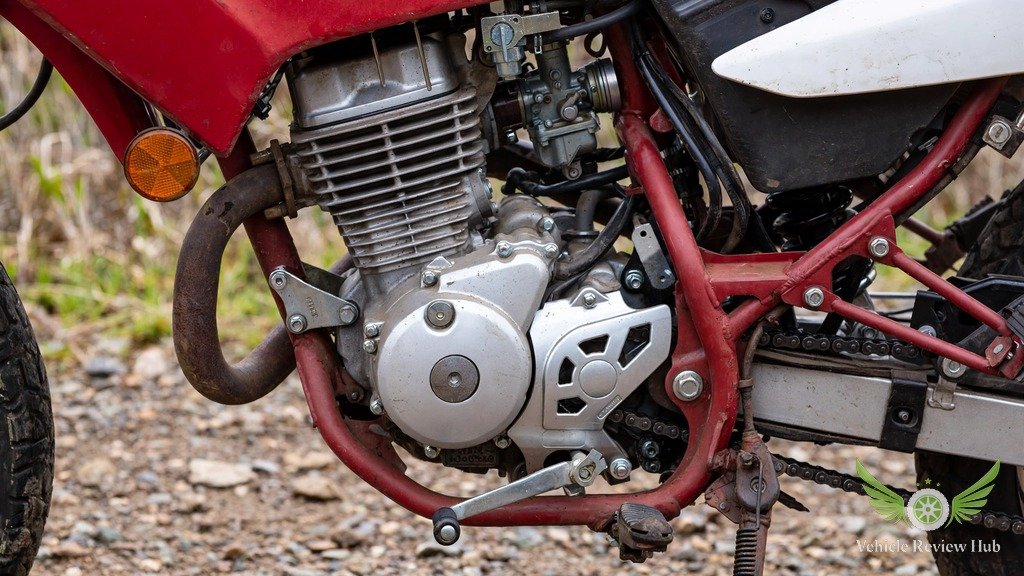
Honda XR150L performance starts with one of the simplest engines Honda sells in the United States: a 149.2cc air-cooled single with a 22mm piston-valve carburetor. There is no fuel injection or liquid cooling. Compression is a modest 9.5:1, and American Honda publishes no horsepower or torque figures for the United States model, which is why every Honda XR150L performance power number comes from either a foreign Honda source or an independent test.
Cycle World Dyno 10.8 HP at 7,600 RPM and Foreign Claim 12.14 HP
The most trustworthy power figure for Honda XR150L performance comes from Cycle World, which ran a 2023 XR150L on its Dynojet 250i dynamometer and measured 10.8 horsepower at 7,600 rpm and 8.3 pound-feet of torque at 6,000 rpm at the rear wheel. Rear-wheel numbers are always lower than crankshaft claims because the chain, gearbox, and tire absorb power first, so 10.8 rear-wheel horsepower is the honest figure for what the rider gets. The competing figure, 12.14 horsepower at 7,750 rpm with 9.22 pound-feet of torque, comes from Honda’s foreign materials for markets where the XR150L has been sold since 2014. The gap is the normal difference between a crankshaft claim and a rear-wheel measurement, so never present 12.14 horsepower as a measured United States result for Honda XR150L performance.
| Figure | Value | Source and measurement |
|---|---|---|
| Rear-wheel power | 10.8 hp at 7,600 rpm | Cycle World dyno test, 2023 bike |
| Rear-wheel torque | 8.3 lb-ft at 6,000 rpm | Cycle World dyno test, 2023 bike |
| Foreign crankshaft claim | 12.14 hp at 7,750 rpm | Honda foreign materials, not a US measurement |
Five-Speed Gearbox, Manual Choke and Low-End Power Delivery
For Honda XR150L performance in everyday riding, the five-speed gearbox matters more than peak power. First gear is short enough for trail work and loaded starts, while fifth gear is a genuine cruising gear that lets the little single settle down at back-road speeds. Two old-school details shape Honda XR150L performance: the carburetor uses a manual choke, so cold starts require pulling the choke lever and warming the engine before riding away, and starting is electric only, with no kick starter as a backup. Power delivery is smooth and low-revving, with usable pull from low rpm for town riding and gentle trails, though it runs out of breath on steep grades, where the rider must downshift.
Honda XR150L Top Speed and Acceleration
Honda XR150L performance at the top end is where expectations need the most adjustment. This is a 282-pound motorcycle with roughly 11 rear-wheel horsepower pushing an upright rider through the air, and physics sets a firm ceiling. No United States reviewer has published an instrumented GPS top-speed run or a timed 0-60 test.
Sustainable 55 to 60 MPH and Around 70 MPH Only Downhill Explained
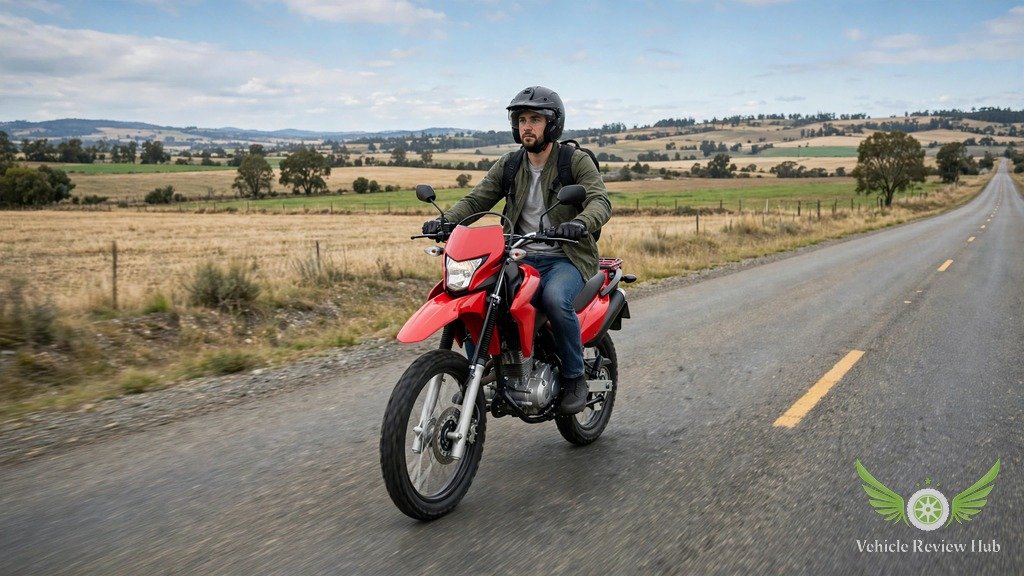
The sustainable top speed for Honda XR150L performance is 55 to 60 mph on flat ground, and around 70 mph only with help from a downhill grade, a tailwind, or both. RevZilla’s tester, fully tucked and fully pinned while merging onto Interstate 405, could squeeze only 60 mph out of the bike. SlashGear’s tester got above 70 mph exactly once in a full day of riding, in a full tuck on a downhill with a tailwind while drafting behind a first-generation Kia Sorento. Cycle News put it plainly: the engine is capable of 65 mph, and should top out at around 70 mph if conditions are just right. That pattern explains why Honda XR150L performance feels fine on roads posted at 55 mph and marginal on freeways: at 55 to 60 mph the engine works hard but holds speed, while above that, aerodynamic drag overwhelms the available power.
Why No GPS Top Speed or 0-60 Test Exists From a US Outlet
No major United States outlet has published a GPS-verified top speed or a timed 0-60 mph acceleration test for Honda XR150L performance, and the reason is straightforward: the bike’s acceleration is slow enough that instrumented testing adds little that a first ride does not already convey. RevZilla’s freeway-merge account, with the speedometer crawling past 30, then 35, then 40 mph while traffic roared past, tells a buyer more than a stopwatch number would. Any 0-60 figure found online for Honda XR150L performance is therefore an estimate, a guess, or a number borrowed from a different motorcycle, and this guide does not repeat one as fact. Based on the published first-ride accounts, a reasonable expectation is a 0-60 time deep into double digits, with the bike feeling brisk up to about 35 mph and leisurely beyond that, so buyers who need confident freeway merging should look at a larger dual-sport, as the standard CRF300L performance figures show.
Honda XR150L Mileage and Fuel Economy
If top speed is the XR150L’s weakest suit, Honda XR150L performance in fuel economy is its strongest. A tiny 149cc engine and a 282-pound curb weight mean the bike sips fuel, and its range is far better than the tank’s size suggests.

Honda Press Claim of 346 Miles per Tank and the 2.8-Gallon US Tank
Honda’s own press features pages for the XR150L state that the 2.8-gallon tank delivers a tested 346 miles of fuel range. The arithmetic deserves attention: 346 miles divided by 2.8 gallons equals about 123.6 miles per gallon. Motorcycle.com’s first ride did exactly that calculation and noted that 123.6 mpg would be the highest average it had seen, The honest reading for Honda XR150L performance is that 346 miles is a gentle test-cycle figure, achieved at steady low speeds under controlled conditions, not a number a normal rider should expect on real roads. Honda USA’s 2026 page confirms the tank: 2.8 gallons including a 0.9-gallon reserve, and with no fuel gauge, range planning for Honda XR150L performance means watching the trip meter.
| Scenario | Fuel economy | Range on 2.8 gallons |
|---|---|---|
| Honda press claim | About 123.6 mpg implied | 346 miles (test conditions) |
| RevZilla tested | Over 76 mpg | About 213 miles |
| Motorcyclist 2025 review | Nearly 100 mpg | About 280 miles |
Tested Over 76 MPG by RevZilla and Around 213 Miles per Tank
Independent testing puts Honda XR150L performance fuel economy in a band that is still excellent, just not 346-mile excellent. RevZilla’s first ride tested over 76 mpg, which multiplied by the 2.8-gallon tank gives about 213 miles per tank, the figure this guide uses as its realistic planning number. SlashGear’s tester, riding hard at higher revs, judged 200 to 250 miles per tank far more realistic than Honda’s claim. Taken together, the tested band for Honda XR150L performance is roughly 76 to 100 mpg, giving a real-world range of about 213 to 280 miles depending on speed, terrain, and riding style. Plan fuel stops at 200 miles, treat anything beyond 250 miles as a bonus, and do not plan a 346-mile leg on Honda’s test figure.
Honda XR150L Real-World Riding Performance
Honda XR150L performance is best judged by where the bike actually spends its time: town streets, back roads, farm tracks, and short highway hops. The bike is light, narrow, easy to balance at walking speed, and cheap to run, which makes Honda XR150L performance genuinely pleasant in the low-speed world most riders actually live in.

Town Riding, Traffic Performance and Everyday Acceleration
Around town, Honda XR150L performance feels right-sized. The 32.8-inch seat height lets most riders put both feet down at stops, the 282-pound weight makes U-turns and parking-lot maneuvers effortless, and smooth low-end power pulls away from traffic lights without drama. Cycle News noted the power is ultra-smooth and docile, so a first-time rider will not feel intimidated. Everyday acceleration for Honda XR150L performance is adequate up to about 40 mph, which covers nearly all urban traffic, and the narrow profile and upright riding position make it easy to see over cars in slow-moving congestion where local rules allow.
Highway Reality: Marginal at Freeway Speeds and Best Below 60 MPH
On the highway, the honest assessment of Honda XR150L performance is that the bike is marginal at freeway speeds and best kept below 60 mph. RevZilla’s freeway-merge account, with the bike fully pinned and fully tucked to reach 60 mph while an 18-wheeler filled the mirrors, is the clearest single illustration of the limit. At freeway speeds the engine is near its maximum, leaving no reserve for passing, grades, or headwinds. The video below shows an on- and off-road test and review of the XR150L, giving a good sense of how Honda XR150L performance behaves at real-world speeds on both surfaces. It is a creator test and review, not a laboratory measurement, so treat it as one more data point alongside the published first rides.
Honda XR150L Handling, Braking and Stability
Honda XR150L performance in corners and on rough surfaces comes from a chassis that favors comfort and forgiveness over precision. The steel frame, long-travel but soft suspension, and big wheels give the bike a stable, easygoing character on dirt roads and broken pavement, For the bike’s intended use, that trade is the right one for Honda XR150L performance.

Soft Non-Adjustable Fork, 19 and 17-Inch Wheels, Tires and Cornering
A 31mm fork with 7.1 inches of travel up front and a single shock with 5.9 inches at the rear offer no adjustment. That soft, non-adjustable setup soaks up potholes, washboard dirt roads, and trail rocks with surprising plushness, but the fork dives under braking and the bike pitches over larger bumps. The wheels are 19 inches up front and 17 inches at the rear, shod with 90/90-19 and 110/90-17 dual-sport tires, and that combination underpins Honda XR150L performance stability: the larger front wheel rolls over obstacles easily, and the 53.5-inch wheelbase with a 27-degree rake feels planted on gravel and dirt roads. Cornering for Honda XR150L performance is predictable and friendly, though 9.6 inches of ground clearance and the soft suspension mean the bike is happiest at moderate lean angles.
240mm Front Disc, 110mm Rear Drum and No ABS Features
Braking for Honda XR150L performance is deliberately old-school: a single 240mm front disc with a two-piston caliper, and a 110mm rear drum, with no ABS on any model year. The front disc provides adequate stopping power at the speeds this bike actually travels, and the rear drum is simple, cheap to maintain, and effective enough for trail use. Without ABS, a hard grab of the front lever on a wet or gravel surface can lock the wheel. That absence of ABS is worth stating clearly because foreign-market XR150L models have gained a front ABS brake and a digital display, and videos of those bikes circulate online. The United States bike has neither, so Honda XR150L performance buyers should weigh that honestly against rivals.
Honda XR150L Performance Compared With Other Small Dual Sports
Honda XR150L performance looks different depending on what it is compared with, so this section puts the bike against its two closest small dual-sport rivals on verified figures, with year-scoped prices. The headline for Honda XR150L performance is that the XR150L is the cheapest full-size dual-sport from a major manufacturer, and it gives up fuel injection, a sixth gear, and some power to do it.

Honda XR150L vs Kawasaki KLX230 and Yamaha XT250
Against the Kawasaki KLX230, Honda XR150L performance is smaller, simpler, and cheaper. The KLX230 S for 2025 is priced at $4,999 without ABS and $5,299 with ABS, against the XR150L’s 2026 price of $3,399 plus $300 destination, a gap of roughly $1,600. The KLX230 brings a 233cc fuel-injected single, a six-speed gearbox, and about 13 pound-feet of torque, so it is genuinely faster and more capable on the highway, but it is heavier at 289 pounds for the S model and drinks more fuel from a smaller 2.0-gallon tank. The XR150L counters with better fuel economy and a lower 32.8-inch seat. Against the Yamaha XT250, the comparison for Honda XR150L performance is closer in spirit but still favors the Honda on price: the XT250 for 2025 is listed at $5,499, with a 249cc fuel-injected single, a five-speed gearbox, a 2.2-gallon tank, a 31.9-inch seat, and a Yamaha-estimated 76 mpg. The XT250 is the more capable highway bike, but it costs about $2,100 more before destination, and its fuel economy merely matches RevZilla’s Honda test.
| Model (2025-2026) | Engine and fueling | Price | Seat height | Tank |
|---|---|---|---|---|
| Honda XR150L (2026) | 149cc single, carbureted | $3,399 + $300 destination | 32.8 in | 2.8 gal |
| Kawasaki KLX230 S (2025) | 233cc single, fuel injected | $4,999 / $5,299 ABS | 33.3 in | 2.0 gal |
| Yamaha XT250 (2025) | 249cc single, fuel injected | $5,499 | 31.9 in | 2.2 gal |
| For Honda XR150L performance value, the XR150L is the cheapest of the three and the only carbureted bike. | ||||
Is the Honda XR150L Suitable for Beginner Riders and Farm Work?
For beginner riders, Honda XR150L performance is close to ideal. The seat is low, the weight is light, the power is gentle, and the price is the lowest of any full-size motorcycle Honda sells in the United States. A new rider can learn clutch control, shifting, and balance without fighting the bike, and slow-speed drops cost little to repair. For farm work, Honda XR150L performance is equally well suited, and its history explains why: the model has served as a farm bike in Australia and New Zealand for years, where its tough little engine, standard rear carrier, folding passenger footpegs, and ability to run all day on a few dollars of fuel made it a staple. The 19-inch front wheel and long-travel suspension handle rutted tracks, the 282-pound weight means one person can push it through a barn, and the air-cooled engine has no radiator to damage. The full XR150L review covers the bike’s price history and features in more detail.
Frequently Asked Questions About Honda XR150L Performance
These direct answers cover the Honda XR150L performance questions buyers ask most often, from horsepower and top speed to fuel range and highway ability. Each answer uses the same tested and claimed figures as the main guide.
How much horsepower does the Honda XR150L make?
Cycle World measured 10.8 horsepower at 7,600 rpm at the rear wheel on a 2023 XR150L. Honda’s foreign materials claim 12.14 horsepower at the crankshaft.
What is the top speed of the Honda XR150L?
The sustainable top speed for Honda XR150L performance is 55 to 60 mph on flat ground. Around 70 mph is possible only downhill, with a tailwind, or drafting another vehicle. No United States outlet has published a GPS-verified top-speed test for this bike.
Is the Honda XR150L good on the highway?
Honda XR150L performance is marginal on the freeway and best below 60 mph. It can hold 55 to 60 mph on flat ground, but it has no reserve for passing, grades, or headwinds at freeway speeds.
What is the real fuel economy of the Honda XR150L?
RevZilla’s Honda XR150L performance test returned over 76 mpg, and Motorcyclist’s 2025 review reported nearly 100 mpg. The realistic band is about 76 to 100 mpg, giving a real-world range of roughly 213 to 280 miles from the 2.8-gallon tank.
Is Honda’s 346-mile range claim realistic?
For Honda XR150L performance, the 346-mile figure implies about 123.6 mpg, which is a gentle test-cycle result, not normal riding. Real riders should plan fuel stops at about 200 miles and treat anything beyond 250 miles as a bonus.
Does the Honda XR150L have fuel injection?
No. The United States XR150L uses a 22mm piston-valve carburetor with a manual choke. Fuel injection is one of the main differences between the XR150L and its KLX230 and XT250 rivals.
Does the Honda XR150L have ABS?
No. The United States model has a 240mm front disc and a 110mm rear drum with no ABS on any model year.
How much does the Honda XR150L weigh?
Honda lists a curb weight of 282 pounds, including all standard equipment, fluids, and a full tank of fuel. Cycle World weighed its 2023 test bike at 283 pounds, essentially confirming the claim.
What is the Honda XR150L price for 2026?
The 2026 XR150L is priced at $3,399 plus a $300 destination charge, in Gray or White. Earlier United States prices were $2,971 for 2023, $3,099 for 2024, and $3,299 for 2025, each plus destination.
Is the Honda XR150L good for beginners?
Yes, Honda XR150L performance makes it one of the best beginner dual-sports available. The seat is 32.8 inches, the weight is 282 pounds, the power is gentle and predictable, and the price is the lowest of any full-size Honda motorcycle.