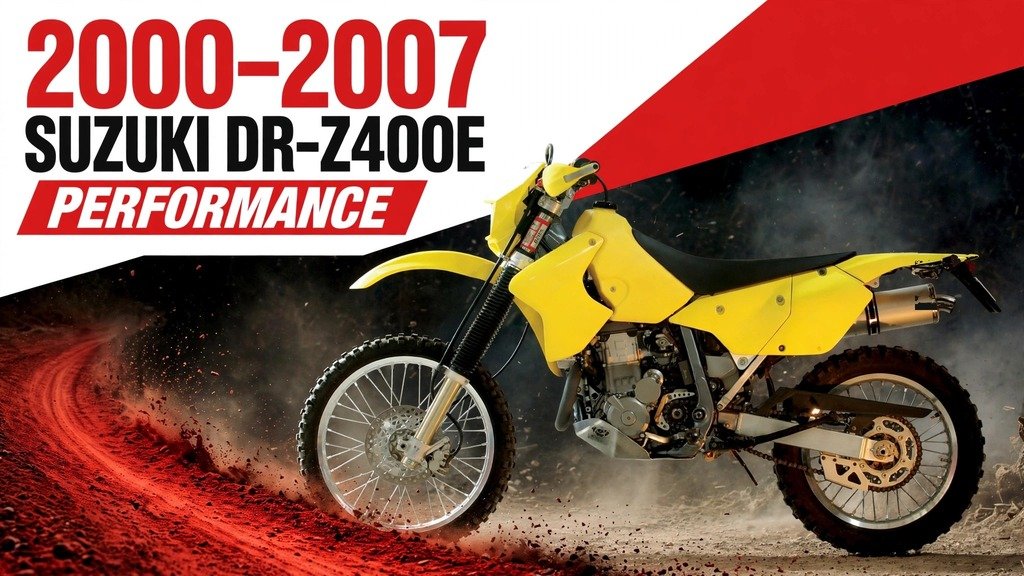
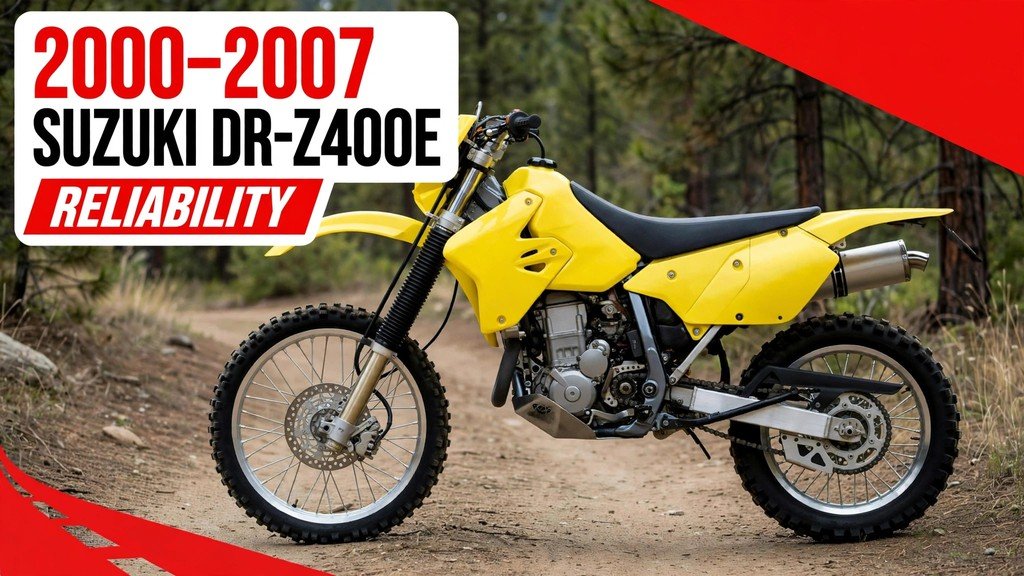
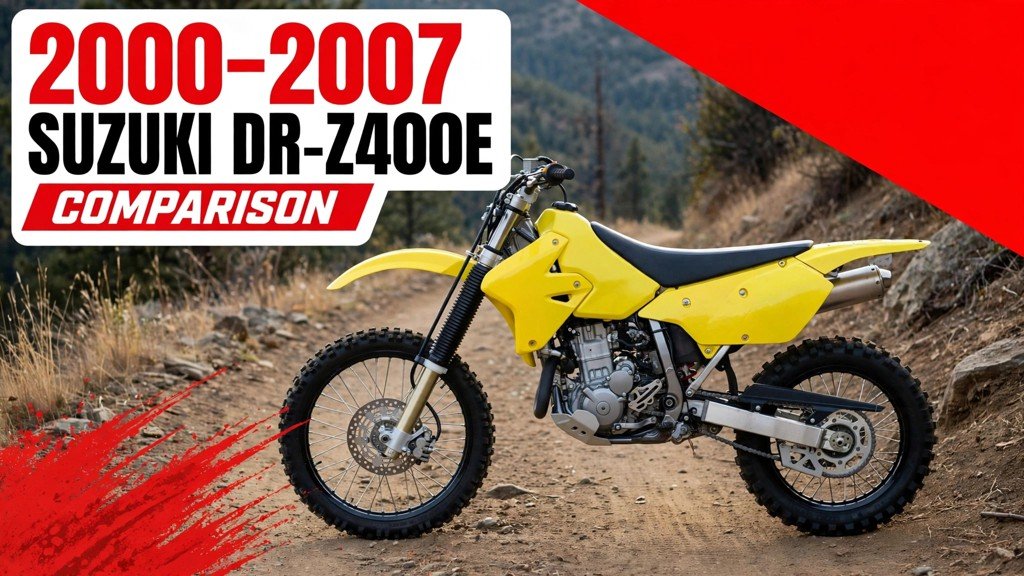
The short answer first: the Suzuki DR-Z400E is the off-road enduro version of the DR-Z400, and it is the sharpest DR-Z ever sold in the USA. It ran from 2000 to 2007, it was never street-legal, and it came with a Keihin FCR39 pumper carb, 12.2:1 compression, a fully adjustable fork and electric start only — no kickstarter, no headlight, no mirrors, no speedometer. Suzuki claimed 48 hp at 9,000 rpm, it weighed 262 lb dry, and the final-year bike cost $5,199. This Suzuki DR-Z400E review covers the US years, the engine, the prices, the design, the riding experience and the verdict.
Suzuki DR-Z400E Overview and Model-Year Updates
The DR-Z400E arrived in the USA in April 2000 alongside two siblings: the kick-start DR-Z400 and the street-legal DR-Z400S. The E was the enduro of the three — the same 398cc liquid-cooled single as the S, tuned harder and stripped of every street part. Suzuki’s own classification for the E is Off-Road, and the US bike had no headlight, no taillight, no turn signals, no mirrors, no horn and no speedometer — it was never street-legal. The DR-Z400S review covers the road-legal sibling; this Suzuki DR-Z400E review stays with the dirt-only bike.

US Years 2000 to 2007, Off-Road Only as Sold
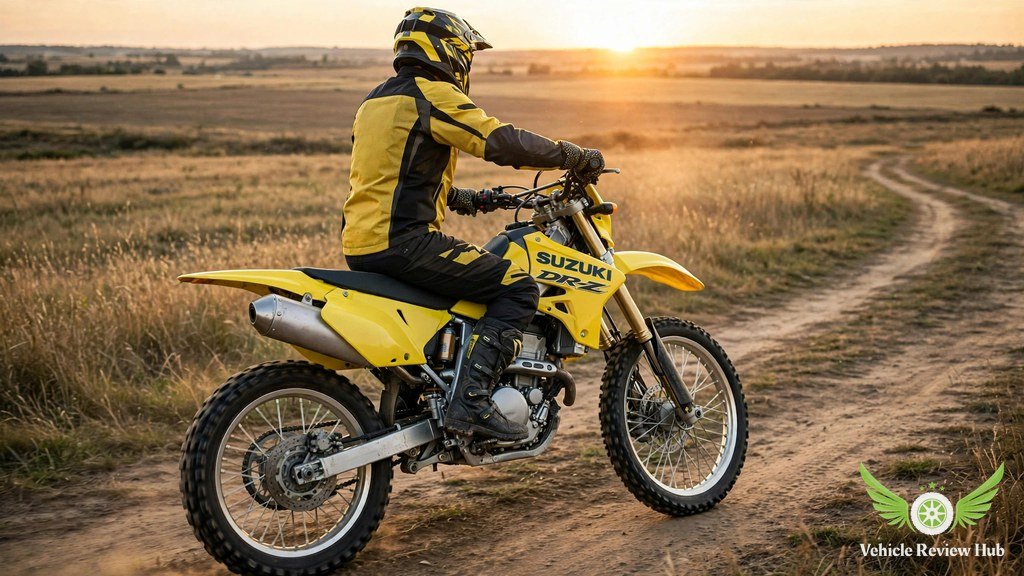
The E was sold in the USA for eight model years, 2000 through 2007, and it barely changed across them: the engine, the carburettor, the suspension and the chassis stayed the same from launch to the final year. The bike’s colour was yellow, sold as Champion Yellow, throughout the US run. One thing buyers must not confuse: the E kept selling in Australia long after the US run ended, and Australian bikes carried road gear the US bike never had. This Suzuki DR-Z400E review covers the whole US run.
The E’s off-road-only status shapes everything about it. With no odometer, service is measured in hours, not miles. The tank holds 2.6 gallons with a 0.6-gallon reserve, the seat sits at 37.2 inches, and ground clearance is 12.8 inches.
A ‘Discontinued 2006’ Claim Conflicts With the 2007 Sheet
One popular DR-Z history says the E was discontinued after 2006. That claim conflicts with the 2007 sheet, and the sheet wins: motorcycle.com lists a 2007 DR-Z 400E at $5,199 with the Keihin 39 mm carb, and MotorTrend published a review of the 2007 DR-Z 400E on April 1, 2007, with the same base price. The same history makes a second error worth naming: it says the 2007 bike was “downgraded to BSR carburetor”. That is wrong for the US 2007 E — MotorTrend’s 2007 spec list says the engine is topped with a Keihin FCR39 carburettor outside California, and the California BSR36 swap was true from 2000, not a 2007 change. The motorcycle.com 2007 E-vs-S compare shows the 2007 E alongside the S, with the E $400 cheaper.
Suzuki DR-Z400E Engine and Specifications
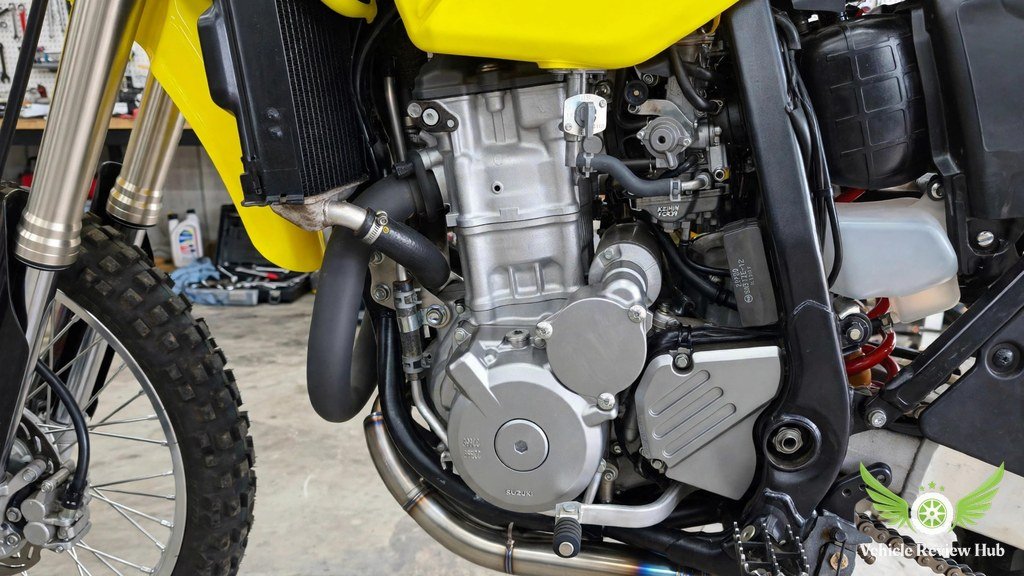
The E’s engine is a 398cc liquid-cooled single with double overhead cams, four valves and a dry sump, built around a 90.0 by 62.6 mm bore and stroke. Suzuki claimed 48 hp at 9,000 rpm and 41 Nm (30 lb-ft) of torque at 7,500 rpm for the E and the kick-start bike together, per Suzuki’s 2000 specification. Some databases print 49 hp for the 2005 E instead — a split between the claim and a database figure, never merged here. This Suzuki DR-Z400E review prints Suzuki’s 48 hp as the claim and says plainly that no US dyno test of the E was ever published with the E named.
| Specification | Suzuki DR-Z400E |
|---|---|
| Engine | 398cc liquid-cooled DOHC 4-valve single, dry-sump |
| Bore x stroke | 90.0 x 62.6 mm |
| Compression ratio | 12.2:1 |
| Claimed power | 48 hp @ 9,000 rpm / 41 Nm @ 7,500 rpm |
| Carburettor | Keihin FCR39 pumper (Mikuni BSR36 in California) |
| Transmission | 5-speed constant mesh, chain drive 14/47 |
| Front suspension | 49 mm conventional cartridge fork, fully adjustable, 288 mm travel |
| Rear suspension | Link type, fully adjustable, 295 mm travel |
| Brakes | 250 mm front disc / 220 mm rear disc, no ABS |
| Tyres | 80/100-21 front, 110/100-18 rear |
| Seat height | 37.2 in (945 mm) |
| Ground clearance | 12.8 in (325 mm) |
| Dry weight | 262 lb (119 kg) |
| Fuel tank | 2.6 US gal (reserve 0.6 gal) |
The full specification comes from the 2000 service manual. The DR-Z400E service manual covers the DR-Z400 and DR-Z400E together, and its spec pages list the engine, the suspension settings and the hour-based service chart that makes this bike different from its street-legal sibling.
FCR39 Carb and 12.2:1, vs the S Bike’s BSR36
The two parts that make the E faster than the S are the carburettor and the compression ratio. The E breathes through a Keihin FCR39 pumper carb with an accelerator pump and a throttle-position sensor tied to the digital ignition, while the S uses a Mikuni BSR36 constant-velocity carb with no accelerator pump. The E’s compression is 12.2:1 against the S’s 11.3:1, made with a thinner base gasket and higher-lift cams. The result is a claimed 48 hp against the S’s detuned output — no primary Suzuki claimed-power figure for the S was found, so this guide describes the S as detuned without printing a number for it. One long-term owner thread notes there is not much evidence the hotter cam made a real difference.
The FCR39 is also the part that asks the most of its owner. It is altitude-sensitive — one owner found it “very grumpy about big changes in altitude” — and its accelerator-pump diaphragm hardens with age, which shows up as an off-idle bog when the throttle is blipped. The fix is a diaphragm kit and a leak-jet and pump-timing check. The engine is liquid-cooled with a radiator and smooth cases and no cooling fins — a finned engine in a photo belongs to an air-cooled bike like the one the DR650S review covers, not an E. There is also no radiator fan: the manual contains no cooling fan anywhere, and cooling is by airflow only.
California Models Swapped to the BSR36 Carb
California E models did not get the FCR39. MotorTrend’s 2007 spec list says the engine is topped with a Keihin FCR39 carburettor outside California, with the Mikuni BSR36 in California — MotorTrend prints it as “SBR36”, its own typo for BSR36. The California bike therefore ran the S’s carburettor, and a buyer comparing a California E with a 49-state E is comparing two different carburettors on the same model name. The swap was true from 2000, so it is not a 2007 change.
Suzuki DR-Z400E Price and Market Availability
The E was cheap when new and it is cheap now, which is half of why it still has a following. The launch price was $5,349 in 2000 and the final-year price was $5,199 in 2007, and no destination charge was found for any E model year in any source, so this Suzuki DR-Z400E review prints MSRP only and never adds a destination amount.

| Model year | MSRP | Source and notes |
|---|---|---|
| 2000 | $5,349 | Dirt Bike Magazine June 2000 shootout; kick-start DR-Z400 $5,249 |
| 2005 | $5,500 | Database figure, labelled as such |
| 2006 | $5,499 | Database figure, labelled as such |
| 2007 | $5,199 | MotorTrend 2007-04-01 and motorcycle.com; S was $5,599 |
Suzuki DR-Z400E Price in the USA: $5,199 for 2007
The 2007 E cost $5,199, confirmed twice: MotorTrend’s review of April 1, 2007 lists a base price of $5,199, and motorcycle.com’s 2007 compare lists the same MSRP. The 2007 S cost $5,599, so the E was $400 cheaper than its street-legal sibling in its final US year. The MotorTrend 2007 DR-Z400E review is the period source for the price. The drop from the 2006 database figure of $5,499 to $5,199 is real but unexplained — no source gives a reason.
Against its 2000 rivals, the E was the value bike of the shootout. Dirt Bike Magazine’s June 2000 eight-bike 400 four-stroke enduro test priced the Yamaha WR400F at $5,899 and the KTM 400 EXC at $6,995, so the E at $5,349 was $550 under the Yamaha and $1,646 under the KTM, and only $50 dearer than the Honda XR400R at $5,299. The kick-start DR-Z400 was $100 cheaper at $5,249 — that $100 bought the electric starter.
The 2000 Launch Price Was $5,349
The 2000 launch price is $5,349, settled from two period sources that agree. Dirt Bike Magazine’s June 2000 shootout tech box lists the E at $5,349 and the kick-start DR-Z400 at $5,249, and Dirt Rider’s 2003 test writes “The $5349 DR-Z earns a demerit for no green sticker” — the same $5,349 three years later, for the electric-start bike. The bike was released in the USA in April 2000.
Suzuki DR-Z400E Design, Features and Technology
The E’s design is a list of things it does not have, and that is the point. No headlight, no mirrors, no signals, no speedometer, no horn, no kickstarter — just a 398cc liquid-cooled single, a five-speed gearbox, a chain and a tall, slim chassis. What it does have is better than the S: a pumper carb, hotter cams, higher compression and fully adjustable suspension from the first year.

Electric Start Only: Kickstart Was a $199 Kit
The E starts by button only. It has no kickstarter and no manual compression release, and its crank is slightly longer on the left side to make room for the starter, with a minimally larger ignition cover. The kick-start DR-Z400 has the lever and the manual decompresser; the E does not. Suzuki offered a $199 kit that lets an owner fit a kickstarter and the manual decompresser to a 400E, as Motorcycle.com’s first ride of January 25, 2000 records — and no kit was offered the other way. The E’s battery is a 12V 6.5 Ah gel-cell with 200W of charging, against 150W on the kick-start bike.
The trap for a new owner is the flat battery. With no kickstarter as a backup, a dead battery means a push start or a charge, and one owner source warns plainly: do not leave the key on, or the gel-cell runs down fast and the owner finds out just how difficult it is to start a 400cc thumper with no kickstarter. A used E with a tired battery will not start on the trail.
Fully Adjustable Fork From 2000, the S Followed in 2002
The E’s fork was fully adjustable from launch. The 2000 service manual lists the 49 mm conventional cartridge fork with rebound damping 18-way adjustable and compression damping 14-way adjustable, and the rear shock with spring preload fully adjustable, rebound 21-way adjustable and compression 26-way adjustable. Front travel is 288 mm (11.3 in) and rear travel is 295 mm (11.6 in). The fork is a conventional, right-side-up telescopic fork — not inverted. Several AI-content sites print “fully adjustable inverted front fork” for the E, and that is wrong; the manual says “Telescopic”.
The S followed in 2002, according to the DR-Z400 history on motocrosshideout, which says the suspension was more adjustable and performed better until 2003, when the S followed. The E half of the claim is manual-verified; the S half rests on that history. The E’s fork is one reason the bike still feels modern on the trail.
Suzuki DR-Z400E Riding Experience and Comfort
The E rides like a trail bike that happens to have a 400cc engine, not like a race bike with lights taken off. The seat is 37.2 inches high, the bars are upright, the waist is slim, and the gearing is short — 14/47, a 3.357 final drive — so the bike pulls hard from low revs and will stand on its back wheel in as high as third gear, as the Australian MCNews test put it. This Suzuki DR-Z400E review takes the riding experience from the period tests, because no new E has been sold in the USA since 2007.

The video below is an Australian review of a 2017 DR-Z400E on the trail — the E was still on sale in Australia in 2017, ten years after the last US bike.
Riding Position, Handling and Low-Speed Maneuverability
The riding position is tall, upright and roomy, with a 58.1-inch wheelbase, 27 degrees 20 minutes of caster and 112 mm of trail. At low speed the E is easy to manage: the short gearing and the smooth, linear power let it trickle through tight woods without clutch abuse, and the 262 lb dry weight keeps it light enough to pick up when it falls over. Dirt Rider’s 2003 test of the kick-start bike — the same engine and chassis as the E — called it a “truly great trailbike” with “ultra-plush suspension and smooth, linear power”, and warned that “at 90 percent, life isn’t nearly so happy”.
At race pace the period tests are blunt. Dirt Bike Magazine’s June 2000 shootout ranked the Suzuki fifth in slow-speed suspension and seventh — last — in high-speed suspension, calling it “truly bad in high-speed whoops”, and sixth for stability. The verdict was that the DR-Z is “more like an updated and modern Honda XR400R” — a bike that could do almost anything with work. The E’s strengths are low-end torque, where it ranked second, and plush suspension at trail pace; its weakness is high-speed whoops at race pace.
262 Pounds Dry: the Real Gap vs the S Is 26-29
The E weighs 262 lb dry and the S weighs 291 lb dry, so the verified gap on Suzuki’s published dry weights is 29 lb. The 262 lb figure is corroborated three ways: Cycle World in March 2000 wrote that the kick-start bike had “a realistic claimed dry weight of 249 pounds (the electric-start E model is said to weigh 13 pounds more)”, which is 249 plus 13, and both MotorTrend and motorcycle.com list 262 lb for the E. The body names 29 lb as the verified gap: no source for a 26 lb gap could be found.
Dirt Bike’s shootout weighed its test bikes with fuel: the E at 277 lb and the kick-start bike at 268 lb. Those are measured test-bike weights, not dry weights — 262 lb dry plus 2.6 gallons of fuel at about 6 lb a gallon is about 278 lb. The wet weight is 138 kg (304 lb), and the E is 29 lb lighter than the S dry and 13 lb lighter than the S wet.
Suzuki DR-Z400E Review: Pros, Cons and Verdict
The verdict of this Suzuki DR-Z400E review is simple: the E is the best DR-Z400 ever sold in the USA for trail riding, and it is still the cheapest way into a serious 400cc enduro. It was $5,199 in its final year, it has no recalls, its engine and suspension were ahead of the S from day one, and parts are still available because the family stayed in production for decades.
Main Advantages and Limitations of the Suzuki DR-Z400E
The advantages start with the engine: a Keihin FCR39 pumper carb, 12.2:1 compression and a claimed 48 hp, against the S’s BSR36 and lower compression. The suspension is the second advantage — fully adjustable front and rear from 2000, with 11.3 inches of front travel and 11.6 inches at the rear. The third is the weight: 262 lb dry is light for a 400cc four-stroke, and the electric start means no kicking on a hot trail. The fourth is the price: $5,199 new in 2007 and roughly $2,500 to $4,200 used now, for a bike with no recalls. The DR-Z400S reliability guide covers the sibling’s own record, including the 2018 recall that cannot apply to the E.
The bike is not street-legal, so it needs a truck or a trailer to reach the trail. The 37.2-inch seat is tall for shorter riders, and there is no factory lowering option. The 2.6-gallon tank is small, and there is no fuel gauge and no odometer. The carburettor is altitude-sensitive and its accelerator-pump diaphragm wears with age. A used buyer should check two owner-reported items: the cam-chain tensioner on 2000–2002 bikes, and the stator bolts and countershaft sprocket, which owners threadlock and fit with a locking washer. Neither is a recall, but both are worth checking. The DR-Z400SM review covers the supermoto sibling, and the DR-Z125L review covers the little off-road-only sibling.
Six-Month Unlimited-Mileage Warranty
The E carried a six-month limited warranty, against the S’s twelve months. The mileage half is unlimited because the bike has no odometer — an off-road warranty cannot cap mileage that nothing measures. A used E today is bought on condition, not on warranty, and the checks that matter are the hour-based service history, the tensioner on early bikes, the battery and the carburettor. The E has no direct successor: the 2025–2026 DR-Z4S at $8,999 plus $600 is a street-legal dual-sport with fuel injection and rider aids, not an off-road-only enduro. Kawasaki’s 2003 KLX400 was a rebadged DR-Z400E, which is the closest thing to a second source for the bike.
Suzuki DR-Z400E Review: Frequently Asked Questions
Direct answers to the questions riders ask in this Suzuki DR-Z400E review.
Is the Suzuki DR-Z400E street-legal?
No. The US DR-Z400E has no headlight, no taillight, no turn signals, no mirrors, no horn and no speedometer, and it was sold as an off-road-only enduro.
What years was the DR-Z400E sold in the USA?
From 2000 to 2007, eight model years. The bike was released in April 2000 and the final US year was 2007 at $5,199.
How much did the DR-Z400E cost new?
The launch price was $5,349 in 2000 and the final-year price was $5,199 in 2007. The 2005 and 2006 figures of $5,500 and $5,499 are database figures, and no destination charge was found for any E model year.
Does the DR-Z400E have a kickstarter?
No. The E starts by button only, with no kickstarter and no manual compression release. Suzuki offered a $199 kit to fit a kickstarter and the manual decompresser to a 400E. With no kickstarter as a backup, a flat battery means a push start.
What is the difference between the DR-Z400E and the DR-Z400S?
The E is the off-road enduro and the S is the street-legal dual-sport. The E has a Keihin FCR39 pumper carb and 12.2:1 compression against the S’s Mikuni BSR36 and 11.3:1, fully adjustable suspension from 2000, no street gear, a 29 lb lower dry weight and a six-month warranty.
How much power does the DR-Z400E make?
Suzuki claimed 48 hp at 9,000 rpm and 41 Nm at 7,500 rpm, as this Suzuki DR-Z400E review records in the engine section. Some databases print 49 hp instead — a split between the claim and a database figure, never merged here. No US dyno test of the E was ever published with the E named.
How much does the DR-Z400E weigh?
262 lb dry and 138 kg (304 lb) wet. The verified gap to the S is 29 lb dry. Dirt Bike’s shootout weighed a test E at 277 lb with fuel — measured, not dry.
What is the DR-Z400E’s seat height?
37.2 inches (945 mm), with 12.8 inches of ground clearance. It is the tallest DR-Z400, 0.4 inches taller than the S, and there is no factory lowering option.
Has the DR-Z400E had any recalls?
No recall has been found for the DR-Z400E in NHTSA recalls API queries for any US model year from 2000 to 2007. The 2018 recall 18V441 covers the 2018 DR-Z400S and DR-Z400SM only, and it cannot apply to a bike whose final US year was 2007.
What is the DR-Z400E’s service schedule?
The service schedule in this Suzuki DR-Z400E review is hour-based, not mileage-based: oil and filter together at 5 hours, then every 60 hours; tappets checked at 5 hours, then every 60 hours; spark plug inspected every 30 hours and replaced every 60 hours; coolant every two years. The chain is cleaned, lubricated and inspected every ride.
How much is a used DR-Z400E worth?
Roughly $2,500 to $4,200 for a mid-2000s US bike at drafting time — a 2006 yellow bike in good condition asked $2,999 in Colorado in November 2026. Condition and service history matter more than the year.
Is the DR-Z400E a good trail bike for beginners?
It is a good trail bike with caveats. The power is smooth and linear, the weight is light and the electric start is easy, but the 37.2-inch seat is tall, the gearing is short and the bike has no instruments.