The 2027 Suzuki GSX-8S makes a claimed 82 horsepower from its 776cc parallel twin, and on a dyno it puts between 73.5 and 76 horsepower to the rear wheel depending on whose dyno you believe. The numbers change with the dyno, so every figure in this Suzuki GSX-8S performance guide is named with the dyno that produced it. There is no instrumented 0–60 mph, quarter-mile or top-speed test of the 8S from any named outlet. What it does cover is the dyno evidence, the real-world fuel economy, and how the 8S stacks up against its rivals.
Suzuki GSX-8S Engine Performance and Power Delivery
The engine is a 776cc liquid-cooled parallel twin with a 270-degree crank and Suzuki’s Cross Balancer, tuned for low and mid-range torque rather than peak power. Suzuki USA publishes no horsepower or torque figure, so the claimed numbers come from Suzuki’s global figures and the measured numbers from three named dynos.
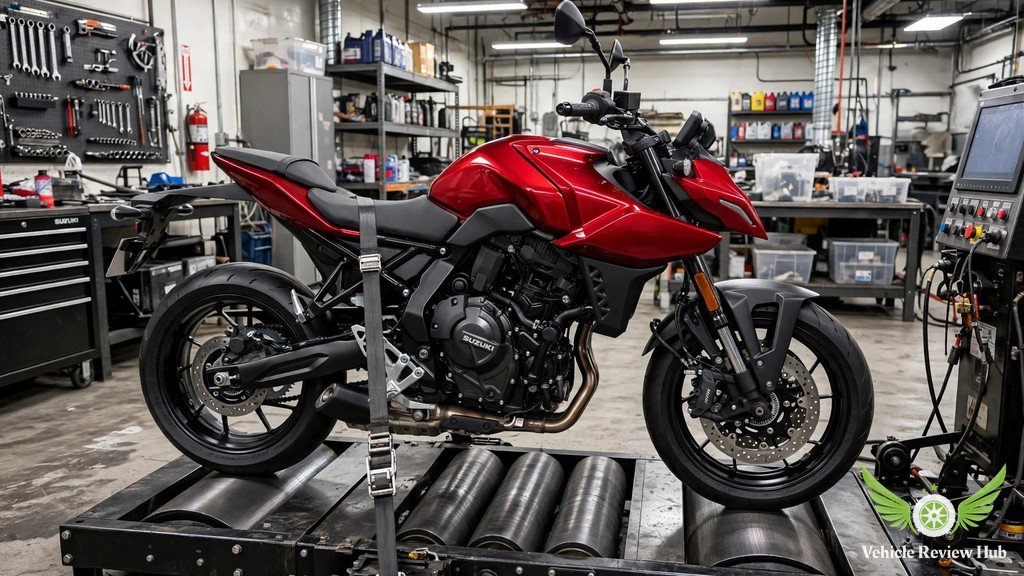
Cycle World Dyno: 74 HP at 8,380 RPM
Cycle World’s dyno test measured 74 hp at 8,380 rpm and 52.3 lb-ft of torque at 5,580 rpm on its in-house Dynojet 250i, with the bike weighing 446 lb wet. The factory claim is 82 hp at 8,500 rpm and 57.5 lb-ft at 6,800 rpm, the global 83 PS figure converted to horsepower. The gap between the claim and the dyno is about 10 percent, the usual drivetrain loss between the crankshaft and the rear wheel. The twin makes its torque low, with the Cycle World torque peak arriving at 5,580 rpm, well below the horsepower peak. That is why the bike feels punchy in town and on a twisty road. The GSX-8S review carries the full specification context, including the 12.8:1 compression ratio and the 84.0 mm bore and 70 mm stroke that produce the 776cc displacement.
Rider’s Dyno Said 75.9: Two Dynos, Two Numbers
Rider Magazine’s comparison dyno at Jett Tuning measured 75.9 hp at 8,300 rpm and 53.3 lb-ft at 6,700 rpm on a 2024 GSX-8S, 1.9 hp more than Cycle World’s figure and a torque peak 1,120 rpm higher. Neither number is wrong: different dynos, different days and different bikes produce this kind of scatter, and about two horsepower of inter-dyno variation is normal. A third independent dyno adds to the picture: Motorcycle.com’s own dyno measured 73.5 hp at 7,900 rpm and 53.4 lb-ft at 5,400 rpm. A fourth, MCN’s long-term bike on BSD Performance’s dyno, made 76.41 bhp and 53.68 lb-ft in stock form. Akrapovič’s own dyno recorded 78.0 hp at 8,400 rpm for a stock bike, and 83.0 hp at 9,000 rpm with its Racing Line exhaust fitted. Taken together, the rear-wheel figures cluster between 73.5 and 78 hp depending on the dyno. The GSX-8R performance guide shows the same pattern on the faired sibling, which made 72.75 hp at 8,120 rpm on Cycle World’s Dynojet, and the V-Strom 800DE performance guide carries the platform’s third dyno figure, 72.2 hp.
| Source / dyno | Bike | Rear-wheel power | Rear-wheel torque |
|---|---|---|---|
| Cycle World, Dynojet 250i | 2023 GSX-8S | 74 hp @ 8,380 rpm | 52.3 lb-ft @ 5,580 rpm |
| Rider / Jett Tuning Dynojet | 2024 GSX-8S | 75.9 hp @ 8,300 rpm | 53.3 lb-ft @ 6,700 rpm |
| Motorcycle.com dyno | 2025 GSX-8S | 73.5 hp @ 7,900 rpm | 53.4 lb-ft @ 5,400 rpm |
| MCN / BSD Performance dyno | 2023 GSX-8S (stock) | 76.41 bhp | 53.68 lb-ft |
| Akrapovič dyno | 2023 GSX-8S (stock) | 78.0 hp @ 8,400 rpm | Not printed (see text) |
| Suzuki factory claim | GSX-8S | 82 hp @ 8,500 rpm (claimed) | 57.5 lb-ft @ 6,800 rpm (claimed) |
One caution on the Akrapovič row: the Racing Line fact sheet’s torque figures were reported as 74.8 lb-ft at 7,650 rpm, but that is physically inconsistent with the sheet’s own 78.0 hp at 8,400 rpm, and the numbers are almost certainly newton-metres mislabelled as pound-feet. This guide prints only the horsepower figures from that sheet.
Suzuki GSX-8S Top Speed and Acceleration
This is the section where most GSX-8S performance pages go wrong, because they print a top speed and a 0–60 mph time as if someone measured them. Nobody has. No named outlet has published an instrumented acceleration or top-speed test of this bike.

No Named Instrumented Acceleration Test Exists
Cycle World, MCN, Motorcycle.com, Rider Magazine and RevZilla have all reviewed the GSX-8S in full, and none of them published an instrumented 0–60 mph run, a quarter-mile time, or a top-speed test. That is the record as it stands, and it means there is no verified top speed or acceleration figure to quote for this bike. What can be said honestly is that the bike has about 74 rear-wheel horsepower pulling 445 lb of curb weight, a 270-degree crank twin tuned for mid-range torque, and a six-speed gearbox with a standard bi-directional quickshifter. Riders who have tested it describe strong low and mid-range pull and a top end that is adequate rather than thrilling.
Aggregator Times and Dragy Videos Do Not Count
The figures you will find if you search for GSX-8S acceleration come from aggregator sites, and they should not be printed as facts. AccelerationTimes.com lists 0–60 mph in 3.4 seconds, a quarter mile in 14.8 seconds at 108 mph, and a top speed of 130 mph, but it gives no methodology and names no tester. AutoTrader South Africa prints 0–100 km/h in 3.8 seconds and a top speed of 210 km/h, but those read as press-kit figures, the same 3.8 seconds and 210 km/h that appear on aggregators, and the article never describes any timing equipment. The rule for this guide is simple: a number counts only if a named outlet measured it with named equipment.
Suzuki GSX-8S Mileage and Fuel Economy
Fuel economy is where the GSX-8S does have real, long-term test data. The longest test comes from MCN, which ran a bike for 7,690 miles, and the figure it returned sits just under the lab figure. The shorter test figures are lower, because they come from harder riding.

MCN Long-Term: About 55 US MPG Over 7,690 Miles
MCN’s long-term GSX-8S averaged 66.4 mpg over 7,690 miles, and that figure is in Imperial gallons, because MCN is a UK publication. Converted, 66.4 mpg Imperial is about 55 mpg in US gallons. The bike covered those miles in mixed use, including a track day. With the full Akrapovič exhaust fitted, the same bike averaged 63.5 mpg Imperial, about 52.9 mpg US, during normal summer riding. MCN lists the tank range as 206 miles on an Imperial-gallon basis, and the fuel capacity is 14 litres, or 3.7 US gallons. The practical limit is the small tank: RevZilla noted the bike will most likely need filling up around 140 miles.
Suzuki Publishes No MPG Figure
Suzuki USA publishes no fuel-economy figure for the GSX-8S. Its spec listings carry no consumption number at all. The global lab figure exists, though: the WMTC test cycle gives 4.2 litres per 100 km, which converts to 56.0 mpg US and 67.2 mpg Imperial. MCN’s real-world 66.4 mpg Imperial sits just under that 67.2 mpg Imperial lab figure. Rider Magazine’s comparison test recorded 48.7 mpg in US gallons, and Motorcycle.com’s 2025 comparison test averaged 40.8 mpg in US gallons in spirited canyon and freeway riding. The honest range is therefore about 41 to 55 mpg in US gallons, depending on how hard you ride.
| Source | Figure | Gallon | Notes |
|---|---|---|---|
| Suzuki global WMTC lab | 4.2 L/100 km = 56.0 mpg | US | Lab figure; Suzuki USA publishes no MPG |
| MCN long-term, 7,690 mi | 66.4 mpg = 55.3 mpg | Imperial (55.3 US) | Stock bike, mixed use incl. track day |
| MCN long-term, Akrapovič fitted | 63.5 mpg = 52.9 mpg | Imperial (52.9 US) | Normal riding, summer |
| Rider comparo test | 48.7 mpg | US | Mixed freeway/backroads |
| Motorcycle.com 2025 comparo test | 40.8 mpg | US | Spirited canyon/freeway riding |
Suzuki GSX-8S Real-World Riding Experience
Dyno numbers and fuel figures only tell half the story. The other half is how the bike behaves on a real road, and here the GSX-8S has two strong, citable results: a first-ride score of 82 percent from Motorcycle.com, and a win in its 2025 three-bike shootout against the Honda CB750 Hornet and the Yamaha MT-07.

Motorcycle.com First Ride Scored It 82 Percent
Motorcycle.com’s first ride gave the GSX-8S an editor score of 82 percent. The breakdown was engine 18 out of 20, suspension 10 out of 15, transmission 7.5 out of 10, brakes 7.5 out of 10, instruments 4.5 out of 5, ergonomics 9 out of 10, appearance 9 out of 10, desirability 8.5 out of 10, and value 8 out of 10. The highs were punchy low to mid-range power. The sighs were soft suspension and driveline lash. The test covered a single day at the global press launch in southern France, in wet conditions with gravel and frost at altitude, so it was a genuine first ride rather than a long-term test. The reviewer’s name could not be verified from the article page, so this guide does not name one.
Motorcycle.com’s 2025 Shootout: 8S Beat Hornet and MT-07
The doc’s old heading claimed no multi-bike shootout had featured the 8S. That was wrong: the 8S won Motorcycle.com’s 2025 three-bike test, and the corrected heading says so. The Motorcycle.com 2025 comparison tested the Honda CB750 Hornet, the Suzuki GSX-8S and the Yamaha MT-07 together, with a same-day dyno, and the Suzuki won overall with 88.8 percent against the Hornet’s 86.8 percent and the MT-07’s 85.9 percent. Both Nic de Sena and Ryan Adams ranked the 8S first, and the bike won the brakes and comfort categories outright. On the same-day dyno the Hornet made the most peak power at 76.6 hp at 8,200 rpm, the 8S made 73.5 hp at 7,900 rpm, and the MT-07 made 65.1 hp at 8,500 rpm, but the 8S made the most torque at 53.4 lb-ft at 5,400 rpm and was strongest below 7,500 rpm, which is where a road bike lives. The 8S was also the most expensive bike in that test at $9,209, against the Hornet at $7,999, and it still won.
The video below is BikeReview’s road and track test of the GSX-8S from the Australian launch, a day on the roads and a day on track. It is a ride test, not a dyno run: no standalone dyno video of the 8S exists.
Suzuki GSX-8S Handling, Braking and Stability
The 8S handles like a middleweight naked should: light enough to flick through traffic, stable enough to hold a line at speed, and limited more by its suspension than by its chassis.

310mm Front Discs: RevZilla’s 320 Is Wrong
The front brakes are dual 310 mm discs with radially mounted Nissin four-piston calipers, and a 240 mm rear disc with a single-piston caliper, all with conventional ABS, the figure in Suzuki’s own features text and in Cycle World’s spec box. RevZilla’s 2023 first-ride review printed 320 mm twice, once in the prose and once in its spec table. Cycle News repeated the same internal contradiction, with 310 mm in its prose and 320 mm in its spec table. The 320 mm size belongs to the Hayabusa and the GSX-S1000, which is the likely source of the confusion. The braking verdicts are consistent: Motorcycle.com’s 2025 comparison said the Suzuki’s brakes are not the strongest and do not have the best feedback, but they are strong enough and give predictable stopping power, and the 8S still won the brakes category, 80.0 percent against the Hornet’s 75.0 and the MT-07’s 73.3. No named outlet has published an instrumented braking-distance test for the 8S, so there is no 60–0 mph figure to quote. The 8S has no IMU, no cornering ABS and no lean-sensitive traction control, so the ABS is a conventional dual-channel system that works from wheel speed only.
Tire, Brake and Suspension Checks That Matter
The suspension is the weakest part of the package, and every tester says so. The KYB inverted fork is non-adjustable, and the rear KYB shock is preload-adjustable only, with 130 mm of travel at both ends. That is the thinnest adjustment in the class, and it shows on rough roads: the fork is soft for heavier riders, the rear shock can feel harsh, and lighter riders have reported the rear as too stiff even at minimum preload. The stock tyres matter as much as the suspension. The original-equipment Dunlop Sportmax Roadsport 2 rear tyre squares off around 2,500 miles, with MCN reporting that the rear had begun to square noticeably once the bike passed 2,500 miles, and that the tyres are hard and lack feel in the cold and wet. One owner ran the stock Dunlops to about 3,666 miles and said they still had plenty of life left, so 2,500 miles is when the squaring starts to show. The practical checks are simple: tyre pressures at 36 psi cold at both ends, chain slack at 20 to 30 mm with the bike on its side stand and no load, and the chain cleaned and lubricated every 600 miles. The GSX-8S reliability guide carries the full service schedule behind these checks.
Suzuki GSX-8S Performance Compared With Other Naked Bikes
Against its rivals, the 8S is rarely the most powerful bike in the room, and it still wins tests. It trades peak power for torque, refinement and price. The comparison that proves it best is the dyno duel with the CFMOTO 800NK, where the Suzuki gives away nearly 18 horsepower and still comes out ahead on the verdict.

Suzuki GSX-8S vs CFMOTO 800NK Dyno Duel
Rider Magazine’s 2024 comparison tested the CFMOTO 800NK against the Suzuki GSX-8S back to back in the Santa Monica Mountains, and dyno’d both with John Ethell at Jett Tuning on a Dynojet. The 800NK made 93.4 hp at 9,400 rpm and 57.1 lb-ft at 6,600 rpm from its 799cc parallel twin, against the 8S at 75.9 hp at 8,300 rpm and 53.3 lb-ft at 6,700 rpm, a gap of 17.5 horsepower and 3.8 lb-ft in the CFMOTO’s favour. The 800NK is also lighter at 410 lb wet against the 8S at 445 lb, cheaper at $8,499 against $8,999 in 2024, and better equipped on paper, with a fully adjustable fork and 320 mm J.Juan discs with a radial master cylinder and braided lines. The 8S wins on refinement: smooth fuelling, easy cold starts, better low-rpm manners, standard traction control, and a standard up and down quickshifter. The 800NK hesitates between 4,000 and 6,000 rpm with a matching dip in its dyno curves. The verdict said it plainly: if you want a light, powerful, somewhat rowdy streetfighter and can live without traction control and a quickshifter, you will want the CFMOTO 800NK, but if you prioritise smoothness and refinement over power, or if you are a newer rider, the Suzuki GSX-8S is for you. The 800NK makes so much more power because its 799cc twin is the previous-generation KTM 790 Duke engine, which CFMOTO builds under licence. The GSX-8S comparison guide carries the full rival-by-rival breakdown against the MT-07, the Hornet and the Trident 660.
| Bike (Motorcycle.com 2025 dyno) | Rear-wheel power | Rear-wheel torque | Shootout score |
|---|---|---|---|
| Suzuki GSX-8S | 73.5 hp @ 7,900 rpm | 53.4 lb-ft @ 5,400 rpm | 88.8% — 1st |
| Honda CB750 Hornet | 76.6 hp @ 8,200 rpm | 50.9 lb-ft @ 7,200 rpm | 86.8% — 2nd |
| Yamaha MT-07 | 65.1 hp @ 8,500 rpm | 46.3 lb-ft @ 6,300 rpm | 85.9% — 3rd |
Is the Suzuki GSX-8S Suitable for Beginner Riders?
The GSX-8S is an excellent first big bike and step-up bike, and it is not a first-ever motorcycle. No named reviewer recommends it as a first-ever bike for a total novice, and the praise is consistently framed as a step up from a 125 or a small bike. MCN calls it novice friendly, and Rider Magazine’s comparison verdict says the 8S is for a newer rider who prioritises smoothness and refinement. The honest counterweights are real: 82 claimed horsepower and 445 lb is a lot for a true first-ever bike, the bike is 202 kg wet, heavier than the MT-07, and the thin seat gets uncomfortable after about 90 minutes. The 8S is ideal for a rider stepping up to a full-size bike, and a total novice should start smaller and come back to it.
Suzuki GSX-8S Performance: Frequently Asked Questions
Direct answers to the questions riders ask about Suzuki GSX-8S performance.
How much horsepower does the GSX-8S make?
Suzuki claims 82 hp at 8,500 rpm and 57.5 lb-ft at 6,800 rpm, which is the global 83 PS figure converted to horsepower. On a dyno the bike makes between 73.5 and 76 hp at the rear wheel depending on the dyno: Cycle World measured 74 hp, Rider’s Jett Tuning dyno measured 75.9 hp, Motorcycle.com measured 73.5 hp, and MCN’s bike made 76.41 bhp.
What is the top speed of the GSX-8S?
There is no verified top speed for the GSX-8S, because no named outlet has published an instrumented top-speed test. Aggregator sites list 130 mph and 210 km/h, but those figures have no methodology and no named tester.
How fast is the GSX-8S 0–60 mph?
There is no verified 0–60 mph time for the GSX-8S. No named outlet has published an instrumented acceleration test, and the 3.4-second figure on aggregator sites comes from a website that never timed the bike.
What is the real-world MPG of the GSX-8S?
MCN’s long-term bike averaged 66.4 mpg in Imperial gallons over 7,690 miles, which is about 55 mpg in US gallons. Shorter, harder test riding returned lower figures: Rider Magazine recorded 48.7 mpg in US gallons, and Motorcycle.com averaged 40.8 mpg in US gallons in spirited riding.
How big is the GSX-8S fuel tank and how far does it go?
The tank holds 14 litres, or 3.7 US gallons. MCN lists the tank range as 206 miles on an Imperial-gallon basis. RevZilla noted the bike will most likely need filling up around 140 miles.
Does the GSX-8S have a quickshifter?
Yes. A bi-directional quickshifter is standard equipment, so clutchless upshifts and downshifts are both covered. Upshifts draw consistent praise, while clutchless downshifts can feel notchy, a shared trait of the 8S, the 8R and the V-Strom quickshifter system.
Does the GSX-8S have traction control?
Yes. The bike has a three-level traction control system plus off, three ride modes called A, B and C, and conventional dual-channel ABS. It has no IMU, no cornering ABS, no lean-sensitive traction control and no cruise control.
What dyno numbers did the GSX-8S make?
Cycle World measured 74 hp at 8,380 rpm and 52.3 lb-ft at 5,580 rpm on its Dynojet 250i. Rider’s Jett Tuning dyno measured 75.9 hp at 8,300 rpm and 53.3 lb-ft at 6,700 rpm. Motorcycle.com measured 73.5 hp at 7,900 rpm and 53.4 lb-ft at 5,400 rpm. The spread is normal inter-dyno variation.
Is the GSX-8S faster than the MT-07?
On the dyno, yes. In Motorcycle.com’s same-day comparison the 8S made 73.5 hp and 53.4 lb-ft against the MT-07’s 65.1 hp and 46.3 lb-ft, and the 8S won the shootout overall, 88.8 percent against the MT-07’s 85.9 percent. The MT-07 is lighter at 403 lb wet and returned better fuel economy in the same test.
Is the GSX-8S faster than the CB750 Hornet?
It depends on what you mean by faster. The Hornet makes more peak power, 76.6 hp on Motorcycle.com’s dyno against the 8S at 73.5 hp, and its claimed 90.5 hp is the highest in the class. The 8S makes more torque, 53.4 lb-ft against the Hornet’s 50.9 lb-ft, and is strongest below 7,500 rpm. The 8S won the shootout overall, 88.8 percent against the Hornet’s 86.8 percent.
Is the GSX-8S good for beginners?
It is an excellent first big bike and step-up bike, not a first-ever motorcycle. MCN calls it novice friendly, and Rider Magazine says it is the bike for a newer rider who prioritises smoothness and refinement. With 82 claimed horsepower and 445 lb, it is a lot for a total novice.
What is the difference between the GSX-8S and GSX-8R in performance?
Both share the same 776cc engine, electronics, TFT dash and quickshifter, and neither has an IMU or cruise control. On Cycle World’s dyno the 8S made 74 hp at 8,380 rpm and the 8R made 72.75 hp at 8,120 rpm, the same engine on the same dyno with normal variation. The 8R costs $450 more and buys a full fairing, a Showa SFF-BP fork, clip-on bars and rearset pegs, and it weighs 7 lb more at 452 lb.