The 2027 Suzuki GSX-R1000 is the cheapest ABS litre bike in America at $17,149 delivered, and this Suzuki GSX-R1000 comparison tests that claim against the three rivals that matter: Honda’s CBR1000RR, Kawasaki’s Ninja ZX-10R and Yamaha’s YZF-R1. The Suzuki is a heavy revision of the 2017 (L7) platform, not a clean-sheet new generation, and the base trim now carries the quickshifter, launch control and full IMU electronics suite that used to be R-only. The short answer: on price, nothing in this group touches it.
Suzuki GSX-R1000 Overview and Its Closest Rivals
The GSX-R1000 has been Suzuki’s litre superbike since the 2001 K1, and the 2027 bike is the latest chapter of the 2017 (L7) platform: the same 999.8cc inline-four and aluminium twin-spar frame, but a reworked engine with 13.8:1 compression, a new Bosch 6-axis IMU with Smart TLR Control, and the full S.I.R.S. electronics suite on the base trim. All three 2027 trims are 40th Anniversary Edition models. The rivals here were chosen for a reason: the Honda CBR1000RR is the benchmark, the Kawasaki Ninja ZX-10R is the value alternative, and the Yamaha YZF-R1 is the premium one. The Suzuki GSX-R1000 review and the Suzuki GSX-R1000 performance guide cover the full specification and the dyno figures.

Why These Three Rivals: Value, Benchmark, Premium
The Yamaha YZF-R1 is the premium rival, and the gap is real money: $19,974 delivered against the Suzuki’s $17,149, a difference of $2,825. The R1 is also the most powerful bike in the group on claimed figures, the tallest, and the one with the strongest track reputation — built around the crossplane-crank engine that gives it a character none of the other three has.
How the Four Bikes Differ at a Glance
On paper, the four bikes are remarkably close in size and weight; the differences that matter are price, claimed power and electronics. The Suzuki is the only one whose maker publishes no horsepower figure in the US at all — the 192.3 hp figure is a global claim, not a Suzuki USA number. Honda publishes no power figure for the 2027 CBR1000RR either.
| Specification | Suzuki GSX-R1000 | Honda CBR1000RR | Kawasaki ZX-10R | Yamaha YZF-R1 |
|---|---|---|---|---|
| Engine | 999.8cc inline-four | 999cc inline-four | 998cc inline-four | 998cc crossplane inline-four |
| Claimed power | 192.3 hp @ 13,200 rpm (global claim; Suzuki USA publishes none) | No 2027 figure published (last claim 189 hp @ 13,000 rpm) | 190 hp @ 11,500 rpm (US figure) | 197 hp @ 13,500 rpm |
| Claimed torque | 81.1 lb-ft @ 11,000 rpm (global claim) | No 2027 figure published (last claim 84 lb-ft @ 11,000 rpm) | 82.5 lb-ft @ 11,300 rpm | 83.2 lb-ft @ 11,500 rpm |
| Curb / wet weight | 448 lb | 432 lb | 463 lb (ABS, Kawasaki spec)* | 448 lb |
| Seat height | 32.5 in | 32.8 in | 32.5 in | 33.7 in |
| Fuel capacity | 4.2 gal | 4.3 gal | 4.5 gal | 4.5 gal |
| 2027 delivered price | $17,149 | $17,874 (ABS $18,174) | $17,839 (ABS $18,839) | $19,974 |
*ZX-10R weight: Kawasaki’s spec sheet lists 463 lb for the ABS model; TopSpeed lists 456 lb. The video below is MCN’s 2017 superbike shootout — a 2017-era test, not a 2027 shootout, and the placings quoted here come from Motorcycle.com’s 2017 shootouts, not from this video.
Suzuki GSX-R1000 vs Honda CBR1000RR
The Honda CBR1000RR is the closest rival the Suzuki has. It costs $725 more delivered — $17,874 against the Suzuki’s $17,149 — and for that money it brings the lightest chassis in the group, a TFT dash the Suzuki does not have, and a reputation for the easiest litre-bike handling of the four.

Engine, Specs and Performance Side by Side
Both bikes are 999cc inline-fours with the same 76.0 × 55.1 mm bore and stroke, but they are tuned differently. The Suzuki’s 2027 engine runs 13.8:1 compression with SR-VVT and 48 mm throttle bodies, and its only published power figure is the global claim of 192.3 hp at 13,200 rpm and 81.1 lb-ft at 11,000 rpm — Suzuki USA publishes no horsepower or torque figure at all. Honda publishes no power figure for the 2027 CBR1000RR either; the last published claim for this engine was 189 hp at 13,000 rpm and 84 lb-ft at 11,000 rpm. The Suzuki’s stock dyno figures are Cycle World’s 177.2 hp (2017 R test), Motorcycle.com’s 161 hp (2017 shootout) and Brock’s 158.22 rear-wheel hp at 11,150 rpm on a stock 2027 base bike; no named-outlet stock dyno figure for the 2027 CBR1000RR was found. The Honda is 16 lb lighter — 432 lb curb against the Suzuki’s 448 lb. In Motorcycle.com’s 2017 Superbike Street Shootout the Suzuki finished fourth of seven at 89.95% while the Honda finished ahead of it; on the track the Honda finished second and the Suzuki fifth.
Price, Equipment and Which Suits Which Rider
On price the Suzuki wins the base comparison by $725, and by $1,025 against the CBR1000RR ABS at $18,174. The Honda comes with a full-colour TFT dash, throttle-by-wire, Honda Selectable Torque Control and three power modes, a Showa SFF-BP 43 mm inverted fork and dual 320 mm discs. What the base CBR1000RR does not list is a quickshifter, launch control or an IMU-based cornering ABS — the Suzuki’s 2027 base trim has all three as standard. The Suzuki’s dash is the weak point here: a black-background LCD panel, not a TFT, and Motorcycle.com’s 2027 first ride asked openly why the bike still uses an LCD screen. The Honda’s warranty is transferable while the Suzuki’s is unlimited-mileage. Buy the Honda for the lightest bike, the best dash and the easiest handling; buy the Suzuki for the quickshifter, launch control and IMU electronics as standard and the lower price. Neither is a beginner bike.
Suzuki GSX-R1000 vs Kawasaki Ninja ZX-10R
The Kawasaki Ninja ZX-10R is the value rival, and on the numbers it is the Suzuki’s toughest price fight: $17,839 delivered against the Suzuki’s $17,149, a gap of only $690. For that $690 the Kawasaki brings the most track-focused package of the Japanese three — winglets as standard, a race-bred chassis, and a quickshifter and cornering ABS that match the Suzuki’s electronics.

Engine, Specs and Performance Side by Side
The ZX-10R’s 998cc inline-four is the only one of the three rivals with a US-published power figure: 190 hp at 11,500 rpm and 82.5 lb-ft at 11,300 rpm. Against the Suzuki’s global claim of 192.3 hp at 13,200 rpm, the two are within 3 hp on paper — effectively tied on claimed power. The Kawasaki is the heavier bike: 463 lb curb for the ABS model on Kawasaki’s spec sheet, against the Suzuki’s 448 lb. Its seat matches the Suzuki’s at 32.5 in and its tank is bigger at 4.5 gal. The ZX-10R carries winglets as standard, where the Suzuki’s base and R have none. In Motorcycle.com’s 2017 shootouts the Suzuki edged the Kawasaki in both tests — fourth against fifth on the street, fifth against sixth on the track.
Price, Equipment and Which Suits Which Rider
On price the Suzuki wins by $690 against the base ZX-10R and by $1,690 against the ZX-10R ABS at $18,839 — and the ABS comparison is the fair one, because the Suzuki has cornering ABS as standard on every trim. The ZX-10R’s MSRP is $600 higher than the Suzuki’s and its destination charge is $90 higher too. On equipment the Kawasaki is the stronger bike on paper: KTRC traction control, a bi-directional quickshifter, KIBS cornering ABS, a 6-axis IMU and electronic cruise control, plus the winglets. The Suzuki matches most of that, but has no cruise control and no winglets below the RS. Buy the Kawasaki if you are a track-day regular who wants winglets, cruise control and the longest, most stable chassis in the group; buy the Suzuki if you want the same electronics for $690 less and the cheapest buy-in of any ABS litre bike in the group.
Suzuki GSX-R1000 vs Yamaha YZF-R1
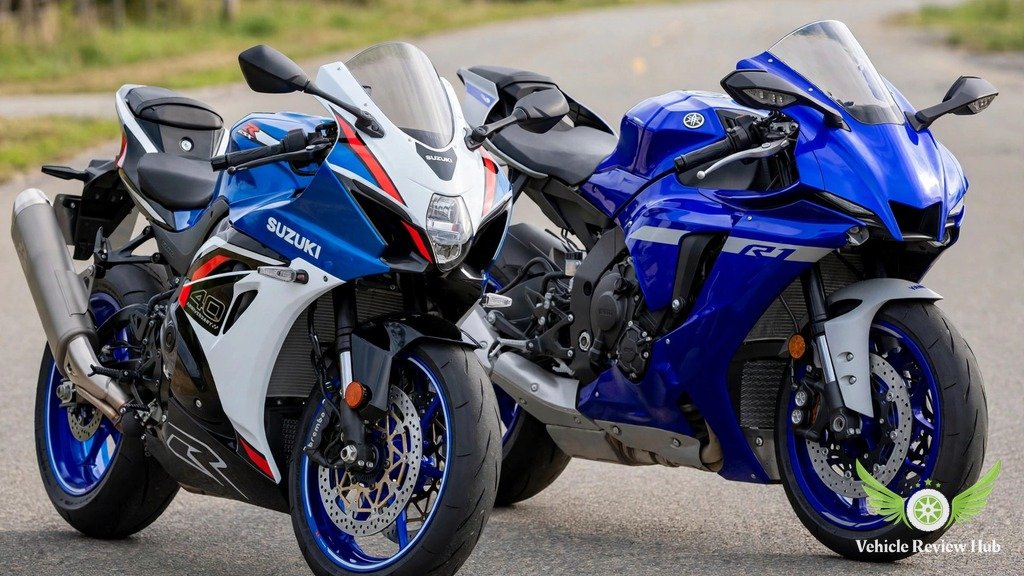
The Yamaha YZF-R1 is the premium rival, and the gap is real money: $19,974 delivered against the Suzuki’s $17,149, a difference of $2,825. The R1 is also the most powerful bike in the group on claimed figures, the tallest, and the one with the strongest track reputation — built around the crossplane-crank engine that gives it a character none of the other three has. The Suzuki’s case against it is value: $2,825 buys a lot of tyres, track days and servicing.
Engine, Specs and Performance Side by Side
The R1’s 998cc crossplane-crank inline-four is the most distinctive engine in the group: 197 hp claimed at 13,500 rpm and 83.2 lb-ft at 11,500 rpm, against the Suzuki’s global claim of 192.3 hp at 13,200 rpm and 81.1 lb-ft at 11,000 rpm. The Yamaha leads by about 5 hp and 2 lb-ft on claimed figures, and it revs 300 rpm higher. Both bikes weigh the same at 448 lb. The R1 is the tallest bike in the group at 33.7 in, a full 1.2 in above the Suzuki’s 32.5 in; its tank is bigger at 4.5 gal against 4.2. The R1 IS still sold new in the US for 2027. Yamaha’s official November 4, 2026 release confirms the 2027 YZF-R1 at $19,199 MSRP. In Motorcycle.com’s 2017 shootouts the R1 finished sixth on the street at 88.49% and fourth on the track at 90.40%. The R1’s quarter-mile claim of 9.95 seconds belongs to the Yamaha, not the Suzuki; the Suzuki’s own claimed quarter-mile is 9.8 seconds at Suzuki’s Ryoyu test track, with aggregator listings at 10.1 seconds.
Price, Equipment and Which Suits Which Rider
On price the Suzuki wins by $2,825, and the gap grows if the Yamaha’s R1M is the comparison: $27,899 MSRP, with a delivered figure of about $28,674 (approximate — the R1M’s destination charge was not separately confirmed and is assumed at $775). On equipment the Yamaha is the stronger bike: a 6-axis IMU driving slide control, lift control, launch control, engine-brake management and a bi-directional quickshifter, plus a TFT dash — the fullest electronics package of the four. The Suzuki’s 2027 suite is close, but it has no slide control and its dash is the LCD panel. Buy the Yamaha for the crossplane engine and the most complete electronics package; buy the Suzuki for 95% of the R1’s performance for $2,825 less and the cheapest ABS litre bike in the country. For the buyer torn between the two, the Suzuki GSX-R1000 reliability guide is the tiebreaker — six recalls, none after 2018, and a decade of L7 owner history.
Suzuki GSX-R1000 Price and Value Compared
Price is where this Suzuki GSX-R1000 comparison is decided. The Suzuki undercuts every rival in the group on delivered price; totals below are MSRP plus destination.

Cheapest ABS Litre Bike in America at $17,149
The Suzuki’s $17,149 delivered price beats every ABS rival in the named set: the CBR1000RR ABS at $18,174 by $1,025, the ZX-10R ABS at $18,839 by $1,690, the R1 at $19,974 by $2,825, the S 1000 RR at $20,970 by $3,821 and the Panigale V4 at $29,290 by $12,141. It also beats the non-ABS rivals on delivered price — the base ZX-10R at $17,839 by $690 and the base CBR1000RR at $17,874 by $725 — so the claim holds even without the ABS qualifier, within this set. The claim is verified only against the doc’s named rivals; other ABS litre bikes exist, such as the Aprilia RSV4, but they were not in scope here and were not priced. The $750 destination charge is dealer and Motorcycle.com sourced, not Suzuki-printed as a dollar figure. The Suzuki is also cheaper than its own 2025 self: the 2027 base is $100 cheaper than the 2025 base at $16,499, and the 2027 R is $710 cheaper than the 2025 R at $18,649.
| Bike (2027, USA) | MSRP | Destination | Delivered |
|---|---|---|---|
| Suzuki GSX-R1000 (base) | $16,399 | $750 | $17,149 |
| Suzuki GSX-R1000R | $17,939 | $750 | $18,689 |
| Suzuki GSX-R1000RS | $18,639 | $750 | $19,389 |
| Honda CBR1000RR | $17,099 | $775 | $17,874 |
| Honda CBR1000RR ABS | $17,399 | $775 | $18,174 |
| Kawasaki Ninja ZX-10R | $16,999 | $840 | $17,839 |
| Kawasaki Ninja ZX-10R ABS | $17,999 | $840 | $18,839 |
| Yamaha YZF-R1 | $19,199 | $775 | $19,974 |
| Yamaha YZF-R1M | $27,899 | $775* | $28,674* |
*R1M destination assumed at $775, not separately confirmed — the delivered figure is approximate. The Yamaha 2027 pricing announcement confirms the R1 at $19,199 and the R1M at $27,899 MSRP.
Running Costs and Resale Value Compared
Running costs are superbike costs on all four bikes. Fuel is the most frequent cost: the only measured figure in the group is Motorcycle.com’s observed 36.7 mpg for the Suzuki in its 2017 Street Shootout, a worst-case number logged while the bike was ridden hard, roughly 150 miles on the 4.2-gallon tank. The Suzuki’s service chart is the L7 chart: oil at every column, roughly every 3,500 to 4,000 miles after break-in, the filter at 600, 7,500 and 14,500 miles, and the valve check at 14,500 miles as the most expensive routine service. No US dealer service-price schedule was found for any of the four bikes — the only published servicing figures are MCN’s UK owner-reported numbers for the Suzuki, £100 a year for the base and £280 for the R, which are UK figures, not US prices. Tyres are the biggest recurring cost after fuel on all four: the Suzuki runs Bridgestone RS11s, a soft track-day-ready compound.
Suzuki GSX-R1000 Comparison Verdict and US Alternatives
The verdict of this Suzuki GSX-R1000 comparison is that the Suzuki wins on value and loses nothing that matters on the road. It is the cheapest ABS litre bike in America, it has the full electronics suite on the base trim, and it carries a decade of L7 owner history with six recalls and none after 2018. The Honda is the easier bike to ride fast, the Kawasaki is the more track-focused bike, and the Yamaha is the most powerful and most complete bike — but none of them is $2,825 better than the Suzuki for a road rider, and none of them is $690 better for a track-day rider. The Suzuki’s weaknesses are real but narrow: the LCD dash, the lack of winglets below the RS, and the absence of a published horsepower figure from Suzuki USA.

The R and RS Sit Inside Suzuki’s Own Range
Before looking outside Suzuki, the R and RS deserve a look, because both sit inside Suzuki’s own range and both are cheaper than the Yamaha. The R costs $17,939 MSRP, $1,540 over the base, delivered at $18,689 — still $285 less than the R1’s MSRP alone, and $1,285 less than the R1 delivered. For that $1,540 the R buys the gold-anodized Showa Balance Free Fork and BFRC-Lite shock, 320 mm Brembo T-drive floating rotors with stainless-steel brake lines, and the launch-control hardware. The RS costs $18,639 MSRP, $2,240 over the base, delivered at $19,389 — still $585 less than the R1 delivered. For that $2,240 the RS adds the carbon-fibre winglets as standard and the colour-matched solo tail cowl. The buyer who wants the suspension and the winglets should buy the R or the RS rather than a rival’s base bike — the R at $18,689 is $150 less than the ZX-10R ABS at $18,839, and the RS at $19,389 is $585 less than the R1. The Suzuki GSX-R600 comparison is the other in-house alternative: the 600 undercuts the 1000 by $4,000 delivered, but gives up the litre-bike engine, the IMU electronics and the quickshifter entirely.
S 1000 RR and Panigale V4 Alternatives
Above the Japanese group sit two European alternatives, and both are worth naming because they frame what the Suzuki’s price really buys. The BMW S 1000 RR is $19,975 MSRP plus $995 destination, $20,970 delivered — $3,821 more than the Suzuki. It brings the most powerful engine in the comparison at a claimed 205 hp, a TFT dash, and the most complete electronics package of any bike named here. The Ducati Panigale V4 is $27,995 MSRP plus $1,295 destination, $29,290 delivered — $12,141 more than the Suzuki — with the V4 S at $35,995 plus $1,295, $37,290 delivered. One price figure to avoid: some listings show the S 1000 RR “from $30,325” — that appears to be an optioned or configurator number, not the base price; the manufacturer figure of $19,975 plus $995 is the one to use. The Honda CBR1000RR-R Fireblade SP belongs in this context too, at $28,999 plus $775, $29,774 delivered — a different price tier from the plain CBR1000RR that is the Suzuki’s direct rival.
| Bike (2027, USA) | MSRP | Destination | Delivered |
|---|---|---|---|
| Suzuki GSX-R1000 (base, for reference) | $16,399 | $750 | $17,149 |
| BMW S 1000 RR | $19,975 | $995 | $20,970 |
| Ducati Panigale V4 | $27,995 | $1,295 | $29,290 |
| Ducati Panigale V4 S | $35,995 | $1,295 | $37,290 |
| Honda CBR1000RR-R Fireblade SP (context only) | $28,999 | $775 | $29,774 |
Suzuki GSX-R1000 Comparison: Frequently Asked Questions
Direct answers to the questions riders ask when comparing the Suzuki GSX-R1000 with its rivals.
Is the Suzuki GSX-R1000 the cheapest litre bike in America?
Against the named rivals in this Suzuki GSX-R1000 comparison, yes: $17,149 delivered beats the CBR1000RR at $17,874, the ZX-10R at $17,839 and the R1 at $19,974. The claim is verified only against this named set — other ABS litre bikes were not in scope and were not priced here.
How much cheaper is the GSX-R1000 than the CBR1000RR?
The Suzuki undercuts the base CBR1000RR by $725 delivered ($17,149 against $17,874) and the CBR1000RR ABS by $1,025 ($17,149 against $18,174).
Which is faster, the GSX-R1000 or the ZX-10R?
On claimed power they are effectively tied: the Suzuki’s global claim is 192.3 hp at 13,200 rpm and the ZX-10R’s US figure is 190 hp at 11,500 rpm, measured to different standards. The only measured rear-wheel figure for the Suzuki is Brock’s 158.22 hp at 11,150 rpm.
Is the GSX-R1000 more powerful than the YZF-R1?
No, on claimed figures. The R1 claims 197 hp at 13,500 rpm and 83.2 lb-ft at 11,500 rpm, against the Suzuki’s global claim of 192.3 hp at 13,200 rpm and 81.1 lb-ft at 11,000 rpm. The gap is about 5 hp on paper. The Suzuki costs $2,825 less delivered.
Does the GSX-R1000 have more electronics than the CBR1000RR?
On the base trim, yes. The 2027 Suzuki base has the Bosch 6-axis IMU, Smart TLR Control, a bi-directional quickshifter, launch control and cornering ABS as standard. The base CBR1000RR has throttle-by-wire, Honda Selectable Torque Control and three power modes, but no quickshifter, launch control or IMU-based cornering ABS.
Which bike is best for the track?
The Yamaha R1 has the strongest track reputation and the most complete electronics package, and the Kawasaki ZX-10R is the most track-focused of the Japanese three with winglets as standard. In Motorcycle.com’s 2017 track shootout the Suzuki finished fifth of seven, the Honda second, the R1 fourth and the Kawasaki sixth.
Which bike is best for the street?
The Suzuki and the Honda are the two best street picks. The Suzuki wins on price, electronics and the unlimited-mileage warranty; the Honda wins on the lightest chassis at 432 lb, the TFT dash and the easiest handling.
Is the GSX-R1000 good for beginners?
No. It is a litre superbike with a claimed 192.3 hp, a 13,200 rpm peak and a 448 lb curb weight, and it is not suitable for beginner riders. A new rider should start on a smaller bike — the GSX-R750 is a more sensible step.
What is the difference between the GSX-R1000, R and RS?
Price and equipment. The base is $16,399, the R is $17,939 ($1,540 more) and the RS is $18,639 ($2,240 more), all plus $750 destination. The R adds the gold-anodized Showa BFF fork and BFRC-Lite shock, 320 mm T-drive rotors and steel lines; the RS adds carbon-fibre winglets as standard and a colour-matched solo tail cowl.
Is the Yamaha R1 still sold new in the US for 2027?
Yes. Yamaha’s official November 4, 2026 release confirms the 2027 YZF-R1 at $19,199 MSRP, available from Yamaha dealers, and the R1M at $27,899.
Should I buy the GSX-R1000 or the S 1000 RR?
The Suzuki costs $17,149 delivered and the BMW $20,970 — a $3,821 gap. The BMW brings a claimed 205 hp, a TFT dash and the most complete electronics package. Buy the BMW if maximum power and the fullest electronics matter most; buy the Suzuki if value matters most.
Which litre bike holds its value best?
No verified resale figures exist for any of the four 2027 bikes — they are too new. The Suzuki’s lower buy-in price means the smallest absolute depreciation if the bikes lose value at similar rates.