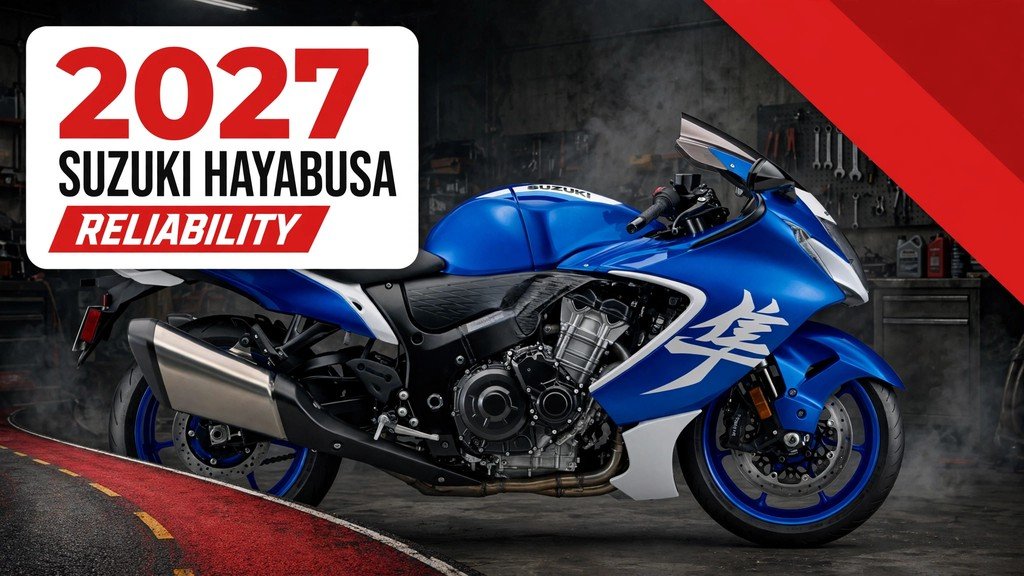
The Suzuki Hayabusa has been the king of speed since 1999, and it has earned a second reputation: it rarely breaks. Owners rate the newest bike 4.6 out of 5 for reliability and the original 1999 bike 4.4 out of 5. This Suzuki Hayabusa reliability guide covers the ratings, the problems by generation, the service schedule, the running costs and all eight recalls, so a buyer knows what to check before buying new or used.
Suzuki Hayabusa Reliability Overview
Suzuki Hayabusa reliability starts with the owner evidence, and the evidence is consistent across a quarter of a century: owners like these bikes, keep them for high mileages, and the problems that appear are specific to one generation. The Gen 3 has no stock inherent engine pattern at all.

UK Reliability: Gen 1 4.4, Gen 3 4.6 of Five
The owner ratings for this Suzuki Hayabusa reliability guide come from MCN, the UK’s largest motorcycle title. Gen 1 owners — 25 of them on MCN’s owner-review pages — rate reliability and build quality 4.4 out of 5. Gen 3 owners rate reliability 4.6 out of 5 on MCN’s 2021 review page. Two warnings: MCN’s Gen 1 owners also give the bike an overall score of 4.7 out of 5, but that is the overall score, not a reliability score. And no MCN owner reliability figure for the Gen 2 could be found — the MCN 2008 page could not be opened — so this guide prints no Gen 2 MCN rating. These Suzuki Hayabusa reliability ratings are the owner evidence, not a press-launch claim. The UK MOT data agrees: of 48,351 Hayabusa MOT tests, 86.3% passed first time against a class average of 84.9%, at a median mileage of 18,876 miles. MCN’s experts score the Gen 1 4 out of 5 overall and 3 out of 5 for reliability.
| Source | Rating | Note |
|---|---|---|
| MCN Gen 1 owners | Reliability 4.4 / 5 | 25 owners; engine 5 / 5; overall score 4.7 / 5 (not a reliability score) |
| MCN Gen 3 owners | Reliability 4.6 / 5 | MCN 2021 review page |
| ZigWheels Gen 3 | 4.6 / 5 | 118 ratings |
| BikeDekho Gen 3 | 4.3 / 5 | 93 reviews |
| UK MOT (DVSA) | 86.3% first-time pass | 48,351 tests; class average 84.9%; median 18,876 miles |
The ratings above are the owner evidence this Suzuki Hayabusa reliability guide stands on.
How Mileage, Storage and Previous Care Affect Reliability
Mileage alone tells you little about a Hayabusa. A cared-for bike with 100,000 km on it is, in the words of one Australian used-bike guide, still a very long way from being worn out, and owners routinely report six-figure mileages on stock internals. Visordown’s owner survey of 36 Gen 1 owners found 83% reported no problems at all — the bikes that had trouble were ridden hard from cold, stored damp, or serviced late. A damp-stored bike shows it in the finish and the fuel system — early bikes suffered fuel-filter blockage that made the fuel pump overheat. Previous care is the real story of Suzuki Hayabusa reliability: a full history with the valve check done at 15,000 miles on a Gen 3, or at 14,500 miles on a Gen 1 or Gen 2, is worth more than low mileage with no records. The most useful check on any used Hayabusa costs nothing: squared-off tyres, a dry rusty chain and black brake fluid tell you the owner skipped the cheap maintenance.
Suzuki Hayabusa Common Problems and Wear Items
Suzuki Hayabusa reliability is best judged generation by generation, because the problems do not carry across. The Gen 1 has a gearbox weakness and a starter-kickback issue. The Gen 2 has charging-system trouble. The Gen 3 has front-brake recalls and little else.

Second-Gear Wear Is a Generation 1 Pattern
The one genuine mechanical pattern in this Suzuki Hayabusa reliability guide belongs to the Gen 1: the second-gear dogs wear and round off, the gear can no longer fully engage, and the bike jumps out of second gear under load. The fix is well documented: undercut the gear dogs for more mesh surface and always replace the shift fork at the same time, because the worn gear machines the fork as it fails. The cases must be split — the top end can stay on — and undercutting cost $44 at 2011 prices, while a full rebuild runs about £800 in the UK. Second-gear wear is documented for the Gen 1 only — no named source shows the same pattern on the Gen 2 or the Gen 3.
Gen 1 Starter Kickback: Owner Reports, No Recall
Hot-restart kickback breaking starter gears is genuinely documented in owner forums, and this Suzuki Hayabusa reliability guide reports it honestly — but it stops where the evidence stops. Owners describe the engine kicking back on a hot restart and shattering the starter drive gears; one owner replaced both with 2003 parts. One owner’s 2000 model kept stripping the starter idle gear, part number 12611-24F01. No recall or service bulletin could be confirmed: no US campaign number and no Suzuki bulletin number was found. So the honest wording is: owners report hot-restart kickback breaking starter gears, Suzuki revised the starter parts for 2003, and no US recall campaign for this issue could be confirmed.
Suzuki Hayabusa Maintenance Schedule and Servicing
The US service schedule is the one that matters for this Suzuki Hayabusa reliability guide. The Gen 3 asks for oil every 3,750 miles, spark plugs at 7,500 miles and a valve inspection at 15,000 miles. The UK interval differs: a service every 12 months or 7,500 miles.

Oil Every 3,750 Miles on the US Chart
Engine oil is the most frequent job on the Gen 3, and the interval is the same for every generation in spirit: fresh oil, often. The US manual for the Gen 3 says replace the engine oil every 3,750 miles or 6,000 km, and the oil filter only at 11,250 miles — the third service — not at every oil change. That is the figure this Suzuki Hayabusa reliability guide uses. The break-in service comes at 600 miles or 1,000 km, with revs kept below 5,500 rpm to 500 miles and below 8,000 rpm to 1,000 miles. One warning: a summary site says the Gen 1 intervals are 3,500 miles, but the manual’s table columns are 4,000, 7,500, 11,000 and 14,500 miles — use the table.
For a visual guide to Suzuki Hayabusa reliability maintenance, the video below shows a second-generation Hayabusa oil and filter change, step by step, by FAST TONY. It is a Gen 2 video, not a Gen 3 service — the drain, the filter and the fill are the same job on both. Watch the torque figures: the drain plug takes 23 Nm and the filter 20 Nm.
Valve Inspection Every 15,000 Miles
The valve check is the big service on a Hayabusa, and the most misunderstood one. On the Gen 3 the manual says inspect the valve clearances only at 15,000 miles or 24,000 km — inspect, not adjust, and only at that one mileage. No valve-clearance measurement in millimetres could be verified for any generation, so this Suzuki Hayabusa reliability guide prints no clearance figures. US dealer prices are quoted at $900 to $1,400 by low-authority sources, with no verified Suzuki USA price list found.
| Service item | 3,750 mi | 7,500 mi | 11,250 mi | 15,000 mi |
|---|---|---|---|---|
| Engine oil | Replace | Replace | Replace | Replace |
| Oil filter | — | — | Replace (3rd service only) | — |
| Air filter | Inspect | Inspect | Replace | Inspect |
| Spark plugs NGK CR9EIA-9 | Inspect | Replace | Inspect | Replace |
| Valve clearances | — | — | — | Inspect only |
| Coolant (Suzuki Super Long Life) | Inspect | Inspect | Inspect | Inspect — replace every 4 years / 48,000 km |
| Brake fluid + clutch fluid (DOT 4) | Inspect | Inspect | Inspect | Inspect — replace every 2 years |
| Brake + clutch hoses | Inspect | Inspect | Inspect | Inspect — replace every 4 years |
| Brake pads | Inspect | Inspect | Inspect | Inspect |
| Drive chain | Clean + lube every 600 mi; slack 20–30 mm | Clean + lube every 600 mi; slack 20–30 mm | Clean + lube every 600 mi; slack 20–30 mm | Clean + lube every 600 mi; 21-pin length under 319.4 mm |
The schedule above is the Gen 3 US manual chart this Suzuki Hayabusa reliability guide uses. The Gen 1 and Gen 2 run the same shape of chart at 4,000, 7,500, 11,000 and 14,500 miles, with valves at 14,500 and the filter at 11,000; the Gen 1’s coolant is replaced every 2 years instead of every 4.
Suzuki Hayabusa Tires, Brakes and Suspension Maintenance
Suzuki Hayabusa reliability at the wheels is a story of parts that wear on schedule rather than parts that fail. The tyres are the most frequent cost, the brakes must not be postponed, and the suspension quietly goes soft while the engine still feels perfect.

Spark Plugs at 7,500 Miles Only
Only the spark plugs are replaced at 7,500 miles — at the 7,500-mile service the plugs, and only the plugs, are replaced, and that is the most useful single fact in this Suzuki Hayabusa reliability guide. The Gen 3 plugs are Iridium CR9EIA-9, inspected at 3,750 miles and replaced at 7,500 miles, with the air filter replaced at 15,000 miles. The Gen 1 and Gen 2 plugs are standard CR9E — or DENSO U27ESR-N — inspected at 3,750 miles and replaced at 7,500 miles. Two things are not done at 7,500 miles: the Gen 3 coolant is replaced every 4 years or 48,000 km, and the brake and clutch fluid every 2 years. The air filter is replaced at 15,000 miles on the Gen 3 and at 7,500 miles on the Gen 1 and Gen 2. The Gen 1 capacities were the only ones verified: 3,100 ml of oil with a filter change, 3,300 ml dry, 2,950 ml of coolant and a 21-litre tank; no Gen 2 or Gen 3 capacity figure could be found.
Gen 1 Aluminium Subframe: the Magnet Test
The Gen 1 has one check that costs nothing and takes ten seconds: the magnet test. The 1999 and 2000 bikes were built with aluminium subframes, and aluminium fatigues and cracks. From 2001 Suzuki changed the subframe to steel, which does not crack the same way. Before buying any Gen 1, hold a magnet against the subframe: if it sticks, the bike has steel, and if it does not, it has aluminium — and if it is aluminium, look at the mounting holes for cracks. A stock exhaust is a good sign. Spin the rear wheel and listen for a rumble or a rough spot, because a collapsed bearing at speed is the one Gen 1 failure that can hurt you — and that is a check no Suzuki Hayabusa reliability buyer should skip.
Suzuki Hayabusa Maintenance and Ownership Costs
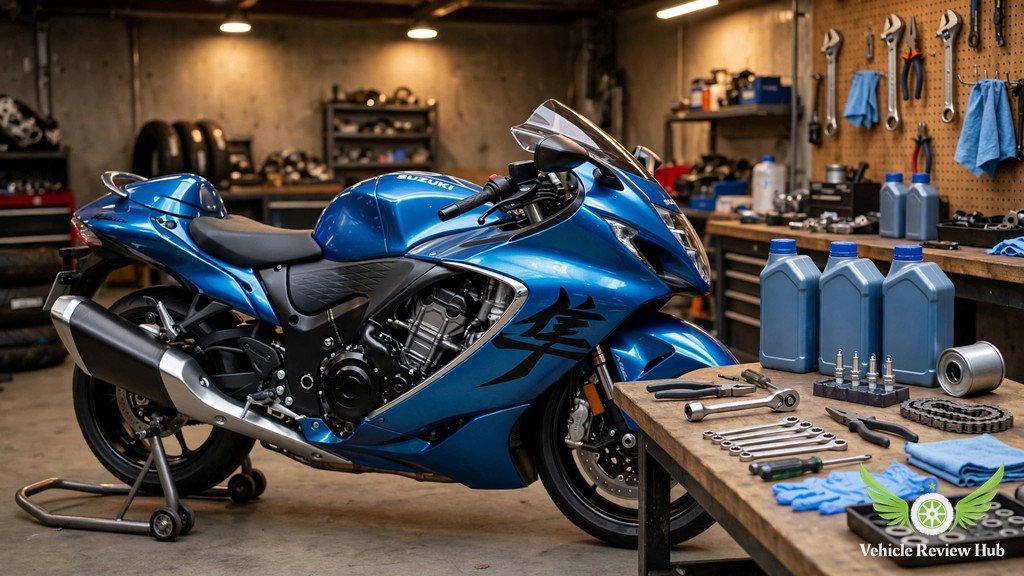
Suzuki Hayabusa reliability costs less than the bike’s performance suggests. The UK figures are from MCN’s owner survey, the US figures are ranges from parts retailers and owner reports, and where no figure could be verified this guide says so.
Fuel, Routine Servicing, Tires and Replacement Parts
Fuel is the cheapest part of running a Hayabusa and the easiest Suzuki Hayabusa reliability number to measure. Rider Magazine tested 38 mpg over about 1,700 miles on a Gen 3, giving a range of 201.5 miles from the 5.3-gallon tank; with spirited riding it drops to around 35 mpg and 160 miles. Cycle World averaged 35.6 mpg on a Gen 2. Servicing costs are where the UK and US stories split. In the UK, MCN puts annual servicing at £210 for a Gen 1 and £180 for a Gen 2; owners report £123 for a minor service, £231 for an intermediate one and £449 for a major service with valves. In the US, no verified Suzuki dealer price list was found, so the figures are ranges: an oil and filter service runs $50 to $100 at a dealer and $120 to $250 for the full 7,500-mile service; the valve service runs $120 to $180 in parts or $300 to $450 at a dealer. Tyres are the most frequent cost: the stock Bridgestone Battlax Hypersport S22 costs $211 for a rear tyre from RevZilla, and a pair runs $220 to $305 on eBay or $360.94 from RevZilla, lasting about 5,971 miles on the rear and 3,909 miles on the front. A chain and sprockets set runs about $200 and lasts about 16,164 miles.
Eight Recalls Across Three Generations
Eight recalls across three generations sounds like a lot, and the number needs unpacking before it scares anyone. The honest split is seven US NHTSA campaigns plus one UK-only 1999 recall, eight in total — and this Suzuki Hayabusa reliability guide never calls all eight of them NHTSA campaigns, because that would be wrong. The Gen 2 carries four: the ignition-switch wiring campaign 08V249000 in May 2008; the regulator/rectifier campaign 11V108000 in January 2011; the combined regulator/rectifier and front-brake campaign 13V312000 in July 2013 — 2,561 bikes according to one source, 2,756 according to another, a discrepancy this guide flags rather than resolves; and the front-brake campaign 16V018000 in January 2016. The Gen 3 carries three, all front brakes: 2A99 in December 2022; 3A01 in January 2023; and 3A04 in June 2024. The eighth recall is the UK-only 1999 frame-weld recall, which took 2.0 hours to fix. Three other numbers that look like recalls are not: 14E012000 is a parts recall; A12/00876/23 is a European Rapid Alert; and 13V-449 is a UK campaign number. Check any used Hayabusa against its VIN on the NHTSA recalls site before you buy.
| Campaign | Date | Issue | Units |
|---|---|---|---|
| 08V249000 / 2A05 | May 2008 | Ignition-switch wiring harness chafing; engine cut-out / stall | 9,109 |
| 11V108000 | Mar 2011 | Regulator/rectifier; overcharging, stalling, fire risk | 73,426 across 12 models |
| 13V312000 / WN | Aug 2013 | ABS modulator contamination; no ABS, extra lever travel | 2,561 (NHTSA quarterly report reads 2,756) |
| 16V018000 / 2A56–2A64 | Jan 2016 | Regulator/rectifier redo; charging heat, stalling, no-start, fire | 68,344 across 11 models |
| 23V088000 / 2A99 | Feb 2023 | Front-brake master cylinder; swollen seal blocks port, no braking | 2,552 |
| 24V038000 / 3A01 | Jan 2024 | ABS flare nut; brake-fluid leak, reduced braking | 993 |
| 24V769000 / 3A04 | Oct 2024 | Reservoir-cap diaphragm; root cause of the 2A99 failure | 6,338 |
| UK 1999 (no campaign number) | 1999 | Cam-chain tensioner + fuel pump insulator + fuel tap | — |
The recall table above is the complete record this Suzuki Hayabusa reliability guide stands on: seven US NHTSA campaigns plus one UK recall, eight in total.
How to Keep a Suzuki Hayabusa Reliable
Suzuki Hayabusa reliability is mostly a matter of doing the small jobs on time — the expensive failures all come from jobs that were skipped or checks that were never made.

Preventive Maintenance, Records and Regular Inspections
Preventive maintenance is the heart of Suzuki Hayabusa reliability, and it is unglamorous: change the oil every 3,750 miles and the filter only at 11,250 miles. Change the plugs at 7,500 miles. Check the valves at 15,000 miles on a Gen 3, or at 14,500 miles on a Gen 1 or Gen 2. Check the chain slack every 600 miles, keep it at 20–30 mm, and replace the chain at 319.4 mm over 21 pins. And keep the records — for Suzuki Hayabusa reliability, a full service book with the valve check done is the single most valuable document on a used bike, worth more than low mileage with no records.
Brake Fix Done Under 2A99 Must Be Redone
The single most important check for Suzuki Hayabusa reliability on a used Gen 3 is the front-brake recall, and the most common mistake is believing a 2A99 stamp in the service book means the brakes are fixed. It does not. The 2A99 campaign replaced only the master-cylinder body and left the root cause — the diaphragm — in place, so the brakes could still drag and overheat. The 3A04 campaign replaced the master-cylinder body and the diaphragm, using updated material, and Suzuki’s letter says the 3A04 remedy is to replace the front brake master cylinder assembly with a countermeasure part. If the 2A99 fix was already done, the 3A04 fix must still be done — the 2A99 fix was incomplete. If the bike has had 2A99 but not 3A04, get 3A04 done before you ride it.
Suzuki Hayabusa Reliability: Frequently Asked Questions
Direct answers to the questions riders ask about this Suzuki Hayabusa reliability guide.
Is the Suzuki Hayabusa reliable?
Yes, by the owner evidence. Suzuki Hayabusa reliability is rated 4.6 out of 5 by Gen 3 owners and 4.4 by Gen 1 owners. The Gen 3 has no stock inherent engine pattern, the Gen 1 has a second-gear weakness, and the Gen 2 had its regulator/rectifier recalled twice.
How much does a Hayabusa cost to maintain each year?
In the US, an oil and filter service runs $50 to $100 at a dealer, the 7,500-mile service $120 to $250, and the 15,000-mile valve service $300 to $450 at a dealer. Tyres are the most frequent cost in any Suzuki Hayabusa reliability budget: a pair of S22s runs $220 to $305.
How often does a Hayabusa need an oil change?
Every 3,750 miles on the Gen 3 US chart. The oil filter is replaced only at 11,250 miles, not at every oil change. The Gen 1 and Gen 2 run intervals of 4,000, 7,500, 11,000 and 14,500 miles, with the filter at 11,000 miles — the same Suzuki Hayabusa reliability schedule, shifted to the older chart.
When do the valves need checking on a Hayabusa?
At 15,000 miles on the Gen 3 and at 14,500 miles on the Gen 1 and Gen 2. The manual says inspect, not adjust, and only at that one mileage. No valve-clearance measurement in millimetres could be verified for any generation, so this Suzuki Hayabusa reliability guide prints no clearance figures.
What is the most common Hayabusa problem?
It depends on the generation, and Suzuki Hayabusa reliability is best judged that way. The Gen 1’s documented pattern is second-gear wear, with the gear jumping out under load. The Gen 2’s is the regulator/rectifier, recalled twice. The Gen 3’s is the front brakes, recalled three times.
Has the Hayabusa been recalled?
Yes — seven US NHTSA campaigns plus one UK-only 1999 recall, eight in total. Check any used Hayabusa against its VIN on the NHTSA recalls site before you buy — it is the first Suzuki Hayabusa reliability check on any used bike.
Do I need the 3A04 brake recall if 2A99 was already done?
Yes. The 2A99 fix only replaced the master-cylinder body, while the root cause was the diaphragm. The 3A04 fix replaced both with updated material. If 2A99 was done but 3A04 was not, the brakes can still drag and overheat — get 3A04 done before you ride it, because Suzuki Hayabusa reliability on a Gen 3 starts with the brakes.
What is the second-gear problem on early Hayabusas?
On the Gen 1 the second-gear dogs wear and round off, so the gear cannot fully engage and the bike jumps out of second gear under load. The fix is to undercut the gear dogs and replace the shift fork at the same time, which means splitting the cases. Test second gear under load on any Gen 1 test ride — it is the oldest Suzuki Hayabusa reliability check there is.
How long does a Hayabusa engine last?
A very long time when it is serviced on schedule. The bikes that fail early are the ones ridden hard from cold, stored damp, or serviced late — and that is the whole of Suzuki Hayabusa reliability in one sentence.
What tyres does a Hayabusa use and how long do they last?
The stock tyre is the Bridgestone Battlax Hypersport S22, 120/70 ZR17 front and 190/50 ZR17 rear. Pressures are 36 psi front and 42 psi rear solo, 42 and 42 with a passenger or luggage. Those are the Suzuki Hayabusa reliability tyre numbers.
Is the Gen 3 Hayabusa more reliable than the Gen 1?
On the owner ratings, yes — Gen 3 owners rate reliability 4.6 out of 5 against 4.4 for the Gen 1. But a well-kept Gen 1 with a full service history is still a reliable bike, and Suzuki Hayabusa reliability depends more on care than on generation.
What should I check before buying a used Hayabusa?
Five things: the service book; second gear under load on a Gen 1; the starter on a hot restart; the VIN against the NHTSA database for the brake recalls; and the subframe with a magnet on a Gen 1 — steel is good, aluminium needs a crack check. Those five checks are the Suzuki Hayabusa reliability buyer’s list.